ART CITIES:N.York-Rashid Johnson
Rashid Johnson is among an the artists whose work employs a wide range of media to explore themes of art history, individual and shared cultural identities, personal narratives, literature, philosophy, materiality, and critical history. His practice quickly expanded to embrace a wide range of media yielding a complex multidisciplinary practice that incorporates diverse materials rich with symbolism and personal history. Johnsons work is known for its narrative embedding of a pointed range of everyday materials and objects, often associated with his childhood and frequently referencing aspects of history and cultural identity.
By Efi Michalarou
Photo: Hauser & Wirth Gallery Archive
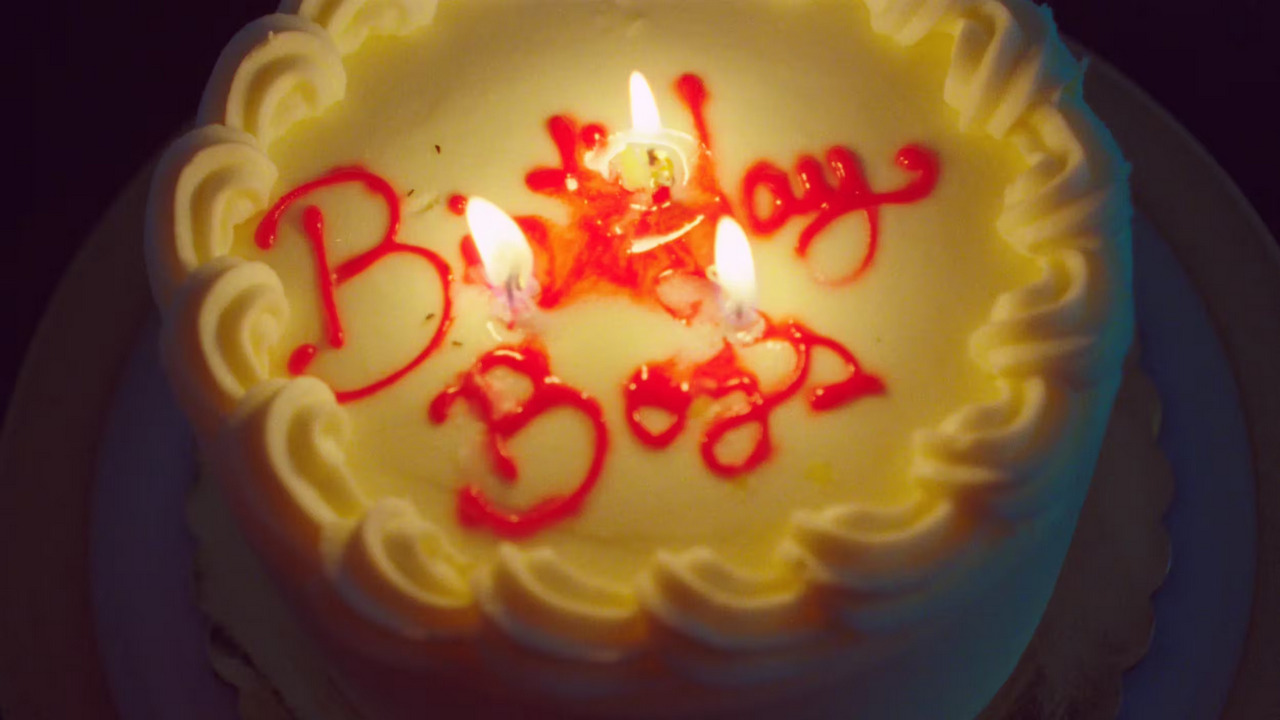
Rashid Johnson presents “Birthday Boys”, a major solo exhibition exploring the intricate, evolving dynamic between fathers and sons. Coinciding with the East Coast context of his major mid-career survey, “A Poem for Deep Thinkers”, this presentation unveils an expansive body of new work spanning monumental tile mosaics, suspended sculptures titled “Exhausted Figures”, and the premiere of a 35mm film transferred to digital video, also titled “Birthday Boys| (2026). Together, these works interrogate the delicate threshold where shared familial history gives way to individual self-determination, considering what it truly means to recognize a child as an autonomous person—even when that person bears one’s own features, gestures, and inheritance.
The conceptual foundation of the exhibition centers on the film “Birthday Boys”, a title carrying intimate personal resonance for Johnson, who shares his exact birthday with his son. Utilizing visual and thematic mirroring, the film documents the shifting emotional landscape between parent and child as the younger moves into adolescence and asserts his own identity and prerogatives. Johnson draws heavily upon French psychoanalyst Jacques Lacan’s theory of the “Mirror Stage”—the crucial developmental moment when an infant first recognizes their reflection in a mirror and conceives of themselves as a distinct individual. The narrative also builds upon critic Hilton Als’s influential essay “Tristes Tropiques” from his 2013 book “White Girls”, which explores how individuals project, discover, and lose parts of themselves within their relationships with others. Johnson recalibrates these theories toward the experience of parenthood, proposing that a father must undergo a reciprocal mirror stage: a secondary process of recognition wherein he learns to uncouple his own identity from his child, seeing his son not as an extension or legacy project, but as a fully realized human being with independent desires and ambitions.
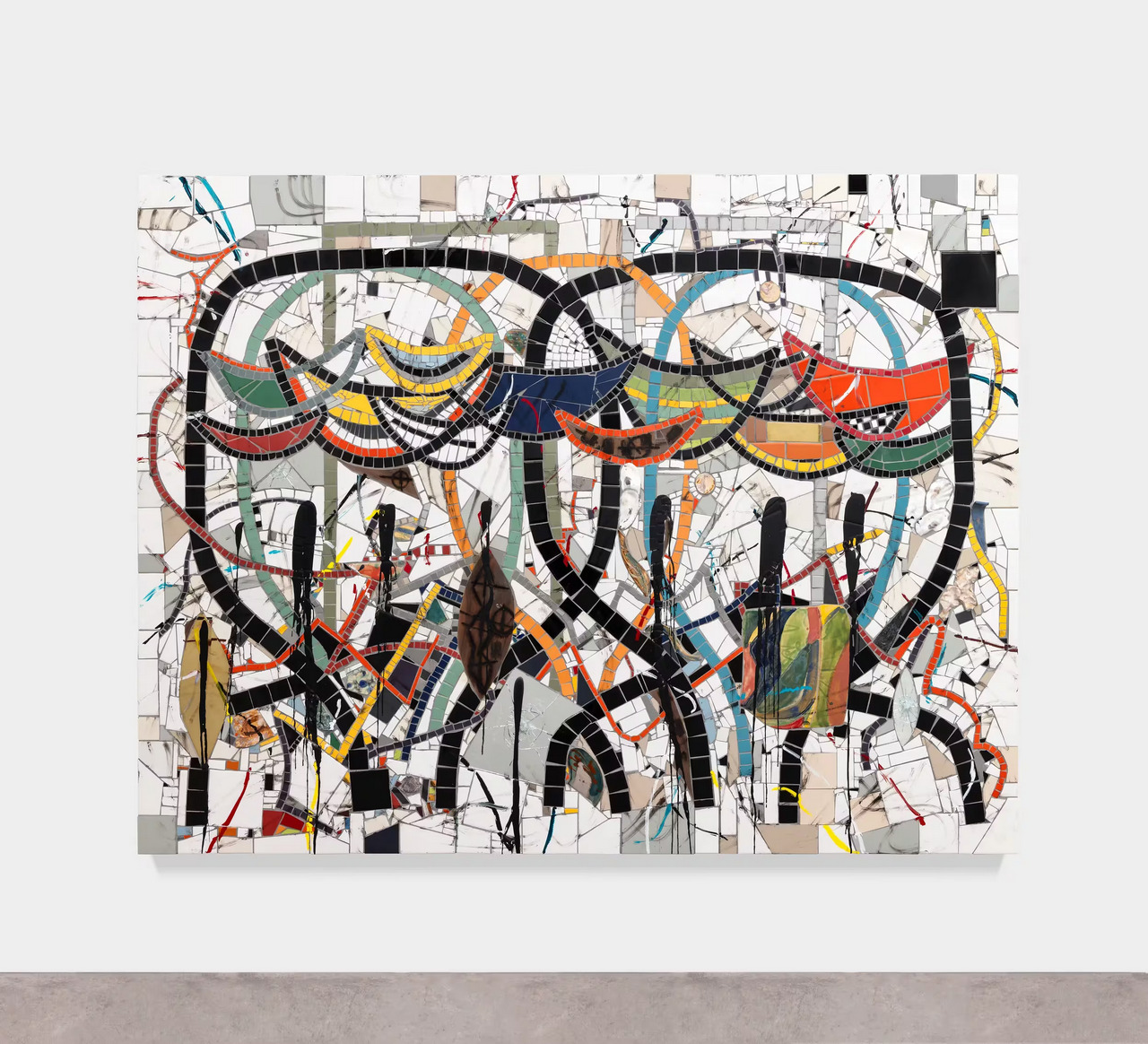
This psychological inquiry extends into five new “Broken Soul” mosaics featured in the exhibition. Working in his signature medium of fractured ceramic tiles, mirror, spray enamel, branded black walnut, bronze, black soap, and wax, Johnson constructs images of unity out of deliberately shattered materials. Each mosaic composition brings two central heads into close proximity, assembled from disparate fragments. The intertwined figures appear to fight for spatial dominance within the frame, their overlapping contours and facial features merging in ways that obscure where one body ends and the other begins. This tension reflects the core paradox of deep familial bonds: the constant negotiation between a desire for intimacy and the urgent need for space and personal autonomy.
The exhibition further expands into three-dimensional space with “Exhausted Figures”, a suite of suspended sculptures that hang overhead in precarious balance. Synthesizing the delicate kinetic balance of Alexander Calder with the emotional and muscular tension of Auguste Rodin, these elongated forms capture physical bodies frozen between movement and collapse. Their awkward, falling gestures evoke both the vulnerability of the physical frame and the intense psychological labor involved in holding oneself—and one’s loved ones—together over time.
The works in “Birthday Boys” demonstrate that genuine closeness does not rely on sameness, but rather that recognizing another person’s complete uniqueness can become its own profound expression of love. The exhibition ultimately serves as a poignant meditation on the challenge and grace of allowing someone you love to emerge fully as themselves, moving beyond the initial expectations, reflections, and projections that first bound them to you.
Photo: Rashid Johnson, Broken Soul “Tristes Tropiques”, 2026, Ceramic tile, mirror, spray enamel, branded black walnut, oyster shell, oil stick, black soap, wax, bronze, 182.88 × 243.84 × 10.16 cm / 72 × 96 × 4 in, © Rashid Johnson, Photo: Stephanie Powell, Courtesy the artist and Hauser & Wirth Gallery
Info: Hauser & Wirth Gallery, 134 Wooster Street, New York, NY, USA, Duration: 3/11/2026-16/1/2027, Days & Hours: Tue-Sat 10:00-18:00, www.hauserwirth.com/