ART CITIES:London- Cady Noland
Cady Noland is an influential American postmodern sculptor whose work dissects the dark underbelly of the American Dream. Emerging in the late 1980s, she uses found industrial objects like metal pipes, fences, and handcuffs, juxtaposed with beer cans and barbecue grills. Her provocative, post-minimalist assemblages explore institutional control, celebrity fixation, sensational tabloid culture, and the pervasive, underlying thread of violence in American society.
By Efi Michalarou
Photo: Gagosian Archive
Cady Noland presents works at Gagosian on Davies Street in London, bringing renewed focus to one of the most incisive commentators on American visual and material culture. In conjunction with the exhibition, Gagosian is relaunching “The Clip-On Method,” a two-volume publication originally published in 2021 and conceived, edited, and designed by Noland herself. Far more than a standard catalogue, the publication operates as an artwork in its own right, offering an immersive survey of Noland’s oeuvre. Structured as a nonlinear archive, it merges extensive photographic documentation of her sculptures and installations with an expansive selection of sociological, political, and historical texts alongside the artist’s own writings. Chief among these is Noland’s landmark 1989 essay, “Towards a Metalanguage of Evil,” a text whose critique of structural cruelty and institutional violence retains a striking resonance today.
Spanning four decades of practice, “The Clip-On Method” offers a comprehensive visual record of Noland’s sustained interrogation into the material and symbolic architecture of the United States. Across these pages and through her physical works, Noland dissects recurring motifs with uncanny clarity, including the mythology of American identity, systems of power and control, inherent violence, celebrity worship, systemic racism, media culture, and the psychological mechanisms governing collective social behavior.
Born in 1956 in Washington, D.C., as the daughter of color field painter Kenneth Noland, she earned her Bachelor of Arts from Sarah Lawrence College in Bronxville, New York, before settling in Manhattan. By 1983, Noland had begun fabricating assemblage works using found objects, leading to her first solo exhibition five years later at White Columns in New York. Her collages, sculptures, and mixed-media installations probe the underbelly of the American psyche, isolating a collective fascination with celebrity, violence, and psychopathological behavior. Visually and conceptually, her vocabulary synthesizes strategies historically anchored in Pop art, Minimalism, and Post-Minimalism, tracing direct artistic ancestry to the anti-form and scatter sculpture movements of the late 1960s.
Noland’s early output routinely deployed press photography, newsprint, and advertising. In her piece “Guns” (1986–87), a black-and-white photocopied image depicts a pistol leaning against a bullet-riddled Diet Pepsi can, flanked by a collage along the right edge detailing instructions on how to reload the firearm. Weapons similarly anchor her series of cutout cowboy figures. “Cowboy Blank With Showboat Costume” (1990) features a silhouetted aluminum cutout of a crouching cowboy discharging a weapon directly toward the viewer, paradoxically styled with a delicate bow tie on his hat, an ostrich plume, and a bandanna tucked into his belt. Punctured by bullet holes, disabled, and subtly feminized, Noland’s cowboys emerge as symbols of impotence. She took up a similar theme in “Saw Action/Duty” (1986), which transforms an orthopedic walker by draping it with police equipment.
During the late 1980s, Noland initiated a series of works examining the hyper-masculine foundations of the American dream, frequently rendered through the ritual of male beer consumption. “Crate of Beer” (1989) gathers a wire-mesh basket filled with empty Budweiser cans, while her 1989 untitled installation at the Mattress Factory in Pittsburgh stacked six-packs of Budweiser into towering structures supported by metal scaffolding, mimicking a construction site. To Noland, the red, white, and blue Budweiser logo functions as a symbol every bit as potent as Old Glory. The American flag itself recurs throughout her work; in pieces like “The American Trip” (1988) and “Cheap and Fast” (1989), flags hang limp, draped, or pierced, mirroring the deflated posture of her cowboy figures.
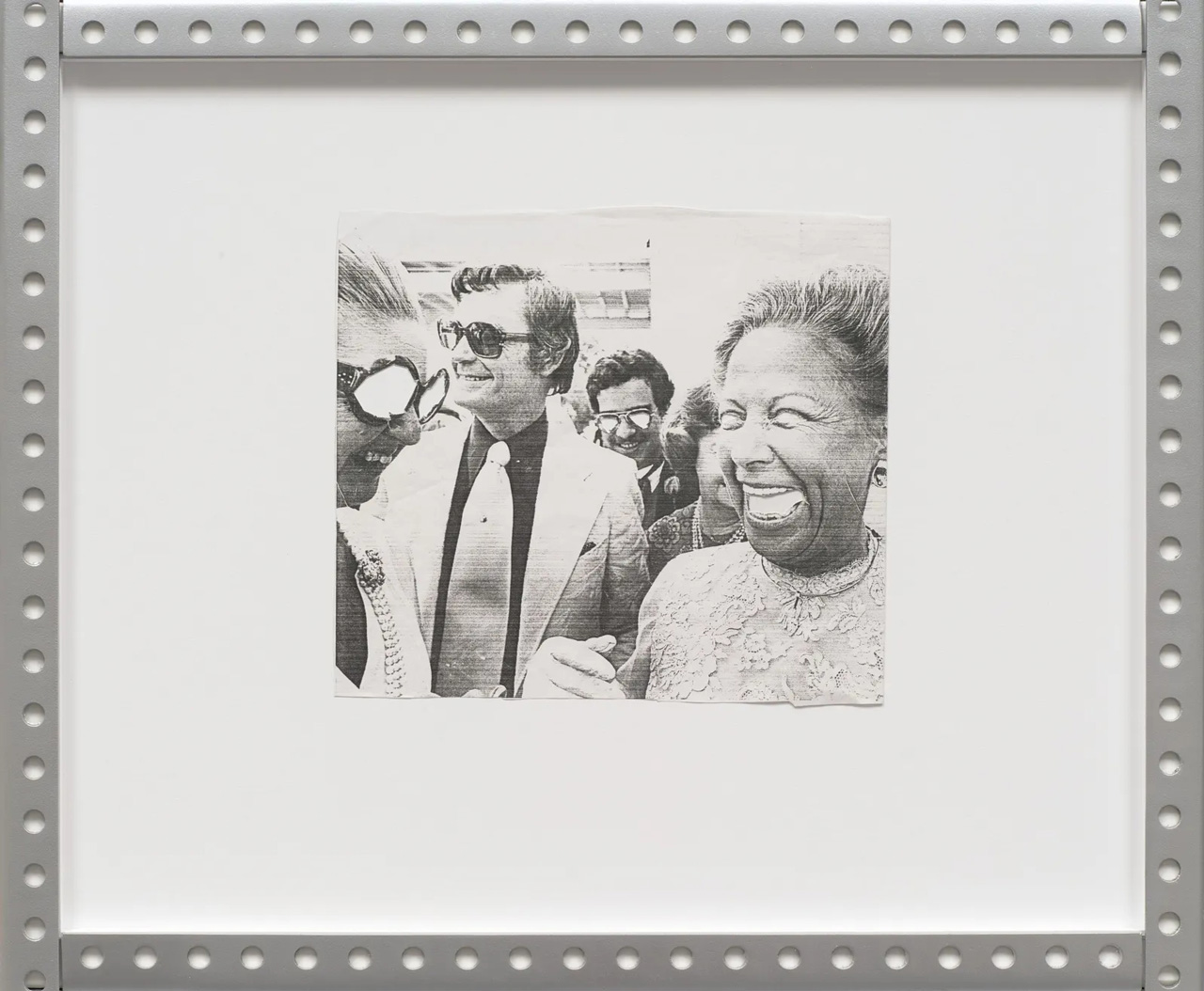
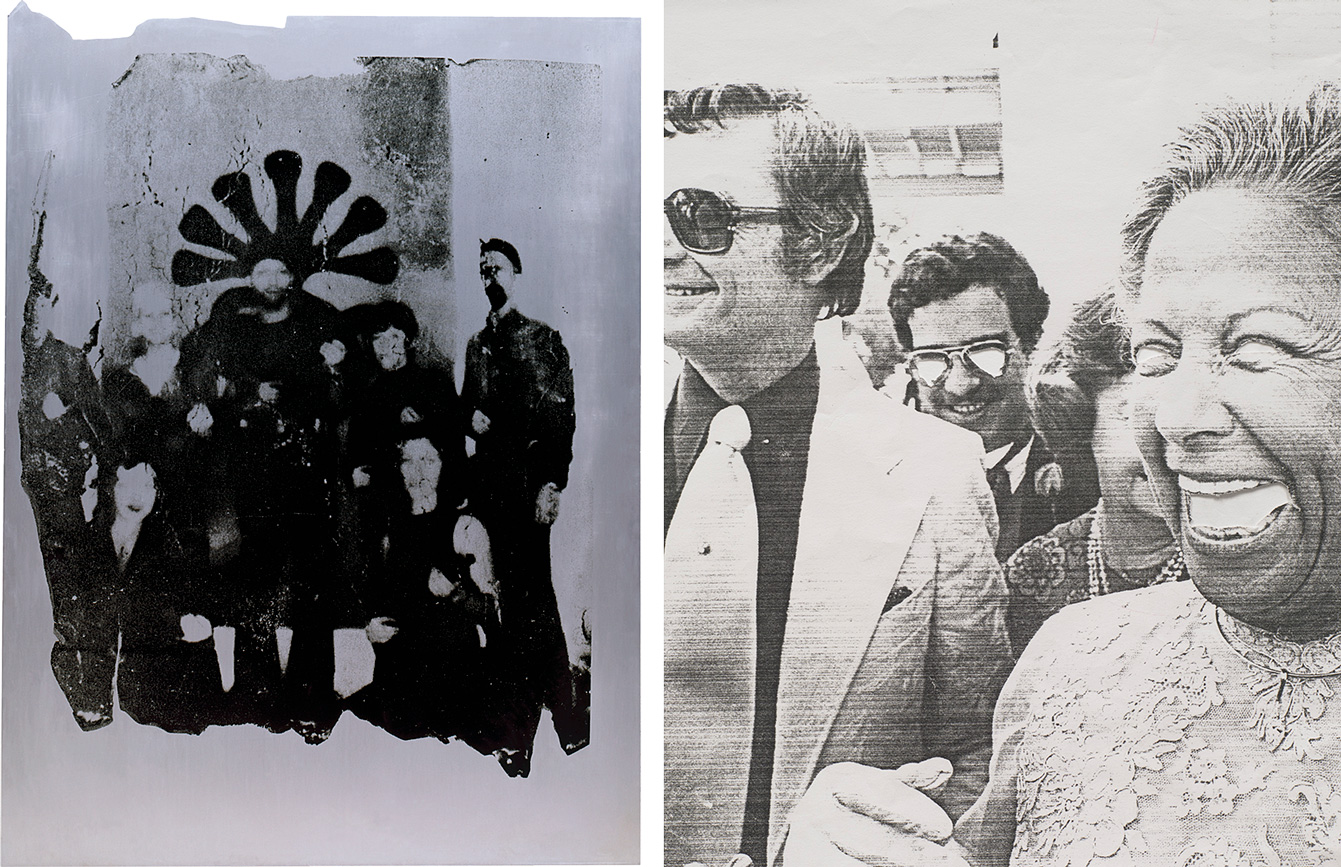
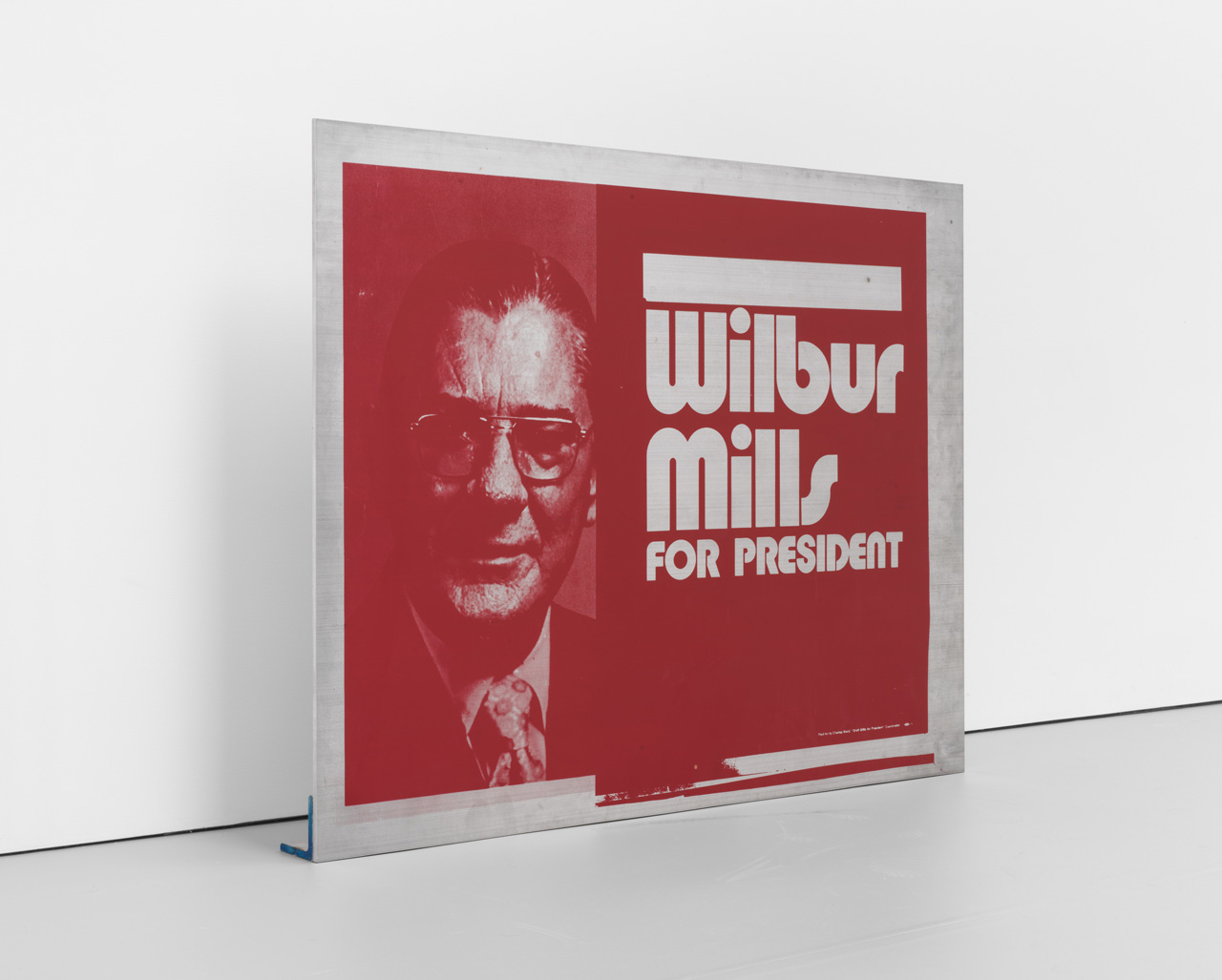
Concurrently, Noland examined the dark, voyeuristic impulses of public culture, focusing on the media’s habit of turning criminals into national celebrities. To Noland, this process reflects a broader cultural urge to reduce human subjects to disposable objects for mass entertainment. Her works “Tanya as a Bandit” (1989) and “Untitled Patty Hearst” (1989) confront this dynamic directly through press photographs silkscreened onto oversized aluminum sheets. The former captures publishing heiress Patty Hearst holding a machine gun alongside her captors-turned-comrades in the Symbionese Liberation Army, while the latter traces Hearst’s rapid media transformation across various roles, including communicant, cheerleader, revolutionary, and bourgeois housewife, alongside an image of her grandfather, yellow journalism pioneer William Randolph Hearst.
In “SLA #4” (1990), Noland continues to pull apart the promises of the American Dream, addressing the widespread anxiety surrounding a broken contract of freedom, safety, and prosperity. By mixing iconic imagery like beer cans, flags, tabloid clippings, and celebrity photographs with mundane hardware such as handcuffs, grocery baskets, walkers, and metal crowd-control barricades, Noland creates haphazard arrangements that evoke impaired physical and social mobility. Her sprawling installations resemble works in progress or hastily abandoned sites rather than polished, finished objects, reflecting discarded hopes, consumer excess, and the distortion of reality by corporate and media interests.
This pervasive sense of unease within Noland’s work grew out of the cultural ruptures of the late twentieth century, shaped by the Vietnam War, the political assassinations of John F. and Robert Kennedy, the violent police response to protesters at the 1968 Democratic National Convention in Chicago, and the Watergate scandal. These defining events shattered the country’s self-image as a unified and heroic society. Noland consistently returned to figures from America’s antihero pantheon, notably Lee Harvey Oswald and Patricia Hearst. In “SLA #4,” for instance, a torn press photo depicts Hearst and members of the Symbionese Liberation Army gathered around leader Donald “Cinque Mtume” DeFreeze in front of their seven-headed cobra emblem.
Noland views the male psychopath as the definitive emblem of human manipulation and objectification in American life. She explored this theme through a series dedicated to Charles Manson, including “Mr. SIR” (1993), a silkscreen on aluminum portraying the mastermind behind the Sharon Tate murders. Another work, “Not Yet Titled (Bald Manson Girls Sit-In Demonstration)” (1993–94), reproduces a press photograph accompanied by its original wire copy, capturing female members of Manson’s follower network staging a sit-in during his trial.
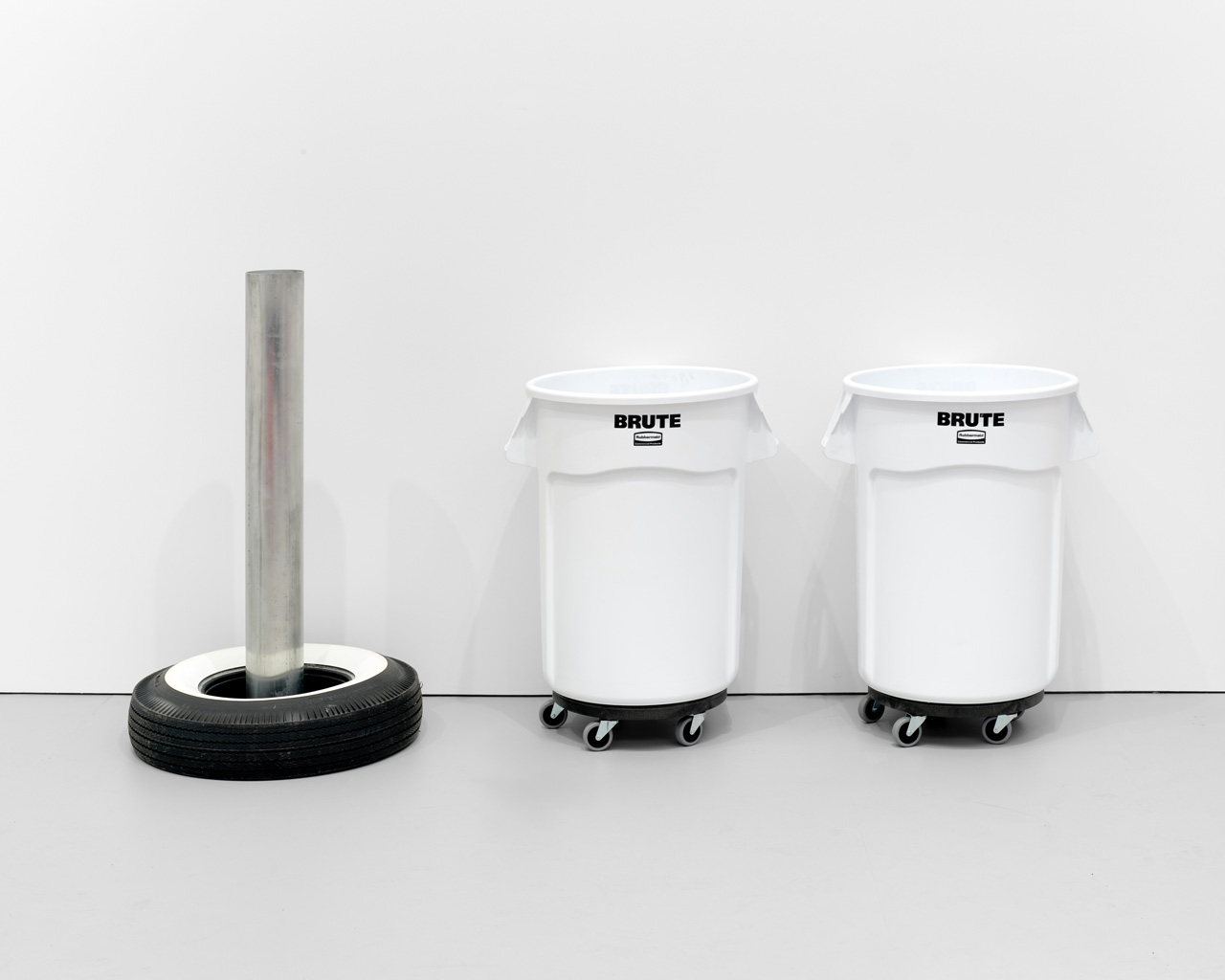
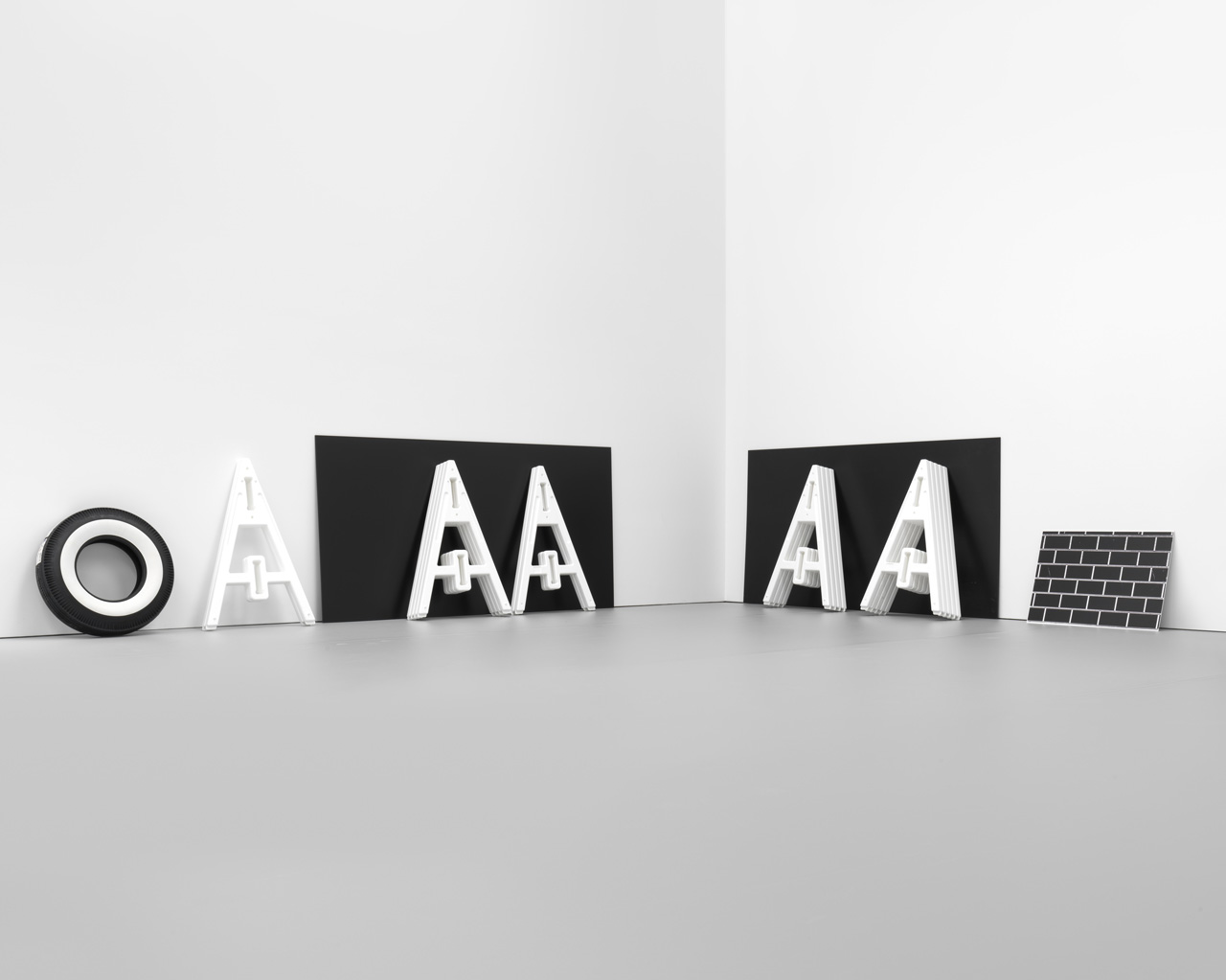
In subsequent years, Noland shifted away from mass-media iconography toward a more strictly sculptural language. “Beltway Terror” (1993–94) features a square wooden slab encased in smooth aluminum with five clean cutouts, visually referencing a historic pillory. “Untitled” (1999) features a piece of raw plywood resting on white plastic police barricades. While these compositions engage directly with the formal geometry of Minimalism, they remain tied to Noland’s critique of American culture, evoking themes of confinement, state control, and public humiliation.
Photo: Cady Noland, Courtesy the artist and Gagosian
Info: Gagosian, 17–19 Davies Street, London, Duration: 12/10-19/12/2026, Days & Hours: Tue-Sat 10:00-18:00, https://gagosian.com/