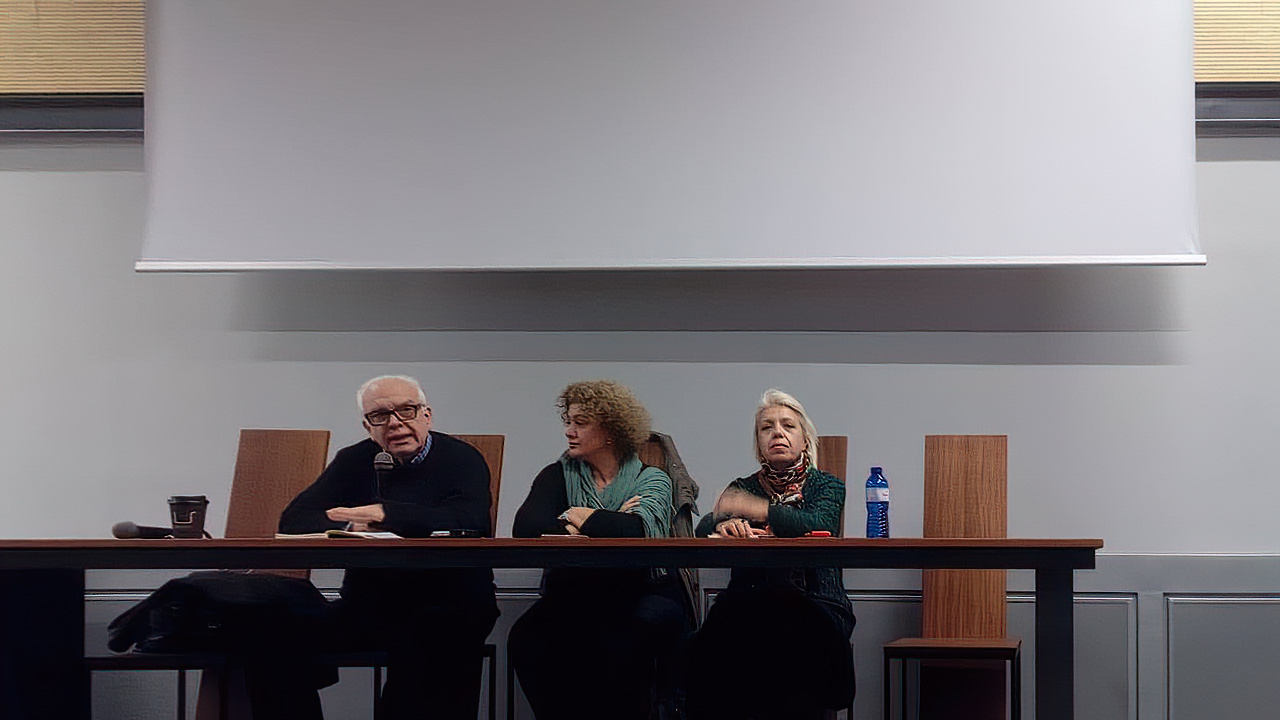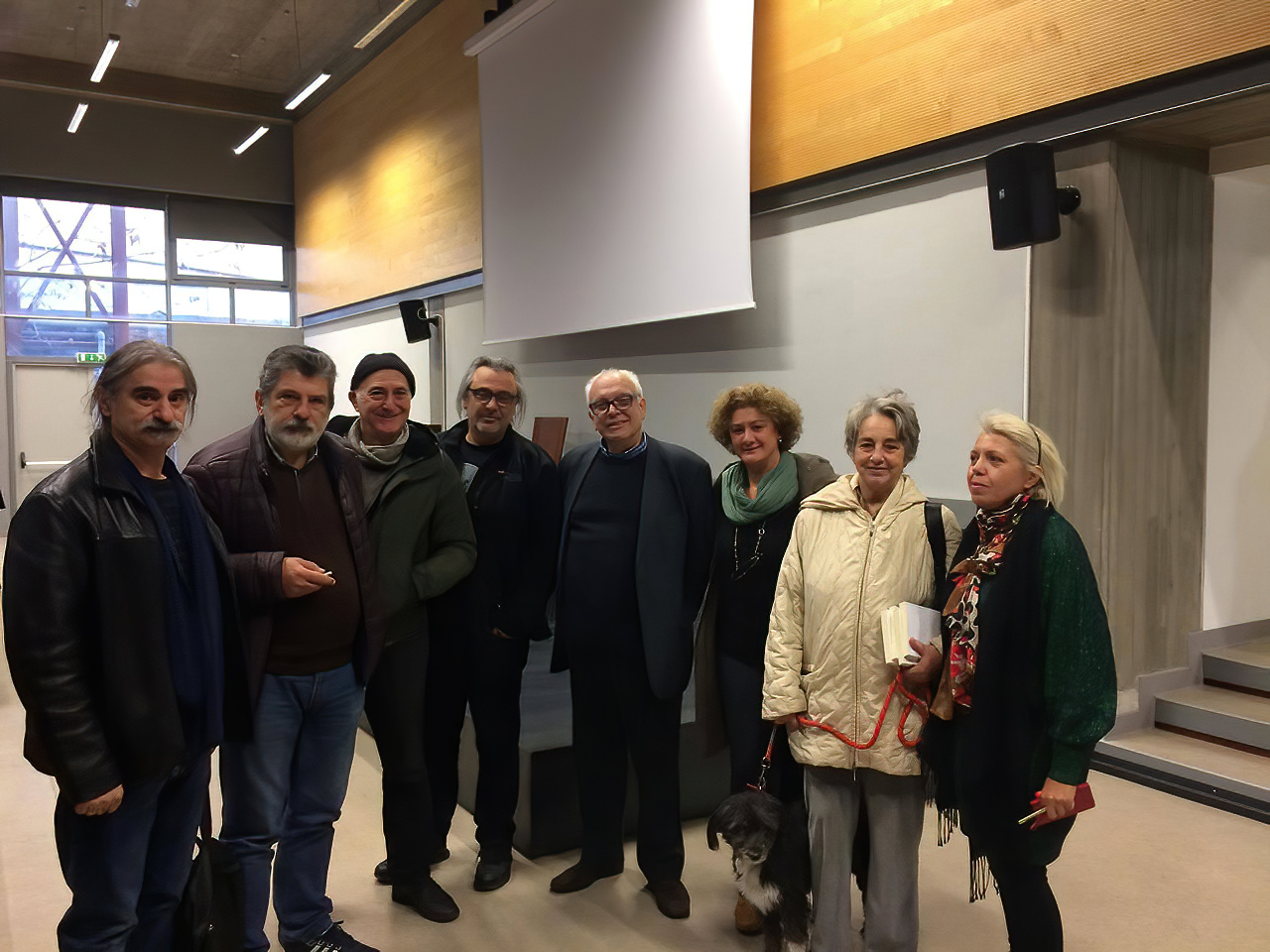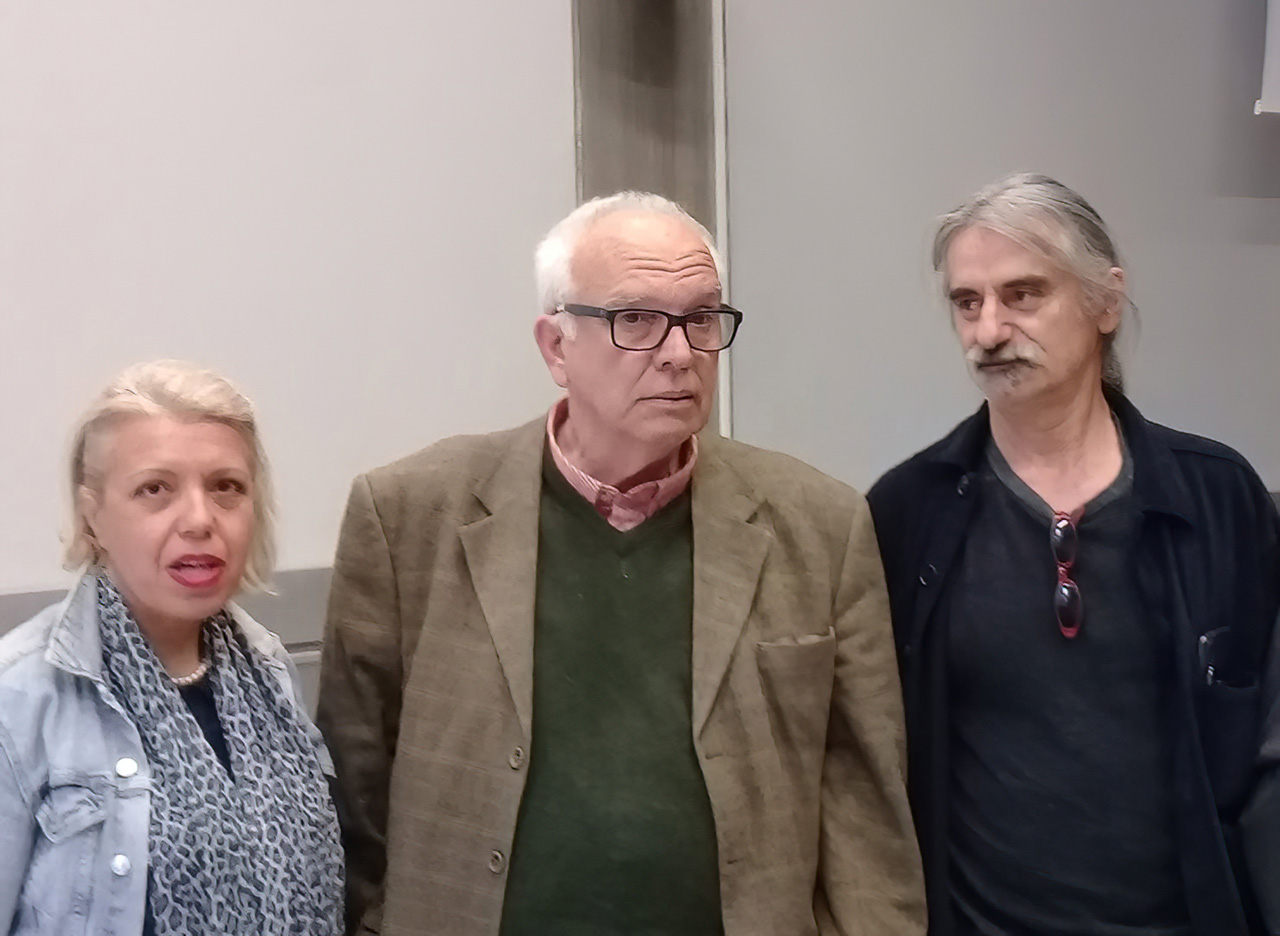
INTERVIEW:Denys Zacharopoulos (11/6/1952-3/10/2026)
In a life-portrait interview, which in truth is a long journey of interviews and a stitching together of conversations, the kind that we people of letters conduct with the persistence of a scholar and which are included in my first book titled “In First-Person Singular & Second-Person Plural”—the hardest part is not the prologue to a tribute written on the occasion of the death of a beloved person, mentor, and friend, as in the case of Denys Zacharopoulos; the hardest part is the epilogue. And as time passes while trying to connect the words and compose a text, the mind wanders back through the years. How many (?) So many!!! New Year’s Day 1994. A life of your own and a life of his. Lives that sometimes run parallel and sometimes cross paths. We spoke often, we spoke recently. Left suspended like a semicolon was my promise that we would meet. Deep down inside, I knew I might not make it in time. He hadn’t told me anything specific, but it is that invisible thread of the soul that connects you with people, and you know that “This is the way the world ends / Not with a bang but a whimper”—and a lump in the throat—the old world ends tonight with the news of your death.
By Efi Michalarou
Photo: Dimitris Lempesis, Mairy Triviza & Denys Zacharopoulos Archive
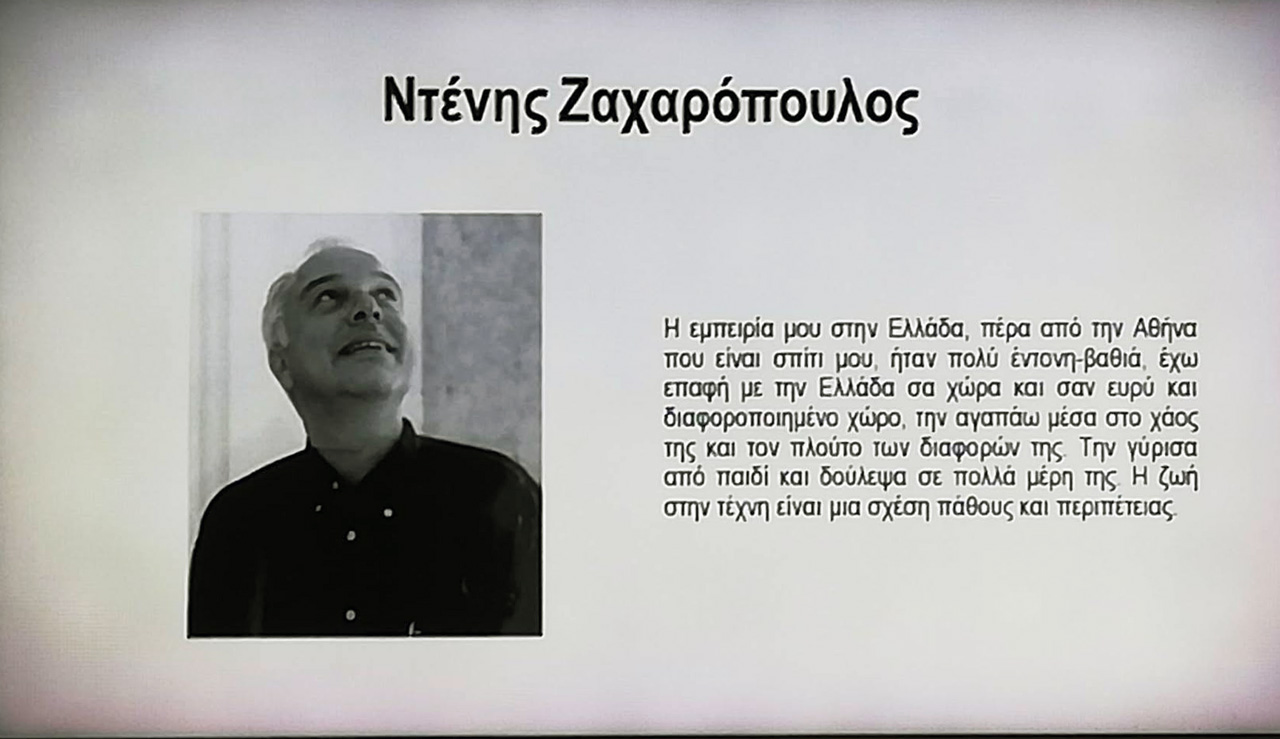
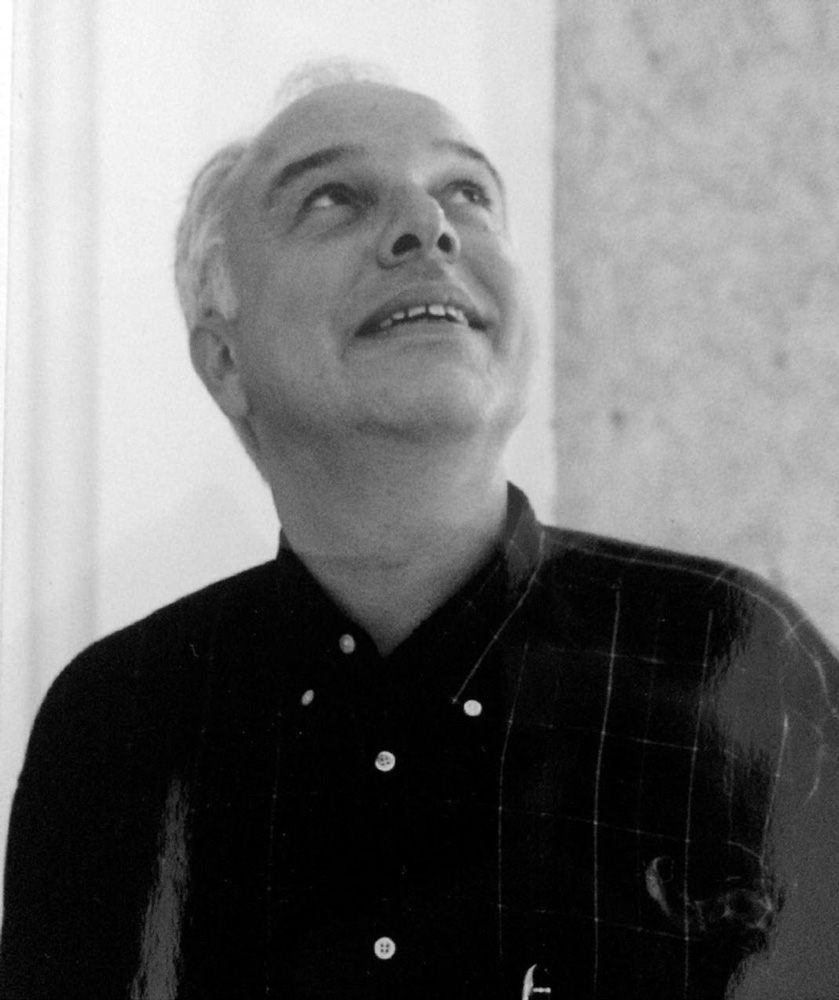 “My experience in Greece, beyond Athens which is my home, was very intense and deep. I have a connection with Greece as a country and as a broad, diverse space; I love it in all its chaos and the richness of its differences. I traveled all over it as a child and worked in many parts of it. Life in art is a relationship of passion and adventure. It was for this very reason that I said from the start: since Anna Kafetsi is doing a sit-in at the FIX building, wanting to create a museum of contemporary art that no government ever wanted, and she has the tenacity and capability to build it, what are you going to say? ‘I’ll take your position’? What position? There was never a position, there was a vision. It’s like someone being in love and you wanting to steal their wife or husband! This kind of work is done out of passion. If there is no passion, it doesn’t get done. In my work, I didn’t want a marriage, a dowry, or security for life, and neither did Anna Kafetsi, obviously. She wanted children to fill the museum, just as I did. I was never a suitor. I was never a Candidate for anything. I knew it ever since I was a teenager when the movie “The Rookie” came out—and the English title was The Candidate—and I remember laughing even then, saying that in my life I want to remain a rookie and never become a candidate! And the one time I found myself a candidate at the Academy of Fine Arts in Vienna (and actually got the position precisely because I wasn’t ready to carry myself as a candidate, but acted like a rookie once again), it was because I was wrapped up in the cunning of the Austrians, who still have courtly strategies and imperial protocols (laughs).”
The list of adjectives that could accompany the name of Denys Zacharopoulos is endless… like his career and his distinct personality. He is an Art Historian and Art Critic. He has served as a Professor at the Academy of Fine Arts in Vienna and in Amsterdam, Inspector General of Fine Arts at the French Ministry of Culture, and founder and director of the Center for Contemporary Art, Sculpture Park, and Residency and Interdisciplinary Research Center, Domaine de Kerguéhennec in Brittany. He was Co-Director of Documenta IX in Kassel in 1992, and Commissioner for France at the Venice Biennale in 1999. He has served as Director of the Institute of Contemporary Art in Austria and Director of the Beltsios Collection in Kalambaka-Greece. Professor of Art History and Museology at the University of the Aegean in Mytilene and in the postgraduate and undergraduate programs of the Athens School of Fine Arts (ASFA), former Artistic Director of the Macedonian Museum of Contemporary Art, and currently Artistic Director of the Art Gallery, Museums, and Collections of the Municipality of Athens. He was the first person I met on New Year’s Day in 1994 as I began my journey in the art world, and since then… a dialogue began that evolved into a series of interviews and discussions extending all the way to today. Choosing a piece from the past and an exceptional interview published in “Theatis” magazine in 2002, we pick up the thread, connecting the past with the present and the future… through a new interview, raising a series of questions that are more relevant than ever. Thus, a unified interview is created that traces not only his personal journey, but the course of Contemporary Art itself…
E.M. You left for Paris many years ago to study, and you stayed.
D. Z. Greece was under the Junta, and even though I was considered an “educated” youth, I knew with certainty that my background was outdated. In Aix-en-Provence, where I began my studies, after a year I called the second-hand dealers to take my library—around 3,000 books—and started over from scratch. I kept a few foundational literary texts—Cavafy, Proust, Sikelianos—as well as Aristotle, Pascal, and Kant. I reclaimed that education later on using new tools.
E.M. You studied Philosophy and Sociology.
D. Z. I abandoned music, which was my primary field, and left with the idea that I would study something between Art History and Philosophy. Art History in France at that time was terribly academic, so I found a more meaningful connection with Art through the Human Sciences.
Ε. Μ. When did you start writing critical texts?
D. Z. My relationship with artists such as Gaitis, Zongolopoulos, Loukopoulos, Kaniaris, and Akrithakis began in Greece when I was a teenager. Meeting Brice Marden in Hydra, and Danil and Jean-Pierre Bertrand in Paris, was transformative. I collaborated with them and wrote my first texts on their work.
Ε. Μ. Your first job was…
D. Z. As soon as I went to Paris, I became assistant to Tonis Spiteris, and we wrote the three-volume history of “Modern Greek Art”, published by Papyros in 1979. Shortly after the fall of Junta, Christos Joachimides and Nikos Hadjinikolaou invited me to collaborate with them on Greek Month in London. Thus, I became Program Coordinator alongside Christos Joachimides and Norman Rosenthal at the I.C.A., and assistant curator alongside Nikos Hadjinikolaou for the exhibition “Ghika, Theofilos, Kontoglou, Tsarouchis”. I worked for a year, first in Greece and then in London—where I was fortunate enough to have an office right next to Sir Roland Penrose—staying until the spring of 1976 after Greek Month ended, as I was collaborating with the I.C.A. on Vlassis Caniaris’ solo exhibition.
Ε. Μ. Coming into contact with such great figures seems like a fairytale…
D. Z. I was fortunate to meet important artists while simultaneously having teachers of great stature, such as Jean Cassou, Gaëtan Picon, Roland Barthes, and Louis Marin. Great figures back then were more accessible, closer to their discipline; art was a secret realm where, when a young person entered, they were embraced. It was like a new recruitment, not a space of social representation. Furthermore, young people entering Art had intellectual demands rather than worldly ones.
E.M. From the early 1980s, an endless journey begins…
D. Z. From Greece to United States, England, Germany, and Italy, first alongside the Arte Povera movement, and from the ’80s onward, encountering Gerhard Richter, Per Kirkeby, and Eugène Leroy—encounters that were decisive for my relationship with Painting. At the same time, I met a number of artists of my generation (Mullican, Welling, Muñoz, Bustamante, Schütte, Mucha, Klingelhöller, Caramelle, Brandl, Zitko, West, Abramović, Dumas, etc.), while also collaborating with several Greek artists: Hadjimichalis, Baikas, Totsikas, Tsekoura, Papoulias. We traveled to various places, engaged in endless discussions, and staged our first exhibitions. That was when alternative spaces—which had originated in the 1960s—became systematized. Art Centers were established across Europe, alongside the Kunsthallen that already existed in Germany, while an entire city could become, in its entirety, an alternative space.
E.M. Like Münster in Germany.
D. Z. Exactly. In 1985, Adelina von Fürstenberg organized the exhibition “Promenades” in Geneva, and in 1986 Jan Hoet did “Chambres d’Amis” (“Rooms for Friends”) in Ghent. I actively collaborated on both. Indeed, both would remain true friends and important colleagues throughout my life. It was then that I was invited from France to visit a park in Brittany and collaborate to create the first Sculpture Park in France.
E.M. Is that how your collaboration with Kerguéhennec began?
D. Z. Exactly. I went in 1986 and saw this breathtaking place where I would go on to collaborate with very important artists (Giuseppe Penone, Gilberto Zorio, Max Neuhaus, Ulrich Rückriem, Richard Long, Maria Nordman). Seeing that there was a château with all its outbuildings and a vast farm set within a 3-square-kilometer forest, I found it strange that we stayed in a hotel even though we spent all day there. I felt an ever-growing connection with the space, which was magical. Until 1990, while organizing Documenta, the French Ministry of Culture asked me to submit a proposal to develop the Park into an Art Center, launching a great and deeply creative adventure. This coexisted with Documenta, with the Fine Arts Academies where I was teaching, and with my broader interests, which resonated immediately with established and very young artists alike from all across Europe and all disciplines, who would visit systematically throughout the decade…
E.M. Was it something like an Artists’ Village?
D. Z. D. Z. A museum and an artists’ workshop at the same time. We ran an educational program with young artists from 54 Schools of Fine Arts who worked with the site, with the public, in studios on their own work, and as assistants alongside internationally acclaimed artists who participated and stayed there. On site, they created the works that we exhibited. All together, this constituted a research program involving cinema, music, circus, theater, and dance, all present year-round, making the center thrive day and night. Artists and theorists worked and shared daily life—we cooked together, met the public together, and set up exhibitions together. Yet it never took on the character of a commune. On the contrary, everyone had their own space, their own studio, their own discipline, and their own methods.
E.M. What was the relationship between the public and the artists?
D. Z. The public visiting the exhibitions and the permanent collection could see the artists working in their studios without disturbing them, while becoming accustomed to the idea that art is a continuous process of work and intellectual engagement. At the same time, we held public discussions and rehearsals, always with free admission and in direct connection with the people from the neighboring villages and the local area…
E.M. Shall we recall the story about Franz West’s chairs and sofas, which are directly connected to Kerguéhennec?
D. Z. When I took over the Institute of Contemporary Art in Vienna, I gave lectures—essentially my classes as a professor at the Academy were open to the public, and at the same time I had organized a program with prominent speakers who gave lectures or public talks. As a result, many people came, and the existing 50 chairs were no longer enough. We calculated that we needed another 80, and I asked where we could find them. In Brittany, I had solved that problem easily, because as Director I had the freedom to go to flea markets where we bought old chairs, all different from one another, very nice, and dirt cheap. In Vienna, however, they sent us a quote that was exorbitant, and I thought that instead of paying for office furniture with that money, we could fund a workshop to design and build 80 chairs. So I invited Franz West to the Academy to direct a workshop around seating. He worked with students at our Institute, with historians from the Museum of Applied Arts, and with art theorists. At the time, West was already making chairs, but they were purely sculptures. Thus, we ended up with 130 chairs in the end, and they were all flawless.
Later on, when we decided at Documenta IX that we would also like to feature cinema, we thought that during the summer no one wants to be cooped up in an indoor hall. Besides, Pier-Luigi Tazzi and I, coming from the South, were well acquainted with open-air summer cinemas! So we proposed an Open-Air Cinema, and Jan Hoet wondered where we would find chairs, because once again they brought us a proposal with a huge sum for purchase. So, with the same ease, I called Franz again, telling him that this time we needed seating for 300 people: “What can you do?” And he says to me: “Now I have you” (at the time, I had undergone back surgery for a herniated disc and couldn’t get comfortable anywhere, and West was curious to see how I could get comfortable, so he used me as a guinea pig and ended up making that sofa with the bolster pillow that you put behind your lower back because there is no single fixed position) “and I want to make 74 three-seater sofas.” At night, the sofas functioned as part of the cinema, and during the day, they formed the auditorium—a work of sculpture.
E.M. How did you manage to buy West’s sofas for Kerguéhennec? I imagine that, as a Documenta work by that point, it would have been very expensive.
D. Z. We also had a subsidy from the Austrian Government for the production. Back then, a single sofa-sculpture by Franz West cost around 35,000 euros in today’s money. A lot of money! But 74 sofas—what do you do with them? If you sell them one by one, you ruin the market. If you sell them all together, who is going to buy them? At first, Marianne Brouwer, who was the Director of the Kröller-Müller Museum in the Netherlands, suggested taking half, and I would take the other half to Kerguéhennec in Brittany. I even have the drawings Franz West sent me from Madrid, where at the Prado he saw paintings of nobles strolling through the woods dressed in brocade jackets, and he told me: “Denys, if you take them to Kerguéhennec, which is a forest, you must add something so that people don’t blend colorless into the landscape.” That’s how he came up with the Persian rugs, which break up the monotony when someone arrives wearing a grey jacket and blue jeans. Thus, it began to become very clear that the auditorium was a single, unified artwork.
Marianne Brouwer said, “I can’t take all of it, I don’t have the space.” I said, “I have the space, I can set it up in front of the château—it will be a masterpiece—but I don’t have the money.” But the most improbable thing happened: the three galleries that helped realize the project said that since the state had covered the production costs, they would waive their commission, so the price dropped by 50%. In the end, we bought all 74 for the market price of just one or two sofas, because West himself asked for a very reasonable fee.
The major problem with the sofas—which they have now permanently installed at the Pompidou—is conservators and the method of conservation. What do you do with the cardboard and plastic wrappings, or when a rug got damaged—since they were all antique—who sews it back together, and so on? At Kerguéhennec, together with the workshop students, we would lay out the rugs twice a year in the old stables, which also served as an exhibition space. Between exhibitions, we would give them a massive shampooing, with all the kids playing and running around, and the whole village gathering! It was wonderful, and afterward we would lay them out in the sun to dry, eat crêpes, drink cider, take off the old cardboard and replace it with new pieces from the local supermarket, while the women of the village would stitch up anything that might have frayed, and so on.
E.M. When does the Kerguéhennec period ends?
D. Z. It doesn’t end; I simply left in 1999 because I saw that Kerguéhennec became a “permanent institution,” and the situation in France is such that it does not allow me to take a creative strategy and program any further. I found myself facing a relapse in the general mindset, oriented toward localist cultural policy on the one hand and a globalized uniformity on the other, both of which feel completely alien to me.
E.M. Was that when you took on the position of Inspector General?
D. Z. I thought that from that position I could contribute to mitigating the problems that institutions and artists were collectively facing, but a year later I resigned.
E.M. What reasons drove you to that decision?
D. Z. Ministers were changing, elections were approaching, and our issues seemed secondary. The devaluation of art and the gradual dismantling of decentralization were becoming increasingly obvious. Populism was beginning to take hold in France as well. So I felt that the conditions to achieve real work simply were not there. If politicians had to answer to the public as a whole, I had to answer to the art world as a whole, and I couldn’t lie.
E.M. And you returned to Greece.
D. Z. That is a long story; although I am also a French citizen, in essence I never truly left Greece (just as right now, as we speak, I never truly left France). I simply returned on a personal basis and took the time to conduct a professional, personal, and political reckoning with myself, rather than making declarations in the newspapers.
E.M. Is that how your collaboration with Leonidas Beltsios came about?
D. Z. It was a very bold venture. It was the first time I collaborated professionally with a collector (even though I had many significant collector friends, I had never had a professional relationship with any of them), and private initiative took on a public dimension. Before returning to Greece, I thought that if I were to start something, it wouldn’t be in Athens. I had gone to Rhodes, Crete, Thessaloniki. I firmly believe in Decentralization, even though I grew up in the heart of the city.
E.M. How did the Beltsios Collection started?
D. Z. It started with the prospect that, besides the Collection, a Museum would be built in Kalambaka. Beltsios’ position, with which I was completely aligned, was a museological one: to buy works of historical significance—both in terms of date and form—and broader bodies of work from the artists we selected. Beltsios poured a lot of money into an unfinished Prefectural Museum to complete it, and it operated for three years as a Museum of Contemporary Art.
The Collection grew significantly, and in 2003–2004 we exhibited it across the entire Macedonian Museum of Contemporary Art in Thessaloniki, while my book, “The Pioneers”, was published around the same time. We had shown artists born between 1920 and 1960. In Kalambaka, we featured younger artists from the ’80s generation onward, alongside corresponding foreign artists, trying to bring a Greek artist into contact with an international one. Artists we didn’t go to seek out in London, but who were coming to Greece and had contact with Greek artists. Thus, we tried to create a dialogue…
The Collection had acquired Marina Abramović’s complete installation “Soul Bathroom” (which she had shown at Kappatos Gallery in 2000), and because the stunning Xenia hotel by Aris Konstantinidis existed in Kalambaka, we dreamed that it could become a model art center and museum on an international level, with the support of local authorities. Beltsios had submitted an application to Public Tourism Properties to grant us the Xenia so we could restore the building and run it as a museum and artist residency in Kalambaka, in collaboration with the Ministry, the Region, and the Municipality. That is, to invite important artists and figures along with students from all over Greece to work there—something that unfortunately never happened, because there was no political will, neither from Athens nor from Kalambaka.
E.M. Yet even though it had all the right conditions, it didn’t have a happy ending…
D. Z. Exactly. Meanwhile, a comical misunderstanding occurred with the Church that delivered the final blow! As long as the clergy saw that we were displaying contemporary art—even the most avant-garde works—they weren’t bothered. In fact, all the Abbots of Meteora and the Metropolitan of Thessaly had attended the opening and were enthusiastic.
But outside, at the entrance of the Museum, I had installed a sculpture by Chris Gianakos consisting of a one-cubic-meter block, with a smaller cube cut out from one side so that it looks like an armchair, and across from its feet, Gianakos placed an unworked stone. The work is called “The Friend”, where you can sit and look at the stone in front of you, so that a person finds themselves between a geometric world and a formless world. An exceptional piece, and perfect for the Museum’s entrance.
The night before the Museum opened, as we were finishing the setup, we lit Totsikas’ artwork with the huge fire. Neighborhood kids gathered around the fence to watch. Some started saying, “The kids should leave,” and I said, “Why should they leave? Let me open early for the kids so they can see the works.” So about 40 kids aged 10 to 14 came in, asking if we had “interactive works.” We took them to the works by Danil and Takis, and they were thrilled. Excitedly, they asked what Chris Gianakos’ piece was, and I told a kid: “You can sit down and you’ll see. It’s called The Friend.”
One little kid sat down like he was on a throne, looking up and down. I had intentionally positioned the sculpture so that the cube faced the stone directly toward the rock of Meteora standing before us. The kid figured it out on his own and started shouting to the other kids: “Guys, guys! Come see how God sees Meteora!” So word started spreading around the schools: “Let’s go to the Museum to see how God sees Meteora.” The Church, which up until then had been overjoyed with the Museum, suddenly felt that we were trespassing on its domain, and word came down from the Monasteries that the Museum should be shut down! Naturally, the Mayor panicked, and Venizelos—even though he had spoken on the phone with Beltsios right in front of me about Kalambaka—didn’t follow through; everyone pulled back, and what could Beltsios do on his own? He took his Collection, and the museum closed down.
E.M. It was a great historic moment and a great personal success when, at the opening of The Pioneers exhibition in Kalambaka…
D. Z. We were very fortunate that, with rare exceptions, almost all of them were still alive and came to the opening: Danil, Kessanlis, Caniaris, Chryssa Romanos, Pavlos, Theodoros, 1984—they were all present, reuniting with the younger generation: Diohandi, Bouteas, Alithinos, Papakonstantinou, Lazongas, Baikas, Totsikas, Georgiou, Hadjimichalis, Papadimitriou, Charalambous, Navridis, Kozaris, Alexiou, and so on.
After the opening, there was a massive dinner where, for the first time in years, Kessanlis, Danil, and Caniaris sat at the same table again—men who, as you know, hadn’t spoken to each other for years. It was a great historic moment. It was the time when Anna Kafetsi was trying to build the collection of EMST (National Museum of Contemporary Art), and we too were doing everything we could to preserve the works of artists whom the State and its institutions up to that point had rejected, because that was where our dialogue was rooted.
E.M. If you had to choose between a newly established museum and an academic career?
D. Z. Both, because they complement each other. Rearranging the placement of artworks in a museum without theoretical reflection is very little. Engaging in readings and commentary at a university while losing contact with the artworks and the artists is equally unacceptable.
I have been teaching since 1984 at Fine Arts Academies, which are complex institutions. There are schools, such as in Vienna, that have the infrastructure to hold museum-level exhibitions, but even here at “The Factory”, exhibitions of the highest international caliber have taken place in recent years. Academies are spaces of fermentation, where everyone’s ego is set aside and dialogue takes place.
E.M. You also taught at the University of Mytilene and at ASFA (Athens School of Fine Arts).
D. Z. Teaching in Mytilene began by chance—exactly like how I got my first position in Geneva in 1984. They invited me to give a talk at a conference that apparently interested the students, so they submitted a petition to the administration to hire me to teach weekly classes for a semester as a Visiting Professor. Ultimately, the experiment succeeded and I received a permanent position, staying from 1984 to 1991. It was the same in Mytilene, where in 2001 I attended a conference, spoke, they listened to me, liked the way I framed the subject, and invited me for a series of lectures, staying until 2010 without interruption.
It was also a great experience to build a department alongside Nicolas Vernicos (whom I knew from Paris at UNESCO), Sisi Daskalopoulou, Dimitris Konstantios (with whom we had collaborated at Kerguéhennec along with Anastasia Lazaridou on Charalambos Bakirtzis and Yiorgos Hadjimichalis’ exhibition “Synaxis”, and Angelos Delivorrias, who was, in a way, the godfather of the department. Because he envisioned a school that would train cultural professionals capable of confronting new specialties and the evolving needs of museums and cultural institutions. Thus, a group of younger colleagues gathered who opened up to a broad spectrum of different academic disciplines, creating an interdisciplinary department with a wonderful mix and interplay of knowledge and interests. From Comics to Byzantine Art, from Impressionism to New Technologies, from the study of social history to material culture, from Cinema to oral history, and so on.
Unfortunately, I was forced to stop for health reasons in 2010. Afterwards, I was invited to come down to ASFA in Athens.
E.M. Why didn’t you continue your collaboration with the postgraduate program at ASFA?
D. Z. Because they brought me into the postgraduate program with the prospect of having a regular salary, and then they told me I had to share it among four people, leaving me with 250 euros a month. Something wasn’t designed functionally, leaving me hanging. Later, they invited me to participate in a European Program for undergraduates aimed at bringing the Theory Department and the Fine Arts Department together, but administratively it didn’t succeed, so I had to teach the same classes twice. Internal affairs caught me both unprepared and, I confess, indifferent, with the result that what I envisioned succeeding failed instead.
I also realized that students didn’t set foot in elective classes; they only attended mandatory ones. And when the only time I could get the amphitheater was at 9:00 in the morning, it was a given that three ladies my age would show up, rather than the young students. I am not accustomed to speaking into a void, so I felt offended by the indifference of both the students and my colleagues. From Mytilene, I produced accomplished students; from ASFA, none.
“My experience in Greece, beyond Athens which is my home, was very intense and deep. I have a connection with Greece as a country and as a broad and diverse space; I love it amidst its chaos and the richness of its differences. I traveled all over it as a child and worked in many parts of it. Life in art is a relationship of passion and adventure.
It was for this very reason that I said from the start: since Anna Kafetsi is doing a sit-in at the FIX building, wanting to create a museum of contemporary art that no government ever wanted, and she has the tenacity and capability to build it, what are you going to say? ‘I’ll take your position’? What position? There was never a position; there was a vision. It’s like someone being in love and you wanting to steal their wife or husband! This kind of work is done out of passion. If there is no passion, it doesn’t get done.
In my work, I didn’t want a marriage, a dowry, or security for life, and neither did Anna Kafetsi, obviously. She wanted children to fill the museum, just as I did. I was never a suitor. I was never a Candidate for anything. I knew it ever since I was a teenager when the movie “Ο Πρωτάρης” (The Novice) came out—and the English title was The Candidate—and I remember laughing even then, saying that in my life I want to remain a rookie and never become a candidate! And the one time I found myself a candidate at the Academy of Fine Arts in Vienna (and actually got the position precisely because I wasn’t ready to carry myself as a candidate, but acted like a rookie once again), it was because I was wrapped up in the cunning of the Austrians, who still have courtly strategies and imperial protocols (laughs).”
E.M. Even though critical discourse is non-existent today, more and more publications are dealing with Art.
D. Z. However, they focus on superficial information: how expensive the artworks are, the lifestyle, and so on. In Art, backstage isn’t Hollywood; it’s a poor neighborhood. The conversation about Art will not move forward unless we get closer to the artists. If they aren’t given a platform, if the right questions aren’t asked, if they don’t show the spaces where they live and work, there will be no proper approach to Art. We live in an increasingly barbaric society that only looks at what glitters.
E.M. You were the only one who criticized the exhibition Antidoron, which was presented as part of Documenta 14 in Kassel. And you took the corresponding heat for it—can you explain to us what happened? Wasn’t all of this a good opportunity for the Greek State to mobilize so that we might finally acquire the coveted Museum?
D. Z. The State did the worst possible thing it could do regarding Documenta 14. Just like in the old days in Trouba when a girl would run out shouting, “Girls, the American Fleet is coming!”—meaning dollars were about to rain down—the exact same thing happened with Documenta. And we treated Culture like political prostitution, literally. The State cared—in Germany as well as in Greece, for that matter—only for the dollars. The State rented out its problematic infrastructure to Documenta; it didn’t grant it, nor did it collaborate—it was simply looking to gain things other than what art can offer. And Documenta funded our inability to make our institutions function. The “Antidoron” exhibition wasn’t Documenta’s. It was, in a way, the payback—because we gave them an empty EMST, and they gave us an empty Fridericianum.
E.M. In the end, was it a good or a bad exhibition, and why?
D. Z. It was bad, for many reasons. First, because of a “the more, the merrier” mentality. Second, because it was poorly installed. When it comes to the selection of artists, not everyone belongs at a Documenta. The purpose of such an exhibition is not to satisfy everyone, nor to honor those who represent art institutionally, whether through AICA or ASFA.
Most importantly, the Museum did not display its own Collection. Crucial works didn’t go. Instead, works went that do not belong to it and aren’t even at the level of the artists they represent. As for the installation, you can’t have Caniaris’ suitcases with “Hopscotch” stopping 1 to 1.5 meters from the wall, only for Akrithakis’ suitcases to continue right next to them. We went with empty suitcases and returned with empty suitcases. You can’t see coal sacks and a huge sheet metal by Kounellis in a row alongside a huge black sheet metal by Takis (from the collection of the Macedonian Museum), with colorful sacks by Kimsooja surrounding them on the other side.
The works were displayed like shop-window decorations. They were far too numerous, crammed on top of one another! They repeatedly made compromises and concessions regarding the quality and essence of the artworks. You can’t include an artist just for their name with a piece that the viewer couldn’t actually see for practical reasons: a video on a staircase which, instead of being properly projected, played on a small TV screen glaring in the light so you couldn’t see anything, while the sound was so low you couldn’t hear it! I’m talking about Maria Papadimitriou’s work with the Magas, where if you can’t hear the clarinet and can’t see the landscape and the attire of the Magas, you see nothing. It makes no sense! Does it make any sense, coming out of the elevator, to see a work by Tzamouranis squeezed into a small narrow hallway, when at that exact same time he had an exhibition in Berlin with 20 works, each more beautiful than the last? Everything was crammed.
Anyway, for me, it was a poorly staged exhibition featuring very good artists—and unfortunately far too many of them—to say that anyone outside of Greece understood that there is a vast artistic wealth here that has never been adequately honored in our country. And this happened, once again, mostly because things were tagged along in the chaotic inability of decision-makers to make clear choices about “whom they truly want to honor,” rather than satisfying either their own vanity or that of the artists who were obviously happy to go to Kassel. They simply went, once again, like refugees of a bankrupt Museum.
E.M. Yes, but wasn’t it a great opportunity for as many Greek artists as possible to be exhibited in such a major institution?
D. Z. The exact same thing happened in 1962 in Paris, when they sent sixty Greek artists to the Grand Palais with the same logic, and they received the worst reviews in all of Europe—we flopped completely! Whereas back then we had a Paris with the finest Greek artists building international careers alongside Duchamp and Yves Klein, we sent a Panhellenic Exhibition that closed all the doors the artists themselves had opened. The same thing happened at Europalia in 1982.
Likewise in Kassel, we sent a Panhellenic Exhibition rather than the Museum—whose collection we still don’t know to this day. The Fridericianum was one of the finest venues of Documenta. In 1990, despite many difficulties and disagreements, we collaborated with the Director of the museum. EMST didn’t collaborate with anyone. It made its choices based on localist criteria and pleased everyone, with an exhibition that was as if it had been put together by the Chamber of Fine Arts. Beyond that, all the artists were good. There was no bad artist in the exhibition. Rather, it often featured great artists represented by borrowed or secondary works, and secondary artists simply because one of their works fit thematically with a curator’s idea.
E.M. E.M. What is the significance of Art in our time?
D. Z. I don’t think there has been an era in recent years when Art was as urgent and as important as it is today. The moments the world is living through are tragically epoch-making, speeds are unimaginable, and sensibilities are so trampled upon that the need for art is imperative. As for the economy, it has tried—and to a large extent succeeded—to incite an appropriation of intellectual life. Art remains, perhaps, the only space where one can reassess all values without losing one’s memory; where one can cultivate, as much as possible, devotion and attentiveness. In this way, it counter-proposes new values that differ little from the old ones, but are essentially contemporary because they are necessary and pose urgent questions in a new way.
E.M. Drawing from your rich personal experience, why do you believe Art does not develop in the Greek regions?
D. Z. In Greece, there is no regional policy whatsoever. I don’t think there is anyone who goes to live in the regions. Athenians will go as far as Nafplio, and Fougaro functions just fine. But in mountainous Arcadia, at Gregory Markopoulos’s Temenos, so many foreigners come from America, Germany, and Switzerland that the 30 or 40 Greeks who show up (and I’m being generous) barely find room to sit. Nobody else sets foot there. I’d like to know how many have ever gone to the Kalamata Dance Festival, which for years was an international event! Very few!
E.M. What do you believe can change?
D. Z. If we want development in Greece, infrastructure must be created. We have eighteen orchestras in Greece, we have great jazz, theater, outstanding artists, historical collections, top-quality cinema. Where will all these works be presented, where will all these young people perform, outside of Athens and Thessaloniki? They need to be able to perform in Tripoli, Patras, Corfu, Crete, Kavala, and so on. It is unacceptable for there to be no easy way to get to the regions. Right now, regional governors are taking initiative—they’ve taken the matter into their own hands—but the infrastructure isn’t there yet. For Culture to function, it needs infrastructure. Just because we have Antiquities and the Acropolis Museum, where we are waiting for the Elgin Marbles to arrive, doesn’t mean we have adequate Infrastructure.
E.M. Since we don’t have it, why don’t we create it? Isn’t EMST part of this Infrastructure?
D. Z. As physical building infrastructure, obviously, except that it isn’t a Museum. It started out as a supermarket project, and they might as well turn it into a supermarket in the end, because as a Museum I don’t see it ever opening under these specifications. If you haven’t made a Plan from the outset and don’t know what Budget you will allocate, you can’t expect a Museum to function. When the building requires most of the subsidy that makes up its budget just for Air Conditioning, how is it going to pay 54 employees—who, according to internal regulations, are slated to reach 80?
E.M. What plan exists to generate revenue?
D. Z. We set out to build a Centre Pompidou or a Tate Modern in Greece—models that are already obsolete internationally in terms of what a museum means today. In any case, we don’t have the money and we never will. It’s ridiculous to keep saying that Athens is comparable to Berlin! Perhaps only to old East Berlin.
E.M. So, the issues are much more serious than whether the Director of EMST will be Greek or foreign. We have a structural problem…
D. Z. But here we have neither a Greek nor a foreigner. Anyone who takes the job of Director at EMST would have to be naive or have such ambition that they care about nothing other than collecting their salary. You know I was very critical of Katerina Koskina, who took Anna Kafetsi’s place. I considered it unacceptable that they didn’t let Kafetsi open the Museum (and be judged fairly and with arguments for the vision she realized). Because she built it out of nothing, without any political support, carrying this Museum on her back with all its problems. When it’s said that Katerina Koskina told the Minister that she wouldn’t open the Museum unless she had a budget of at least 2,000,000 euros, I give her credit—even if I consider that its internal regulations heavily weigh down the Museum’s operation, turning it into something like the Louvre: a bureaucratic and unwieldy organization.
E.M. Your name is among the leading contenders for the position of Director.
D. Z. Yes, every day I receive emails asking why I don’t submit a candidacy. And I ask laughing, “For Mayor?” If you look back at old interviews, they’ve been asking me ever since I returned from abroad why I don’t take over the Museum of Contemporary Art—because back in 1998, Venizelos had announced that Joachimides would go to Athens and I would go to Thessaloniki. Later, Papanikolaou ended up in Thessaloniki and Kafetsi in Athens. I don’t think Papanikolaou accomplished much; he is simply a very likable person with a party affiliation. Kafetsi, however, built a Museum out of nothing through sheer stubbornness. Without the Costakis Collection, without anything behind her—even though the major exhibition of the Costakis Collection at the National Gallery in Athens was actually curated by Anna Kafetsi. Maria Tsantsanoglou is a most remarkable person; she speaks wonderful Russian, knows the entire historical and cultural milieu of 20th-century Russian artists, but she is not an art historian.
E.M. In the strict sense of the term…
D. Z. Yes, I simply say it because, by that same logic, neither am I, and I wouldn’t go claiming a position at the Louvre, where a different kind of knowledge is required.
E.M. Shall we move on to Thessaloniki and your collaboration with the Macedonian Museum?
D. Z. Frankly, the experience with the Macedonian Museum was difficult. We disagreed many times. We fought, but in the way people who share a common goal fight. You can’t achieve anything in Art without fighting. Unlike with other Museums, I never had a problem with the Board of Directors—not because there weren’t issues, but because its members were not political appointees. They served purely the interests of the Museum, even if there were constant disagreements, just like in a family. They were all devoted to keeping the Museum dynamic and active. Art provokes misunderstandings precisely so that you can overcome them…
E.M. What was the most important exhibition you organized at the Macedonian Museum?
D. Z. There isn’t one, in the sense that the entire programming was important. From the very beginning, there was an organized rationale centered on the Collection, the identity of the Museum, and its history. I started as Director at the Macedonian Museum in 2006 with Lazongas’s exhibition “A4”, in which I was not directly involved, but I agreed to it because I love Yiorgos and it was a wonderful exhibition, and I stayed until 2015. During that time, I did a tremendous amount of work and staged numerous exhibitions; we brought the Collection to Athens (Places, 2007, at the Benaki Museum, ASFA, and Zappeion), and the Mylonas Museum entered the fold as well, which meant I was organizing exhibitions in Athens too, as well as fostering an international dialogue.
E.M. With very high quality…
D. Z. And with a very good team of collaborators. I brought in exhibitions that were always funded or had very minimal costs. Because I usually start thinking about exhibitions in reverse: I look at the artworks first—which I know where to find—I reflect on them, talk to the artists, colleagues, and collectors, and only then do I ask, “How do I bring them here?” “Art in Europe After ’45” was considered a major international success by the European Union and the Council of Europe, featuring a massive catalog, yet it cost a mere 30,000 euros and drew huge attendance.
E.M. What was the personal challenge when taking over the position of Artistic Director of the Municipal Gallery of the City of Athens?
D. Z. The loss of the donation of Papaloukas’s works!I knew the Municipal Nursery [Vrefokomeio] because ever since I was a little child, my family and I would go there to put on puppet shows for the kids, and every month we would take a child home to eat and play with us. Whatever clothes we didn’t wear and toys we didn’t play with, we gave to them. So I feel connected even to the building itself.
I still consider Piraeus Street to be a magnificent street in Athens. That was also where the Athens Conservatoire was located, where I studied throughout my teenage years. The beautiful factories, and the road to Eleusis. When the Papaloukas bequest was lost, I began to wonder why on earth that happened. I asked a friend who was a City Councilor if she could find me the Gallery’s Charter, what budget it had, and its Collection, and she couldn’t find anything. The Charter was lost in the fire of 1914–15; a Budget doesn’t exist because the Gallery isn’t autonomous—the Municipality allocates whatever the political view of the Mayor of the day and his staff deems appropriate. The Collection is now barely digitized—back then it wasn’t at all—and the works have not been photographed. So I was left with my questions unanswered.
When a few years later we closed the Macedonian Museum for 6 months, I was the first to accept being laid off, as you know, in order to save the Museum, knowing full well that I would be the last to be rehired. Upset because they announced it to me over the phone—even telling me that I would get 350 euros from unemployment benefit (which, as a freelancer, I obviously couldn’t receive)—I considered myself free to find work. I had gone to the Ileana Tounda Gallery to see an exhibition, and as I was leaving, I told her that it was over with the Macedonian Museum, I had been laid off, I had no income, and so I had to find a job to make a living. I left, and Ileana caught up with me in the street, telling me that as a Municipal Councilor in Athens, she was on the Visual Arts Committee alongside Julia Dimakopoulou and that they were looking for a museologist to re-curate the Gallery’s Collection, though the money was modest. And I told her, “I’m unemployed, the money is low, but I am interested in a historical and meaningful way.”
So I sent my CV, and the then-president of OPANDA called me and said, “I cannot accept a person of your stature and credentials in this position under these terms,” so he issued a new call, using the competition budget for a six-month period with the prospect of formally hiring me in 2016. I accepted, and they held a press conference where they officially presented me as the Artistic Director for the Municipality of Athens. But I’m still on a freelance invoice basis.
Anyway, at the Gallery, I discovered the historical and artistic documentation of the Greek relationship with the modernization of Art prior to the notion of “Greekness” [Ellinikotita] and the pessimism of the Generation of the ’30s. The concept of free expression, of the independent artist, of the self-driven intellectual, of cultural and social modernization—these are the themes that define a stance in life within Greek history and society, as well as in the life of the city where I was born and where I saw these artists—the ones in the Collection—as part of my life and history.
E.M. I notice that your entire trajectory and the exhibitions you have organized possess a cohesion and a continuity…
D. Z. Indeed, they are based on the question with which Hamlet begins: “Who’s there?” Is it a friend appearing in the dark, or the ghost of the father? I even curated an exhibition with that title and that question to commemorate the 40th anniversary of the Junta’s coup d’état, in 2007, at the Macedonian Museum and at Yenti Koule in Thessaloniki.
It was a tribute to Pavlos Zannas’s translation of Proust’s In “Search of Lost Time” while in prison (the publication of which was just completed these days, and we finally have the entire work in a magnificent edition, on which Stratis Tsirkas, Pavlos Zannas, Panagiotis Poulos, and Pantelis Boukalas collaborated from 1968 to 2018).
Crucially, the question “Who’s there?” is the fundamental question of the entire history of art. There is no artwork that doesn’t ask you: “Who’s there?” And who am I, and where is “here”? I think Athens closes the circle of my wanderings—even if I continue—in the same way that Paris closed another circle and sent me “home.” Here at home, I can now engage seriously with Time Regained. To complete this journey which doesn’t simply end, but transforms into a body of work.
Denys Zacharopoulos (born 1952, Athens) is a prominent art historian, curator, academic, researcher, and author. He completed his studies in Aix-en-Provence and at the École des hautes études en sciences sociales (EHESS) in Paris, focusing on philosophy, art history and theory, and the sociology of literature and culture under seminal thinkers including Jean Cassou, Gaëtan Picon, Louis Marin, and Roland Barthes.
Across his distinguished leadership career, Zacharopoulos founded and directed the Domaine de Kerguéhennec National Centre for Contemporary Art in Brittany from 1986 to 1999, served as Inspector General of Contemporary Art at the French Ministry of Culture from 1999 to 2000, and led the Macedonian Museum of Contemporary Art in Thessaloniki as Artistic Director from 2006 to 2015. Since 2015, he has served as Artistic Director of the Municipal Gallery, Collections, and Museums of the City of Athens (OPANDA). His major international curatorial highlights include co-directing Documenta IX in Kassel alongside Jan Hoet in 1992, curating the French Pavilion at the 48th Venice Biennale in 1999, and staging landmark exhibitions across major museums in Europe and the Americas.
His academic trajectory spans three decades across top European institutions, holding professorships and lectureships at the Akademie der bildenden Künste in Vienna, the Rijksakademie in Amsterdam, ESAV in Geneva, Le Magasin in Grenoble, the University of the Aegean, and the Athens School of Fine Arts, where he was awarded an Honorary Doctorate.
In an advisory capacity, Zacharopoulos has served as a permanent member of the Evaluation Commission for Art Education of the Swiss Confederation since 2000, an associate member of the Museums Council of the Greek Ministry of Culture, and a long-standing consultant to French national committees on art acquisitions and international cultural policy. A prolific author, he has published extensive monographs, essays, and museum catalogs alongside regular contributions to major international journals such as Artforum, Domus, Parkett, Artistes, Tefchos, and Arti. For his contributions to global contemporary culture, he has been honored as a Chevalier of the Order of Arts and Letters in France and awarded the Cross of Honor for Science and Art in Austria.
© Interview by Efi Michalarou
First published in the book “In First Person Singular & Second Person Plural”, 2018, dreamideamachine publications
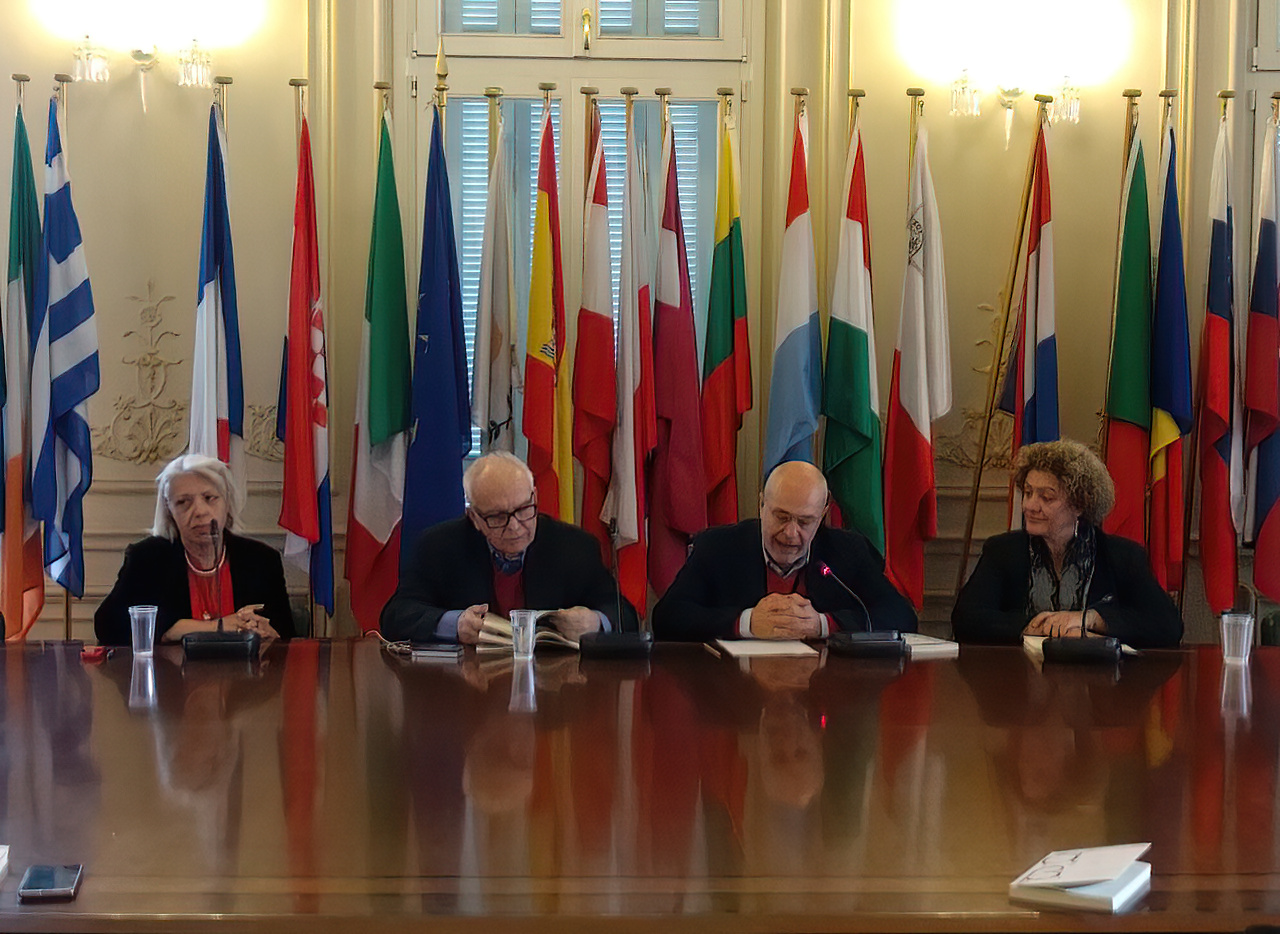
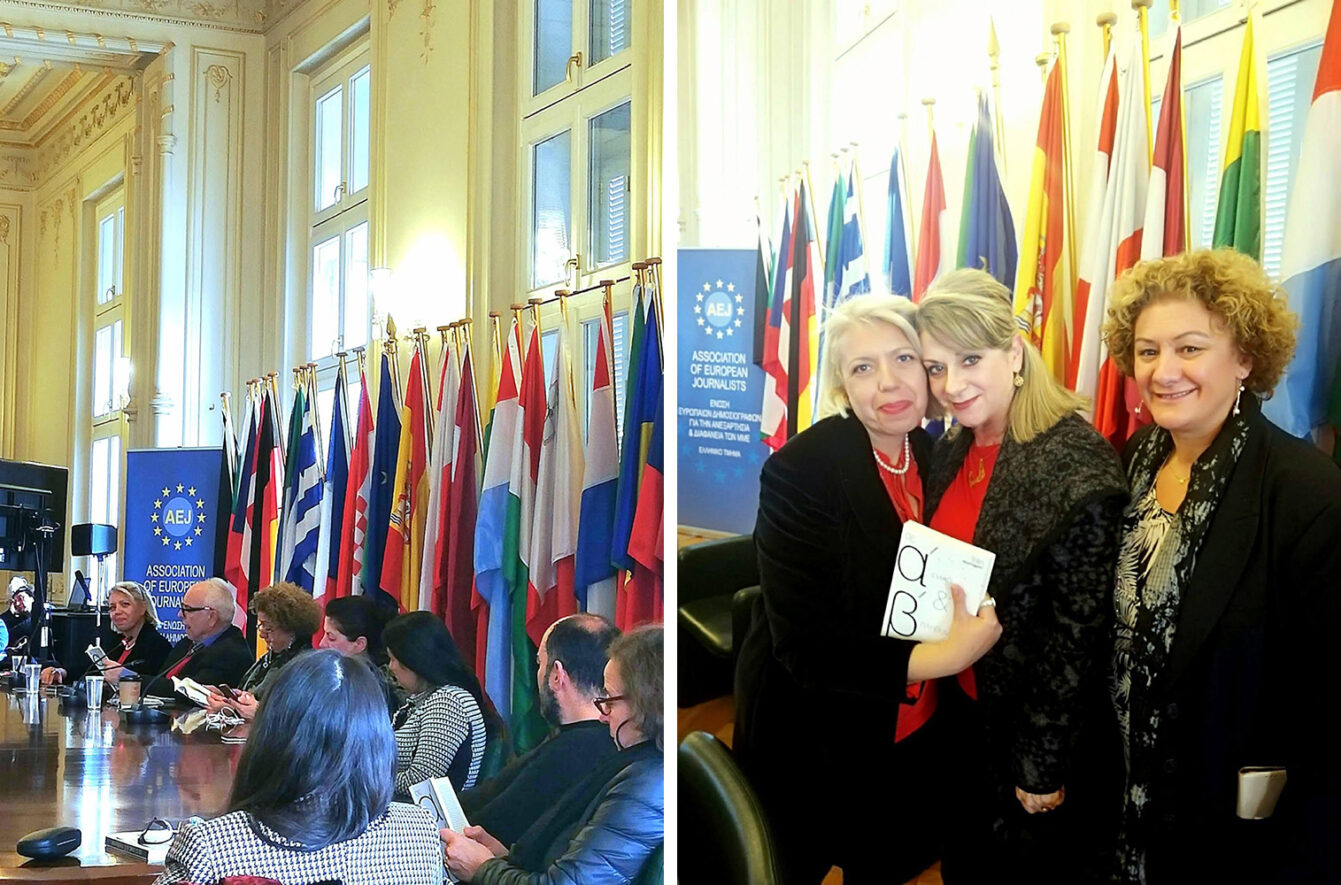
Right: Efi Michalarou at her book presentation with artist Ms. Mary Triviza and the President of the Association of European Journalists, Ms. Saia Tsaousidou, Mary Triviza Archive