ART CITIES:Athens-Elina Belou
Elina Belou’s exhibition “Life of a Sunflower” is her first with Bernier/Eliades Gallery, the exhibition brings together a new body of ceramic works that reconsiders familiar forms from traditional pottery as contemporary sculptural objects. Working between Athens and the south of France, Belou revisits vases, pots, bowls and boxes, shifting them between domestic function, ceremonial association and abstraction.
By Efi Michalarou
Photo: Bernier/Eliades Gallery Archive
Born in 1988, Belou followed an unconventional route towards ceramics. She initially studied midwifery in Brussels before completing a master’s degree in photography at La Cambre. Her photographic practice developed alongside an interest in objects, materials and traditional forms of making. Travels through France, Finland, Portugal, Mexico, Japan and Greece introduced her to different ceramic traditions and artisanal techniques. In 2019, she returned to formal ceramic education at the Maison de la Céramique de Dieulefit, completing her ceramic diploma in 2020. Her first solo exhibition devoted entirely to ceramics was presented at Arch Athens in 2024.
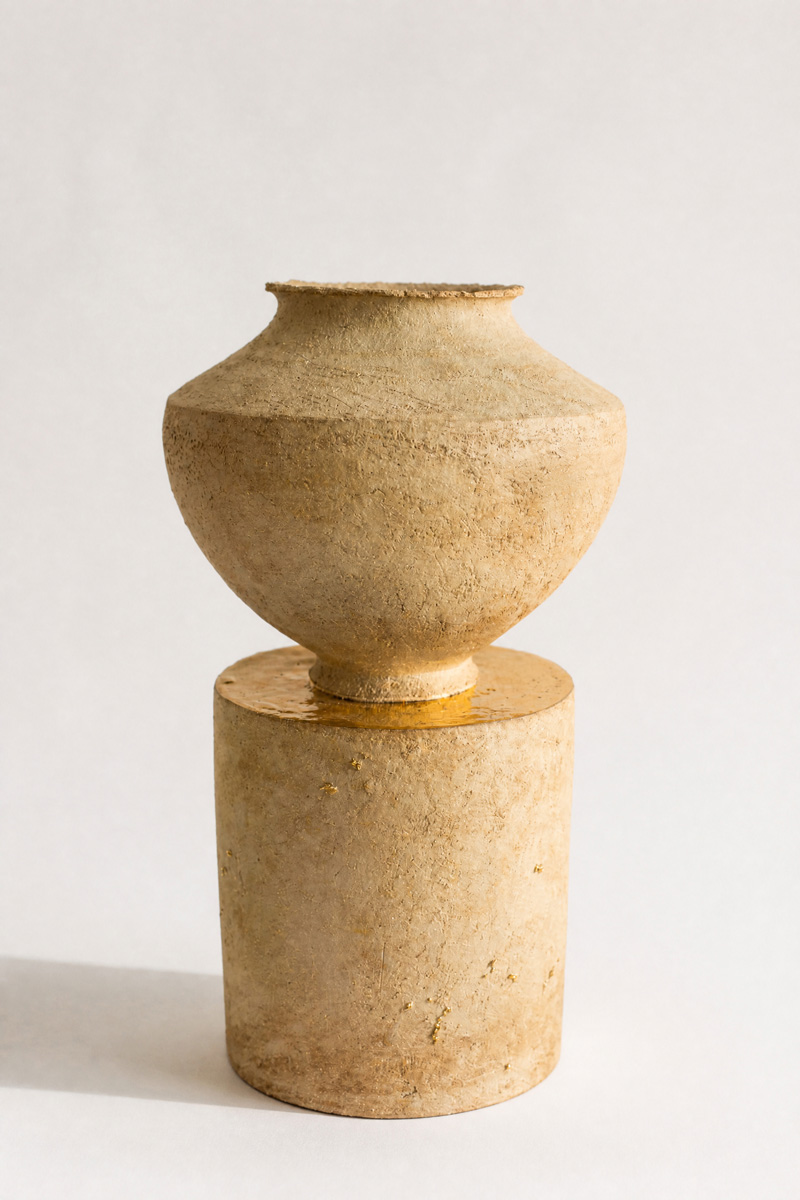
The vessel remains the starting point of Belou’s practice. Vases, pots, bowls and boxes belong to a shared history of making, appearing across cultures as both functional objects and carriers of ritual or symbolic meaning. Belou draws on this familiar vocabulary without reproducing it literally. Through changes in scale, proportion, silhouette and surface, she pushes recognisable forms towards sculpture.
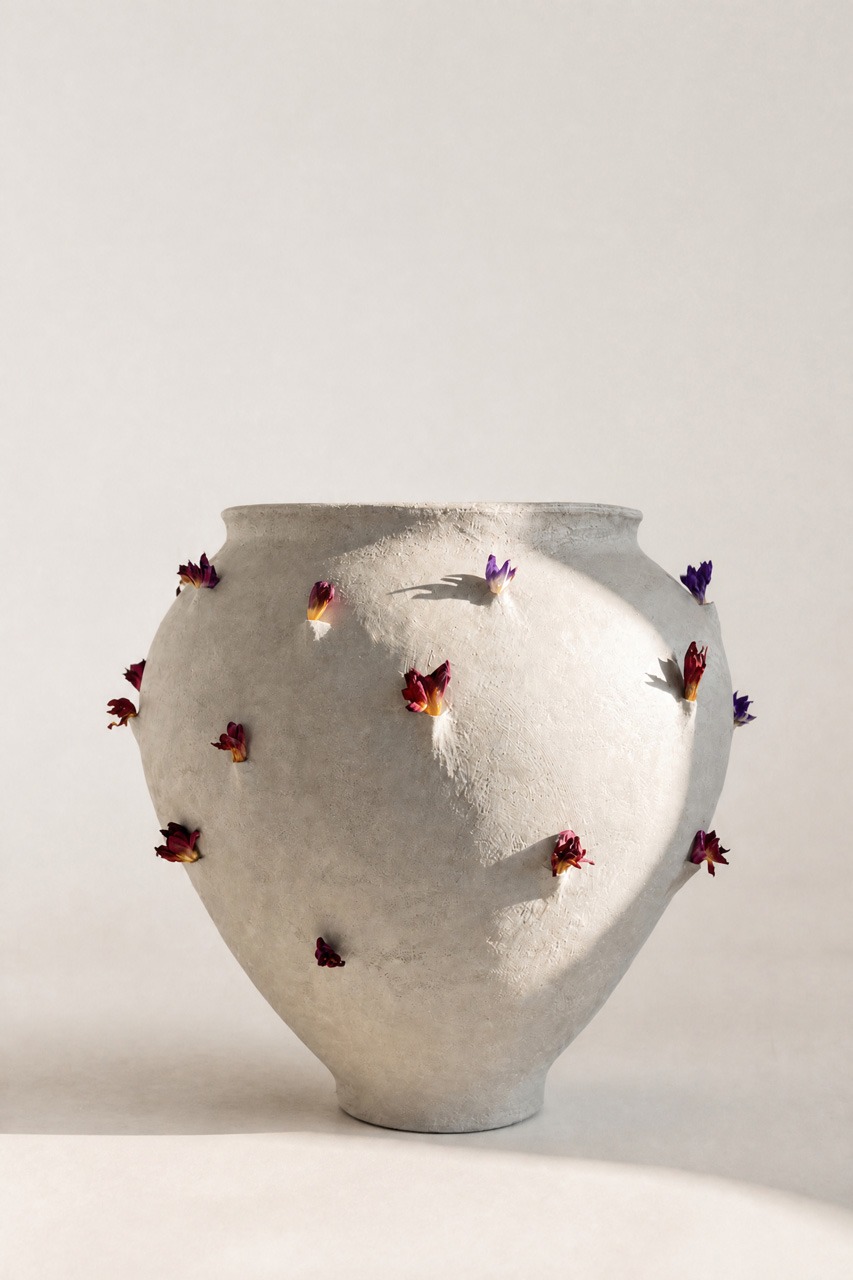
Her works often retain the physical suggestion of a container while acquiring a more corporeal presence. Necks, limbs and curved extensions give certain vessels an anthropomorphic quality, while porcelain ornaments and natural materials alter their outlines. Belou describes this process as “dressing” the ceramics. The additions resemble jewellery or clothing, but become structurally integrated into the forms rather than functioning simply as decoration.
Her relationship with nature is rooted partly in her childhood in the Pyrenees. Seasonal change, vegetation, shifting skies and the textures of the landscape inform her work, while collected materials bring this environment directly into the studio. Flowers, branches, grasses, ash, local soils, rocks and other fragments gathered during walks are incorporated into the ceramics.
The juxtaposition of these materials with fired clay introduces a difference in scale and duration. Organic elements are associated with growth and decay; ceramic is capable of enduring for generations. Belou does not attempt to eliminate this contradiction. Instead, she uses it to give the objects a sense of material and temporal tension, preserving fragments of a landscape within forms that can outlast them.
Surface is central to this process. Through clay, glazes and layered treatments, Belou allows variations, irregularities and traces of making to remain visible. The resulting textures can recall mineral, geological or vegetal surfaces without directly depicting them. The kiln adds another degree of unpredictability, ensuring that the final appearance remains partly beyond the artist’s control.
Belou’s works are also developed in relation to one another. Rather than producing isolated objects, she creates families of forms connected through proportion, colour, texture and gesture. Similarities establish continuity, while differences in scale or shape create rhythm across an installation. The individual vessel becomes part of a larger visual composition.
Her process is largely intuitive. Rather than translating a predetermined concept into clay, Belou allows relationships between forms and materials to emerge during making. Experimentation and repetition gradually establish connections between objects, producing groups held together by visual and material affinities rather than a single narrative.
This openness is consistent with Belou’s interest in beauty, precision and proportion. Her research into archaeological collections, ethnographic imagery and anthropological literature informs her understanding of the vessel as an enduring human form, but she avoids treating these references as a fixed conceptual framework. The objects are allowed to communicate through their physical presence.
The title “Life of a Sunflower” introduces another reference to cycles of growth and change. Rather than functioning as a literal subject, the sunflower suggests a process of emergence, maturity and decay that resonates with Belou’s use of organic materials and her interest in transformation.
At Bernier/Eliades, these elements come together in works that move between pottery and sculpture without settling entirely into either category. Belou takes forms with long histories and subjects them to an individual process of reshaping, ornamentation and material experimentation. The result is contemporary ceramic work grounded in the physical intelligence of the vessel while remaining open to new associations.
The exhibition presents ceramics as a meeting point between inherited form and personal experience. Clay provides the continuity, while collected materials, surface treatments and the unpredictability of firing introduce variation. What emerges is a restrained but distinctive language in which the familiar vessel becomes something less functional and more enigmatic: an object shaped by craft, landscape and time.
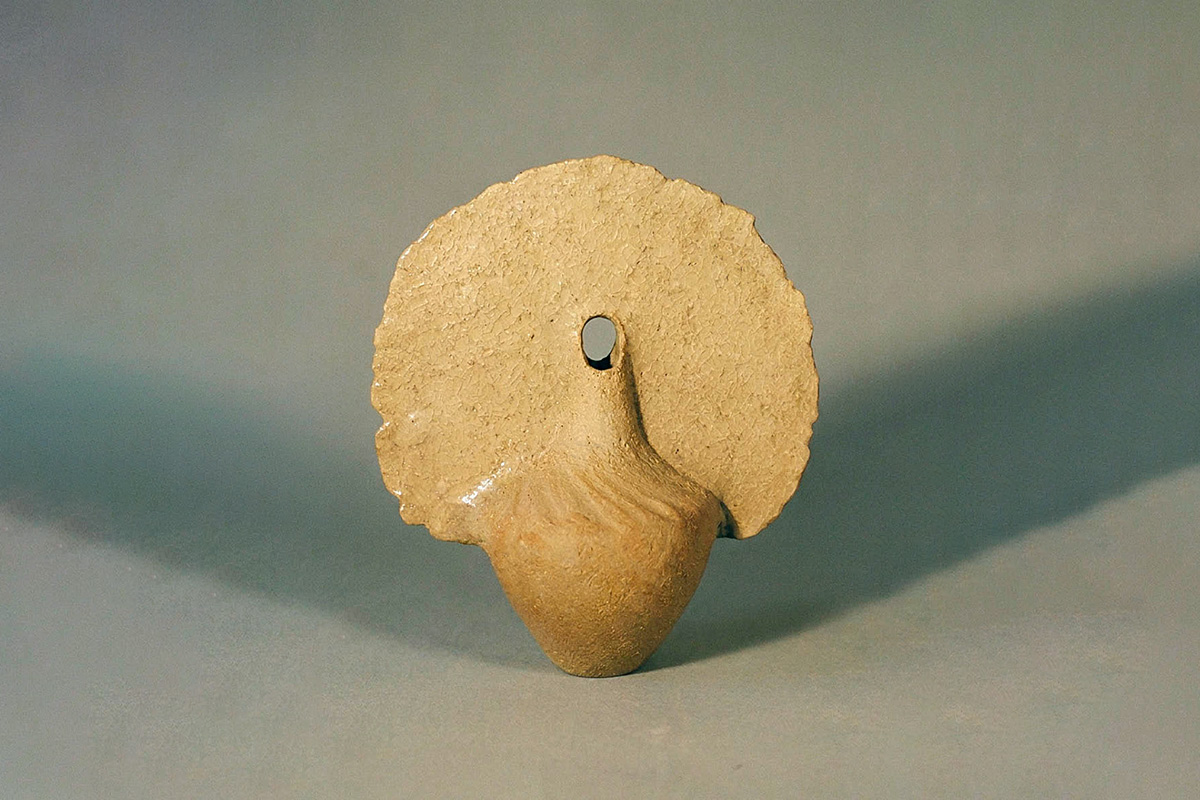
Photo: Elina Belou,Vase paon, 2026, Handmade stoneware with glaze, gold 10K, 23 x 19 x 5 cm | 9.1 x 7.5 x 2 in,Courtesy of the artist and Bernier/Eliades Gallery , Photo: Elina Belou
Info: Bernier/Eliades Gallery, 11 Eptachalkou Street, Athens, Greece, Duration: 1/10-17/11/2026, Days & Hours: Tue-Fri 11:00-18:30, Sat 12:00-16:00, https://bernier-eliades.com/