ART CITIES:Dubai-Rana Begum
Rana Begum’s work focuses on the interplay between light and color, blurring the boundaries between sculpture, painting and architecture. Her visual language draws from the urban landscape as well as geometric patterns from traditional Islamic art and architecture. Light is fundamental to her process. Her work moves across a wide range of media—from metal, glass, and stone to paper, wood, and textiles—each absorbing or reflecting light to produce an experience that is at once temporal and sensorial.
By Dimitris Lempesis
Photo: Third Line Galley Archive
Rana Begum’s solo exhibition “Taking Form”, her fifth presentation with The Third Line, brings together a new body of work across wool, linen, wood and paper. The exhibition continues the artist’s longstanding investigation into light, colour, geometry and material, while introducing a softer and more tactile dimension to her abstract vocabulary.
Begum’s practice has consistently explored the relationship between geometric structure and perception. Drawing on Minimalism as well as the geometric principles of Islamic art and architecture, she works with repetition, rhythm and modular forms to create compositions that appear both precise and open-ended. In Taking Form, squares, rectangles and triangles establish boundaries, but the patterns contained within them suggest a continuation beyond the physical limits of the work. Geometry becomes a structure through which the possibility of expansion is implied.
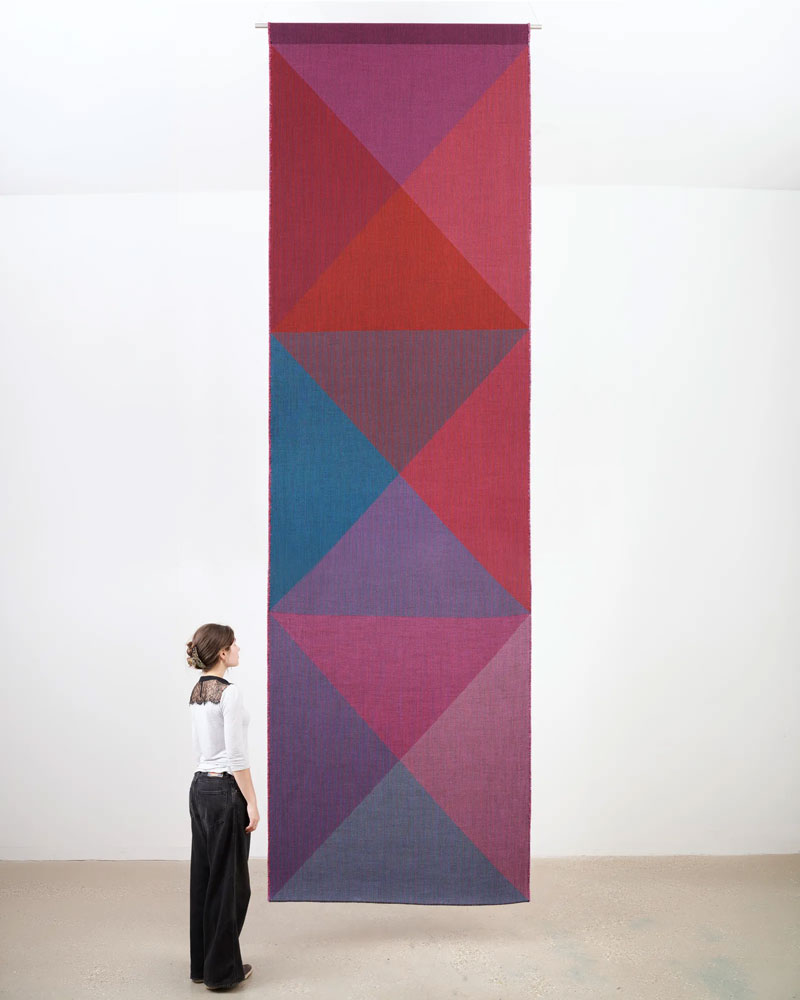
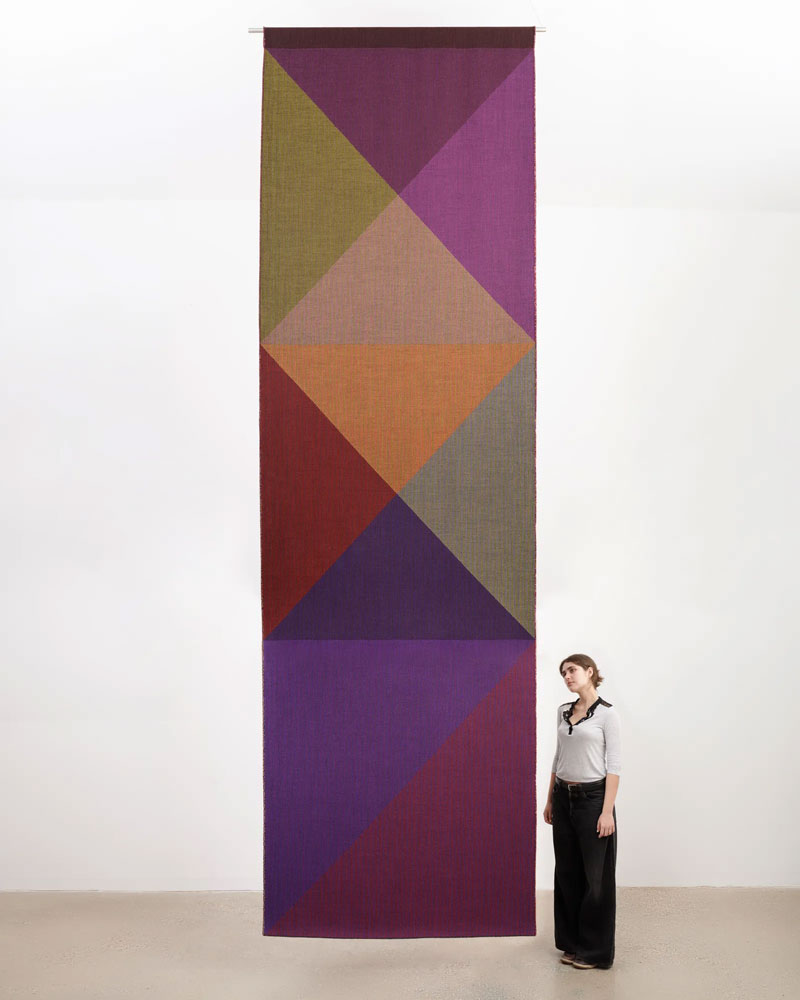
This idea is particularly evident in the large-scale wool tapestries installed in the first Gallery . Suspended from the ceiling and reaching almost five meters in height, the works transform the gallery into a vertical field of color. Composed of colored triangles, the tapestries extend Begum’s geometric language into a material traditionally associated with craft, domesticity and softness. Their monumental scale, however, gives the textile works an architectural presence.
The tapestries are produced in collaboration with textile studio Dash & Miller, continuing Begum’s interest in woven surfaces that began with her 2022 commission for Bristol Beacon. The artist’s involvement in the transformation of the concert venue led to a sustained exploration of how textiles could interact with architecture, colur and movement. In “Taking Form”, this research becomes more expansive. The works are woven using a ridging technique that creates a dual pattern, revealed differently as the viewer moves around the surface.
Movement is therefore integral to the experience of the tapestries. From one position, a particular arrangement of color and geometry becomes dominant; from another, the surface appears to reorganise itself. The work cannot be reduced to a single viewpoint. Color, texture and pattern remain in constant dialogue with the viewer’s position in the gallery.
Alongside the tapestries, Begum presents a group of works on paper that offers a more intimate investigation of color. Watercolor marks are reduced to a few delicate gestures, allowing individual hues to interact through transparency and proximity. Their pale, aqueous character creates a visual counterpoint to the density and scale of the woven works, while establishing a connection between the two bodies of work.
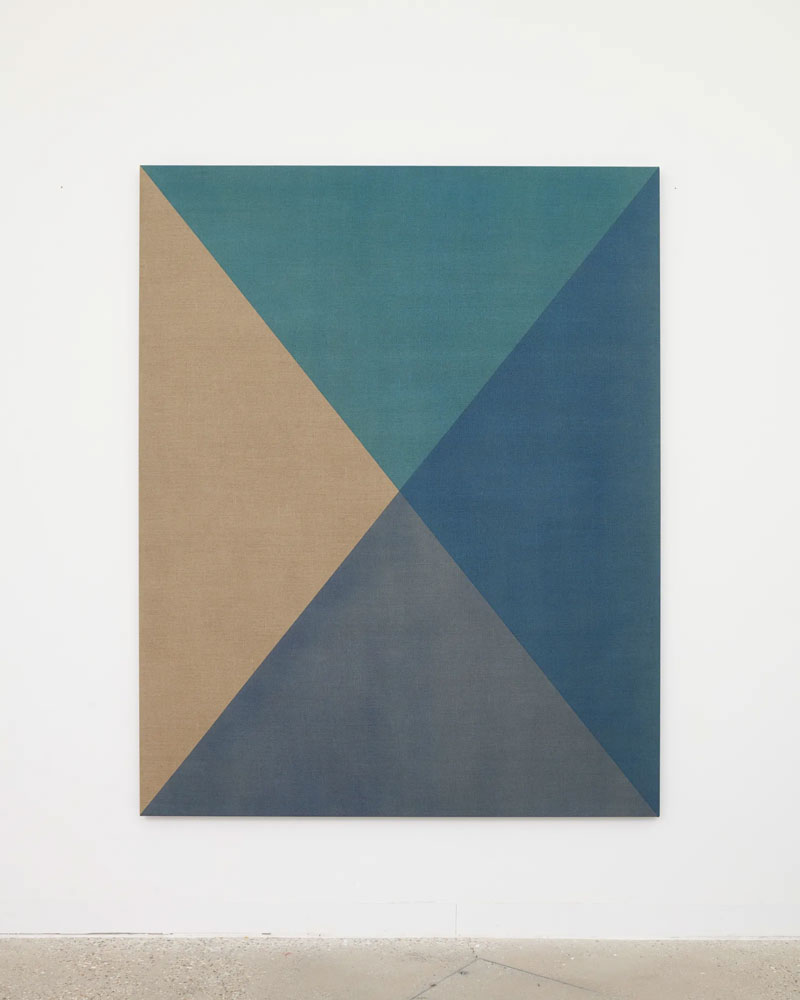
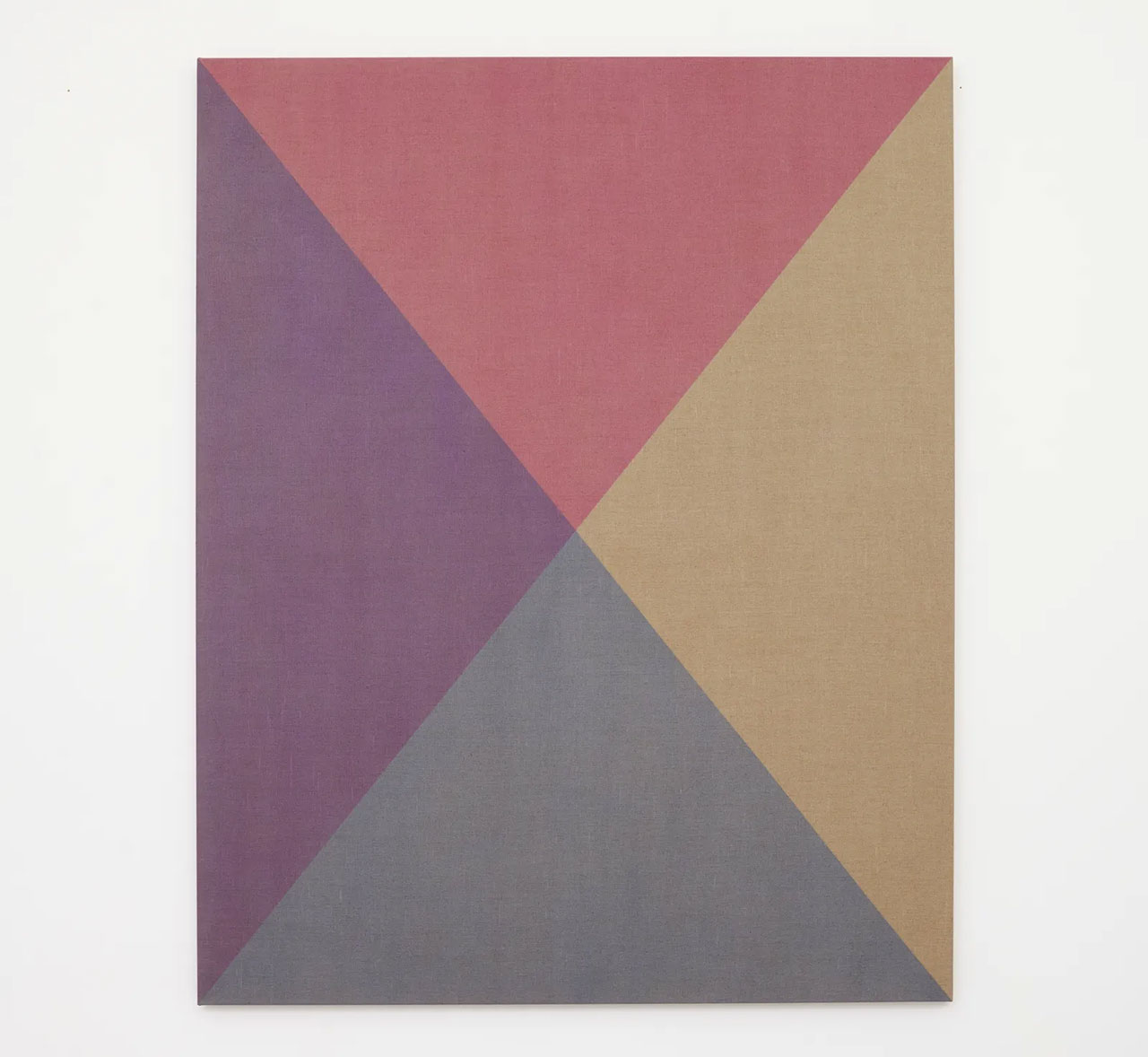
The transition from wool to paper is followed by a series of large-scale linen paintings in Gallery 2. Here, Begum continues her exploration of the relationship between colour and surface through layers of diluted acrylic paint. The natural tone and texture of the unprocessed linen become an active element within the composition. Rather than simply supporting the paint, the fabric absorbs it into its weave, altering the intensity and character of the color.
Overlapping triangles form the underlying structure of these works. Yet, as the diluted paint penetrates the linen, the geometry loses some of its rigidity. Forms appear, overlap and dissolve into one another, producing surfaces that seem to shift between geometric abstraction and atmospheric color. The materiality of the linen introduces an element of rawness, allowing the paintings to retain a sense of process.
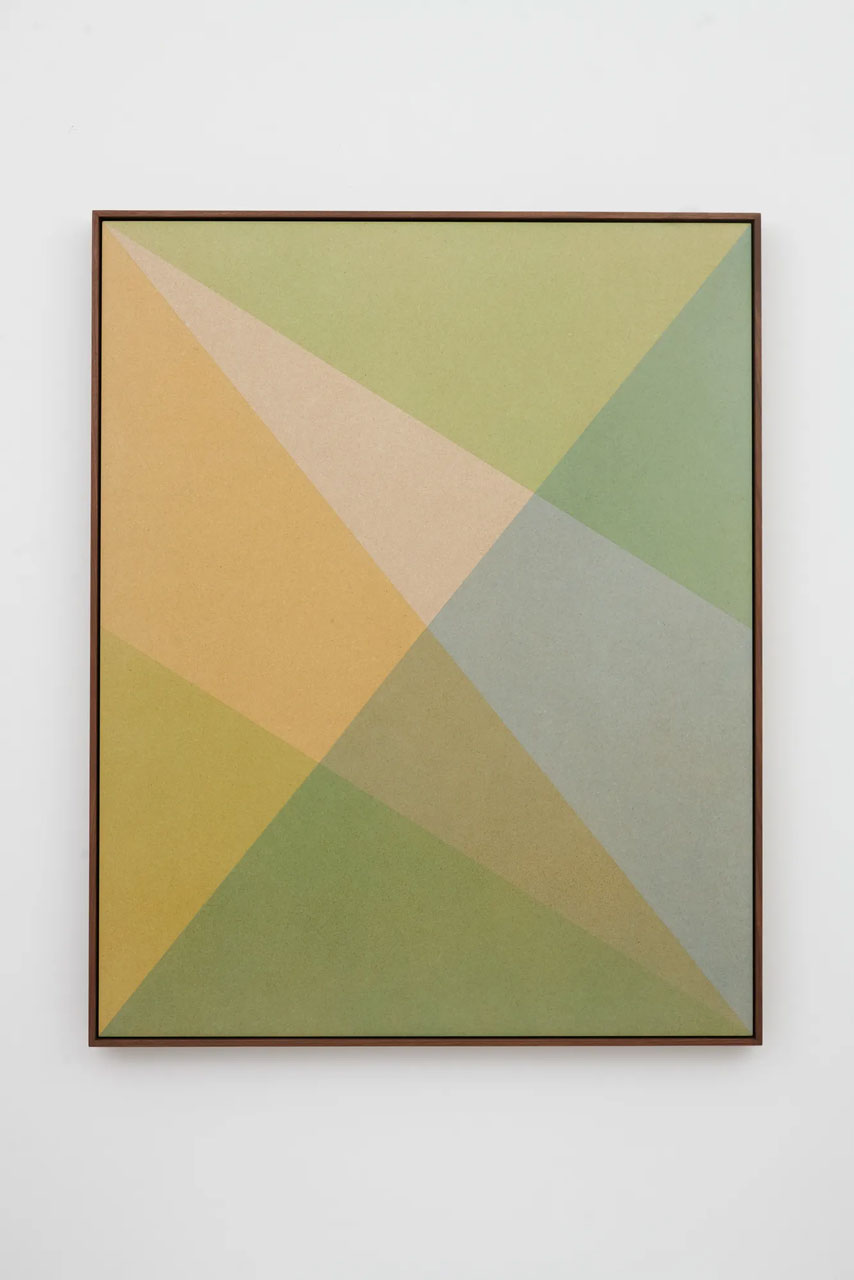
The wooden panel paintings presented alongside the linens offer a contrasting response to the same concerns. Their smooth surfaces hold the paint differently, creating a more consistent veil of colour. Smaller in scale, they punctuate the gallery with subtle changes in hue and density. Multiple layers accumulate gradually, allowing apparently pale colors to acquire greater intensity.
Together, the linen and wooden works create a luminous field across Gallery 2. Their differences in scale, texture and absorption demonstrate how strongly material influences Begum’s perception of color. The same chromatic language produces different visual effects according to the surface on which it is applied.
Light has been a central concern throughout Begum’s practice. Rather than treating it simply as an external phenomenon, she uses color, material and spatial relationships to make its effects perceptible. Her works change according to distance, movement and the surrounding environment. In “Taking Form”, this approach is extended through materials that absorb, diffuse and structure light in different ways.
The exhibition also reflects Begum’s continuing movement between art, architecture and craft. Wool, linen, wood and paper are not simply alternative supports; each introduces a different physical condition into the work. Weaving creates relief and rhythm, linen absorbs and softens color, wood provides a controlled surface, while paper allows color to remain transparent and fluid.
At the centre of these different approaches is Begum’s understanding of geometry as something open rather than fixed. Her forms may be contained within squares, rectangles or triangular configurations, but their patterns suggest that they continue beyond the edge. Repetition becomes a means of imagining expansion, while color and light prevent the geometry from becoming static.
“Taking Form” consequently represents a continuation rather than a departure in Begum’s practice. The move toward textiles and softer materials does not abandon the discipline of her earlier geometric abstraction. Instead, it expands it into a more tactile and spatial territory, where structure is experienced through surface, light and movement.
Photo: Rana Begum, No.1635, 2026, Acrylic paint on linen, 200 x 160 x 4 cm, © Rana Begum, Courtesy the artist and Third Line Gallery
Info: Third Line Gallery, Alserkal Avenue, Warehouse 78, Street 8, Al Quoz 1, Exit 43 off Sheikh Zayed Road, Dubai, UAE, Duration: 23/9-10/11/2026, Days & Hours: Mon-Sat 11:00-19:00, www.thethirdline.com/