PREVIEW:Dimitris Neveskiotis-We were never really here
Dimitris Neveskiotis is a visual artist based in Athens, working across sculpture, ceramics, and installation. His practice is deeply rooted in material research, with a particular focus on clay and earth-based processes. Drawing inspiration from ancient art, archaeology, and prehistorical forms, his work explores the relationship between matter, form, and memory, while reactivating historical references through a contemporary lens.
By Efi Michalarou
Photo: Kalfayan Galleries Archive
The Greek artist Dimitris Neveskiotis presents his first solo exhibition titled “We were never really here”, at Kalfayan Galleries in Athens. His work invites viewers into a complex, darkly humorous, and visually arresting universe where antiquity collides with modern anxieties. Born in Drama and having studied at the Athens School of Fine Arts, Neveskiotis embodies a creative trajectory that might seem expected, but is by no means a given: painter, sculptor, ceramicist. In this order, from his studies to the present day, these three identities mark the steps he has taken, ultimately arriving at the place from which he essentially began—painting. Although the practice with which he feels most at home is pottery, everything in his oeuvre leads back to the brush. It is no coincidence that he repeatedly describes his artworks as “ceramic canvases.”
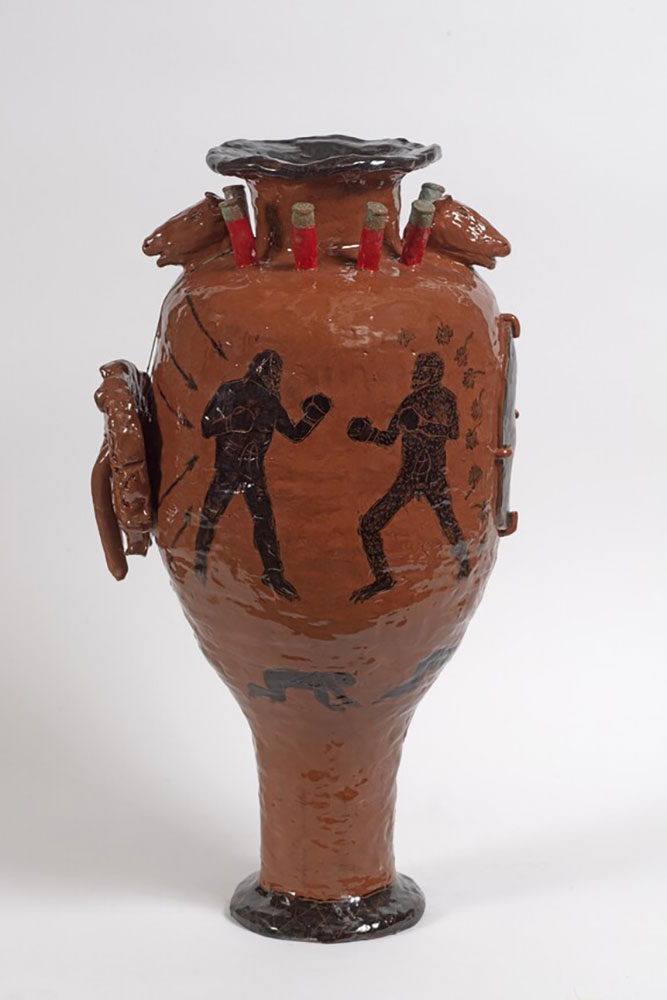
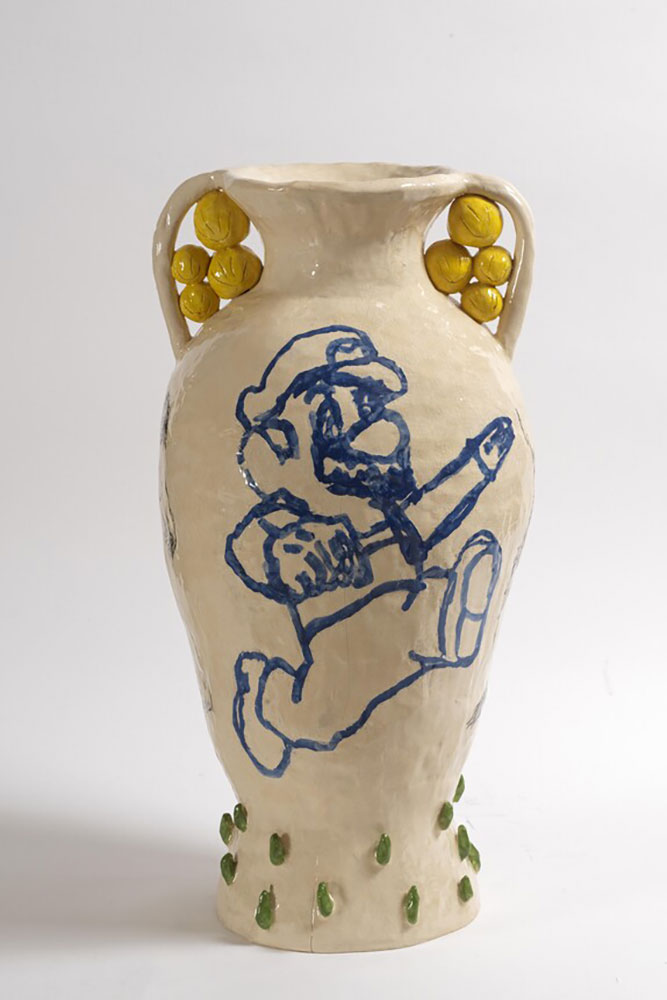
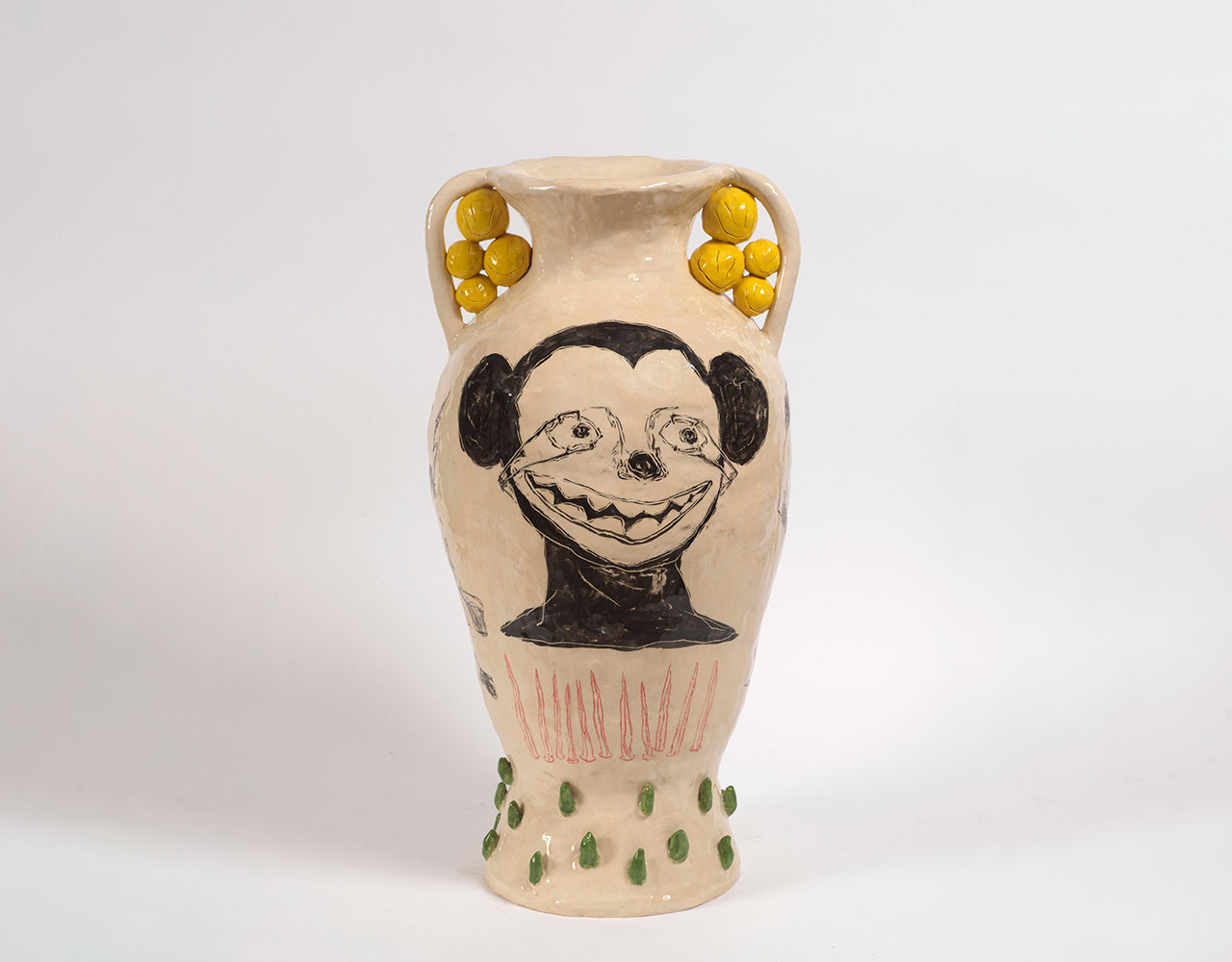
Neveskiotis’s vessels are much more than mere surfaces for painting; they possess their own distinct and often aggressive morphological particularities. Generally medium-sized, his works shift between white and black-figure designs, carrying clear references to the techniques of ancient cultures, extending beyond just the ancient Greek tradition.
However, these are not utilitarian objects. They are deliberately characterized by elements that render them entirely unsuitable for any kind of functional use. Jutting nails, thorns, raised protuberances, and sharp points emerge from their surfaces, giving the ceramics an intentionally “raw” and hostile image. These aggressive structural additions complement the intense iconography that unfolds across them, physically manifesting the tension in his visual narratives.
Upon these sharp, textured vessels, Neveskiotis composes palimpsests of narratives driven by caustic humor and socio-political commentary. The imagery is violent, strange, satirical, surreal, and erotic, yet above all, it is deeply anthropocentric. He populates his work with dark figures that evoke the earliest prehistoric cave paintings of Indonesia and France, while simultaneously drawing from contemporary pop culture and online gaming.
The result is a small human epic condensed into brief scenes of everyday madness. The artist introduces animals to amplify these themes: goats appear as prey, horses and birds as creatures roaming freely through nature, and lions as symbols of power and authority. This blending of elements leaves the viewer uncertain as to whether the anthropomorphic presences enacted on the clay are primordial cave dwellers or their modern-day counterparts.
Neveskiotis draws on a remarkable arsenal of ideas inspired by music and the distinct cinematic universes of directors like Stanley Kubrick, Pier Paolo Pasolini, Alejandro Jodorowsky, and Yorgos Lanthimos. Through these influences, he gives form to sit-uations that transcend reality: a flying saucer hovering beside newborn babies; a man boxing a lobster; a procession of submissive pilgrims advancing into the unknown; sirens and birds with human heads; alongside classical motifs like putti, flowers, and meanders.
His creative process is deeply intuitive. By creating a dialogue between digital and hand-drawn designs, these compositions usually emerge when the ceramic artworks—and occasionally flat ceramic slabs—have already come out of the kiln. Confronted with the fired clay, Neveskiotis works almost automatically and reflexively, responding to fleeting impulses. Through his brush parades a circus of half-civilized, strange beings that define his iconography, articulating his personal social concerns and political perspective.
Like a distorting mirror reflecting human history, the work of Dimitris Neveskiotis suggests that the umbilical cord connecting primordial communities with the modern age has never truly been severed. Confronted with the chaotic “rabble and disgrace” depicted on his vessels, the viewer is forced to ask a provocative question: has nothing truly changed over the centuries, from the origins of humankind to the present day? Or are we, despite our digital age and modern facades, simply living through renewed variations of the exact same species?
Photo: Dimitris Neveskiotis, It wasn’t meant to last, and yet it found a way to remain, 2026 , hand-painted clay, underglaze, glaze, 60 x 31 cm, Courtesy the artist and Kalfayan Galleries
Info: Kalfayan Galleries, 11 Haritos Stree, Kolonaki, Athens, Greece, Duration: 24/9-30/10/2022, Days & H/ours: Mon & Sat 11:00-15:00, Tue-Fri 11:00-19:00, https://kalfayangalleries.com/