PRESENTATION:Robert Rauschenberg-Important Early Works from the Cy Twombly Foundation
Following Abstract Expressionism, Robert Rauschenberg revolutionized postwar American art alongside contemporary Jasper Johns. Their groundbreaking approach was dubbed “Neo-Dada” because it bridged European avant-garde traditions with the bold, physical gestures of American abstraction. By incorporating everyday materials and ready-made objects into their work, they challenged traditional artistic boundaries and profoundly influenced the rise of Pop Art, Conceptual Art, and modern visual culture.
By Dimitris Lempesis
Photo: Gagosian Arcjve
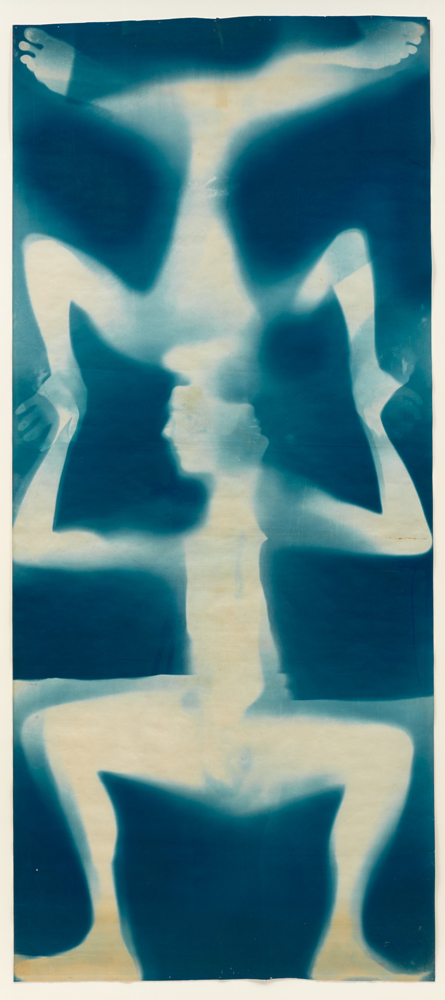
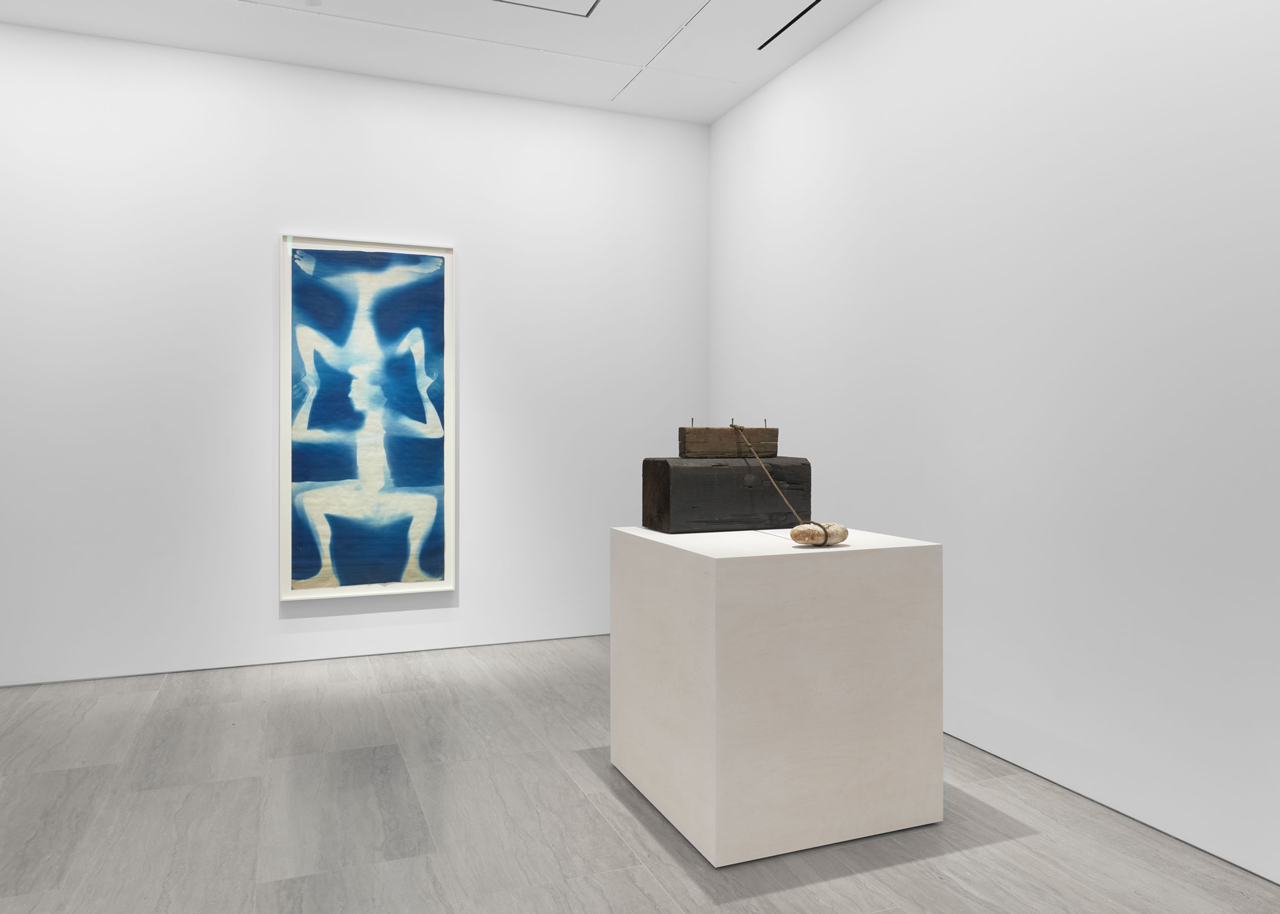
”Important Early Works from the Cy Twombly Foundation” is an exhibition of six important early works by Robert Rauschenberg from the Cy Twombly Foundation. Organized during the centennial of Rauschenberg’s birth. Rauschenberg and Twombly met in 1951 at the Art Students League of New York and subsequently attended Black Mountain College near Asheville, North Carolina, before traveling together throughout Italy, Morocco, and Spain in 1952 and 1953. Key milestones of Rauschenberg’s early development, the works from Twombly’s collection on view are especially significant given the close friendship and substantial exchanges of ideas that took place between the two artists. The exhibition features one of Rauschenberg’s earliest known surviving sculptures, an assemblage he made in 1950. Whereas much of his production of 1950–51 was lost, destroyed, or incorporated into new works, this sculpture was kept and preserved by Twombly. Also included is “Untitled| (1950), a life-size photogram that is among the most recognized of the blueprint works that Rauschenberg and Susan Weil made in collaboration shortly before they were married. “Untitled” (c. 1950) is a groundbreaking, monumental photogram created in collaboration with fellow artist and his then-wife, Susan Weil. This radical artwork captures a ghostly, life-sized silhouette of a human figure set against a striking backdrop of intense Prussian blue. To achieve this haunting imagery, the duo utilized a photographic method known as the cyanotype process. Working outdoors, they carefully laid out large sheets of light-sensitive blueprint paper, and Weil positioned her body directly on top. They held up portable lights to alter the exposure dynamically, casting shadows and burning white paths across the composition. Where the natural sunlight hit the paper directly, the chemical solution turned a rich blue; where her body or targeted light beams blocked the rays, the paper remained starkly white. Created shortly after their influential time experimenting at Black Mountain College, “Untitled” represents a monumental shift away from traditional canvas-bound paintings. The artwork challenges the boundaries of mid-century photography by scaling the medium to the size of a human body, eliminating the camera entirely, and introducing indexical performance into the visual arts. Long celebrated as a milestone of early American avant-garde experimentation, this collaborative monoprint is preserved as a permanent fixture within the collection of the Museum of Modern Art (MoMA) in New York.
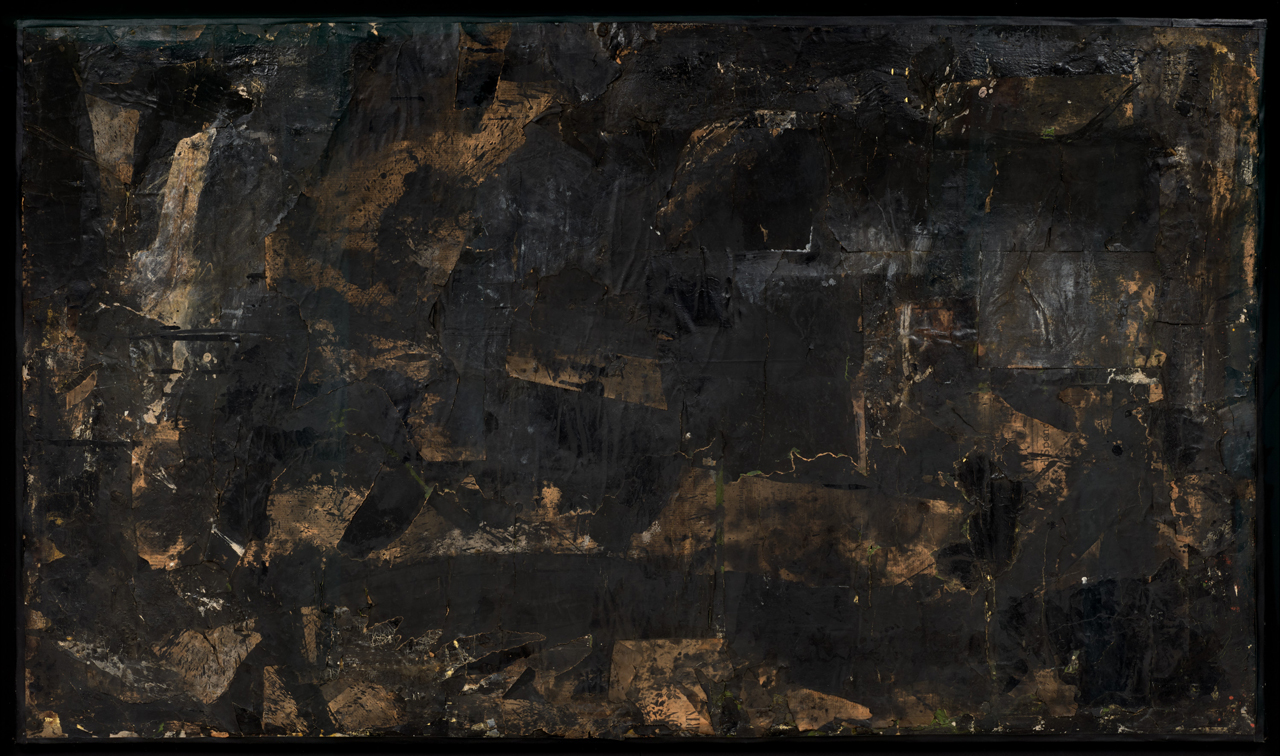
Additional pieces include key examples from the “Black Painting”, “Elemental Sculpture”, and “Combine” series. Together, they chart Rauschenberg’s engagement with Duchamp’s radical reconception of art making and his commitment to acting in the gap between art and life, while anticipating the incorporation of technology and performance into his practice. Robert Rauschenberg’s “Black Painting” series (1951–1953) is a definitive body of monochromatic work that bridges Abstract Expressionism and the birth of Pop art. Developed primarily at Black Mountain College and in New York, Rauschenberg produced these works concurrently with his famous “White Paintings”. He famously noted that he worked on both styles simultaneously so that “neither would be the answer.”. Unlike the flat, reflective fields of his “White Paintings”, the “Black Paintings” focus heavily on texture, material constraints, and the intersection of painting and collage. To create them, Rauschenberg attached torn sheets of salvaged newspaper directly onto single or multi-panel canvases, coating the assemblies in dense layers of matte or glossy black paint. The underlying newsprint forms an activated, uneven topography. In some areas, text and commercial advertisements remain subtly visible, while in others, they are completely engulfed by dark pigment. This series challenged the rigid color theories of his instructor, Josef Albers. More importantly, it served as an essential laboratory for Rauschenberg’s iconic “Combines,” introducing the everyday world directly onto the canvas surface.
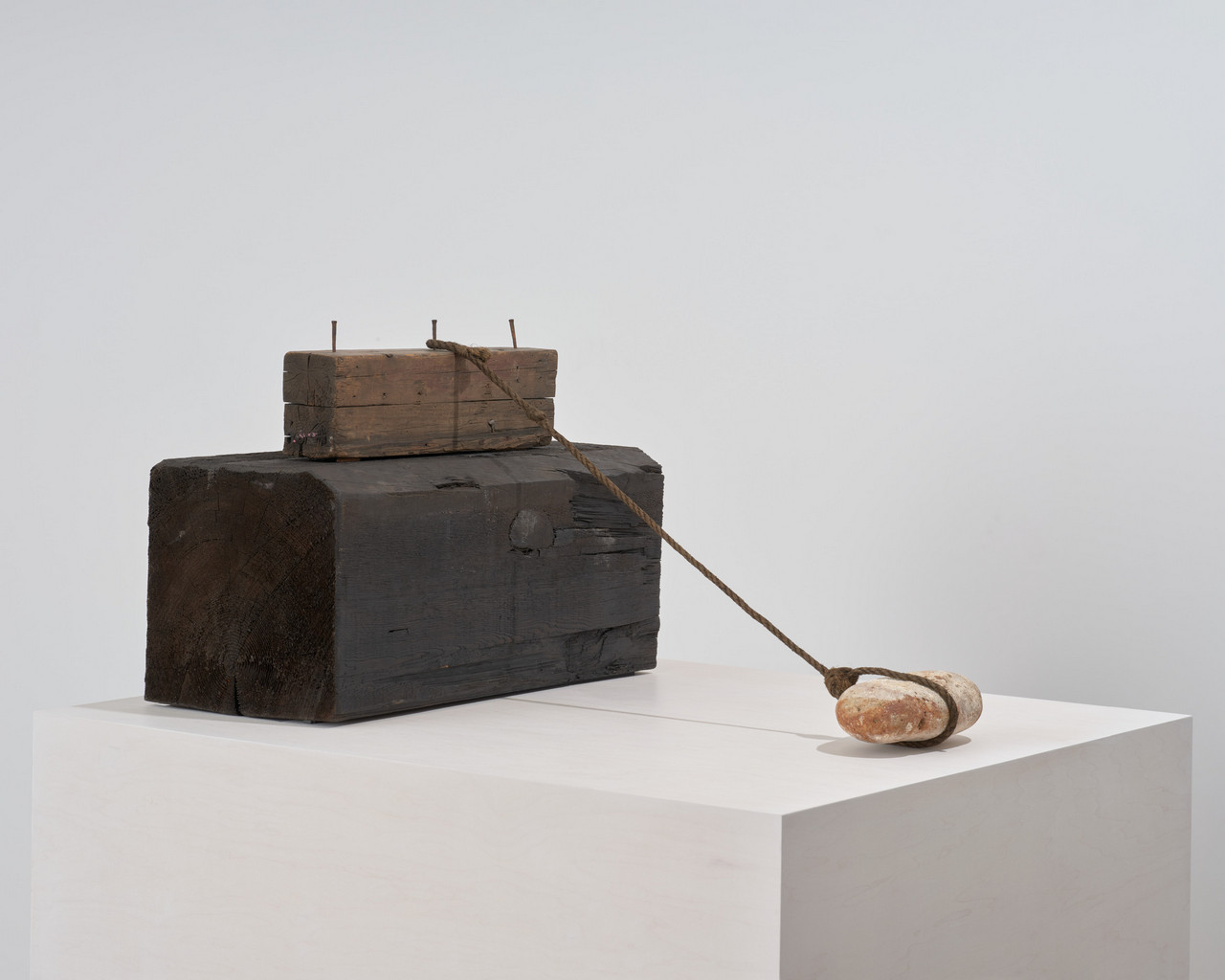
Robert Rauschenberg’s “Elemental Sculpture” series (1953–c. 1955) represents a foundational moment in the history of assemblage. Conceived in his Fulton Street studio following an informative journey through Europe and North Africa with Cy Twombly, this collection of nineteen small works—of which only nine survive—radically strips down the traditional definitions of three-dimensional form. Rather than carving or sculpting raw materials, Rauschenberg relied entirely on scavenged detritus collected from construction sites around mid-century Manhattan. He combined unembellished, heavily weathered items like rusted steel straps, iron spikes, twine, bricks, and ordinary stones. He allowed these items to arrange themselves naturally, highlighting the inherent weight, tension, and texture of the everyday world. Crucially, these works rejected the idea of a fixed composition. Many contained adjustable components or lacked a definitive base, inviting viewer interaction and variable orientations. For example, in Music Box, loose stones placed inside a nail-lined wooden crate generate variable sounds when shifted. By elevating abandoned proletarian materials to the status of fine art without decorative alteration, the series laid the conceptual groundwork for his legendary “Combines” and presaged the emergence of Minimalism.
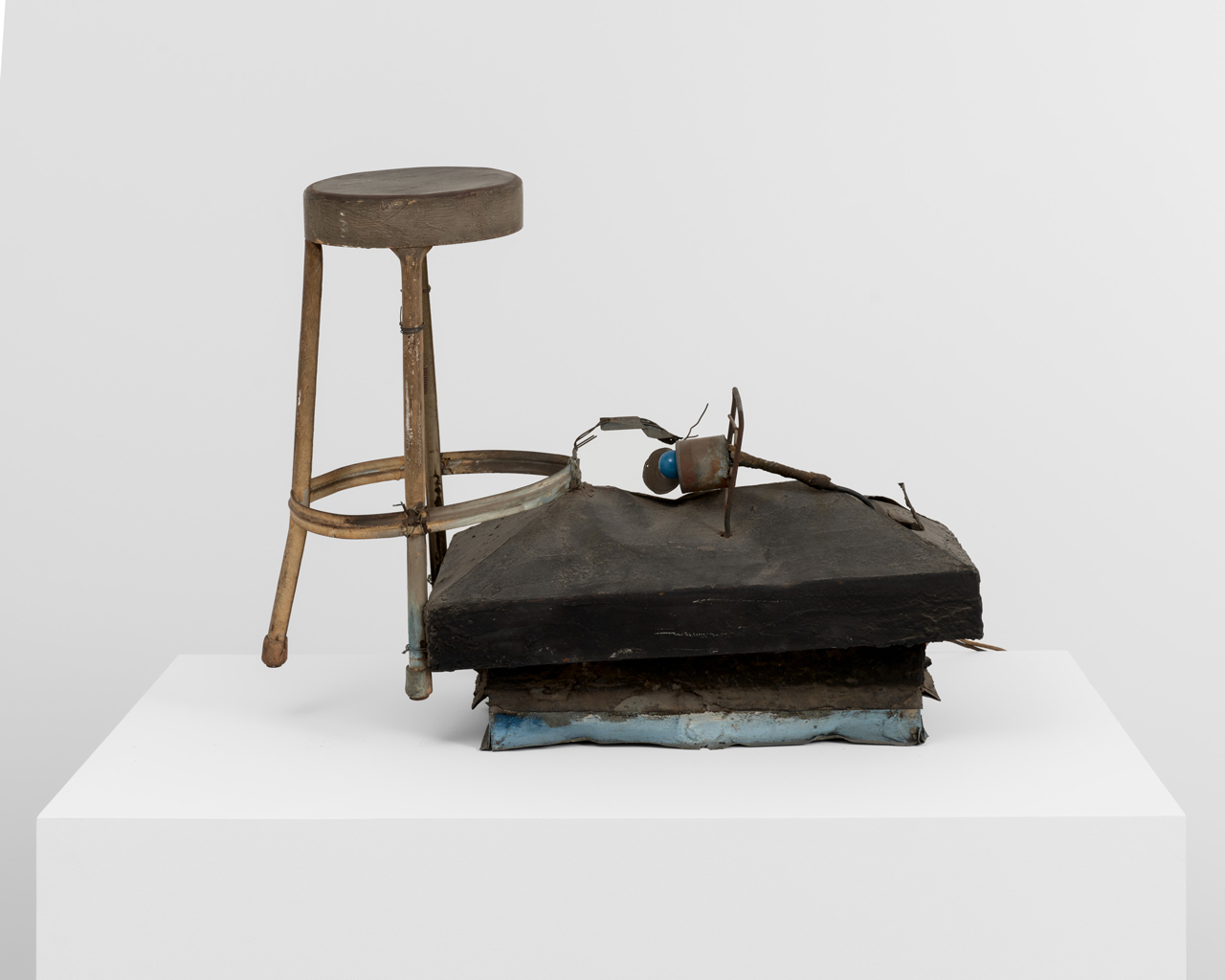
Robert Rauschenberg’s “Combine” series (1954–1964) is a groundbreaking body of work that permanently dismantled the boundaries between painting and sculpture. Coining the term “Combine” to describe artworks that were neither purely one nor the other, Rauschenberg famously stated that he wanted to operate in the gap between art and life. To achieve this, he attached real-world objects directly onto painted canvas surfaces. He utilized an astonishing array of scavenged urban detritus, including rubber tires, street signs, pillows, wood, and even taxidermy animals. Works like “Bed” (1955)—where he splashed paint across his own quilt and pillow—and “Monogram” (1955–1959)—featuring a stuffed Angora goat encircled by a tire—shocked the mid-century art world. By integrating these disparate, mass-produced items with messy, gestural Abstract Expressionist brushwork, Rauschenberg challenged the elitism of fine art. The series introduced everyday consumer culture into gallery spaces, directly paving the way for the Pop Art movement. Ultimately, the Combines redefined artistic production by proving that any ordinary object could serve as a powerful medium for fine art.
Photo: Robert Rauschenberg, Untitled, 1961, Metal, wire, tin can, electric cord, and light bulb with stool, 27 × 34 × 15 inches (68.6 × 86.4 × 38.1 cm), © 2026 Robert Rauschenberg Foundation/Artists Rights Society (ARS), NY, Photo: Owen Conway, Courtesy Gagosian
Info: Gagosian, 974 Madison Avenue, New York, NY, USA, Duration: 25/4-26/9/2026, Days & Hours: Mon-Fri 10:00-18:00, https://gagosian.com/
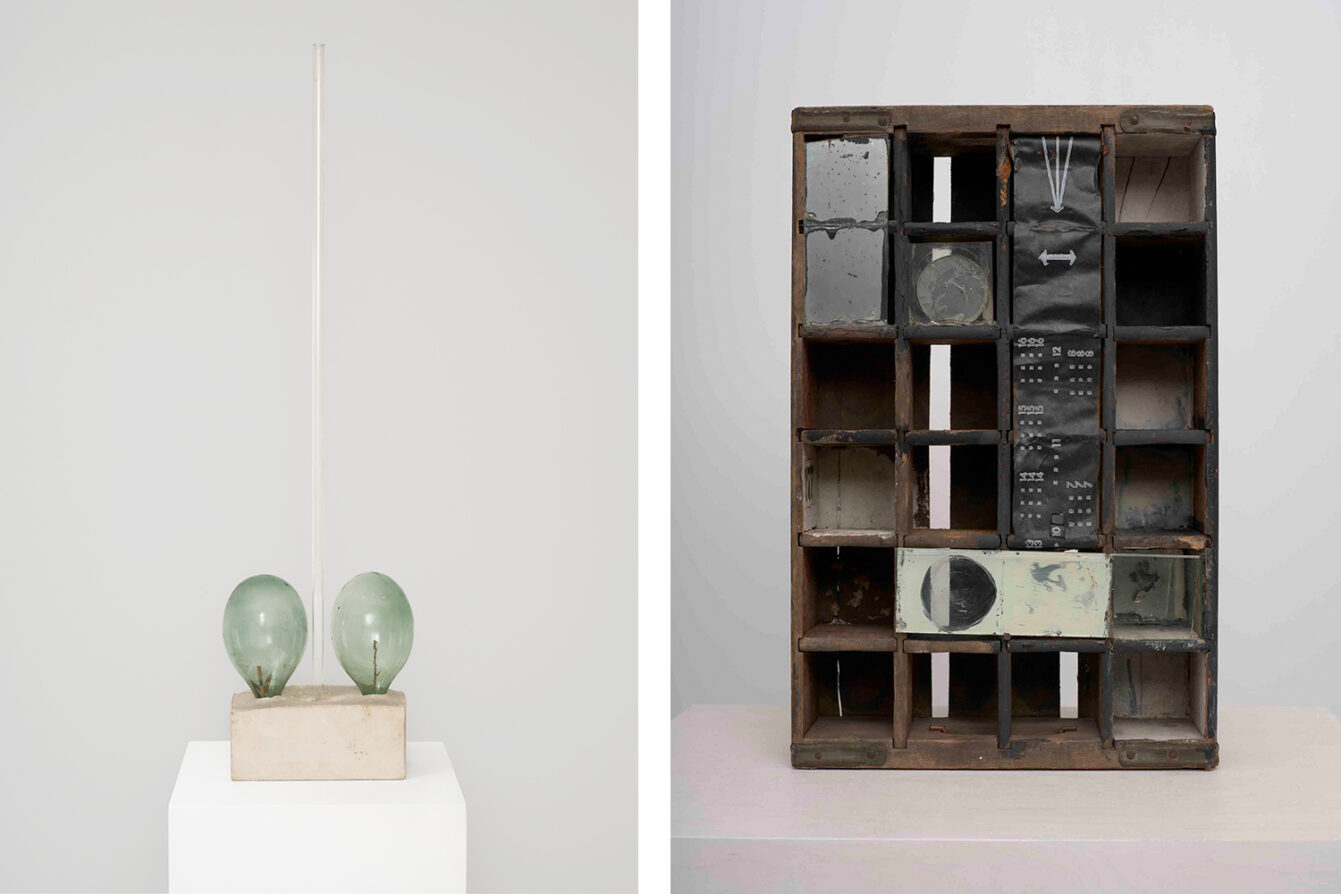
Right: Robert Rauschenberg,, Title unknown, 1950, Glass bottles, twig, and arrow fletching in plaster with glass tube, 47 1/4 × 12 3/8 × 5 3/4 inches (120 × 31.5 × 14.7 cm), © 2026 Robert Rauschenberg Foundation/Artists Rights Society (ARS), NY, Photo: Owen Conway, Courtesy Gagosian