PRESENTATION:This is (Not) Conceptual Art
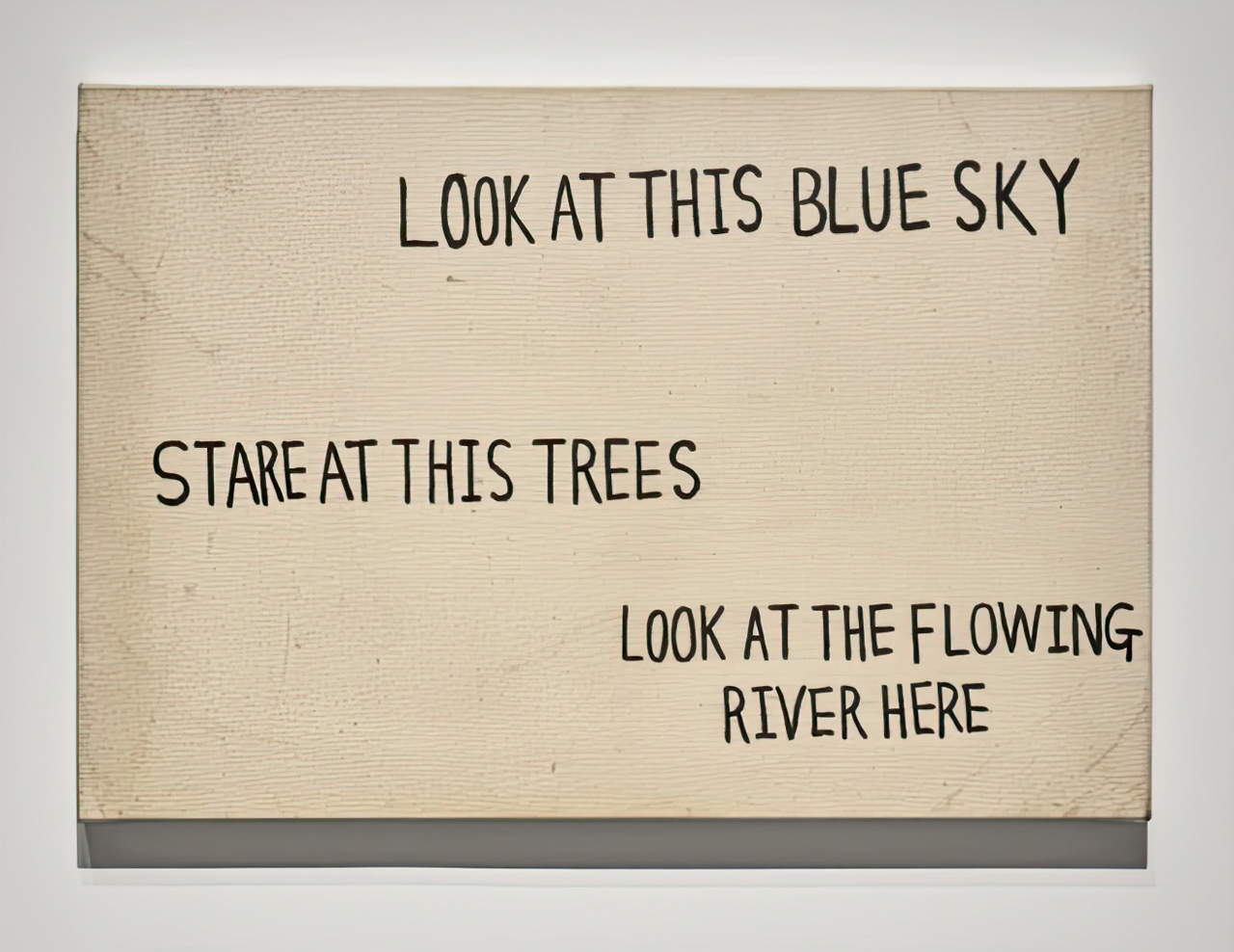
Conceptual art” is generally understood as art that emphasizes the artist’s ideas or concepts over the outward appearance or material form of an artwork. In the late 1960s, conceptual art reintroduced the element of language, which had largely been excluded from the visually oriented discourse of modernist painting. It came to be recognized as a form of art that posed fundamental questions about the nature of “art” itself while encouraging linguistic thought and philosophical speculation. An important shift ushered in by conceptual art was the transition of art’s focus away from visually perceived objects and toward language and thought.
By Efi Michalarou
Photo: MMCA Archive
The exhibition “This is (Not) Conceptual Art” presents a critical reexamination of Korean contemporary art, tracing the historical pivot from an object-centered discourse to a language-centered one. Moving beyond formalist paradigms, Korean artists beginning in the 1970s embarked on rigorous intellectual experiments to interrogate the fundamental essence, function, and limits of the artistic object. While the linguistic and logical explorations of the 1970s and 1980s served as an internal critique of art’s ontology, practices from the 1990s onward transformed conceptualism into a vital social methodology—an attitude for interrogating political, economic, and cultural realities through language, systems, and institutional critique.
This transformation aligns with a broader shift in global art history. The long-standing canon of Western conceptual art—traditionally centered on North American and Western European dematerialization—has gradually yielded to the paradigm of global conceptualism. This framework recognizes that conceptual strategies emerged independently and simultaneously across regions like Latin America, Eastern Europe, and Asia, strictly tied to localized socio-political struggles. Within this expanded narrative, Korean conceptual art demands to be evaluated not as a derivative reflection of Western movements, but as a distinct response to the country’s rapid modernization, authoritarian regimes, global diaspora, and economic shifts.
By probing historical vernaculars such as gaenyeom misul (conceptual art), gaenyeomjeok misul (conceptually oriented art), and gaenyeomjuui (conceptualism), the exhibition rejects a single, monolithic definition. The deliberate ambiguity in the title, This is (Not) Conceptual Art, frames conceptualism not as a closed, reductive stylistic movement, but as an open, heterogeneous field of practices operating across diverse media, contexts, and intentions.
Critique in an Era of Overabundance: In a contemporary age shaped by hyper-capitalism, rapid technological acceleration, and ecological distress, traditional modes of artmaking—those reliant on static, visible forms and material accumulation—face intrinsic limitations. Reexamining historical conceptual practices offers contemporary audiences unfamiliar pathways of thought. Stripping away the primacy of the physical object forces a confrontation with the systems of value, visuality, and market consumption that govern modern life.
Rather than treating conceptualism merely as a neat historical timeline of dematerialization, the exhibition is organized around four thematic chapters: “Language, Logic, Performance,” “Objects and Language,” “Mapping and Measuring,” and “Manipulators of Signs.” These sections map out how Korean artists mobilized language, spatial logic, systems of measurement, and mass media to continuously reconceptualize human existence and the surrounding world.
Language, Logic, Performance: Performance and temporal actions occupy a central position in conceptual practice because they resist physical ownership and permanent preservation. By shifting the artwork from a physical commodity to an experiential event, performance foregrounds process over product.
During the 1970s and 1980s, Korean artists systematically assigned linguistic logic to bodily acts. Lee Kun-Yong pioneered the “Event-Logical” approach, where repetitive, highly controlled physical gestures were executed under pre-established rules, stripping away personal expression or emotional spontaneity. Parallel to this, the Space & Time Group (ST)—including artists like Kim Yongmin, Sung Neung Kyung, and Yoon Jin Sup—transformed mundane, daily routines into structured events through strict logical parameters. These actions sought to examine the world not through sensory aesthetic indulgence, but as an interconnected system of ideas.
Subsequent generations expanded this conceptualization of the body through diverse approaches. Kyojun Lee staged photographic series exploring the geometric conditions of the frame, manipulating body positions to question the visual dynamics between seeing and being seen. Kim Soungui engaged with post-1960s immateriality through natural, everyday performances like IL-KI (Journal), and used action scripts derived from randomly selected texts in Space Time 1975 to link language, action, and spatiotemporal structures. Hong Myung-Seop developed floor-based installations in the 1980s that deconstructed the visual supremacy of traditional painting, compelling the viewer to experience art through tactile walking and physical engagement. Meanwhile, Cody Choi redefined the body as a symbolic energy system by repeatedly placing himself within enclosed boxes for timed durations, transforming systemic body constraints into a metaphor for the fragmented identity of the diasporic subject.
Objects and Language: Korean conceptual art rarely abandoned physical materials entirely in favor of abstract text; instead, it thrived at the unstable intersection where linguistic concepts clash with physical forms. Artists from the 1970s through the 1990s exposed the fragile, arbitrary relationship between physical objects and the words used to label them.
Artists such as Kim Beom, Bahc Yiso, Ahn Kyuchul, U Sunok, and Chung Seoyoung systematically undermined society’s faith in language as a stable descriptor of reality. By stripping objects of their practical functions and applying poetic subversion, absurd instructions, or dry humor, their works render the everyday unfamiliar. Furthermore, erasure and wordplay became powerful tools for artists like Choi Byungso, Lee Seung-taek, and Kim Soungui, who used blacked-out text and erased script not to indicate a vacuum of meaning, but to liberate language from fixed definitions and open up silent, infinite possibilities.
This thematic section also investigates how the relationship between objects and language deepens through animistic and cross-cultural lenses. Park Hyunki and Kim Beom infused their work with a hylozoist imagination—treating non-human objects, such as stones, as sentient presences capable of listening or responding to language, thereby dismantling anthropocentric worldviews. Simultaneously, artists like Bahc Yiso, Cody Choi, Kim Sora, and Gimhongsok navigated cultural translation, using hybrid, incomplete vocabularies to expose translation errors, miscommunication, and the productive gap between established cultural definitions.
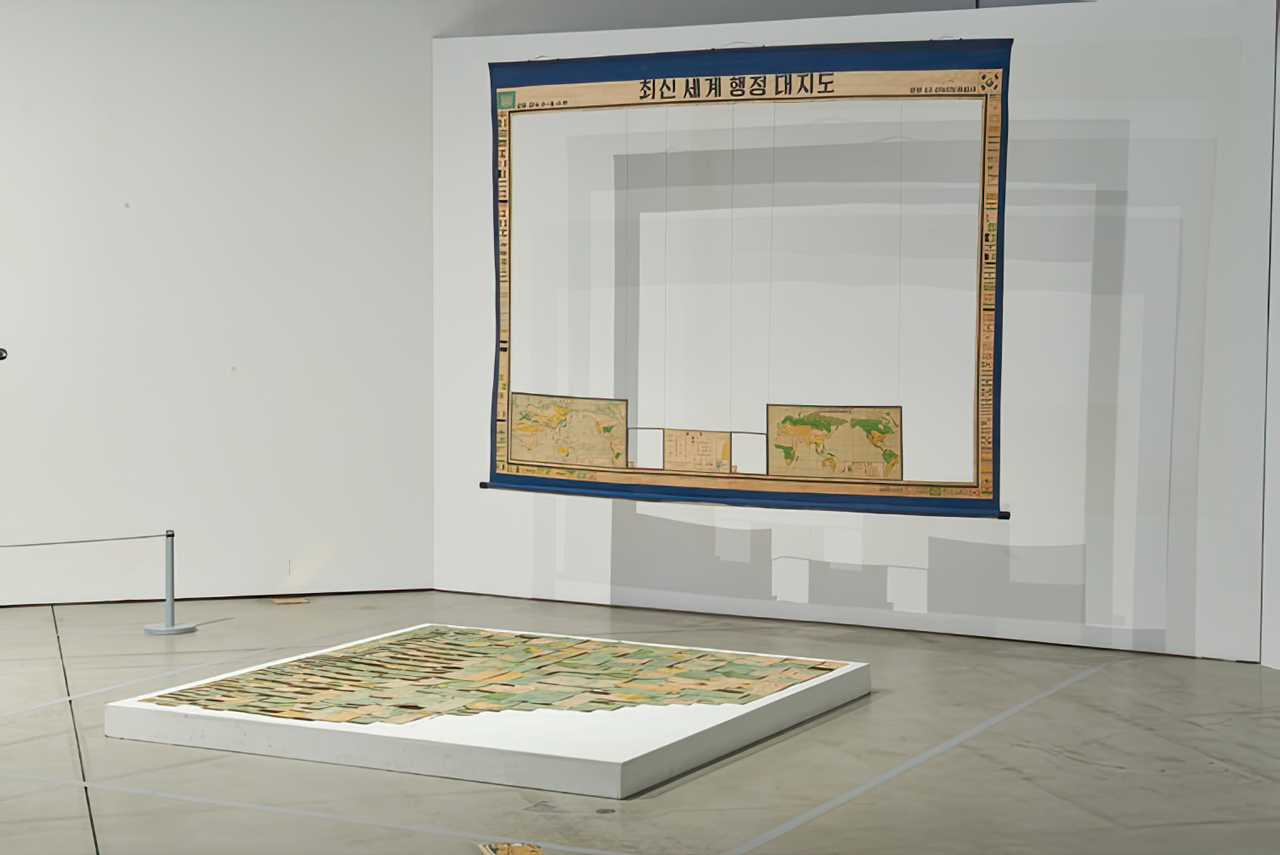
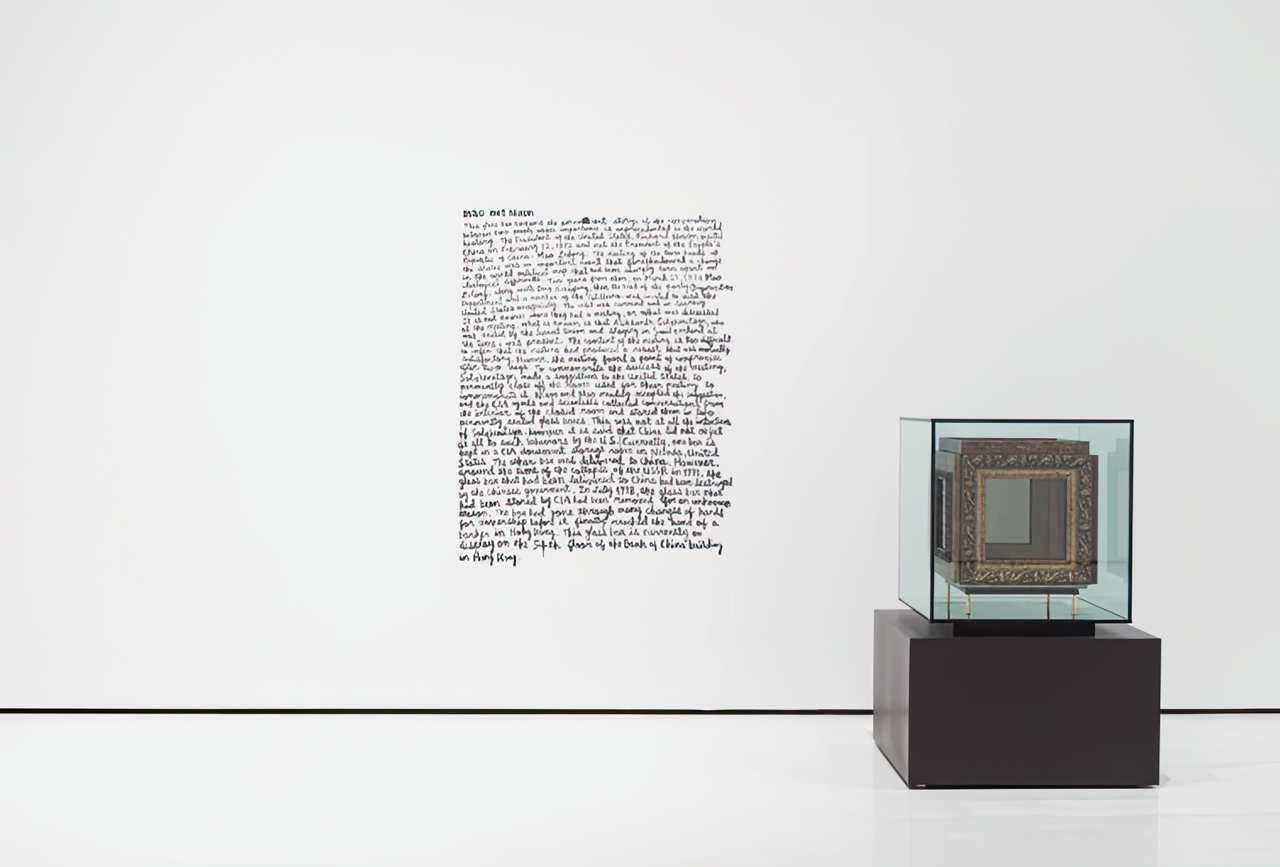
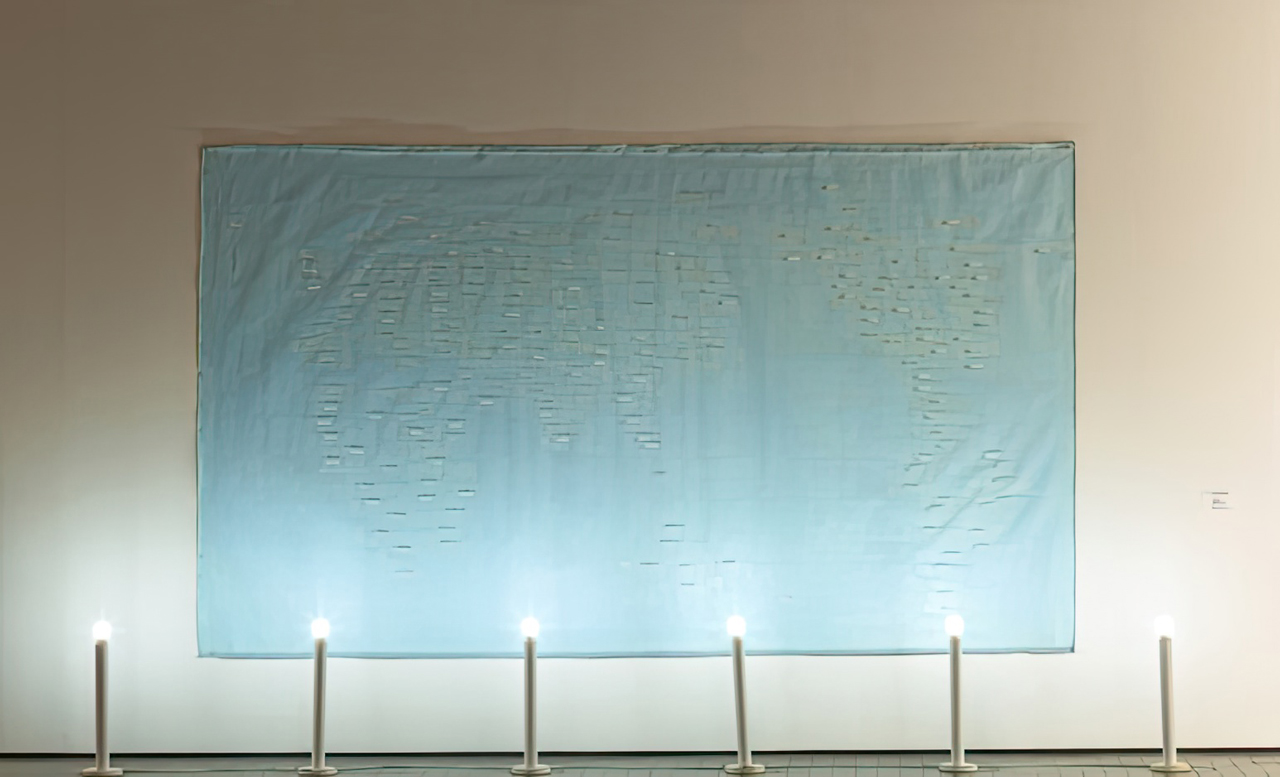
Mapping and Measuring: Standardized systems of order—such as maps, clocks, coordinates, and scales—are typically accepted as neutral, objective tools for organizing the world. This section demonstrates how Korean contemporary artists since the 1970s interrogated the underlying political biases of these systems. Maps enforce geopolitical centers and peripheries, while measuring tools establish arbitrary social standards and hierarchies.
Artists including Kwak Duckjun, Tchah-Sup Kim, Bahc Yiso, Sung Neung Kyung, Inhwan Oh, and Lee Kun-Yong systematically subverted these rational metrics. Sung Neung Kyung famously dissected a printed world map into hundreds of uniform fragments along lines of latitude and longitude, reassembling them horizontally without hierarchy into an unreadable grid. The resulting abstraction reveals that cartographic orientation is an arbitrary historical construct rather than an objective truth.
For artists living across borders or enduring diasporic conditions—such as Zainichi Korean artist Kwak Duckjun or Korean-American artist Tchah-Sup Kim—these standardized systems felt restrictive. By turning clocks inside out, altering scales, or inverting maps, they expressed the dislocation of dual identities, deconstructing rational systems to reveal spaces omitted from official maps and challenging the arbitrary division between center and margin.
Manipulators of Signs: In modern society, information circulates endlessly through newspapers, mass media, advertising, and statistics. The artists featured in this final section position themselves as manipulators of signs. Rather than creating entirely new images, they intervene directly in existing mass-produced media, editing, recontextualizing, and redacting circulating symbols to expose hidden power structures.
Kim Yong-ik, Kim Yongchul, Gimhongsok, Sung Neung Kyung, Jo Kyoungsook, and Joo Jaehwan deleted text from newsprint or rearranged corporate symbols, exposing how media messages are manipulated by institutional authority. In a similar vein, Jo Kyoungsook and Yoon Dongchun appropriated advertisement imagery and juxtaposed text with everyday images to critique consumer culture and gender stereotypes. Kim Yong-ik engaged in self-reflexive erasure, blotting out and recompiling his own previous artworks to highlight the emptiness of formal artistic signifiers.
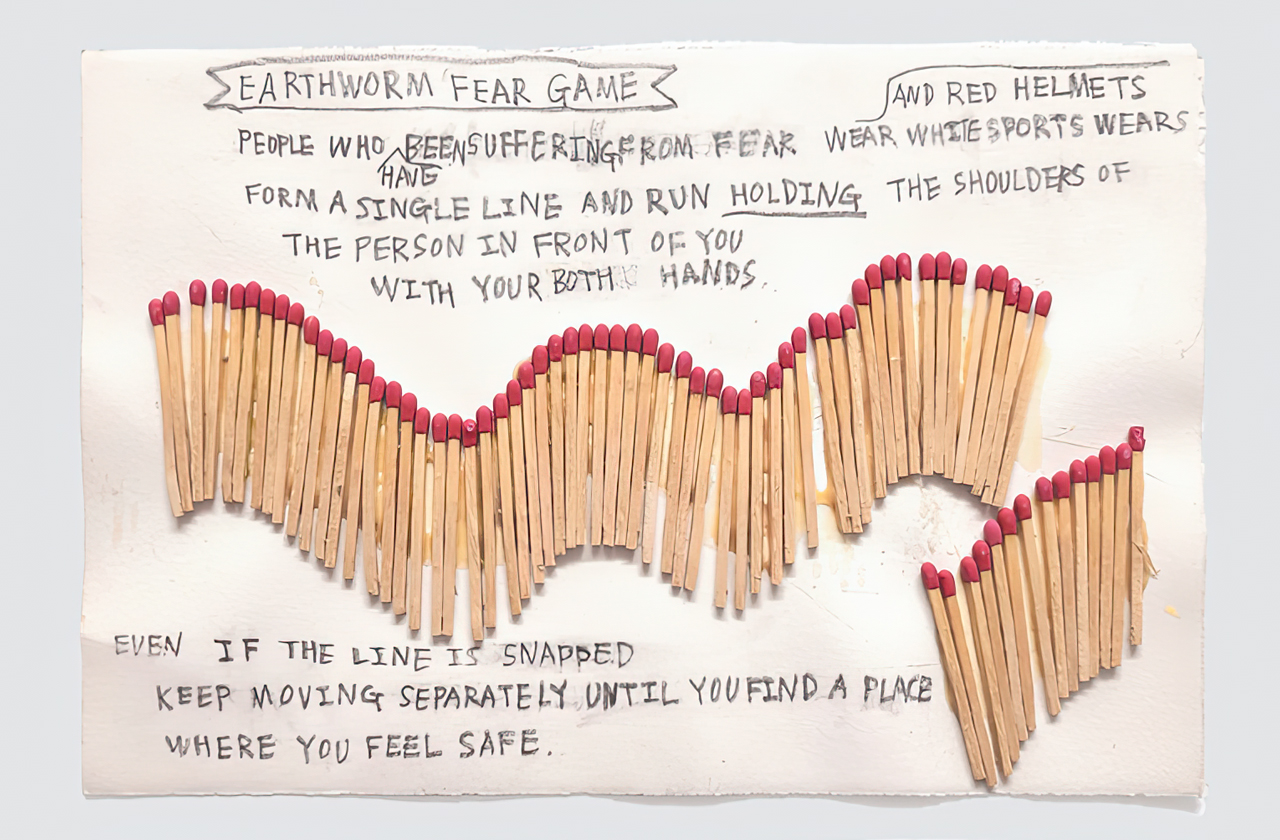
Finally, artists such as Kim Kulim, Tchah-Sup Kim, Yoon Dongchun, and Inhwan Oh circumvented traditional galleries altogether, utilizing postal mail networks and advertising spaces to circulate art. By distributing their work outside the physical museum, they forged new public spheres and expanded art into an active cultural practice that disrupts the everyday flow of signs.
Participating Artists: Ahn Kyuchul, Bahc Yiso, Choi Byungso, Chung Seoyoung, Cody Choi, Gimhongsok, Hong Myung-Seop, Inhwan Oh, Jo Kyoungsook, Joo Jaehwan, Kim Beom, Kim Kulim, Kim Sora, Kim Soungui, Kim Tchah-Sup, Kim Yong-ik, Kim Yongchul, Kim Yongmin, Kong Sunghun, Kwak Duckjun, Kyojun Lee, Lee Kun-Yong, Lee Seung-taek, Park Hyunki, Sung Neung Kyung, U Sunok, Yoon Dongchun, Yoon Jin Sup
Photo: Bahc Yiso, Wide World Wide, 2003, Acrylic and oil paints, light fixture, paper label on canvas, 265 × 510 × 25 cm. Leeum Museum of Art Collection. Courtesy of Leeum Museum of Art
Info: National Museum of Modern and Contemporary Art, Korea (MMCA), 30 Samcheong-ro, Jongno District, Seoul, South Korea, Duration: 19/6-11/10/2026, Days & Hours: Mon-Tue, Fri & Sun 10:00-18:00, Thu & Sat 10:00-21:00, www.mmca.go.kr/
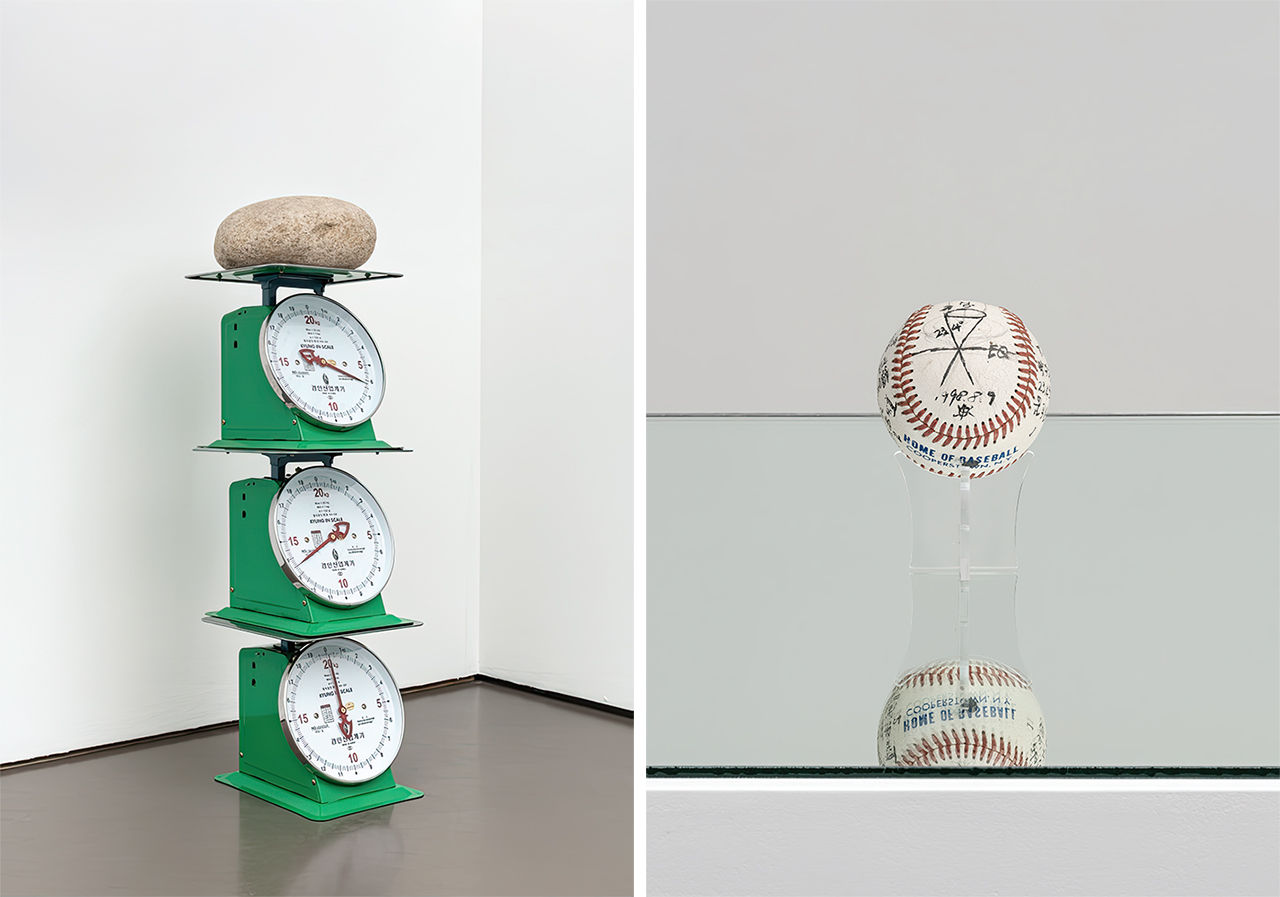
Right: Tchah-Sup Kim, Earth Axis Movement, 1998, Marker on baseball, 0 7.2 cm. Artist’s Estate Collection, Courtesy of Gallery Hyundai