PRESENTATION: Adrián Villar Rojas-First Gods, Lost Animals
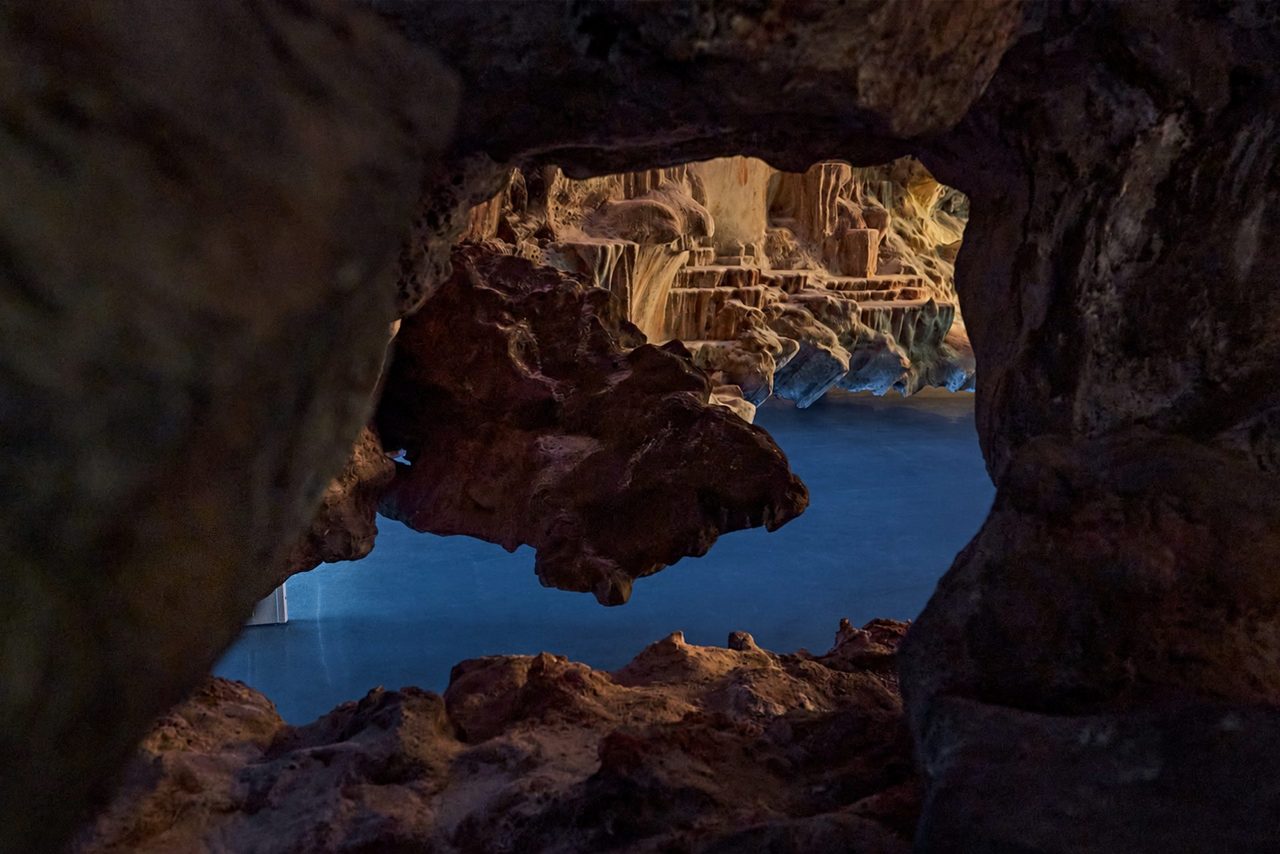
Adrián Villar Rojas lives and works nomadically. Villar Rojas conceives long term projects, collectively and collaboratively produced, that take the shape of large-scale and site-specific installations, both imposing and fragile. Within his research, which mixes sculpture, drawing, video, literature and performative traces, the artist explores the conditions of a humanity at risk, on the verge of extinction or already extinct, tracing the multi-species boundaries of a post-anthropocene time folded in on itself, in which past, present and future converge.
By Efi Michalarou
Photo: Aspen Art Museum Archive
credits: photographed by Jörg Baumann
For more than two decades, Adrián Villar Rojas has occupied a singular position in contemporary art. His installations resist easy categorization, moving freely between sculpture, architecture, archaeology, speculative fiction, and environmental intervention. Rather than producing autonomous objects, the Argentine artist constructs immersive worlds where geological time, evolutionary history, mythology, and technology collapse into one another. His latest exhibition, “First Gods, Lost Animals” at the Aspen Art Museum, continues this ambitious trajectory, transforming the museum into a vast speculative landscape where humanity’s earliest symbolic gestures encounter the computational systems shaping the twenty-first century. At first glance, the exhibition appears to revolve around caves. Yet Villar Rojas is less interested in archaeology than in the conditions that first allowed humans to think symbolically. The prehistoric cave becomes neither an historical monument nor a romantic image of humanity’s origins, but a conceptual device through which the artist examines how knowledge is produced, preserved, and continually reinvented. In this sense, the exhibition proposes that mythology, religion, mathematics, museums, and artificial intelligence belong to the same lineage: each is a technology developed to help finite human minds navigate an immeasurably complex world.
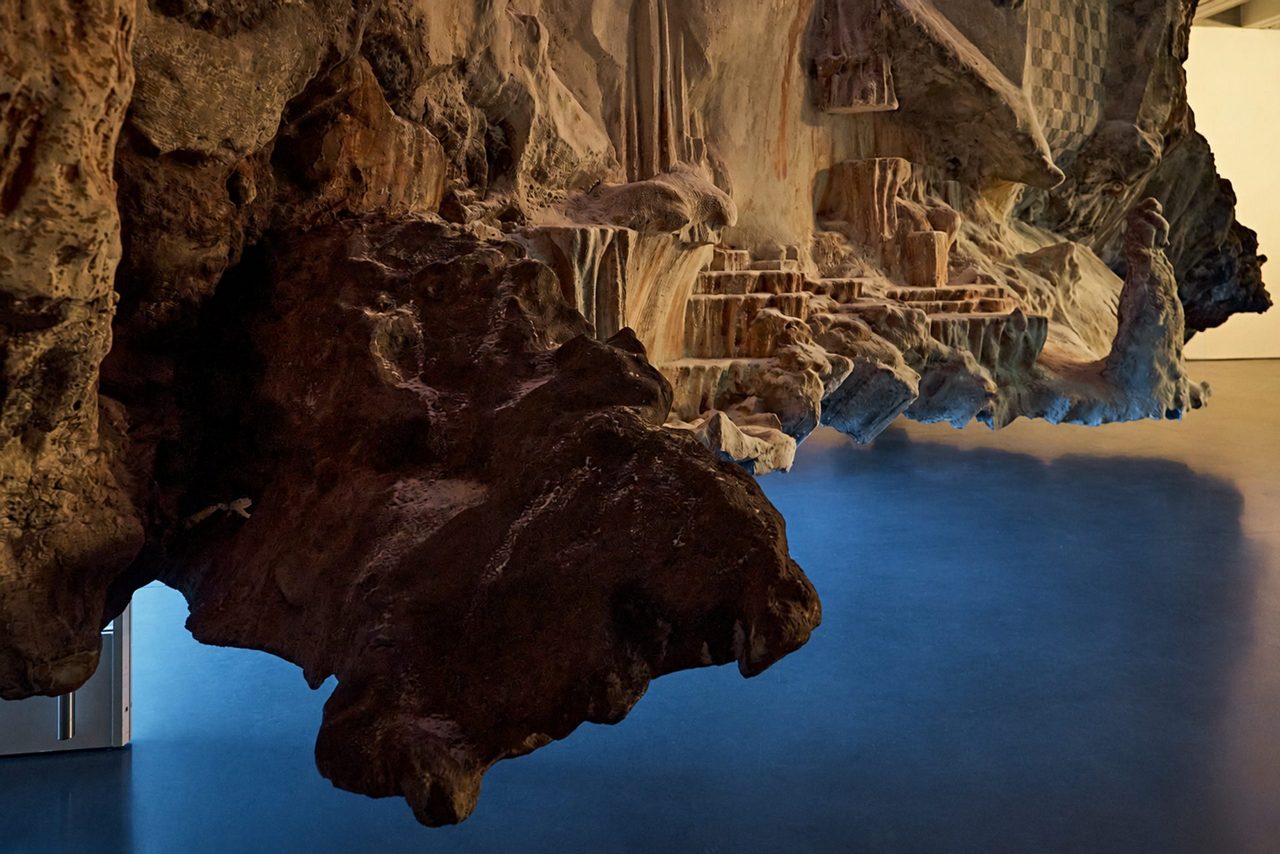
Occupying both floors of the Aspen Art Museum, the exhibition unfolds as a single continuous environment. The architecture itself becomes part of the artwork, dissolving the conventional separation between exhibition space and exhibited object. Visitors do not simply observe sculptures; they move through an ecosystem in which light, circulation, atmosphere, and spatial disorientation become essential elements of the experience. This holistic approach has become characteristic of Villar Rojas’s practice, where exhibitions function less as collections of individual works than as total environments that question the institutional frameworks through which art is encountered.
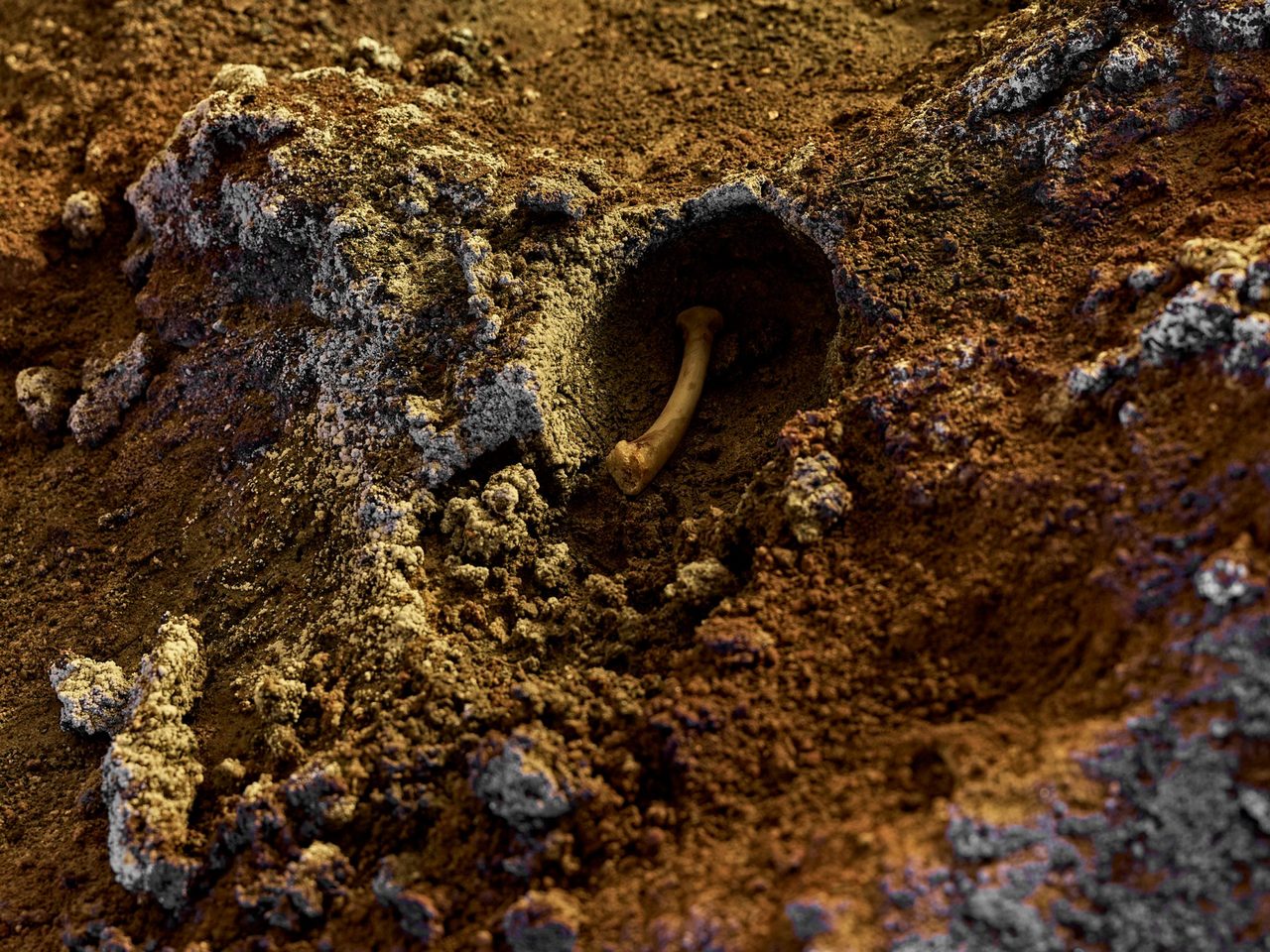
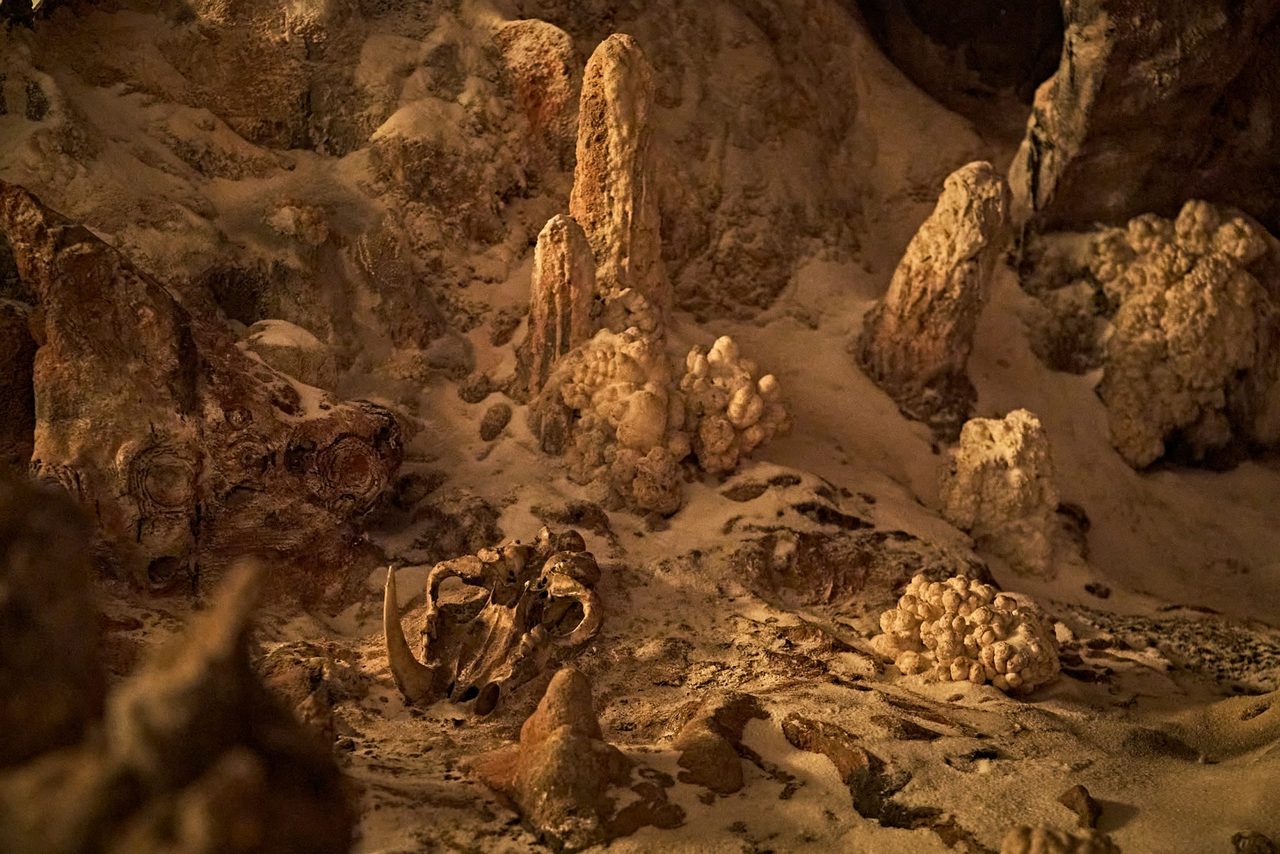
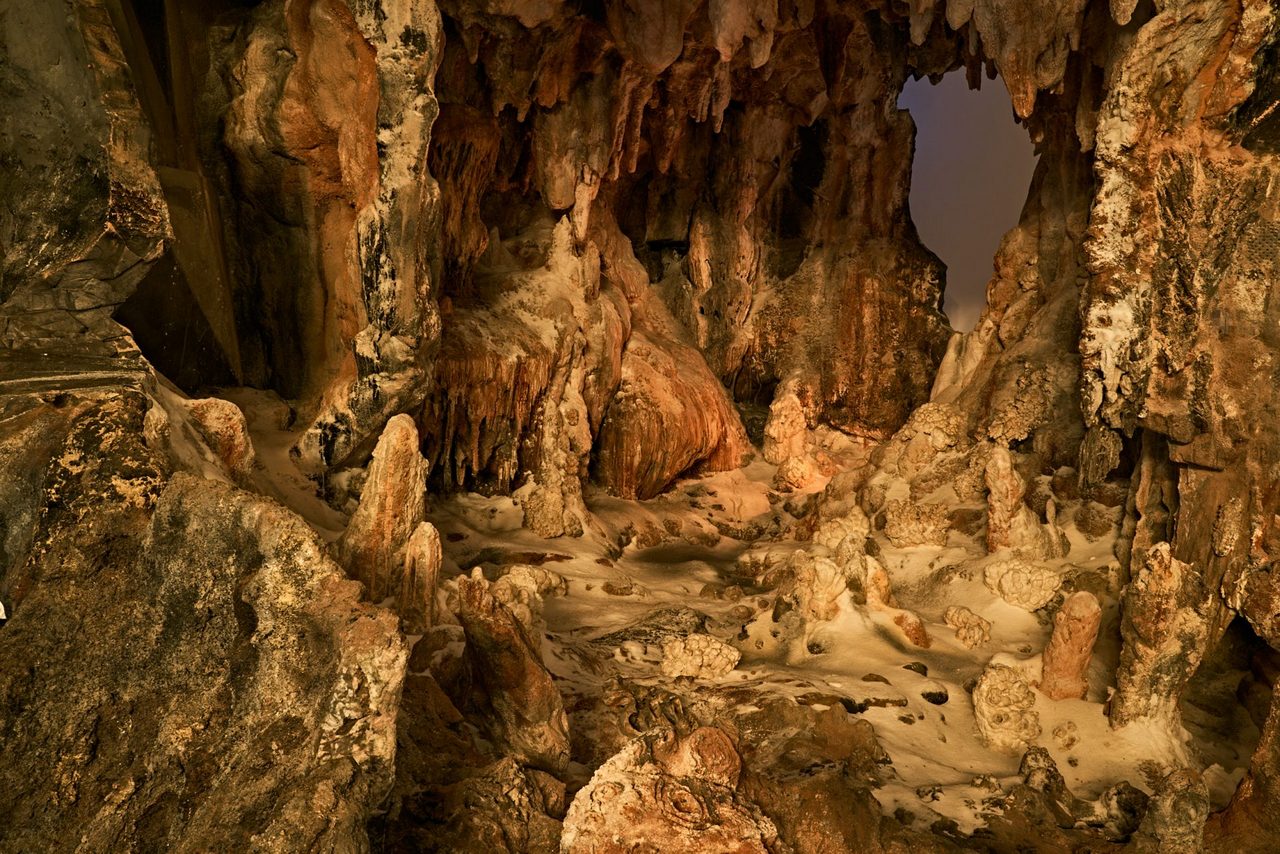
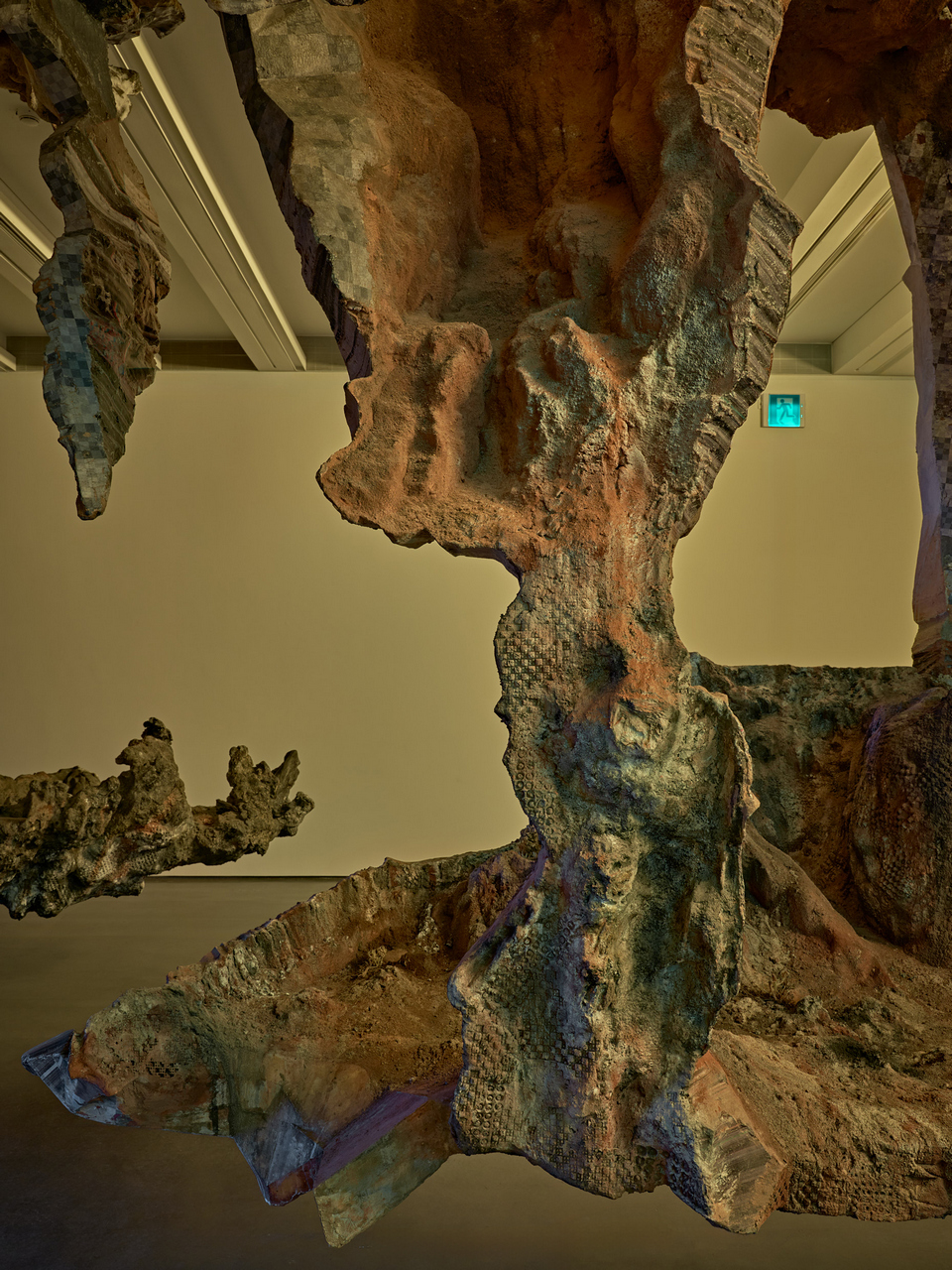
The monumental installation from which the exhibition takes its title is based on photogrammetric scans of sections from the Paleolithic caves of Lascaux and Chauvet, two of Europe’s most celebrated prehistoric sites. Yet Villar Rojas deliberately avoids reproducing their famous animal paintings. Instead, he focuses on peripheral spaces where little or no figurative imagery survives, redirecting attention away from representation itself toward the material conditions that made representation possible. Here, the cave is understood as an active threshold—a place where natural formations slowly evolved into cultural meaning.
This subtle shift transforms the installation into a meditation on translation. Geological formations become archaeological artifacts; archaeological evidence becomes digital information; digital information is ultimately transformed back into physical sculpture. Rather than hiding these successive transformations, Villar Rojas exposes them. Across the cave surfaces, prehistoric traces coexist with geometric grids, topographical markings, UV transfer paper, and visual references associated with contemporary scanning technologies. The resulting forms appear suspended between ancient ritual and machine vision, suggesting that today’s computational systems may represent only the latest chapter in humanity’s long history of symbolic invention.
The exhibition repeatedly challenges linear conceptions of historical progress. Artificial intelligence is not presented as a radical break with the past but as another cognitive framework extending human perception beyond its biological limits. Mythology once fulfilled this role, mathematics later expanded it through abstraction, and today’s algorithms continue that trajectory by translating reality into computational models. Villar Rojas refuses to privilege any one of these systems over another. Instead, he invites viewers to recognize them as successive attempts to confront uncertainty, each shaped by the historical conditions from which it emerged.
Equally significant is the collective nature of the exhibition’s production. Developed over two years by a team of long-term Argentine collaborators working in a temporary New Jersey studio, the project combines advanced digital modeling with painstaking manual fabrication. Technology, in Villar Rojas’s practice, never replaces human labor; rather, it becomes another material with which collective knowledge is constructed. The exhibition therefore embodies not only technological innovation but also an alternative model of artistic production grounded in collaboration and sustained experimentation.
Among the exhibition’s most striking works is Villar Rojas’s first bronze sculpture, depicting a life-sized triceratops skull from which emerges the prehistoric Venus of Lespugue*. Fossil and figurine become inseparable, collapsing distinctions between natural history and cultural production. The sculpture imagines an impossible genealogy in which symbolic thought predates modern humanity itself, echoing recent archaeological research suggesting that Neanderthals may have engaged in symbolic practices before Homo sapiens. By undermining the familiar narrative of human exceptionalism, Villar Rojas proposes that artistic imagination may be less an invention than an inheritance shared across multiple branches of human evolution.
This speculative archaeology resonates with historian Adrienne Mayor’s influential studies of fossil mythology, while also engaging with Stefanos Geroulanos’s recent argument that every account of prehistory ultimately reflects the concerns of the era that produces it. Origins, in Villar Rojas’s exhibition, are never stable historical facts but cultural constructions continuously rewritten by new scientific discoveries, political ideologies, and technological paradigms. The past becomes a mirror through which each generation imagines itself anew.
The exhibition’s atmosphere owes much to its subtle manipulation of light. Conventional museum illumination gives way to emergency exit signs and specially designed luminous structures whose diffused glow slowly permeates the galleries. These familiar institutional devices acquire unexpected symbolic resonance, recalling the simplified human figures that populate contemporary pictograms while simultaneously evoking humanity’s earliest graphic languages. Even the museum’s infrastructure becomes part of Villar Rojas’s broader investigation into how meaning is encoded and transmitted.
A different meditation on temporality emerges through the inclusion of “Return the World XIX” (2012), one of the few surviving sculptures from Villar Rojas’s celebrated project for dOCUMENTA (13). Constructed from unfired clay, cement, and epoxy, the work embraces material instability as a fundamental aesthetic principle. Its inevitable deterioration challenges conventional expectations of permanence, preservation, and market value, reminding viewers that every cultural artifact—whether prehistoric cave, museum collection, or digital archive—exists within processes of continual transformation rather than timeless stability.
“First Gods, Lost Animals” is less an exhibition about prehistory than an inquiry into the mechanisms through which humans construct reality. Villar Rojas suggests that caves, museums, algorithms, fossils, myths, and artificial intelligence all participate in the same evolving ecology of representation. They are not isolated historical phenomena but interconnected systems through which societies organize memory, negotiate uncertainty, and imagine their place within a universe that continually exceeds human understanding.
Rather than presenting history as a linear progression from primitive beginnings to technological sophistication, Villar Rojas proposes a more cyclical vision in which ancient rituals and machine intelligence belong to the same unfinished conversation. In doing so, he offers one of the most intellectually ambitious exhibitions of recent years—one that invites us to reconsider not only where art began, but also how every symbolic system, regardless of its historical moment, remains an attempt to illuminate the unknown.
* The Venus of Lespugue is a Venus figurine, a statuette of a female figure of the Gravettian, dated to between 26,000 and 24,000 years ago. It was discovered in 1922 in the Rideaux cave of Lespugue (Haute-Garonne) in the foothills of the Pyrenees by René de Saint-Périer. Approximately 150 mm tall, it is carved from tusk ivory, and was damaged during excavation.
Photo: Adrián Villar Rojas, First Gods, Lost Animals, 2026. Detail view, Aspen Art Museum, Aspen, USA, 2026. Courtesy the artist, Aspen Art Museum, kurimanzutto and Marian Goodman Gallery. Photo: Jörg Baumann
Info: Curator: Claude Adjil, Aspen Art Museum, 637 East Hyman Avenue, Aspen, CO, USA, Duration: 2/7/2026-11/4/2027, Days & Hours: Tue-Sun 10:00-18:00, https://aspenartmuseum.org/