ART CITIES:Oslo-Matias Faldbakken
Matias Faldbakken often uses industrial materials and heavy-duty objects in his works, which he then manipulates or even partially destroys. By negating the functionality of these items and placing them within an art context, Faldbakken explores the tipping-over moment in which readymade and industrialized materials become recognized as art. In his well-known tape works, black tape is applied on canvas or directly onto walls, referencing both postmodern abstraction and graffiti culture, with letter-like shapes that recall tags.
By Efi Michalarou
Photo: KORO (Public Art Norway) Archive
On 22 July 2011, Norway suffered the most horrific terrorist attack in its modern history. Driven by far-right, anti-democratic extremist ideology and a deep contempt for minorities, a solitary perpetrator detonated a deadly bomb in central Oslo’s Government Quarter, killing eight people and causing vast structural destruction. Shortly after, the attacker drove to the AUF (Workers’ Youth League) summer camp on the nearby island of Utøya, where he brutally murdered 69 people—most of them teenagers—and left countless others seriously injured.
In the aftermath, the Oslo District Court confirmed what society already felt deeply: the attack was a politically motivated assault aimed directly at democratic institutions, pluralism, and the Labour Party. The trauma reverberated throughout Norwegian society.
In 2012, the Norwegian government decided to establish two official memorial sites to honor the victims—one connected to Utøya, and the other in the heart of Oslo’s Government Quarter. The task of capturing this profound historical weight while upholding the values of a free society culminated in April 2025, when artist Matias Faldbakken’s proposal, titled “Upholding”, won the international competition to design the national memorial site in Oslo.
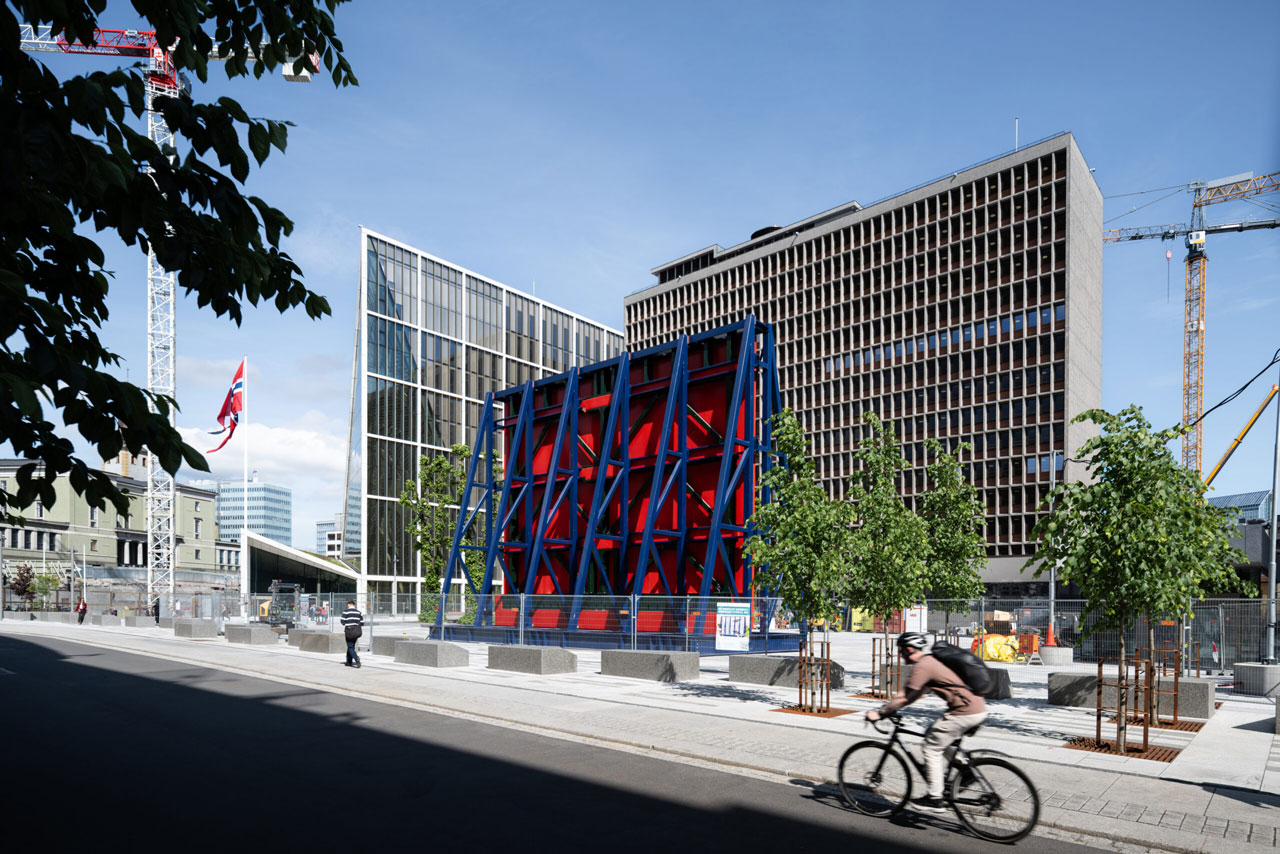
Positioned in the plaza opposite the iconic 1958 Highrise Building (H-Block)—framing the space between its Western Pavilion and the entrance to the new 22 July Centre—Faldbakken’s monumental installation serves both as a site of quiet grief and an active defense of democratic life.
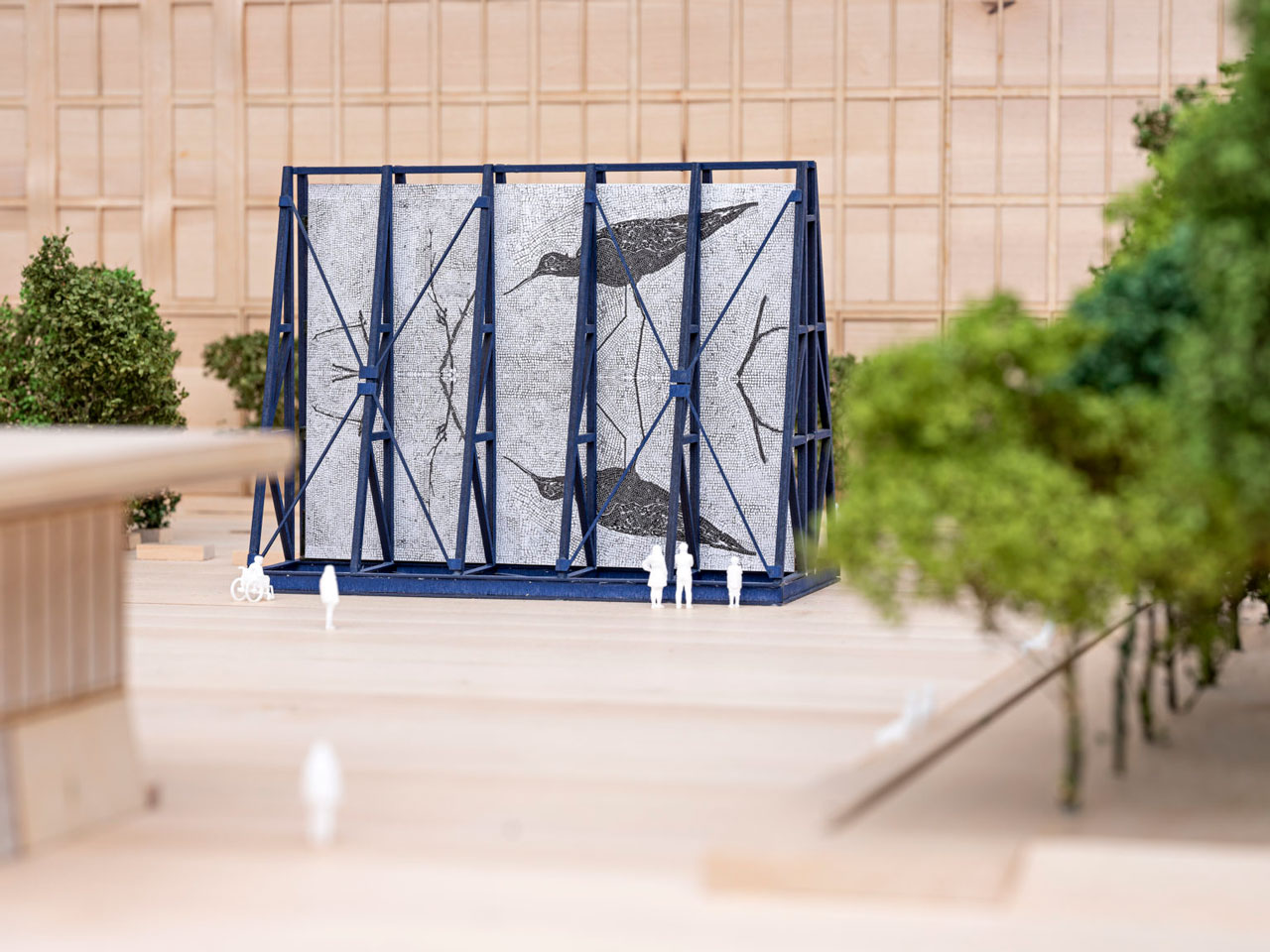
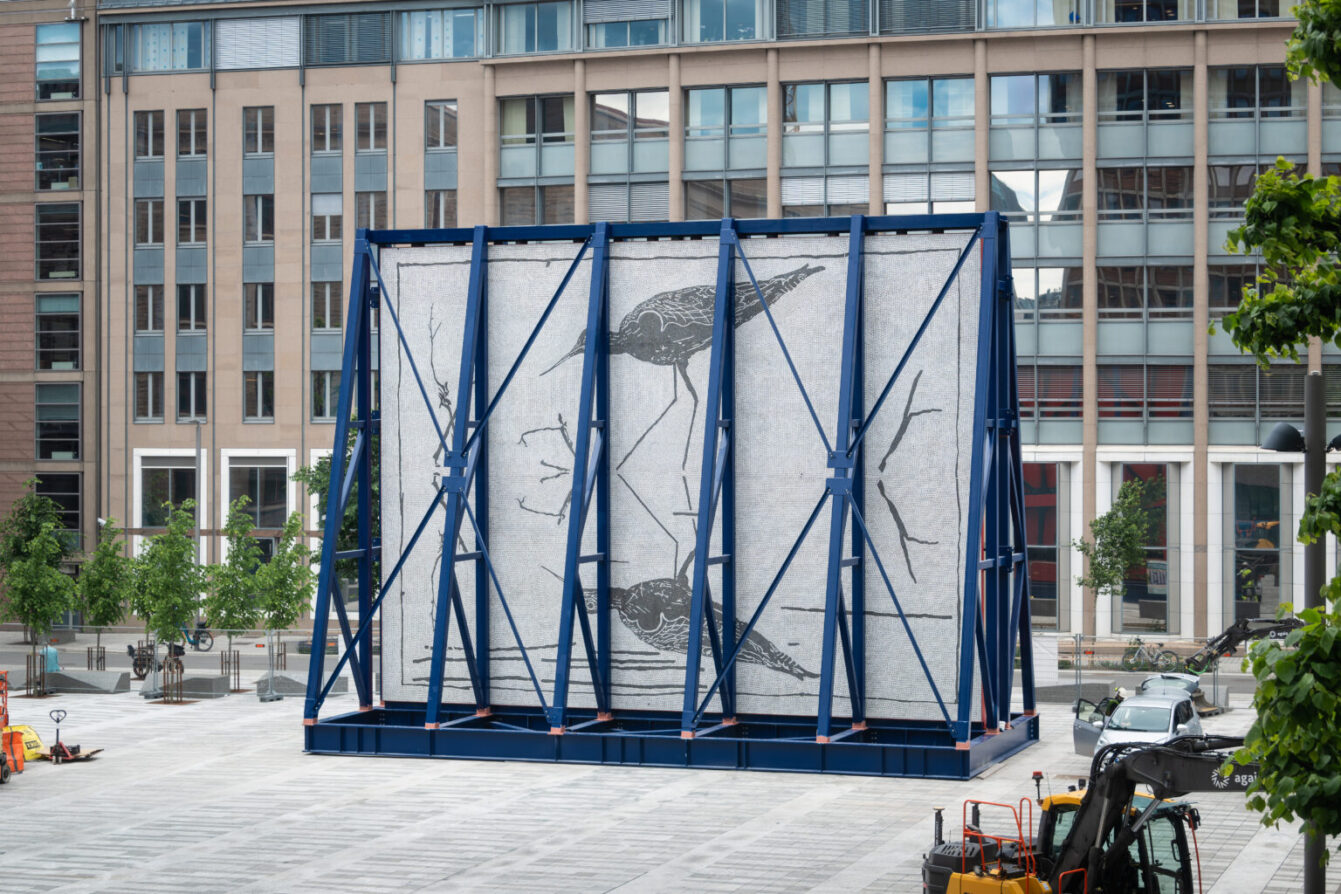
Faldbakken’s “Upholding” is a work of striking duality. The sculpture’s framework re-erects the massive steel rig originally built to hold and relocate Pablo Picasso’s famous artwork, “The Fishermen”, from the demolished Y-block to the new A-block during the Quarter’s post-bombing redevelopment. Industrial, insistence, and brutal in its sheer scale, the exposed steel structure reflects the immense weight of the 2011 tragedy and evokes the physical labor required to rebuild and sustain a society under threat.
On one side, the structure displays a geometric relief frame painted in deep blue, vivid green, and vibrant red, highlighting the structural bracing that holds the installation together. Nestled within this industrial framework is a monumental mosaic composed of roughly 300,000 stone pieces.
The mosaic depicts a scene from Utøya: a common greenshank—a small wader bird—standing among reeds and twigs reflected in the quiet waters of the Tyrifjord. Through this imagery, Faldbakken creates a visual bridge connecting the two attack sites, Oslo and Utøya. The bird’s delicate stance and steady gaze embody vitality and vulnerability, offering a poignant counterpoint to the massive steel frame. The wader stands as a silent witness to the ongoing political and democratic life unfolding around it.
“Upholding” is not merely an object to be observed; it is the product of collective action. In a collaborative initiative organized alongside the 22 July Centre and KORO, Faldbakken invited survivors, bereaved families, teenagers, and members of the public to participate directly in the creation of the memorial.
Over three weeks, approximately 2,000 people gathered at a provisional workshop on-site to lay the final 7,000 stones of the mosaic. The final stone was placed by Merete Stamneshagen, chair of The National Support Group after July 22, whose daughter was killed on Utøya. This shared gesture transformed the construction of the artwork into a powerful act of community healing and active participation.
Faldbakken’s sculpture marks a significant shift away from the traditional, canonical memorial traditions that have dominated commemorative art since the 1980s—frameworks that often focus exclusively on static loss, past tragedy, and quiet contemplation.
“Upholding” challenges the viewer to think of democracy not as an unchanging structure, but as an ongoing practice requiring continuous work, maintenance, and vigilance. As Minister of Digitalisation and Public Governance Karianne Tung noted during the project’s announcement, the site stands as a vital symbol “that our democracy withstood even the gravest threat.”
By weaving together industrial permanence, fragile natural imagery, and active public participation, Matias Faldbakken has created a monument that honors the 77 lives lost while urging society forward. “Upholding” reminds us that democratic resilience, like art, is built piece by piece, stone by stone, through collective responsibility and an enduring commitment to pluralism.
Photo: Matias Faldbakken, Upholding, 2026, © Matias Faldbakken / BONO Photo: Niklas Hart / KORO
Info: Johan Nygaardsvolds plass, Oslo, Norway