ART CITIES: Paris-Moving Colors
Color has always been one of painting’s most powerful instruments, but throughout the twentieth century it underwent a radical transformation: it ceased to be merely a tool for describing reality and became a subject, a structure, and even the very substance of the artwork itself. The exhibition “Moving Colors” explores this long and complex journey, bringing together Italian and international artists whose practices reveal the extraordinary potential of color as an independent artistic medium. The exhibition traces different ways artists have investigated color as a force capable of shaping perception, emotion, and space.
By Dimitris Lempesis
Photo: Tornabuoni Art Archive
Rather than treating color as a decorative element, these artists approach it as a living phenomenon—something that acts upon the viewer, alters the perception of space, and creates relationships between the artwork and the body. Color exists at the meeting point between science and aesthetics: it belongs simultaneously to physics, psychology, philosophy, and artistic expression. The history of modernism is, in many ways, also the history of artists attempting to understand what color can do when liberated from representation.
At the beginning of the twentieth century, artists increasingly questioned traditional systems of representation. The discoveries of optics and color theory, together with the experiments of movements such as Fauvism, Futurism, Constructivism, and Bauhaus, encouraged painters to examine color not as a reflection of the visible world but as an autonomous language.
This process reached a decisive moment with artists who isolated color from its descriptive role. Instead of using blue to represent the sky or red to suggest an object, they explored color as a physical and emotional presence. The canvas became a laboratory where artists could investigate contrasts, harmonies, vibrations, and perceptual effects.
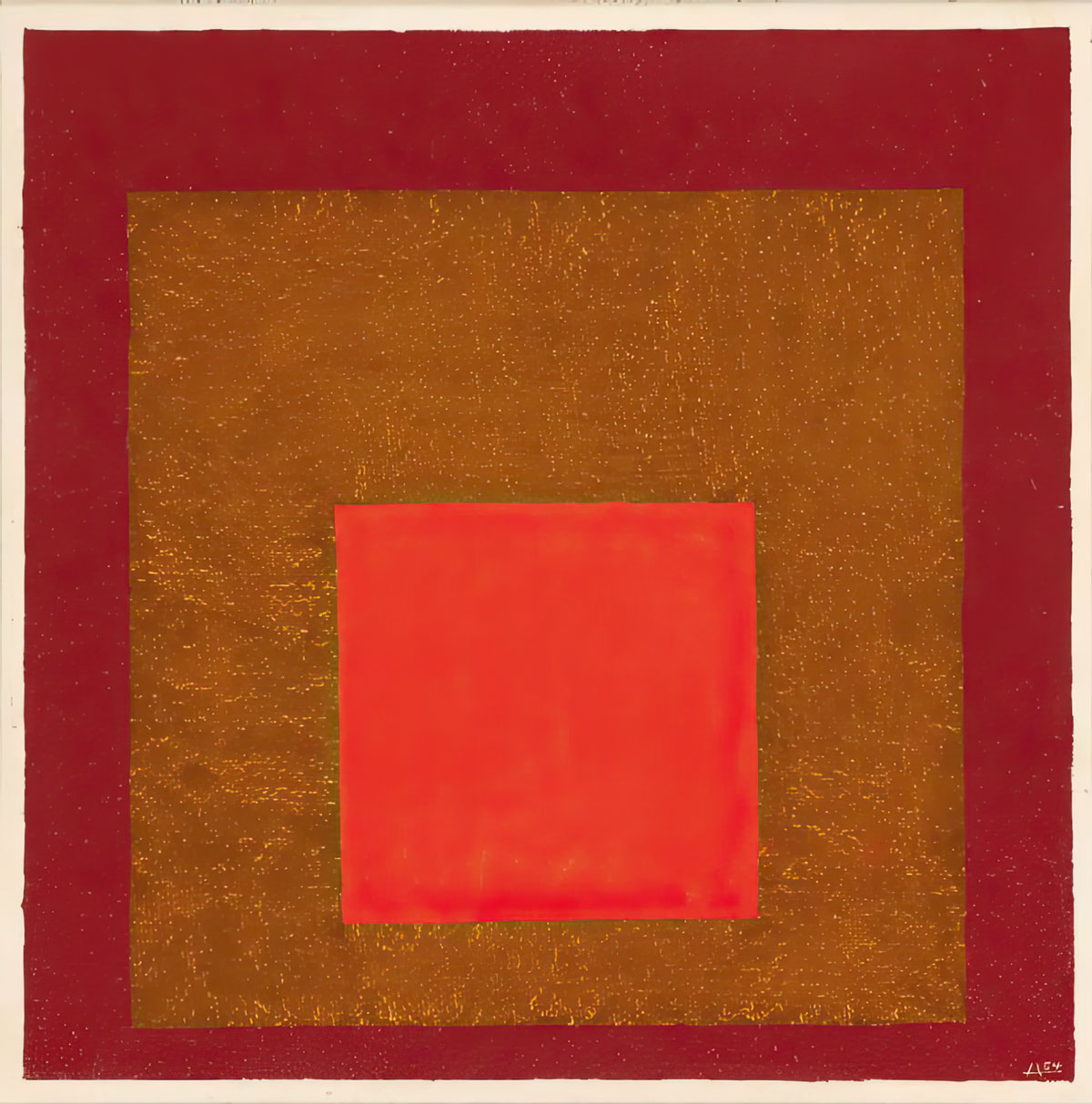
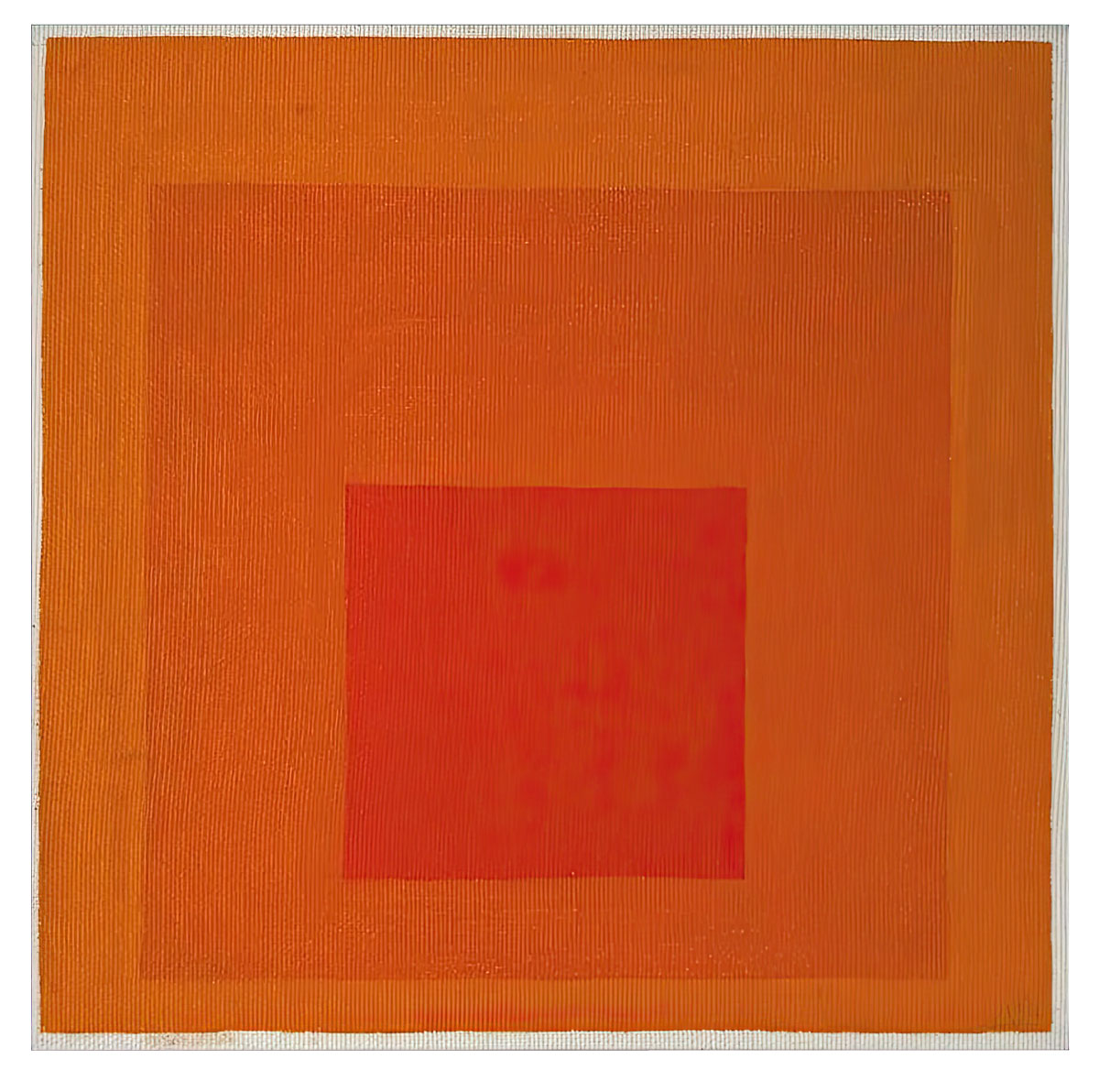
One of the most influential figures in this transformation was Josef Albers, whose theoretical and artistic research profoundly shaped modern approaches to color. His celebrated series “Homage to the Square” (1950–1976) became a rigorous exploration of chromatic relationships, demonstrating that colors do not exist independently but change according to their surroundings. A single hue can appear warmer, colder, brighter, or darker depending on the colors placed beside it.
For Albers, color was not something simply applied to a surface; it was an event produced through interaction between artwork and viewer. His investigations became foundational for generations of artists interested in perception and visual experience.
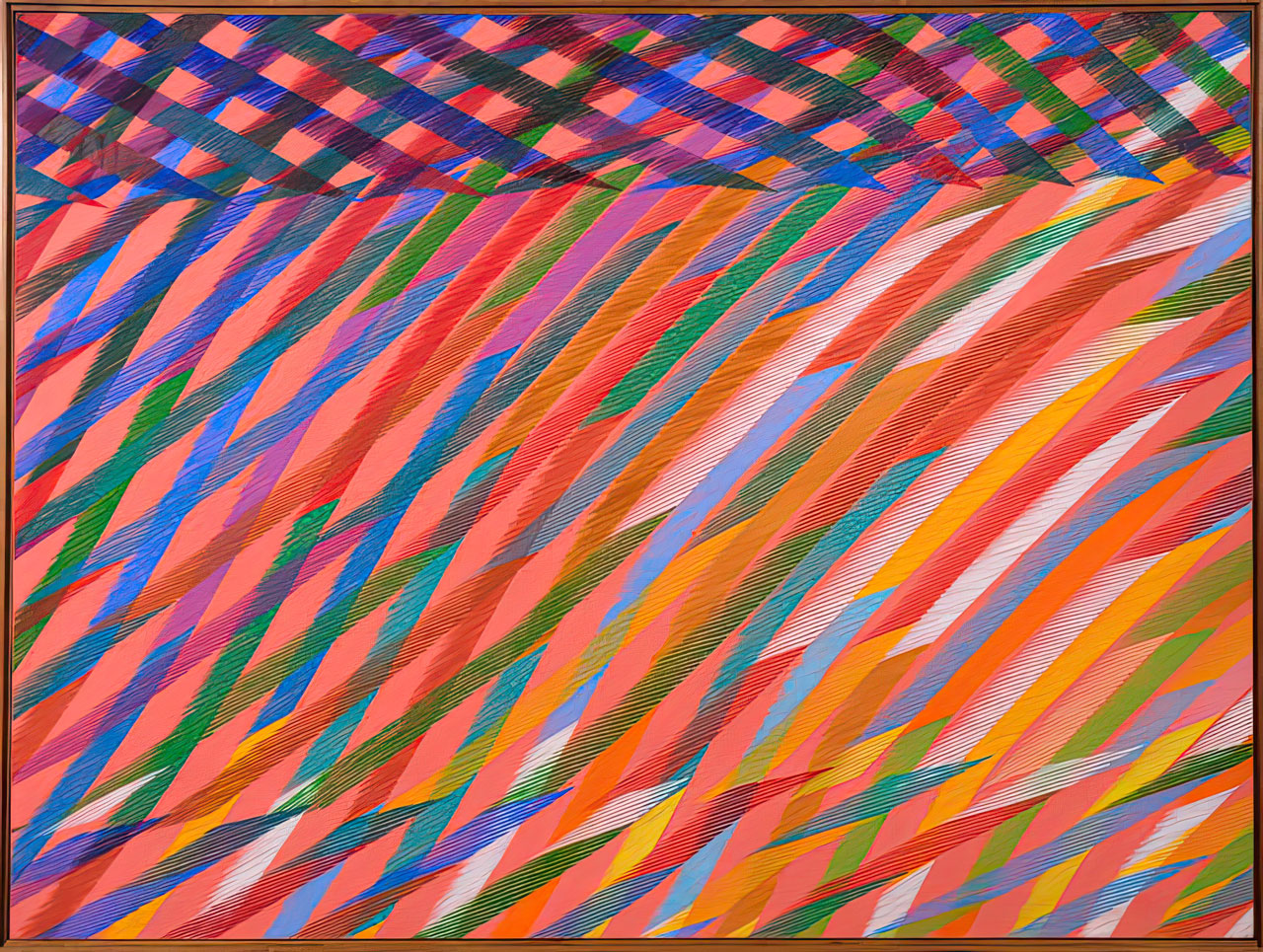
Among Italian artists, Piero Dorazio stands as one of the most profound interpreters of color as an autonomous force. A central figure of Italian abstraction and co-founder of the influential Forma 1 group in 1947, Dorazio rejected traditional representation in favor of a painting built from rhythm, transparency, and chromatic relationships.
His celebrated “Reticoli” series of the 1960s transforms the canvas into a woven field of color. Through repeated lines and overlapping layers, Dorazio created surfaces where color seems to generate its own movement. His brushstrokes do not describe objects; they construct a visual environment in which light, vibration, and rhythm become the true subjects of painting. For Dorazio, color was not an accessory to form—it was form itself.
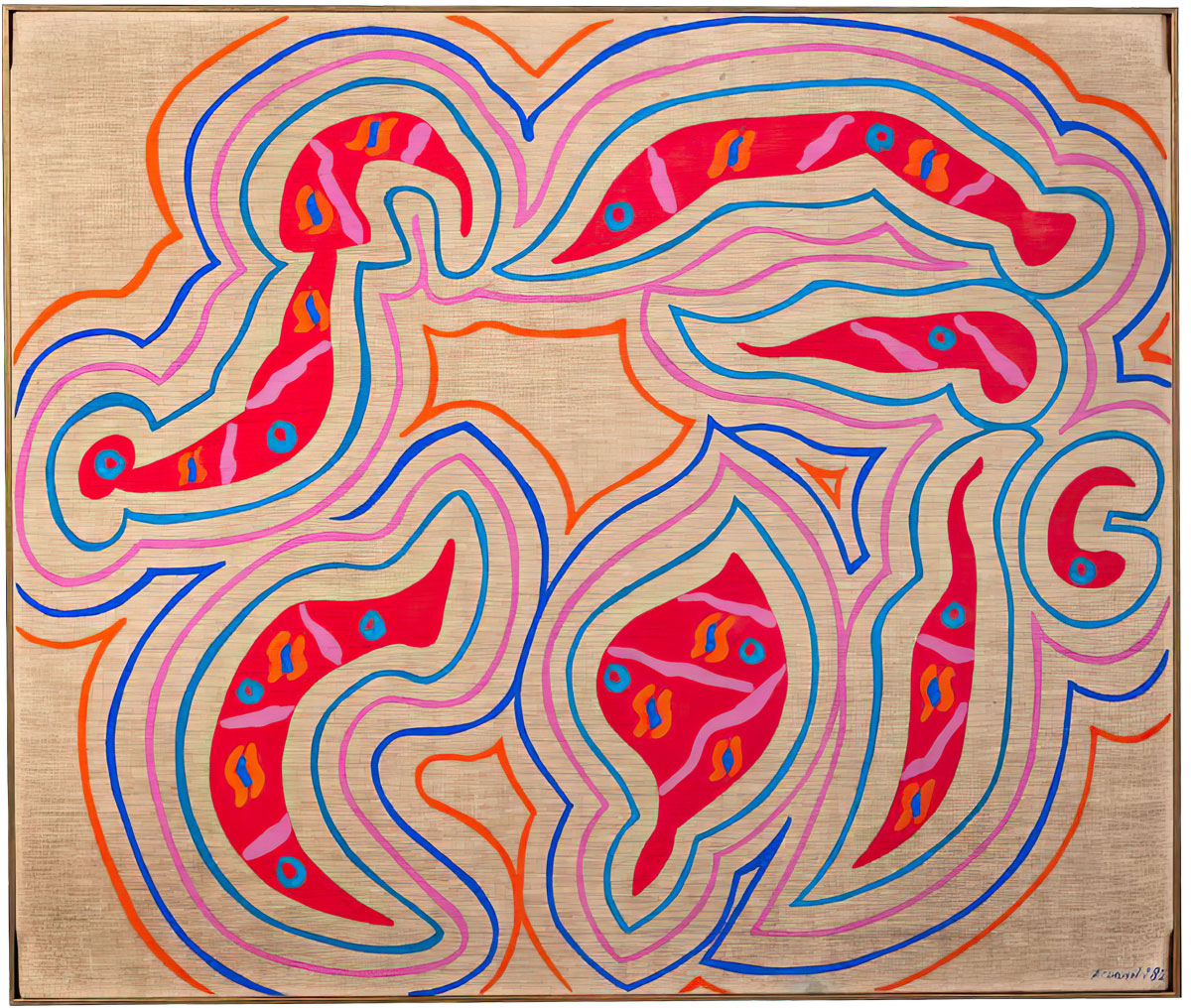
Working in the same Roman artistic environment, Carla Accardi pursued a different but equally radical investigation into color. Also associated with Forma 1, Accardi developed a language based on signs, repetition, and luminous surfaces.
During the 1960s and 1970s, she moved beyond the traditional limits of painting, introducing transparent plastic supports such as “Sicofoil”. Her brightly colored marks floated across translucent surfaces, transforming painting into an experience of space and light.
Accardi’s work questioned the idea that a painting must be a fixed image contained within a frame. Color became something dynamic—an element that could expand into the surrounding environment.
In the work of Giorgio Griffa, color becomes reduced to its most essential presence. His paintings of the 1970s and later periods often consist of simple gestures and delicate marks placed directly onto unprimed canvas.
Rejecting the traditional authority of the finished composition, Griffa allows the material itself to participate in the creation of the work. His canvases, often hung without frames, reveal the fragility and temporality of painting. The artist’s intervention is minimal, leaving color and gesture as the primary protagonists.
His approach connects with both the radical simplicity of Minimalism and the material awareness associated with Arte Povera.
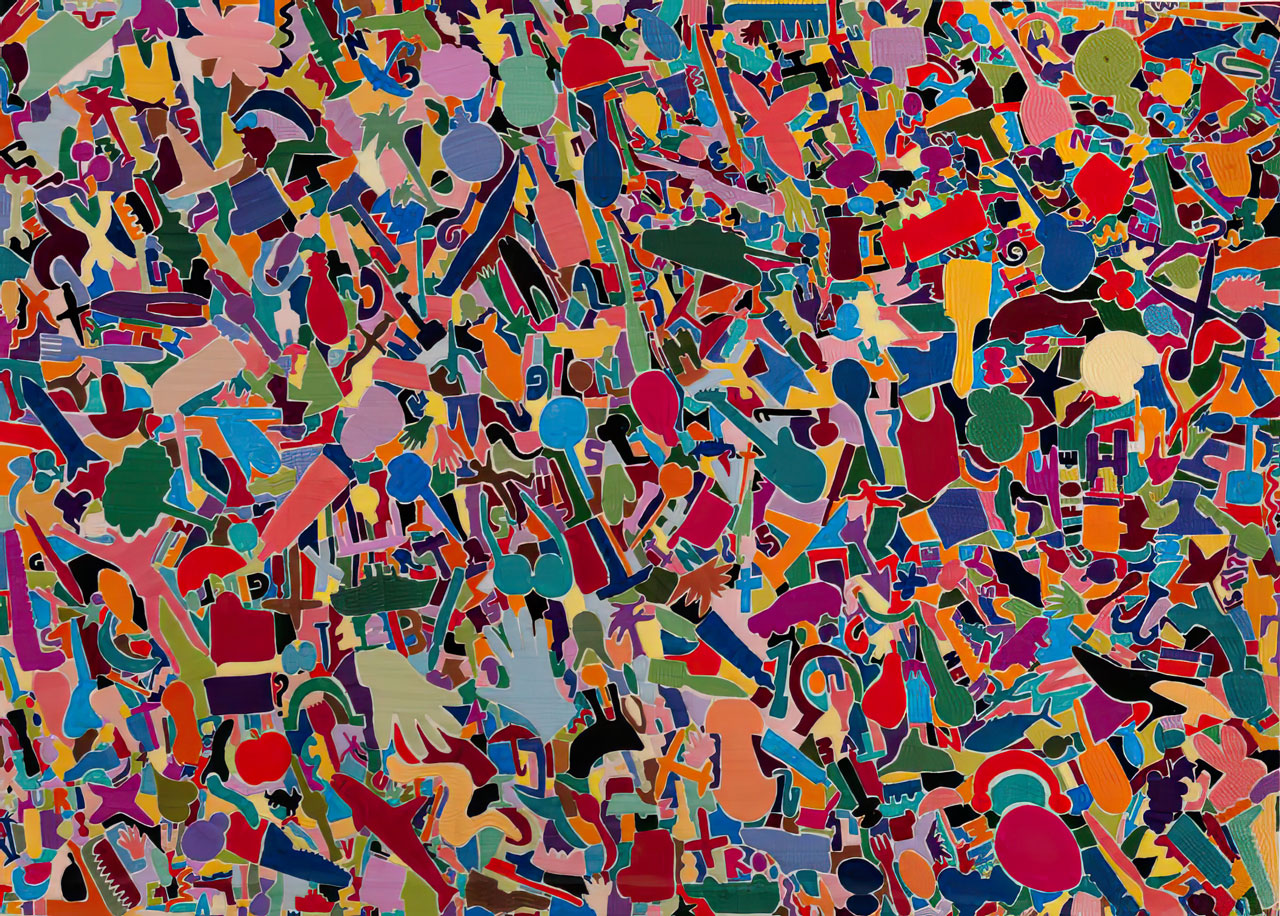
The expansion of color beyond traditional painting reaches another dimension in the work of Alighiero Boetti. His monumental embroidered work “Tutto” (1988–89) transforms color into a complex visual universe. Hundreds of different figures and forms are assembled like a contemporary mosaic, each embroidered by Afghan artisans according to a rule that prevented identical colors from touching adjacent areas.
Here, color becomes a system of organization, but also a social and collaborative process. The artwork is not simply painted—it is constructed through labor, material, and cultural exchange.
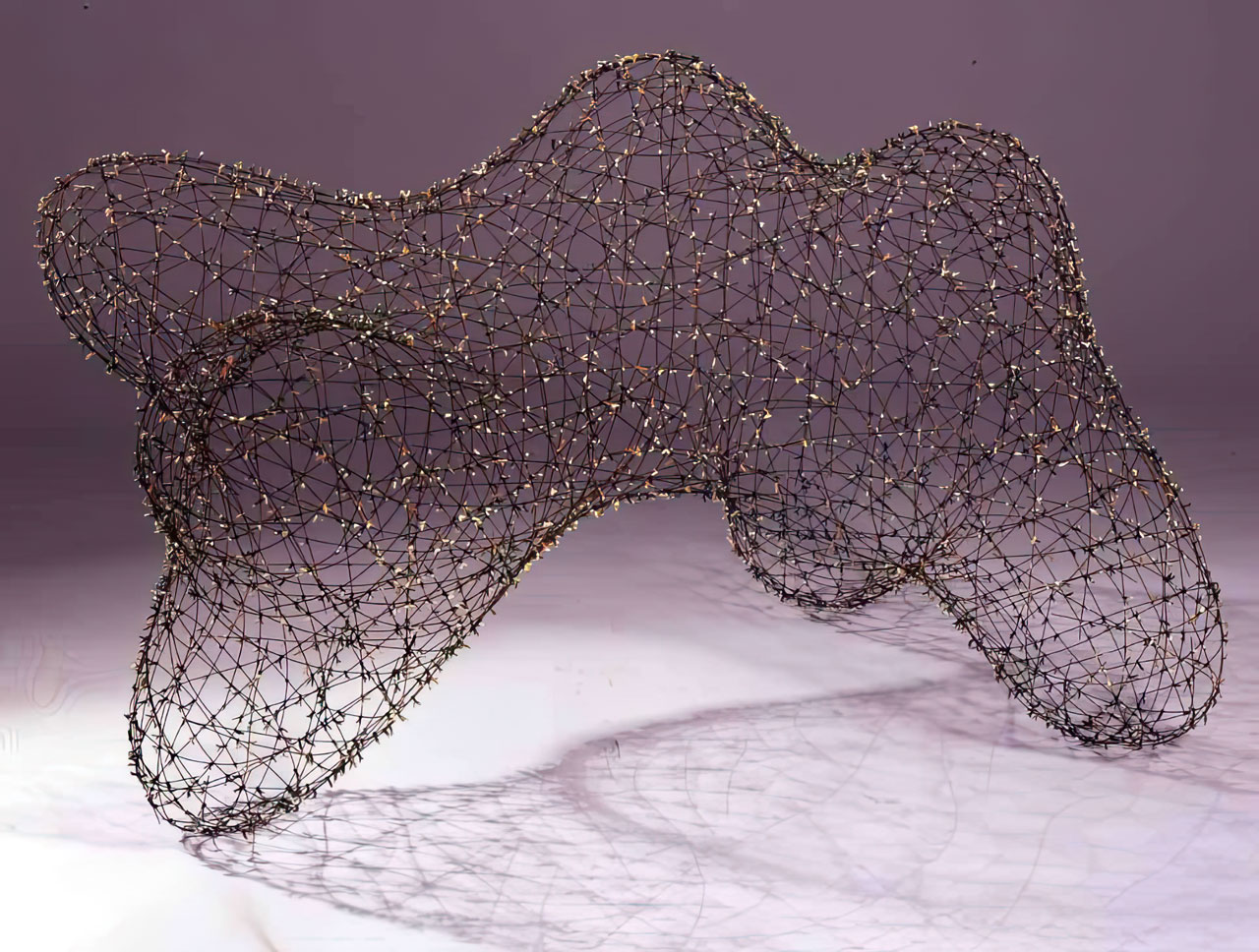
Decades later, Korean artist Lee Sung-Kuen similarly gives color a physical body through delicate sculptures made of colored threads. His installations move beyond the flat surface of painting, creating immersive environments in which color occupies real space and interacts with light and movement.
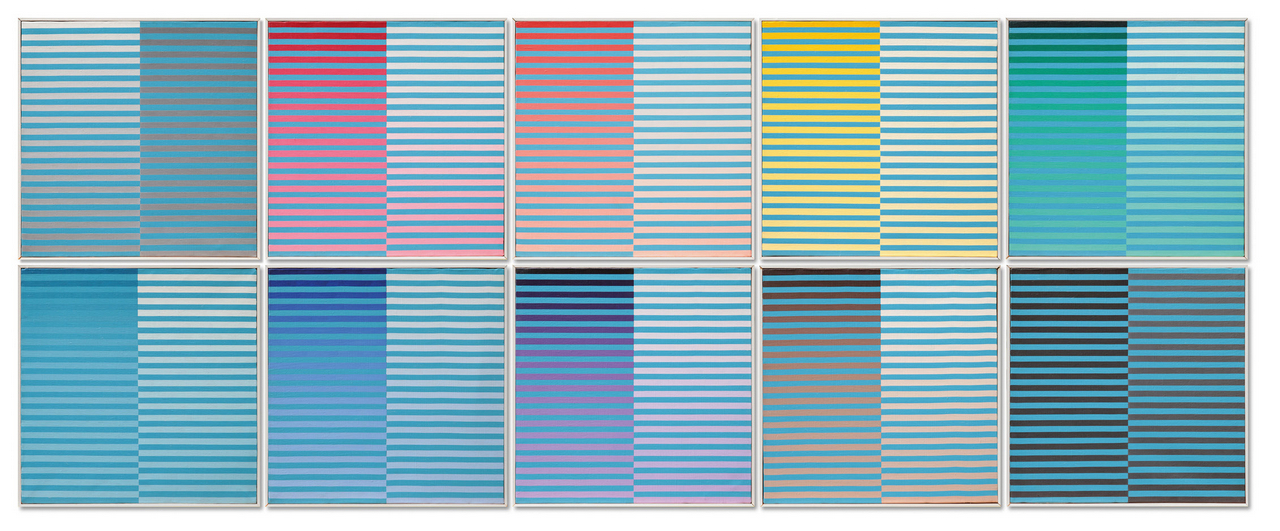
The exhibition also examines artists who explored color through the science of perception. Among them, Dadamaino investigated the relationship between color and visual experience in her series “Ricerca del colore” (1966–1968). Through systematic variations and combinations, she examined how small changes in chromatic relationships could transform perception. Her work connects the analytical rigor of Minimalism with the optical investigations of Op Art and kinetic art.
Similarly, Alberto Biasi developed his “Oggetti ottico-dinamici”, works that activate through the viewer’s movement. Rather than presenting a fixed image, these pieces produce changing visual effects through physiological and optical phenomena.
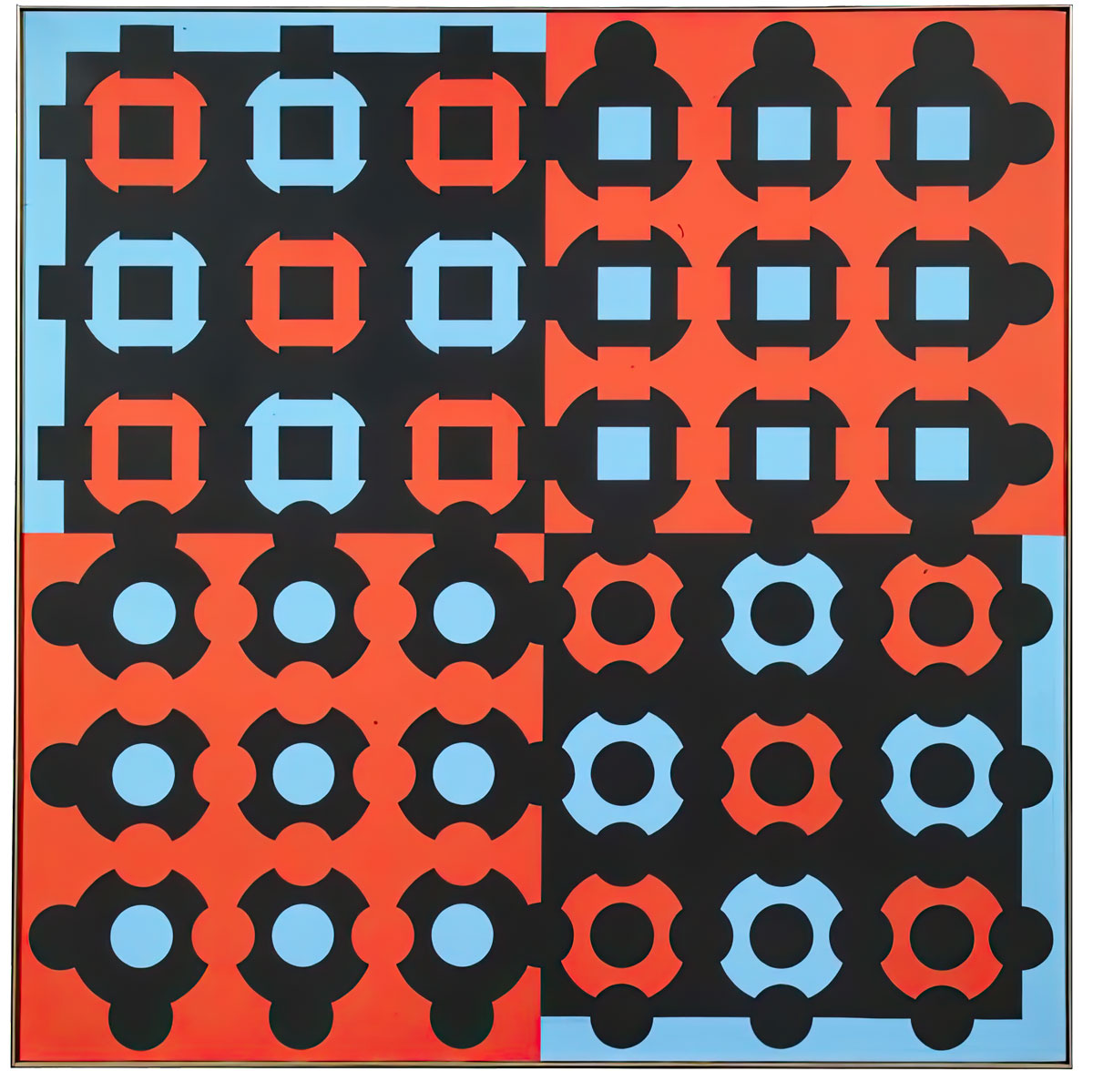
The presence of Victor Vasarely completes this exploration. Often considered the father of Op Art, Vasarely combined geometric structures and intense color relationships to challenge the limits of vision itself. His works demonstrate that seeing is not passive: perception is an active process shaped by movement, contrast, and the interaction between eye and artwork.
“Moving Colors” ultimately presents color not as a surface quality but as an active agent. Across different generations and artistic movements, the featured artists reveal how color can construct space, generate emotions, challenge perception, and redefine the relationship between artwork and viewer.
From Albers’s scientific investigations to Dorazio’s luminous networks, Accardi’s transparent signs, Boetti’s embroidered worlds, and the perceptual experiments of Op Art, the exhibition follows a century-long pursuit: the search for a color that no longer represents something else, but exists as a complete artistic reality in itself. Color moves—not only across the canvas, but through perception, memory, and experience.
Works by: Carla Accardi, Josef Albers, Alberto Biasi, Alighiero Boetti, Dadamaino, Piero Dorazio, Giorgio Griffa, Lee Sung-Kuen, Victor Vasarely
Photo: Piero Dorazio, L’incarnato, 1991, oil on canvas, 150 x 200 cm – 59,05 x 78,74 in, reverse: signed, dated and titled Piero Dorazio / 1991 / L’incarnato, Courtesy Tornabuoni Art
Info: Tornabuoni Art Paris, 16 avenue Matignon, Paris, France, Duration: 2/7-33/10/2026, Days & Hours: Tue-Sat 10:30-18:30, www.tornabuoniart.com/
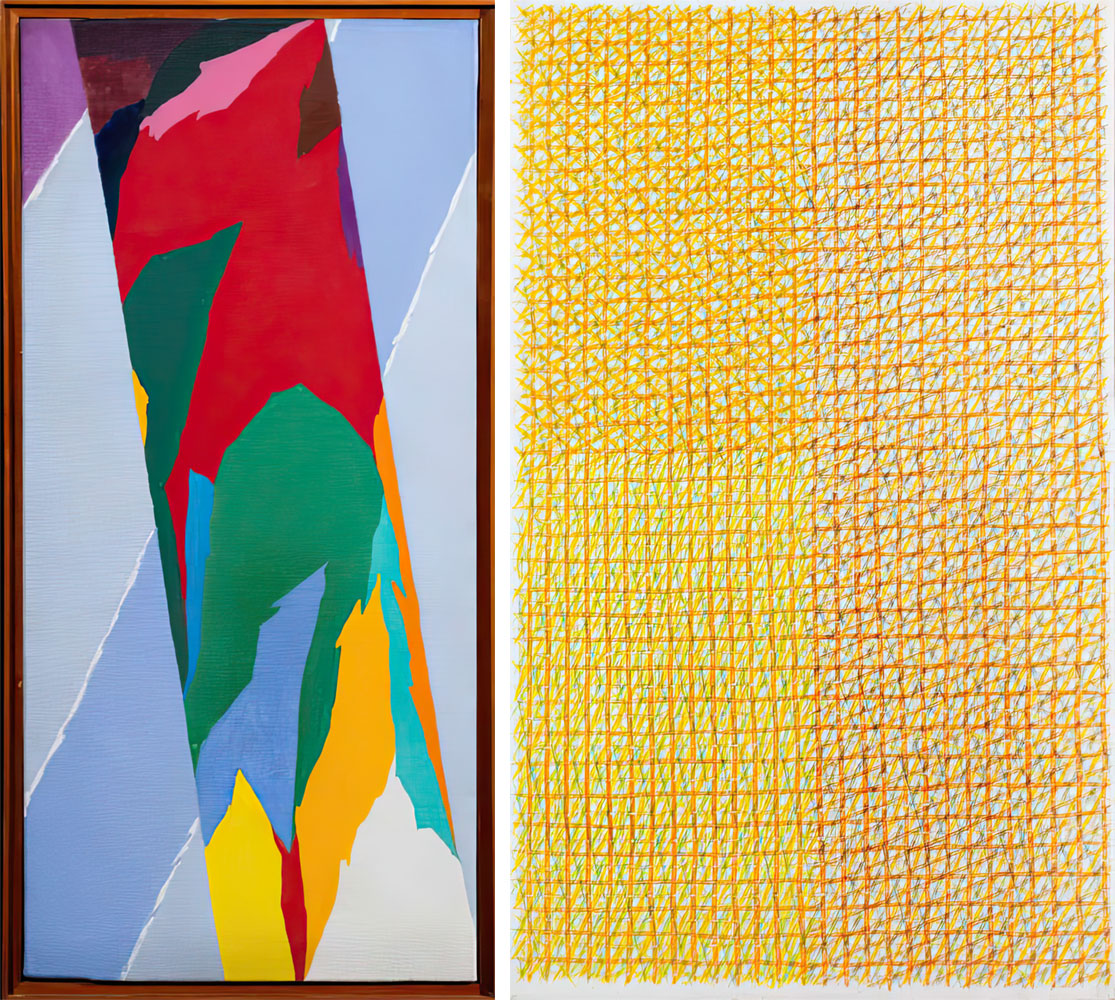
Right: Piero Dorazio, Time locker, 1963, oil on canvas, 162 x 97 cm – 63,77 x 38,18 in, reverse: signed, titled and dated Piero Dorazio 1963.8. “Time Locker”; label Galerie Bonnier, Losanna; Galerie Im Erker, St. Gallen; Galleria Marlborough, Roma; stamp Galleria Tega, Milano, Courtesy Tornabuoni Art
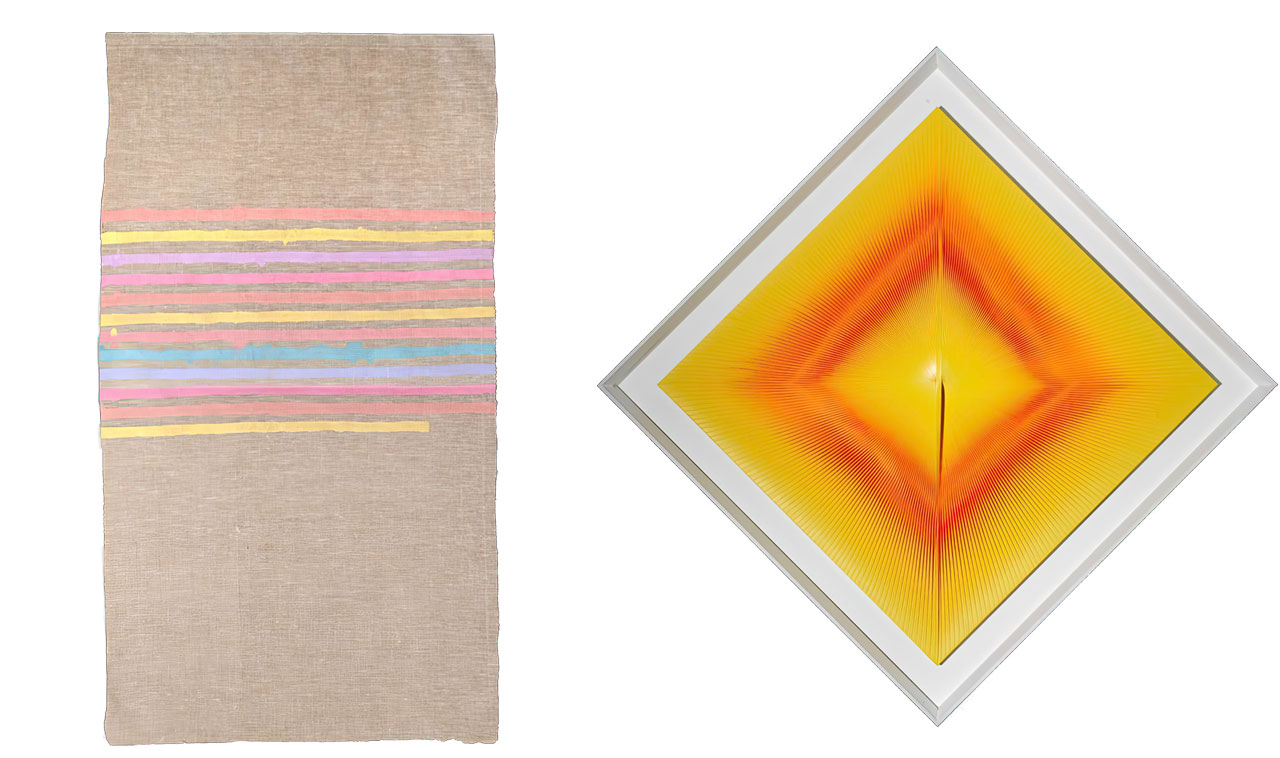
Right: Alberto Biasi, Abbagliante come un sole, 2010. PVC strips and acrylic on panel, 127 x 127 cm – 50 x 50 in, reverse: signed, titled and dated ‘Alberto Biasi 2010 Abbagliante come il sole’; label Alberto Biasi reg. no. T 718, Courtesy Tornabuoni Art