BIENNALS: Is Austria the Winner? Holzinger at the Venice Biennale
Does Austria’s radical approach ultimately manage to conquer the “underwater” lyricism of Venice? Can it overshadow the disarming innocence of India? Can it prevail over the heavy historical footprint of Germany or the monumental ephemerality of the Spanish pavilion? Let us examine why the Austrian pavilion has become the focal point of this year’s Biennale.
By Mimika Christodoulopoulou
Photo: Mimika Christodoulopoulou’s Archive
Prompted by the European Commission’s decision to move forward with the withdrawal of €2 million in funding due to the permitted participation of Russia in the Biennale Arte 2026, we return to the lush Giardini and the Arsenale of “La Serenissima”, continuing to wonder whether Austria’s participation will ultimately be the year’s great winner. Naturally, this is without a “Golden Lion,” as the entry has withdrawn from the awards to express support for the resigned members of the jury.
Let us recall that the curatorial framework of the late Koyo Kouoh, “In Minor Keys”, proposed introspection as an approach to collective trauma. This is why many creators negotiate trauma as a fragile condition, archiving memory and reflecting upon loss. The Austrian pavilion, however, shatters this premise, as “minor keys” are entirely abandoned within it. Florentina Holzinger’s Seaworld Venice is not merely one of the most important participations of the Biennale; it is a powerful awakening that reminds us of the self-evident, in the face of crisis, art must jolt us out of our complacency.
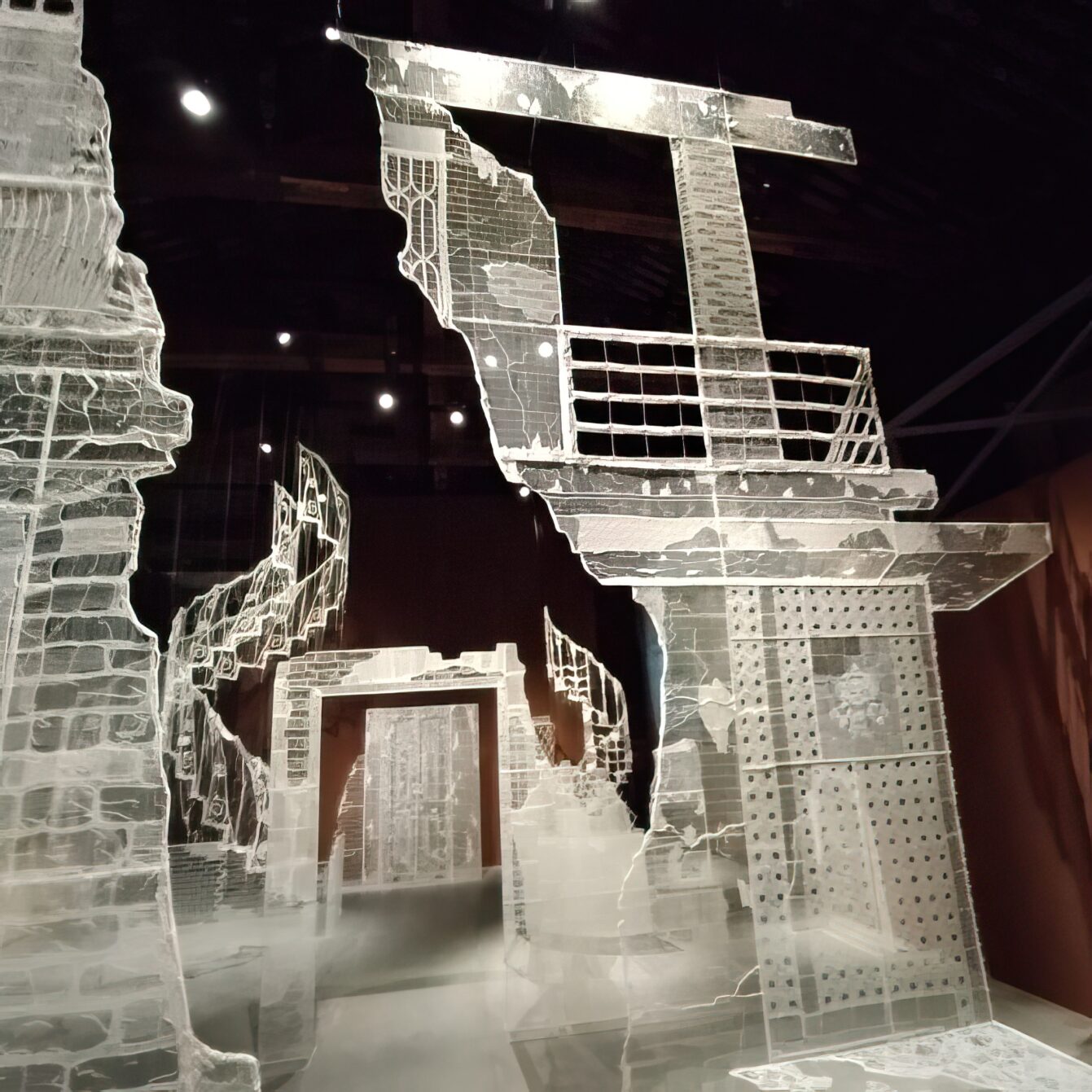
Memory vs. the Present: To understand the dominance of Austria, curated by Nora-Swantje Almes, one need only look at how its “competitors” negotiate the past. At this year’s edition, Germany, under the curation of Kathleen Reinhardt, performs a striking anatomy of memory. Henrike Naumann and Sung Tieu stage Ruin, excavating the architectural ghosts of East Germany. In the Greek Pavilion, Andreas Angelidakis, curated by Yorgos Bekirakis, deconstructs the past through a digital Platonic Cave—an Escape Room. Truth be told, he is not keeping the tone low, either. Meanwhile, in Spain, Oriol Vilanova, curated by Carles Guerra, monumentally constructs a museum surrogate by gathering thousands of postcards.
India, on the other hand, approaches loss with disarming innocence. Curator Amin Jaffer guides a group of creators—among them Alwar Balasubramaniam and Ranjani Shettar—who enlist thread, clay, and paper to reconstruct the fragile memory of home and homeland, standing against the modern megalopolises.
All these approaches are flawless and moving. Yet, they share a common trait: they keep the viewer safe. They hold the audience in the position of a mere observer of events that have already passed. Holzinger seems to cancel this distance. Within the aquatic mechanism of her work, the past is not archived; its consequences are experienced now, in the water.
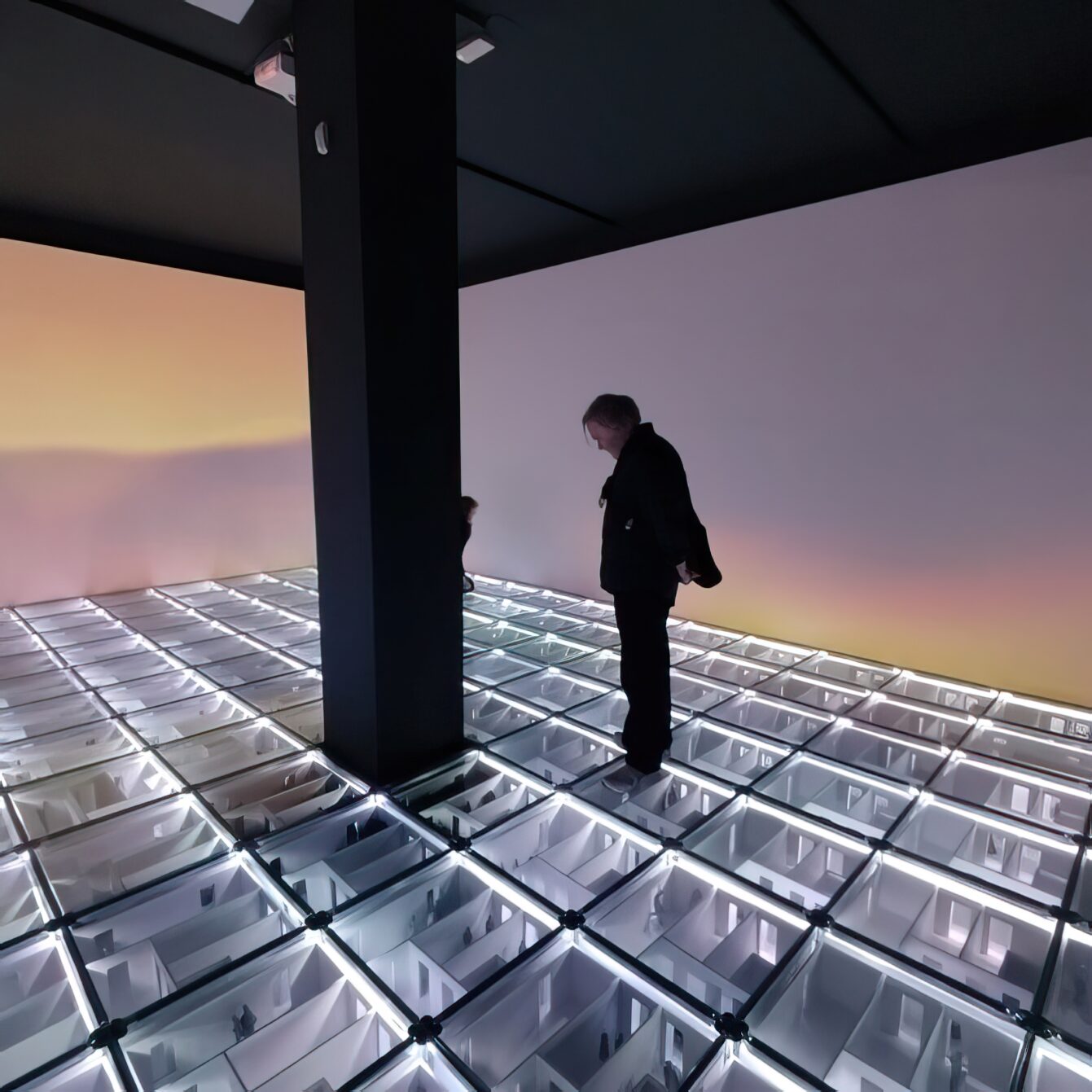
The Illusion of Control and the Rupture: Some national pavilions choose to grapple with the coldness of the contemporary world. The Montenegro pavilion, curated by Svetlana Racanović, is truly striking. Siniša Radulović traps us above a sterile, glass floor, transporting us into a condition of absolute control.
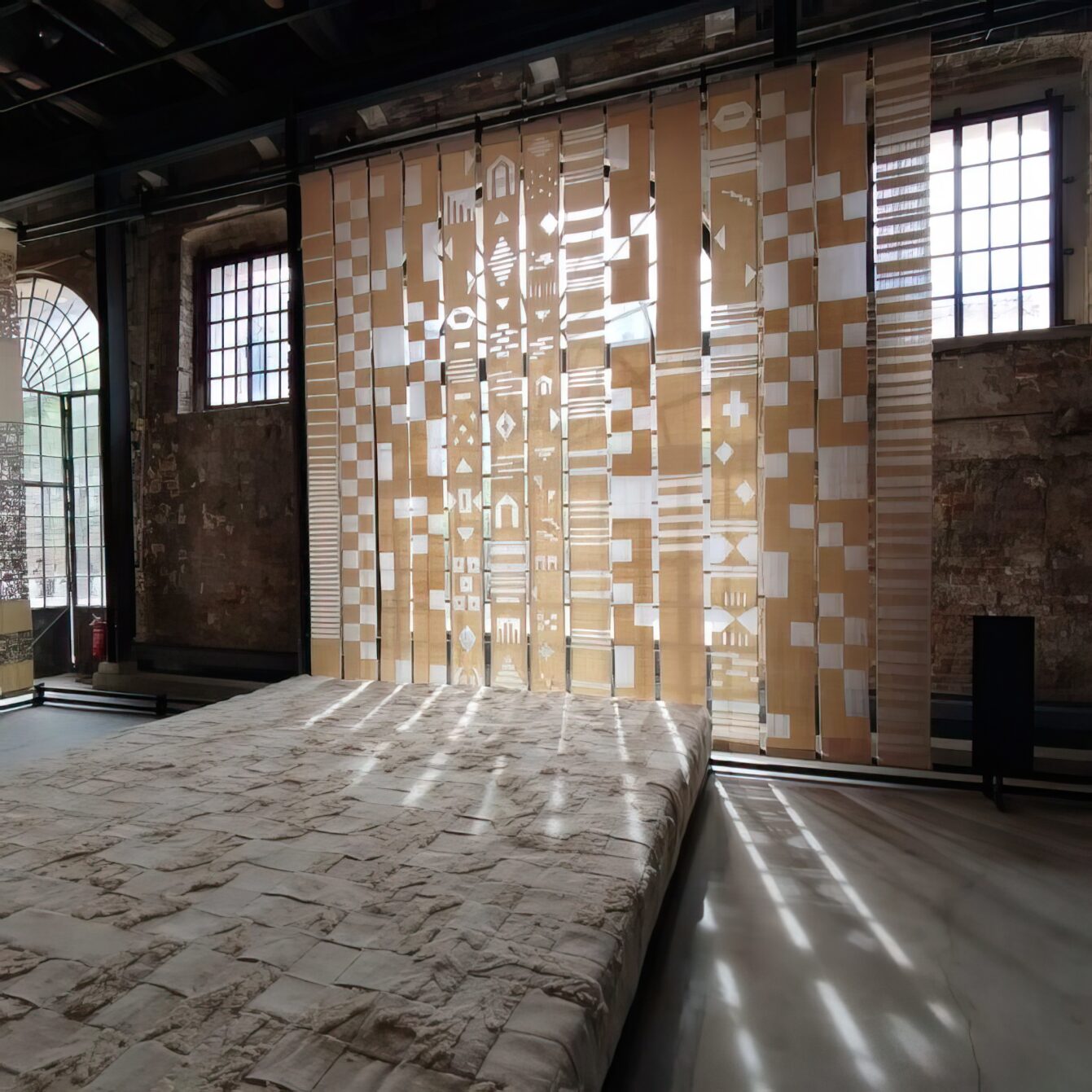
Confronted with this coldness, some artists seek a way out through collectivity or lyricism. Italy, curated by Cecilia Canziani, creates a polyphonic world with the natural sculptures of Chiara Camoni. Morocco, curated by Meriem Berrada, sees Amina Agueznay and 166 other individuals transform sacred weaving into a warm threshold of care. Similarly, the Venice Pavilion, curated by Giovanna Zabotti, delivers a masterful acoustic submersion. Faithful to “minor keys,” it transforms the city’s history into an underwater melody—a triumph of lyricism, a beautiful whisper.
In stark contrast to the lyrical submersion of Venice, Holzinger orchestrates a raw plunge into a tank of treated sewage—recycled from the very toilets used by the visitors. She presents an ecosystem out of control, where water is simultaneously a source of life and a reservoir of infection. Here, nature offers no protection; it is a threat, and we are deeply complicit in this pollution.
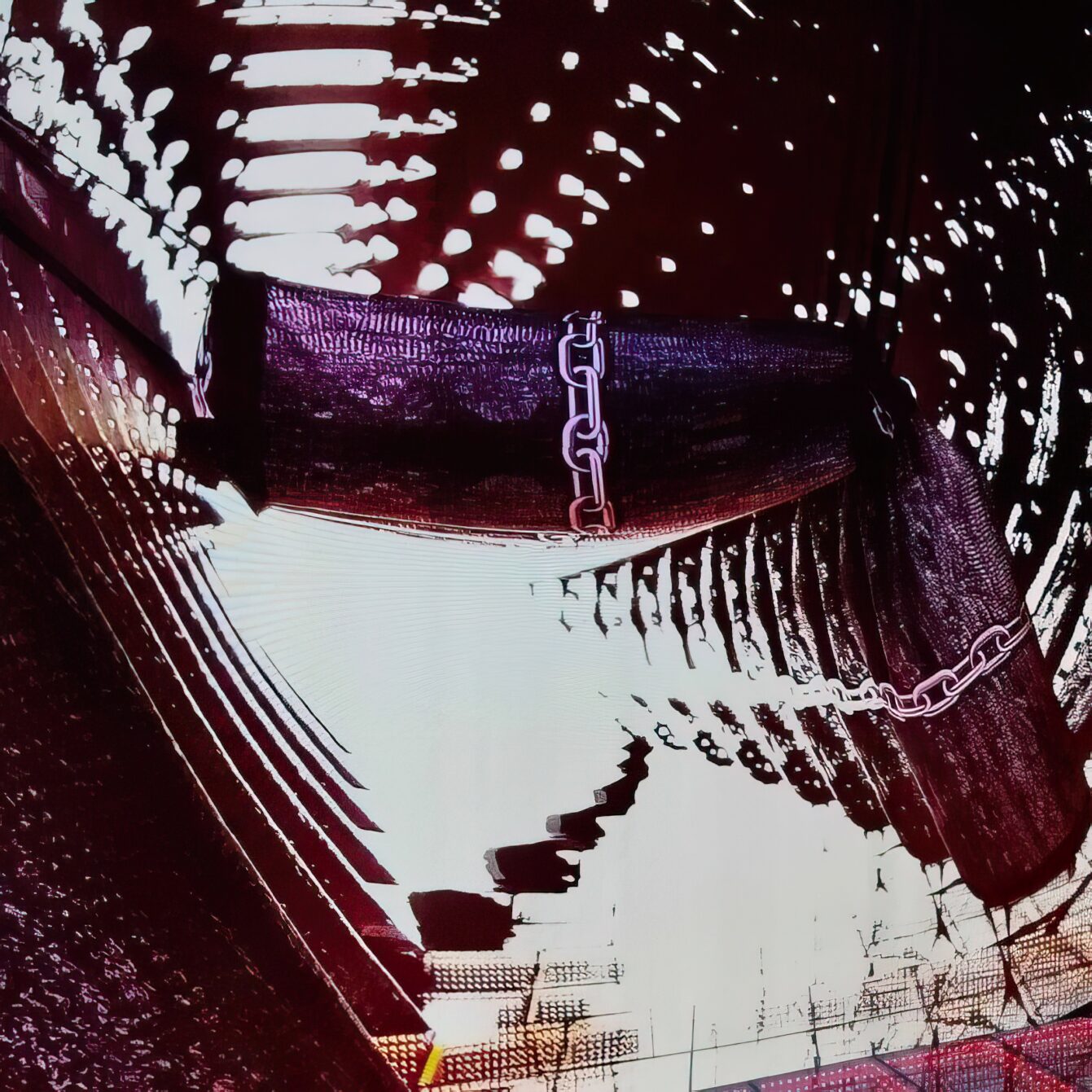
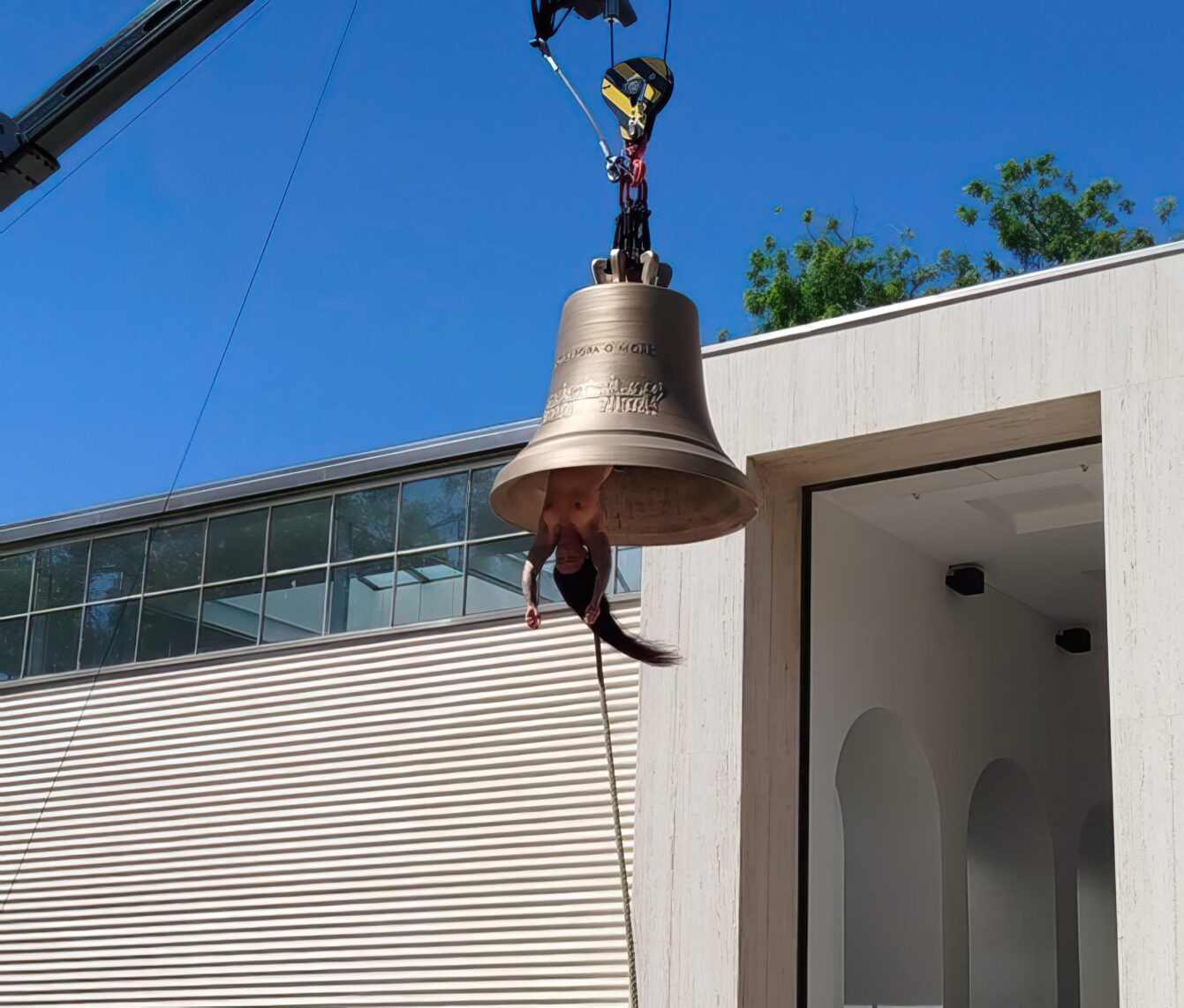
Bosch’s Hell Echoes in the Giardini: But if there is a single moment that encapsulates Austria’s dominance, it unfolds ritually at the turn of every hour. Outside the pavilion, a crane holds a massive bronze bell suspended in mid-air, engraved with Cicero’s words: “O TEMPORA, O MORES!”- Oh the times, oh the customs! Hanging inside it, upside down, a naked female body serves as a human clapper. Austria does not keep “minor keys.” Austria sounds the alarm.
This image, which hits like an electric shock, draws inspiration from Hieronymus Bosch’s The Last Judgment triptych (1486). Yet, Holzinger rejects Renaissance theology and redefines sin. Humanity is no longer punished in an afterlife for its moral transgressions. The consequences of our “sin”, our arrogance toward the ecosystem, are experienced now, in real-time. The bell does not toll mechanically; it is activated by the naked female body. The artist appropriates the symbol to demand social change as well.
These are the reasons why Austria wins. Holzinger leaves us no room for theoretical distance. She forces us to raise our eyes upward. Her presence is an act of unwavering resolve; she finds it impossible to remain silent.
Photo: Austria Pavilion, Photo © & Courtesy Mimika Christodoulopoulou
Info: Venice Biennale 2026, The Giardini, Viale Trento 1260 and the Arsenale, Campo de la Tana, Duration : 9/5-22/11/2026, Days & Hours : Tue-Sun 10:00-18:00, www.labiennale.org/en/