
PREVIEW: Simon Hantaï-The Last Studio:
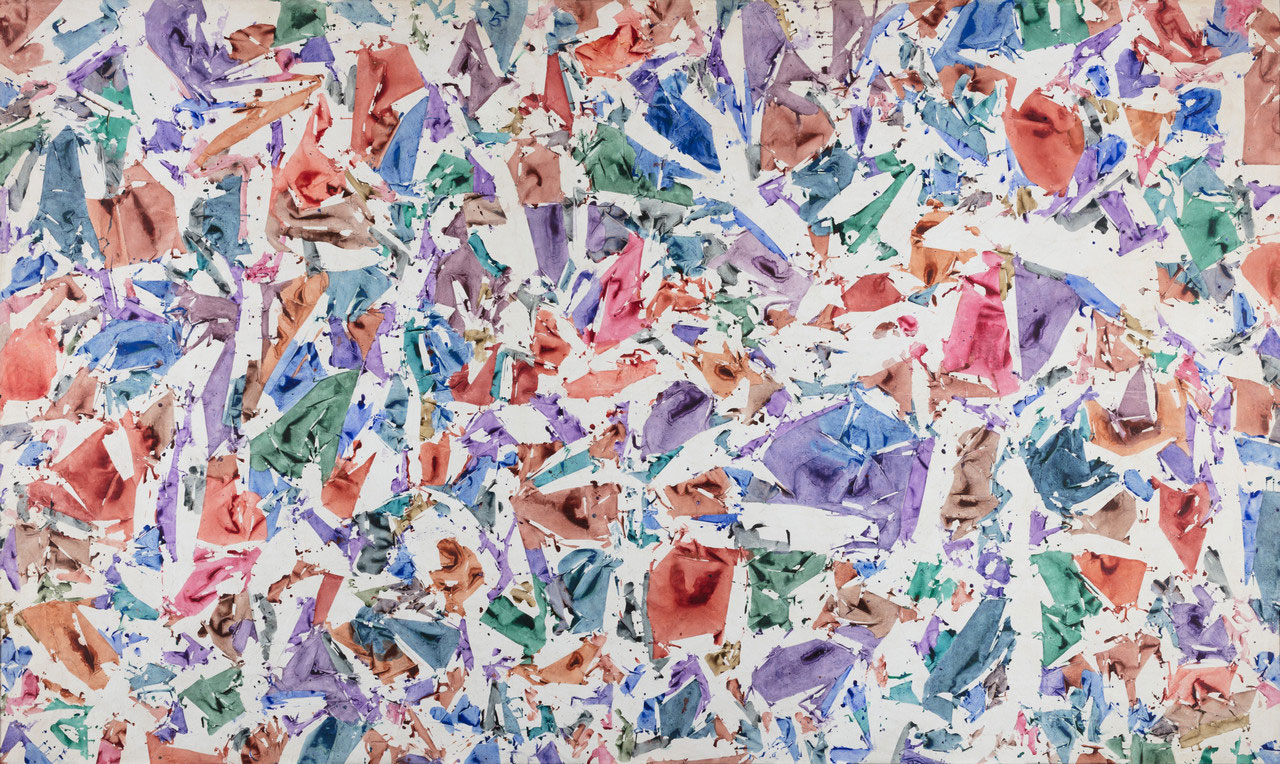
More than four decades after they were created, a remarkable group of paintings by Simon Hantaï is finally taking centre stage. The exhibition “Simon Hantaï: The Last Studio” presents sixteen works from the artist’s elusive “dernier atelier” (last studio) series, painted between 1982 and 1985 during one of the most enigmatic periods of his career. Never exhibited during Hantaï’s lifetime, the paintings offer an extraordinary glimpse into the private creative world of an artist who fundamentally changed the language of post-war abstraction before choosing to retreat from public view.
By Efi Michalarou
Photo Gagosian Archive
“Simon Hantaï: The Last Studio” revisits a pivotal yet often overlooked chapter in the career of one of Europe’s most influential abstract painters. Known for inventing the revolutionary pliage (folding) technique, Hantaï transformed the act of painting into a dialogue between intention and chance. His folded canvases, opened only after layers of pigment had been applied, generated luminous compositions in which colour and untouched canvas coexist in complex, rhythmic structures. Over the course of three decades, this deceptively simple process produced one of the most original bodies of work in twentieth-century painting. “The Last Studio”demonstrates that Hantaï’s artistic evolution did not end with the celebrated “Tabulas”or his acclaimed representation of France at the 1982 Venice Biennale. Instead, it reveals an artist continuing to experiment in relative isolation, expanding the possibilities of folding, layering and paint in ways that remained hidden for decades.
Born in Bia, Hungary, in 1922, Hantaï studied at the Budapest School of Fine Arts during the turbulence of the Second World War. In 1948, he left Hungary for Paris on a government scholarship, but political upheaval following the Soviet consolidation of power resulted in the withdrawal of his grant. Rather than return home, Hantaï chose to remain in France, a decision that would shape the trajectory of European post-war painting.
His early years in Paris coincided with the final flourishing of Surrealism. After meeting André Breton in 1952, Hantaï became associated with the movement, producing paintings filled with hybrid creatures, dream imagery and symbolic narratives. While Surrealism offered an intellectual framework, it ultimately proved too restrictive for an artist increasingly interested in the physical act of painting itself.
A decisive turning point came through his encounter with the work of Jackson Pollock. Pollock’s radical reimagining of painting as an arena of action rather than representation profoundly affected artists across Europe, and Hantaï was no exception. Breaking with Breton and the Surrealists in 1955, he embarked upon an entirely new investigation into gesture, process and materiality.
Unlike Pollock, however, Hantaï sought a method that would deliberately remove aspects of conscious control from painting. His solution was pliage. Instead of painting directly onto a stretched canvas, he folded, crumpled and knotted the fabric before covering its exposed surfaces with pigment. Only after the painting process was complete would the canvas be unfolded, revealing intricate constellations of painted forms and untouched reserves.
The method fundamentally altered the relationship between artist and image. Rather than composing a painting conventionally, Hantaï established a system in which the folded canvas itself became an active participant in determining the final composition. The balance between accident and intention produced works that appear simultaneously spontaneous and rigorously structured, qualities that distinguish Hantaï from both American Abstract Expressionism and European geometric abstraction.
Throughout the 1960s and 1970s, he refined the technique across celebrated series including “Mariales”, “Catamurons”, “Meuns”, “Études” and “Tabulas”. Each body of work explored new possibilities of scale, color and repetition, while maintaining folding as the essential conceptual framework. By the late 1970s, Hantaï had become one of France’s most respected living painters, exhibiting internationally and influencing generations of younger artists.
His selection to represent France at the 1982 Venice Biennale appeared to mark the culmination of this extraordinary ascent. Instead, it became the beginning of an unexpected withdrawal.
Following the Biennale, Hantaï gradually retreated from public exhibition, refusing to show new paintings until 1998. His absence fuelled a certain mythology around both the artist and his work. While museums and collectors continued to celebrate the major pliage series, relatively little was known about what Hantaï continued to produce behind the closed doors of his studio.
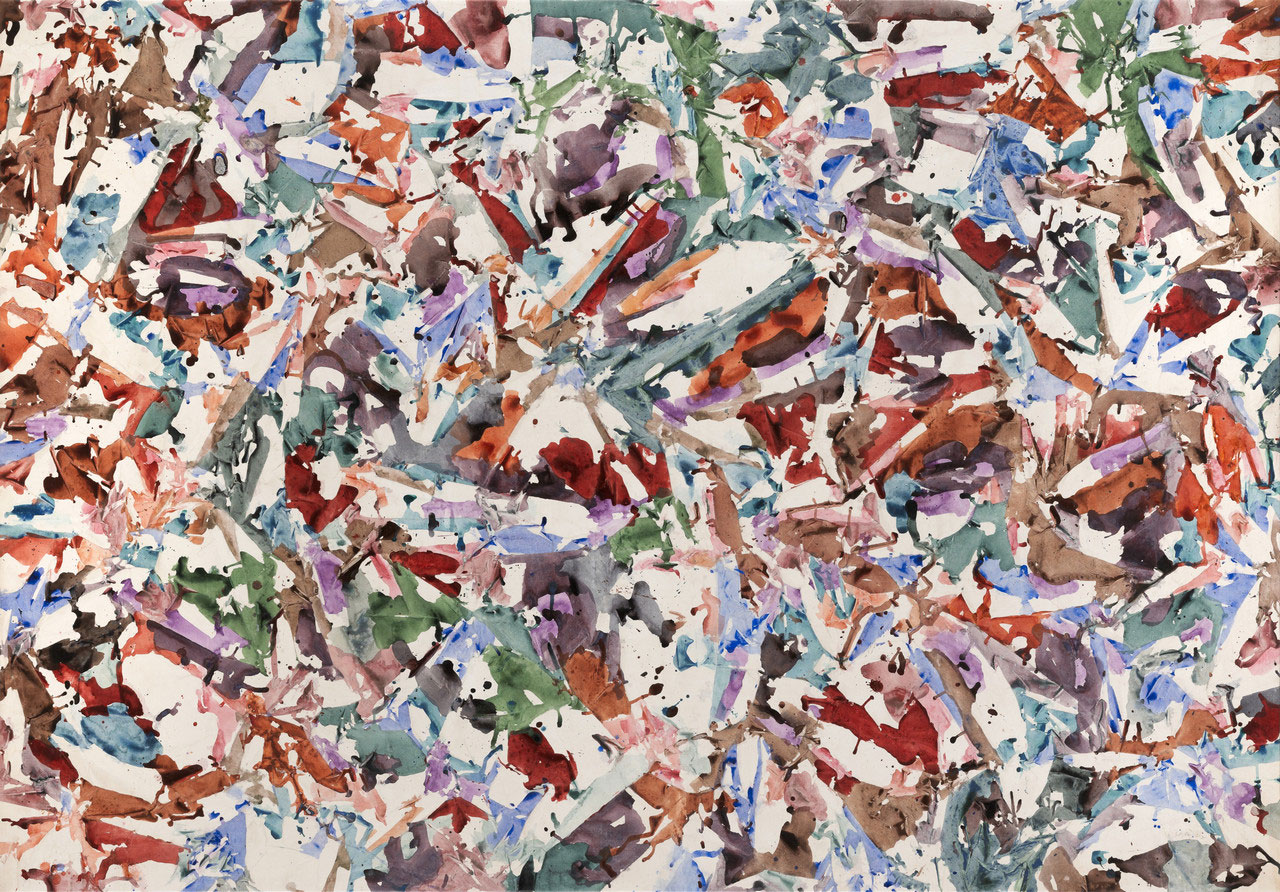
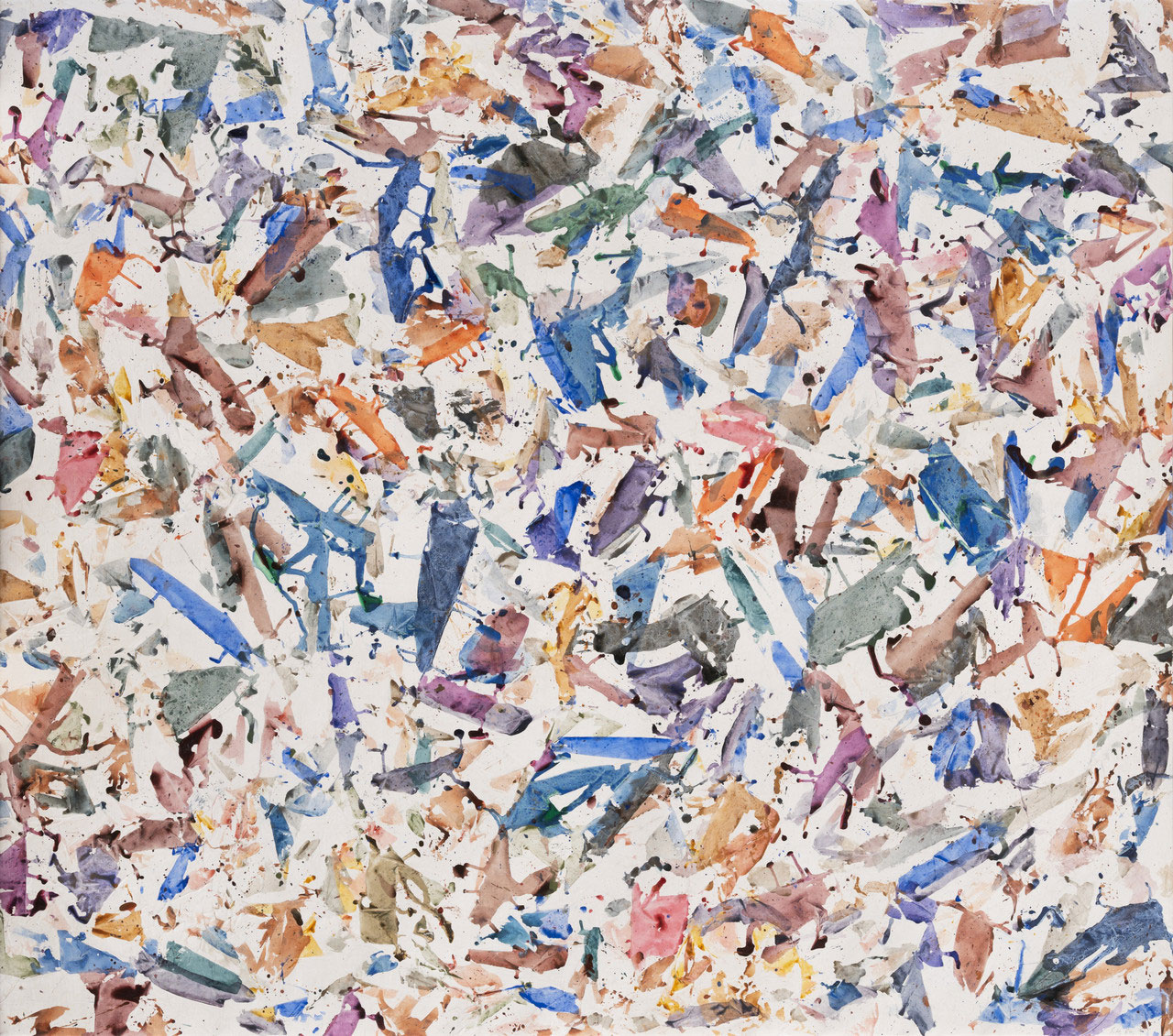
It is precisely this period that forms the focus of Gagosian’s exhibition. The sixteen paintings gathered in Gstaad belong to what has become known as the “dernier atelier” or “last studio” series. Distinguished by richly saturated color and unusually fluid surfaces, they extend Hantaï’s folding process in unexpected directions. Wet folded canvases allowed paint to drip naturally along the creases, introducing new chromatic relationships while preserving the structural logic established by the folds themselves.
These paintings also demonstrate an increasing freedom from the expectations of exhibition-making. Working privately, Hantaï experimented with overlapping canvases, repeated reductions, cropping, tearing and refolding. Rather than treating each painting as an isolated object, he developed them as interconnected components of an evolving studio environment.
Among the most compelling works in the exhibition are examples from “Pliages interminables par réductions successives” (“Endless Foldings Through Successive Reductions”), in which Hantaï continually transformed existing canvases through cropping, tearing, folding and repainting. These recursive procedures generated increasingly concentrated compositions whose dense chromatic structures seem almost geological in their layered complexity.
What emerges throughout the exhibition is an artist less concerned with producing individual masterpieces than with creating an open-ended system of painting. Baldassari has described the last studio as “a modern myth”—an ecosystem in which painting appears capable of generating itself through the repeated logic of folding. The phrase captures Hantaï’s lifelong ambition to move beyond conventional authorship without abandoning formal precision.
That ambition has resonated strongly with subsequent generations of artists. Long before process-based practices became central to contemporary art discourse, Hantaï had already questioned the traditional authority of the artist’s hand, allowing material, gravity and chance to participate actively in the making of the work. His investigations anticipated later developments in conceptual art, post-minimalism and contemporary abstraction, while remaining rooted in an intensely physical engagement with paint and canvas.
The renewed international interest in Hantaï over the past decade reflects this growing recognition of his historical importance. Major museum exhibitions, expanding scholarship and increasing institutional acquisitions have repositioned him not simply as an important French painter, but as one of the defining figures of post-war European abstraction. Collectors have followed suit, with works from his major pliage series attracting sustained attention in both private and public collections.
Seen in this context, the exhibition represents far more than the presentation of previously unseen paintings. It offers an opportunity to reconsider the final phase of an artist whose withdrawal from public life has often overshadowed the extraordinary originality of his late work.
The exhibition promises something increasingly rare: the chance to encounter paintings that have preserved their sense of discovery. Created in solitude and without immediate expectation of exhibition, the works possess an experimental vitality that feels remarkably contemporary. Their flowing colours, layered structures and evolving systems demonstrate that Hantaï remained restlessly inventive even after achieving international acclaim.
As these long-hidden paintings finally enter public view, they challenge familiar narratives surrounding Hantaï’s career. Rather than an epilogue, “The Last Studio” emerges as a vital continuation of his lifelong investigation into the possibilities of painting itself. In revealing the private experiments of an artist who consistently embraced uncertainty as a creative principle, Gagosian’s exhibition confirms that Simon Hantaï’s final works remain among the most compelling—and perhaps most forward-looking—achievements of post-war abstraction.
Photo: Simon Hantaï, Sans titre (Untitled), 1984, Acrylic on canvas. 115 x 193 inches (292 x 490 cm), © Archives Simon Hantaï/Adagp, Paris, 2026, Photo: David Bordes, Courtesy Archives Simon Hantaï and Gagosian
Info: Curator: by Anne Baldassari, Gagosian, Promenade 79, Gstaad, Switzerland, Duration: 9/7-29/9/2026, Days & Hours: Daily 11:00-18:00, https://gagosian.com/
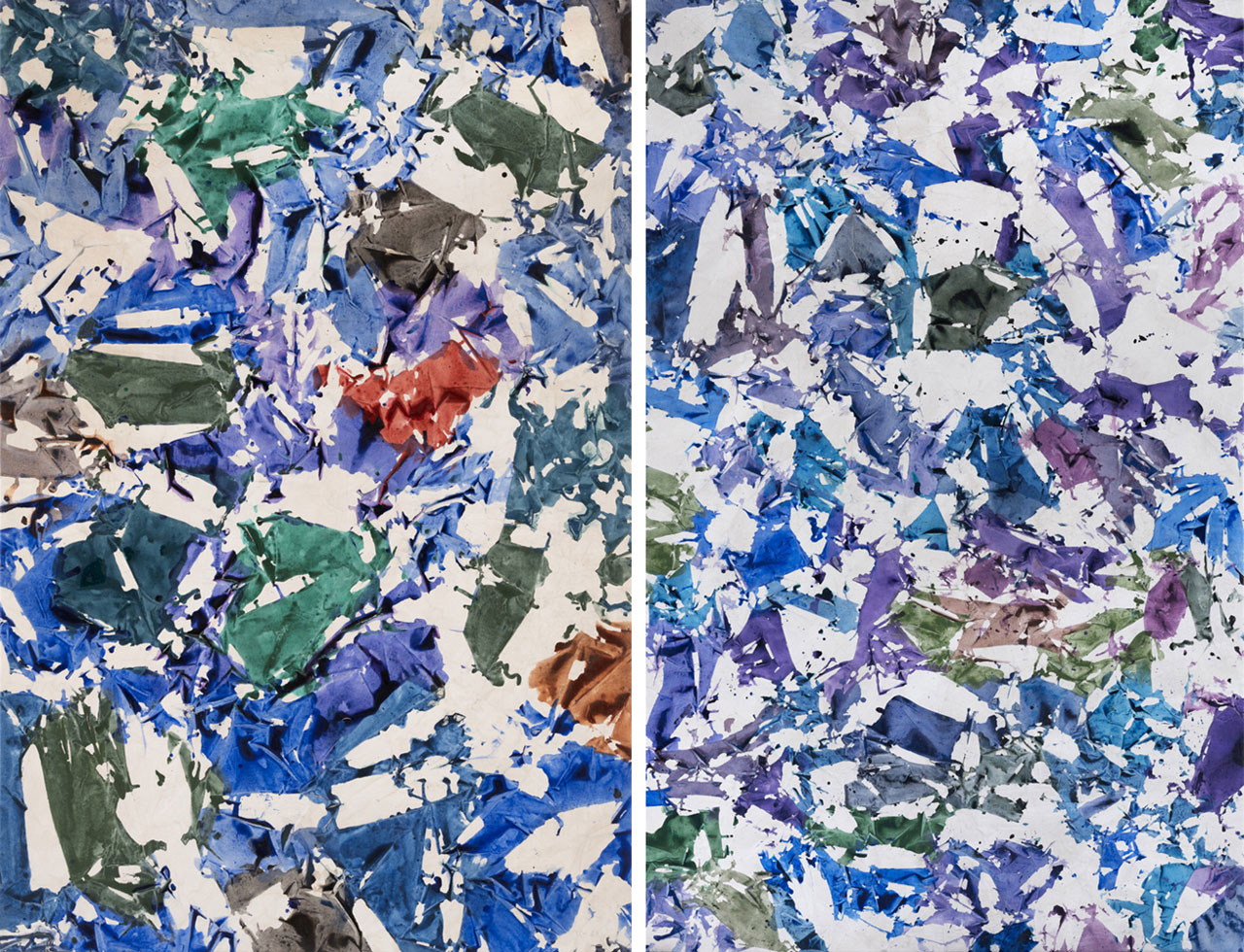
Right: Simon Hantaï, Sans titre (Untitled), 1983, Acrylic on canvas, 93 3/8 x 58 1/8 inches (237 x 147.5 cm), © Archives Simon Hantaï/Adagp, Paris, 2026, Photo: David Bordes, Courtesy Archives Simon Hantaï and Gagosian