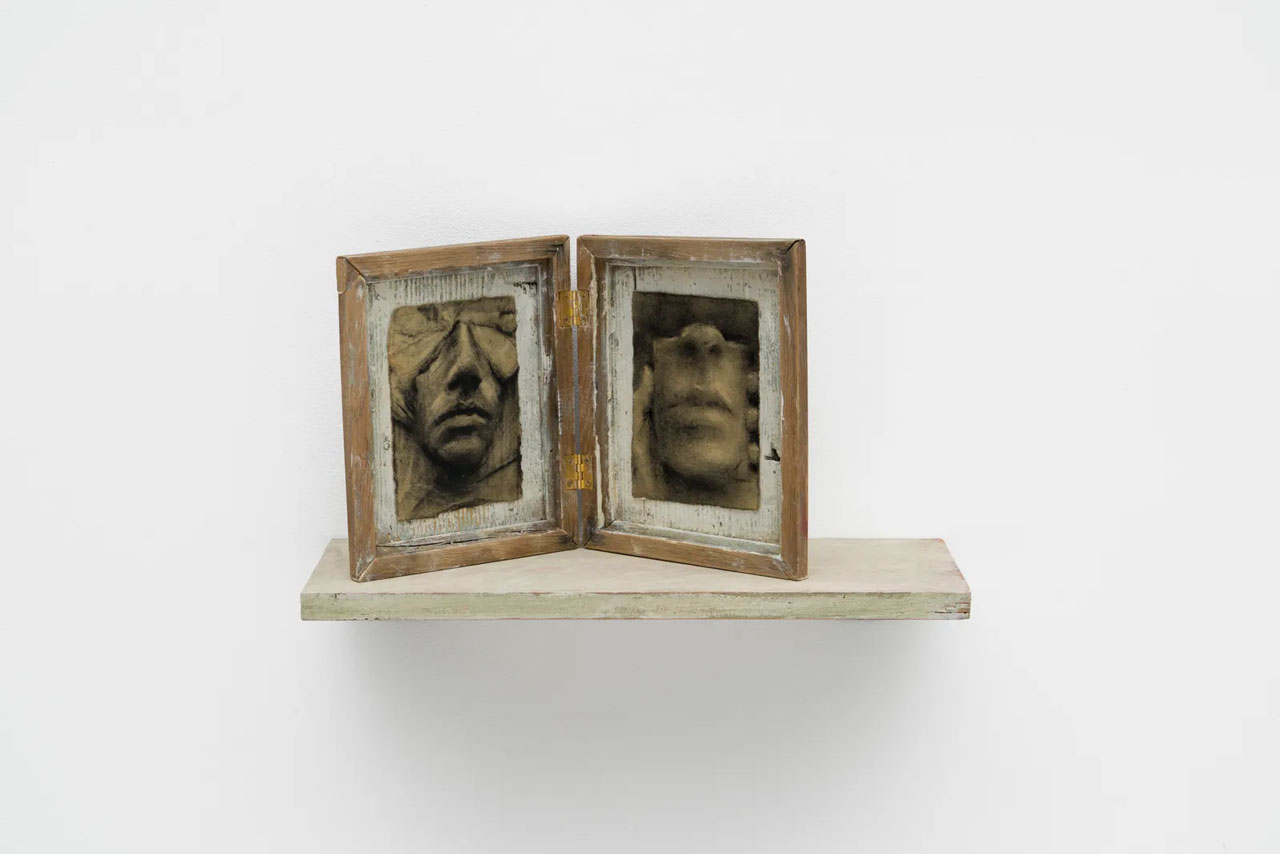
PRESENTATION: You Must Change Your Life
The exhibition “You Must Change Your Life” takes its title from the final line of Rainer Maria Rilke’s poem “Archaic Torso of Apollo” (1918), which has puzzled and inspired readers for more than a century. In this work, written at a time when Rilke was employed as secretary to the sculptor Auguste Rodin, the poet gazes lingeringly at a headless and limbless fragment of Classical statuary, which suddenly and without warning addresses him with the words: ‘For there is no place that does not see you. You must change your life’.
By Efi Michalarou
Photo: GRIMM Gallery Archive
Bringing together an international group of thirteen painters and sculptors, the exhibition “You Must Change Your Life” does not seek to illustrate Rilke’s poem, but rather to trace its multiple preoccupations, and channel its enigmatic atmosphere and orphic energies. Accordingly, |You Must Change Your Life” is concerned with how the past speaks to the present; the animation of materials and art objects by the numinous; the fragment as synecdoche; the persistence of the metaphysical impulse in our material age; the tranquillity, erotics and violence of visual contemplation; and how the human psyche is shaped by the act of seeing, and being seen.
Perhaps the closest work in the exhibition to Rilke’s statue is Matthew Day Jackson‘s anthropomorphic bronze figure, cast from a dead and leafless tree. Two birds roost in its inverted root system, while its branches extend downwards to meet with a geometric support, which sprouts with cast Scotch thistles – a highly invasive plant species that has spread from its native Eurasia across much of the globe. Possessed of an almost Futurist locomotion, Jackson’s striding sculpture might also call to mind the nymph Daphne in Ovid’s “Metamorphoses|, who transformed herself into a laurel tree to escape the infatuated attentions of the god Apollo.
Avian lifeforms also appear in two casein on linen works by Mahesh Baliga, each of which has been painted from memory. While “Bird Watchin0”g (2026) is a portrait of a taxidermied cockatoo, who regards us through lifeless glass eyes, Scream (2026) was inspired by a walk through the grounds of a shuttered Indian zoo, where the artist witnessed a snake zigzagging up a tree trunk to attack a flock of parakeets. Here, this event tips what is at first glance a placid scene into an image in which the inherent violence of the natural world suddenly asserts itself.
In Kinga Bartis’s large scale watercolour and charcoal painting “Realities of seeing” (2026), a group of languid, androgynous figures occupy an ethereal, cloud-wreathed realm, where they watch a huge, disembodied eye float gently by. Informed by the rhythms of Rilke’s poem, this is a work in which looking – and being looked at – inaugurates not asymmetric power relations, but what appears to be personal and collective emancipation. No pictorial element – line, form, colour – feels fixed, here. Rather, everything flows.
The surfaces of Sara Rossberg’s paintings are at once so heavy with pigment and acrylic medium as to be almost sculptural, and so luminous that they appear to be made not from matter but pure, condensed light. Her “You Must Change Your Life” (2021) depicts two side-by-side images of the same woman, who bears a close resemblance to the artist. In one, she turns her back on the viewer, while in the other she stretches out her right hand towards us, as though inviting us into her painted world, where we will find ourselves transformed.
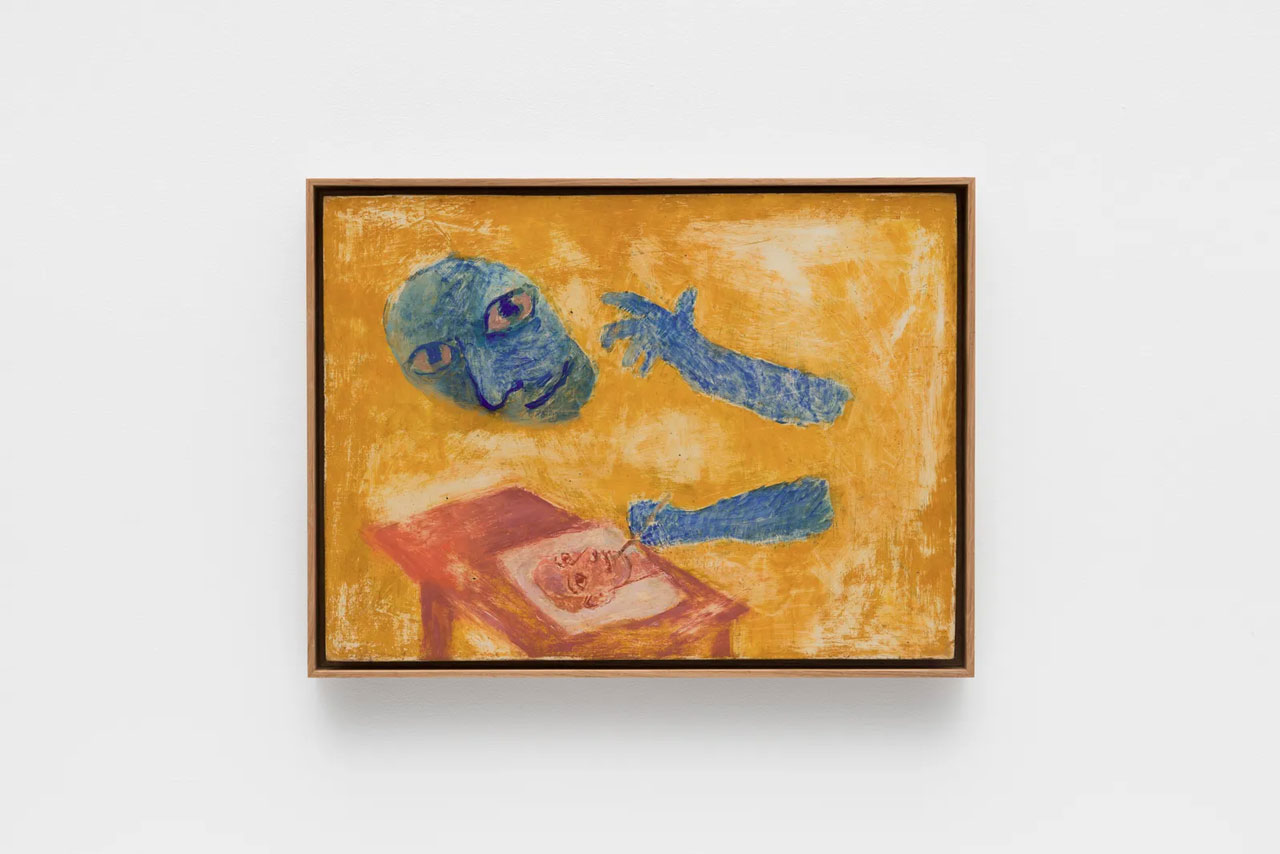
Fashioning (and refashioning) the self is perhaps also the theme of two works by Ken Kiff, one of the key British painters of the later 20th-century. In “Untitled – Blue Arms Drawing” (c.1967-69) and “Untitled – Red Man Painting” (c.1970-74), we see male figures – who may well be Kiff’s avatars – caught in the process of making images of, respectively, a man’s face and a man’s headless body, while staring not at the fruits of their labours but directly out of the work. Who exactly are they are looking at, and whom are they portraying? These are not, it seems, questions that Kiff – a perennially playful, probing artist – was minded to settle.
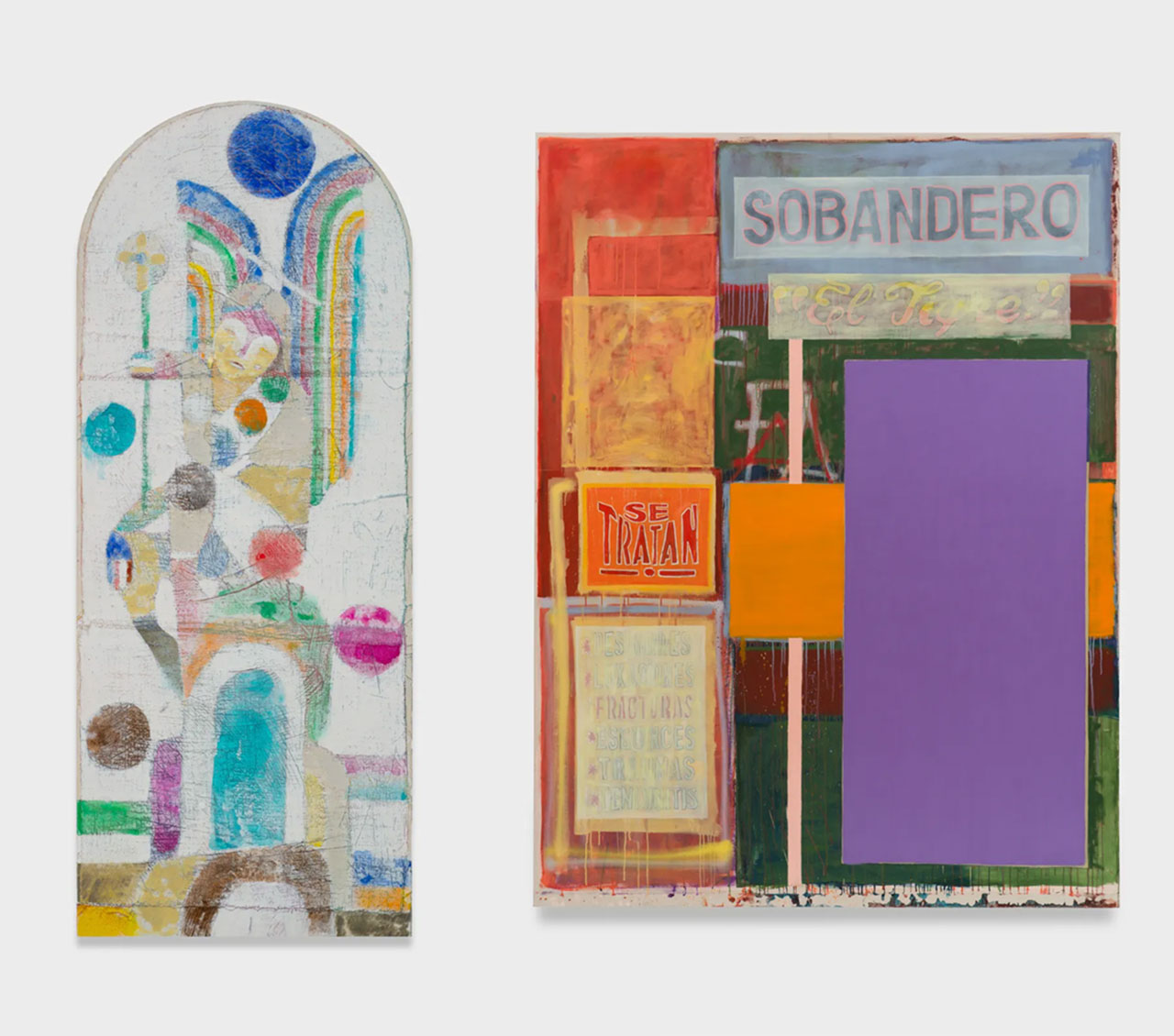
Jhonatan Pulido’s painting “Sobandero No.2” (2026) presents us with the storefront of a traditional Colombian folk healer, hung with handmade signs and posters, among them one listing the ailments that might be cured within. The artist veils this text with a thin wash of white pigment – a formal decision that also summons thoughts of pain fading from the body under the healer’s hands. And yet, we see no pictorial evidence that this business is open, or staffed, or indeed that anything lies beyond its colourful façade. In this work desire – for amelioration, for transformation – is caught in the surface of Pulido’s paint, which it cannot penetrate.
Working primarily with found wood, Anderson Borba creates ambiguous forms that suggest at once Modernist sculptures and the sacral art of an ancient, hitherto unknown culture. Heavily carved, and often coloured with scale-like micro-collages of images cut from books and magazines, these works have a totemic quality, as though they’re not only objects of aesthetic contemplation, but also agents in the world who might be petitioned, for good or for ill.
Higher powers are made manifest in Alexander Tovborg’s pair of paintings on panel “Skyscraper 2” and “Skyscraper 3” (2026). In each work, an angel perches atop what might be a threshold or domed basilica, their rainbow wings at rest, a cruciform flower grasped in their left hands. Occupying a space between the mortal and the divine, these beings were, for Rilke, not the gentle figures of mainstream Christian understanding, but so overwhelmingly beautiful that they defy human comprehension.
Sophie Ruigrok’s painting “Phantom Limb” (2026) and her related pair of drawings Containers (Twice) (2025) depict hands forming figures from clay – a motif that echoes the creation myths of multiple cultural traditions. In the exhibition, these works are placed in dialogue with her painting Life in Widening Circles (2026), which borrows its title from a line of Rilke’s verse, and presents us with an image a nest containing two pale, glowing eggs – primal symbols of the origins of life, and of the feminine.
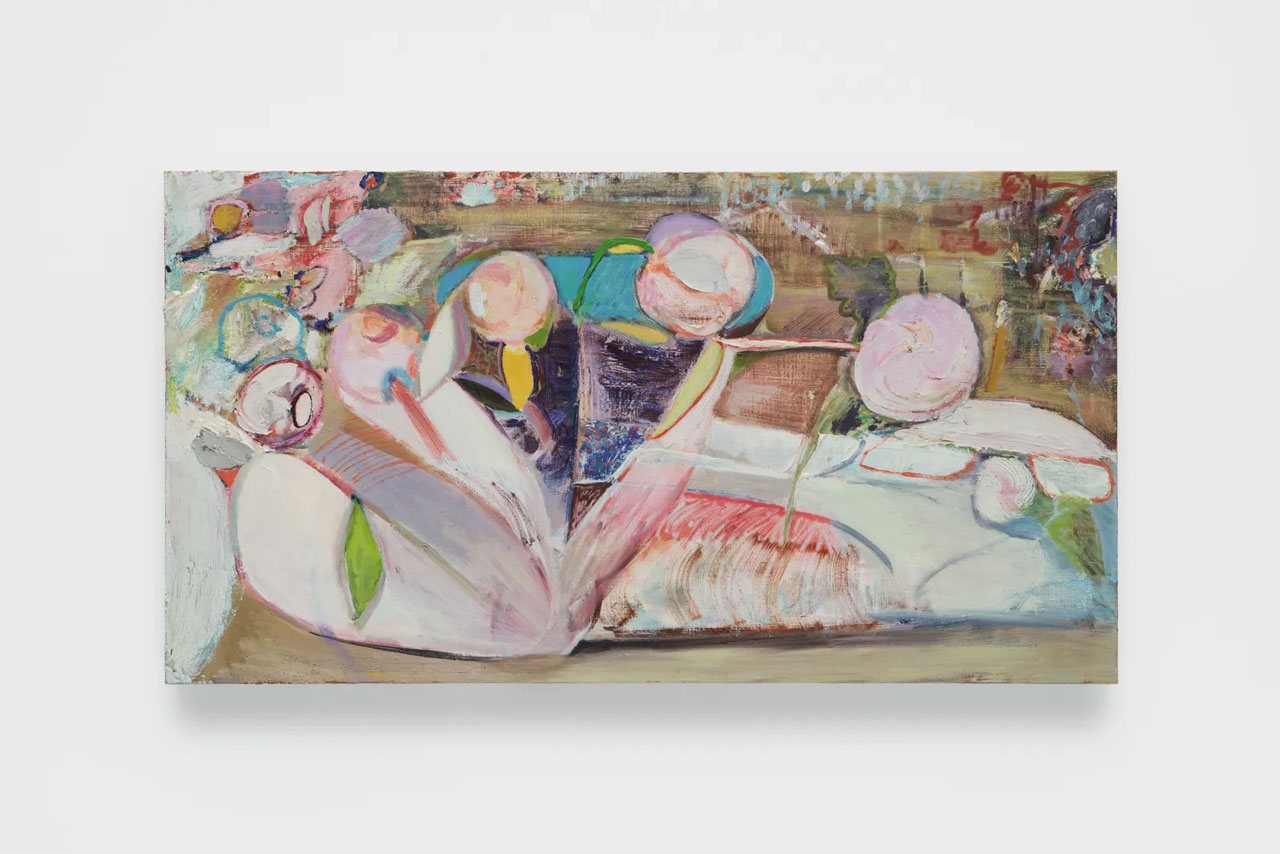
An organic cycle of sorts also seems to be playing out in Gabriella Boyd’s canvas “Peonies” (2026), in which a group of the titular blooms (which here also call to mind heads, or fists) appear to emerge from a pale, supine figure, their arching configuration recalling a pendulum marking the inexorable passage of time. To the right of the work, we detect the presence of a person or animal, in the act of watching over, or perhaps tending to, its prone charge.
Ted Gahl’s “Winsted Road Parkade 2042” (2026) imagines an alternate future, in which a shopping arcade that the artist frequented as boy was not demolished in the 1990s, but rather remained standing into the 2040s – an archaeological relic of a lost consumer age. Looking at this painting, in which a lone figure stalks by the windows of defunct stores, plastered with ageing posters and flyers, we might reflect on paths not taken, roads untrod. Relatedly, Gahl’s “Commuter (w/split)” (2026) depicts a traveller exiting through the aisle of a train car or bus, to alight at a destination – and a future – that we will never know. The titular ‘split’ in the work’s composition perhaps suggests not only a sundering of the image, but of space and of time.
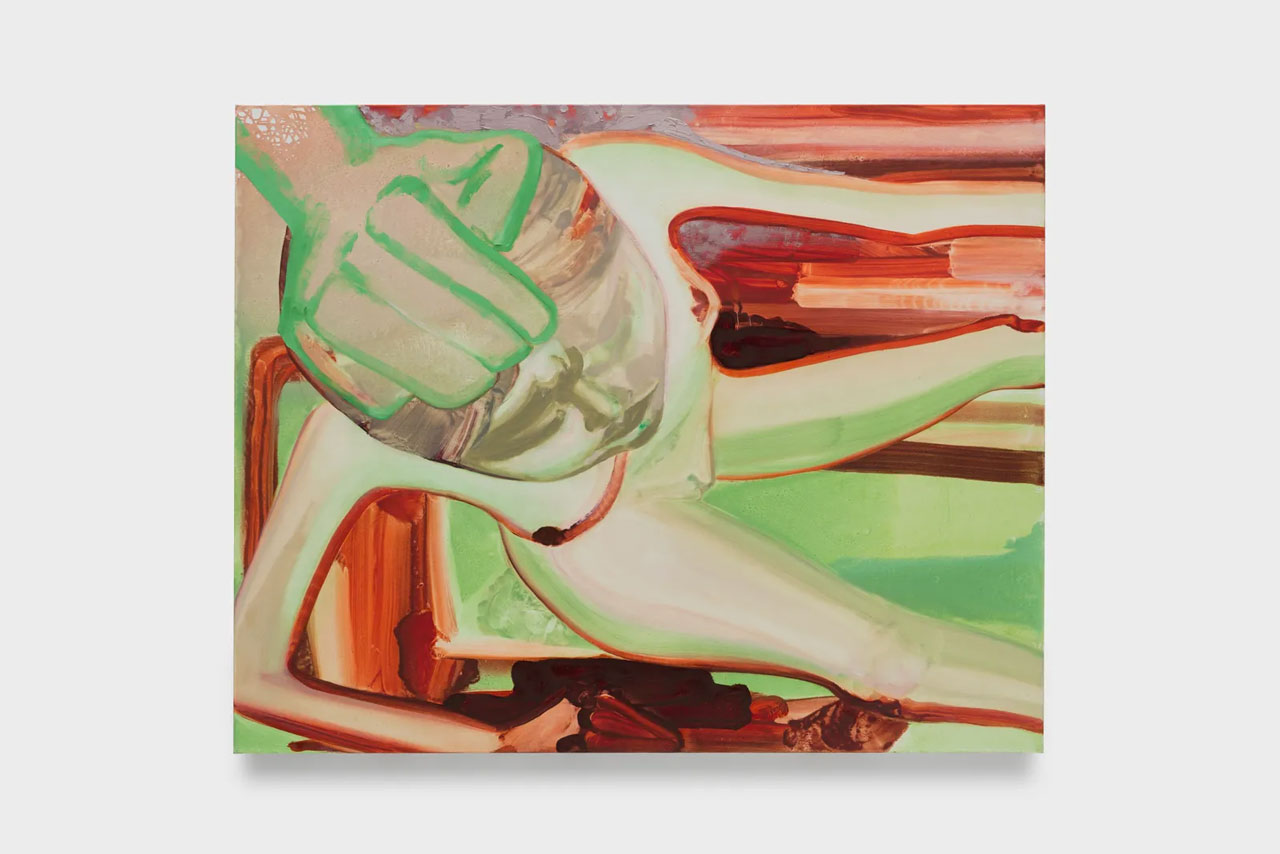
Spatial and temporal disconnection is also a preoccupation of the paintings of Elinor Stanley. In her “Bust” (2026), a closed hand floats above (and in part pictorially summons) the head of a nude female figure, who appears unaware of – or perhaps indifferent to – its presence. Likewise, her “Asking” (2026) pairs an awkwardly-posed androgynous nude with their much smaller near-doppelganger, who we see not straight on, but from a bird’s-eye perspective. Stanley’s use of different painterly registers across the two figures, combined with the subtle illogic of the background foliage, not only asks us to confront our deeply human desire to reconcile the irreconcilable, but also explores how a painting might achieve this, when other forms of thinking may not.
This question is, to a degree, also central to Charles Avery’s “Untitled (Desert Goers with Eidolon)” (2026), in which two distinct aspects of his practice meet. Above the horizon line, we encounter an abstract, curvilinear motif, belonging to his body of work “Eidolorama, we see a party of robed figures and their attendant animals – inhabitants of the imaginary island at the centre of Avery’s epic project, “The Islanders”. Looking at this image, in which two surely incommensurate realities share pictorial space, we might wonder whether the desert goers and the Eidolon are aware of each other, and if so, what the nature of their relationship might be.
Participating Artists : Alexander Tovborg, Elinor Stanley, Sophie Ruigrok, Sara Rossberg, Jhonatan Pulido, Ken Kiff, Matthew Day Jackson, Ted Gahl, Gabriella Boyd, Anderson Borba, Kinga Bartis, Mahesh Baliga, Charles Avery
Photo left: Charles Avery, Untitled (Desert Goers with Eidolon), 2026, Acrylic and gesso on linen, 170 x 120 cm | 66 7/8 x 47 1/4 in, Courtesy the artist and GRIMM Gallery, Photo right: Anderson Borba, The Hover, 2024, Wood, gilt cream, oil painting, wood stain, spirit stain, sawdust, linseed oil, and metal plate, 153 x 40 x 19 cm | 60 1/4 x 15 3/4 x 7 1/2 in, Courtesy of the Artist and The Approach, London
Info: Curator: Tom Morton, GRIMM Gallery, 54 White Street, New York, NY, USA, Duration: 26/6-7/8/2026, Days & Hours: Tue-Sat 11:00-18:00, https://grimmgallery.com/
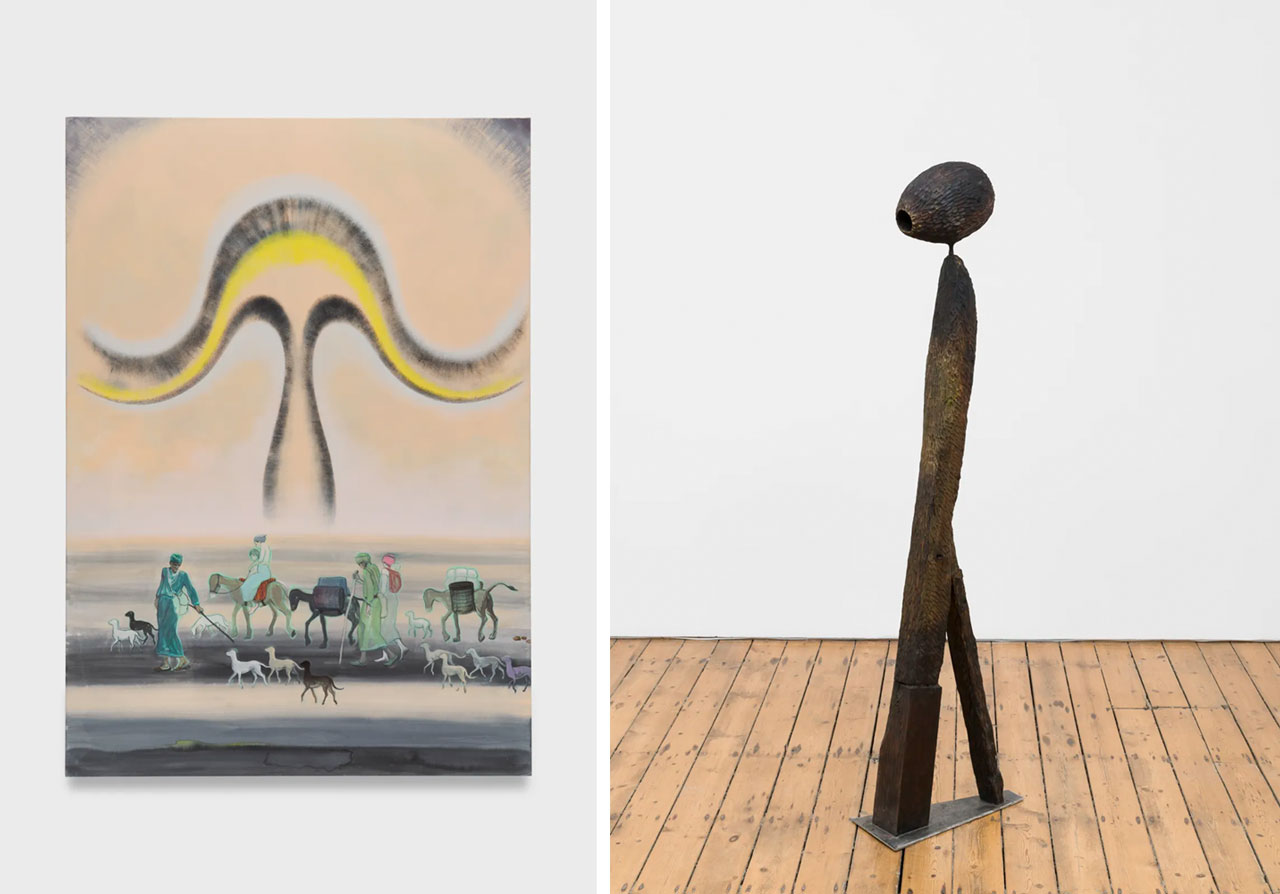
Right: Anderson Borba, The Hover, 2024, Wood, gilt cream, oil painting, wood stain, spirit stain, sawdust, linseed oil, and metal plate, 153 x 40 x 19 cm | 60 1/4 x 15 3/4 x 7 1/2 in, Courtesy of the Artist and The Approach, London
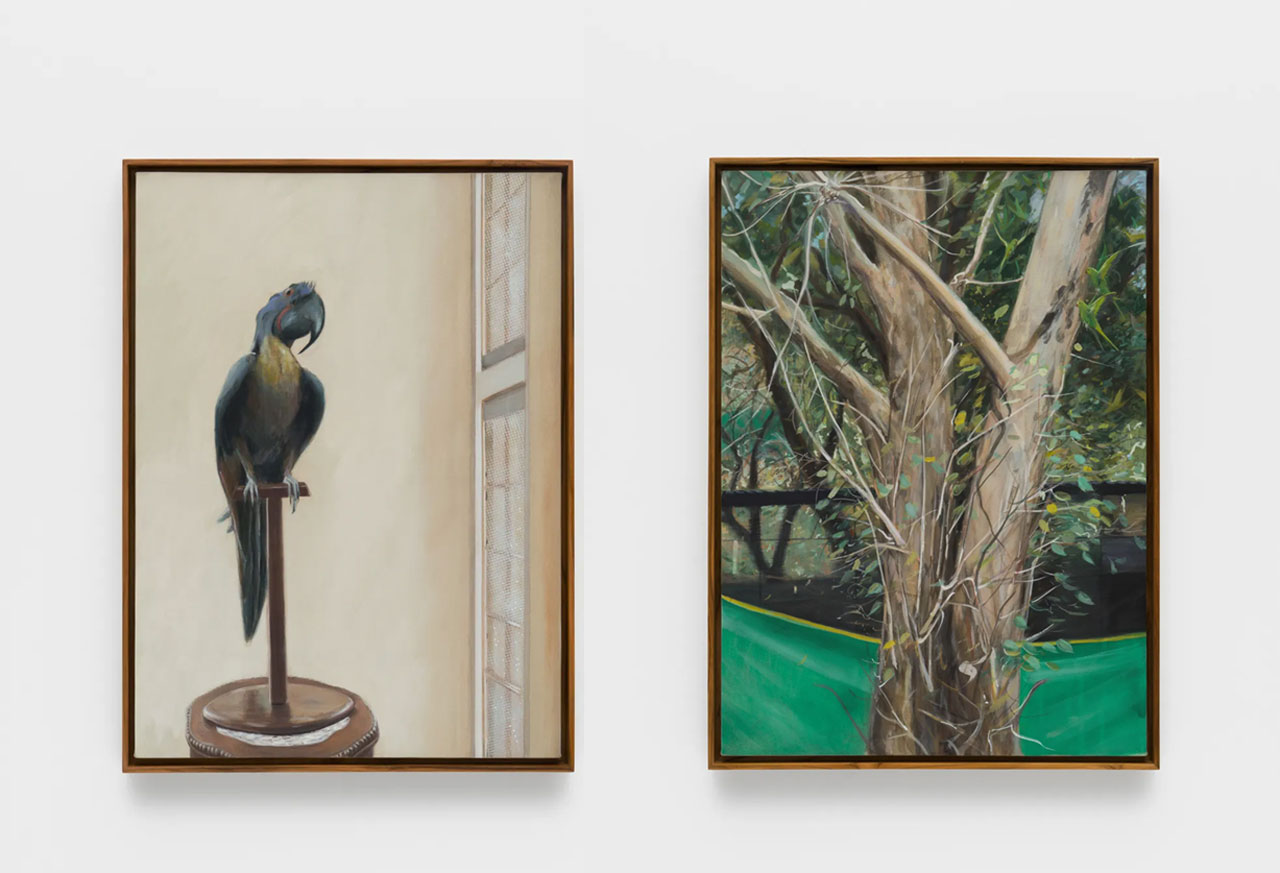
Right: Mahesh Baliga, Scream, 2026, Casein on linen, framed, 80.6 x 58.4 cm | 31 3/4 x 23 in, Courtesy of the Artist and Project 88 Gallery
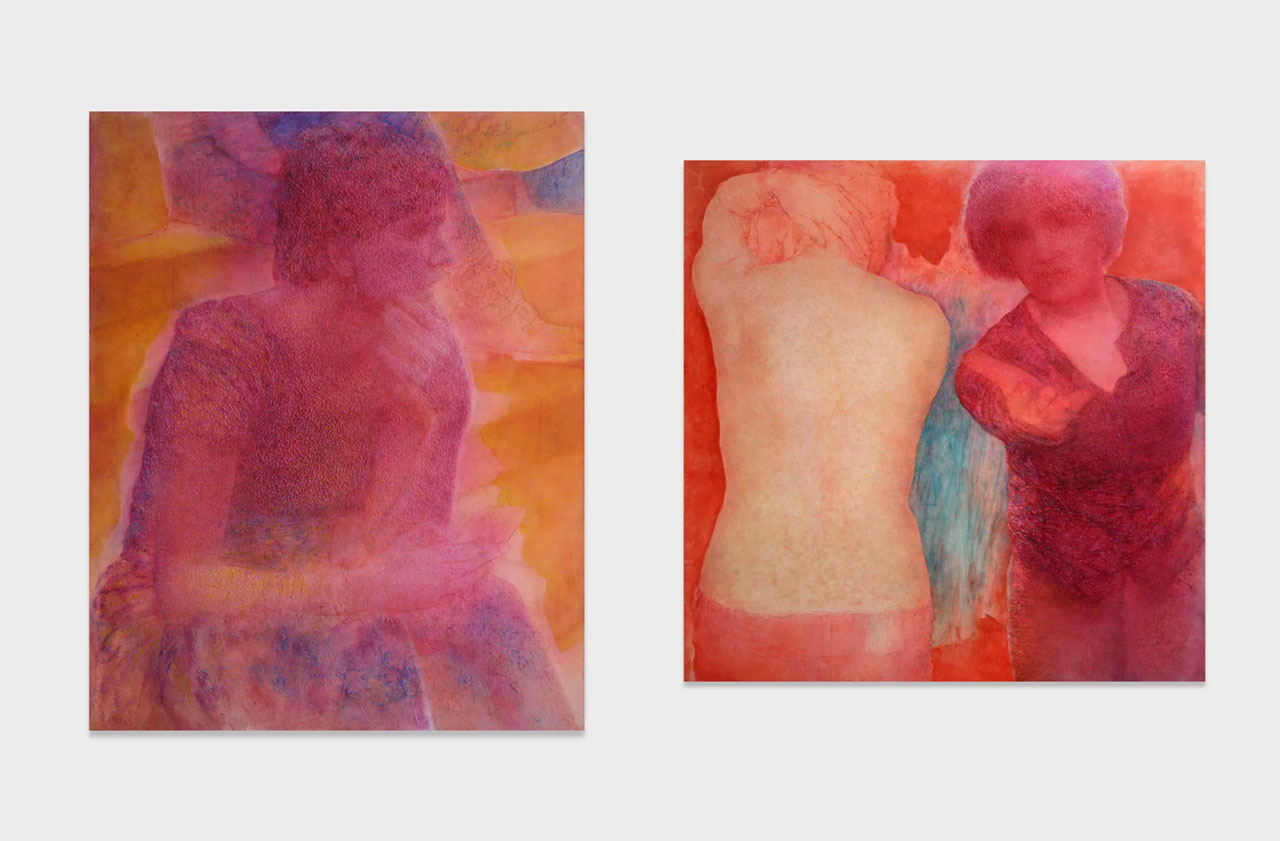
Right: Sara Rossberg, You Must Change Your Life, 2021 , Acrylic medium and pigment on canvas, 200 x 200 cm | 78 3/4 x 78 3/4 in, Courtesy the artist and GRIMM Gallery