INTERVIEW: Panos Charalambous
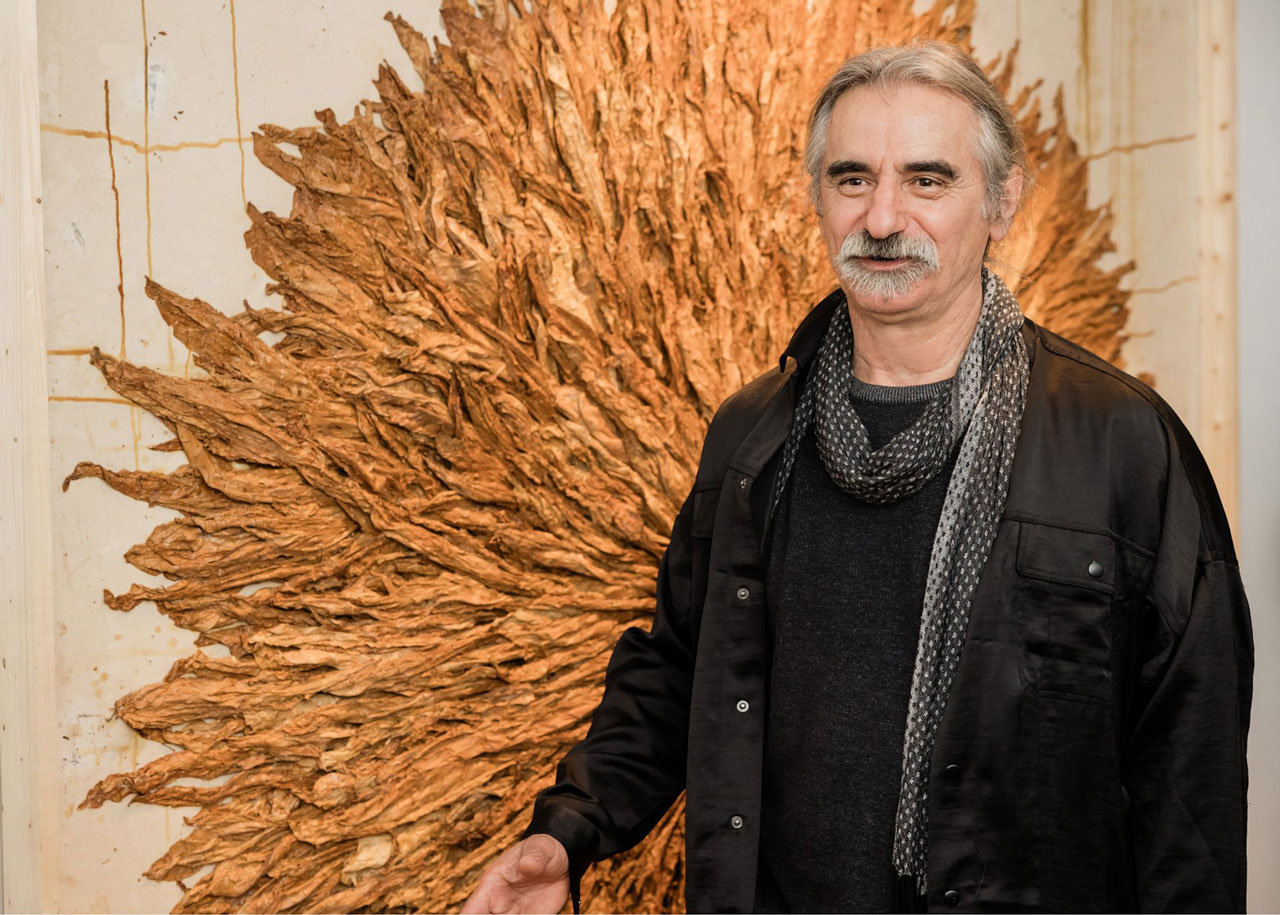
Panos Charalambous is widely considered one of the most significant and influential visual artists on the contemporary Greek art scene. With a long career that seamlessly weaves together artistic research, academic teaching—as professor emeritus and former Rector of the Athens School of Fine Arts (ASFA)—and a strong international presence in landmark exhibitions such as documenta 14 (Athens and Kassel, 2017) and the 58th Venice Biennale (2019), Charalambous has forged a distinct artistic idiom centered on time, memory, and loss. On the occasion of his new solo exhibition at Citronne Gallery in Athens, titled “COLUMBIA – Die Ruinen von Athen” (The Ruins of Athens), we met within the exhibition space. What followed was a wide-ranging, comprehensive conversation charting his journey from childhood and the primal impulses that drew him into the magical world of art, to his current practice and his philosophical stance toward life and creation. It is a conversation that traces the path of a renowned artist, reconfirming the mystifying, ritualistic nature of his work, as well as his “retrospective” relationship with life itself, as he transforms fragments of the past into active vessels of memory…
By Valia Katsimpa
Photo: Citronne Gallery &Valia Katsimpa’s archive
When did you realize that you wanted to become actively involved in the world of art? Could you share specific events or individuals who influenced this choice?
Panos Charalambous: In the beginning, it was an inclination, a symptom… which over time transformed into a fierce desire! When thought retroactively initiates the search for the starting point, countless focal points and crossroads spring up at that very moment, preventing it from succeeding. The attempt to analyze the origin of any artistic subject, or any human condition, is simultaneously a dismantling—a disconnecting of the apparent unity of the “EGO.” Yet, it allows lost events to “flourish” across different spaces, positions, eras, and moments.
Perhaps there are certain ancestral images, certain primal sounds, from which one can never truly break free. Such an image, such a sound—elusive by its very nature—might have been the catalyst for an artistic birth. Precisely because people cannot fully “remember,” despite striving to do so, they engage in conjecture; their life becomes a blend of the real and the imaginary!
You have to picture a child “hiding” in a boat tied with a hemp rope… the rope is wet… now it tenses, now it slackens, producing creaks… strange creaks that multiply in the stillness of the landscape and terrify him. To ward off the fear, the child sings popular folk songs he picked up from radio stations and jukeboxes. This is the atmosphere of the Greek countryside in the 1960s, where agricultural production (tobacco farming) dictates the cycles of life and leisure.
Here and now, within this Baroque composition—in this auditory calling, this chord, this fusion—occurs the revelation of escape lines, of transitions from local realities to temporalities… back to the brilliant era of childhood, which “creaks” just like that wet rope!
You have stated in the past: “While others try to define the talented person, I try to define the untalented. Everyone has an inclination, and when they find a clearing, they show it (…)” This statement leads me to believe that your path into education was no accident. Could you tell us a bit about this journey and what you personally gained from your relationship with your students?
P.Ch.: The most fitting version of how events unfold is serendipity, pure chance! Nikos Kessanlis, my teacher, spotted a talent, a capacity for communication, an ability to transmit ideas in me and in a generation of young visual artists during the 1980s… and he helped immensely in integrating me into the Athens School of Fine Arts. From various positions over the years, I tried to prove myself worthy of the favor of a man and an artist whom I admired boundlessly.
I have always been deeply preoccupied with the issues of artistic expression and education as political possibilities—the emancipatory stakes, the equity in the destiny and right of expression for every citizen. Moving beyond aesthetic “policing” and the dominance of conventional styles, I discovered with awe the antinomy of the “untalented,” the “out-of-tune,” the “unsketched,” the “disobedient,” the “dirty.” The pained, the wounded, the betrayed, the stutterer, the broken—these were preeminently the people of passion, the articulators of a profound grievance. These people, along with the animistic farmers and fishermen of labor and toil—celebrating in festive gatherings—solidified within me the priority of a PUNCTUM (as Roland Barthes defined it) over a STUDIUM; of raw experience over the structured studies of colleges and Academies.
The Initiate, the Priest, the Shaman earns the right to subtle transgressions, to skillful mixtures… flinging soil into the sky, splashing mud onto the stars… acting as an interpreter of the flight of omens, an augur, a guardian of ancient dances, sounds, and voices. All of this takes part in an enterprise to “re-enchant” the world, within the framework of a mixed, ingenious peripheral MODERNISM.
You have mentioned before that your role models are not the great artists and curators, but rather everyday folk figures. In a sense, even the opinion of someone “unversed” carries more weight for you than that of someone with a trained eye in art. What makes the spontaneous reaction of a non-expert more interesting? Does this segment of the audience occupy your mind during the “production” of a new work?
P.Ch.: When I refer to folk art and folk expression as a source, I do not dismiss the art history of Forms, the singularity of artworks, style, character, or personalities… it is in their combination that I always place my hope! However, if a certain “emptying out,” a re-virginization within history without metaphysics is not achieved, inspiration and grace become impossible. Folk art (music, dance, crafts, storytelling, etc.) is not a lifeless, stagnant reservoir meant for continuous reproduction—re-released with fewer scratches, restorations, and purifications by contractors of “rebetology” or crypto-colonialists. It is a formative experience of vital importance. It is a clean cut that opposes both folkloric calcification and the republicanism of mere heirs! It is not the revival of a representational, auditory archive. It is action; it is a struggle. The Sarcophagus Bear of tradition is dangerous; once they defang it and feed it honey, it becomes domesticated—fit for a museum—dancing merely for the sake of spectacle.
You have represented Greece in major international exhibitions. Which participations stand out to you, and what did you take away from that process?
P.Ch.: The most important organization, the most significant event to take place concurrently in ATHENS and KASSEL (2015-2017), was DOCUMENTA 14. Since the founding of the modern Greek state in 1830, it literally shook up the numbed minor Greek art scene, which had been deeply traumatized by the financial and socio-political crisis.
What could be more paradoxical than unusual, unimaginable events occurring right in the vortex of a crisis? Yet, the acumen, intuition, and inspiration of the formidable philhellene Polish curator ADAM SZYMCZYK resulted in an event that raised the suspicion of German administrators and caused discomfort among the Greek institutional establishment, both left and right. We saw extraordinary works by artists from the corners of the earth—not necessarily the well-known “Stars”. Questions of emancipation and Democracy in the Global South were raised, alongside issues of contemporary colonialism, ecology, and underdevelopment in the third world. Crucially, it addressed expressive, historical, and aesthetic issues concerning modern Greek history—stretching back to the creation of the first National States by Europeans and Germans acting as the guardians of ancient marbles and the originators of “White” civilization! What a wonderful alignment of stars it was for me to be Rector of ASFA, a selected artist for D14, and head of the 4th Studio.
Looking back today, I can confidently say that the most significant developments occurring later—the operation of National Museum of Contemporary Art, higher standards of art education, advanced curatorial practices—exist in the echo of that period. On the flip side, the tragedy is that as an exceptional, singular, and unusual event, it was largely rejected like a foreign body by the modern Greek intelligentsia and a resentful, localized cultural establishment.
With your current exhibition focusing on the Columbia factory as our point of reference, I would like to return to your earliest musical influences. Let us unearth them through scents, images, and lived experiences… How deeply do these memories operate in shaping your contemporary visual work? Are there musical memories you wish to exorcise, or perhaps the exact opposite?
P.Ch.: The project “COLUMBIA – Die Ruinen von Athen” is an iconography, a staging of imagery. It possesses surface and materiality. It is a world of magic! Everything participates in a functional framework distinct from the flat world of history and historical consciousness, entirely separate from Euclidean “space”. Internal relationships emerge to the surface under the light of the “affinity” inherent in the materials, rendering the world representable—the world as a “curling” of the visible and the unutterable, the invisible and the spoken (to borrow from Michel Foucault). It is then that the destiny of these iconographies aligns and walls itself in with the destiny of the world!
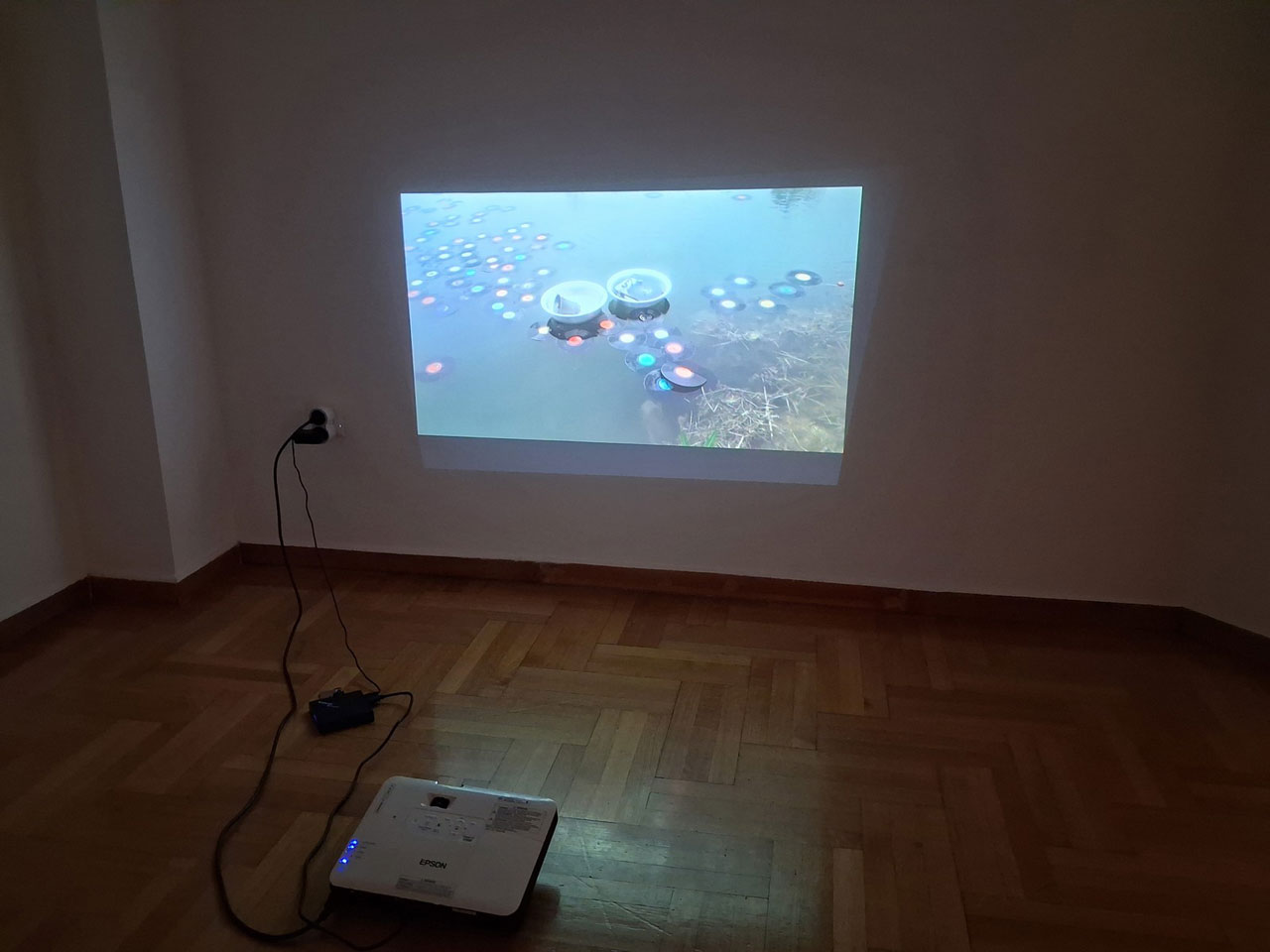
“Installations,” like COLUMBIA in this instance, abandon foundational, tautological approaches and conventional normalcy; they transform into states of “emergency.” The “glass dancer,” walking on waves, leaping over fires and burning coals, wandering through ruins of vinyl (RITUAL OF THE PASSAGE), moving in a hallucinatory state… ensures the sacredness of the space through bodily actions; he establishes it! Feasts, rituals, celebrations, and revelries are organized as opportunities for a clean break from the established order. It is impossible to speak of these things unless the soul (psychic tone, STIMMUNG) and the body (muscle tone) are fully engaged. It is a physiology!
There are no prescribed methods of reconnection (Religio = Religion, Religere = To reconnect), despite the dictates of legal heirs, successors, and descendants. Every religio is singularly brilliant! Ultimately, the art of making these installations is a liturgy performed by other means!
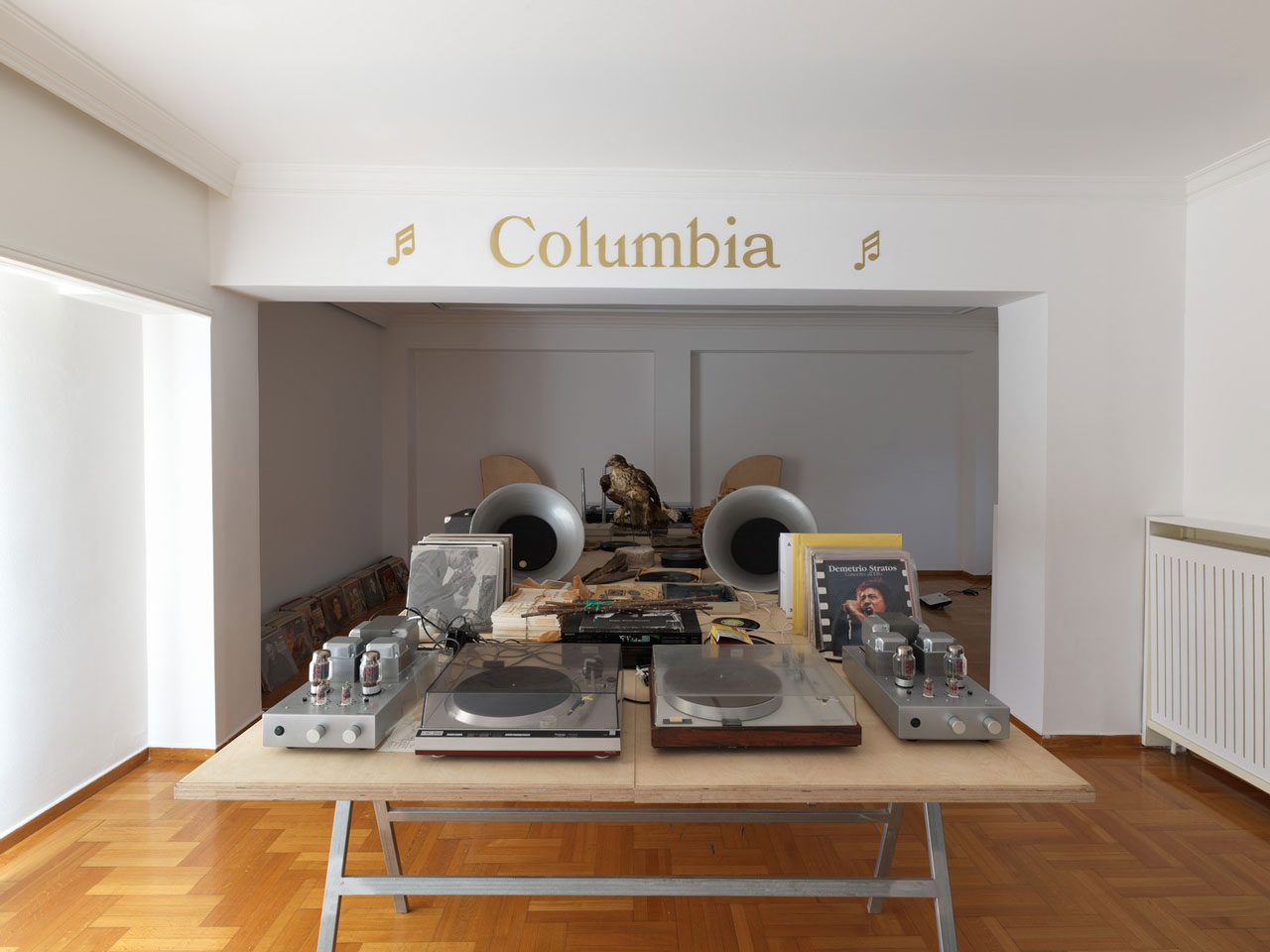
AUDIO ROOM: a “personal” still life, a contemporary cabinet of curiosities, or even a form of an epitaph. What is the reasoning behind reusing and linking these seemingly disparate objects in this installation? Is it an attempt to renegotiate the past through these remnants?
P.Ch.: According to Samuel Beckett, the meeting of the dead and the living takes place in the trash cans! Gazing at the materiality, the visual condition of objects, perceptive and sensitive people arrive at intuitive conclusions regarding the “inner state.” People and objects that are out of “use”, stripped of relationships, “withdrawn” and spent, become devalued and deadened. I am not claiming nor aiming for a rescue or a restoration.
Behind the phenomena and the events, behind the “eternal event” of the Beginning and the “secret of Essence,” another secret emerges: events, occurrences, and things are gradually and accidentally assembled from foreign, “imported” materials, shapes, and matter. Even though there is a human need for a symbolic ordering of the world into “above” and “below,” into the living and the dead… the world, in reality, is a beautiful mess!!
I sense a collector’s passion behind the creation of these installations. To what extent does this passion fuel or shape the final outcome of these works?
P.Ch.: Record libraries and collections are monuments of subjectivity! They emerge as Loci (places) where the constantly “deferred rendezvous” between the archaic and the contemporary takes place. The Before meets the Now! In the past, we do not seek historicity, but rather synchronicity, simultaneity!
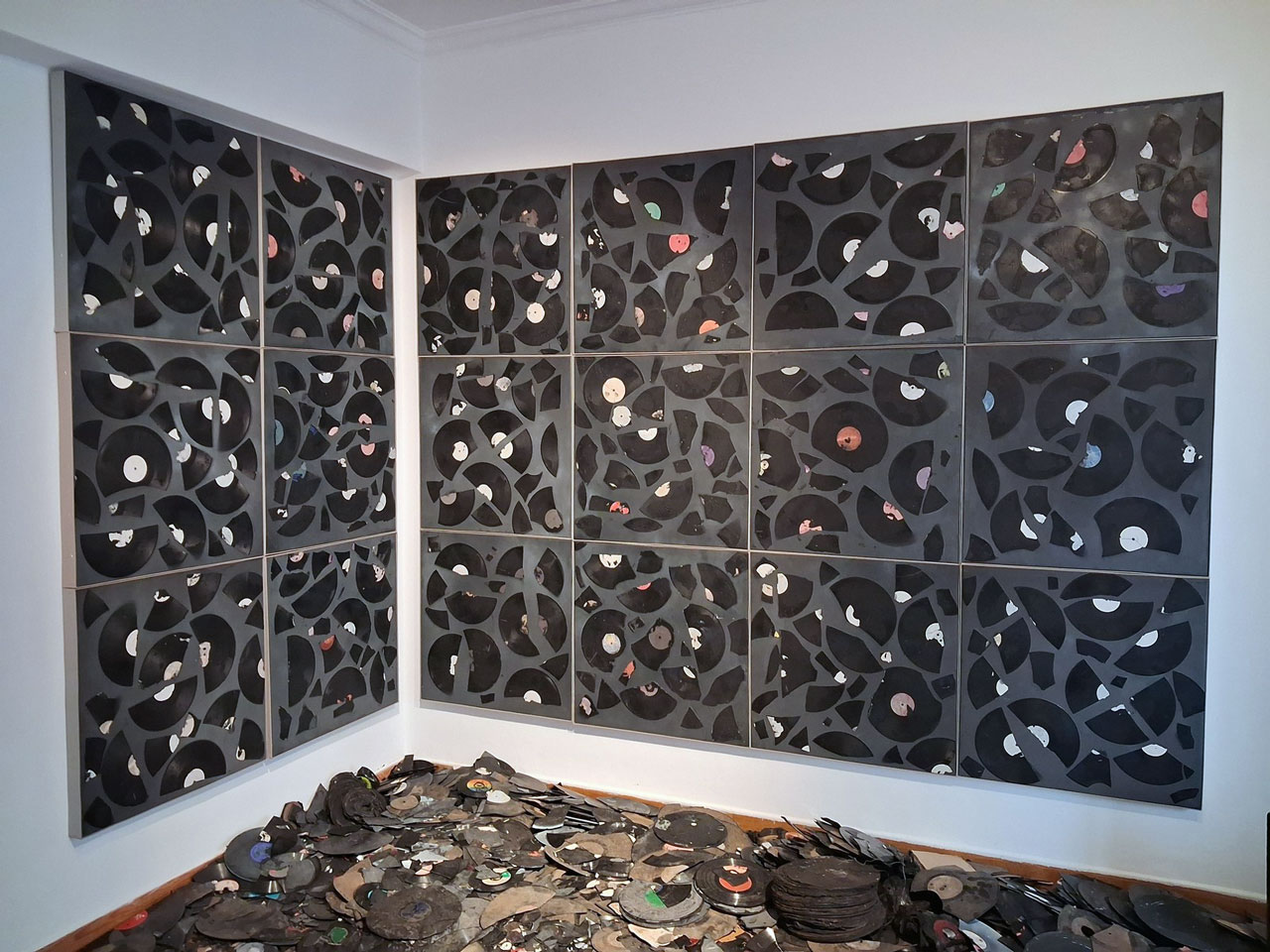
The grooves, the scars, the “scratches,” the wounds—whether violent, deliberate, or accidental—on vinyl records allow unexpected sonic adventures to bleed through. Take, for instance, the records of Mikis Theodorakis destroyed by the censorship of the 1967 Junta. The recorded voices of the dead (D. STRATOS, T. Karnavas, K. Chronis, M. CALLAS) are much more than simple imprints. They are sonic vectors that disrupt any transient calm; they resonate as voices of an impending crisis… they startle wild birds… the fog recedes… time is cut in two!
Survival through loss is a recurring motif in your work. Does this affection for everything ephemeral—anti-monumental, I would say—reflect an attitude of indifference or even defiance toward the sweeping power of death?
P.Ch.: Because a love for life governs me, I do not disregard death! Death is not the END! It is a boundary, a threshold, and we possess the ability to find ourselves on both sides of it. Funerary cares, tiny details, the small daily deaths (“death in installments”), memorial services, the exhumation of bones… there is no fruit in life that does not carry death within it, as Thomas Mann warns us in The Magic Mountain—an influence that is highly visible in this exhibition.
Surrendered to the magnetic pull of vinyl ruins (RELICTAS), both the act of finding and the act of listening ascend to a rite of passage. It is a descent and ascent to Hades, where vocal phantoms crowd together, engaging in incantations to dredge up psychic payloads… a Neo-Orphism!!! In order for Eurydice to remain alive, she must not be looked at directly; left unseen, any definitive decisions weaken her… they strike her dead!
How do you view the new generation of visual artists? How different is the hyper-technological landscape in which young people develop today, and what opportunities or limitations do you identify?
P.Ch.: Illness, symptoms, passion, the side effects of an intense life, dehydration, drought, the lack of water… these will render us perpetual suppliants, standing with open arms toward the heavens. Compounding this is the fact that at the final moment before its calcification, crystallization, and polarization, civilization enlists elements of “non-civilization.” It fertilizes itself with “dead,” archaic mythological motifs and intimate performative practices.
At the end of the 19th century, Paris “heard” GAMELAN music from Southeast Asia; it “saw” sculpture from Africa (DOGON), Japanese woodblock prints, and so forth. This is how modern art was shaped…Picasso, Satie, Matisse…! The eternal hope for every contemporary artist, whether young or old, is “the accursed share”, its use or operation within any hyper-technological environment… This reservoir will always be the ultimate regulator of the human condition!
Download Greek Version here
Info: Curator: Tatiana Spinari-Pollali, Citronne Gallery – Athens, 19 Patriarchou Ioakim, 4th Floor, Kolonaki, Athens. Duration: April 29 – June 29, 2026, Opening Hours: Tue, Thu, Fri: 11:00 – 20:00 | Wed, Sat: 11:00 – 16:00. https://citronne.com/
First Published: 25/06/2026
www.dreamideamachine.com
© Interview by Valia Katsimpa
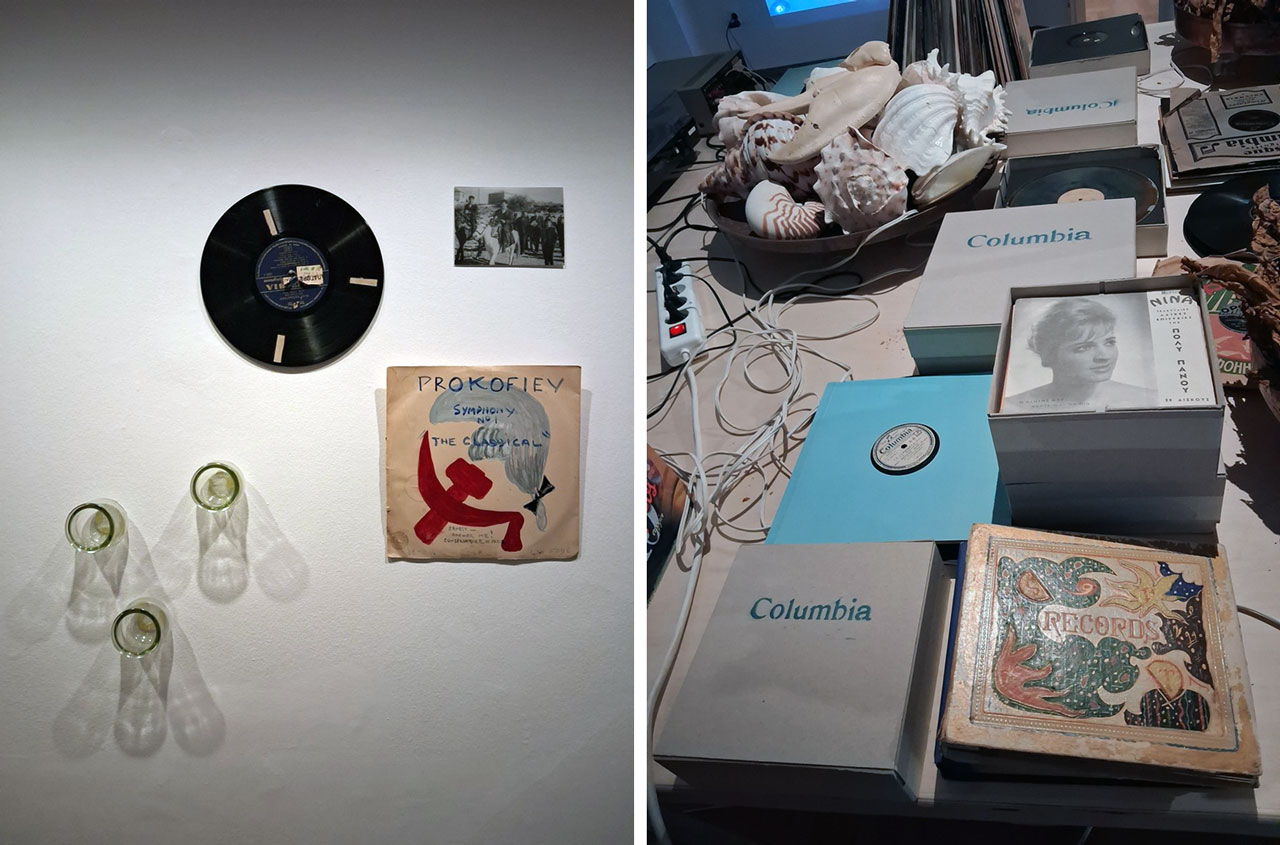
Right: Panos Charalambous, Αudio Room (installation detail) , Photo: © & Courtesy Valia Katsimpa