
PRESENTATION: Chalisée Naamani-Octogone
The contemporary digital landscape is an unceasing torrent of visual stimuli. We scroll, we double-tap, and we discard images at a velocity that leaves little room for contemplation. Yet, in the hands of Franco-Iranian artist Chalisée Naamani, this fleeting digital debris is rescued, slowed down, and calcified into rich, tactile monumentality. Through her signature vêtements-images (“image-garments”), Naamani intersects sculpture, fashion, popular culture, and political iconography, creating a physical manifestation of the endless scroll.
By Efi Michalarou
Photo: Kunst Halle Sankt Gallen Archive
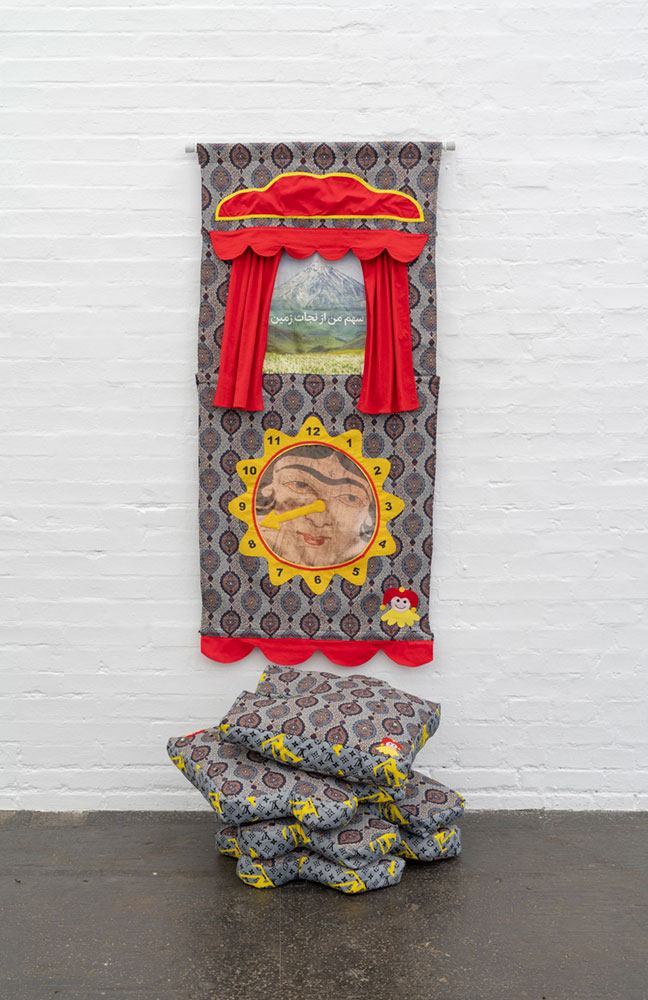
Photo: Kunst Halle Sankt Gallen, E. Sommer.
Courtesy: the artist and Ciaccia Levi, Paris/Turin
Naamani’s references range from political resistance movements and ornamental textile traditions to religious iconography, pop culture, brand logos and her personal family archive. By combining these diverse sources within the textile medium, Naamani on the one hand addresses the constant circulation and appropriation of images and symbols in a globalised world shaped by migration, social media and the accelerated cycles of the fashion industry. On the other hand, fashion is reframed as a fundamentally political arena in which overarching power dynamics are articulated alongside practices of individual expression and collective resistance. The exhibition title, “Octogone”, refers to the Zurkhaneh («House of Strength»), which can be found in Iran and neighbouring countries. In this octagonal training hall, the traditional martial art of Varzesh-e Pahlavani is still practised today, with its roots stretching back to pre-Islamic times. Following the Arab conquest of Iran in the seventh century, the sport was banned due to its revolutionary potential. As a site of physical and cultural resistance, the Zurkhaneh provides the conceptual and formal framework for the exhibition. Naamani also draws attention to the complexity of historical power relations; for example, this martial art is exclusively practised by men and was officially prohibited for women in Iran. However, in the wake of feminist movements, women are increasingly appropriating it as a symbol of female emancipation.
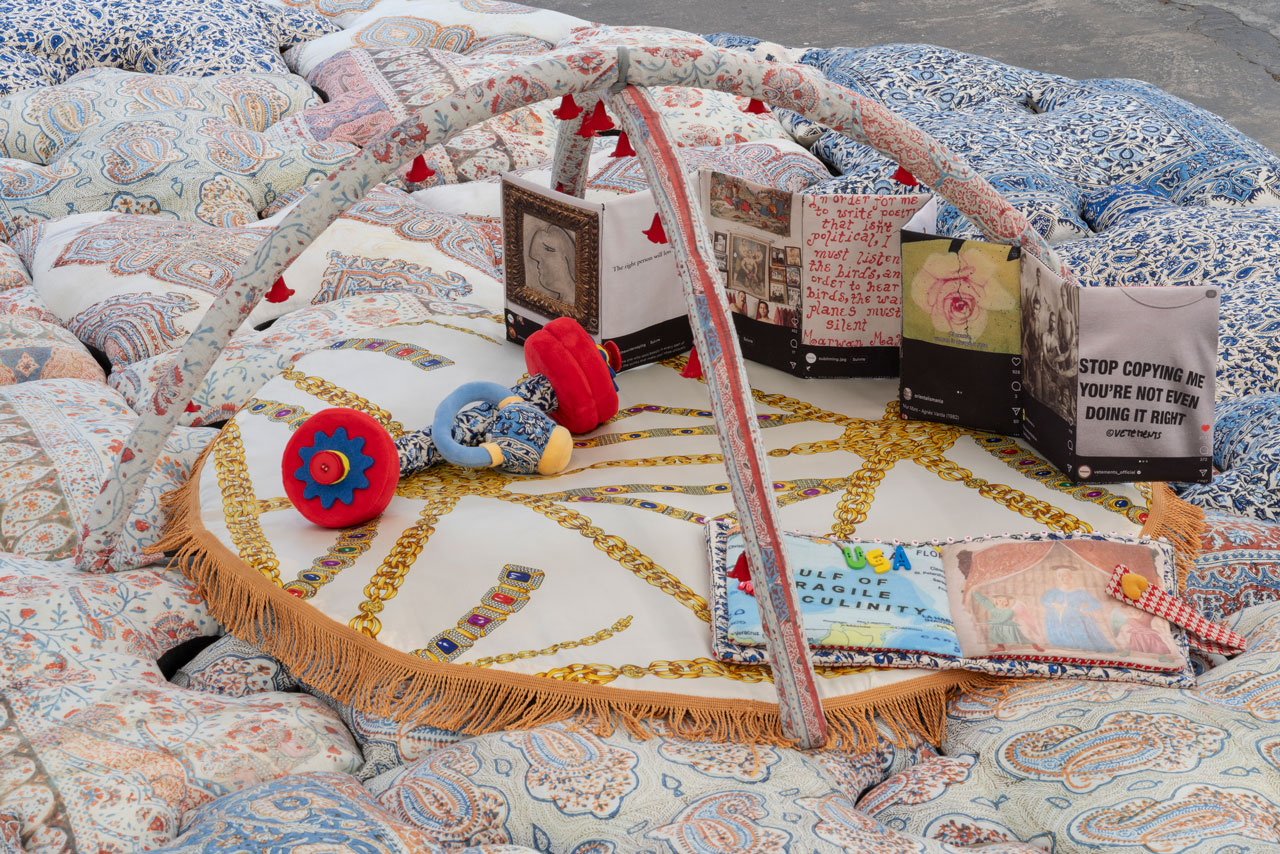
These ambivalences are expressed in the work of the same name, “L’Octogone”. Naamani translates the octagonal fighting ring into a mat made of puzzle-shaped cushions, transforming it into a soft play area. Scattered across the mat are plastic flowers, toys and other objects designed to aid the cognitive development of young children. Drawing on her experiences as a mother, Naamani invokes and reinterprets established gender stereotypes, thereby deconstructing societal ideals of growth, physical optimisation and discipline.
In “Bunch of Flowers”, which is installed directly above, Naamani interweaves the idea of sport as a metaphor for resilience with an exploration of textile history. Like an upside-down bouquet of flowers, coloured punching bags hang from the ceiling. Naamani has covered these with various handmade, industrially produced or archival fabrics, which she has elaborately embroidered. Many of these feature the Persian Boteh Jeghe pattern, which became popular in the West in the 18th and 19th centuries under the name «Paisley». Here, Naamani refers to the dissemination and appropriation of this ornamental textile design, which travelled via colonial networks from Persia to the Mughal Empire and ultimately to Britain, where it was mass-produced and exported again. Significantly, the Boteh Jeghe, or Paisley, is also firmly rooted in the textile tradition of Eastern Switzerland, as seen in the «Glarner Tüechli» («Glarus handkerchief»), which Naamani incorporates into the newly created series “Have you ever thought about your mother’s dreams at your age? 1–5” at the end of the exhibition.
Migratory movements, cultural transmissions and recodings are among Naamani’s central interests. Right at the entrance to the exhibition, a collection of luggage items entitled “Life is a carrousel (Pharrell Williams)” evokes experiences of diaspora rooted in the artist’s family history. A luggage tag bears a black-and-white photograph of Naamani’s Iranian grandparents, and a miniature Iran Air aeroplane lies on top of one of the suitcases. Tulips appear on several suitcase covers and items of clothing, rendering homage to both the artist’s favourite flower and its significance as a symbol of martyrdom in Iran. A neck pillow bearing the names of global metropolises evokes associations with international tourism, while oversized emblems of luxury brands raise questions about authenticity, imitation and desire.
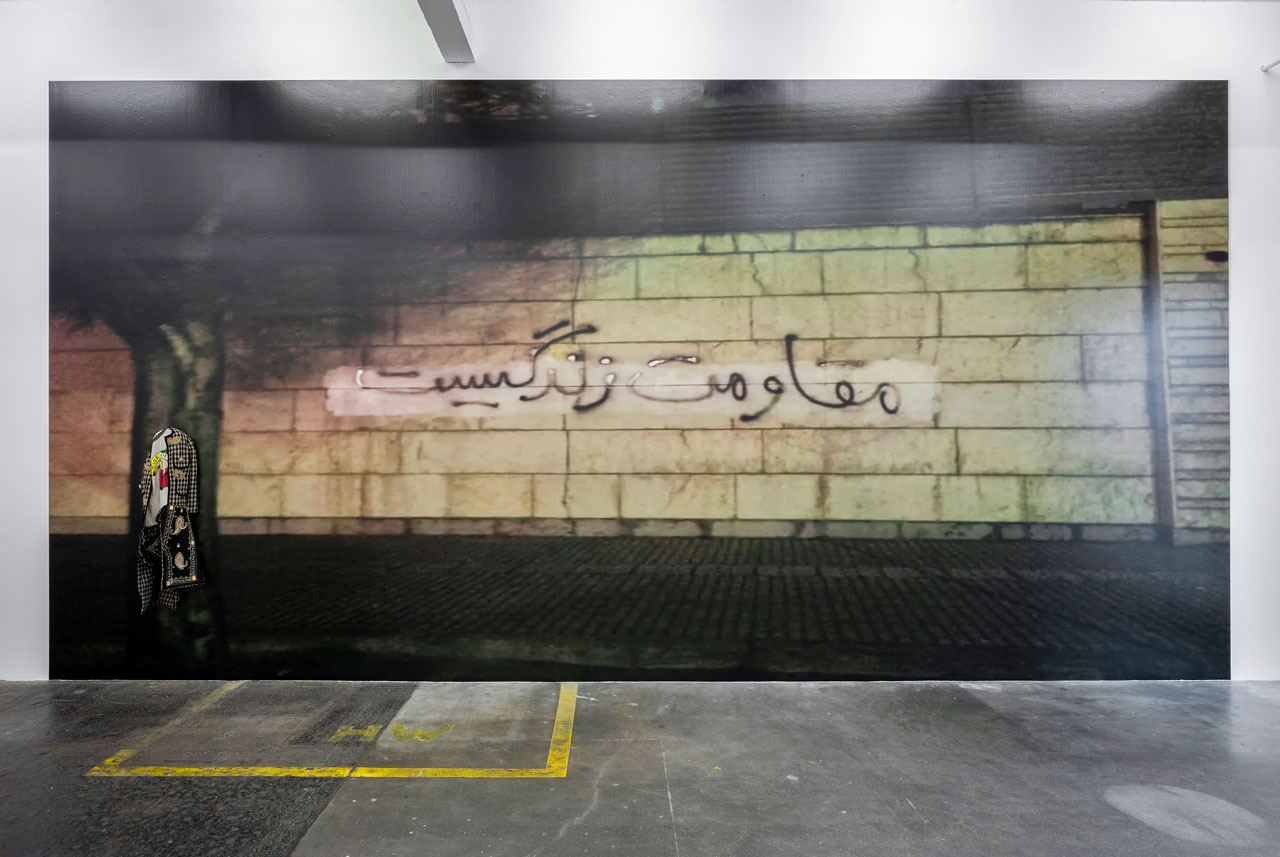
Several pieces in the exhibition explore the visual language of international protest movements. The photo wallpaper “From Iran: addresses the Iranian freedom movement «Woman, Life, Freedom», which emerged in 2022 following the death of Mahsa Amini in police custody. A photograph that went viral on social media shows a wall bearing the Persian inscription «Resistance is Life». The Iranian authorities painted over the graffiti several times with white paint, but it was always sprayed back in the same spot. With the title of the work, Naamani pays tribute to the Instagram account @from_iran, where she found the image, and commemorates Amini, who was reportedly arrested for being «inappropriately» dressed.
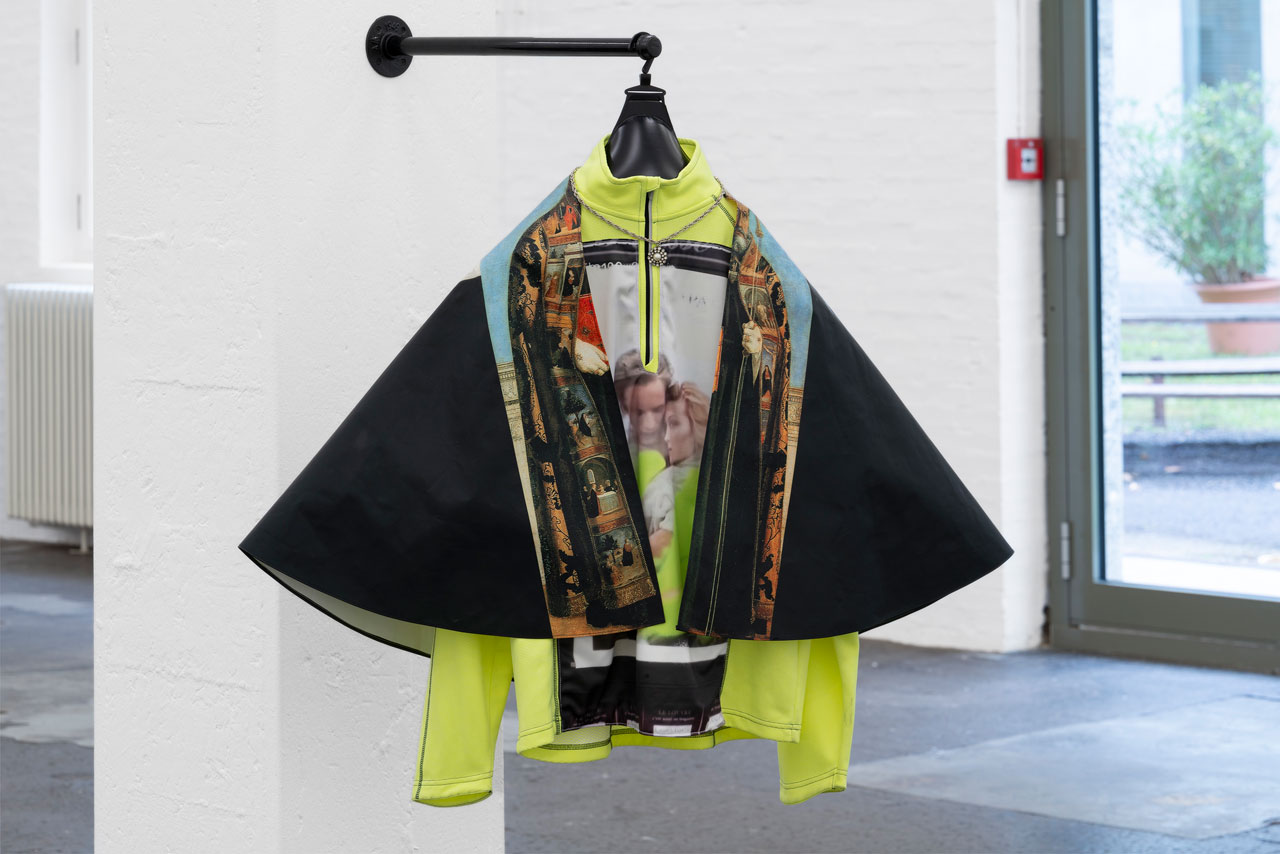
Nearby, “Athéna” is a collage made of various elements that allude to staging and gestures of display. The blue-and-yellow colour combination also refers to pro-Ukrainian protests. In other works in the first room of the exhibition, such as “Cape et gilet jaune”, Naamani demonstrates how clothing colour functions as a sign of political resistance. She repeatedly uses fluorescent yellow, a colour characteristic of the French «Gilets Jaunes» («Yellow Vests») movement and their eponymous high-visibility vests. Naamani short-circuits these entrenched visual codes in her sculptural assemblages, where political messages meet sports equipment and fashion accessories, memes and reproductions of canonical artworks. Thereby, Naamani playfully makes processes of appropriation, superimposition and hybridisation visible.
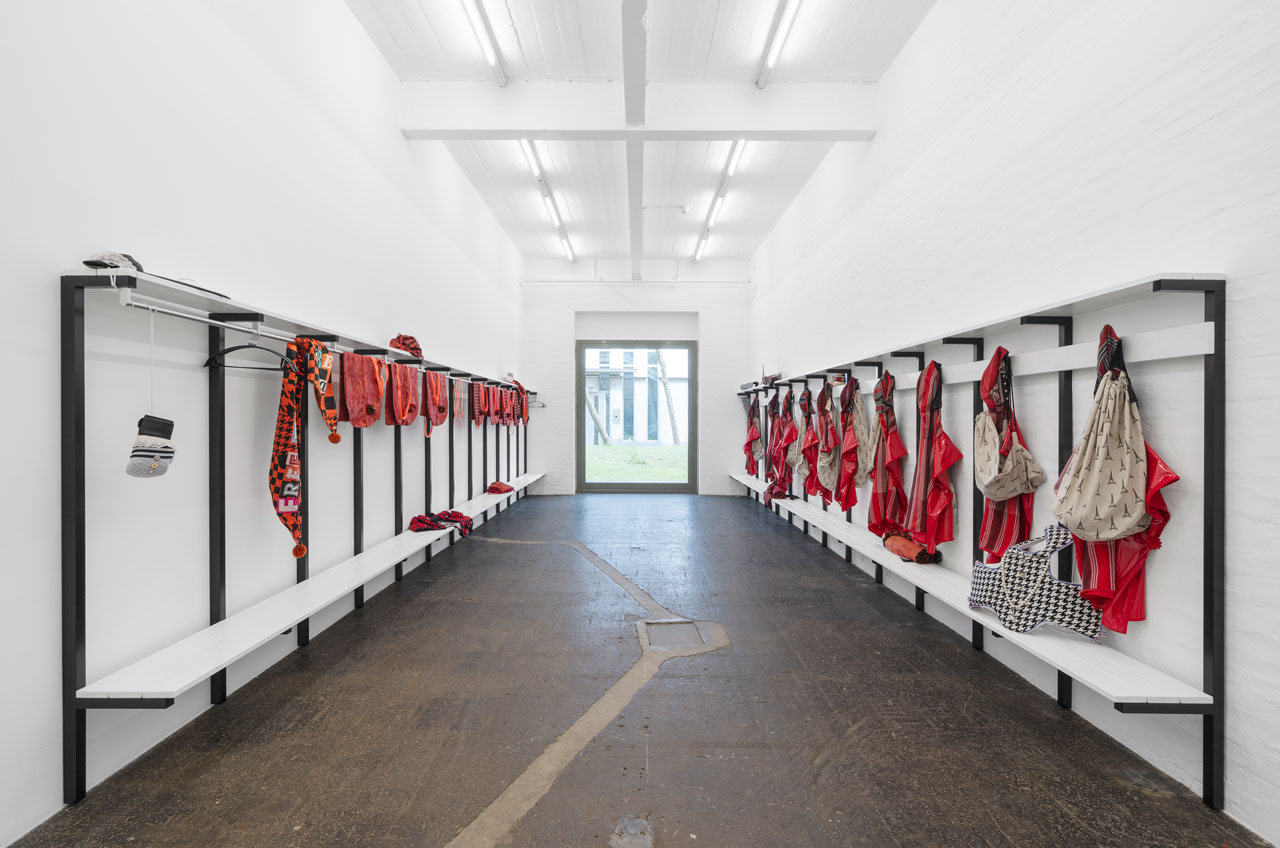
In the second exhibition space, we find ourselves in the setting of a sports changing room. “Who claims love?” presents a view of a row of red Varzesh-e Pahlavani capes that have been upcycled and modified by Naamani. For example, one cape features a photograph of her grandfather sewn onto the fabric, who poses with medals for his sporting achievements. This reference is interwoven with elements from Naamani’s birthplace of Paris through the incorporation of luxury brand logos and tourist souvenirs, such as Eiffel Tower replicas. The artist’s exploration of martial arts attire continues with breastplates adorned with houndstooth patterns. Much like the Persian Boteh Jeghe pattern, this design spread to various geographical regions and was adopted by local textile industries. In the work vis-à-vis, “Mohamed Ali, Britney Spears and Me”, Naamani draws connections between the slogans of two freedom movements that appear, at first glance, to be unrelated: «Free Britney» and «Free Iran», which found particular resonance on social media, were both directed against patriarchal oppression.
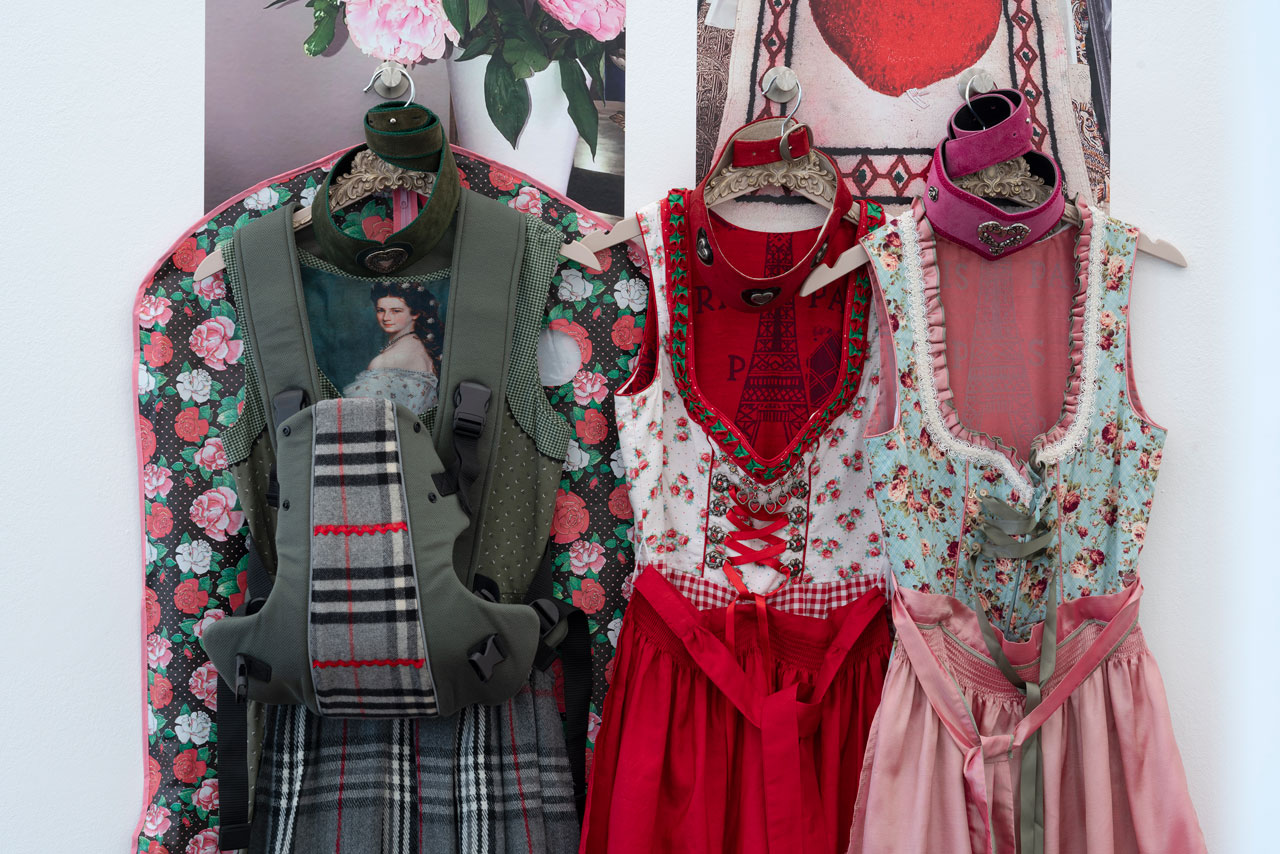
The works in the third room of the exhibition explore the tension between folklore, identity and a sense of home, as well as global tourism, and raise questions about the contemporary conditions of belonging. Both Lederhosen and Dirndls appear as bearers of local tradition and conservative role models, as well as mass-produced goods that are subject to global marketing logic. The boundaries between traditional costume and disguise, conditioning and cosplay are made fluid. Edelweiss, Empress Sisi, the Eiffel Tower and the Louis Vuitton logo are no longer tied solely to their places of origin; they circulate around the world as consumable symbols in an endless loop. At the same time, the question of what constitutes a home or «Heimat», and who has the right to one, is more pertinent than ever – particularly with regard to people whose lives are shaped by exile and displacement. Naamani builds on these conditions in her work, using artistic appropriation to open up new avenues of interpretation and evaluation. The result is not so much an overt critique as a reflective assertion of the connection between historical visual worlds and lived political realities, and their ceaseless, mutual transformation.
Photo: Chalisée Naamani, L’Octogone, detail, 2023. Photo: Kunst Halle Sankt Gallen, E. Sommer. Courtesy: Collezione E.Righi
Info: Kunst Halle Sankt Gallen, Davidstrasse 40, St.Gallen, Switzerland, Duration: 13/6-13/9/2026, Days & Hours: Tue-Fri 11:00-18:00, Sat-Sun 11:00-17:00, www.kunsthallesanktgallen.ch/
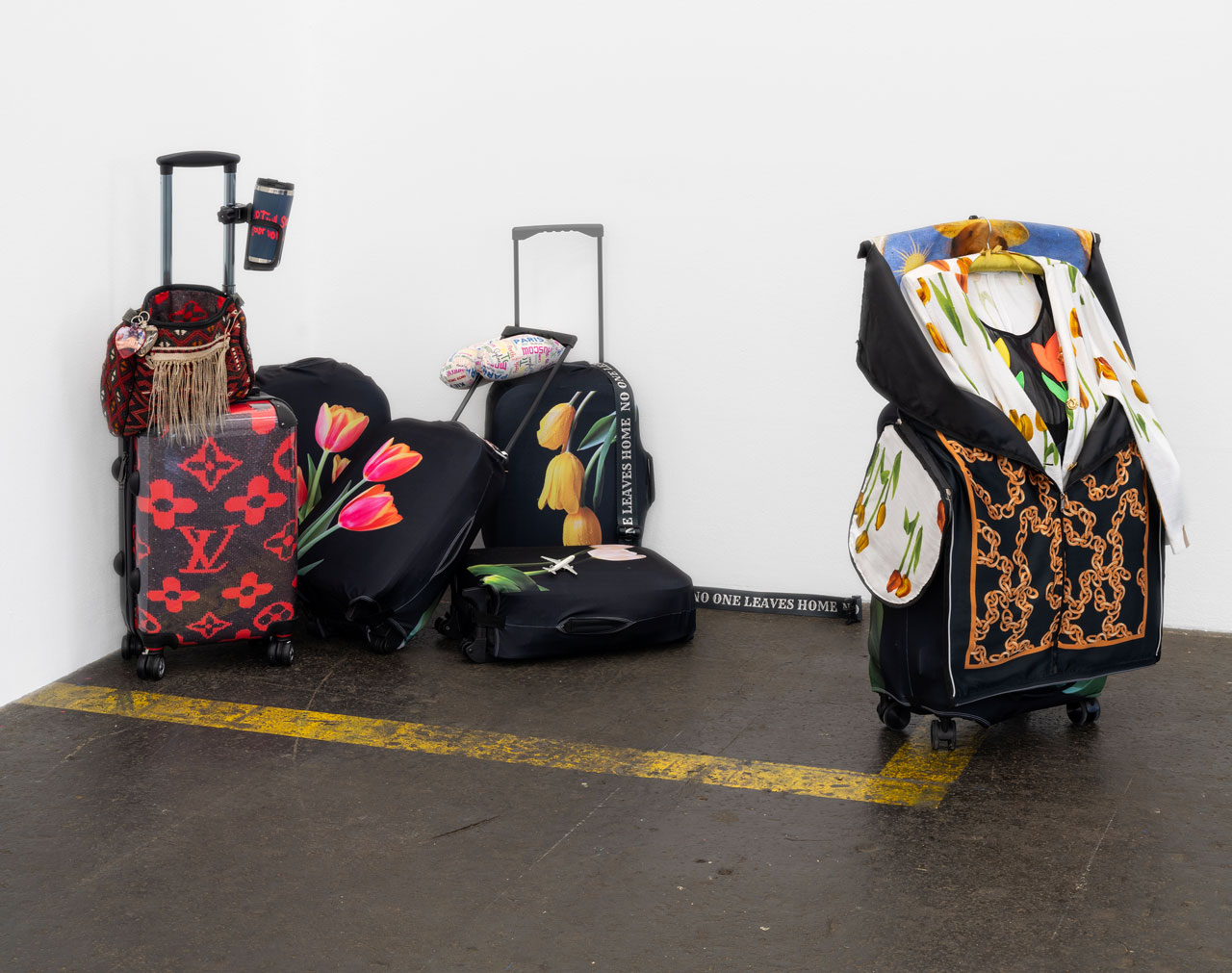
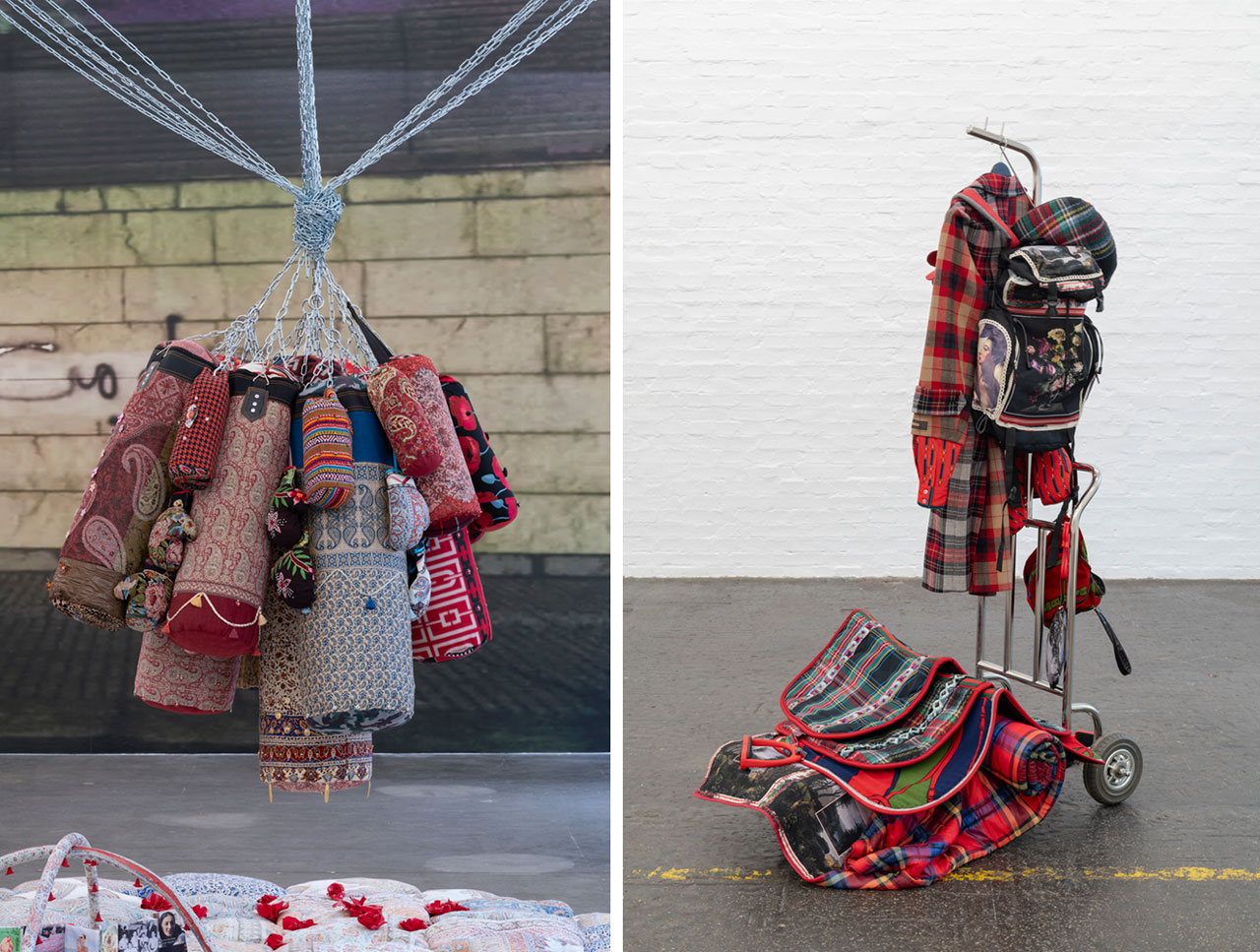
Right: Chalisée Naamani, La liberté guidant le peuple, 2025, Photo: Kunst Halle Sankt Gallen, E. Sommer. Courtesy: the artist and Ciaccia Levi, Paris/Turin
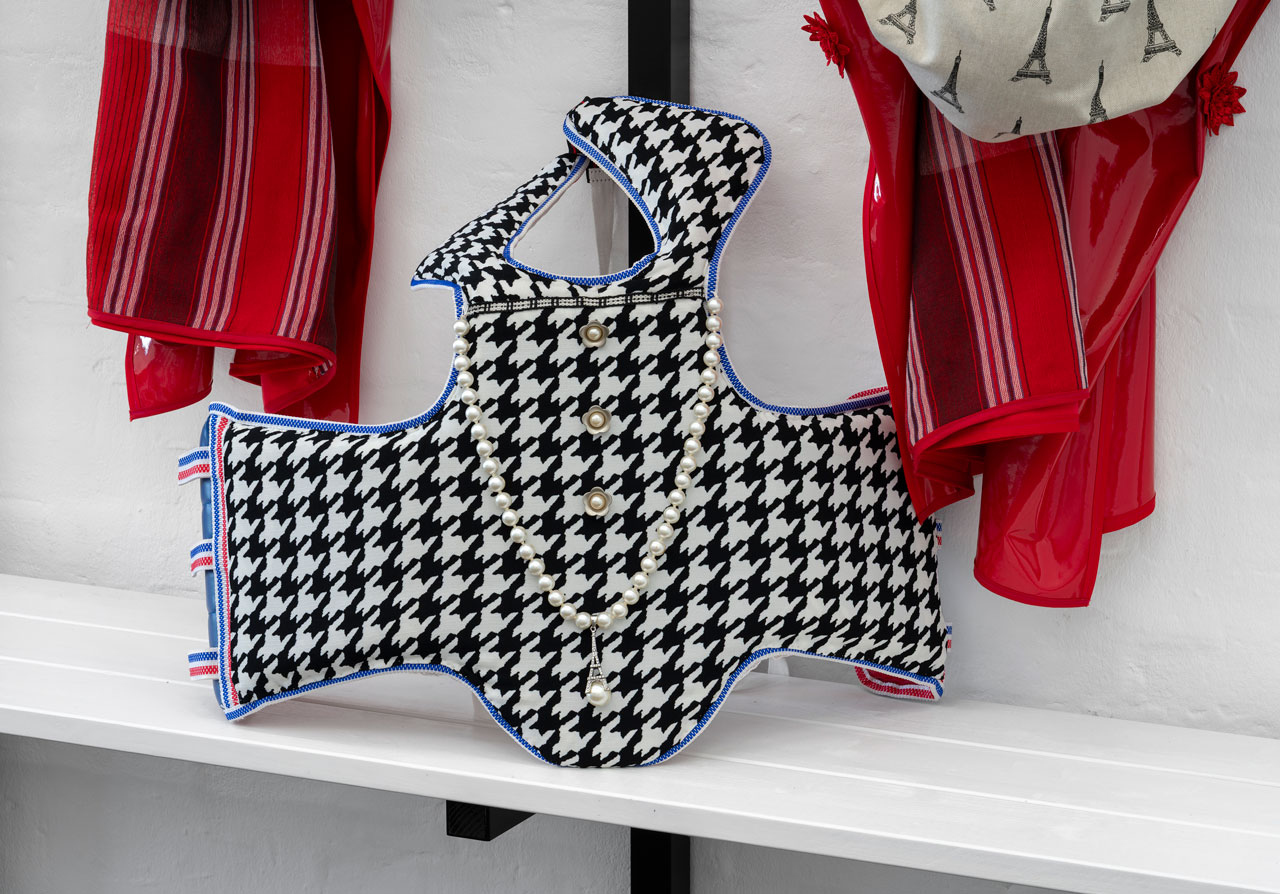
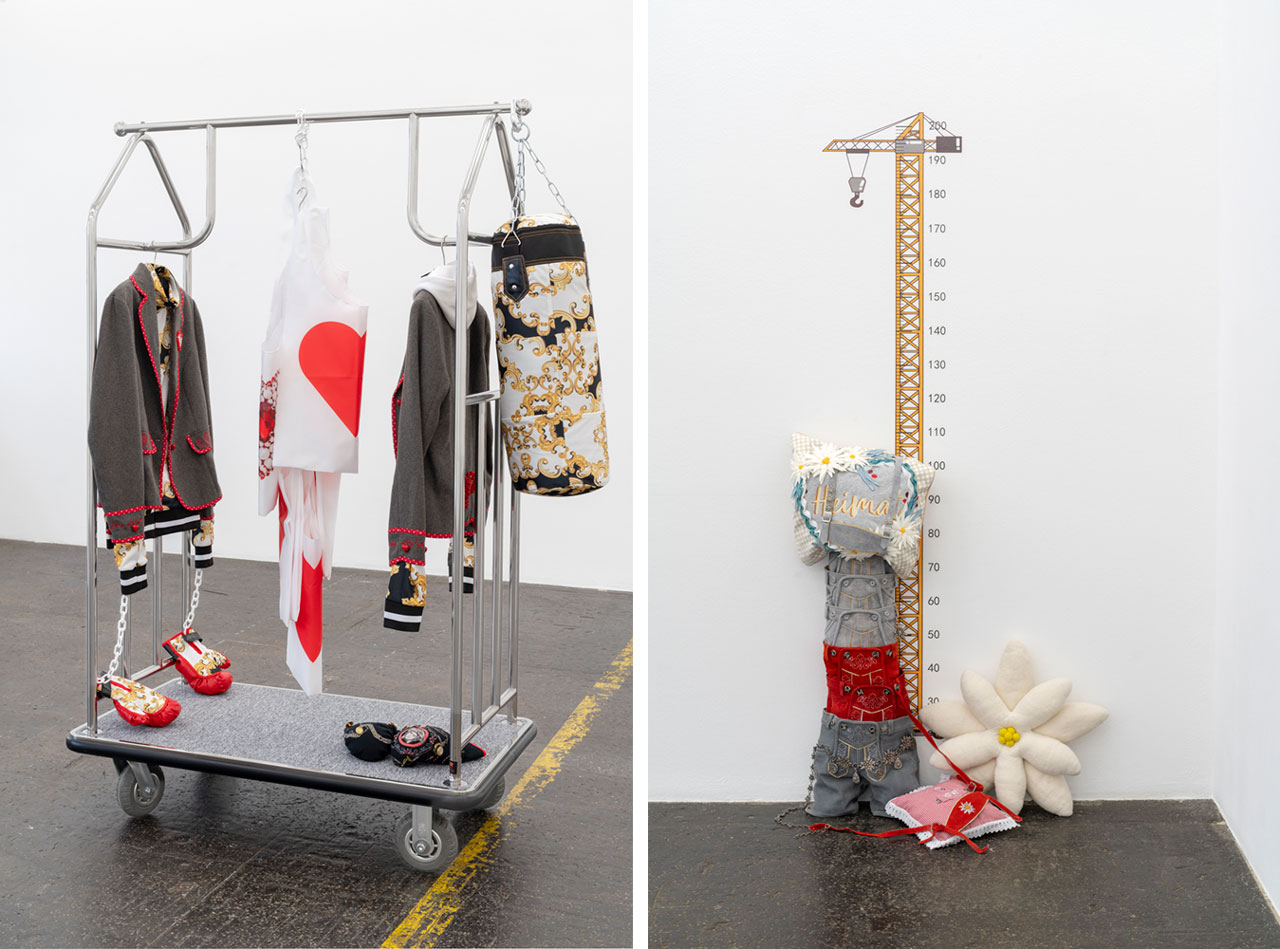
Right: Chalisée Naamani, Born to Be Growth, 2025. Photo: Kunst Halle Sankt Gallen, E. Sommer. Courtesy: the artist and Ciaccia Levi, Paris/Turin