ART CITIES: Paris-Liang Hao
Liang Hao’s paintings stage a drama of the hand—its hesitations, its tests, its suspended intentions. What emerges is not a narrative of making, but a choreography of touch: gestures that approach without resolving, that probe the threshold between perception and action. Across his recent bodies of work, the hand becomes both subject and instrument, a site where technical skill, memory, and affect converge.
By Dimitris Lempesis
Photo: Massimodecarlo Gallery
Liang Hao’s paintings are built through meticulous layering. Early strata remain visible at the edges, where clean borders reveal what has been erased. This is not simply a technical choice but a conceptual one: the surface becomes a palimpsest of decisions, hesitations, and revisions. The painter’s labor is present precisely where it seems most concealed.
In the works gathered under the exhibition title “Essayer”—the French verb “to try”—hands enter from the margins of the canvas and move toward its center. They reach, pinch, fold, hover, or hold back. They touch animal teeth, fossilized coral, aluminum foil, elastic bands, books, mirrored cubes. Yet they never complete an action. They do not grasp, repair, measure, or claim. They test.
To try is to approach without certainty. Liang’s hands measure distance, tension, and pressure. They hold a volume of energy at the brink of contact. They are experimental, divining, playful, devotional—each quality tied to a different series (Decentralized, Essayer, Elasticity, Orchid), yet all orbiting the same minor verb: essayer.
This suspended state is the emotional core of Liang’s work. The hand becomes a threshold between intention and effect, between the visible and the invisible.
Liang’s use of chiaroscuro is central to this threshold. Since the Renaissance, shadow has given bodies weight and depth, but it has also carried psychological and symbolic charge. In Liang’s paintings, shadow is neither theatrical nor absent. It is the condition from which visibility emerges.
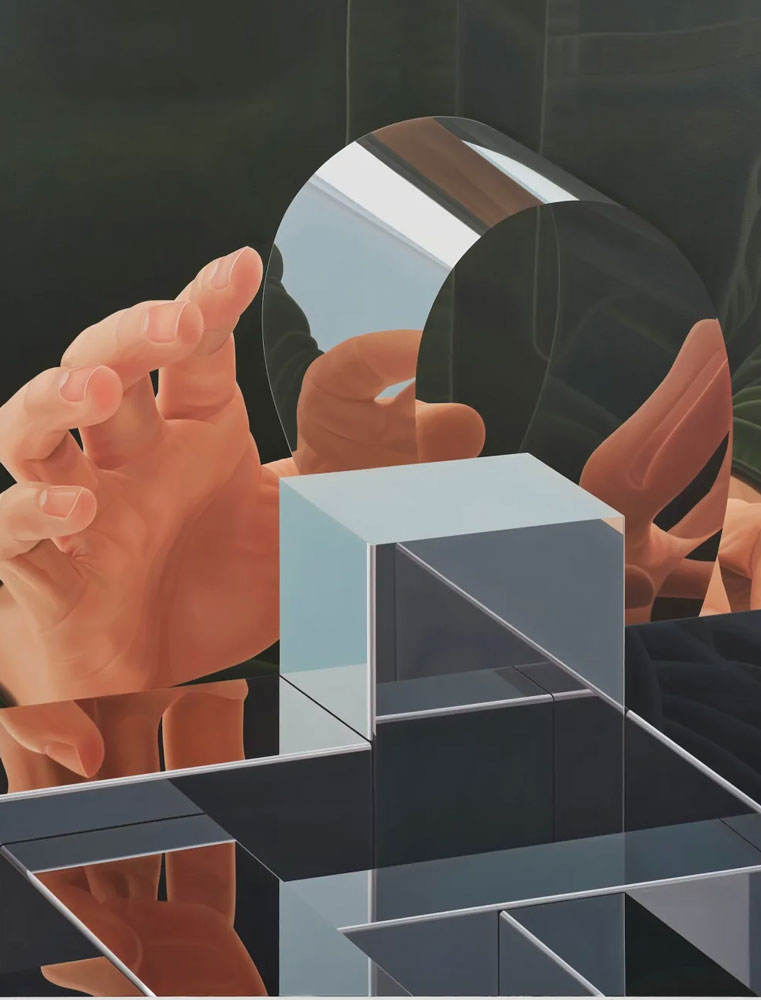
In “Essayer”, a deep green drapery forms a tenebrist field. Hands, reflective arches, and geometric planes appear to be drawn out of darkness. Even the brightest surfaces cast new shadows, bending vision back into uncertainty.
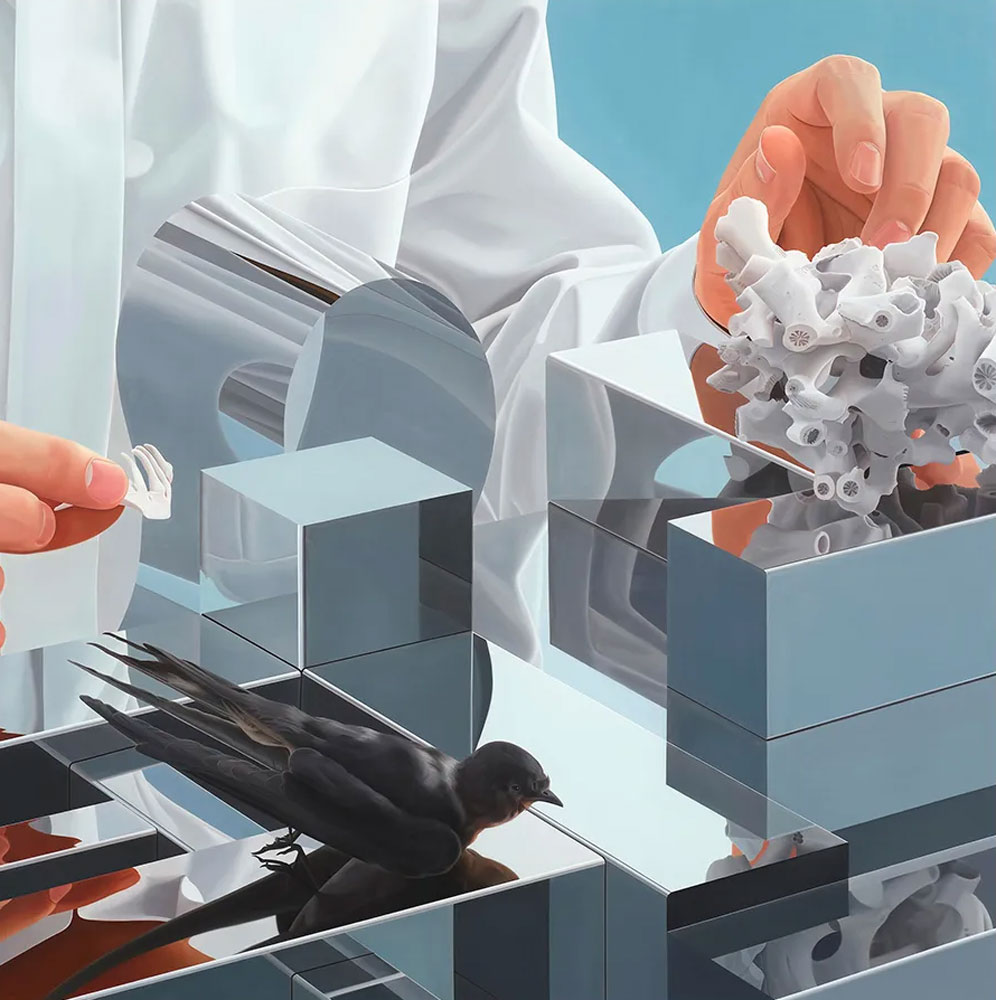
In “Decentralized”, the palette shifts: white cloth, pale blue air, mirrored planes, coral, and skin rise together in a cooler, more evenly distributed light. Yet shadow remains decisive. It cuts through the swallow’s body, deepens the mirrored surfaces, and gathers in the folds where white turns grey. The work decentralizes not only vision but painterly labor itself—foregrounding the act of looking as a dispersed, unstable process.
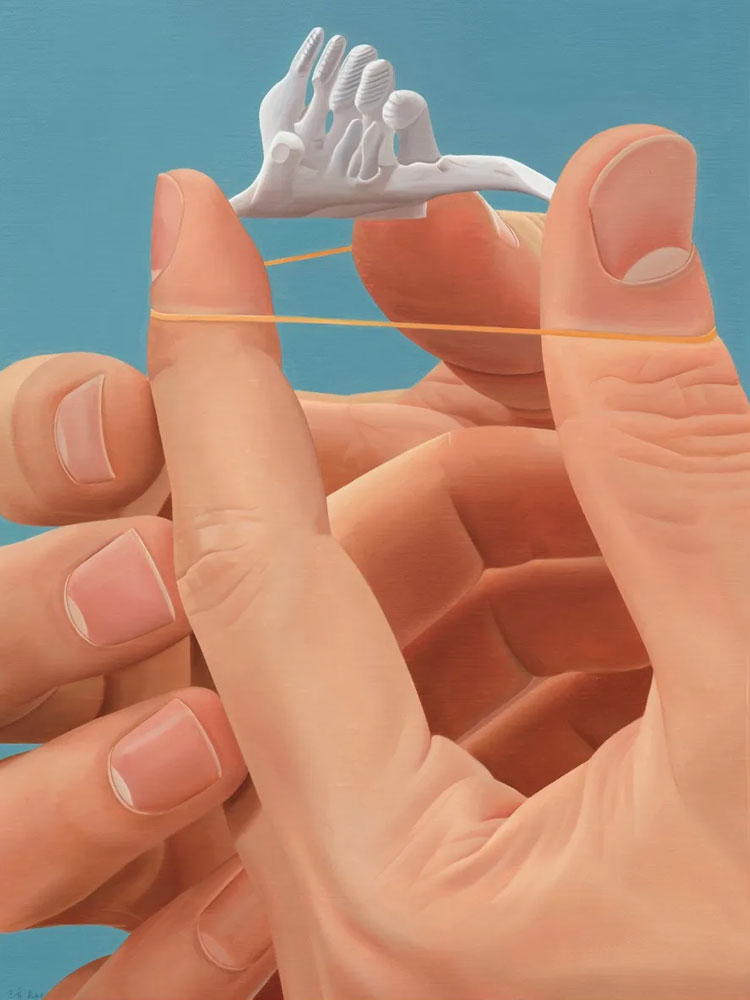
In “Elasticity”, scale contracts. A hand holds an animal tooth while an elastic band stretches across the image. The gesture becomes a game of endurance and risk: if the hand resists too strongly, the tooth may fall; if it yields, the sharpened edge may snap back against the skin. Testing becomes tension—sustained, precarious, almost musical.
This is Liang’s most playful series, yet its play is edged with danger. The hand is caught between control and surrender, between the desire to hold and the impulse to release.
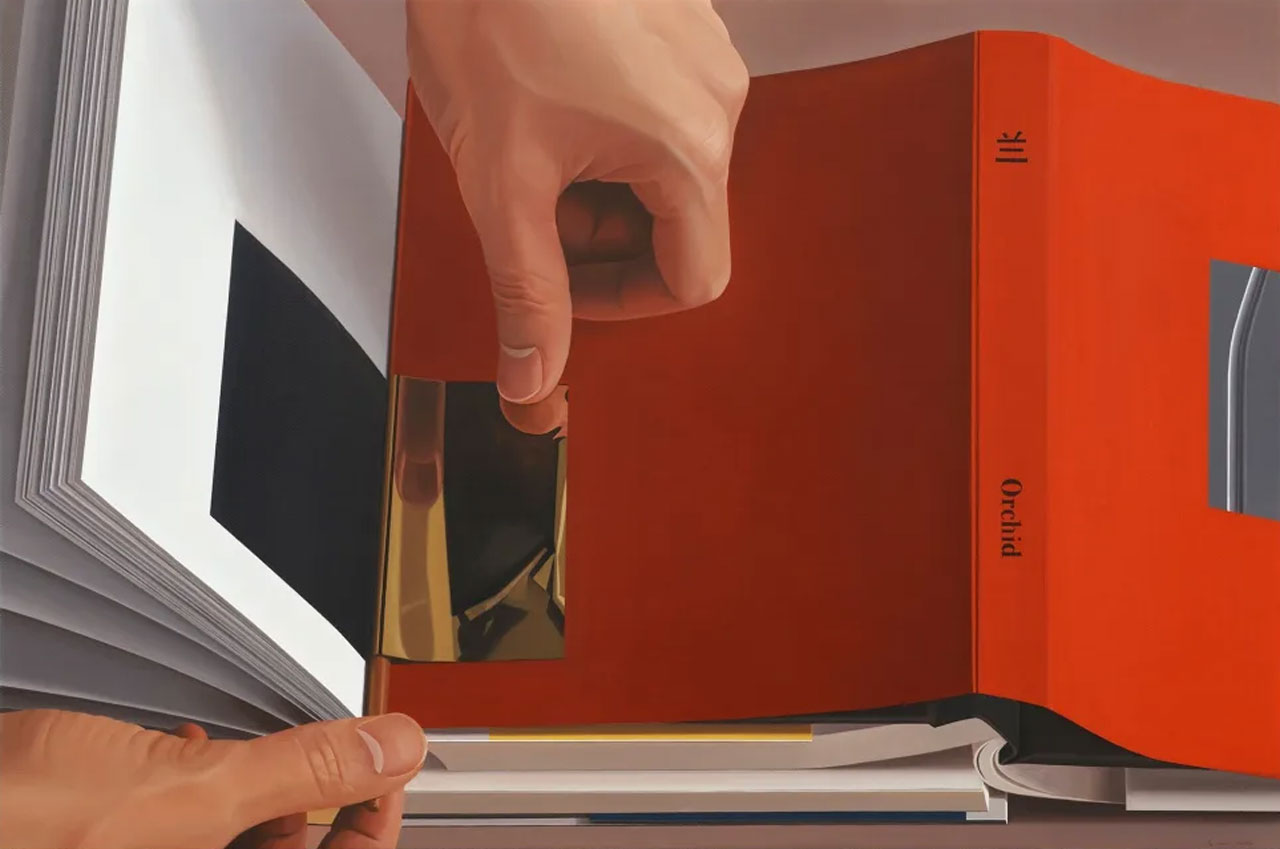
In “Orchid”, the hand takes the posture of applying gold leaf. The Chinese character “兰” appears on the red spine of a book. It is the name of a plant, but also a common element in Chinese names. Here, language loosens from communication and becomes line, color, and devotion.
The character’s materiality—its font, its surface—approaches that of Liang’s fossils. It becomes a form that carries memory through its texture. The red of the book, the gold of the gesture, and the suspended hand together create a quiet ritual of inscription.
Across these works, Liang Hao paints not actions but thresholds: between light and shadow, touch and distance, intention and hesitation. His hands do not perform; they inquire. They test the world and the image simultaneously.
In an era saturated with speed and certainty, Liang’s paintings insist on the value of trying—of approaching without knowing, of holding a gesture at the edge of becoming. They remind us that the hand is not merely a tool of execution but a site of thought, doubt, and desire.
Photo: Liang Hao, Orchid, 2026, 40 × 60 cm, 78 3/4 × 78 3/4 inches, Oil on linen, © Liang Hao, Courtesy the artist and Massimodecarlo Gallery
Info: Massimodecarlo Gallery, 57 Rue de Turenne, Paris, France, Duration: 23/6-4/7/2026, Days & Hours: Tue-Sat 11:00-19:00, https://massimodecarlo.com/