
PRESENTATION: Tetsuya-Ishida
In the brief span of a decade, Japanese artist Tetsuya Ishida (1973–2005) created one of the most unsettling and prophetic bodies of work in contemporary art. Producing just 217 paintings before his untimely death at the age of thirty-two, Ishida transformed the social and psychological anxieties of post-bubble Japan into haunting visual allegories that continue to resonate with audiences around the world. His paintings, populated by expressionless salarymen, students, and workers fused with machines, consumer goods, and industrial structures, offer a powerful meditation on alienation, technological dependence, and the erosion of individual identity in modern society.
By Efi Michalarou
Photo: Gagosian Arcjive
This is the first exhibition dedicated to the artist’s work in France. Ishida came of age during Japan’s so-called “Lost Decade,” the prolonged economic stagnation that followed the collapse of the country’s asset bubble in the early 1990s. What had once appeared to be an unstoppable economic miracle gave way to unemployment, social uncertainty, and a growing sense of disillusionment among young people entering adulthood. Ishida belonged to a generation confronted with shrinking opportunities and mounting pressures to conform to traditional social expectations despite a rapidly changing economic landscape.
Rather than depicting these conditions directly, Ishida translated them into surreal, hyper-detailed scenarios in which human beings become literal extensions of the systems that govern their lives. His paintings are not political manifestos; they are psychological landscapes that reveal the emotional consequences of economic and technological transformation. Through a visual language that combines Social Realism, Surrealism, manga aesthetics, and dark humor, Ishida exposed the hidden costs of a society organized around productivity, consumption, and efficiency.
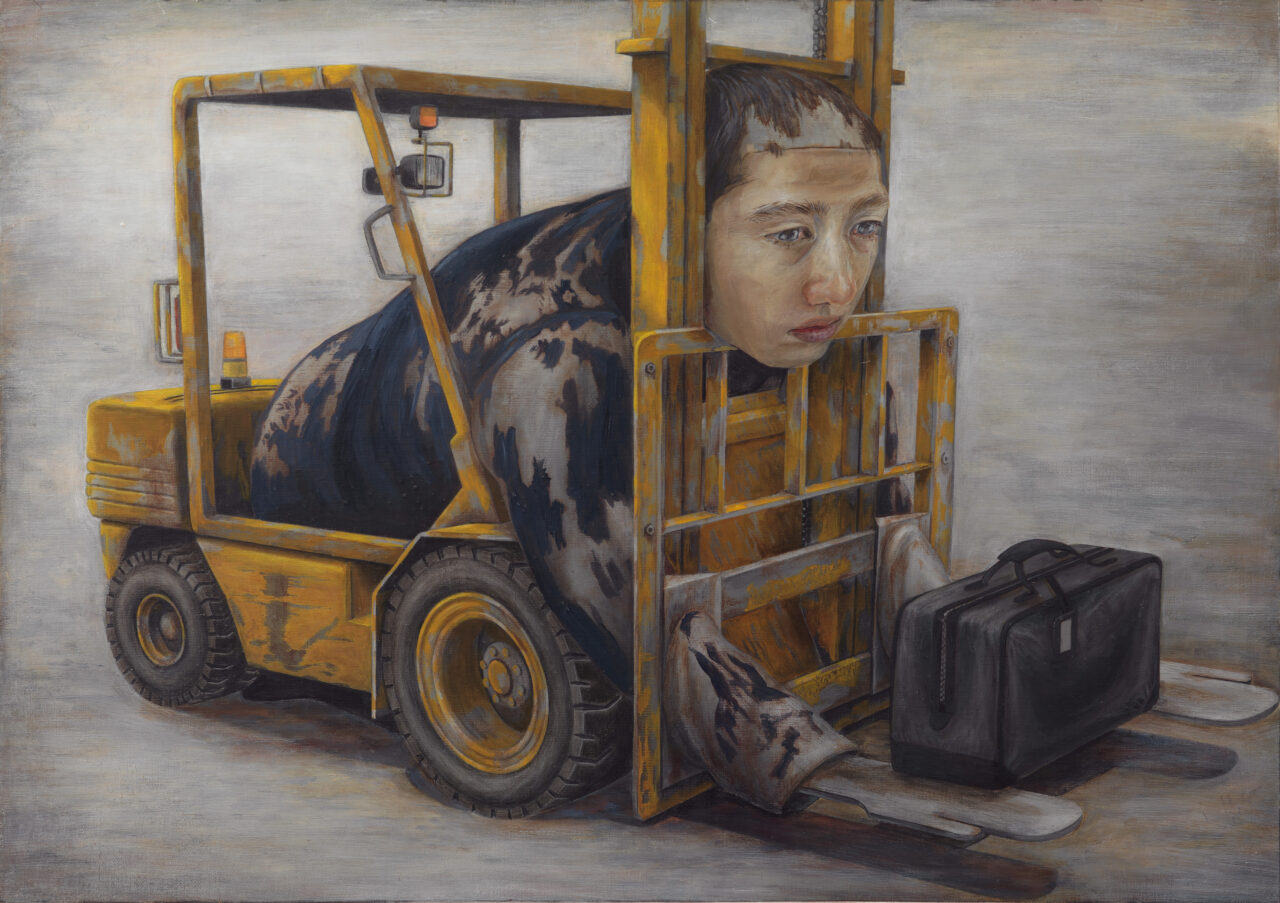
One of the most striking aspects of Ishida’s work is his recurring portrayal of individuals merged with everyday objects. The anonymous figures that populate his paintings often resemble the artist himself: young men with blank, exhausted expressions who appear trapped within bizarre transformations. Their identities are reduced to functions, as though they have become products to be manufactured, repaired, transported, or consumed.
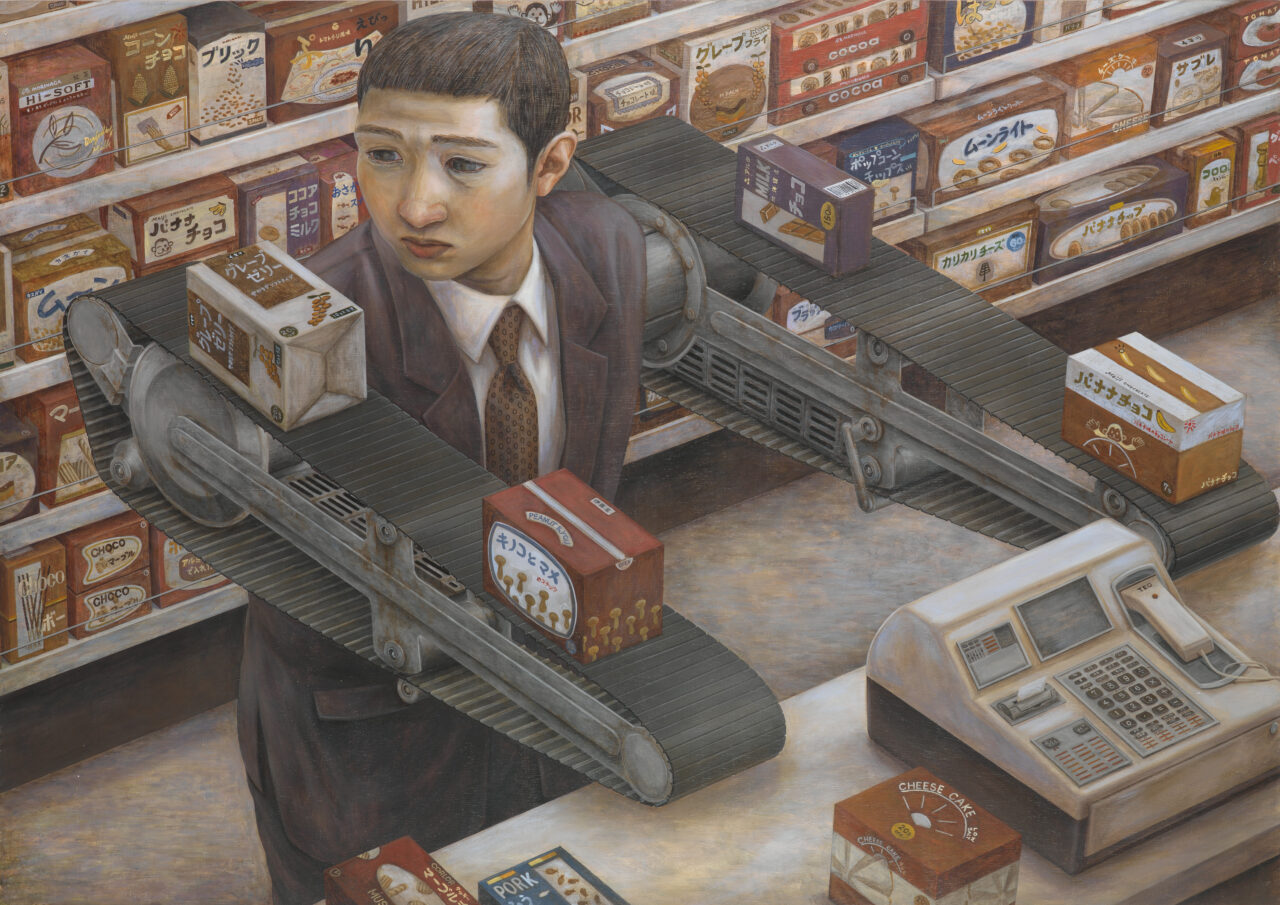
In “Supermarket” (1996), a suited office worker stands among shelves of packaged goods while his arms have been transformed into conveyor belts. The image functions as a devastating critique of consumer capitalism, suggesting that workers have become inseparable from the mechanisms of production and consumption. Human labor is no longer merely exploited; the worker himself becomes part of the machine.
Similarly, “Convenience Store Mother and Child” (1996) depicts a man curled inside a shopping basket that simultaneously resembles a crib. A woman cradles his head while scanning him with a barcode reader. The painting collapses multiple identities into a single image: the man is infant, employee, and commodity at once. By invoking both retail technology and maternal care, Ishida creates an unsettling vision in which nurturing and commodification become indistinguishable.
Many of Ishida’s paintings evoke a profound sense of confinement. Unlike traditional surrealist works that invite viewers into dream worlds of possibility, Ishida’s dreamscapes often feel inescapable. Every surface is rendered with meticulous precision, creating environments that seem both familiar and oppressive.
In “Getting Up” (1999), the artist replaces a conventional bed with a dump truck whose raised platform threatens to spill its occupant onto the ground. What should be a routine act of waking becomes a precarious struggle for survival. Everyday life is transformed into a mechanical process beyond individual control.
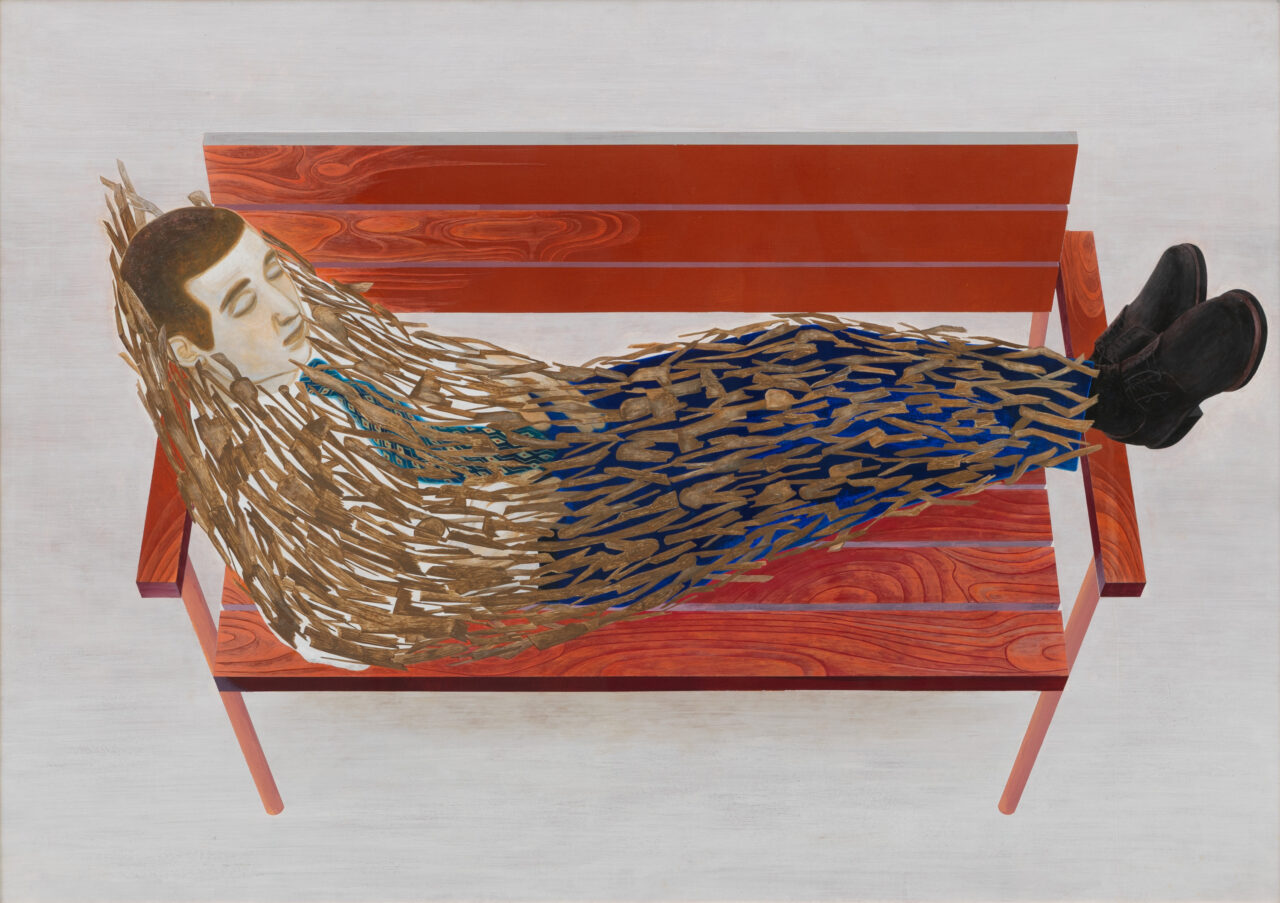
“Sleeping Bagworm” (1995) presents another compelling example. A businessman sleeps on a bench encased within a cocoon-like structure. The enclosure appears protective, yet simultaneously suffocating. Ishida captures a central contradiction of modern life: the very systems designed to provide security can become instruments of isolation.
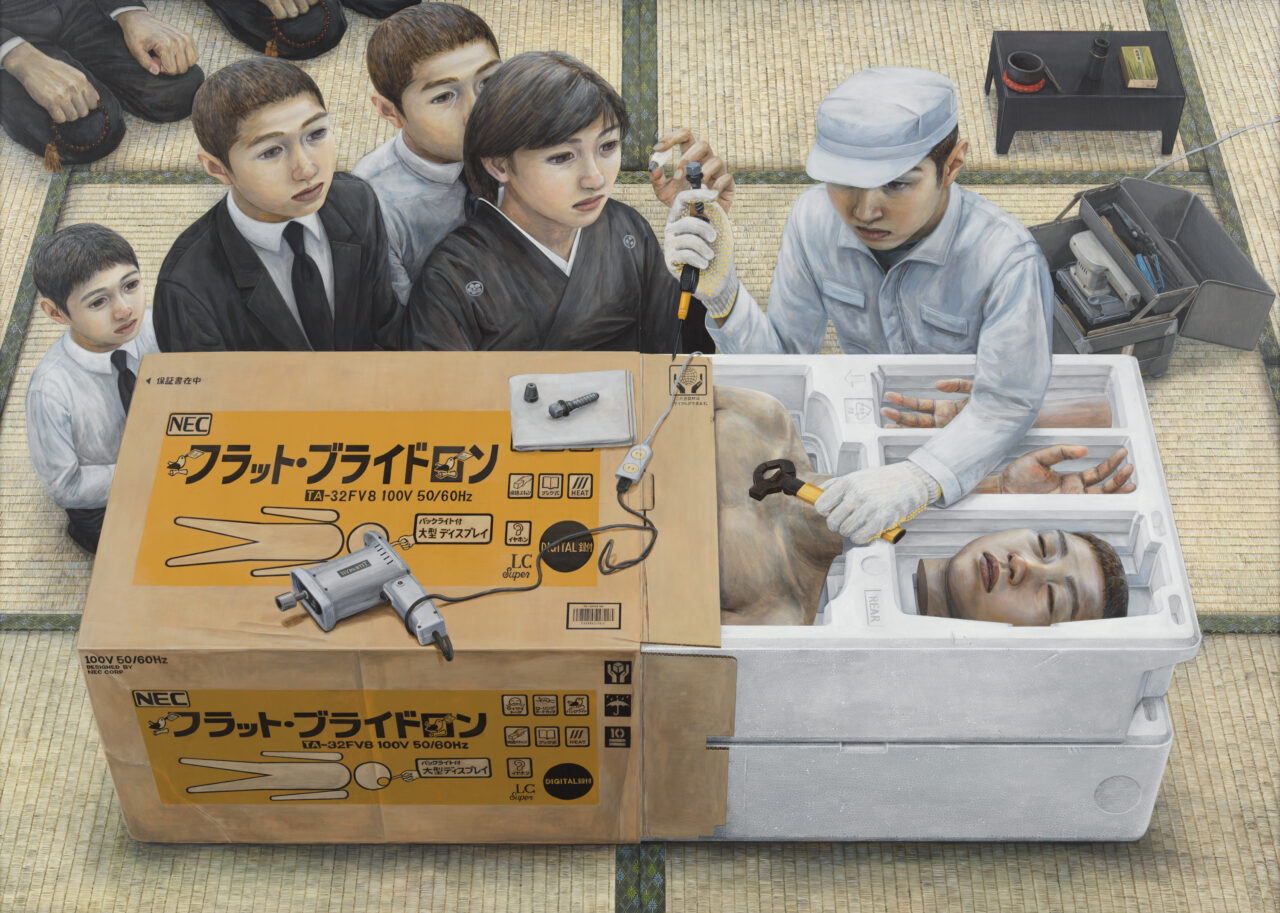
Perhaps nowhere is Ishida’s critique more incisive than in “Recalled” (1998). The painting portrays a family dressed in mourning attire while a technician examines the disassembled body of a deceased man. His head and hands are arranged within a container that resembles both a coffin and the packaging of a consumer electronic product. The title evokes a defective commodity being returned to a manufacturer, reducing human mortality to a bureaucratic procedure within a technological society.
This image encapsulates one of Ishida’s enduring concerns: the transformation of human beings into objects. In his world, the logic of the marketplace extends beyond the workplace and into the most intimate aspects of existence. Family, identity, and even death become subject to the same processes of standardization and commodification that govern consumer goods.
Art historians have often noted the affinities between Ishida’s work and the writings of Franz Kafka. Like Kafka’s protagonists, Ishida’s figures find themselves trapped within incomprehensible systems that strip them of agency and individuality. His paintings also recall the anonymous men of René Magritte, whose bowler-hatted characters similarly embody modern alienation. Yet Ishida’s vision is distinctly rooted in contemporary Japan. His imagery draws not only on European Surrealism but also on manga, advertising, mass media, and the visual culture of late twentieth-century Japanese urban life.
The result is a uniquely Japanese form of existential realism. His figures are neither heroic nor rebellious. They endure. Their vacant expressions suggest a resignation born from navigating institutions that appear immovable: schools, corporations, bureaucracies, and technological networks.
Ishida’s career lasted only ten years, his reputation has expanded dramatically since his death. Major exhibitions in Madrid, Chicago, New York, and, most recently, Paris have introduced his work to international audiences. In 2026, Gagosian presented the first exhibition dedicated to Ishida’s work in France, highlighting the growing recognition of his importance within global contemporary art.
What makes Ishida’s paintings feel so relevant today is that the conditions he observed have not disappeared. If anything, they have intensified. The anxieties of precarious employment, technological dependency, digital surveillance, and social isolation now extend far beyond Japan. His visions of humans merged with machines anticipated many of the concerns associated with the twenty-first century’s increasingly automated and interconnected world.
Tetsuya Ishida transformed the specific experience of Japan’s Lost Decade into a universal exploration of modern alienation. Through extraordinary technical precision and a surreal imagination of remarkable power, he revealed how economic systems, technological change, and social expectations can reshape human identity itself. His paintings remain disturbing not because they depict a distant nightmare, but because they reflect realities that continue to define contemporary life. More than twenty years after his death, Ishida’s art stands as a profound testament to the emotional costs of modernity and a warning about what happens when human beings become indistinguishable from the systems they create.
Photo: Tetsuya Ishida, Recalled, 1998, Acrylic on board, 57 3/8 x 81 1/8 inches (145.6 x 206 cm), © Tetsuya Ishida Estate, Photo : Robert McKeever, Courtesy Gagosian
Info: Gagosian, 4 rue de Ponthieu, Paris, France, Duration: 10/6-31/7/2026, Days & Hours: Tue-Sat 10:30-18:30, https://gagosian.com/
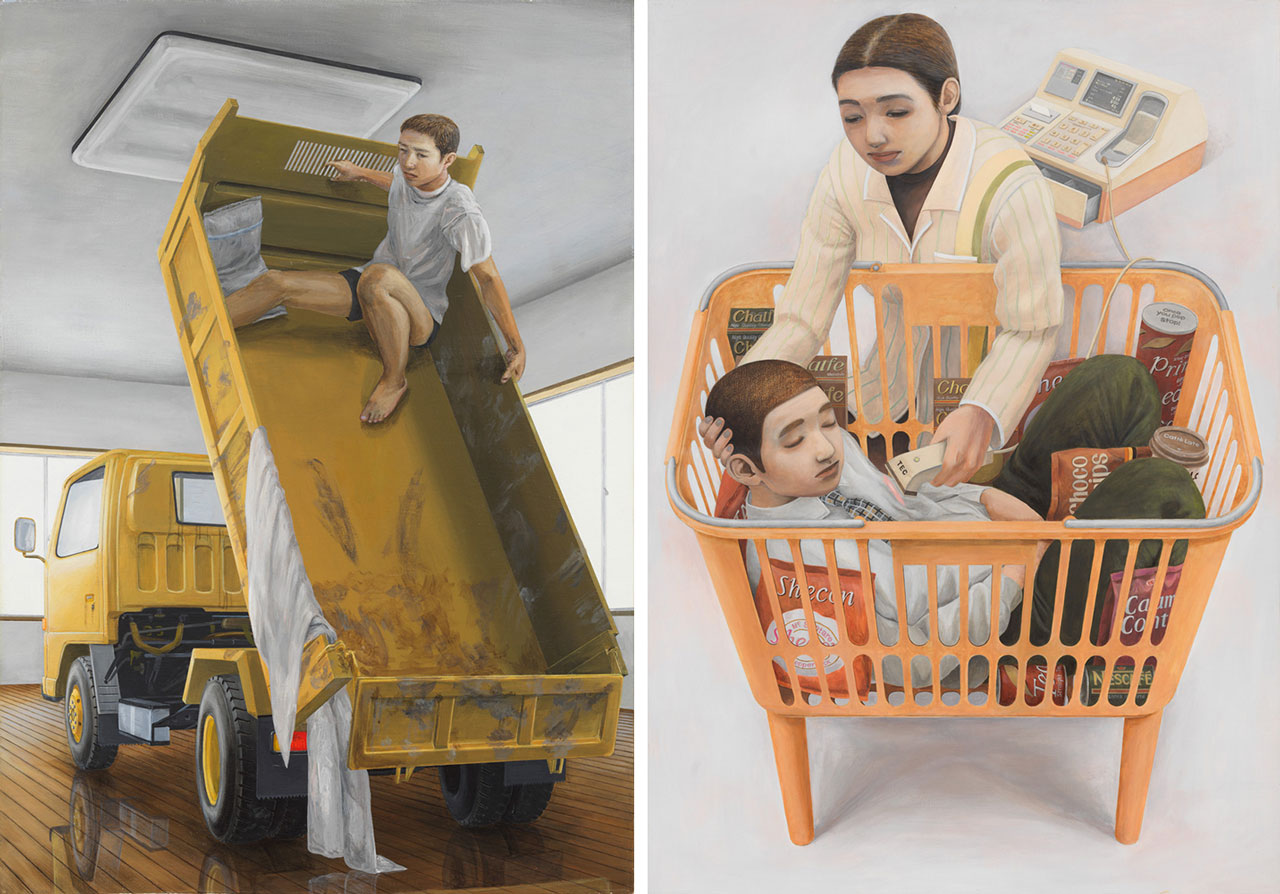
Right: Tetsuya Ishida, Convenience Store Mother and Child, 1996, Acrylic on board, 57 3/8 x 40 5/8 inches (145.6 x 103 cm), © Tetsuya Ishida Estate, Photo: Robert McKeever, Courtesy Gagosian