
PRESENTATION: Chico da Silva-And the soul is for the birds
![Chico da Silva (Francisco Domingos da Silva), Sem título [Untitled], 1969. Photo: Ding Musa | Courtesy Galatea](http://www.dreamideamachine.com/web/wp-content/uploads/2026/06/00-2.jpg)
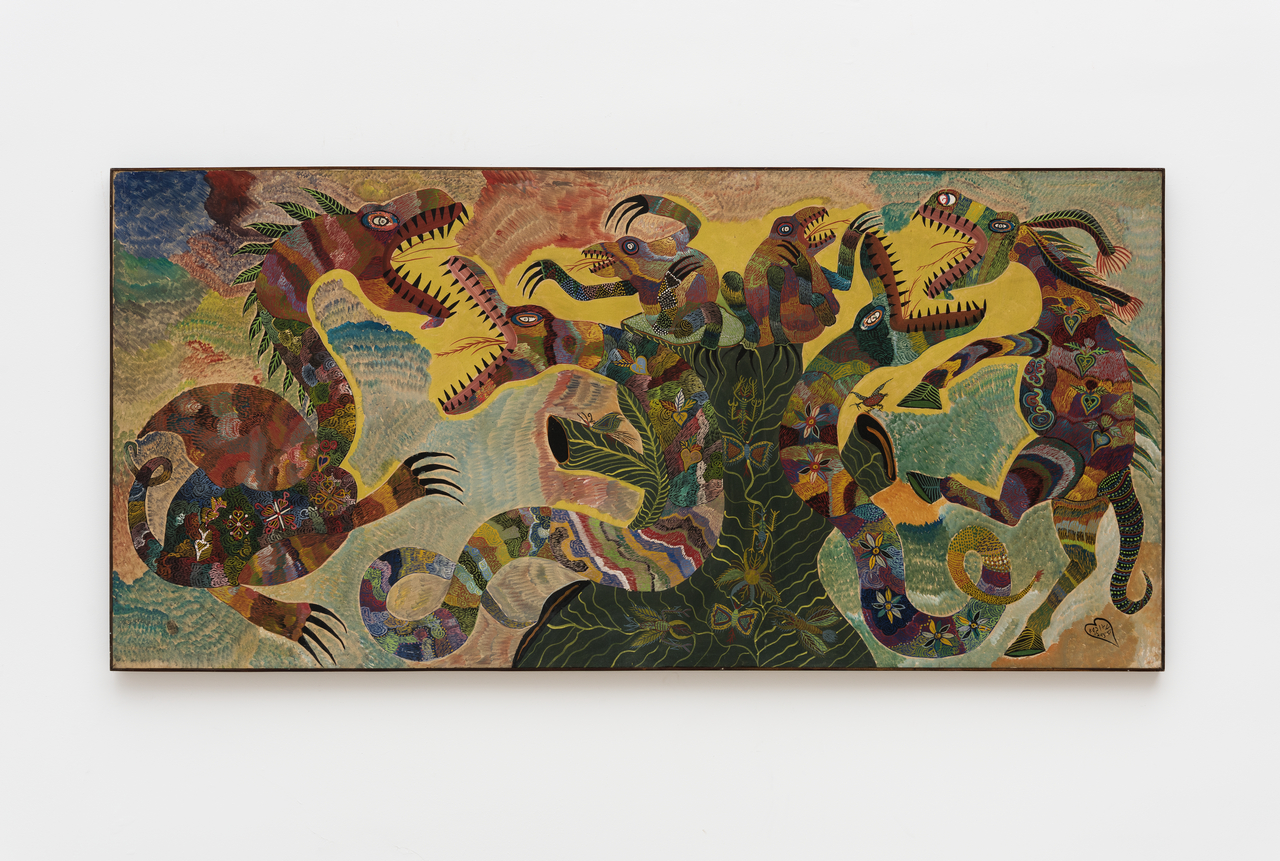
Chico da Silva’s paintings were a glimpse into an immense non-hierarchical cosmology that was fuelled by the artist’s own imagination, mythology and folklore. Depicting sea creatures swimming on the currents of outer space, and fantastical creatures vividly painted in hallucinatory battles or stretching their jaws agape to consume smaller creatures, Chico’s works call attention to the interconnectedness of everything.
By Dimitris Lempesis
Photo: Nottingham Contemporary Archive
For much of his life, Chico da Silva occupied a paradoxical position within the art world. Celebrated internationally for the originality of his paintings yet frequently categorized through the reductive lens of “primitive art,” he became both a symbol of artistic discovery and a subject of misunderstanding. Today, exhibitions such as “And the Soul is for the Birds” revisit his work, a more nuanced understanding is emerging—one that recognizes Chico da Silva not as an exotic curiosity, but as one of the most singular and influential figures in twentieth-century Brazilian art.
Born in Alto Tejo, Acre, amid the vast Amazon rainforest, Francisco “Chico” da Silva grew up immersed in environments that would later define his artistic imagination. Although he moved across different regions throughout his life, he remained deeply connected to Brazil’s northern landscapes and cultural traditions. His earliest artistic experiments took place in Fortaleza, where he decorated the whitewashed walls of fishermen’s houses in Praia Formosa using charcoal, brick fragments, leaves, and other materials readily available in his surroundings. These humble beginnings laid the foundation for a visual language that would become instantly recognizable and internationally celebrated.
Chico’s paintings and gouaches are populated by an extraordinary bestiary of birds, fish, serpents, dragons, and hybrid creatures. Drawing from the oral traditions, myths, and cosmologies of Northern Brazil, he transformed stories passed down through generations into vivid pictorial worlds. His compositions are characterized by intense polychromy, intricate networks of lines, and dense graphic textures that create a sense of movement and vitality. Rather than depicting nature as a passive landscape, Chico presented it as a dynamic arena of encounter, tension, coexistence, and transformation.
The originality of this visual language distinguished him within the context of Brazilian popular art. Critics and collectors alike were captivated by his highly imaginative compositions, which combined technical sophistication with a powerful sense of invention. During his lifetime, Chico achieved considerable commercial success and attracted significant critical attention, eventually gaining recognition far beyond Brazil’s borders. In 1966, he represented Brazil at the 33rd Venice Biennale, where he received an Honorable Mention, cementing his place on the international stage.
Yet Chico’s career cannot be understood solely through the narrative of artistic success. As an artist of Indigenous ancestry and modest socioeconomic background, he developed his practice outside formal academic institutions and conventional artistic training. His creative vocabulary emerged from lived experience, sensory perception, and cultural memory rather than from established art schools. The Amazonian world inherited from his father and the coastal environment associated with his mother converged in a visual grammar uniquely his own. The rainforest provided an endless source of fantastical creatures and organic forms, while the light, sea, and atmosphere of Ceará infused his paintings with luminosity and aquatic abundance.
Scholars have also noted that aspects of Chico’s personal experiences, including mental health challenges documented during his lifetime, may have influenced the development of his expansive imaginative universe. Rather than diminishing his artistic achievement, these complexities underscore the deeply personal dimensions of a practice that transformed subjective experience into richly symbolic imagery.
One of the most debated chapters of Chico’s career concerns the Pirambu School, the collective studio practice he established in Fortaleza during the 1960s. Originally conceived as a workshop where local children and artisans could learn artistic techniques, the initiative evolved into a collaborative model of production. While the Pirambu School expanded Chico’s visual language and provided opportunities for emerging artists, it also generated controversy regarding authorship and authenticity. Critics questioned the extent of individual participation in works associated with his name, and these debates contributed to a decline in his reputation during the later years of his career. Contemporary scholarship, however, increasingly views the Pirambu School not as evidence of artistic dilution but as a pioneering experiment in collective creativity that challenged Western assumptions about individual authorship.
Central to any discussion of Chico da Silva is his relationship with the Swiss artist and critic Jean-Pierre Chabloz. Their encounter in 1943 proved transformative. Chabloz introduced Chico to gouache, paper, and canvas, while also promoting his work in Brazil and Europe. Without this support, Chico’s rise to international prominence might have been far more difficult. Yet the relationship was also shaped by unequal power dynamics and colonial attitudes. Chabloz frequently framed Chico as a “primitive” genius, reinforcing narratives that exoticized Indigenous creativity for European audiences. Recent reassessments seek to move beyond these interpretations, recognizing Chico as a sophisticated artist whose work cannot be reduced to ethnographic curiosity or outsider status.
Viewed today, Chico da Silva’s paintings reveal an artist who fundamentally challenged dominant artistic conventions. His compositions often dispense with the traditional Western landscape, replacing fixed horizons and perspectival depth with densely populated pictorial fields where creatures, patterns, and forms interact on equal terms. His paintings construct worlds governed by their own internal logic—spaces in which mythology, memory, imagination, and observation coexist seamlessly.
The renewed international interest in Chico da Silva reflects a broader effort to recognize the contributions of Indigenous and self-taught artists to global modernism. Rather than approaching his work through outdated categories such as “naïve” or “primitive,” contemporary audiences are increasingly acknowledging the intellectual complexity, technical refinement, and cultural significance of his practice. His art emerges not from exoticism but from acute observation, intuitive understanding, and a profound engagement with the environments and traditions that shaped his life.
More than four decades after his death in 1985, Chico da Silva continues to resonate with audiences around the world. His fantastical creatures, luminous colors, and intricate visual narratives remain compelling not only because they evoke the richness of the Amazon and the Brazilian Northeast, but because they speak to universal themes of imagination, coexistence, transformation, and belonging. In reclaiming Chico da Silva’s legacy on his own terms, contemporary scholarship and exhibitions offer a more complete portrait of an artist whose vision transcended the limitations imposed upon him and whose work remains a vital contribution to the history of contemporary Indigenous art in Brazil.
Photo: Chico da Silva (Francisco Domingos da Silva), Sem título [Untitled], 1969. Photo: Ding Musa | Courtesy Galatea
Info: Curators: Salma Tuqan and Niall Ó Faircheallaigh, Nottingham Contemporary, Weekday Cross, Nottingham, United Kingdom, Duration: 6/6-6/9/2026, Days & Hours: Tue-Fri 10:00-17:00, Sat 10:00-18:00, Sun 1:00-17:00, www.nottinghamcontemporary.org/
![Chico da Silva (Francisco Domingos da Silva), Sem título [Untitled], 1968. Photo: Ding Musa | Courtesy Galatea](http://www.dreamideamachine.com/web/wp-content/uploads/2026/06/CDS-0012_alta@Ding-Musa.jpg)
![Chico da Silva (Francisco Domingos da Silva), Sem título [Untitled], 1967. Photo: Ding Musa | Courtesy Galatea](http://www.dreamideamachine.com/web/wp-content/uploads/2026/06/CDS-0091_alta_@EstudioemObra.jpg)
![Chico da Silva (Francisco Domingos da Silva), Sem título [Untitled], 1968. Photo: Ding Musa | Courtesy Galatea](http://www.dreamideamachine.com/web/wp-content/uploads/2026/06/CDS-0103_alta_@Ding-Musa_DSC9095.jpg)
![Chico da Silva (Francisco Domingos da Silva), Sem título [Untitled], 1976. Photo: Ding Musa | Courtesy Galatea](http://www.dreamideamachine.com/web/wp-content/uploads/2026/06/CDS-0106_alta_@Ding-Musa_DSC9101.jpg)
![Chico da Silva (Francisco Domingos da Silva), Sem título [Untitled], 1978. Photo: Ding Musa | Courtesy Galatea](http://www.dreamideamachine.com/web/wp-content/uploads/2026/06/CDS-0108_alta_@Ding-Musa_DSC9124.jpg)
![Chico da Silva (Francisco Domingos da Silva), Sem título [Untitled], 1968. Photo: Ding Musa | Courtesy Galatea](http://www.dreamideamachine.com/web/wp-content/uploads/2026/06/CDS-0113_alta_@Ding-Musa_DSC8790.jpg)
![Chico da Silva (Francisco Domingos da Silva), Sem título [Untitled], c. 1950s. Photo: Ding Musa | Courtesy Galatea](http://www.dreamideamachine.com/web/wp-content/uploads/2026/06/CDS-0115_alta_@Ding-Musa_DIN5151.jpg)
![Chico da Silva (Francisco Domingos da Silva), Sem título [Untitled], c. 1950s. Photo: Ding Musa | Courtesy Galatea](http://www.dreamideamachine.com/web/wp-content/uploads/2026/06/CDS-0116_alta_@Ding-Musa_ADI3835.jpg)
![Chico da Silva (Francisco Domingos da Silva), Sem título [Untitled], 1966. Photo: Ding Musa | Courtesy Galatea](http://www.dreamideamachine.com/web/wp-content/uploads/2026/06/CDS-0118_alta_@Ding-Musa_DSC8784.jpg)
![Chico da Silva (Francisco Domingos da Silva), Sem título [Untitled], c. 1960s. Photo: Ding Musa | Courtesy Galatea](http://www.dreamideamachine.com/web/wp-content/uploads/2026/06/CDS-0120_alta.jpg)
![Chico da Silva (Francisco Domingos da Silva), Sem título [Untitled], 1978. Photo: Ding Musa | Courtesy Galatea](http://www.dreamideamachine.com/web/wp-content/uploads/2026/06/CDS-0122_alta_@Ding-Musa_DIN5979.jpg)