PRESENTATION:M.C. Escher-The Exhibition
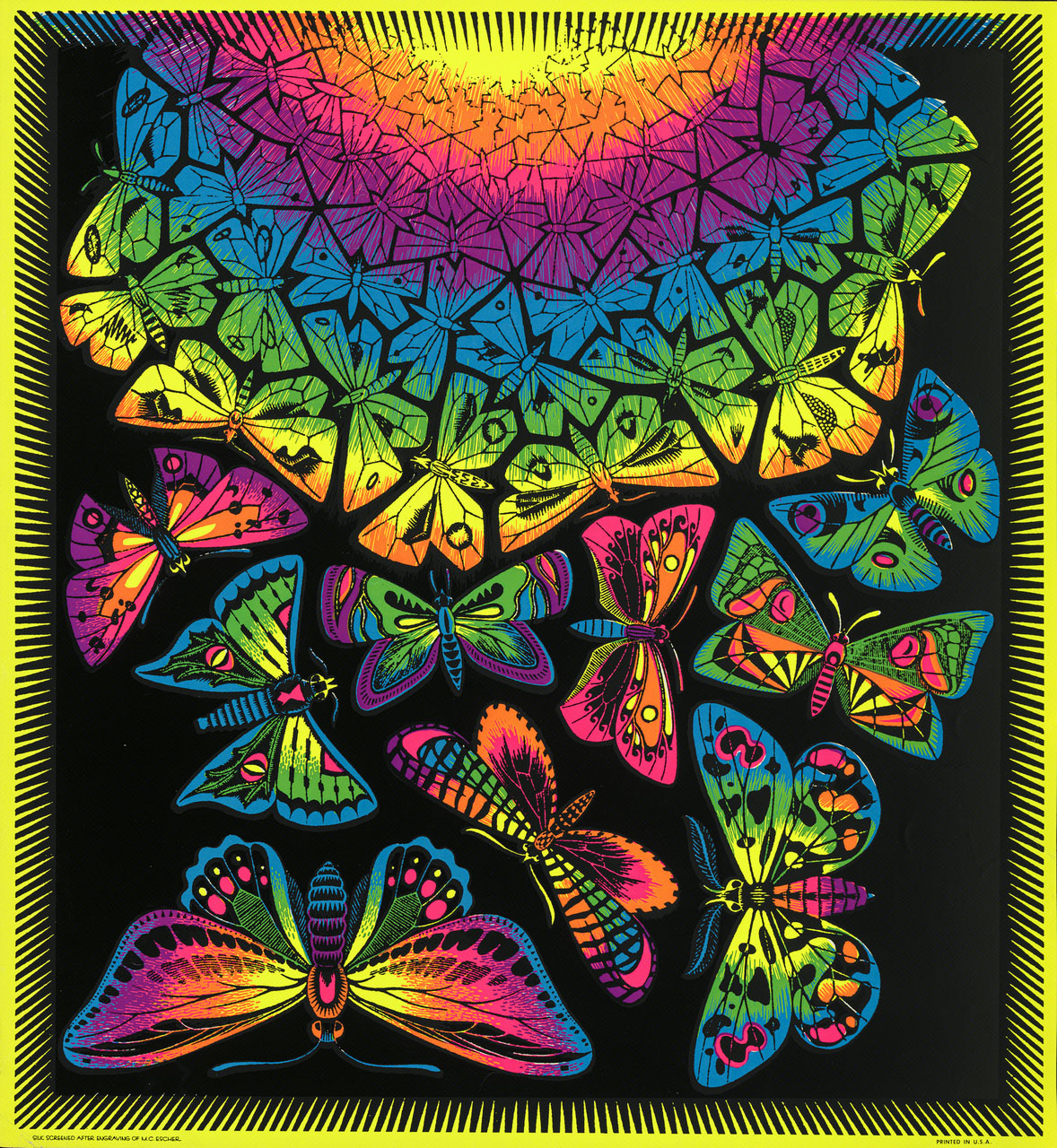
M.C. Escher occupies a singular position in the history of art. Rooted in the traditions of printmaking yet constantly pushing beyond conventional representation, he created a body of work that transcends disciplinary boundaries. Through landscapes, tessellations, metamorphoses, impossible architectures, and visual paradoxes, he challenged viewers to reconsider their understanding of reality. His art demonstrates that imagination and logic need not be opposites; instead, they can work together to reveal entirely new ways of seeing the world.
By Dimitris Lempesis
Photo: Somerset House Archive
Few artists have bridged the worlds of art, mathematics, and visual imagination as successfully as M.C. Escher. Renowned for his impossible architectures, metamorphosing forms, and mind-bending paradoxes, the Dutch graphic artist transformed the traditional language of printmaking into a unique exploration of perception, geometry, and infinity. By retracing the full development of Escher’s artistic career—from his earliest works to the masterpieces of his mature years—this exhibition reveals the techniques, research, and inspirations that shaped one of the most recognizable artistic visions of the twentieth century.
A major retrospective dedicated to Dutch graphic artist M.C. Escher (Maurits Cornelis Escher). Designed to appeal to a wide audience, the exhibition offers a unique opportunity for lovers of art and mathematics alike to explore over 150 works of a remarkable artist who masterfully combined art and mathematics, giving rise to a unique and unmistakable style, expressed in his famous visual paradoxes and impossible worlds – but which goes far beyond such creations. These are the sections of the exhibition.
The Beginnings: Maurits Cornelis Escher’s path to becoming one of the world’s most celebrated graphic artists was far from straightforward. After experiencing academic difficulties, he enrolled at the School of Architecture and Decorative Arts in Haarlem, where he came under the guidance of the influential artist and teacher Samuel Jessurun de Mesquita. It was a decisive encounter. Recognizing Escher’s talent, De Mesquita encouraged him to abandon architecture and devote himself to graphic arts, introducing him to woodcut, linocut, etching, and mezzotint. Although he experimented with a variety of printmaking techniques throughout his life, woodcut remained his preferred medium and the one in which he achieved extraordinary mastery.
From his teacher, Escher inherited a sensitivity to natural forms, a refined sense of line, and an appreciation for simplicity and clarity of composition. His early works reveal the influence of Art Nouveau and Symbolism, artistic currents that were still prominent in Europe during his formative years. Yet even in these youthful creations, one can already identify the seeds of the themes that would define his career: close observation of nature, an interest in geometric order, and an early fascination with tessellation. Works such as Beauty from the Flor de Pascua series demonstrate a remarkable ability to combine decorative elegance with structural rigor, anticipating the artistic investigations that would occupy him for decades.
The Italian Period and Travels: Italy played a fundamental role in Escher’s artistic development. He first visited the country in 1921 and returned after completing his studies, eventually settling in Rome in 1923. He would remain there until 1935, a period marked by personal happiness and professional growth. During these years he married Jetta Umiker, started a family, and began receiving recognition for his work. The cultural vitality of Rome exposed him to a vibrant artistic community and broadened his creative horizons.
Travel became an essential component of his practice. Escher journeyed extensively throughout Italy and the Mediterranean, filling sketchbooks with studies of villages, mountains, coastlines, and architectural monuments. These sketches later served as the basis for highly detailed lithographs and woodcuts. He also visited France on several occasions, developing a particular fascination with the dramatic landscapes of Corsica.
In 1926, Escher achieved his first significant success with a solo exhibition at Palazzo Venezia in Rome, where he presented a series of woodcuts dedicated to the Days of Creation. During the same period, he produced illustrations for publications such as “XXIV Emblemata dat zijn zinne-beelden” and “De vreeselijke avonturen van Scholastic”a. These works reveal an increasingly sophisticated manipulation of perspective and space. While rooted in careful observation of the natural world, they also introduce unusual viewpoints and compositional structures that foreshadow the visual paradoxes and optical illusions of his later career.
Tessellations: A decisive turning point occurred in 1936, when Escher undertook a second journey to southern Spain. During this trip he revisited two extraordinary monuments of Islamic architecture: the Alhambra in Granada and the Mezquita in Córdoba. Their walls, ceilings, and arches were covered with intricate geometric decorations created through the repetition of interlocking forms. The experience profoundly affected him.
Escher became fascinated by tessellations—patterns formed by repeating shapes that completely cover a surface without gaps or overlaps. Inspired by the Moorish artisans’ mastery of geometry, he embarked on a systematic study of plane-filling designs. He produced 137 watercolours gathered in a notebook that explored numerous tessellation patterns, investigating the seventeen possible ways in which a plane can be filled through translation, rotation, and reflection of a single shape.
What distinguished Escher’s approach was his gradual transformation of abstract geometric forms into recognizable figures. Birds, fish, reptiles, insects, and human beings emerged seamlessly from mathematical structures. In these works, geometry became a vehicle for imagination. The resulting images represent a perfect synthesis of scientific order and artistic invention, establishing tessellation as one of the defining features of Escher’s visual language.
Metamorphoses: The study of tessellations naturally led Escher toward another central theme: metamorphosis. Beginning in 1937, he explored the idea of transformation through compositions in which one form gradually evolves into another. Derived from the Greek word meaning “change of form,” metamorphosis became for Escher a means of visualizing continuity and interconnectedness.
He devoted three major works to this concept: “Metamorphosis I “(1937), “Metamorphosis II” (1939–1940), and “Metamorphosis III” (1967–1968). In these ambitious compositions, geometric patterns evolve into animals, architectural forms, landscapes, and abstract structures, only to transform again into new realities. A lizard becomes a honeycomb, fish become birds, and architectural forms emerge from seemingly unrelated shapes.
These transformations reflect profound ideas about cyclicity, eternity, and the interconnected nature of existence. Opposites such as day and night, order and chaos, or good and evil coexist within the same visual system, revealing Escher’s fascination with unity emerging from contrast. His investigations into metamorphosis also fueled his interest in representing infinity, culminating in the celebrated “Circle Limit” series, where repeating forms diminish endlessly toward the edge of the composition.
Structure of Space: Throughout his career, Escher displayed an extraordinary concern for the organization of space. While many artists focused primarily on color and representation, he treated space itself as a subject worthy of investigation. From the mid-1930s onward, he increasingly challenged conventional Euclidean perspectives, searching for new ways to visualize reality.
His growing interest in mathematics and geometry inspired studies of spheres, reflective surfaces, polyhedra, and topological structures. Among the most famous examples is “Hand with Reflecting Sphere” (1935), a lithograph in which a mirrored sphere captures the entirety of the surrounding room while simultaneously placing the artist at its centre. The work functions both as a self-portrait and as a meditation on perception, suggesting that every observer occupies a unique position within the universe.
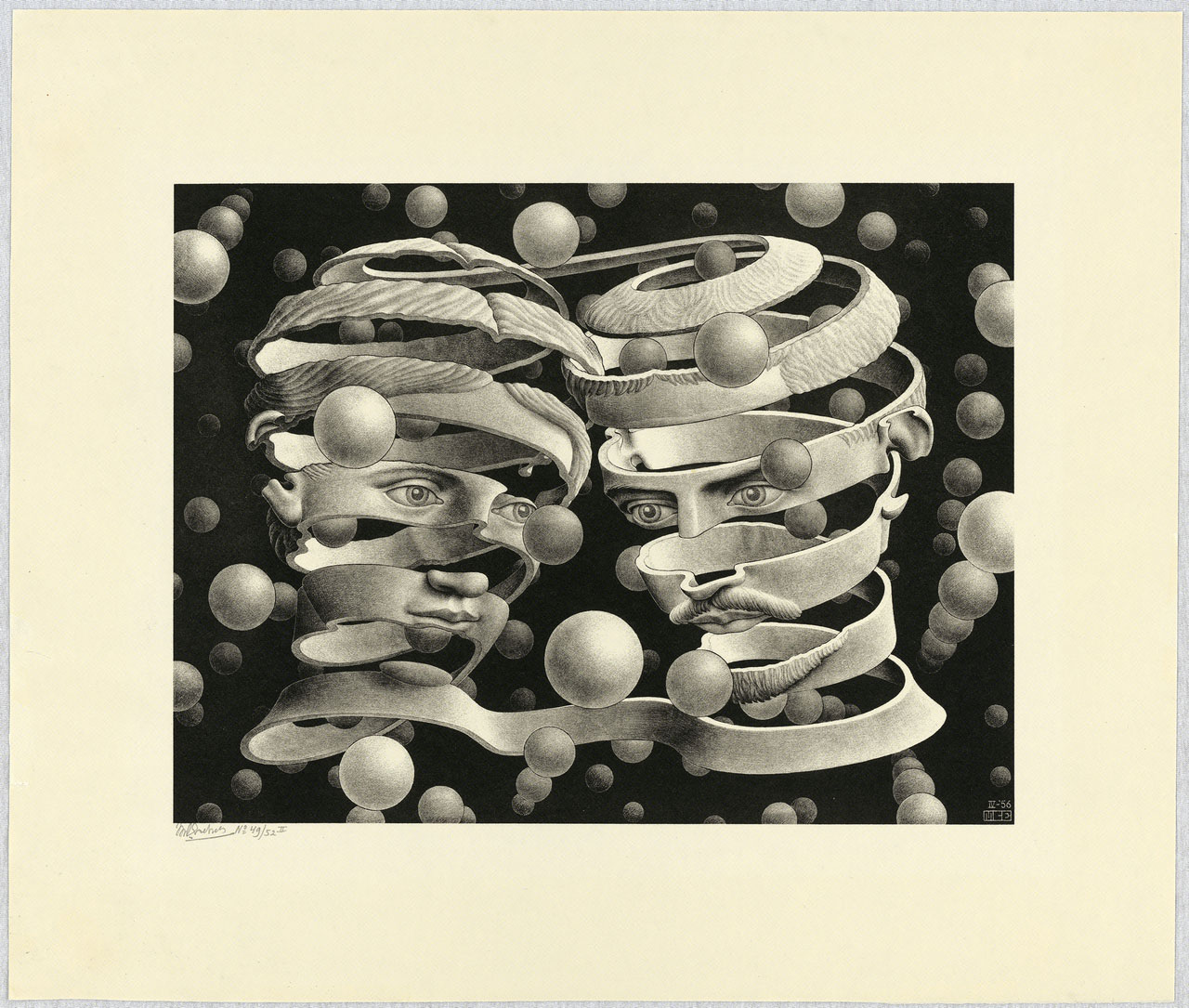
Escher also explored the Möbius strip, a geometric form with only one continuous surface. Such investigations allowed him to challenge viewers’ assumptions about space, dimensionality, and orientation. These studies paved the way for the impossible constructions and visual paradoxes that would define his mature period.
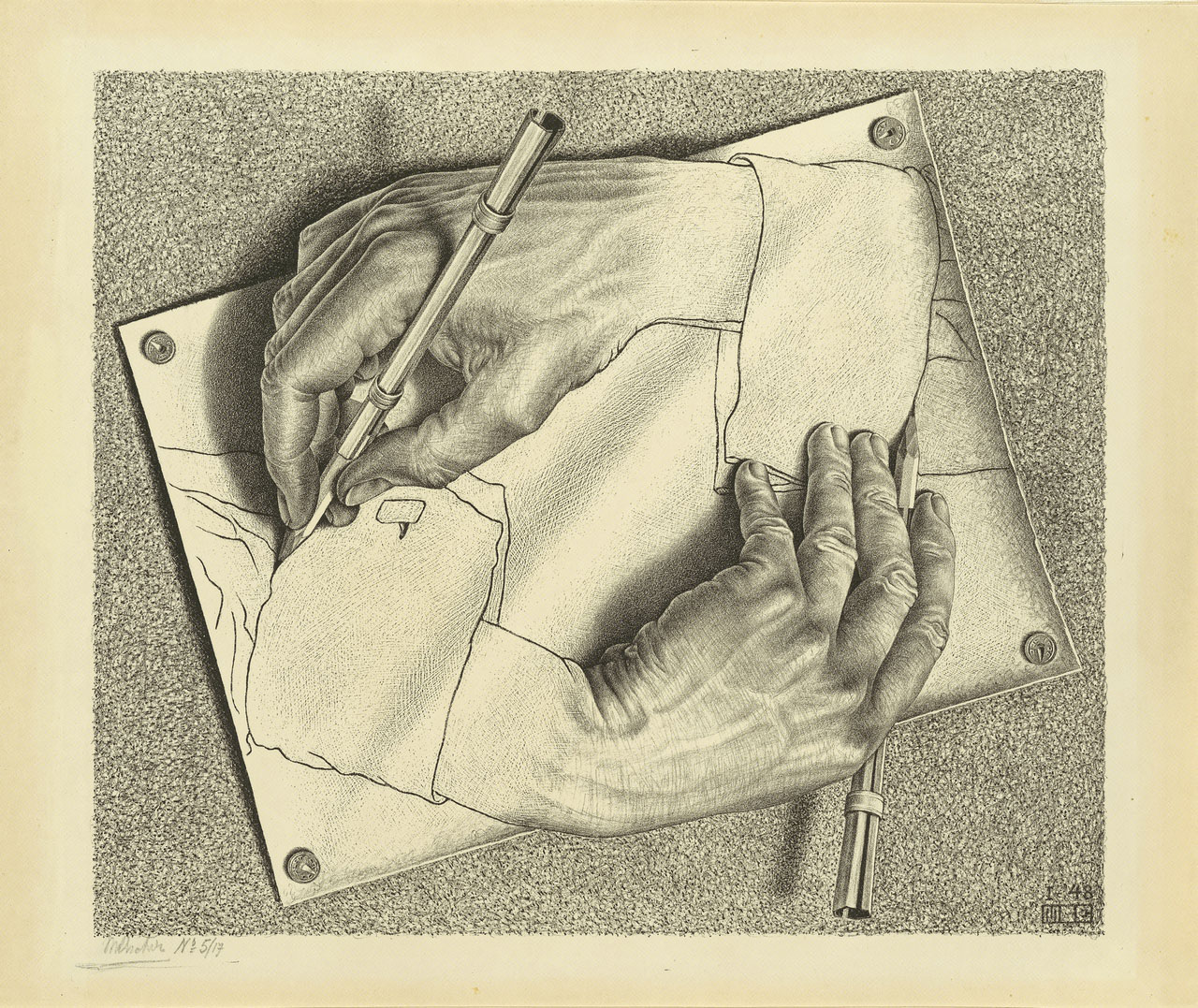
Geometric Paradoxes: Although Escher lacked formal mathematical training, his understanding of mathematics was remarkably intuitive and visual. Rather than approaching equations theoretically, he explored mathematical concepts through images. His works often depict structures that appear perfectly logical at first glance but reveal themselves to be impossible upon closer inspection.
A pivotal moment came in 1954, when an exhibition of his prints was included in the International Congress of Mathematicians in Amsterdam. This event fostered lasting exchanges between Escher and mathematicians, crystallographers, and scientists, who recognized in his work a unique capacity to visualize complex concepts.
Among the masterpieces resulting from this dialogue are “Ascending and Descending”, “Belvedere”, “Waterfall”, “Print Gallery”, and “Relativity”. In these works, staircases loop endlessly, architectural structures defy gravity, and multiple realities coexist within a single image. These compositions demonstrate Escher’s enduring fascination with infinity, paradox, and the limits of human perception. They remain among the most iconic visual expressions of mathematical thought ever created.
Commissioned Work: Despite his growing reputation, Escher was not widely celebrated until the final years of his life. For much of his career, he depended on commissioned projects to support himself and his family. These ranged from concert programme covers and greeting cards to ex libris designs intended for private book collections.
He also undertook larger public commissions, including the design of banknotes and postage stamps. Among the most significant of these projects was “Metamorphosis III”, a monumental seven-metre-long woodcut commissioned in 1967 by the Dutch Post Office in The Hague. Combining many of the themes explored throughout his career—tessellation, transformation, symmetry, and infinity—the work stands as one of his greatest achievements and a culmination of decades of artistic research.
Eschermania: Today, Escher’s influence extends far beyond the traditional boundaries of fine art. His visual language has become a global cultural phenomenon often described as “Eschermania.” Contemporary painters, digital artists, designers, and architects continue to draw inspiration from his innovative use of geometry and perception.
His imagery captivated the countercultural movements of the 1960s, appearing on album covers and in popular visual culture. Comic artists, animators, and filmmakers have repeatedly referenced his impossible worlds, while the advertising industry has embraced the playful ambiguity of his visual paradoxes. Prestigious fashion houses, including Chanel and Alexander McQueen, have incorporated Escher-inspired motifs into their collections, translating his geometric visions into wearable art.
The impact of his work is perhaps most evident in cinema, where images inspired by “Relativity” and other iconic prints continue to shape visual storytelling. More than fifty years after his death, Escher’s art remains remarkably contemporary. His exploration of infinity, transformation, and perception continues to inspire artists, scientists, and audiences alike, confirming his status as one of the most influential and imaginative creators of modern times.
Photo: Personality Posters of Canada, Creation of Butterflies , Blacklight poster, 660×600 mm Maurits Collection, Italy, All M.C. Escher works © 2026 The M.C. Escher Heritage, Baarn, The Netherlands, All rights reserved www.mcescher.com
Info: Curator: Federico Giudiceandrea, Somerset House – Embankment Galleries, Strand, London, United Kingdom, Duration: 5/6-6/9/2026, Days & Hours: Tue-Sat 10:00-19:00, Sun 10:00-17:00, www.somersethouse.org.uk/
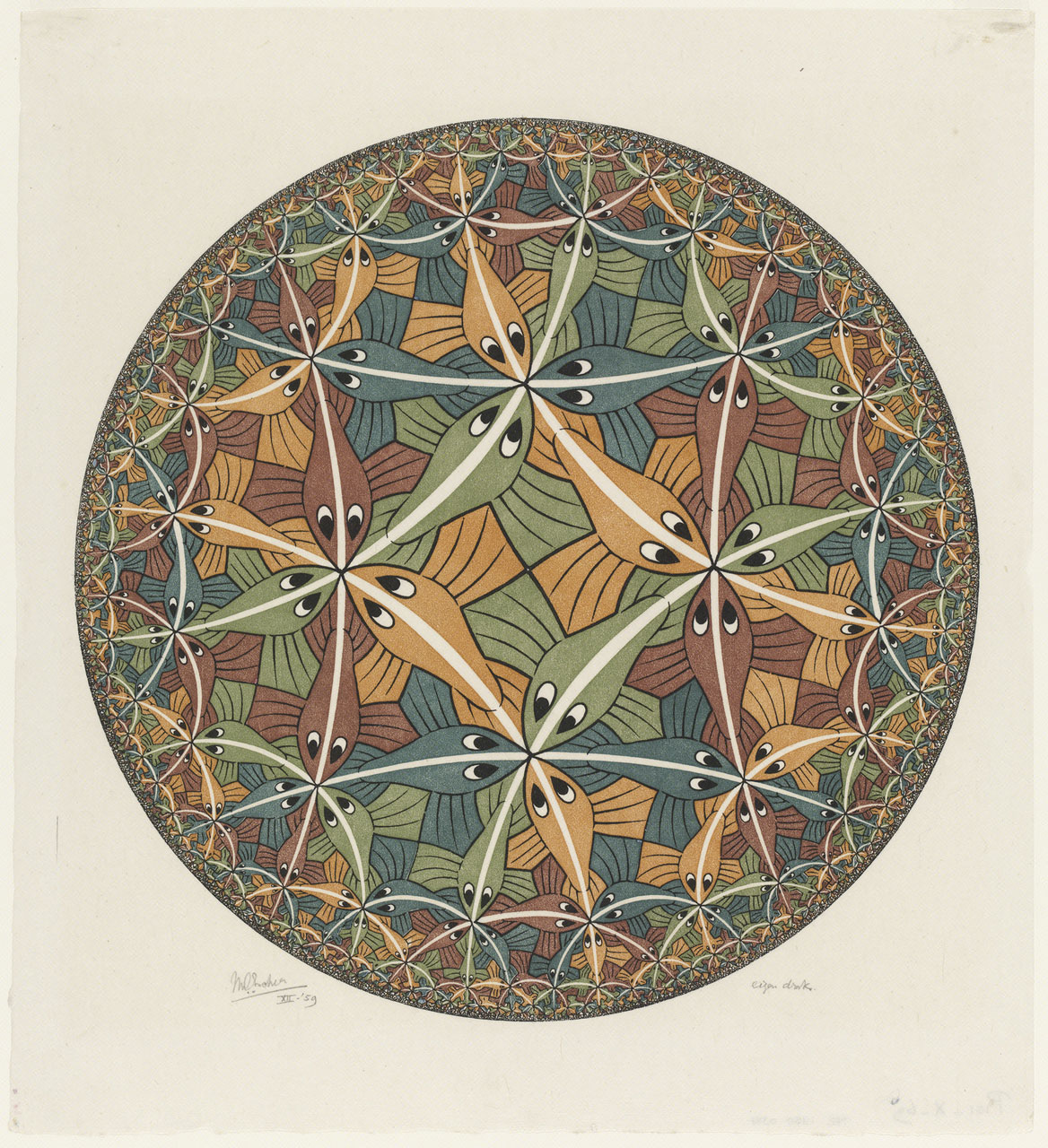
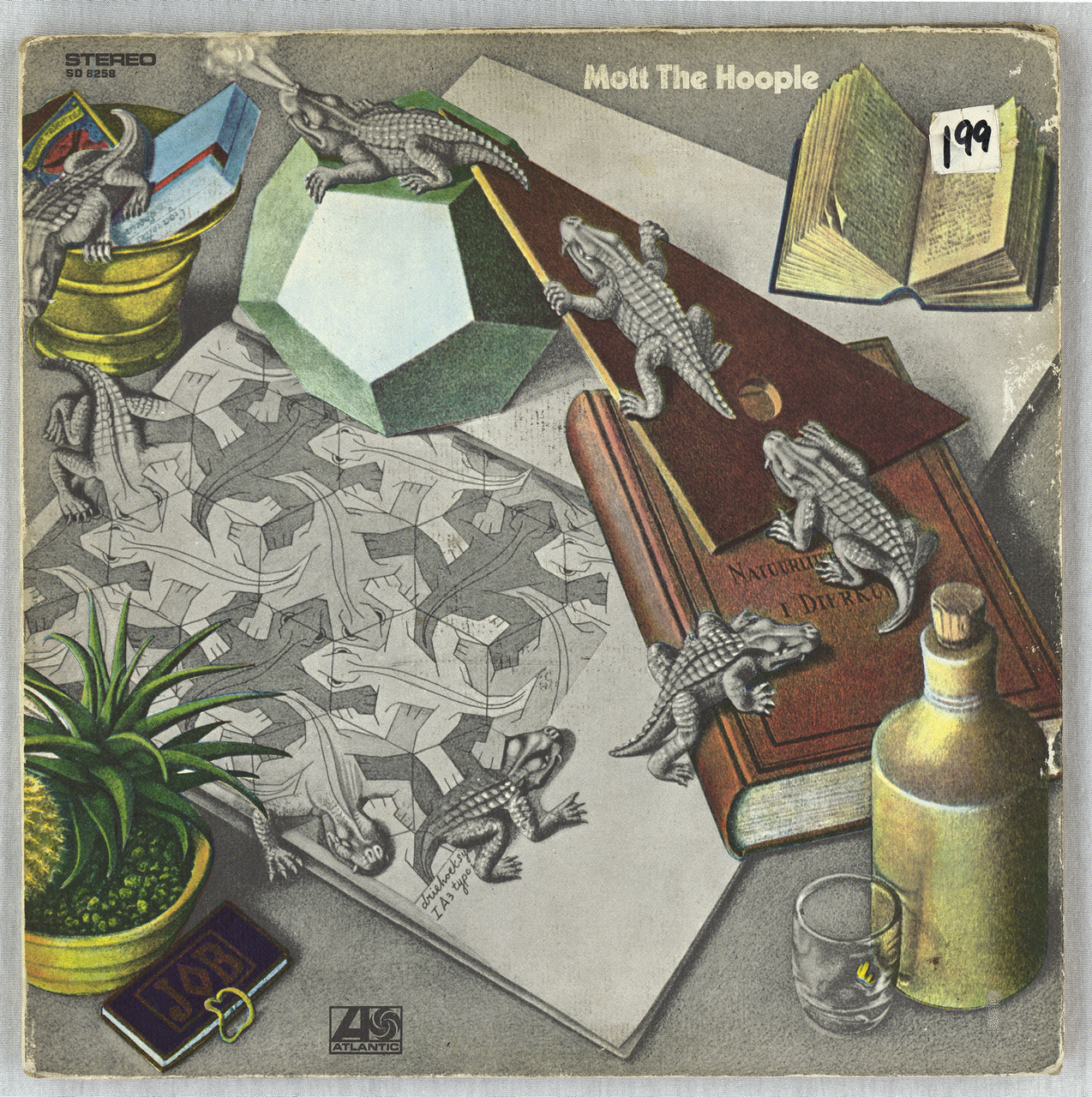
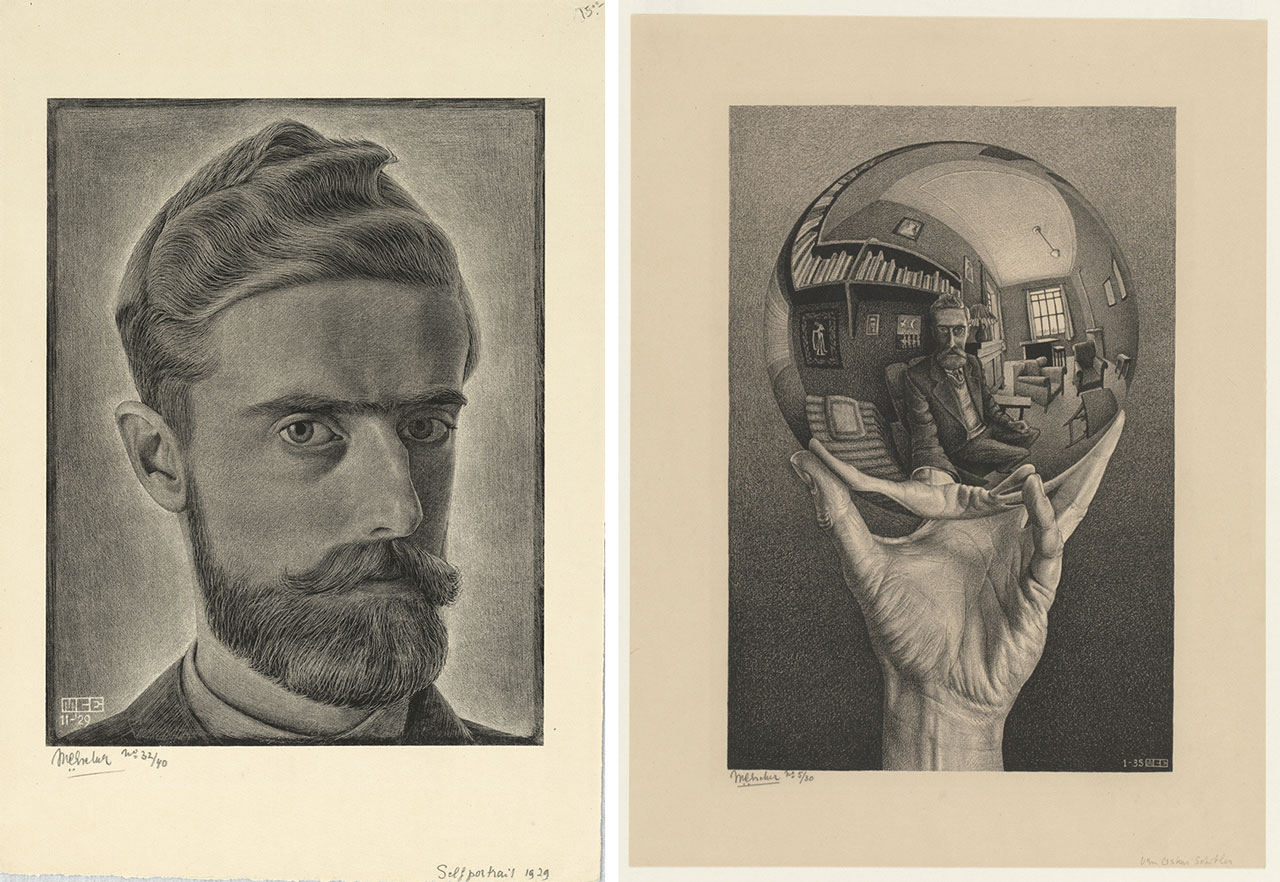
Right: M.C. Escher , Hand with Reflecting Sphere, 1935 Lithograph, 318×213 mm , M.C. Escher Heritage Collection, The Netherlands , All M.C. Escher works © 2026 The M.C. Escher Heritage, Baarn, The Netherlands, All rights reserved www.mcescher.com
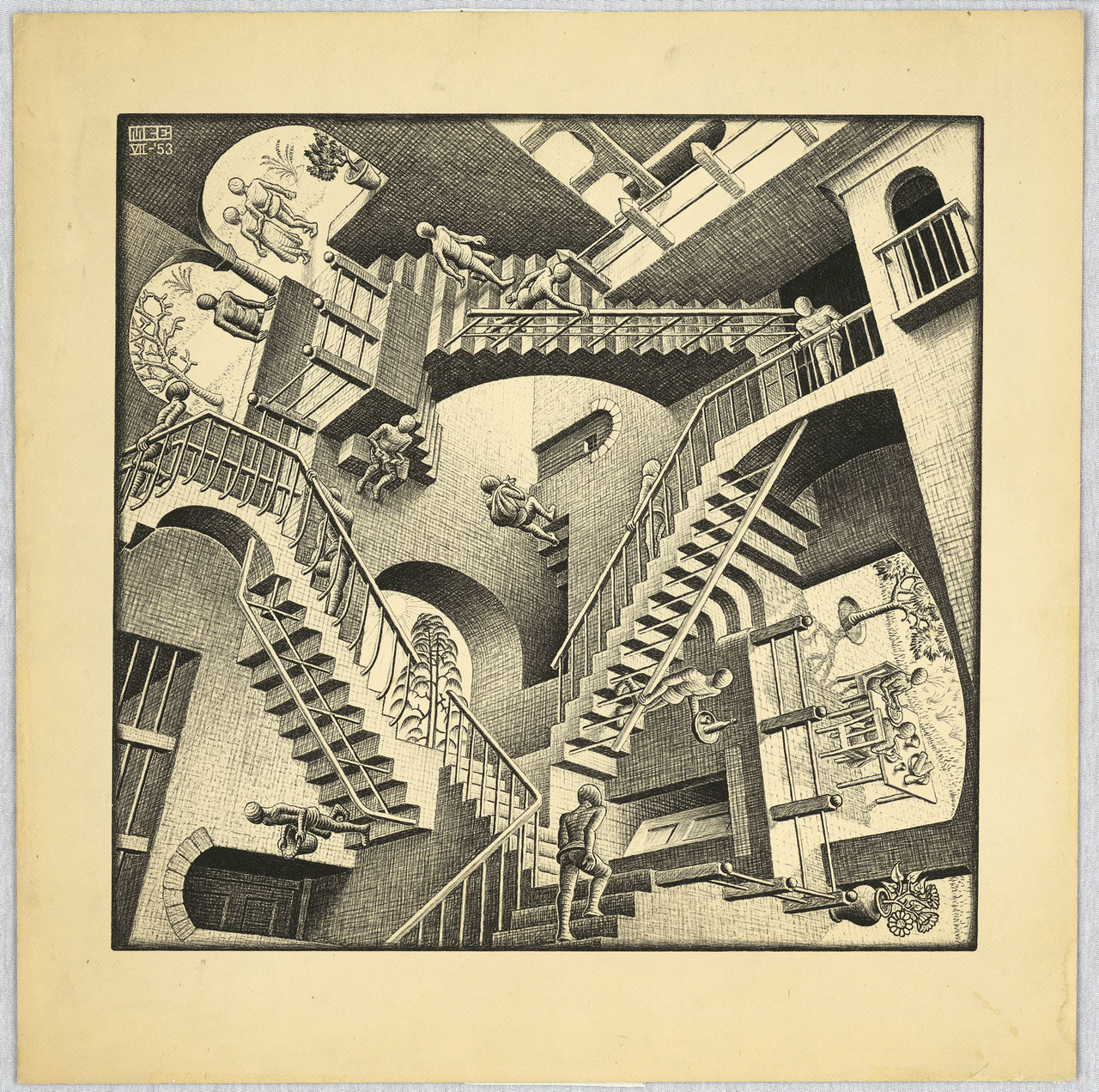
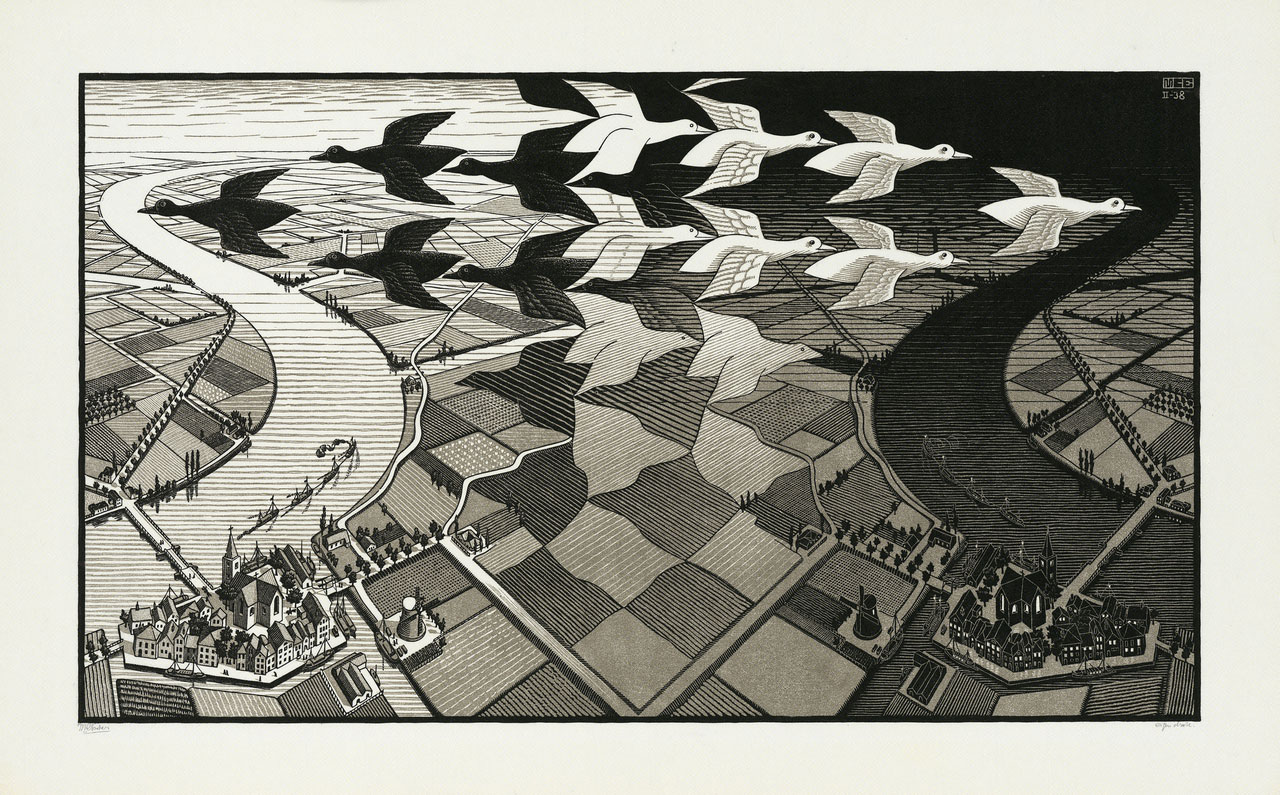
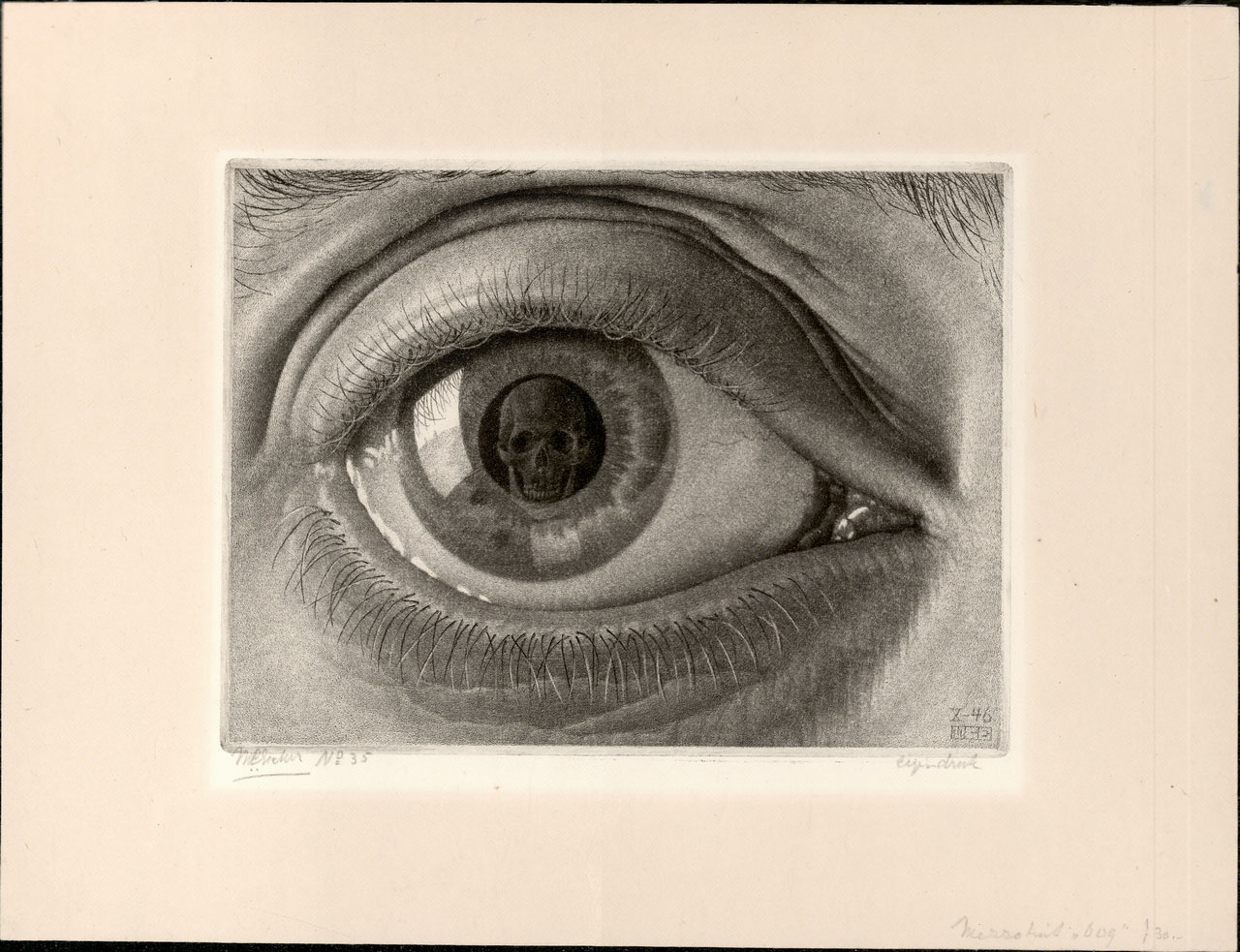
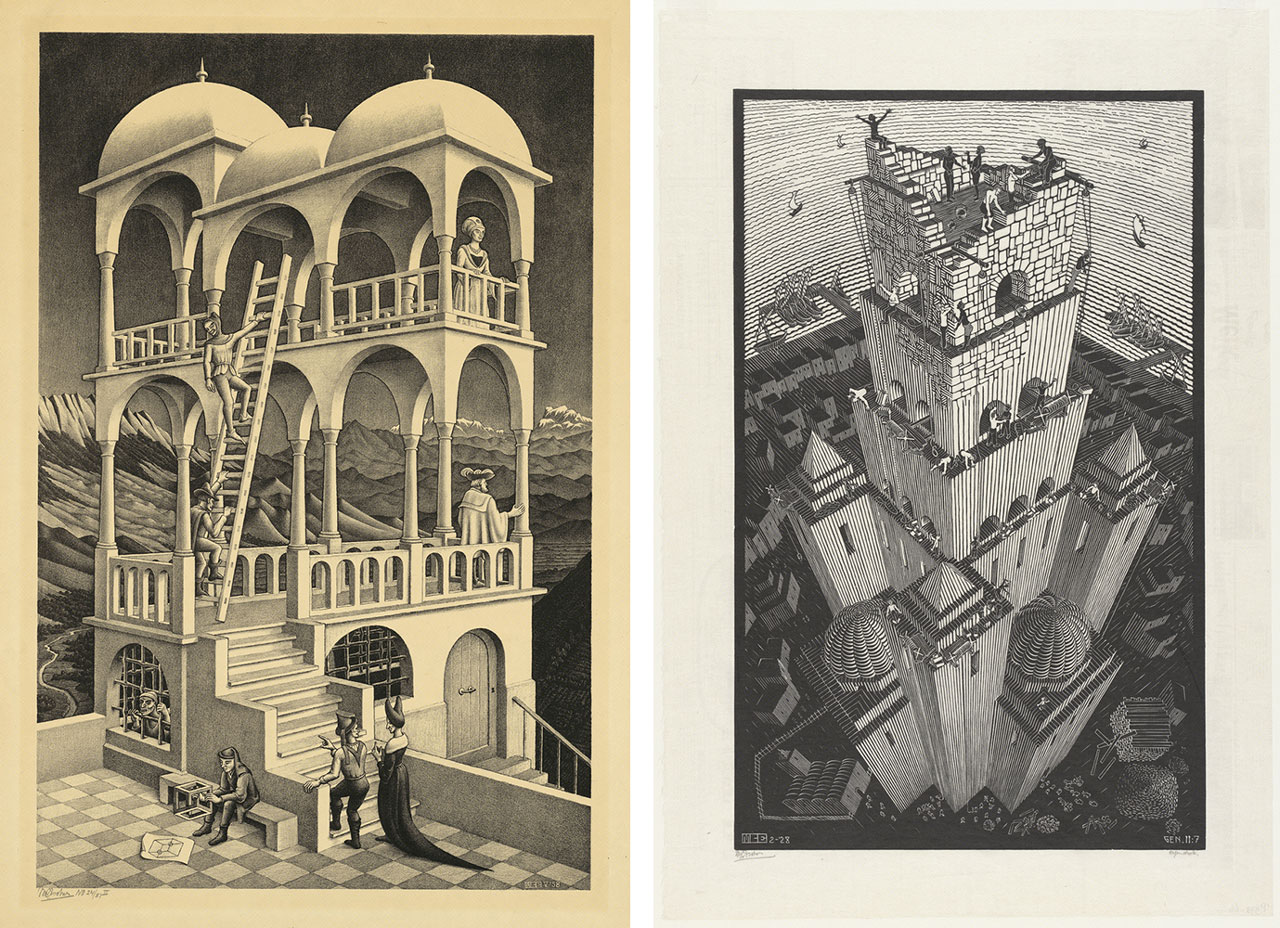
Right: M.C. Escher, Tower of Babel, 1928, Woodcut, 621×386 mm, M.C. Escher Heritage Collection, The Netherlands, All M.C. Escher works © 2026 The M.C. Escher Heritage, Baarn, The Netherlands. All rights reserved www.mcescher.com
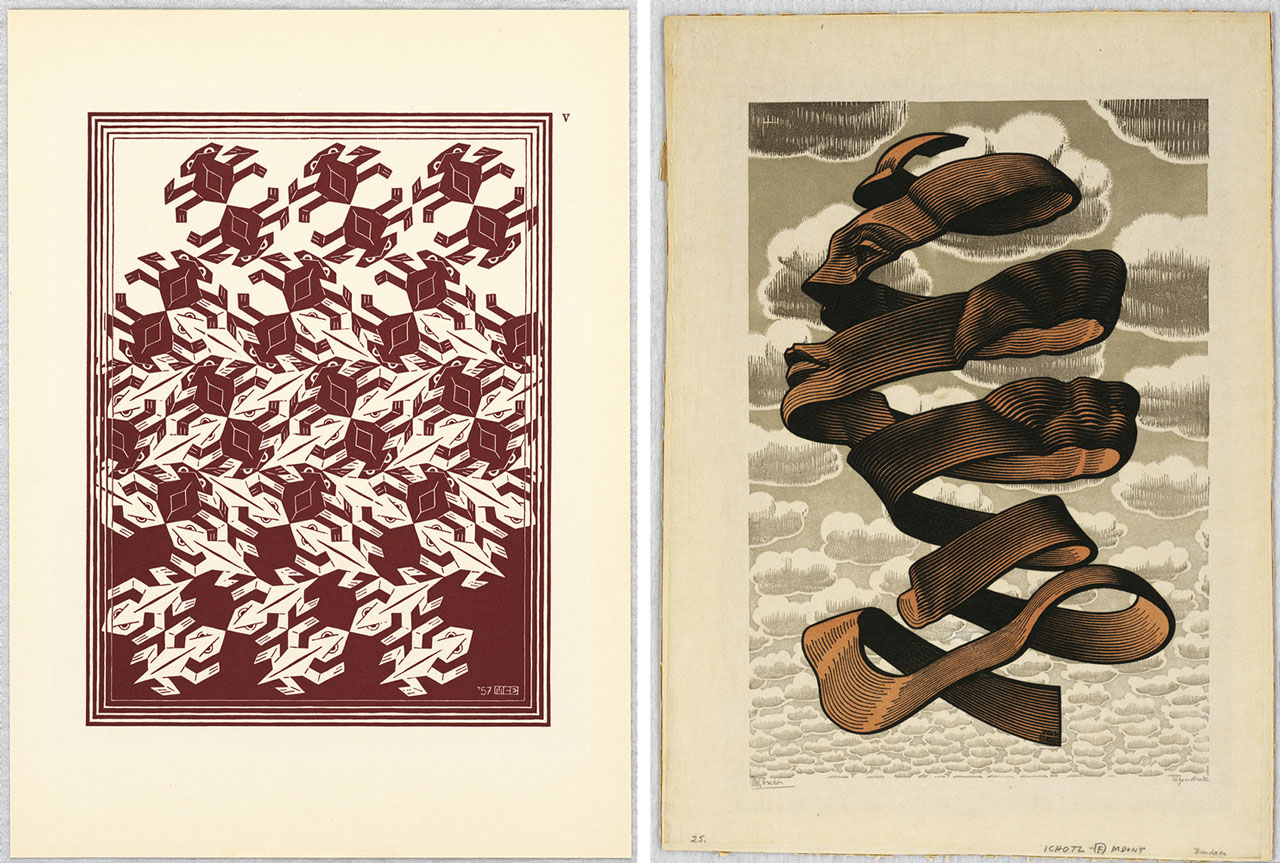
Right: M.C. Escher, Rind, 1955, End-grain woodcut and woodcut, 345×235 mm, M.C. Escher Heritage Collection, The Netherlands, All M.C. Escher works © 2026 The M.C. Escher Heritage, Baarn, The Netherlands, All rights reserved www.mcescher.com
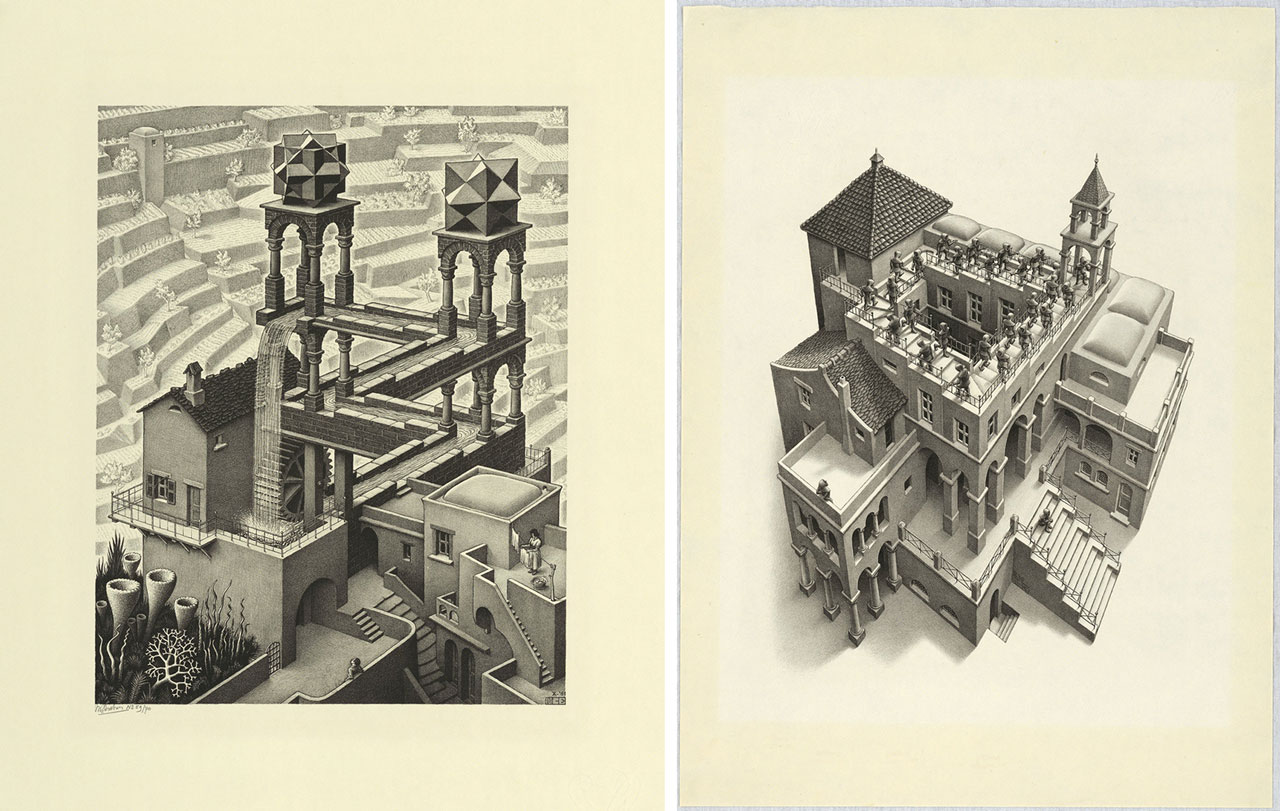
Right: M.C. Escher, Ascending and Descending, 1960 Lithograph, 355×285 mm , M.C. Escher Heritage Collection, The Netherlands, All M.C. Escher works © 2026 The M.C. Escher Heritage, Baarn, The Netherlands, All rights reserved www.mcescher.com