
OPEN CALL: Submissions: Cornell Journal of Architecture 14—“Spare”
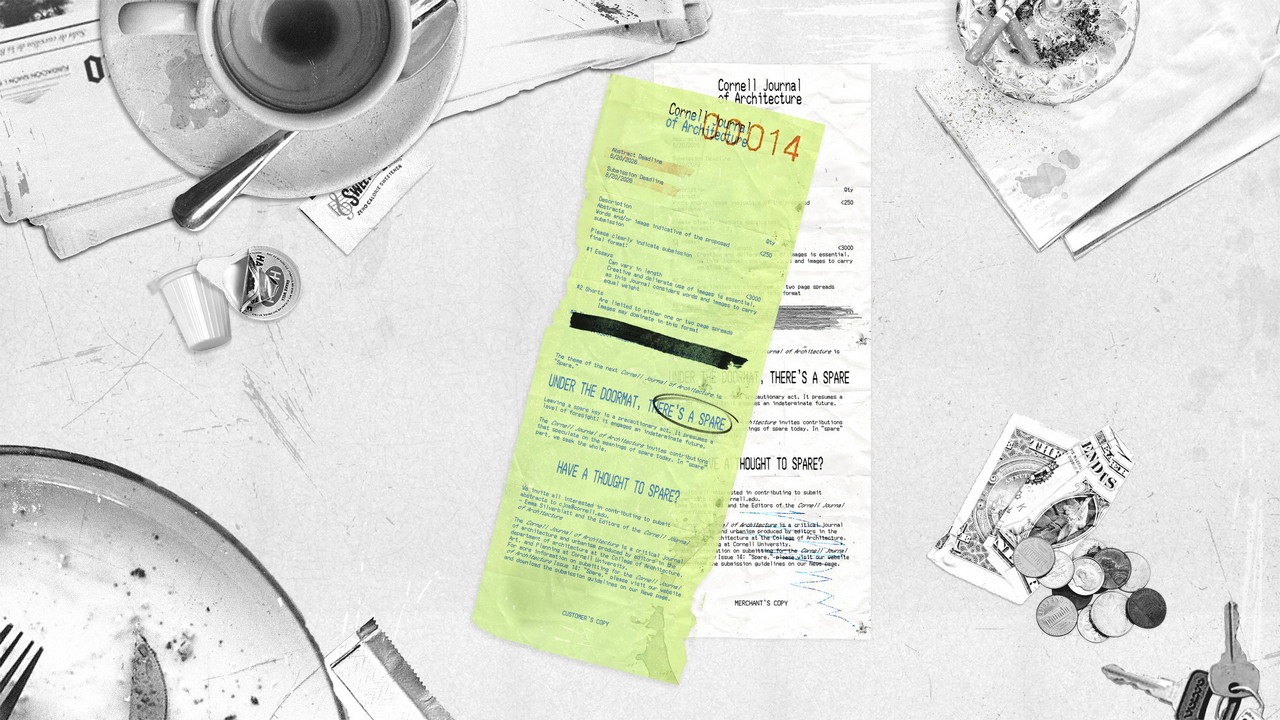
The theme for the next issue of the “Cornell Journal of Architecture” is “Spare.”
Under the doormat, there’s a spare.
Leaving a spare key is a precautionary act. It presumes a level of foresight; it engages an indeterminate future.
Spare is never simply extra.
It is reserved from use, protected from harm, or left over after a need has been met. Spare acknowledges the likelihood of contingencies and alternate plans.
Spare is relational.
Meaning both “excess” and “withholding,” the word “spare” encompasses a contradictory premise, linking present abundance to anticipated scarcity. How does this logic apply to the contemporary moment, characterized by overproduction and shortage? What is held in reserve in the built environment—for whom, and at what cost?
Spare is a state that fluctuates with context.
There is rarely a fixed line between necessary and useless, too much or not enough. A spare part becomes primary within an ongoing cycle of surplus and obsolescence. Bowling a spare leaves something to be desired, while sparing no expense indulges all desires. A spare room (home or planet) awaits inhabitation, yet a spare room relishes its own existenzminimum. Does the un-built environment harbor potential to spare?
Spare exists in anticipation: of use, of need, of loss, of return.
Something fails. Someone arrives. Something secondary becomes essential. A spare points to the unexpected possibilities within the present. In changing conditions, the spare—all but nominal—supersedes the original.
The “Cornell Journal of Architecture” invites contributions that speculate on the meanings of spare today. In “spare” part, we seek the whole.
—Emma Silverblatt and the Editors of the Cornell Journal of Architecture
Have a thought to spare?
We invite all interested in contributing to submit abstracts for consideration by June 21, 2026. Selected authors will be notified by July 5, 2026, and final submissions will be due by August 21, 2026.
The “Cornell Journal of Architecture” is a critical journal of architecture and urbanism produced by editors in the Department of Architecture at the College of Architecture, Art, and Planning at Cornell University. Issue 13, “Missing” is now available for preorder. For more information about the “Cornell Journal of Architecture”, and access to back issues please visit our website. Submission guidelines below can also be downloaded on our news page.
Submission guidelines
The “Cornell Journal of Architecture” accepts original, previously unpublished work in the form of drawings, images, and/or writing. Please send all materials to cjoa@cornell.edu and use the subject line: “submission: spare”
Abstracts should be no more than 250 words, and/or include an image indicative of the proposed submission.
Please clearly indicate your submission’s final format: [1] Essays: May vary in length but typically do not exceed 3,000 words; creative and deliberate use of images within the text is essential, as this journal considers words and images to carry equal weight, or [2] Shorts: Limited to either one- or two-page spreads; images may dominate in this format.
Text
–Must be edited for clarity and formatted in accordance with The Chicago Manual of Style.
–Spelling should follow American conventions.
–Should be saved as Microsoft Word or RTF format.
The “Cornell Journal of Architecture” maintains that all contributors are responsible for the originality of their pieces. As part of our dedication to original and credited architectural work, CJoA discourages any use of Generative AI in which such tools are or would be listed as a co-author, or lead to inaccuracies, plagiarism, or a violation of confidentiality or copyright protections. Use of Generative AI tools must be clearly cited. CJoA reserves the right to reject submissions if a text does not pass third-party AI detection.
Images
It is the responsibility of the author to secure permissions for image use for both print and electronic publication. The journal may be able to cover limited image costs.
Author biography
Please include a short (50-word) biography for each author.