
PRESENTATION: Francis Picabia-Expanding Horizons
There are artists who define a movement, and there are artists who refuse to belong to any movement at all. Francis Picabia belongs decisively to the latter category. Across more than five decades, Picabia moved restlessly through Impressionism, Neo-Impressionism, Cubism, Dada, figuration and abstraction with such velocity that his oeuvre now reads less like a linear artistic career than a sequence of deliberate acts of self-erasure and reinvention.
By Efi Michalarou
Photo: Hauser & Wirth Gallery Archivw
The exhibition “Francis Picabia: Expanding Horizons”, offers a sweeping reassessment of one of modernism’s most elusive figures, Francis Picabia. Spanning from 1902 to the early 1950s, the exhibition traces Picabia’s refusal to settle into a stable visual identity and reveals an artist whose greatest commitment was to instability itself.
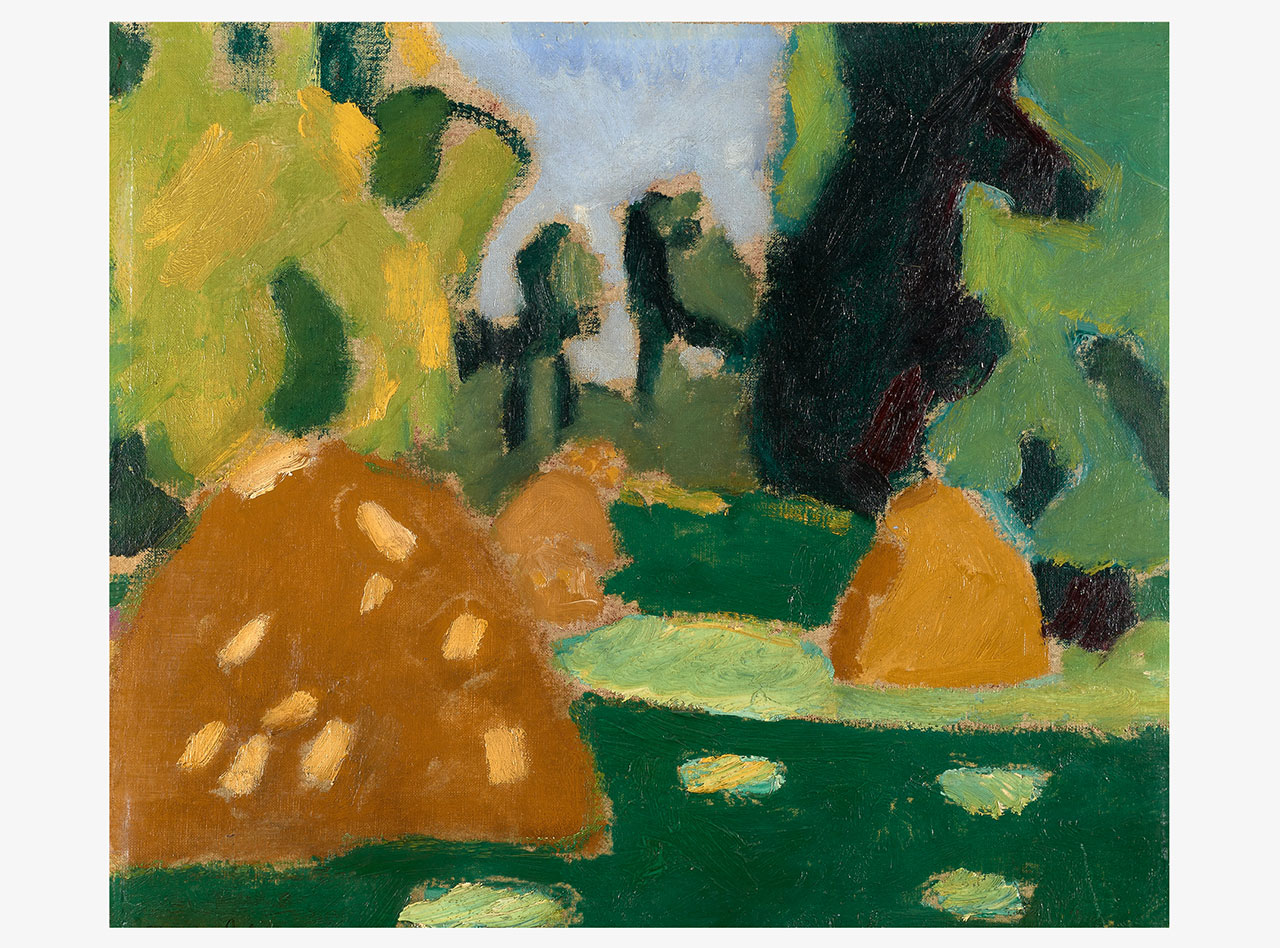
Picabia’s earliest landscapes already contain the seeds of his future transformations. The 1902 paintings, produced after travels through Moret and Martigues with Georges Manzana Pissarro, demonstrate his dialogue with late Impressionism and the lingering influence of Claude Monet and Alfred Sisley. Yet even at this stage, Picabia’s brushwork appears less interested in optical fidelity than in testing painting’s possibilities. The haystacks and luminous countryside scenes are not merely homages to Impressionism; they are rehearsals for departure.
By 1908, following his pivotal encounter with Gabrielle Buffet, Picabia had begun articulating a radical desire to liberate painting from natural description. He famously declared his intention to create “forms and colors liberated from their sensory attributes,” anticipating the anti-naturalist impulses that would dominate the avant-garde. The transition can be seen in works such as “Untitled” (ca. 1911), where landscape dissolves into simplified geometric structures edging toward abstraction.
This appetite for rupture propelled Picabia toward the radical circles of New York, Zurich and Paris during the 1910s. Alongside Marcel Duchamp and the Dada movement, he embraced anti-art gestures, mechanomorphic imagery and linguistic play. Yet even within Dada, Picabia remained suspicious of orthodoxy. By 1921 he denounced the movement for no longer being “new,” a rejection entirely consistent with his allergy to permanence.
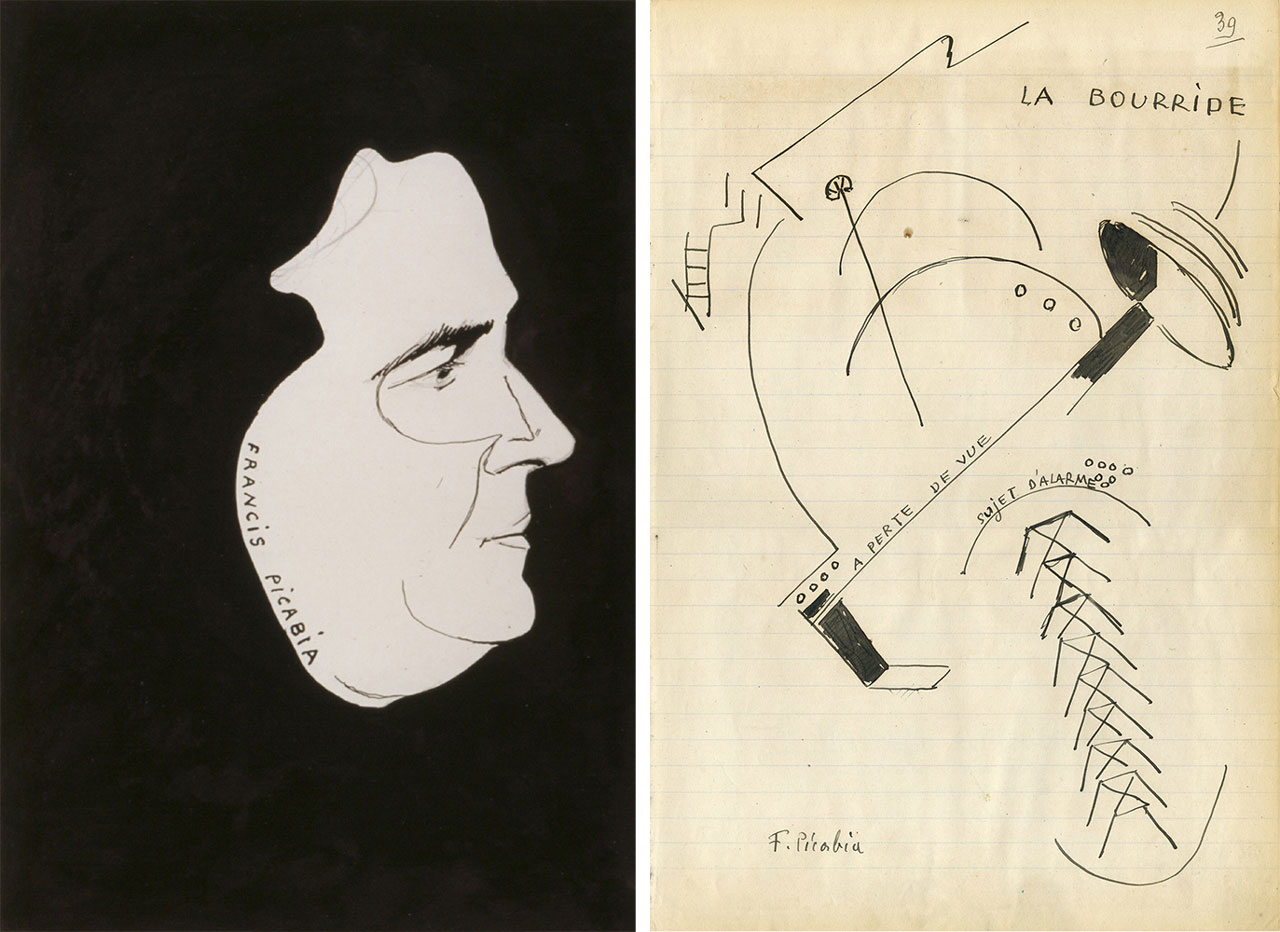
The exhibition’s rare self-portrait “Francis Picabia” (ca. 1924) crystallizes this paradoxical relationship with identity. Rendered with stark contrasts and graphic precision, the artist’s face appears mask-like, almost theatrical. The inscription of his signature along the jawline transforms language into image, echoing his Dada-era experiments while simultaneously mocking the very notion of artistic authenticity. Picabia presents himself not as a stable subject, but as a constructed persona perpetually in flux.
Perhaps the exhibition’s most compelling section centers on the celebrated “Transparencies”, initiated in the late 1920s after Picabia relocated to the South of France. These layered compositions remain among the most singular achievements of interwar painting. Drawing from classical statuary, Romanesque frescoes, photography and popular imagery, Picabia superimposed faces, bodies and symbols until they hovered in dreamlike suspension.
Works such as “Genèses” (ca. 1930–1931) embody a visual philosophy built on multiplicity. Rather than a single genesis, Picabia proposes many beginnings simultaneously: children, monkeys, dice and monumental faces coexist within unstable spatial planes where chance, memory and mythology collapse into one another. As critic Jean van Heeckeren observed at the time, Picabia’s discovery of superimposition through transparency was as revolutionary as abstraction itself.
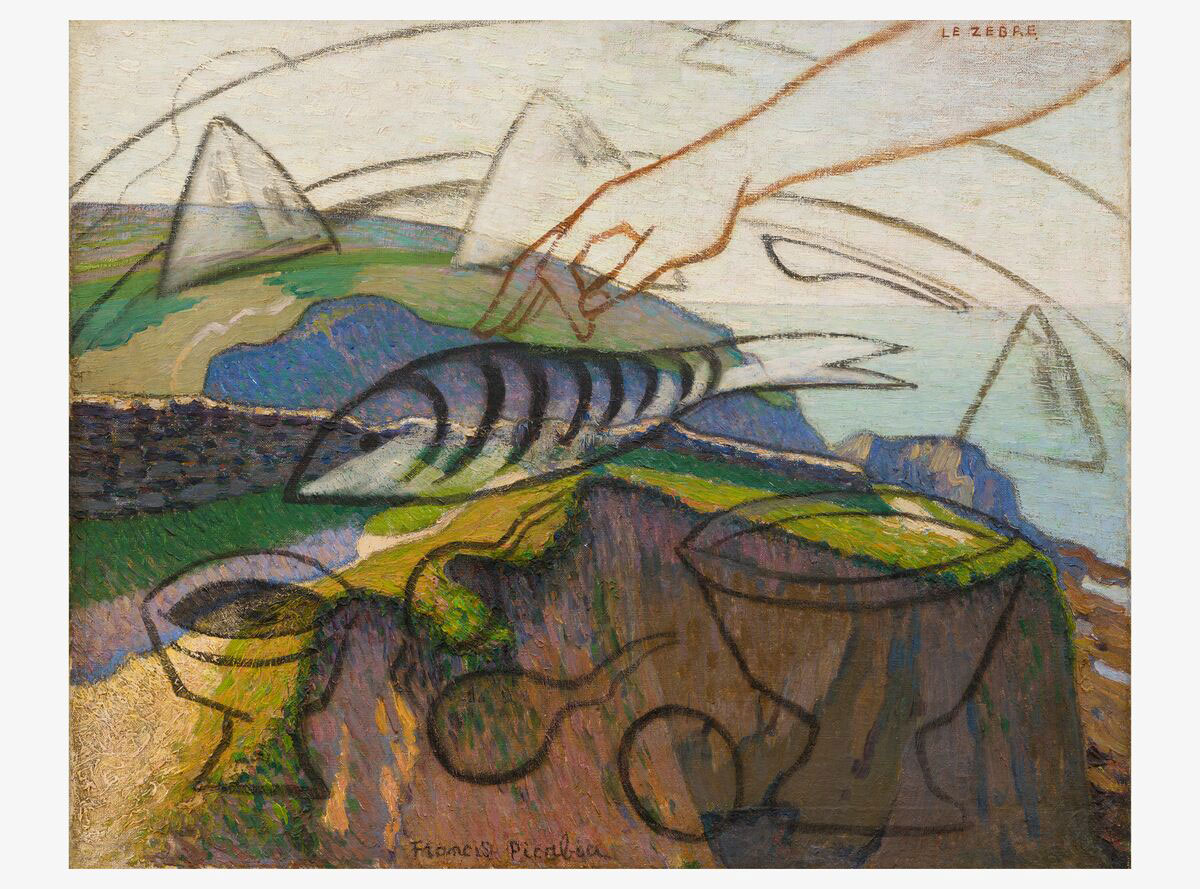
The exhibition also demonstrates how Picabia repeatedly cannibalized his own past. “Le Zèbre” (ca. 1909–1933) overlays a Neo-Impressionist landscape with a translucent domestic still life decades later, transforming an earlier canvas into an archaeological site of artistic memory. This habit of revisiting, repainting and overwriting previous works suggests that for Picabia, style was never fixed; it was material to be dismantled and reused.
If the “Transparencies” represent a poetic culmination of layered consciousness, the wartime nudes and realist works of the 1940s reveal Picabia at his most provocative. During the Second World War, he turned toward imagery appropriated from magazines such as Paris Sex-Appeal and Mon Paris, producing smooth, photo-based paintings that scandalized critics accustomed to avant-garde experimentation.
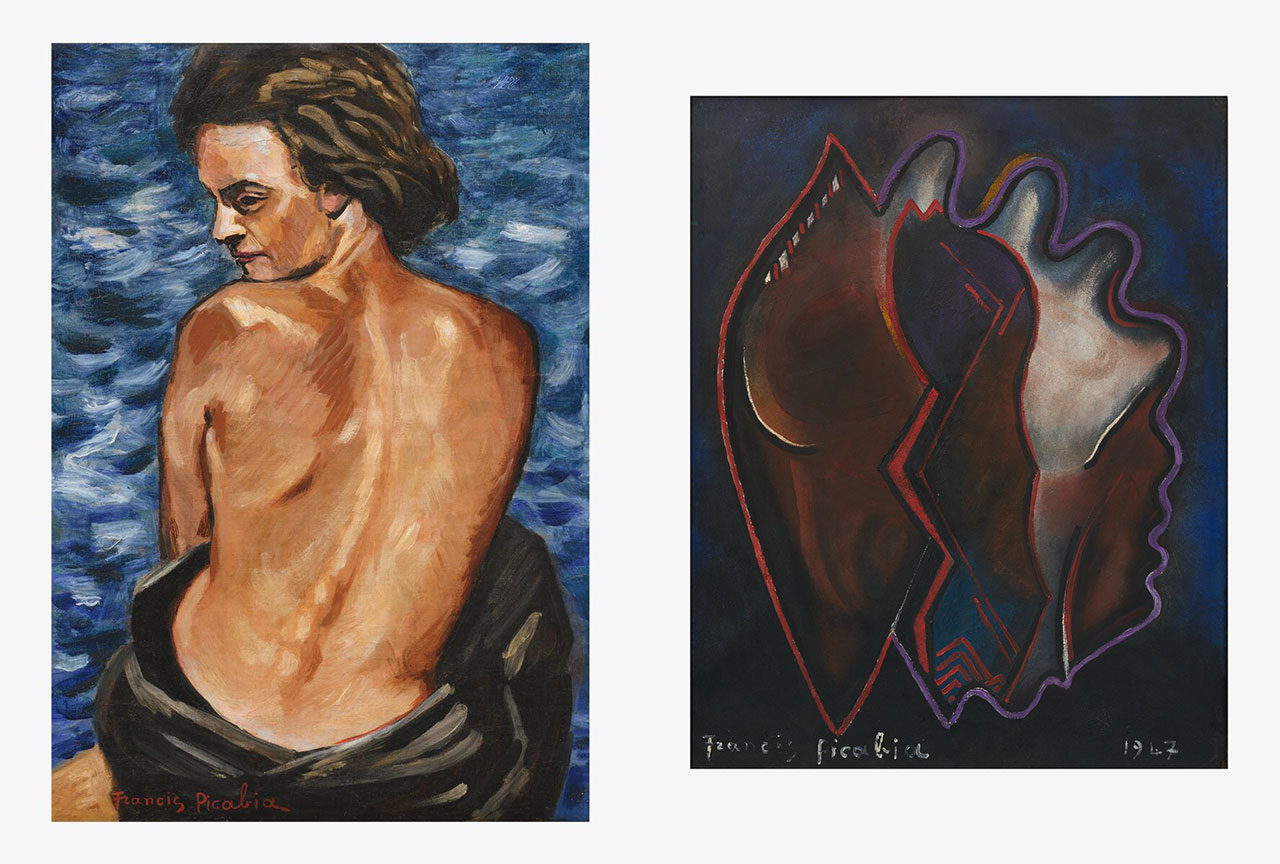
Today, these works appear remarkably prescient. Paintings like “Nu de dos devant la mer” (ca. 1942–1943) collapse distinctions between “high” and “low” culture decades before Pop Art and postmodern appropriation. Borrowing directly from commercial photography, Picabia transformed mass-media erotica into unsettling meditations on spectatorship, reproduction and desire. The flattened surfaces and carefully staged poses reveal an artist deeply aware of the growing power of photographic imagery within modern life.
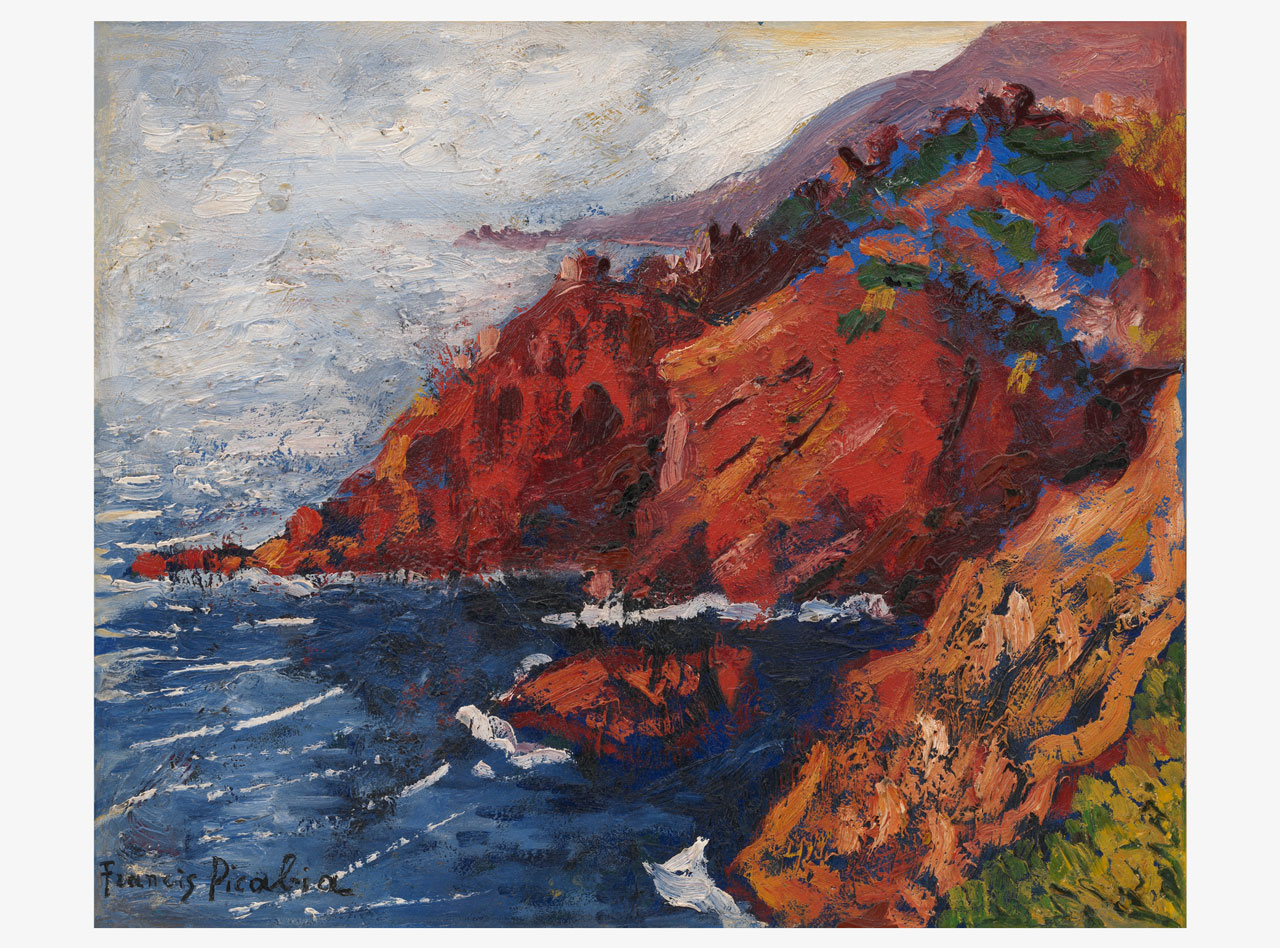
Even his return to landscape during this period carried an ironic edge. The Riviera scenes, based not on direct observation but on postcards, parody the mythology of plein-air authenticity associated with Impressionism. In “Les rochers rouges” (ca. 1942–1943), thick impasto and exaggerated color simultaneously celebrate and mock painterly tradition. Nature itself becomes mediated through reproduction.
Following the war, Picabia once again shifted direction, embracing heavily textured abstraction that aligned loosely with the emergence of Art Informel in postwar Paris. Yet even these late works resist easy categorization. “Trèfle à une feuille” (ca. 1946–1947) evokes African masks, shields and primordial symbols, while “Niagara” (ca. 1947) oscillates between shell, machine fragment and archaeological relic. Abstraction for Picabia was never purely non-representational; forms remained haunted by memory and association.
What becomes clear throughout “Expanding Horizons” is that Picabia anticipated many of the defining artistic strategies of the late twentieth century: appropriation, stylistic quotation, self-referentiality, irony and the collapse of distinctions between elite and popular culture. Long before postmodernism acquired its terminology, Picabia was already destabilizing originality and authorship.
More than any single style or movement, Picabia’s true subject was transformation itself. He treated painting as a mutable language rather than a fixed identity, repeatedly abandoning success in pursuit of uncertainty. In an era increasingly preoccupied with branding and consistency, Picabia’s refusal to remain legible feels extraordinarily current. His legacy lies not simply in the images he produced, but in the radical freedom with which he produced them.
Photo left: Francis Picabia, Francis Picabia, ca. 1924, Indian ink and pencil on paper 23 x 16 cm / 9 x 6 1/4 in, Photo: Damian Griffiths, Courtesy Hauser & Wirth Gallery. Photo right: Francis Picabia, La Bourride, 1919, Ink on paper, 28.3 x 19 cm / 11 1/8 x 7 1/2 in, 54 x 44 x 5 cm / 21 1/4 x 17 3/8 x 2 in (framed), Photo: Damian Griffiths, Courtesy Hauser & Wirth Gallery
Info: Hauser & Wirth Gallery, 23 Savile Row, London, United Kingdom, Duration: 21/5-1/8/2026,Days & Hours: Tue-Sat 10:00-18:00, www.hauserwirth.com/
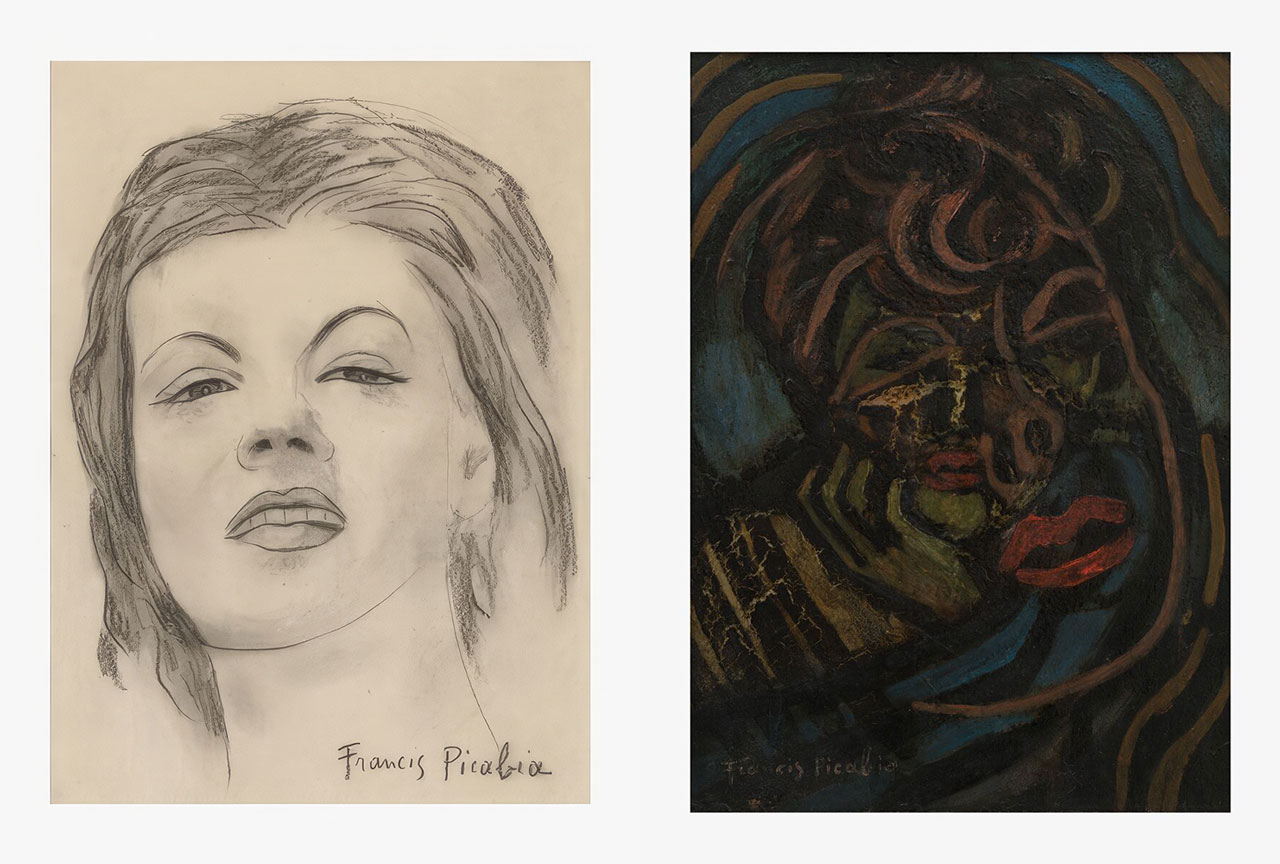
Right: Francis Picabia, Transparence, Portrait de femme (Transparency, Portrait of a Woman), c. 1937 – 1939, Oil on board, 52.5 x 38 cm / 20 5/8 x 15 in, 63.5 x 49 x 3.7 cm / 25 x 19 1/4 x 1 1/2 in (framed), Photo: Jon Etter, Courtesy Hauser & Wirth Gallery
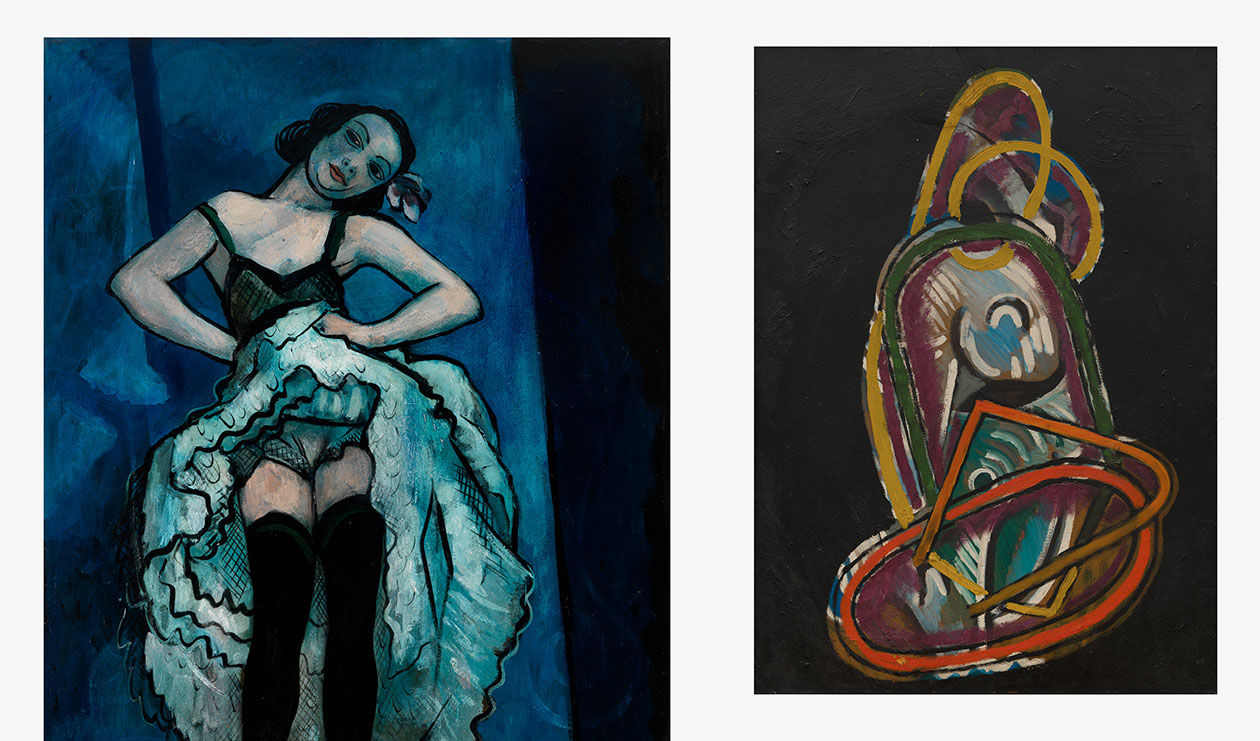
Right: Francis Picabia, Le viol (The Violation), c. 1948, Oil on cardboard, 105 x 75 cm / 41 3/8 x 29 1/2 in, Photo: Damian Griffiths, Courtesy Hauser & Wirth Gallery
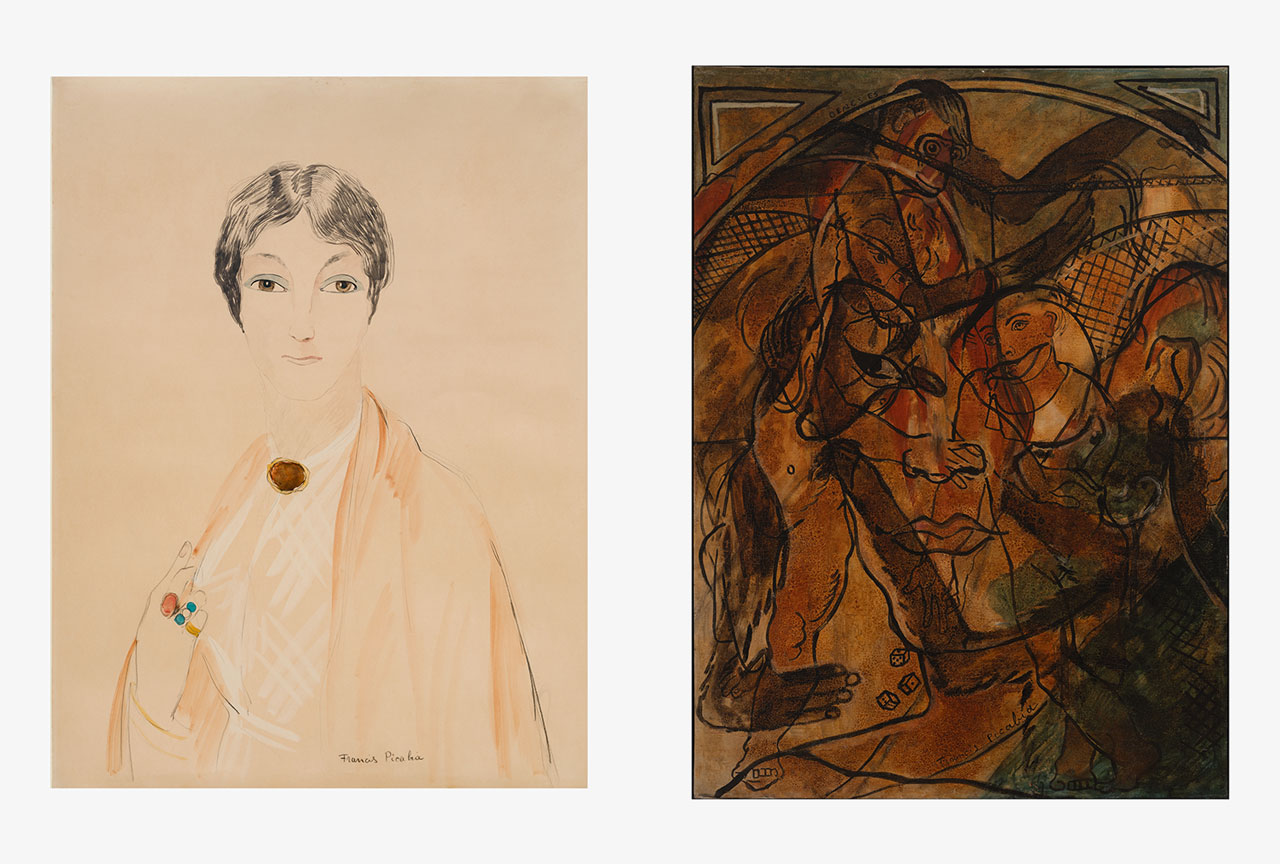
Right: Francis Picabia, Genèses (Geneses), c. 1930 – 1931, Oil on canvas, 116 x 85 cm / 45 5/8 x 33 1/2 in 128 x 96.7 x 3 cm / 50 3/8 x 38 1/8 x 1 1/8 in (framed), Photo: Damian Griffiths, Courtesy Hauser & Wirth Gallery
Right: Francis Picabia, Composition abstraite, 1947, Oil on cardboard, 90 x 72 cm / 35 3/8 x 28 3/8 in, 106.7 x 86.5 x 5 cm / 42 x 34 x 2 in (framed), Photo: Jon Etter, Courtesy Hauser & Wirth Gallery