PRESENTATION: Anicka Yi and Saif Azzuz
Set against the sweeping terrain of New York’s Hudson Valley, the forthcoming exhibitions by artists Anicka Yi and Saif Azzuz reimagine sculpture not as static monument, but as a living system—one shaped by biology, memory, environmental history, and Indigenous relationships to the land. Through site-responsive installations that engage microorganisms, endangered species, and geological time, Storm King continues its longstanding commitment to expanding the possibilities of contemporary sculpture while deepening the dialogue between art and the natural world.
By Dimitris Lempesis
Photo: Storm King Art Center Archive
At Storm King Art Center, the landscape has long functioned as more than a backdrop for sculpture. Across its 500 acres of rolling fields and engineered vistas, the institution has cultivated a distinctly American dialogue between monumental form and environmental scale. But in 2026, two new commissions—Anicka Yi’s “Message from the Mud” and Saif Azzuz’s “weych-pues / tàkhòne” (where the rivers meet)—shift that conversation away from monumentality toward ecology, ancestry, and the temporal instability of the living world itself. Rather than treating nature as scenery, both artists position it as collaborator, archive, and active agent.
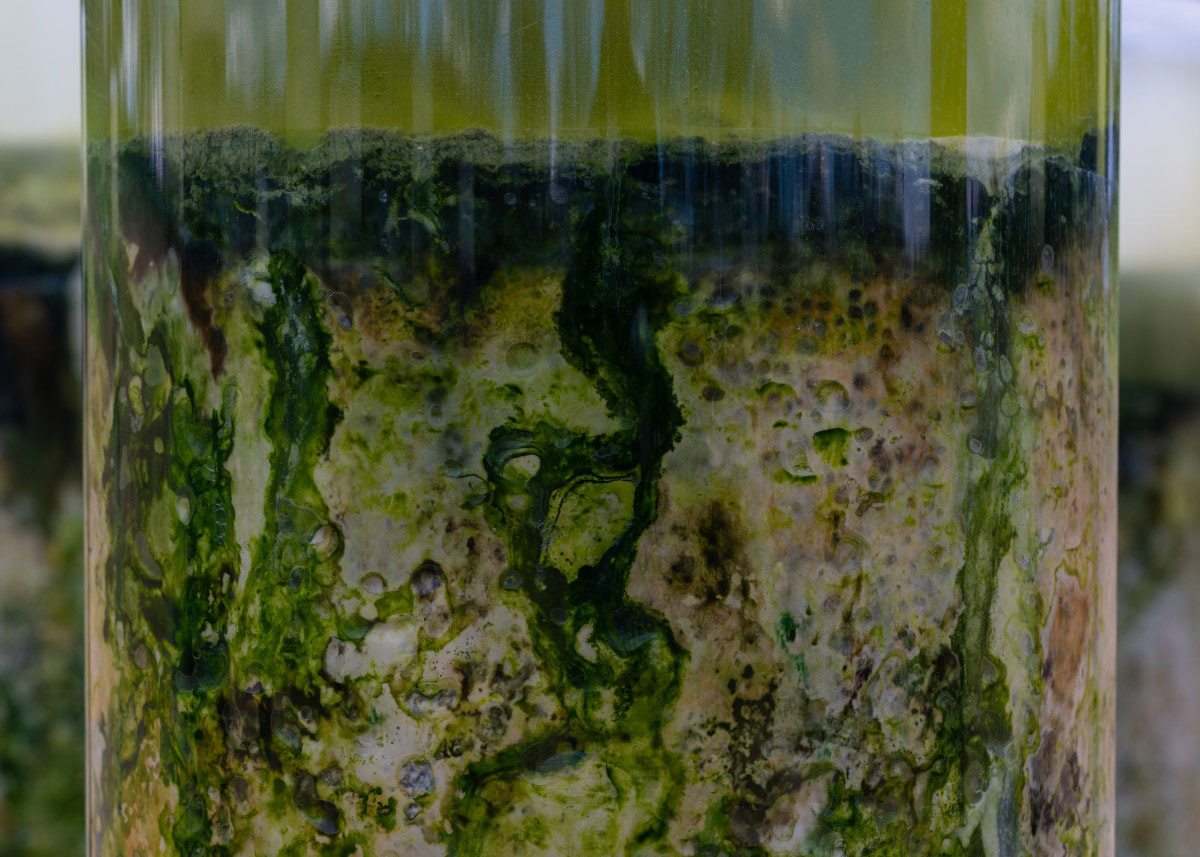
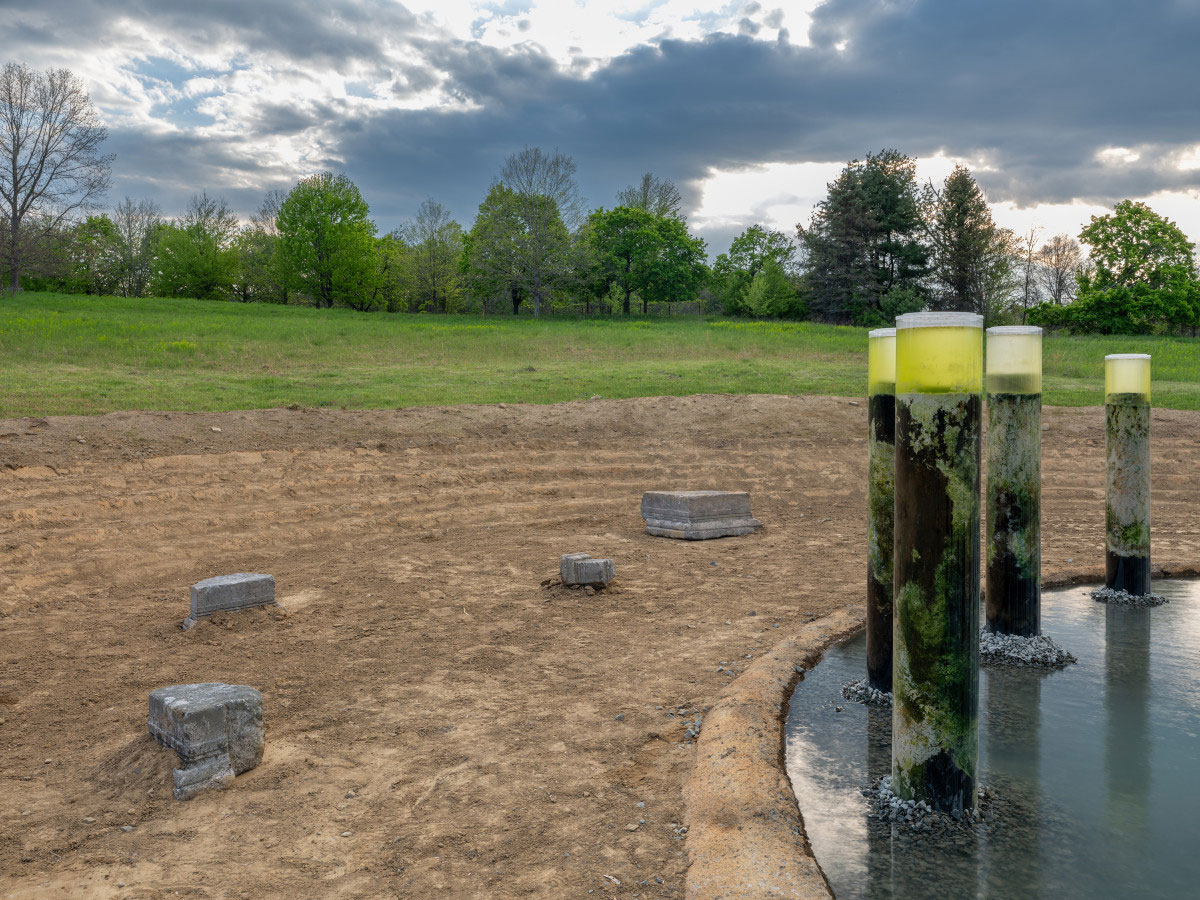
For Yi, whose practice has consistently dissolved boundaries between biology, technology, and speculative fiction, “Message from the Mud” marks a significant evolution: her first large-scale outdoor project. Installed like an archaeological excavation at Storm King’s South Ponds, the work imagines a terrain suspended between primordial past and posthuman future. Acrylic columns rise from a shallow circular pool like remnants of a submerged civilization or the fossilized organs of an unknown ecosystem. Filled with organic matter and microbial cultures, the translucent structures transform over time through exposure to sunlight and atmospheric conditions, becoming living sculptures whose appearance cannot be fully controlled by the artist.
Yi describes the conceptual framework of the installation through the term “prehistoric biofiction,” an invented methodology that fuses scientific research with speculative evolutionary imagination. Rather than reconstructing Earth’s biological past with archaeological precision, the artist asks what alternate evolutionary histories might have produced—and what forms of life may yet emerge in ecological futures altered by climate change, biotechnology, and human intervention. In this sense, Message from the Mud operates less as an installation than as a temporal thought experiment.
Central to the work is the use of Winogradsky columns, a nineteenth-century soil science technology developed by Russian-Ukrainian microbiologist Sergei Winogradsky. Yi combined soil and water gathered from Storm King’s South Ponds with carbon and calcium sources to cultivate visible microbial ecosystems within the acrylic cylinders. Over weeks and months, algae, cyanobacteria, and bacteria separate into stratified chromatic bands, creating luminous abstract compositions reminiscent of Color Field painting or geological sedimentation. Yet unlike painting, these surfaces are metabolically alive. The work literally grows itself.
What emerges is a radical inversion of sculptural permanence. Traditional outdoor sculpture resists weathering; Yi’s installation depends upon it. Time is not an external force acting upon the work but its primary medium. The installation’s microbial communities continuously negotiate coexistence, revealing an ecological model grounded in reciprocity and interdependence. Each organism survives through the metabolic byproducts of another. Life appears here not as individual expression but as collaborative infrastructure.
This logic of entanglement has animated Yi’s practice for over a decade. From scent-based installations to AI-generated organisms and bacterial cultures, she has persistently questioned anthropocentric hierarchies and categorical distinctions between organic and synthetic life. Her installations often feel simultaneously clinical and spiritual, oscillating between laboratory experiment and speculative cosmology. In “Message from the Mud”, however, that inquiry acquires a geological scale. The work situates humanity within deep time, rendering human civilization as only one temporary layer within a much larger continuum of biological becoming.
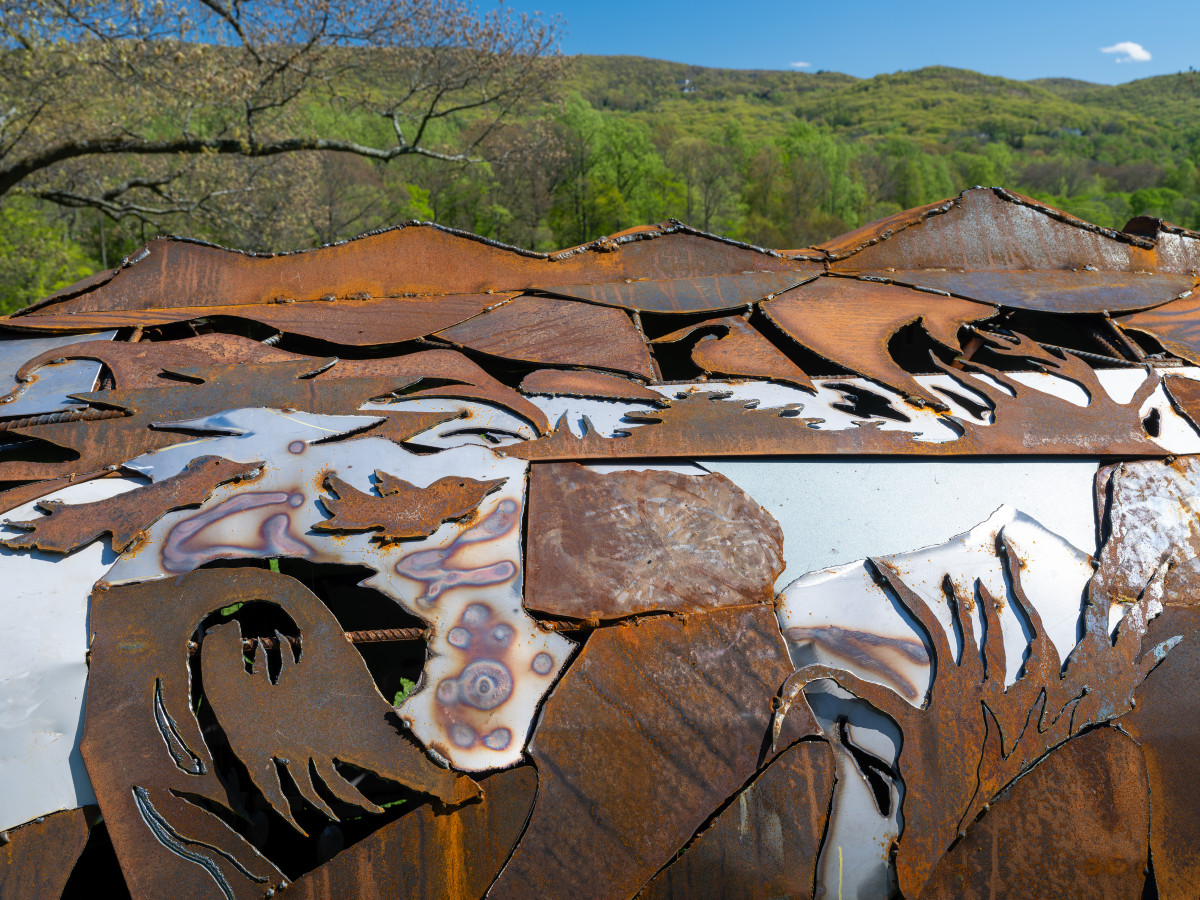
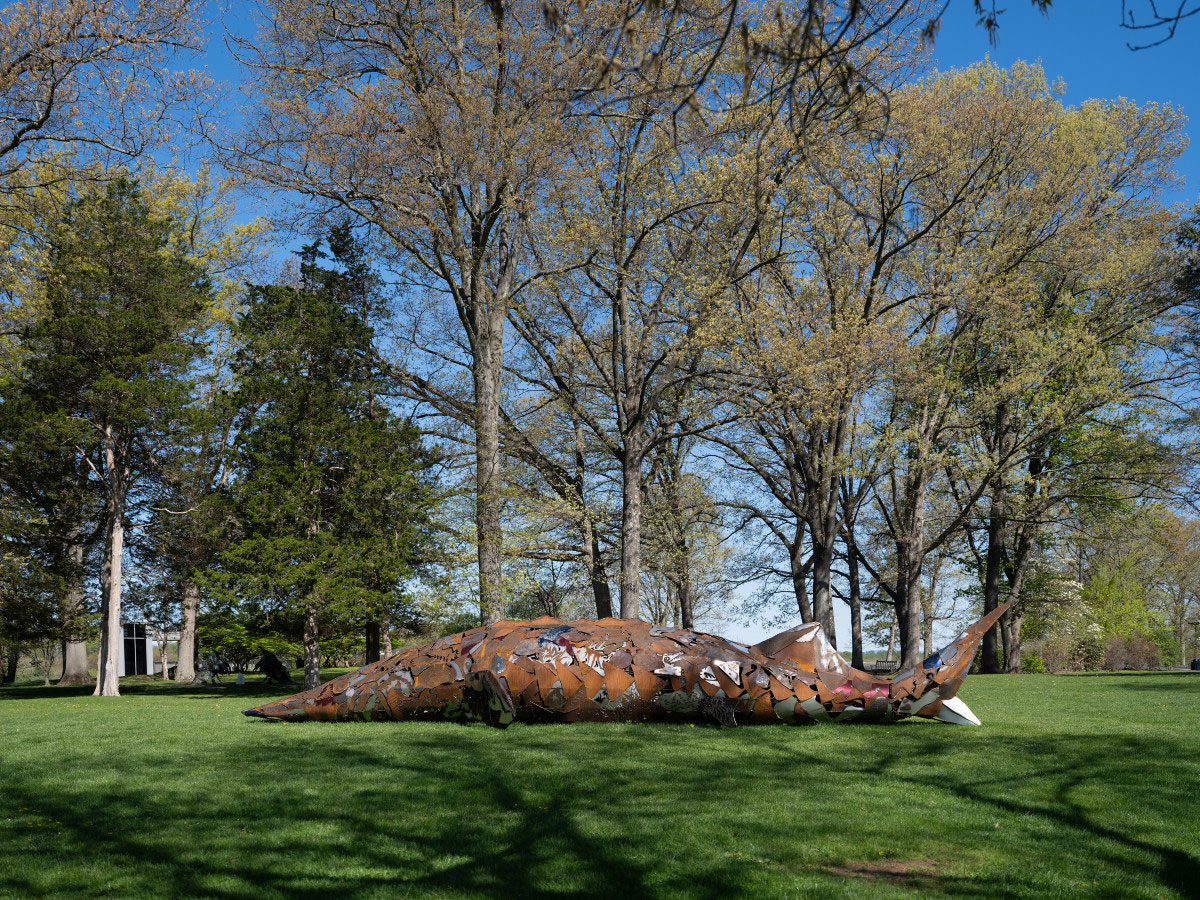
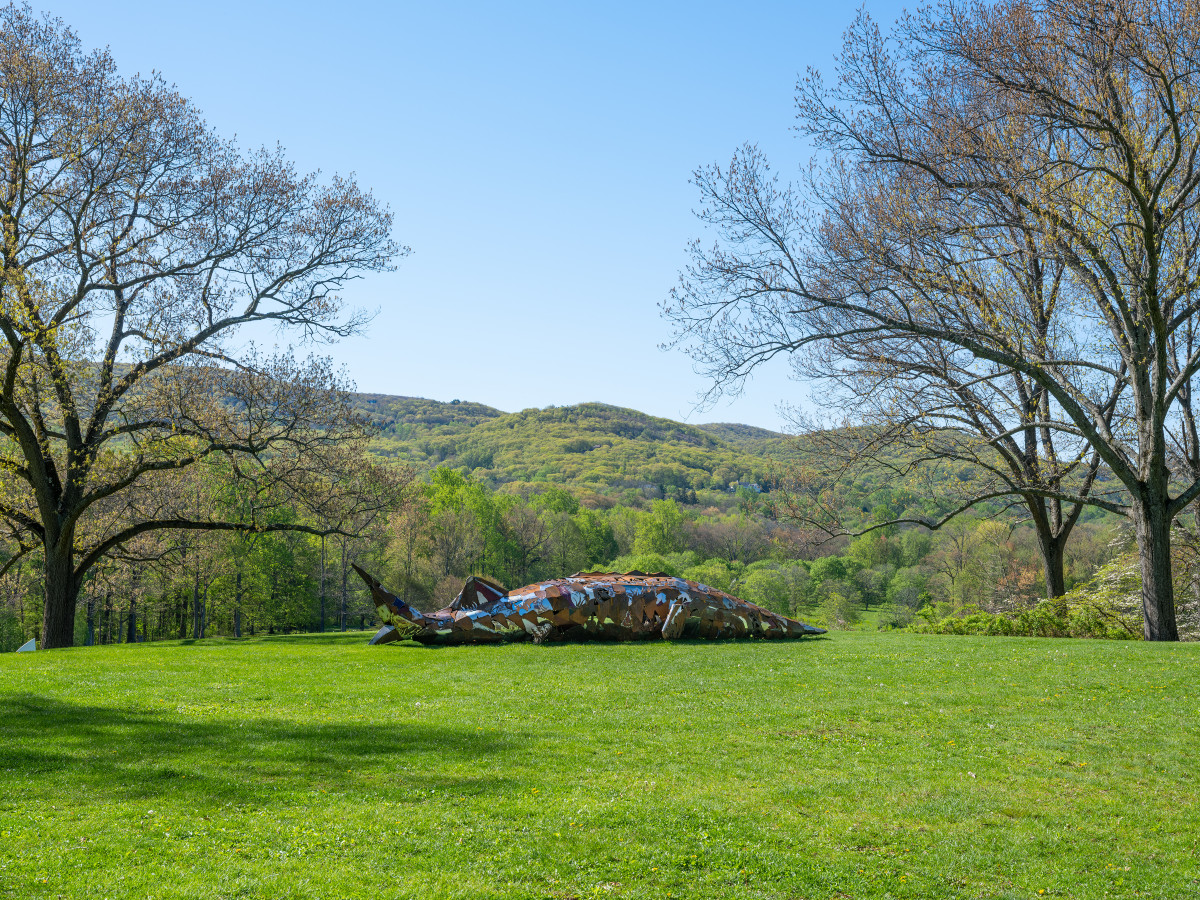
If Yi’s installation examines planetary interdependence at the microbial level, Azzuz’s “weych-pues / tàkhòne” (where the rivers meet) approaches interconnectedness through Indigenous memory, migration, and survivance. Created for the twelfth edition of Storm King’s Outlooks program, the work takes the form of an enormous sturgeon assembled from steel, aluminum, salvaged car parts from the Hudson Valley, and natural materials sourced from the San Francisco Bay Area
The sculpture originated in a moment of geographic recognition. During a 2024 residency at Storm King, Azzuz noticed that signs marking the Hudson River Estuary featured sturgeon imagery—a fish deeply familiar from the Klamath River near the Yurok Reservation in California, where the artist’s community maintains longstanding cultural relationships with the species. The connection became a conduit between distant ecologies and Indigenous histories separated by thousands of miles yet linked through colonial displacement, environmental precarity, and ancestral continuity.
The sturgeon itself is a profoundly resonant figure. Existing for millions of years with relatively little evolutionary change, the fish is often described as “prehistoric,” a living remnant of ancient aquatic worlds. For many Indigenous communities, sturgeon are not merely ecological entities but cultural relatives embedded within systems of knowledge, ceremony, and sustenance. Today, however, sturgeon populations worldwide face severe threats from overfishing, pollution, and habitat destruction. In Azzuz’s sculpture, the animal becomes both memorial and survivor.
The artist connects the sturgeon to the concept of “survivance,” articulated by Gerald Vizenor, which reframes Indigenous survival not as passive endurance but as active resistance and presence. Azzuz’s massive fish does not read as extinct or defeated; it appears animate, watchful, and enduring. The salvaged industrial materials embedded within its body evoke histories of extraction and environmental violence, yet the sculpture refuses collapse into despair. Instead, it imagines continuity through adaptation.
Etched across the sturgeon’s surface are drawings of native plants, Yurok visual motifs, and collaborative markings created with family members and Storm King staff. Strings of beads, steel fragments, and abalone shells move with the wind, giving the sculpture an acoustic and kinetic dimension that resists static monumentality. Like Yi’s microbial columns, Azzuz’s work remains environmentally responsive, activated by weather, movement, and changing light.
The title itself—”weych-pues / tàkhòne” (where the rivers meet)—bridges Yurok and Lenape languages, connecting the ancestral homeland of the Yurok people in Northern California with Lenapehoking, the original homeland of the Lenape people of the Hudson Valley, who were forcibly displaced through colonization. Language here becomes a geographic and political act, reasserting Indigenous presence within landscapes often stripped of their original histories.
Together, Yi and Azzuz articulate a notable shift within contemporary environmental art. Rather than producing didactic ecological critique or romanticized visions of nature, both artists foreground systems of relation—between microorganisms, rivers, species, histories, and peoples. Their works reject the fantasy of human separateness from the natural world. Instead, they propose that identity itself is ecological: contingent, collaborative, and perpetually transforming.
What makes these projects especially compelling within the context of Storm King is their resistance to the heroic tradition historically associated with sculpture parks. Neither work seeks dominance over landscape. Yi cultivates living systems that evolve beyond artistic control, while Azzuz constructs a monument rooted not in conquest but in kinship. In both cases, sculpture becomes less an object than an ecological condition.
There is also a striking temporal convergence between the two projects. Yi examines evolutionary time through microbial emergence and speculative futures; Azzuz invokes ancestral time through Indigenous continuity and ancient species memory. One looks downward into soil and cellular life, the other outward across rivers and migratory histories. Yet both insist that the past is not inert. It remains metabolically active within the present.
Photo: Saif Azzuz, weych-pues / tàkhòne” (where the rivers meet), 2026, installation view, Storm King Art Center, © Saif Azzuz, Courtesy the artist and Storm King Art Center
Info: Curators: Nora Lawrence (Anicka Yi) & Eric Booker (Saif Azzuz), Storm King Art Center, 20 Old Pleasant Hill Road, New Windsor, NY, USA, Duration: 17/5-9/11/2026, Days & Hours: Mon & Wed-Sun 10:00-18:00, https://stormking.org/
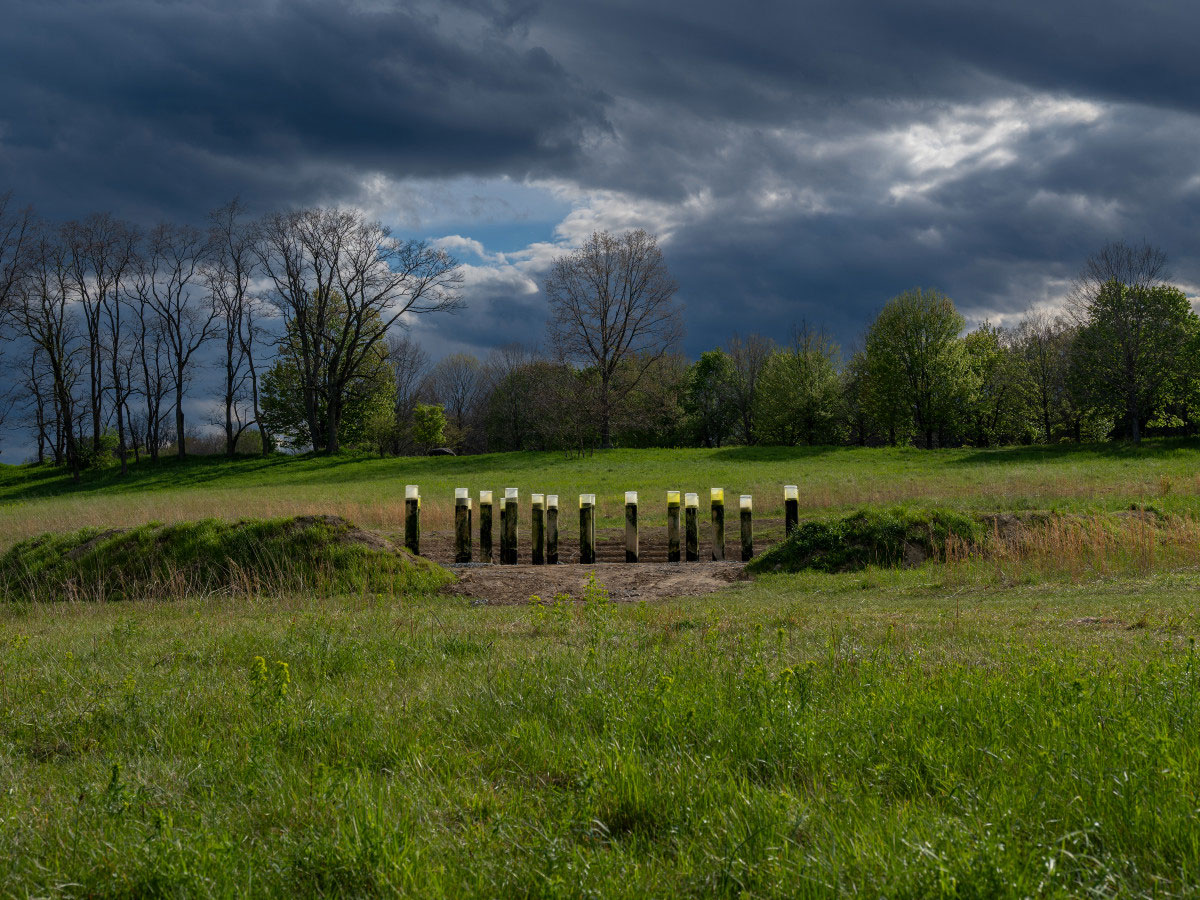
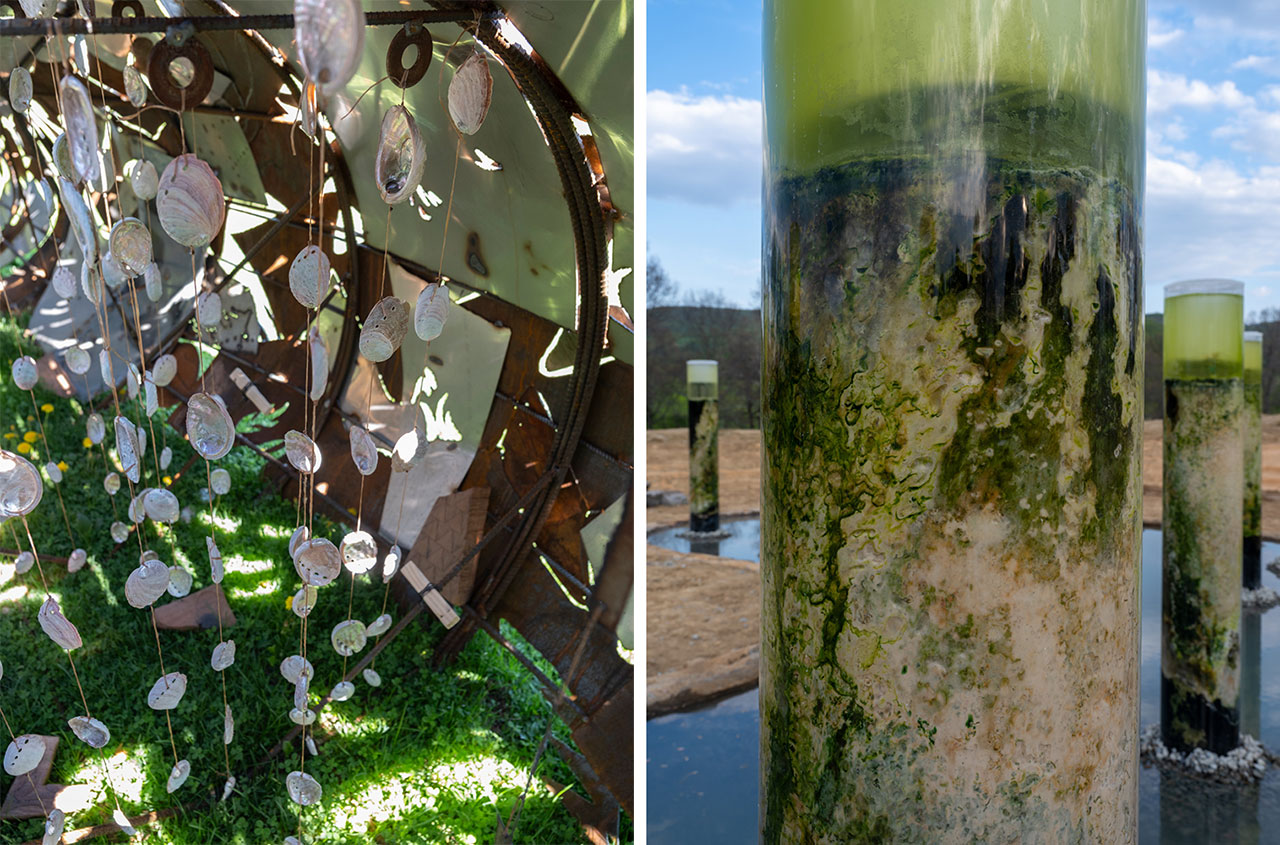
Right: Anicka Yi, Message from the Mud, 2026, installation view, Storm King Art Center, © Anicka Yi, Courtesy the artist and Storm King Art Center