ART CITIES: Venice-Jennifer West
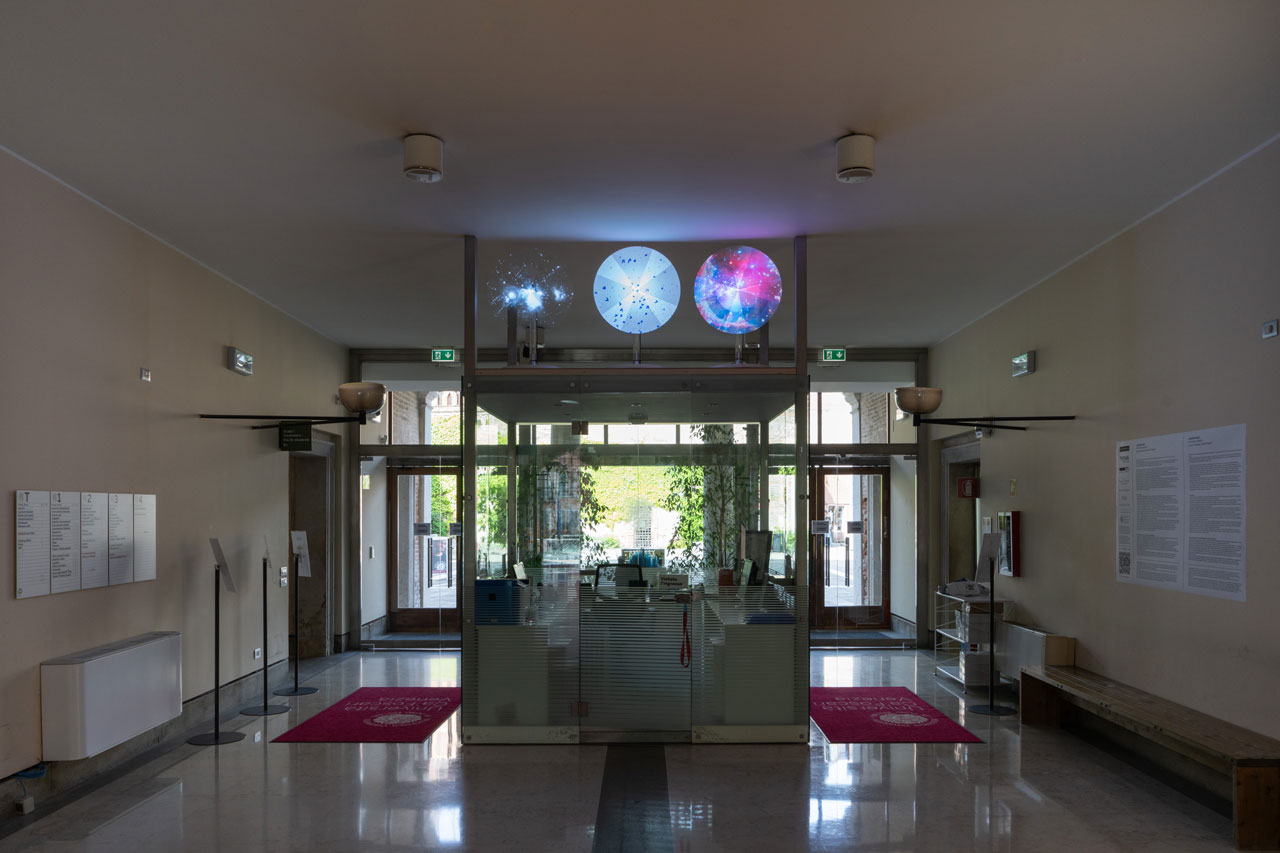
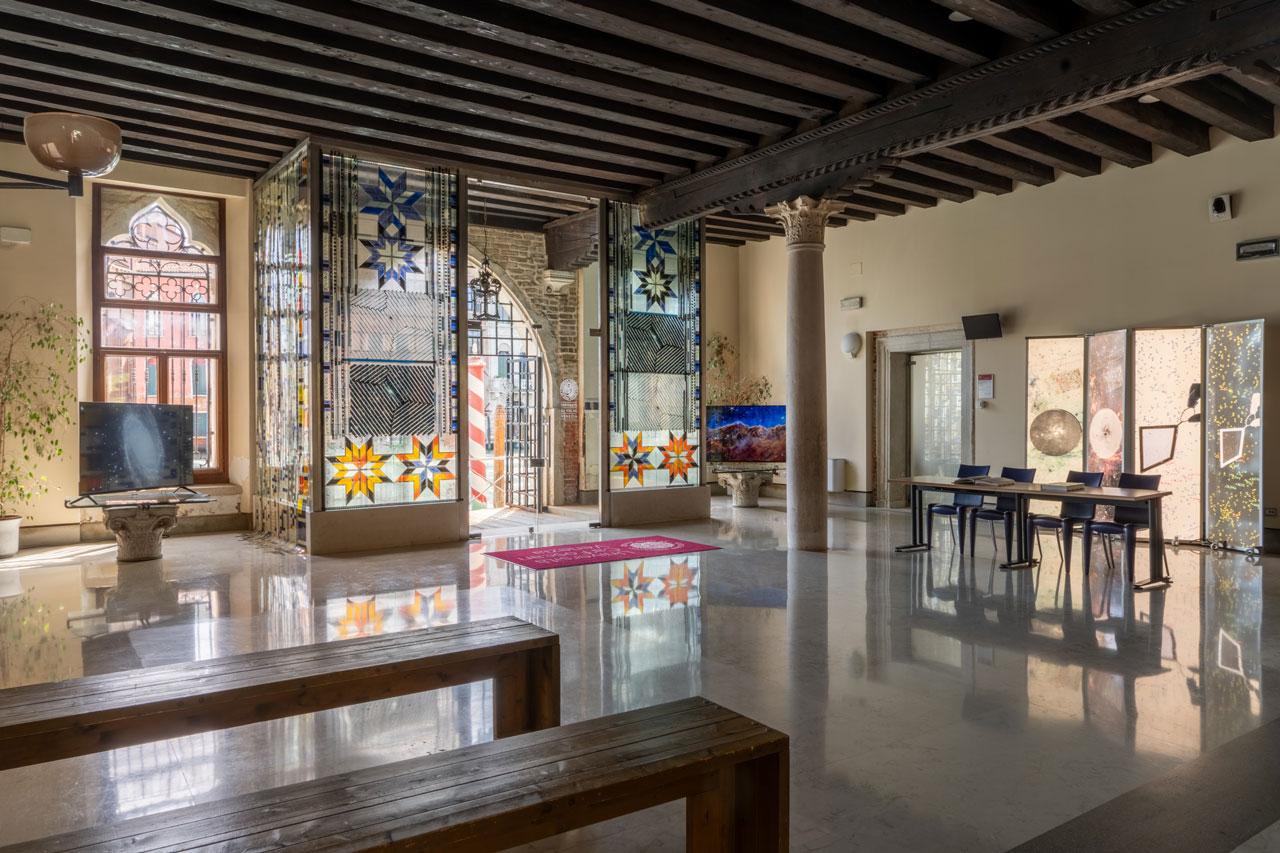
At the threshold between art installation, archival excavation, and speculative cosmology, Jennifer West transforms the ground floor of Ca’ Foscari University of Venice into a shimmering apparatus for seeing history differently. Her new environmental installation, “Stitched Cosmos”, on the occasion of the 61st Venice Biennale, is less an exhibition than a living observatory: a space where forgotten scientific labor, obsolete image technologies, and celestial abstraction converge within a psychedelic architecture of light and memory.
By Efi Michalarou
Photo: Ca’ Foscari University of Venice Archive
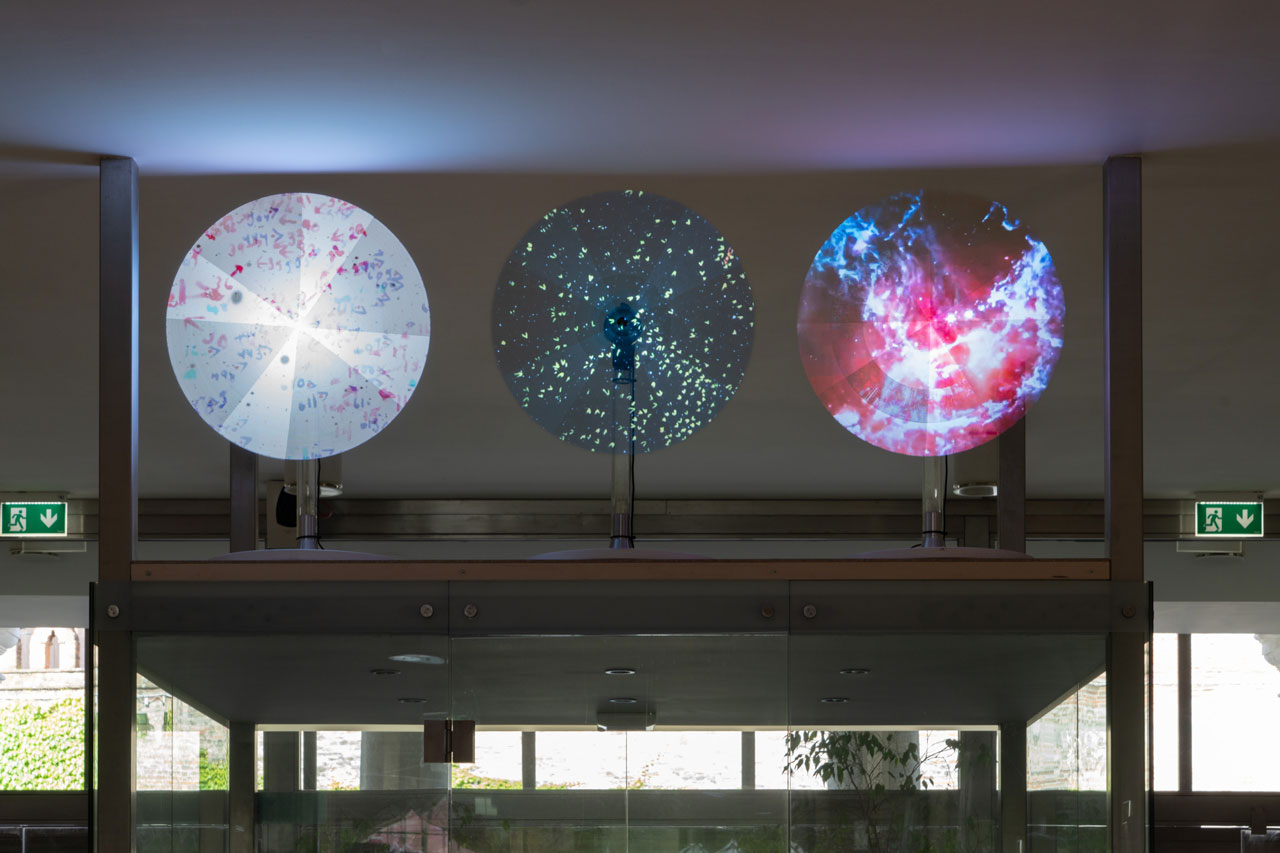
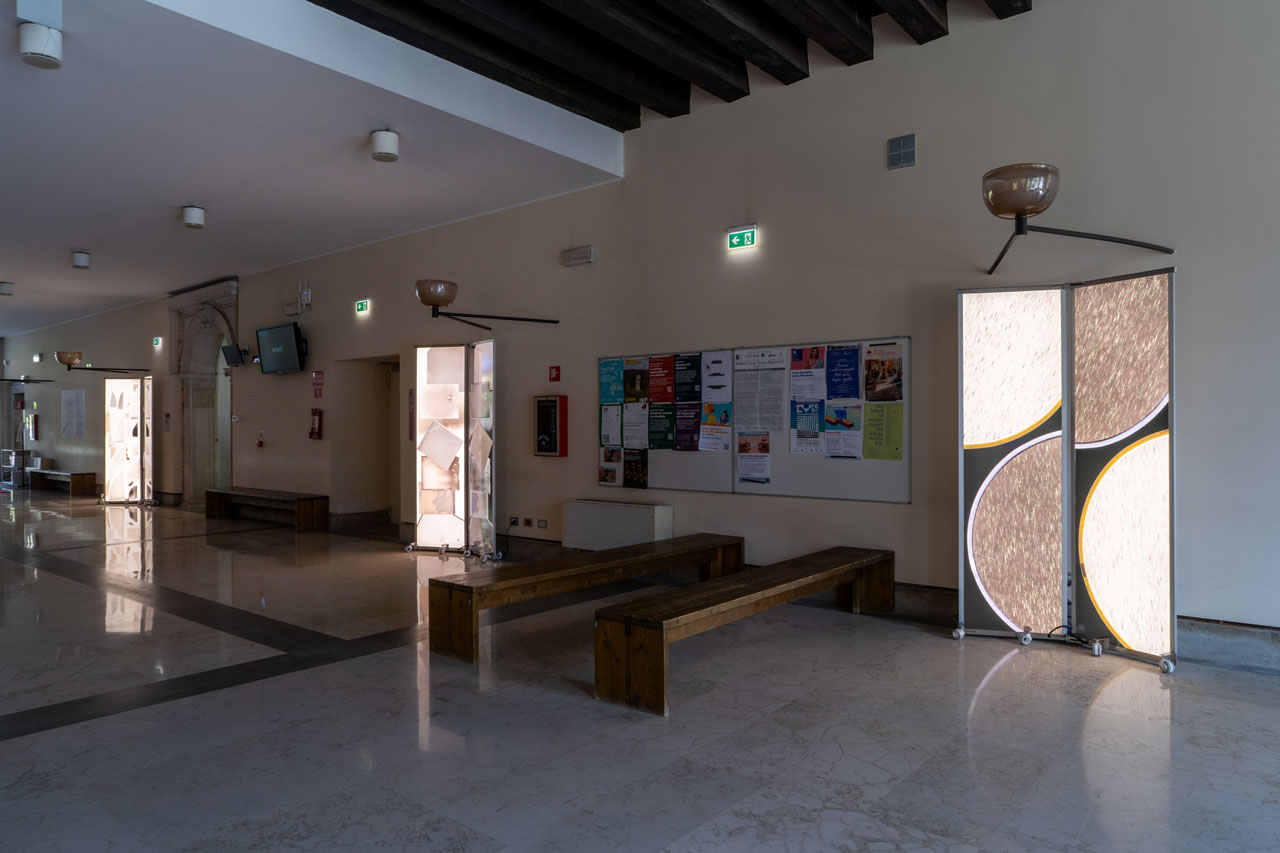
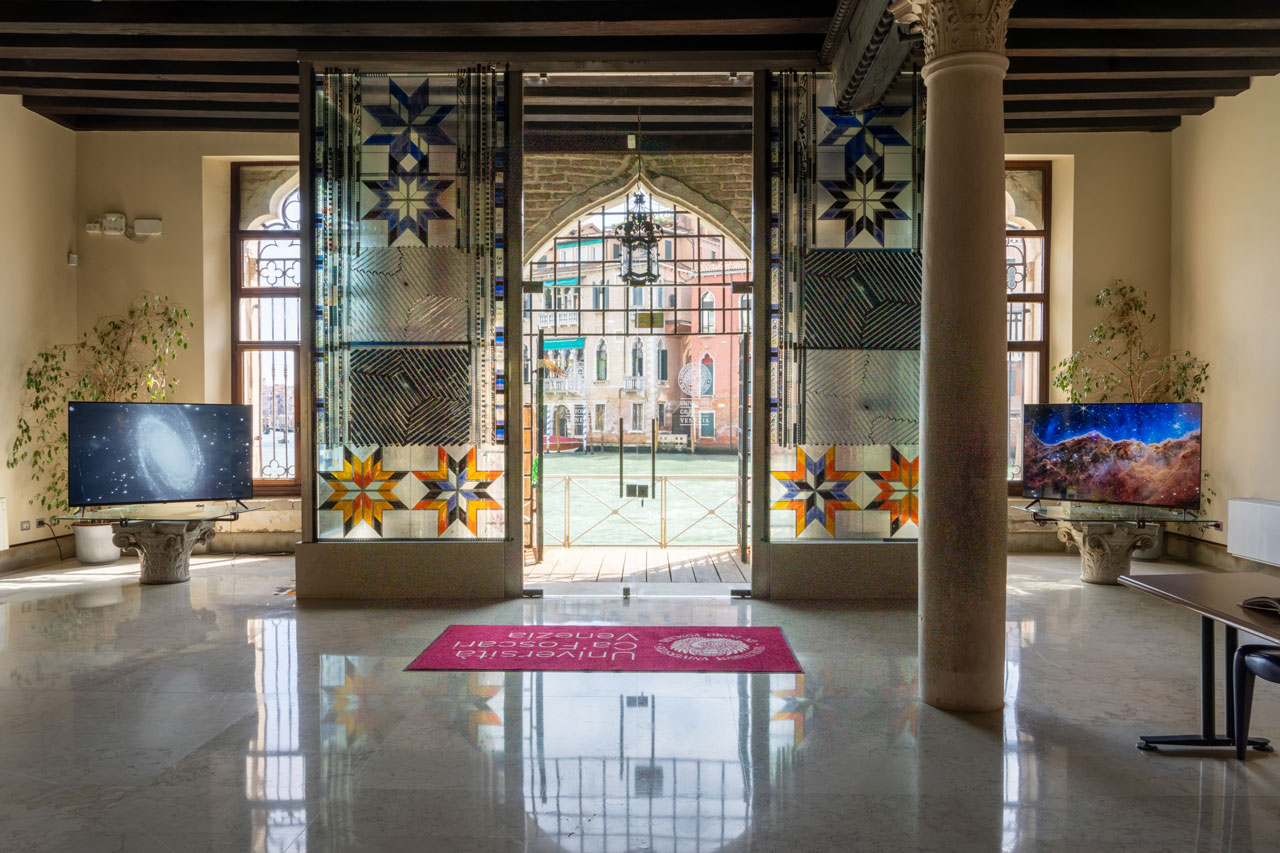
Installed within the university’s historic Venetian headquarters, Jennifer West’s project “Stitched Cosmos”, appears almost extraterrestrial in its presence. Film quilts shimmer against the building’s water gate, holographic projections drift through the atrium, and luminous diptychs pulse among the rhythms of student life. Yet beneath its hallucinatory visual language lies an unusually rigorous engagement with scientific history. The exhibition emerges from research West conducted during her Smithsonian Artist Research Fellowship at the Harvard-Smithsonian Center for Astrophysics, where she worked directly with the Astronomical Plate Collection: more than 500,000 glass photographic plates documenting the universe from the late nineteenth century through the dawn of digital imaging.
For West, whose practice has long explored media archaeology and the materiality of image-making, these plates occupy a critical historical threshold. Used systematically from the 1870s until the 1990s, they represent a transitional technology suspended between analog observation and computational imaging. The plates are not merely records of distant galaxies; they are physical accumulations of light itself — traces of photons traveling across incomprehensible distances before imprinting onto chemically sensitized glass. In “Stitched Cosmos”, this scientific archive becomes both raw material and conceptual terrain.
Yet the exhibition’s true protagonists are not telescopes or stars, but the women whose labor made modern astrophysics possible. The Harvard Astronomical Computers — among them figures such as Henrietta Swan Leavitt, Annie Jump Cannon, and Williamina Fleming — were employed to analyze, classify, and calculate astronomical data at a time when “computer” referred not to a machine, but to a person performing calculations by hand. Underpaid and systematically marginalized, these women nonetheless revolutionized astrophysics, developing stellar classification systems still used globally today.
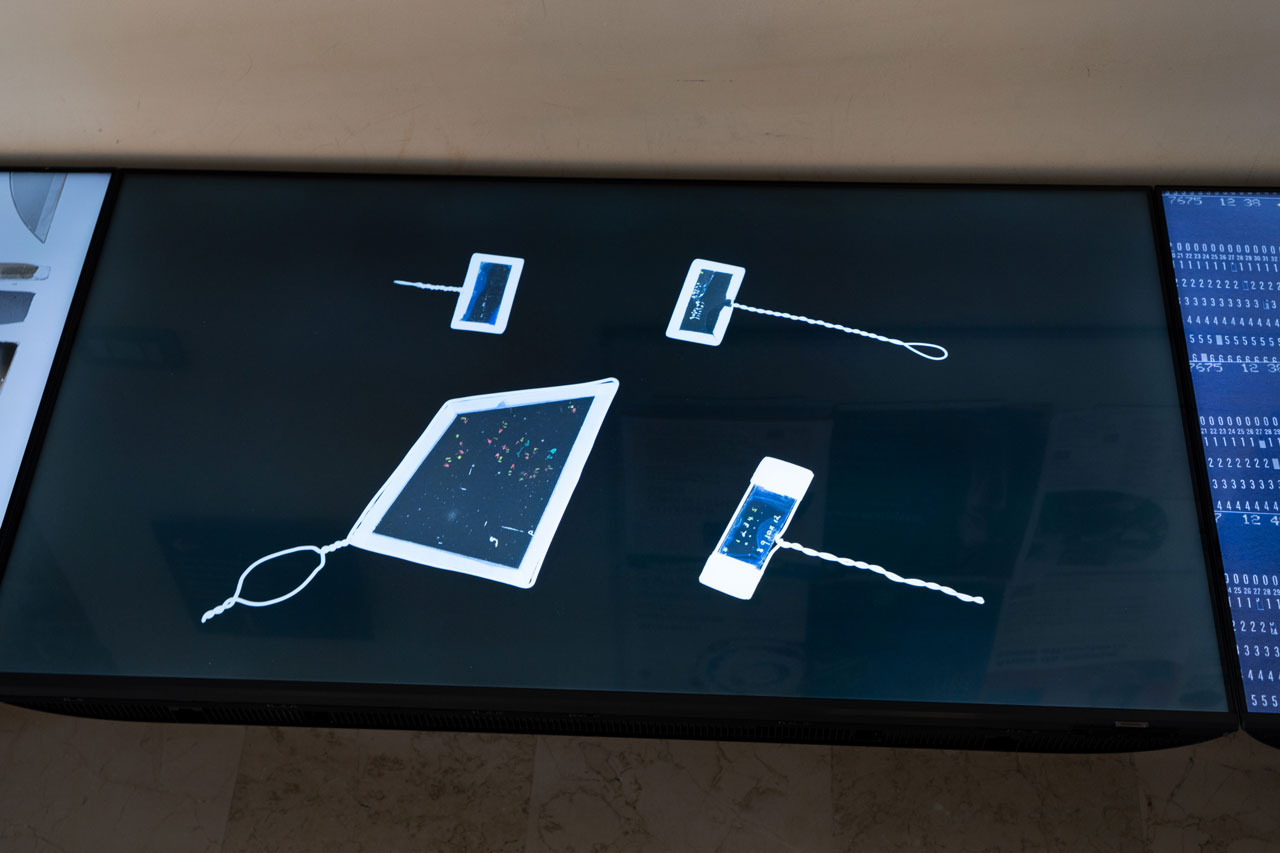
West approaches their legacy not through didactic reconstruction but through acts of aesthetic reanimation. The glass plates themselves contain dense networks of handwritten annotations, color markings, measurements, and diagrammatic interventions — visual evidence of intellectual labor embedded directly onto the surface of the cosmos. In her hands, these markings become both abstraction and tribute. By enlarging, fragmenting, and translating these annotations into film, collage, and projection, West foregrounds the invisible human infrastructure behind scientific knowledge production.
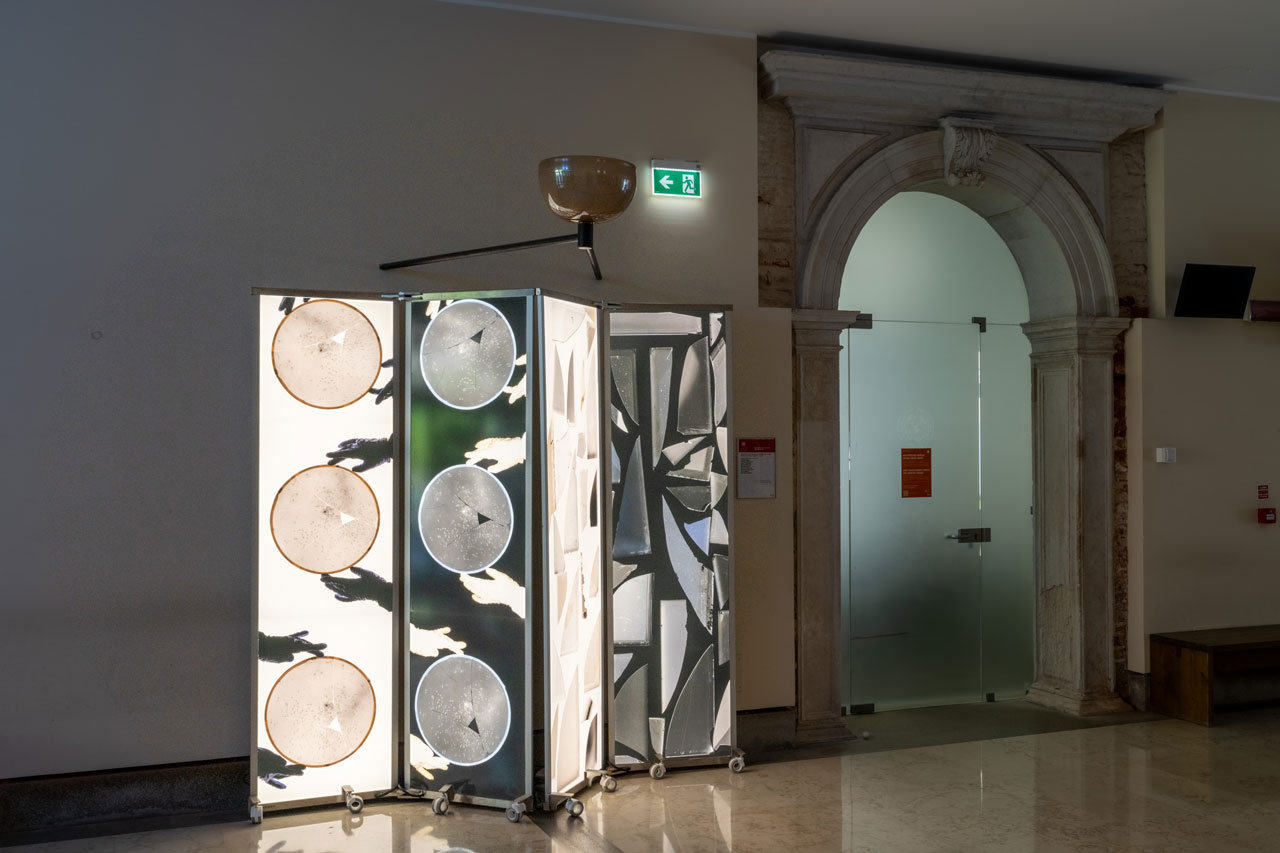
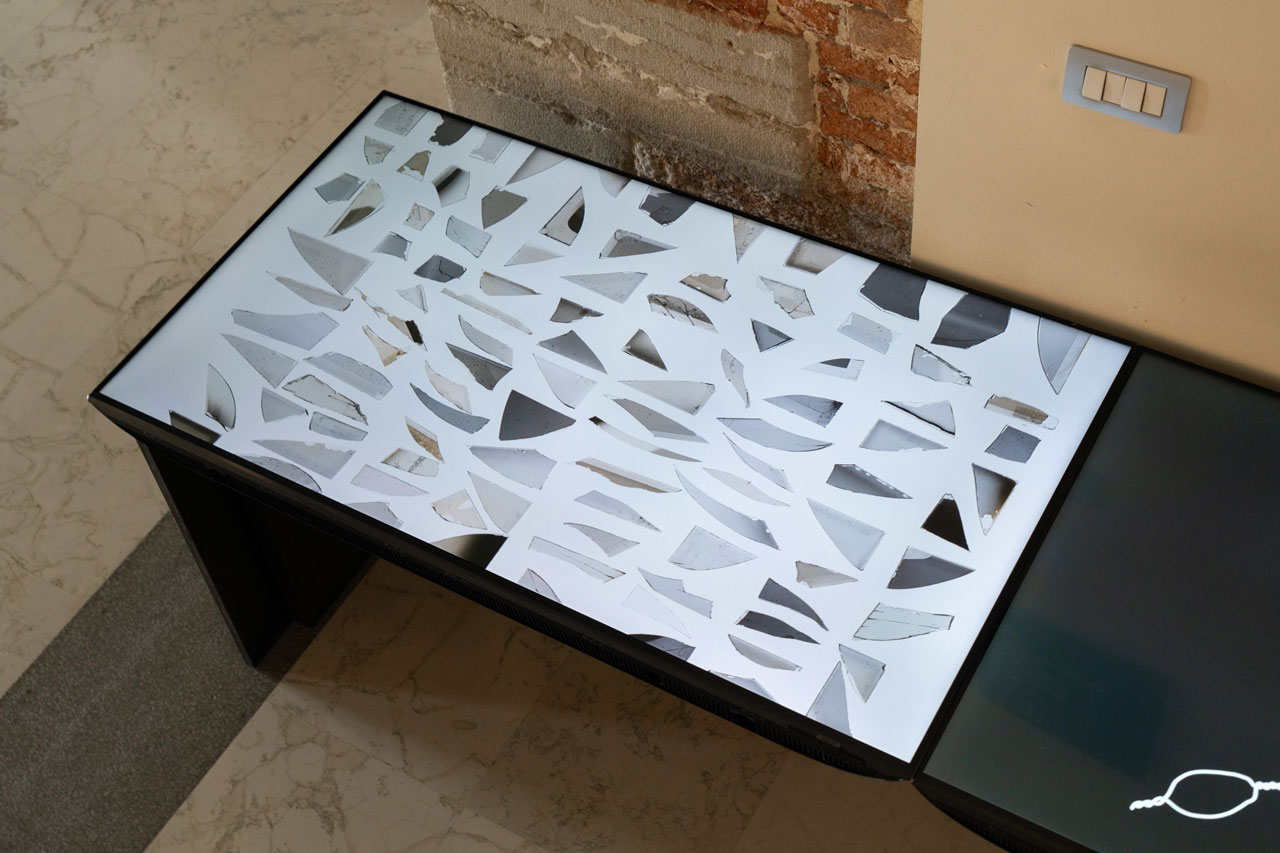
Particularly striking is her focus on damaged and fractured plates whose scientific data has been partially lost. Rather than treating these compromised objects as failures of archival preservation, West recognizes them as sites of transformation. Through re-photographing and filming their surfaces, she activates the cracks, scratches, and degradations as aesthetic events. The resulting works disperse astronomical imagery into kaleidoscopic constellations of fragments, suggesting that knowledge itself survives through mutation, translation, and recombination rather than permanence.
This logic of transformation extends throughout the exhibition. Mounted on modular display systems typically associated with commercial product photography, West’s luminous collages juxtapose historical astronomical imagery with contemporary satellite telescope images. Analog and digital cosmologies collapse into one another. Elsewhere, animations accompanied by music from the Japanese experimental group Open Reel Ensemble animate the exhibition with a sonic texture built from open-reel tape recordings, reinforcing the project’s fascination with obsolete media technologies and their lingering spectral qualities.
The exhibition reaches its emotional and conceptual apex in the monumental film-strip quilts suspended before the building’s glass façade. Constructed from hand-inked 16mm, 35mm, and 70mm film strips stitched into geometric star patterns, these translucent textiles merge cinematic material with the traditions of American quilting. The gesture is profoundly resonant: quilting, historically associated with communal female labor and domestic craft, becomes here a cosmological language. As sunlight filters through the stitched film, the installation transforms the university atrium into what feels like a secular cathedral of projected light.
The symbolism is precise without becoming reductive. West does not simply recuperate forgotten women scientists into institutional history; she reconstructs the material conditions through which marginalized labor becomes visible. Scientific observation, cinematic editing, sewing, coding, annotation, and archival preservation all emerge as interconnected forms of pattern-making. The exhibition suggests that both art and science rely upon acts of stitching: assembling fragments into intelligible systems capable of producing meaning.
Within the broader trajectory of “Stitched Cosmos” also marks a notable institutional shift. Earlier projects occupied spaces shaped by late-capitalist transformation — a former cinema converted into a supermarket, a palazzo transformed into a fast-food restaurant, a convent functioning as a prison. Here, however, the curators turn toward the university as a site still dedicated to the production and transmission of knowledge. In an era defined by austerity measures, attacks on higher education, and the erosion of public trust in scientific expertise, this repositioning carries unmistakable political weight.
What makes “Stitched Cosmos” compelling is precisely its refusal to separate aesthetic experience from epistemological inquiry. West stages not a conflict between art and science, but their mutual contamination. Her installation dissolves disciplinary boundaries, allowing drawing to become data, film to become textile, annotation to become abstraction, and damaged archives to become luminous environments of speculative repair.
In doing so, “Stitched Cosmos” proposes a radically expanded understanding of knowledge itself — one rooted not in technological mastery or institutional authority, but in collective labor, material fragility, and the persistence of human curiosity across generations. At a moment when scientific research increasingly appears politically vulnerable, West’s exhibition insists on the cultural necessity of both remembering and reimagining the infrastructures that allow humanity to see beyond itself.
Photo: Jennifer West, Stitched Cosmos, Installation view, Curated by Francesco Urbano Ragazzi,_Photo: Gaia Cambiaggi, Courteys the artit and Ca’ Foscari University of Venice
Info: Curators: Francesco Urbano Ragazzi (David Elliott and Pier Luigi Tazzi), Ca’ Foscari University of Venice, Dorsoduro 3246, Calle Larga Foscari, Venice, Italy, Duration: 7/5-6/7/2026, Days & Hours: Mon-Fri 9:30-18:30, Sat 9:30-12:30, www.unive.it/