
ART CITIES: N.York-Kelly Akashi
In an age fixated on preservation—cloud backups, archival inks, climate-controlled vaults—Kelly Akashi proposes something more radical: that loss need not be resolved to be held. Her first exhibition with Lisson Gallery in New York, “Heirloom,” arriving on the heels of her 2025 Los Angeles presentation and concurrent with her participation in the 2026 Whitney Biennial, finds the Los Angeles-based artist deepening her investigation into how absence takes form.
By Efi Michalrou
Photo: Lisson Gallery Archive
Where Kelly Akashi’s earlier work examined inheritance through material and formal tension, this new body of sculpture turns toward grief itself—not as a problem to be solved, but as a condition to be articulated. Across bronze, Corten steel, flame-worked glass, and carved stone, Akashi stages a quiet but insistent confrontation with what remains when something is no longer there.
Over the past year, Akashi has been tending the land where her home and studio once stood—not restoring it to some prior state, but attending to what persists. This garden, cultivated with deliberate care, becomes the exhibition’s quiet engine. From it emerge bronze roses, irises, and branches, cast directly from organic forms now transformed into resilient relics. These are not sentimental reproductions. They bear the precise irregularities of their living sources, memorializing gestures of domestic care even as their original context has vanished.
The gesture recalls vernacular preservation practices—pressing flowers between pages, encasing a lock of hair—but stripped of Victorian sentimentality. Akashi’s heirlooms acknowledge the futility of such gestures even as she performs them with exquisite rigor. The result is a tension between endurance and fragility that never resolves into easy consolation.
At the exhibition’s center stands its most imposing gesture: an enlarged rendering of an inherited stone ring once worn by the artist. Expanded to monumental scale while retaining the rough, unpolished surface of the original, the sculpture oscillates between bodily intimacy and geological deep time. Its altered proportion speaks to how grief reshapes perception—enlarging what is absent until it exceeds any container’s capacity.
The ring does not function as a replacement or monument in the classical sense. Rather, it stages a confrontation with weight: literal tons of stone, but also the psychological burden carried forward through generations. One feels in its presence the particular strangeness of inheriting objects whose original significance has been partially lost—things that mean more than they can say.
Akashi’s inquiry extends into two monumental Corten steel panels, cut from doily patterns traced from scans of her grandmother’s handmade lace tablecloth. Suspended with a deliberate gap between them, the panels demarcate a space of interruption that resists closure. The choice of material is critical. Weathering steel records exposure over time, its surface continually oxidizing, paradoxically increasing its structural integrity while developing a distressed, rusted patina.
Here, permanence and impermanence coexist without contradiction. Absence is not a void but an active, ongoing presence—something that weathers, transforms, and persists. Nearby, works incorporating book-ash flocked paper retain remnants of the artist’s former library, suggesting how knowledge, memory, and history are transmitted through fragile substrates. Domestic familiarity meets archival impulse; personal grief situates itself within broader cultural continuities.
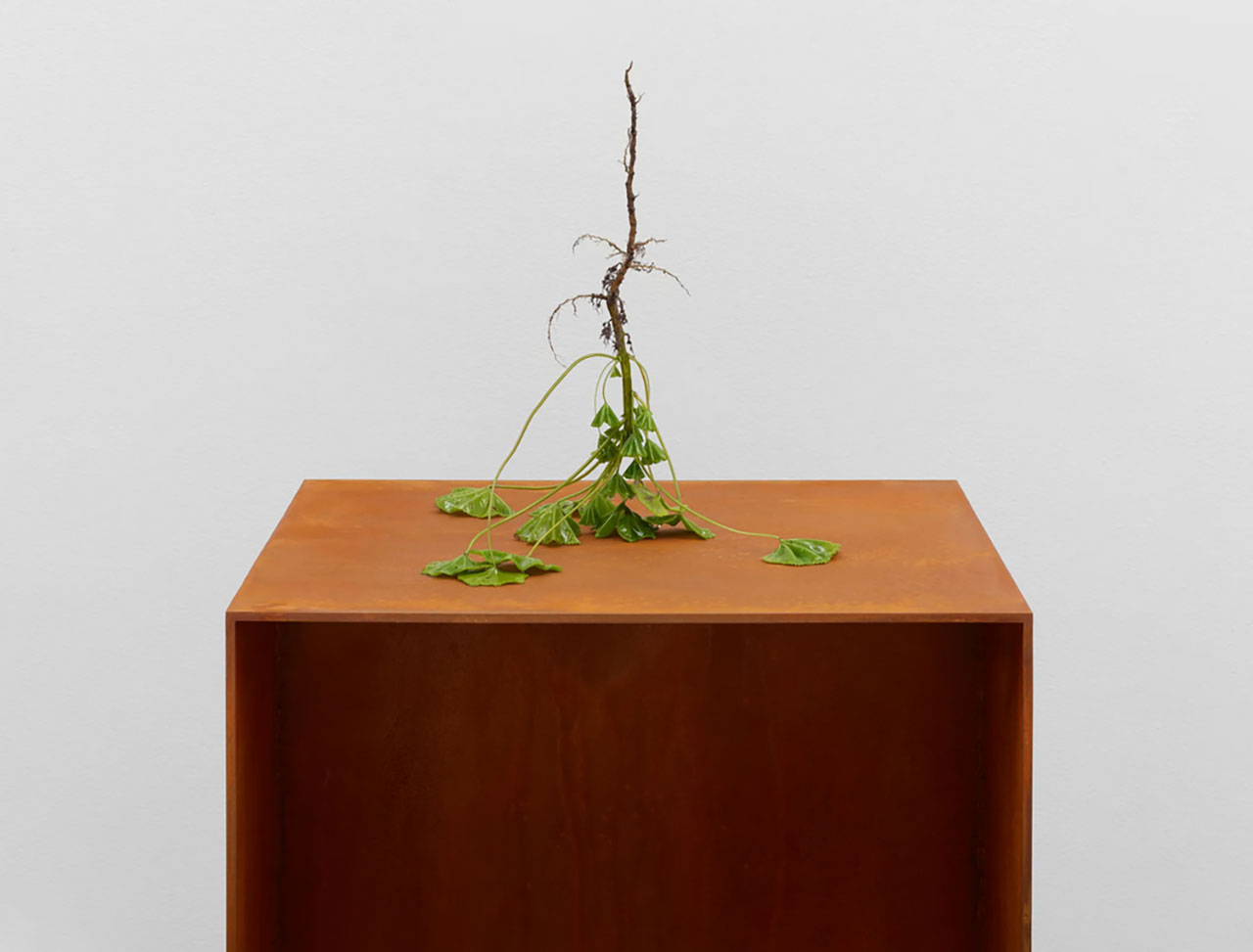
The exhibition’s glass works introduce another register entirely: fragility as a mode of attention, not a weakness. A mallow plant discovered while gardening has been painstakingly recreated in glass with its root system fully exposed. This particular species, Akashi notes, commonly emerges from disturbed soil, signaling emerging biodiversity after disaster. The parallel to her own practice—making art from disrupted ground—is unmistakable but never overstated.
Another glass and bronze sculpture takes a finely latticed botanical form that suggests both containment and permeability. Its intricate construction demands sustained looking, rewarding careful attention with the revelation of delicate connections that could easily fracture. In these works, loss is neither obscured nor resolved. It is articulated through forms that remain open, provisional, responsive.
Throughout “Heirloom,” one recognizes the signature elements of Akashi’s broader practice: the deft manual skill, the astute material knowledge, the deep reverence for process that has characterized her work since her emergence. Her repeated use of the hand as motif—here dispersed across objects that bear the trace of human touch without directly representing it—continues her investigation into temporality and the body. Those earlier bronze and crystal hands, marked by growing fingernails and aging flesh, find their echo in works that register human presence through absence.
But “Heirloom” pushes further. If Akashi’s earlier work emphasized the impermanence of the natural world, this exhibition asks what happens when we stop trying to preserve and instead learn to attend. Her glass flowers will not wilt, but neither will they hide their constructedness. Her bronze roses acknowledge that the living flower is gone even as they honor its form. The Corten steel panels will continue to oxidize long after the exhibition closes—a reminder that sculpture, like grief, is not a fixed state but an ongoing process.
“Heirloom” proceeds from an understanding of sculpture as uniquely capable of holding absence in materiality. These works do not function as static tokens of remembrance but as dynamic carriers of history, shaped as much by what is no longer present as by what endures. In an era that demands resolution, closure, and moving on, Akashi offers something more honest: forms that sustain rupture, that allow erosion and transformation to remain visible, that treat loss not as an event to be overcome but as a condition to be lived within.
Photo: Kelly Akashi, Root Inversion (Mallow), 2026 Flame-worked borosilicate glass, weathering steel, 35.6 x 35.6 x 35.6 cm, © Kelly Akashi, Courtesy the artist and Lisson Gallery
Info: Lisson Gallery, 508 West 24th Street, New York, NY, USA, Duration: 13/5-25/7/2026, Days & Hours: Tue-Sat 10:00-18:00, www.lissongallery.com/
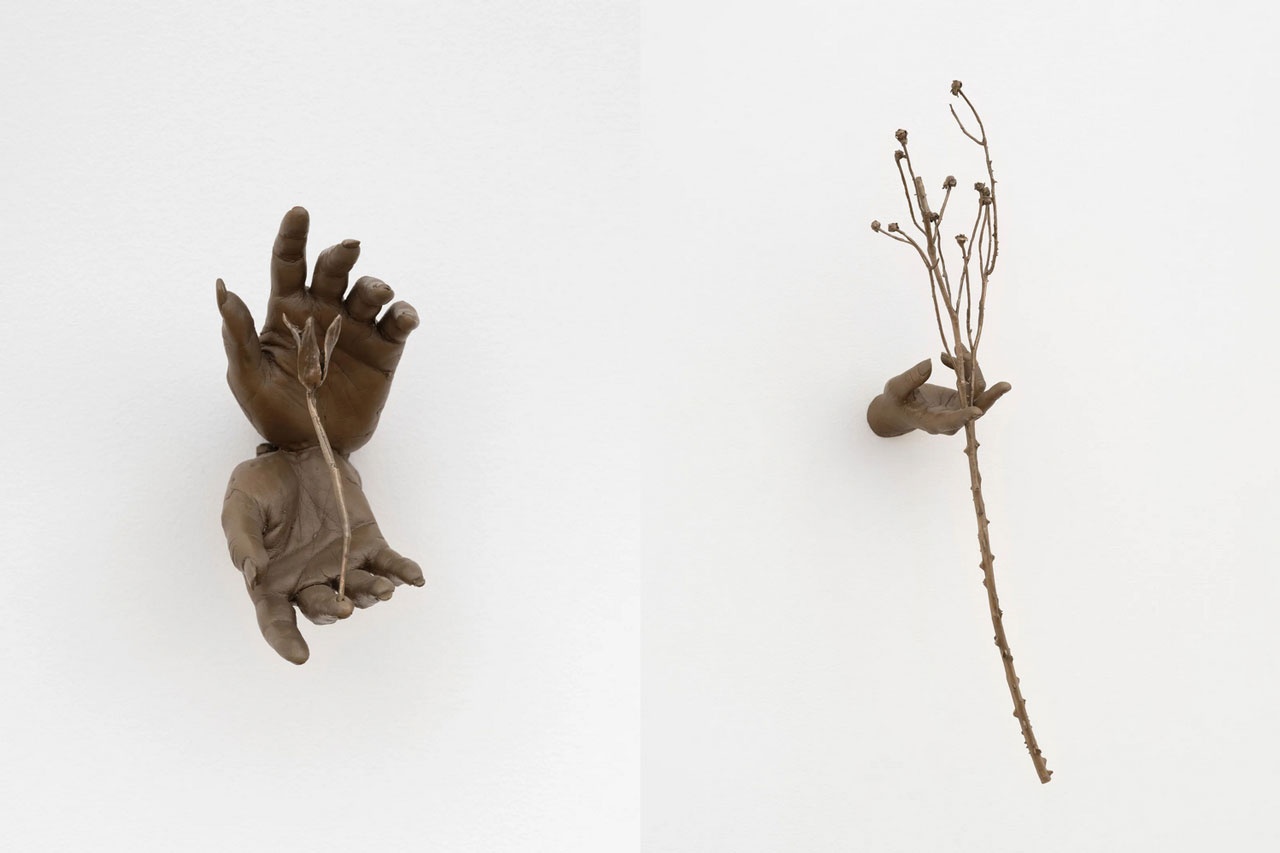
Right: Kelly Akashi, Witness (Highview), 2026 Lost-wax and burn-out cast bronze, 68.6 x 15.2 x 17.8 cm, © Kelly Akashi, Courtesy the artist and Lisson Gallery
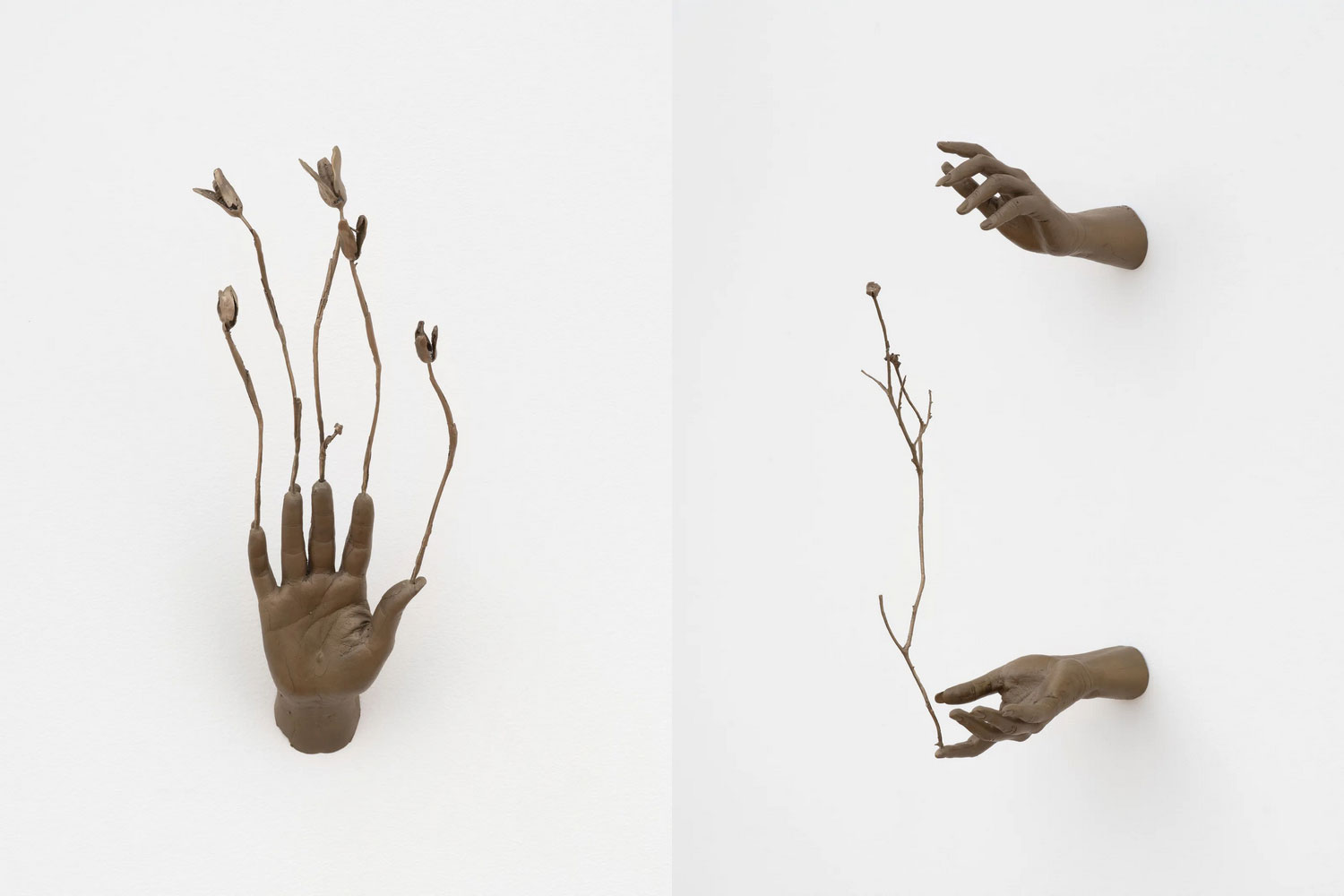
Right: Kelly Akashi, Witness (Highview), 2026 Lost-wax and burn-out cast bronze, 58.4 x 22.9 x 22.9 cm, © Kelly Akashi, Courtesy the artist and Lisson Gallery
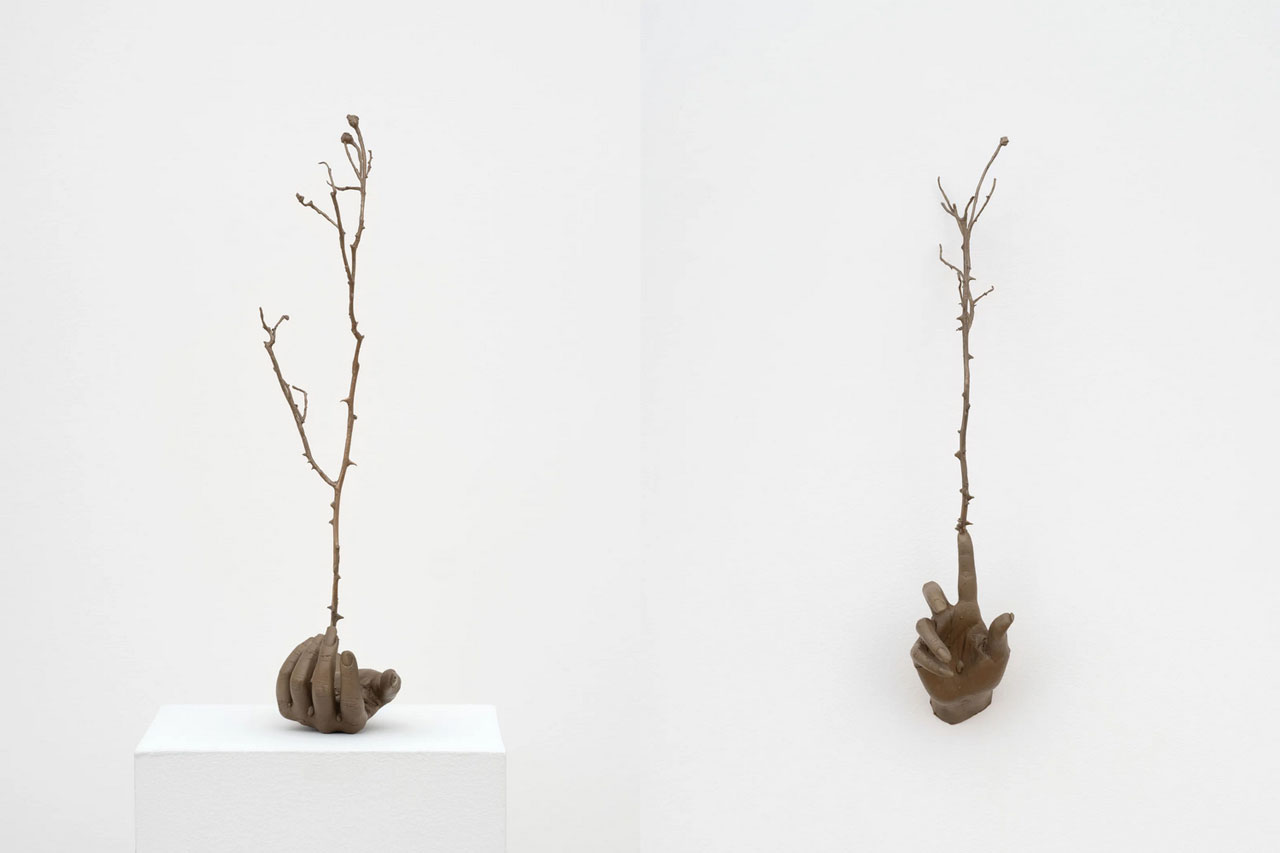
Right: Kelly Akashi, Witness (Highview), 2026 Lost-wax and burn-out cast bronze, 58.4 x 22.9 x 22.9 cm, © Kelly Akashi, Courtesy the artist and Lisson Gallery
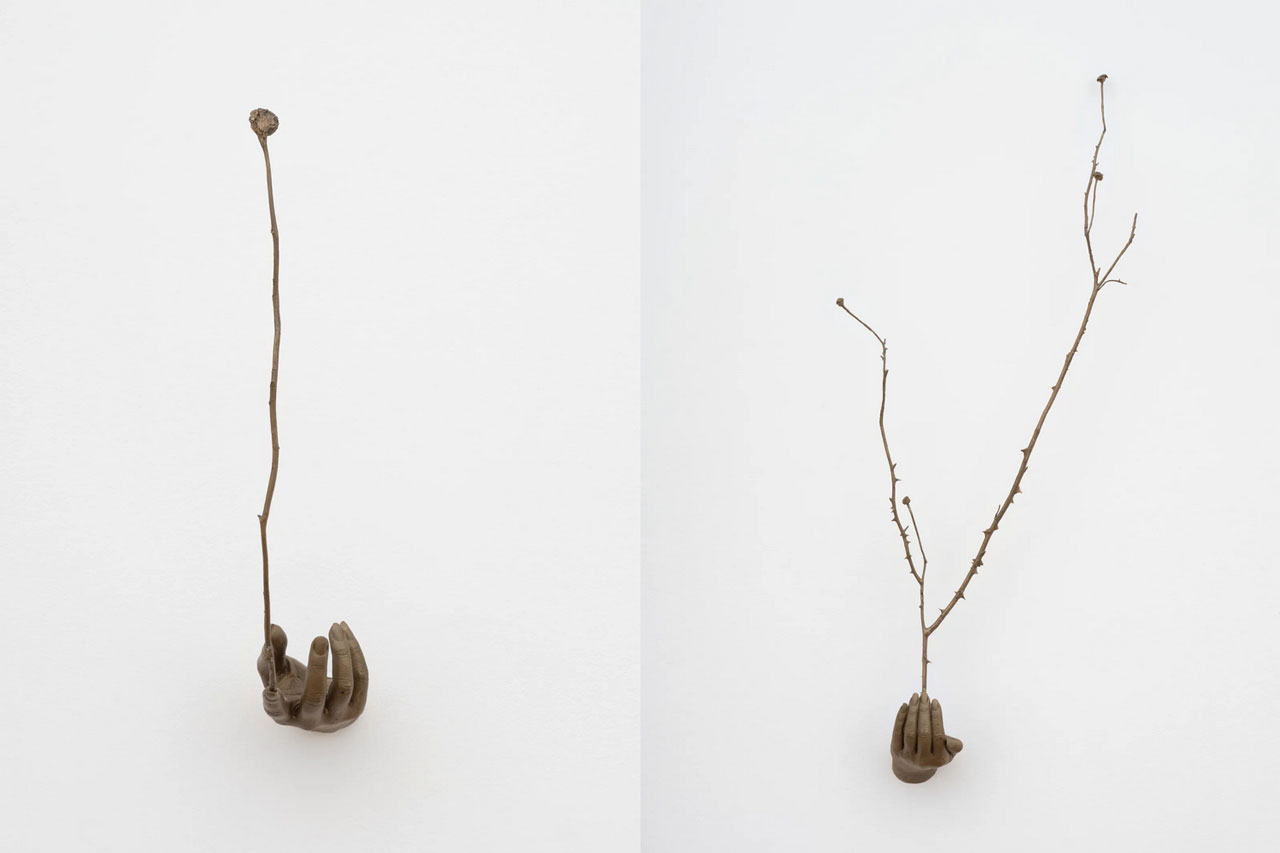
Right: Kelly Akashi, Witness (Highview), 2026 Lost-wax and burn-out cast bronze, 90.2 x 36.8 x 12.7 cm, © Kelly Akashi, Courtesy the artist and Lisson Gallery
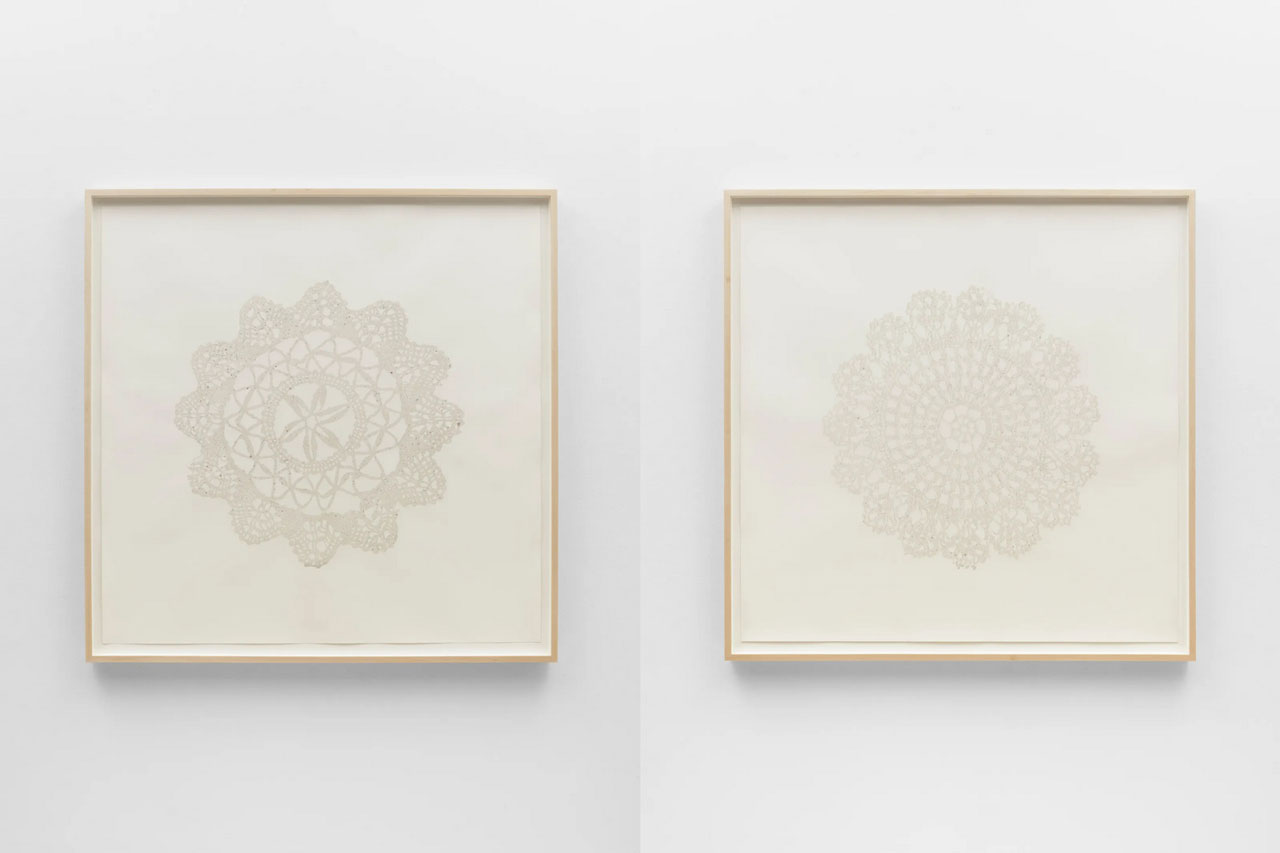
Right: Kelly Akashi, Heirloom, 2026 Book-ash flocked paper in artist’s frame, 125.7 x 125.7 cm, © Kelly Akashi, Courtesy the artist and Lisson Gallery