PRESENTATION: House of Nisaba-New Stories of Painting
“House of Nisaba: New Stories of Painting” signals a return to figurative painting in contemporary art, through the lens of allegory. The exhibition highlights 29 international artists, of whom 25 are commissioned to make a new painting especially for this occasion. What does painting look like and mean today as knowledge transforms, information accelerates and societies splinter? What stories are these artists telling us?
By Dimitris Lempesis
Photo: Moderna Museet Archive
In 3100 BC, writing emerged in Mesopotamia—first for counting grain, then for recording myths and hymns on clay tablets. The goddess Nisaba*, who cannot write but speaks through others, oversaw this transformation as storytelling took material form. Fast-forward to 2026: knowledge is shifting again amid rapid, unstable information. We evoke Nisaba as a new generation of allegorical painters arises. The artists of “House of Nisaba” paint not as a movement but with a shared method—using allegory to express deeper meaning, like a skull. The twenty-nine artists in “House of Nisaba” render new pictorial languages that draw as much from art history, mythology and literature, as from fashion, cinema, news media, science fiction, astrology, and digital platforms like Instagram and TikTok. Information becomes algorithmic, the feed starts to matter. Rather than offering stable narratives, these paintings propose worlds shaped by discontinuity, ambiguity, and multiplicity.
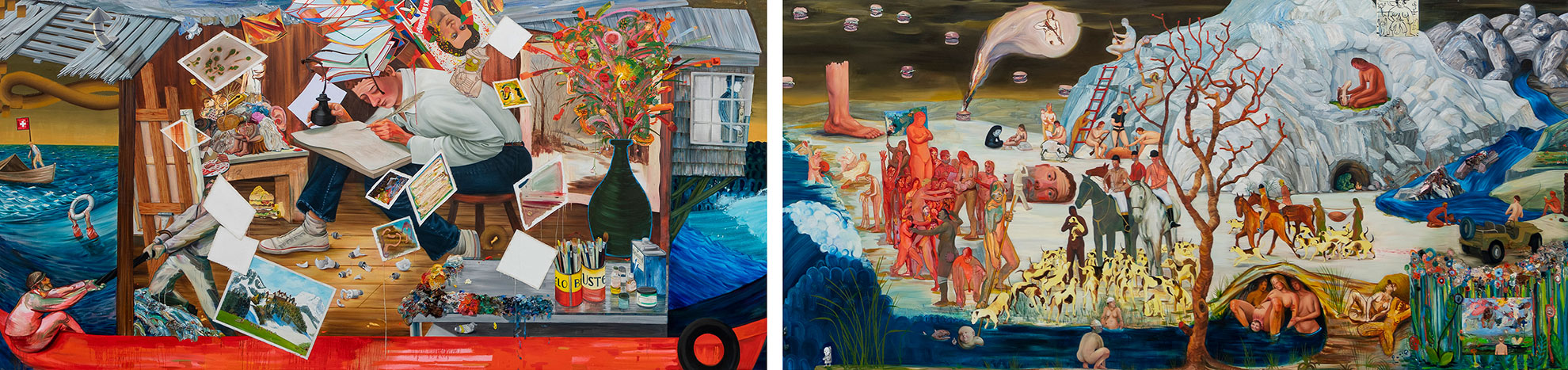
The exhibition takes its point of departure from the work of Nicole Eisenman, whose practice fundamentally reshaped the language of painting from the 1990s onward. Drawing on the legacies of 20th century figures such as Max Beckmann, Philip Guston, and Robert Rauschenberg, Eisenman fused historical painterly traditions with the queer, punk-inflected sensibilities of the approaching Y2K era. Her diptych “Progress: Real and Imagined” crystallizes this inquiry through an allegorical vision of artistic existence, staging the tension between material struggle and imaginative possibility. In the left panel, the artist bends over a desk within a claustrophobic workspace precariously attached to a vessel navigating violent seas. The right panel unfolds as its counter-image: an Edenic terrain where thought becomes form and every register of human experience appears in exuberant circulation. The two scenes remain inseparable and mutually constitutive; it is precisely in the unstable space between hardship and invention that artistic language emerges.
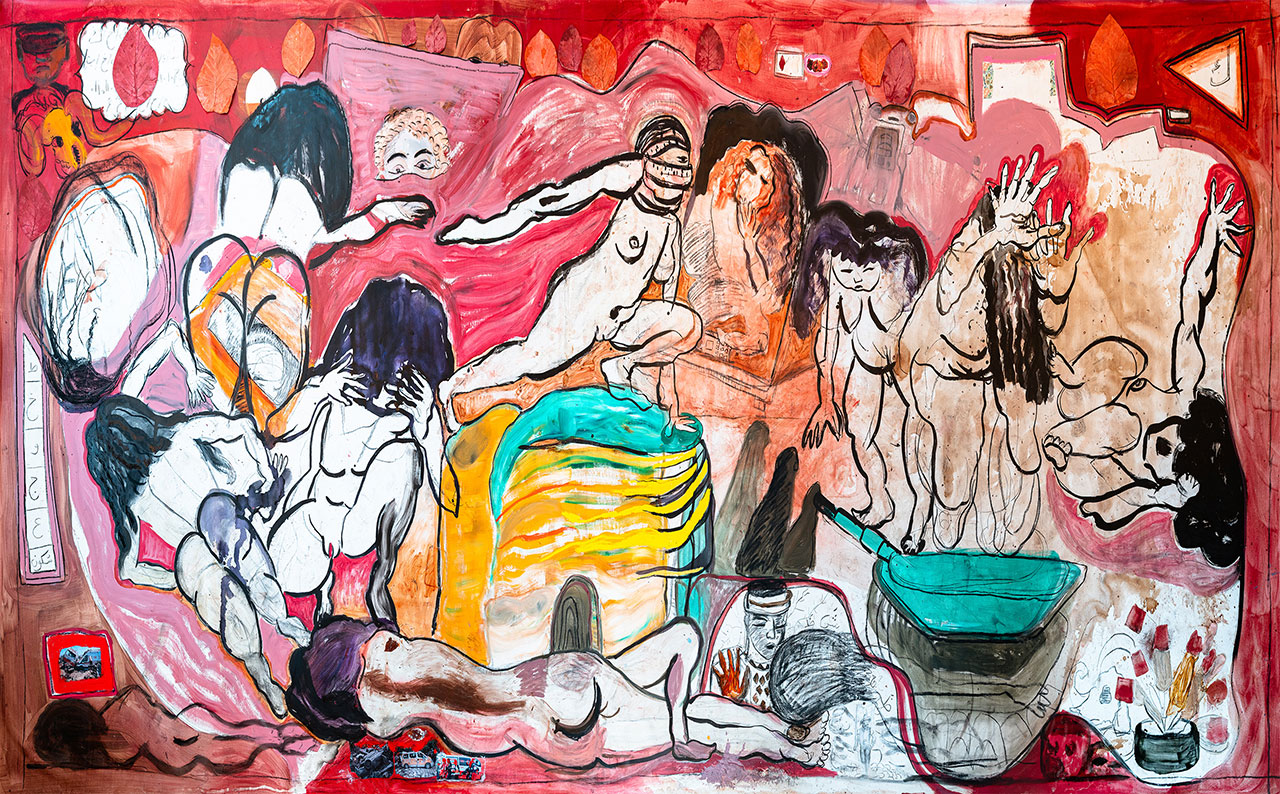
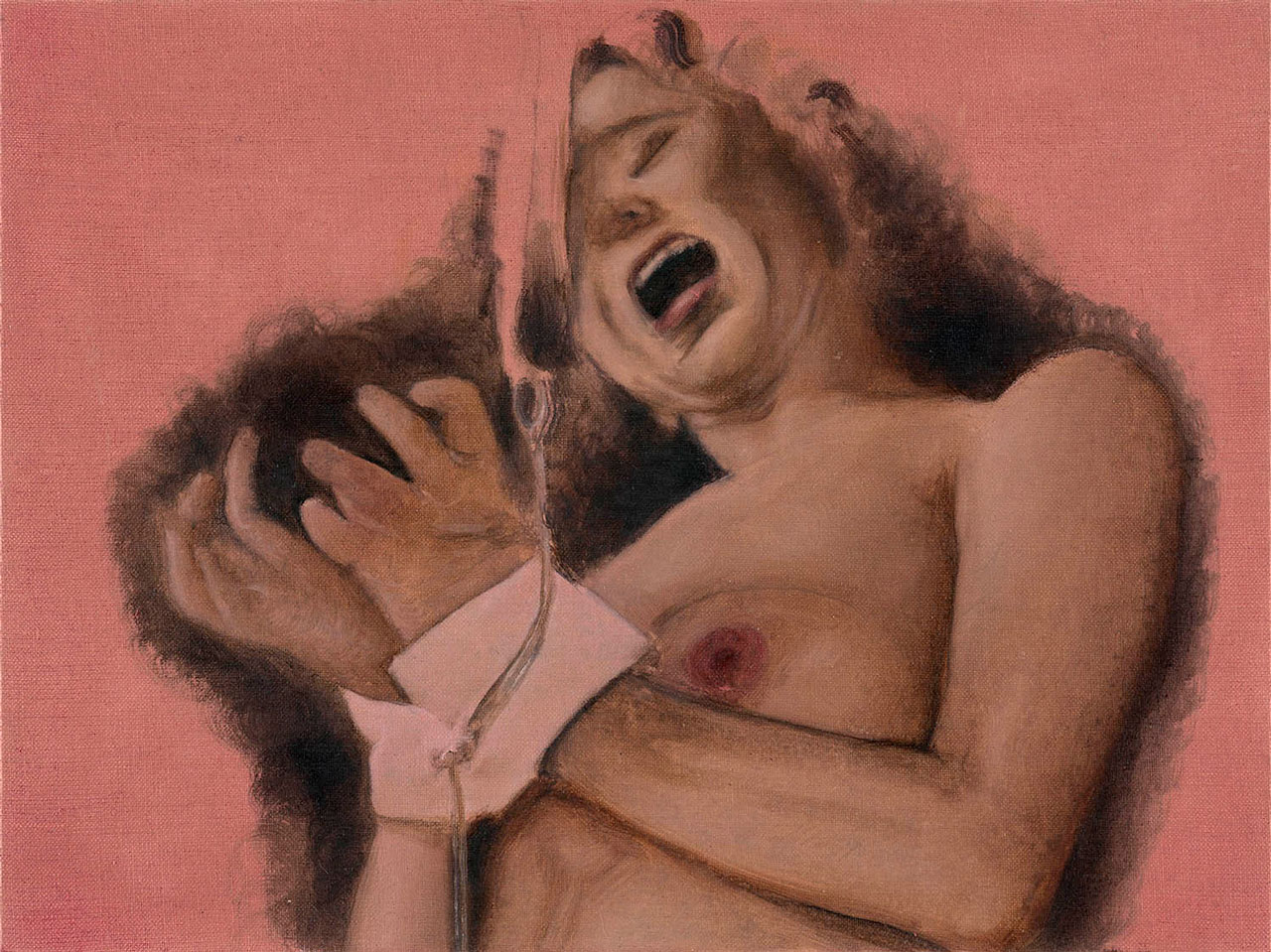
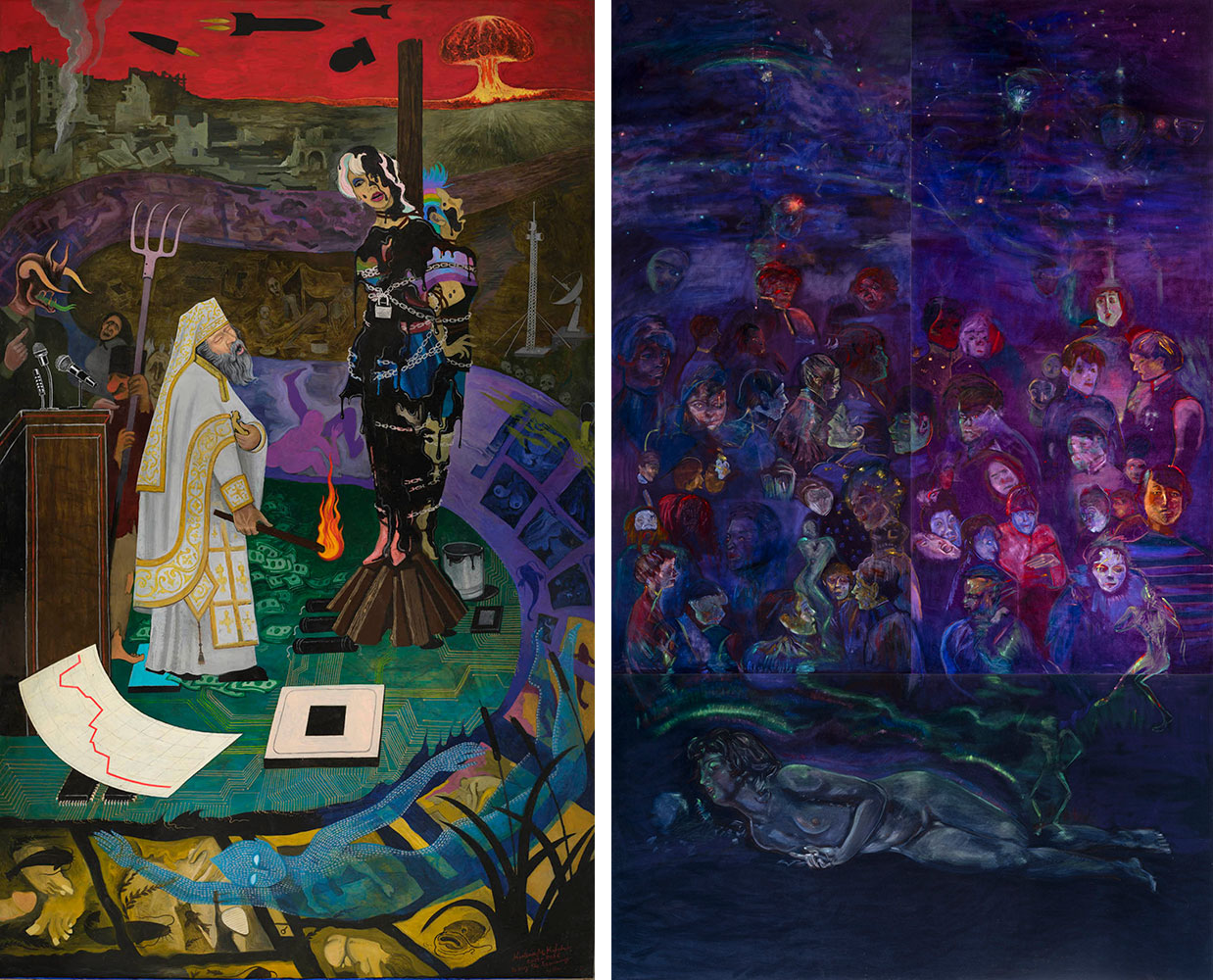
In “Fixing the Economy”, Hortensia Mi Kafchin constructs another unstable avatar: a doubled figure condemned at the stake by demonic authorities masquerading as holy men and political leaders. The chromatic intensity of the figures’ hair recalls the colors of national flags once carried with conviction and pride. Against a landscape saturated with despair, the composition is enveloped by a relentless stream of pornographic imagery, collapsing distinctions between spectacle, violence, and ideology. Kafchin renders reality itself as a hallucinatory fiction, exposing the instability of political and symbolic systems alike.
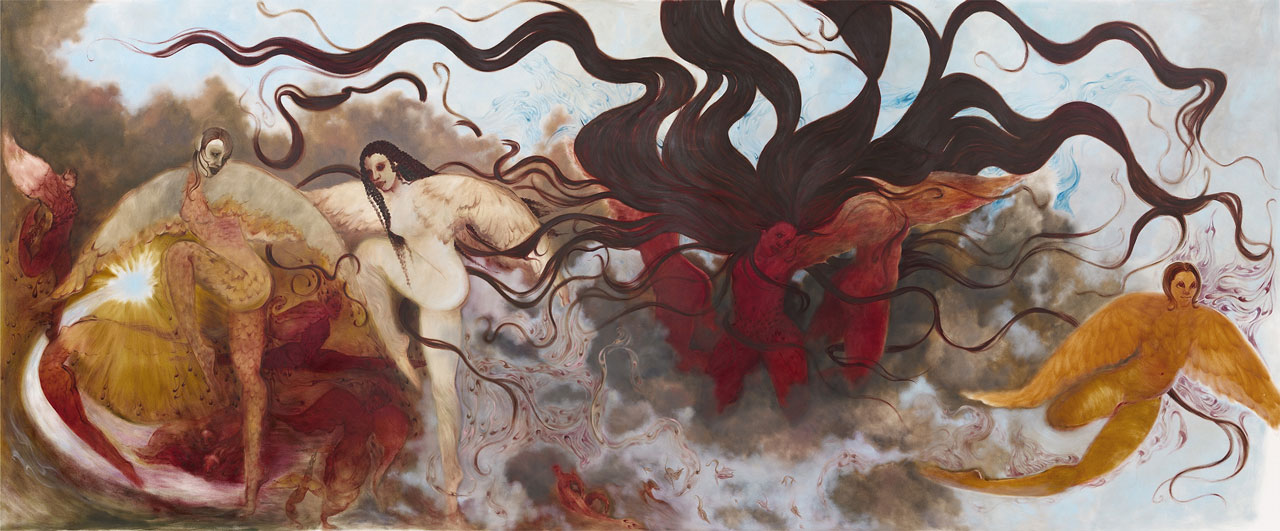
Naudline Pierre develops a cosmology in which art history, speculative fiction, mysticism, and mythology continuously fold into one another. Central to her practice is a recurring proxy figure through which queer and Black subjectivities become engines of fabulation and world-building. For this exhibition, Pierre extends that mythology in “Chiasma”, positioning the figure at the threshold between appearance and disappearance, illumination and obscurity. Renaissance altarpiece conventions intersect with Baroque spatial drama, while celestial architectures shape mythological narrative structures. Yet the allegory resists closure. Rather than stabilizing meaning, Pierre suspends the viewer within a scene governed by its own elusive spatial and temporal logic.
Questions of vision and transformation animate Selma Selman’s new work “Govgons (Do Not Look Into Our Eyes)”, which takes the figure of Medusa as its conceptual point of departure. Once transformed by Medusa into a monstrous Gorgon whose gaze petrified men, Medusa has persisted as both patriarchal nightmare and mythic archetype. In Selman’s work, she becomes an avatar through which the artist channels personal histories, inherited trauma, and desire. Extending her materially expansive approach to painting, Selman fragments and reconstructs this chimeric body across salvaged objects drawn from everyday life: satellite dishes, wheel rims, ventilation ducts, and boilers. The result is a dispersed anatomy in which mythology collides with industrial debris and lived experience.
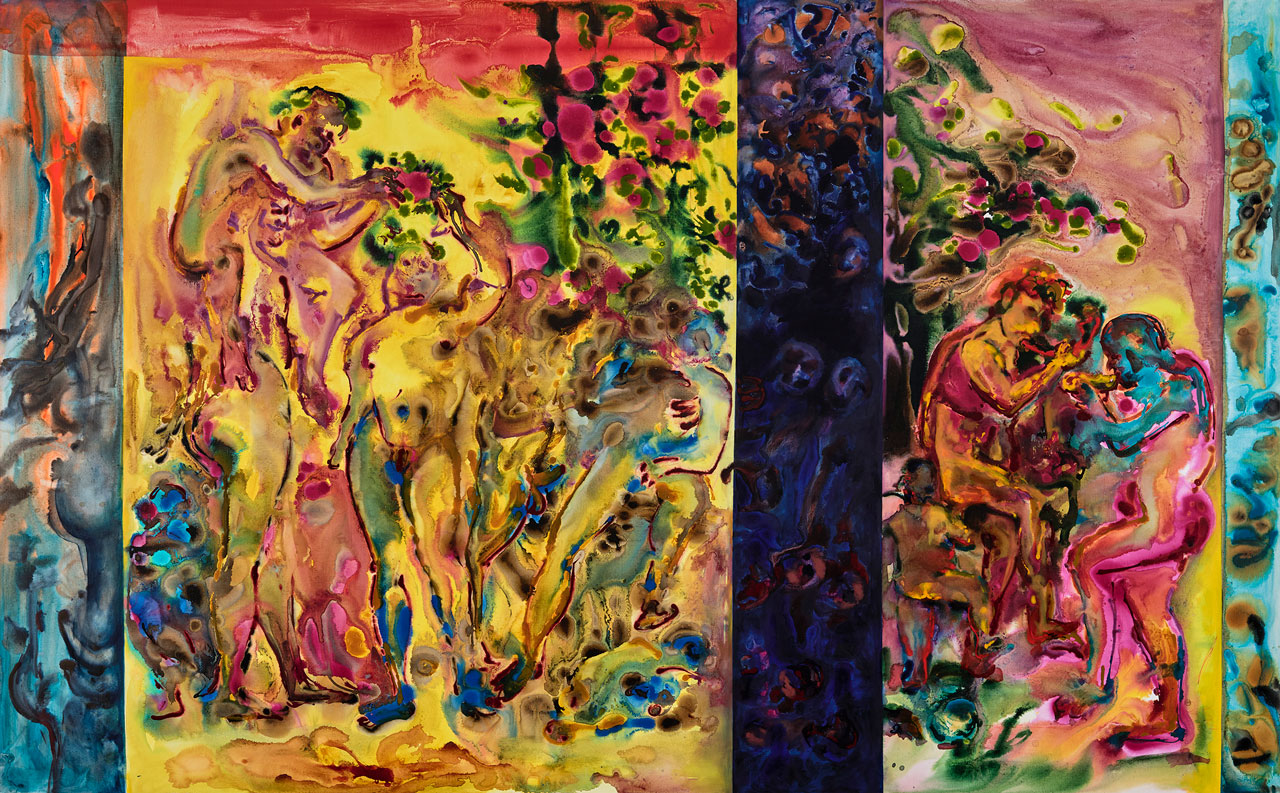
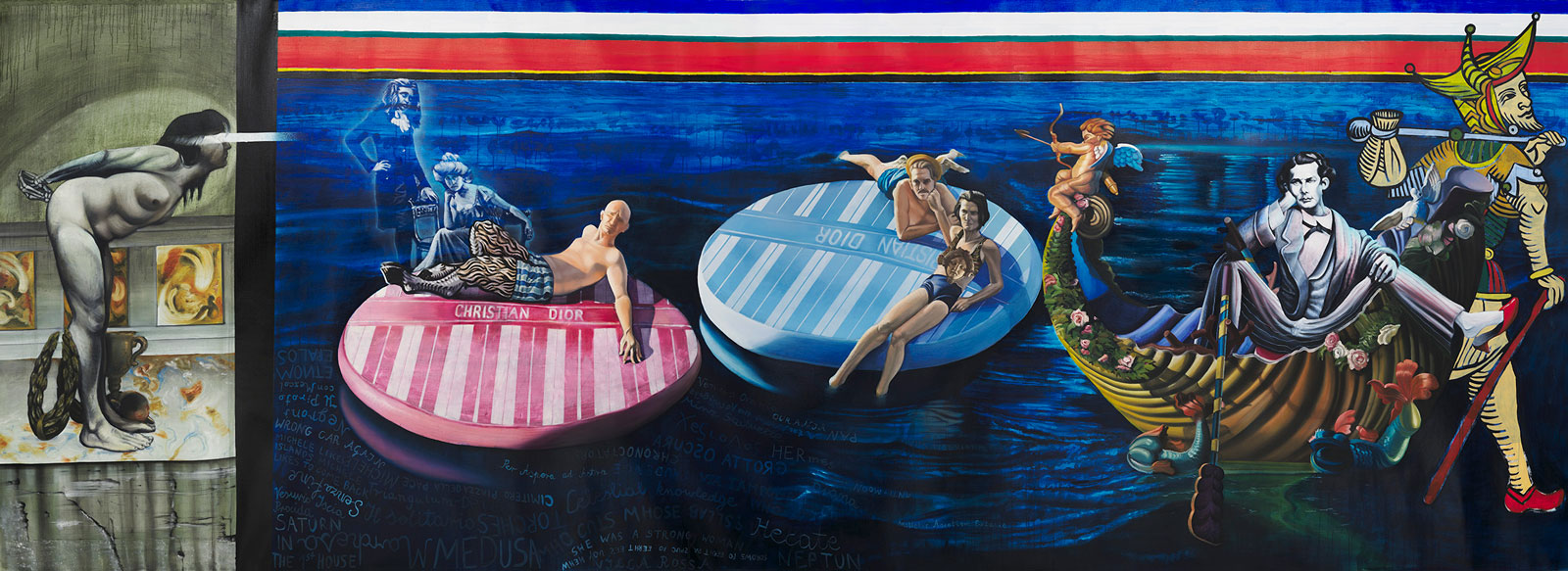
Mikołaj Sobczak approaches history through what might be described as a speculative apparatus of desire, excavating queer, libidinal, and minoritarian narratives that remain absent from official historical accounts. In Pavole, “Pavole, Pavole”, the muse of history, Kleio, emerges as Sobczak’s guiding avatar, peering through the aperture of time toward the nineteenth-century Uranians — a poetic subculture of homosexual intellectuals whose aesthetic and mythological aspirations generated alternative modes of belonging. At the center of this constellation stands Ludwig II of Bavaria, the extravagant monarch imagined gliding toward Capri’s Blue Grotto. Around him gather contemporary Uranians, drifting across the Mediterranean aboard Christian Dior-sponsored inflatables in pursuit not of stable mythologies but of language itself. Sobczak assembles fragments of iconography into an unstable genealogy where fantasy, longing, and historical projection eclipse the authority of bloodline and nationhood.
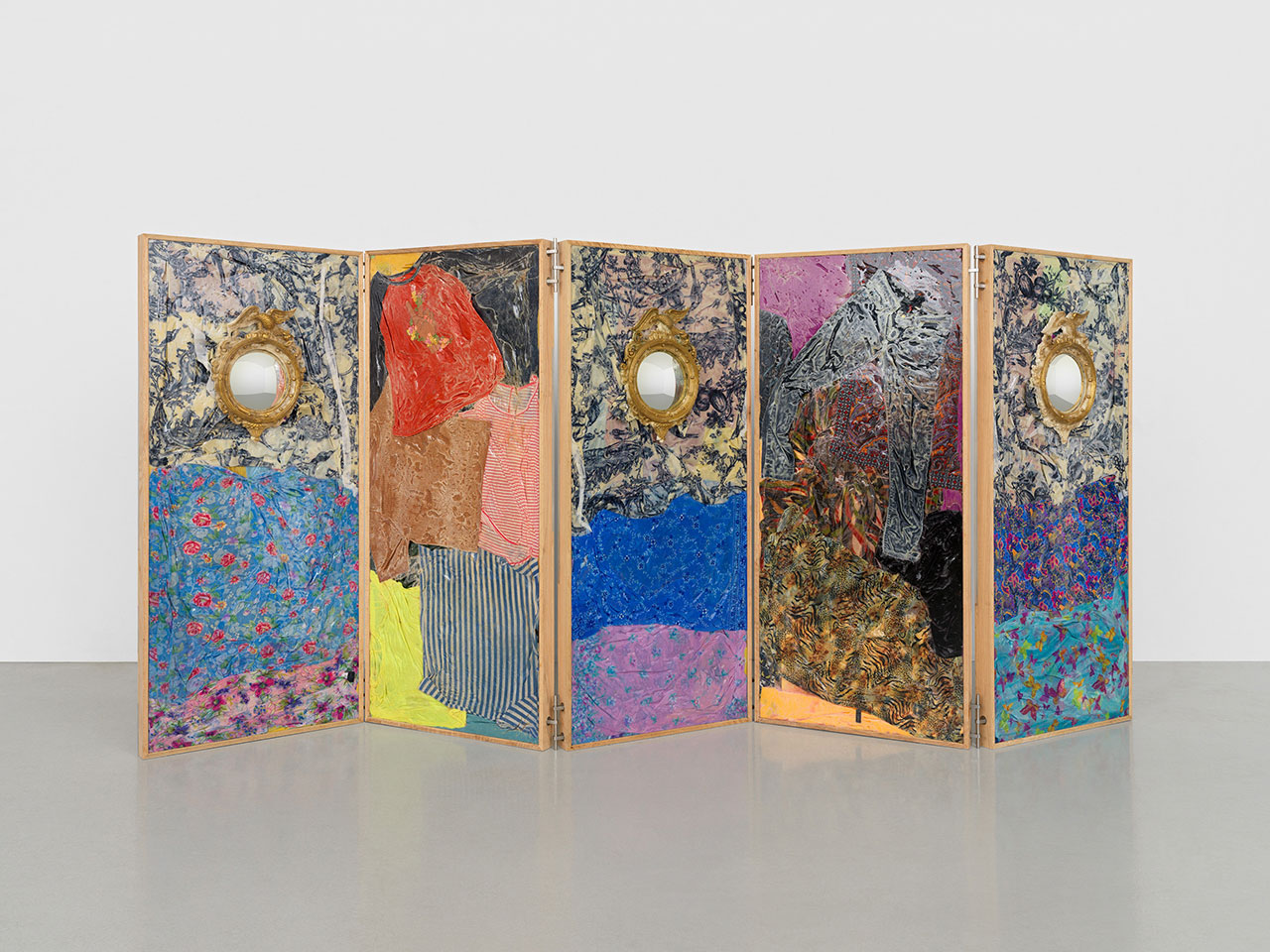
Kevin Beasley works with clothing, textiles, and quotidian materials cast in resin to produce sculptural forms that oscillate between painting and architecture. “Portrait III (Federal Five)” adopts the structure of a room divider while assuming the scale and gravitas of history painting. The work draws on a formative memory: a school visit to historic homes in Lynchburg, Virginia, whose interiors embodied the Federal style, itself a post-independence adaptation of British imperial classicism into the visual language of the early American republic. On the reverse side, Beasley paints a pastoral landscape dominated by the image of a southern colonial house engulfed in flames. Materiality becomes both subject and method: house, landscape, and history are rendered as tactile accumulations, while allegory remains unstable and fugitive.
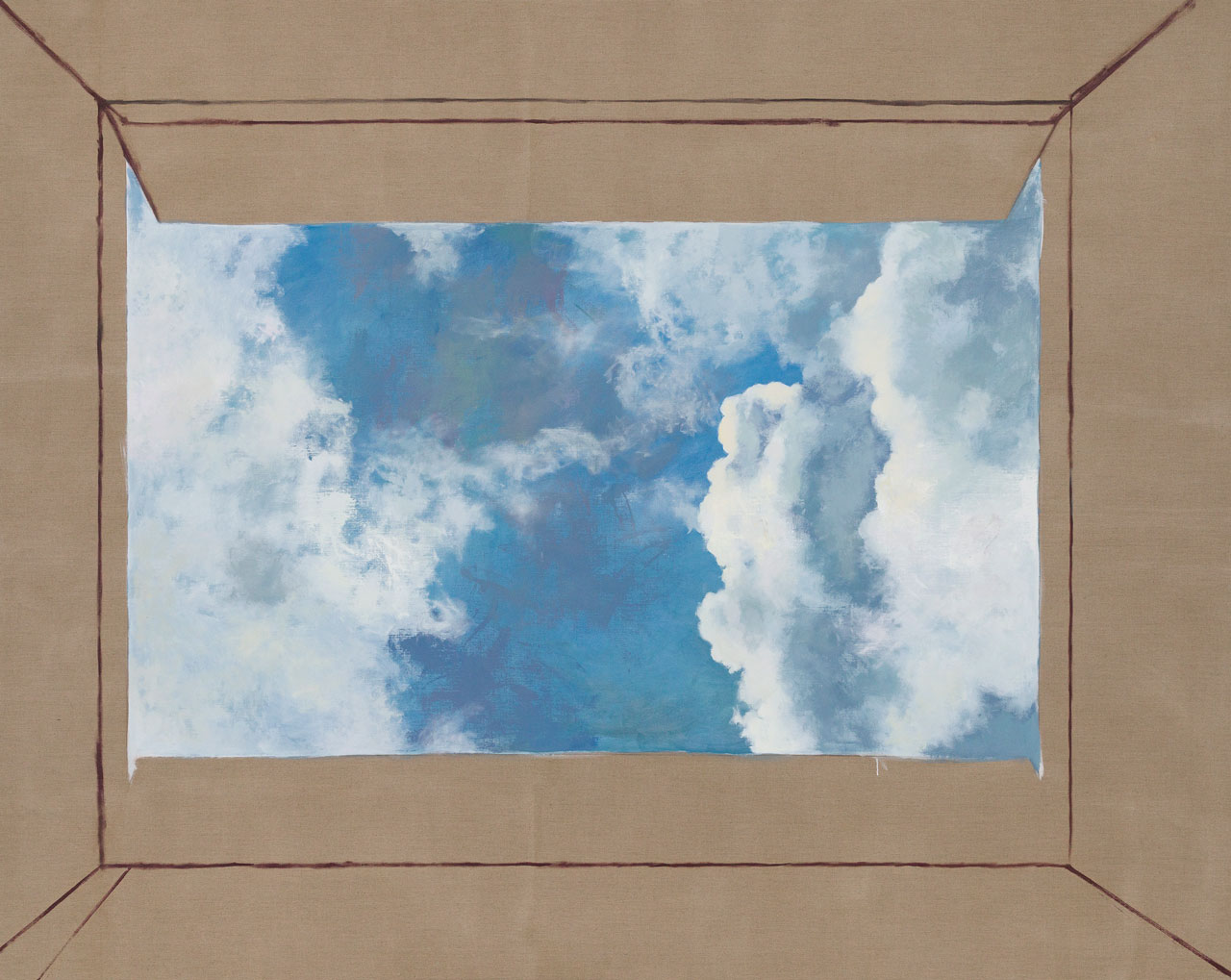
Mohammed Sami’s “Framed Liberty” presents the sky as seen from inside a cardboard box, transforming a simple image into a reflection on freedom, perception, and the limits of representation. Referencing theories of perspective developed by Leon Battista Alberti, Erwin Panofsky, and Georges Didi-Huberman, the work questions the idea of painting as a transparent “window” onto reality. Instead, Sami emphasizes the instability of vision, suggesting that every image is shaped as much by what remains hidden or absent as by what is visible. The painting ultimately explores how representation is always incomplete, haunted by what exists beyond the frame.
* Nisaba was the Mesopotamian goddess of writing and grain. She is one of the oldest Sumerian deities attested in writing and remained prominent through many periods of Mesopotamian history. She was commonly worshiped by scribes, and numerous Sumerian texts end with the doxology “praise to Nisaba” as a result.
Participating Artists:
Soufiane Ababri, Michael Armitage, Felipe Baeza, Kevin Beasley, Cornel Brudascu, Alex Červený, Leidy Churchman, Nicole Eisenman, Hamishi Farah, Martin Gustavsson, Gordon Hookey, Hortensia Mi Kafchin, Sanya Kantarovsky, Melanie Kitti, Matthew Lutz-Kinoy, Jill Mulleady, Wangechi Mutu, Naudline Pierre, Kevin Quashie, Mohammed Sami, Cinga Samson , Agnes Scherer, Selma Selman, Agata Słowak, Mikolaj Sobczak, Mounira Al Solh,Abdellah Taïa, Salman Toor, Evelyn T. Wang
Photo: Nicole Eisenman, Progress: Real and Imagined, 2006. Ringier AG/Ringier Collection, Switzerland, © Nicole Eisenman 2026, Photo: ullmann.photography. Courtesy of the artist and Hauser & Wirth
Info: Curator: Hendrik Folkerts, Moderna Museet, Exercisplan 4, Skeppsholmen, Stockholm, Sweeden, Duration: 14/5-30/8/2026, Days & Hours: Tue & Fri 10:00-20:00, Wed-Thu & Sat-Sun 10:00-18:00, www.modernamuseet.se/
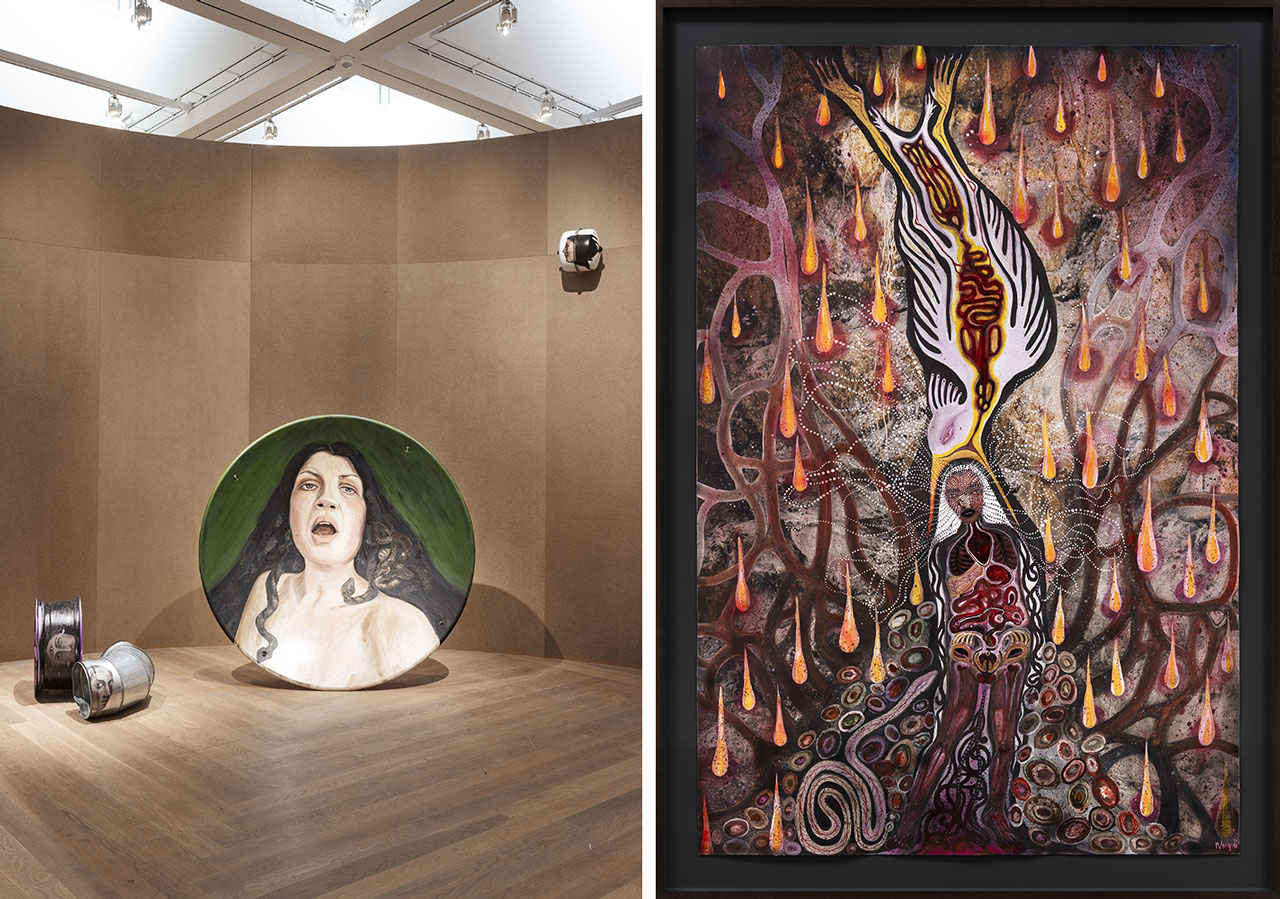
Right: Wangechi Mutu, Subterranea Falling Flames, 2023. Courtesy of the artist and Gladstone Gallery, © Wangechi Mutu 2026, Photo: David Regen. Courtesy of the artist and Gladstone Gallery
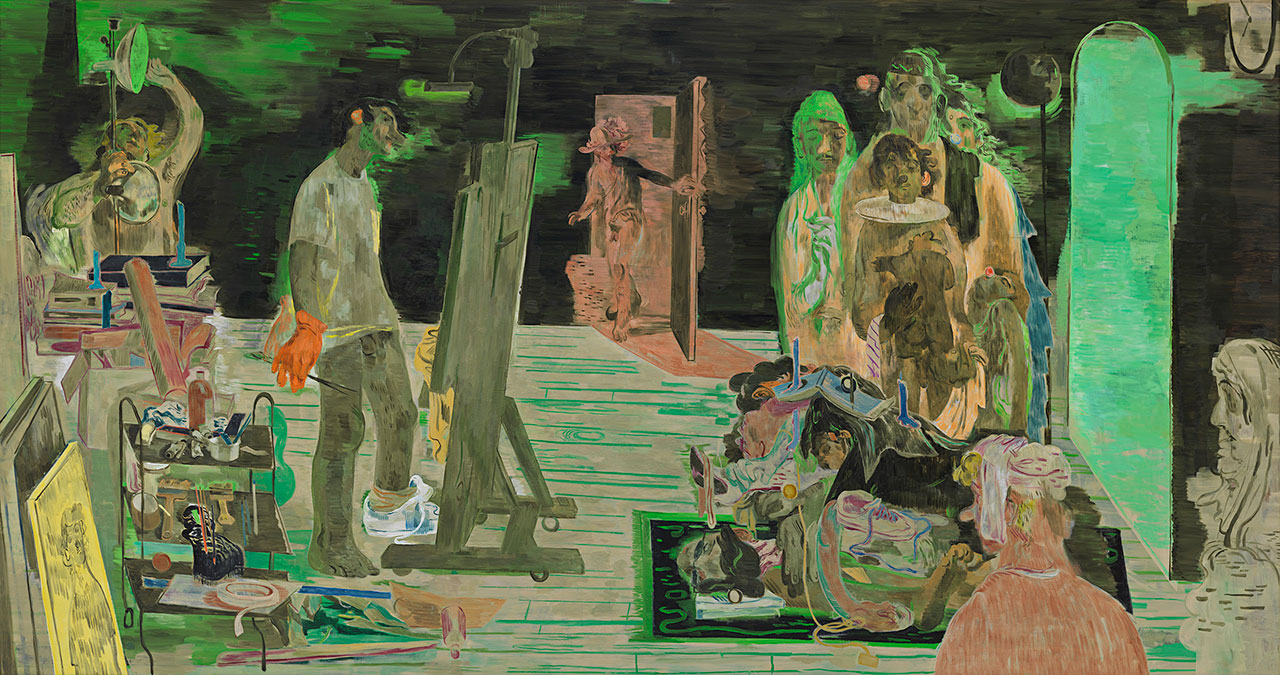
Right: Jill Mulleady, The Shift, 2025. Courtesy of the artist and Gladstone Gallery. © Jill Mulleady 2026, Photo: Nicolas Brasseur. Courtesy of the artist and Gladstone Gallery
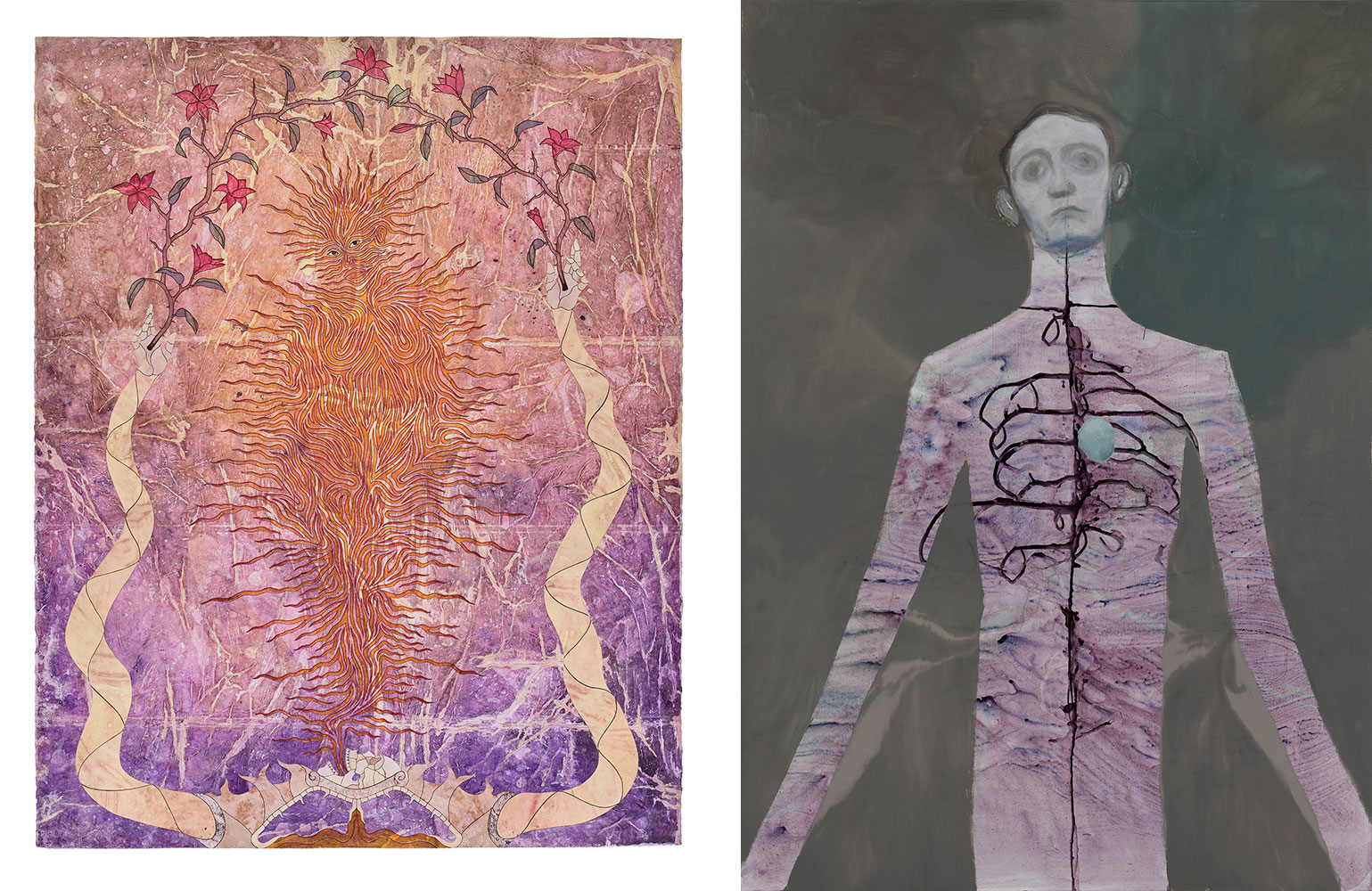
Right: Sanya Kantarovsky, Scarecrow, 2025. Moderna Museet. Donation 2025 from Arif Suherman. © Sanya Kantarovsky 2026, Photo: Pierre Le Hors. Courtesy of the artist and Michael Werner Gallery