ART CITIES: N.York-Katharina Fritsch
Nearly fifty years after first assembling a group of modest sculptural models on a classroom table at the Kunstakademie Düsseldorf, Katharina Fritsch has returned to those early forms with astonishing scale and renewed psychological force. In her latest exhibition at Matthew Marks Gallery, the artist revisits a body of work conceived in 1979, transforming objects once presented with cool academic detachment into monumental presences that dominate architectural space.
By Dimitris Lempesis
Photo: Matthew Marks Gallery Archive
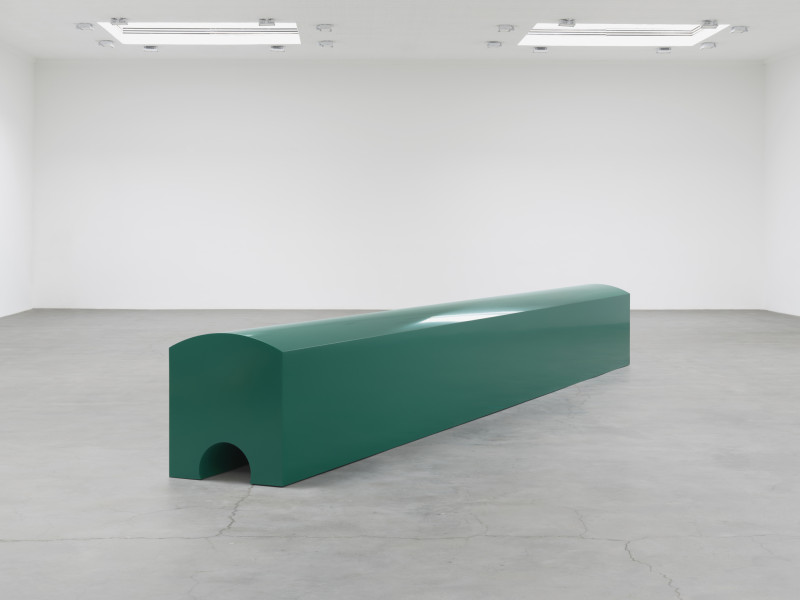
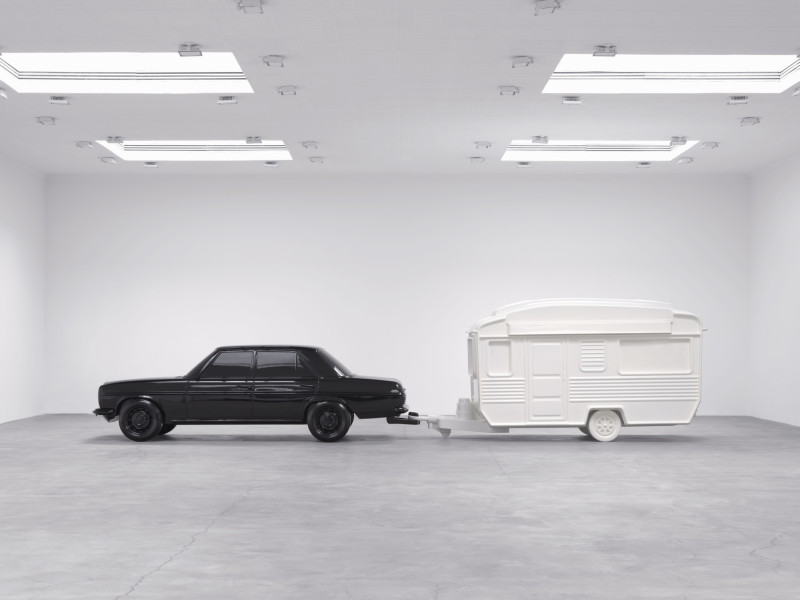
Katharina Fritsch’s exhibition centers on three sculptures derived from models Fritsch made as a student: “Auto und Wohnwagen” (1979/2026), “Tunnel” (1979/2025), and “Schornstein” (1979/2026). Originally displayed together on a standard classroom table, the works appeared less like conventional sculptures than prototypes or showroom miniatures. Their emotional restraint was deliberate. Fritsch has recalled arriving at the academy wanting to create “really strong pictures” at a time when Minimalism and Conceptual art still defined the dominant intellectual climate. Her insistence on image, theatricality, and symbolic immediacy struck many of her contemporaries as almost perversely unfashionable.
That tension remains central to the work today. Fritsch’s sculptures continue to resist easy categorization: they are at once deadpan and uncanny, banal and mythic, materially precise yet psychologically unstable. What has changed is scale. The classroom maquettes have now expanded into immersive sculptural events.
“Auto und Wohnwagen” is perhaps the exhibition’s most startling transformation. Stretching more than thirty feet in length, the work depicts a black car towing a pristine white caravan. Despite its monumental dimensions, the sculpture retains the simplified contours and compressed proportions of a child’s toy. The result is disorienting. What might ordinarily signify leisure, mobility, or postwar middle-class freedom instead feels strangely inert, as though frozen in an existential pause. The polished surfaces intensify the sculpture’s emotional ambiguity: immaculate yet ominous, familiar yet inaccessible.
The work also carries subtle cultural resonances specific to Germany and to Düsseldorf itself, where caravanning culture occupies a peculiar place between bourgeois aspiration and escapist fantasy. The caravan promises mobility while remaining tethered to domesticity; it is both vehicle and home, freedom and enclosure. Fritsch amplifies these contradictions without resolving them. The sculpture’s toy-like origin only deepens the unease, recalling how childhood objects often acquire disproportionate psychic weight in memory.
Nearby, “Tunnel” extends this atmosphere of suspended narrative. Inspired by a toy train set, the dark green structure measures twenty-six feet long and opens into a hollow cavity at either end. It functions simultaneously as minimalist form, architectural fragment, and psychological metaphor. One instinctively wants to peer through it, walk around it, decode its implied destination. Yet the sculpture withholds any narrative payoff. Like much of Fritsch’s work, it stages anticipation without release.
The tunnel has long occupied a symbolic role in modern visual culture: a passage into the unknown, an emblem of industrial progress, a cinematic threshold between realities. Fritsch empties the motif of explicit symbolism while preserving its emotional charge. The sculpture becomes less a representation of a tunnel than a distilled image of transition itself. Its matte industrial color and exaggerated proportions lend it the mute authority of public infrastructure, but its origins in a toy train set prevent it from settling into pure monumentality.
If “Tunnel” suggests passage, “Schornstein” — a towering red chimney cast from a hand-built brick model — evokes industrial memory and vertical aspiration. Rising thirteen feet into the gallery, the sculpture transforms an ordinary architectural appendage into something approaching a ritual object. Chimneys traditionally signify production, labor, and domestic warmth, but Fritsch abstracts the form into an isolated emblem. Detached from any building, the chimney becomes strangely anthropomorphic, almost ceremonial.
This process of estrangement has defined Fritsch’s practice for decades. Whether depicting rats, Madonna figures, flowers, or everyday commodities, she repeatedly selects familiar imagery only to drain it of stable meaning. Her sculptures are never merely Pop appropriations, despite their visual clarity and bold coloration. Instead, they operate through a kind of symbolic overexposure. By enlarging, simplifying, and isolating objects, Fritsch turns them into psychic containers charged with contradictory associations.
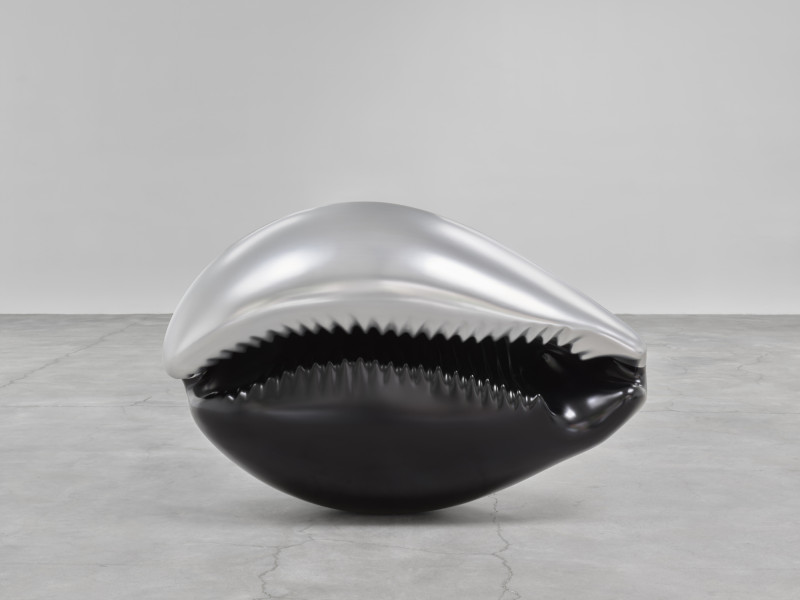
The current exhibition extends this strategy through spatial choreography. Alongside the three early motifs are “Vase” (2006/2024) and “Muschel” (2026), both revisitations of recurring forms from the artist’s earlier work. Installed together, the five sculptures loosely resemble a human face when viewed from above: “Schornstein” and “Vase” serve as eyes, while “Muschel” forms a mouth. This hidden compositional logic introduces another layer of instability. The exhibition oscillates between landscape, showroom, playground, and portrait.
What emerges most powerfully is Fritsch’s enduring belief in the autonomy of images. At a historical moment when much contemporary sculpture leans heavily on research, discourse, and social systems, Fritsch continues to trust the mysterious authority of visual encounter itself. Her sculptures do not explain; they confront. They derive their power from silence, scale, repetition, and estrangement.
There is also something moving about the temporal structure of the exhibition. These works collapse nearly five decades of artistic life into a single spatial experience. The young student who once presented miniature objects on a classroom table now remakes them with the confidence of an internationally celebrated sculptor, yet the essential impulse remains unchanged. Fritsch still pursues what she once called “strong pictures” — images capable of bypassing interpretation and lodging themselves directly in the viewer’s subconscious.
In this sense, the exhibition is less a retrospective gesture than a return to origin. The sculptures suggest that certain images never stop evolving inside an artist’s imagination. They wait, dormant for decades, until scale, context, and time finally allow them to assume their fullest form. For Fritsch, the monumental is not simply a matter of size. It is a method for revealing the latent strangeness already embedded within the ordinary world.
Photo: Katharina Fritsch, Auto und Wohnwagen / Car and Caravan 1979/2026, Vinyl ester resin, stainless steel, aluminum, lacquer, Car: 56⅜ × 193⅜ × 70 inches; 143 × 491 × 178 cm, Caravan: 84⅝ × 173¼ × 74⅞ inches; 215 × 440 × 190 cm, Overall: 84⅝ × 357 × 74⅞ inches; 215 × 907 × 190 cm, © Katharina Fritsch, Courtesy the artist and Matthew Marks Gallery
Info: Matthew Marks Gallery, 522 West 22nd Street, New York, NY, USA, Duration: 7/5-27/6/2026, Days & Hours: Tue-Sat 10:00-18:00, https://matthewmarks.com/