ART CITIES: N.York-Gerhard Richter
One of the most famous artists to emerge from post-war Germany, Gerhard Richter is known for his prolific, varied, and widely influential painting practice. He has explored the intersection of photography and painting, making figurative canvases based on found images and abstractions that incorporate visual effects of photography. Richter often works at a monumental scale and has made glass panels and stained glass windows. Layering and erasure are often critical to his practice.
By Efi Michalarou
Photo: David Zwirner Gallery Archive
“Landschaften” is an exhibition of Gerhard Richter’s celebrated photorealist landscape paintings from the 1960s to the 2000s, which are displayed alongside a considered selection of works from his series of “Abstrakte Bilder” (1976–2017). The exhibition features loans from significant private and museum collections, including paintings that were recently on view in the artist’s acclaimed retrospective at the Fondation Louis Vuitton, Paris, in 2025–2026, as well as works lent from Richter’s personal collection.
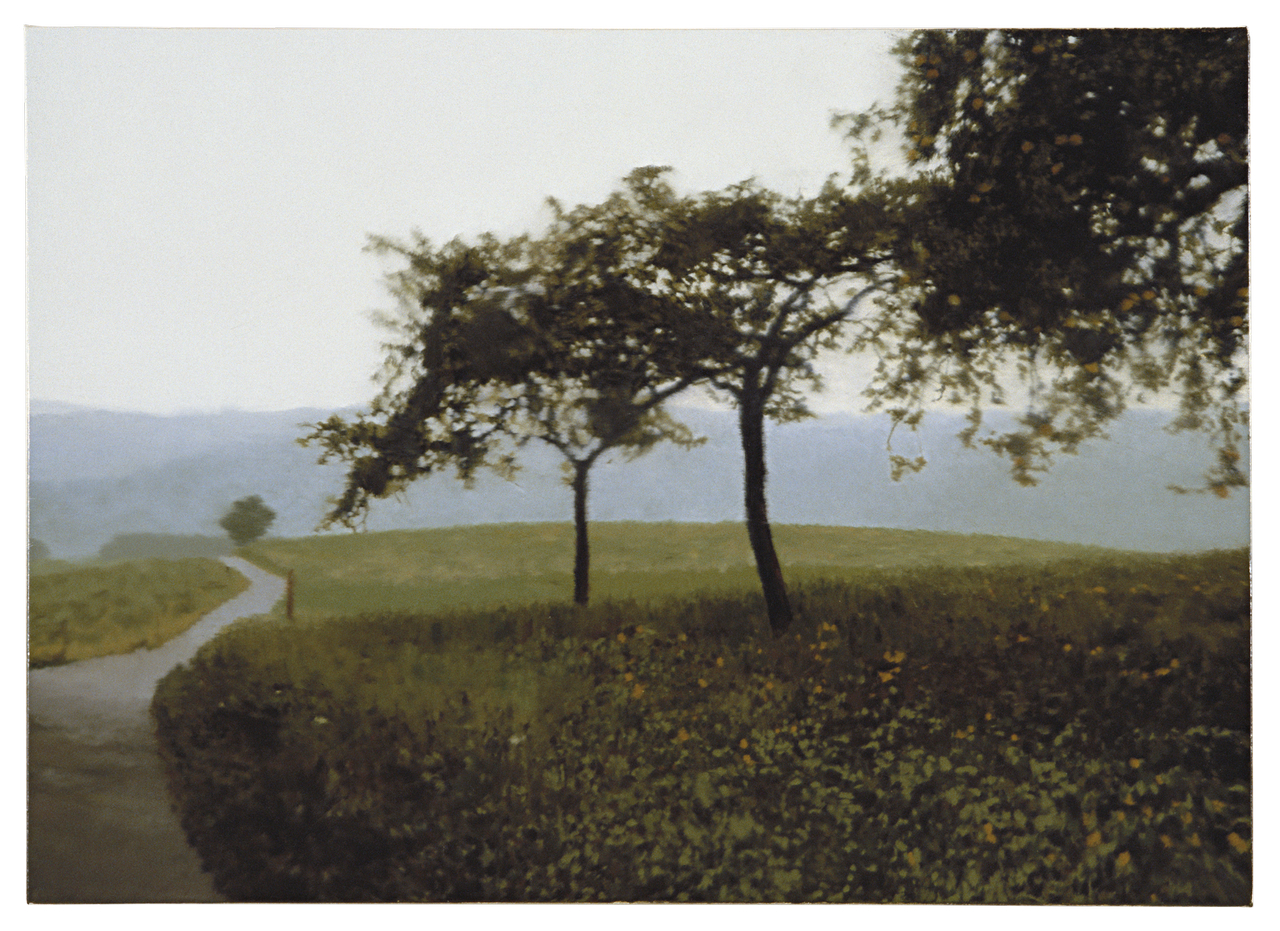
Richter began to engage the subject of landscape almost six decades ago in the late 1960s, creating atmospheric compositions based on snapshots from his travels. These paintings evoke art-historical precedents—particularly the work of Caspar David Friedrich—while eschewing traditional notions of the aesthetic sublime. Over the following years, Richter continued to paint landscapes from photographic sources, often working on them at the same time as his “Abstract Paintings” so that each body of work might inform the underlying pictorial concerns expressed by the other. Displayed in dialogue through a chronological series of rooms each dedicated to a period of the artist’s career, these abstract and representational aspects of Richter’s oeuvre together illustrate his enduring investigation into the nature of images and the perception of reality—how it is personally interpreted, mediated by the external world, and visually portrayed through painting.
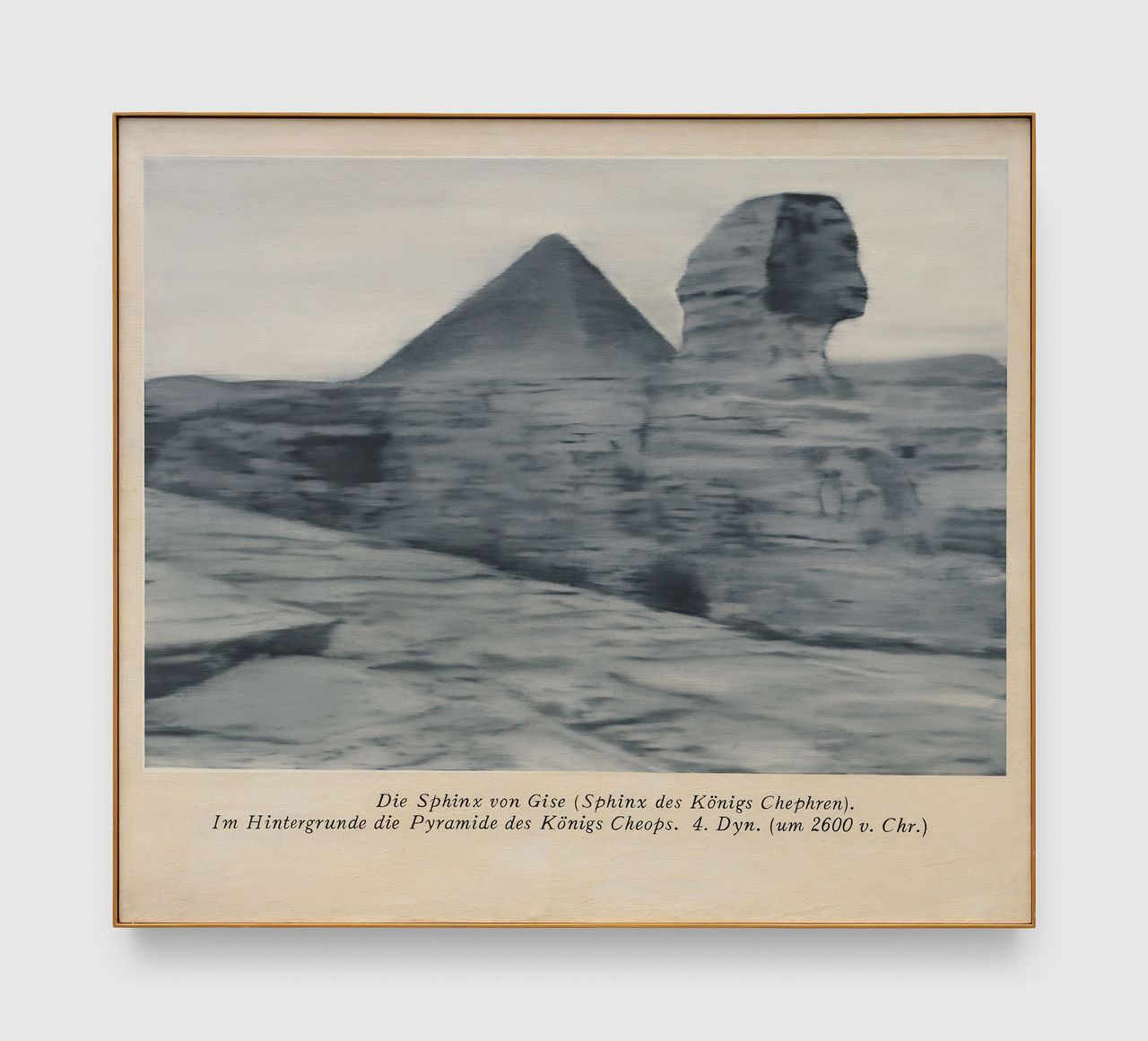
The earliest painting on view, “Grosse Sphinx von Gise” (Great Sphinx of Gizeh, 1965), is part of Richter’s acclaimed series of “Fotobilder” (Photo Paintings), which are largely based on found snapshots, postcards, and media clippings of news events and scenes from everyday life. Depicting a photorealistic black-and-white view of the ancient Egyptian monument accompanied by a written caption, as if excerpted from a book illustration, this painting serves as a kind of proto-landscape; it speaks to the artist’s interrogation of the history of photography and the collection and dissemination of images, as well as his interest in themes of travel—a topic that would similarly inspire his subsequent landscapes and seascapes.
In 1968, following a formative visit to the French island of Corsica, Richter used the photos he had taken on his trip as the basis for a group of large-scale square seascapes showing views of open seas framed by cloudy skies or vast mountain ranges—marking his first in-depth engagement with the genre of landscape. Furthering his conceptual experiments with the iterative translation and interplay of mediums, Richter created some of these paintings—including “Seestück (Gegenlicht)” (Seascape [Contre-jour], 1969), featured in the exhibition—by collaging two photographs of sea and sky and using the resultant composite as a reference for the final work. Atmospheric and evocative, these manipulated landscapes investigate the existence of a subjective visual reality that exceeds the bounds of real-world perception.
Throughout the 1970s, Richter created several series depicting expansive natural views: icebergs, volcanoes, Alpine mountains, and open waters. Whilst sharing a visual affinity with Friedrich’s Romantic depictions of human figures dwarfed by forests and oceans, Richter’s works engender a modernized alteration of reality that is detached from person and place and often blurred to the precipice of unrecognition. These paintings possess a subversive undercurrent, complicating how a landscape—in the artistic and sociopolitical sense—can be visually and culturally understood. Moreover, Richter’s landscapes from this period led to the genesis of his earliest Abstract Paintings, which evolved out of a collage technique in which the artist pieced together painterly layers and shadows from several photographic sources. In Richter’s words, these abstractions served as “fictive models, because they make visible a reality that we can neither see nor describe, but whose existence we can postulate.”2
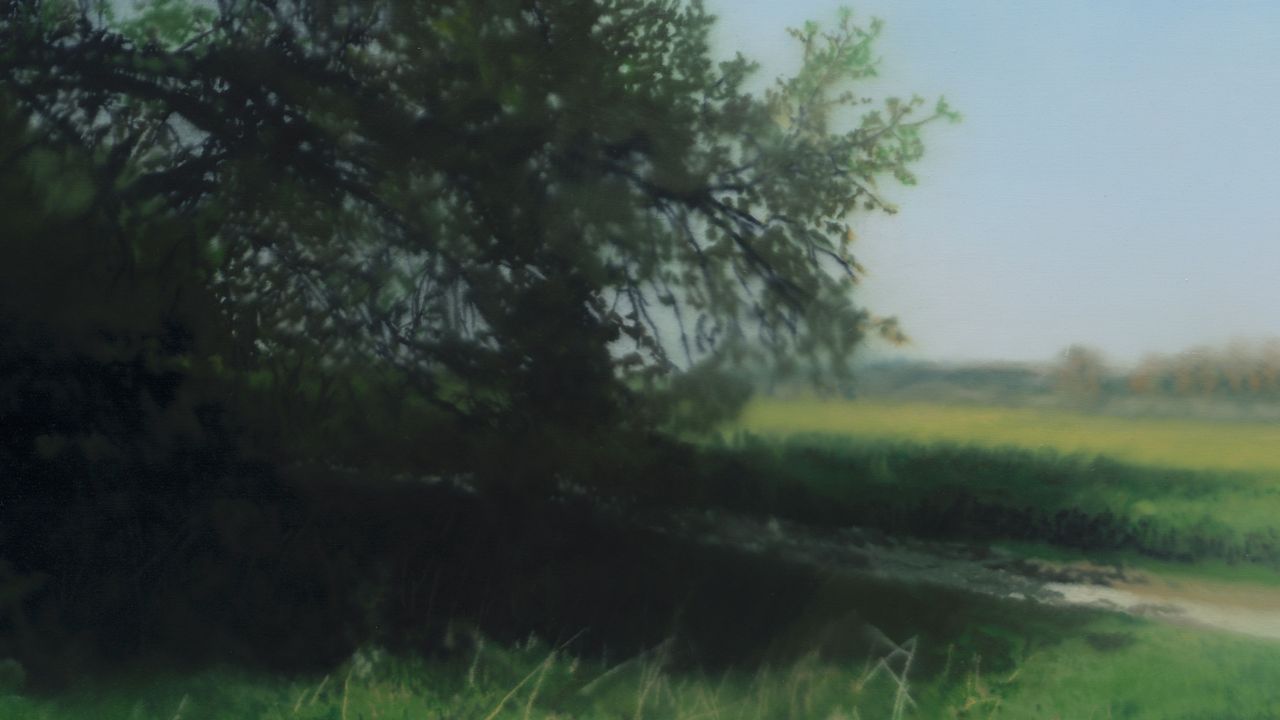
Richter would return to landscapes across the 1980s and 1990s, each time depicting anonymized locations with his signature “sfumato” surface treatment. Paintings such as Lichtung (Clearing, 1987) also see him overlaying scenes of nature with abstract brushstrokes, effectively collapsing these two fundamental pillars of his oeuvre in a single canvas. At the same time, Richter began titling some of his “Abstract Paintings” after real-world objects, including “Fenster” (Window, 1985) and “Wolken” (Clouds, 1982), further playing on what he identifies as the viewer’s inherent desire to read into abstraction and create a personal understanding of the marks made therein.
Photo: Gerhard Richter, Buche (Beech Tree), 1987 (detail). © Gerhard Richter 2026, Courtesy the artist and David Zwirner Gallery
Info: Curators: David Zwirner and David Leiber, David Zwirner Gallery, 537 West 20th Street, New York, NY, USA, Duration: 7/5-10/7/2026, Days & Hours: Tue-Sat 10:00-18:00, www.davidzwirner.com/