PRESENTATION: Rebecca-Horn Emotion in Motion
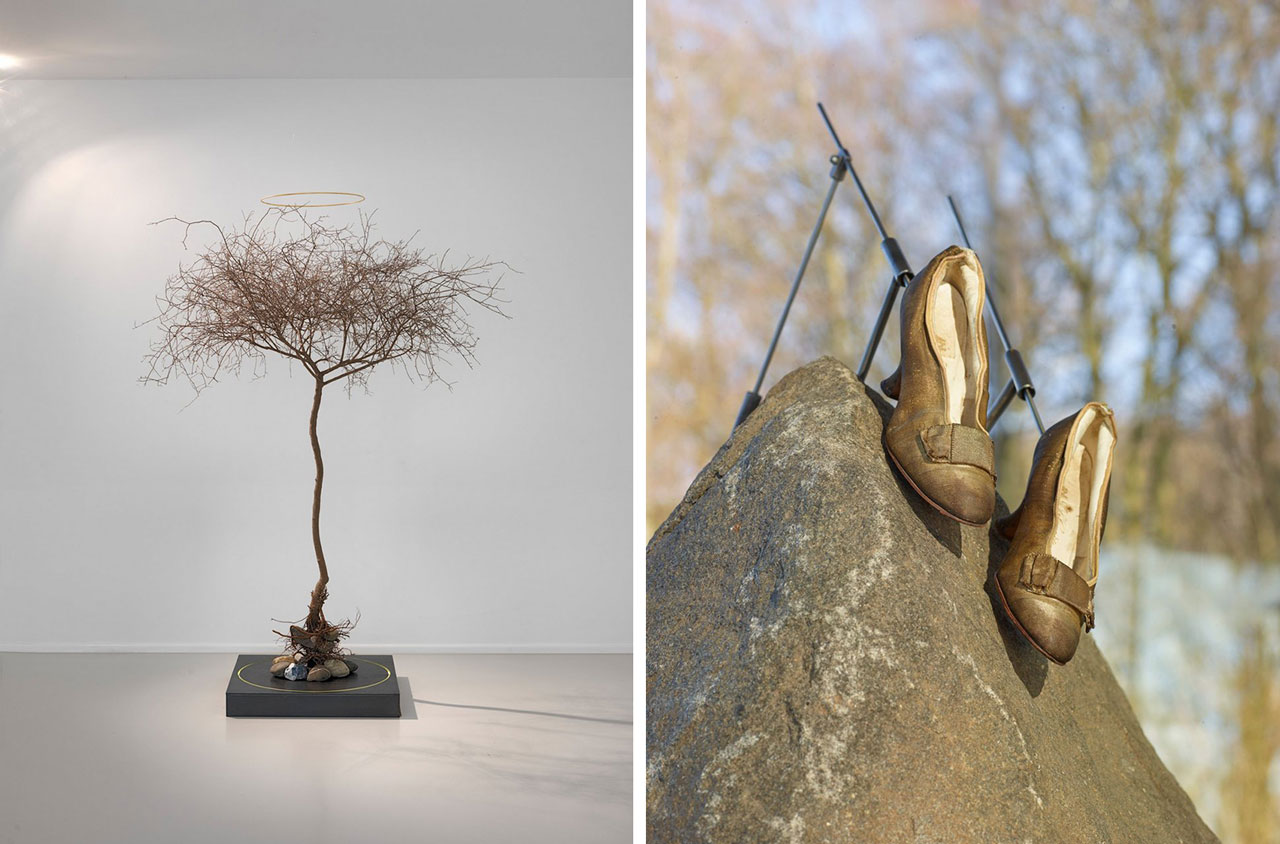
In 2026, the grounds of Skulpturenpark Waldfrieden becomes the stage for an exhibition that is less a retrospective than a living system: “Emotion in Motion”, dedicated to Rebecca Horn. Organized in collaboration with the Moontower Foundation, the exhibition unfolds across architecture, landscape, and machine-time, offering not a static archive but a continuously activating field of forces. It is an exhibition that insists on duration, on encounter, and above all, on movement as a primary condition of meaning.
By Efi Michalarou
Photo: Skulpturenpark Waldfrieden Archive
Any serious reading of Rebecca Horn’s later kinetic environments must begin with the body—not metaphorically, but materially. In the late 1960s and early 1970s, Horn’s early works—body extensions such as “Finger Gloves” and “Pencil Mask”—emerged from a period of physical vulnerability and isolation. These wearable sculptures were not simply performative props; they were prosthetic propositions. They redefined the body as something elastic, extendable, and fundamentally unstable.
This foundational logic persists in “Emotion in Motion”, though the body is no longer visibly present. Instead, it is displaced into apparatus. Mechanical arms extend where human limbs once strained. Feathers flutter without breath. Violins play without musicians. The human figure is both absent and omnipresent—distributed into systems of motion that echo physiological rhythms: pulse, tremor, hesitation, repetition.
Horn’s machines, therefore, should not be read as autonomous objects but as afterimages of the body. They retain a kind of phantom corporeality, a memory of touch and constraint embedded within their mechanisms.
Installed across the pavilions and the Villa Waldfrieden, “Emotion in Motion” resists linear curatorial narrative. Instead, it operates choreographically. Each room functions like a temporal chamber, governed by cycles of activation and rest. Works start, stop, repeat—sometimes predictably, sometimes with subtle irregularity.
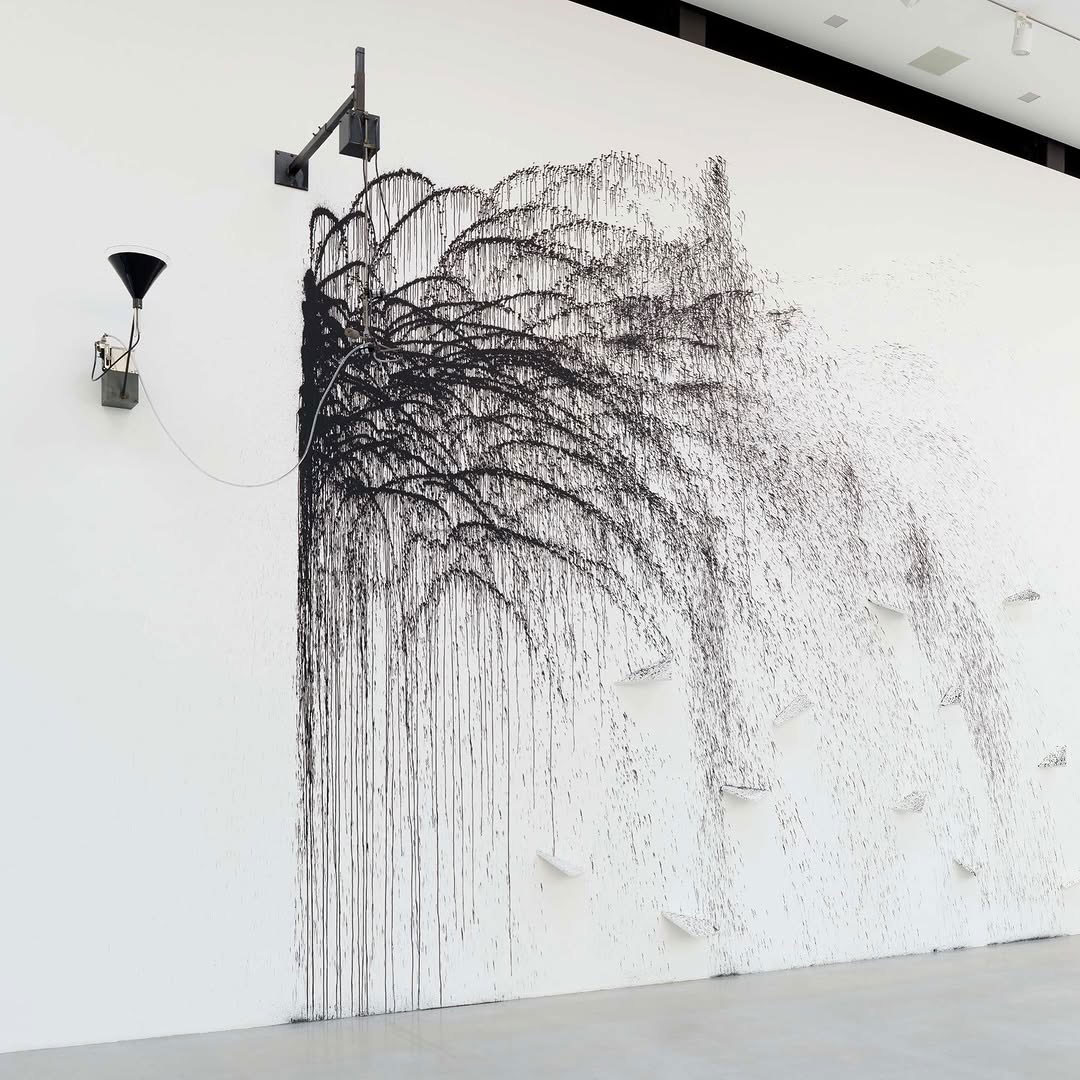
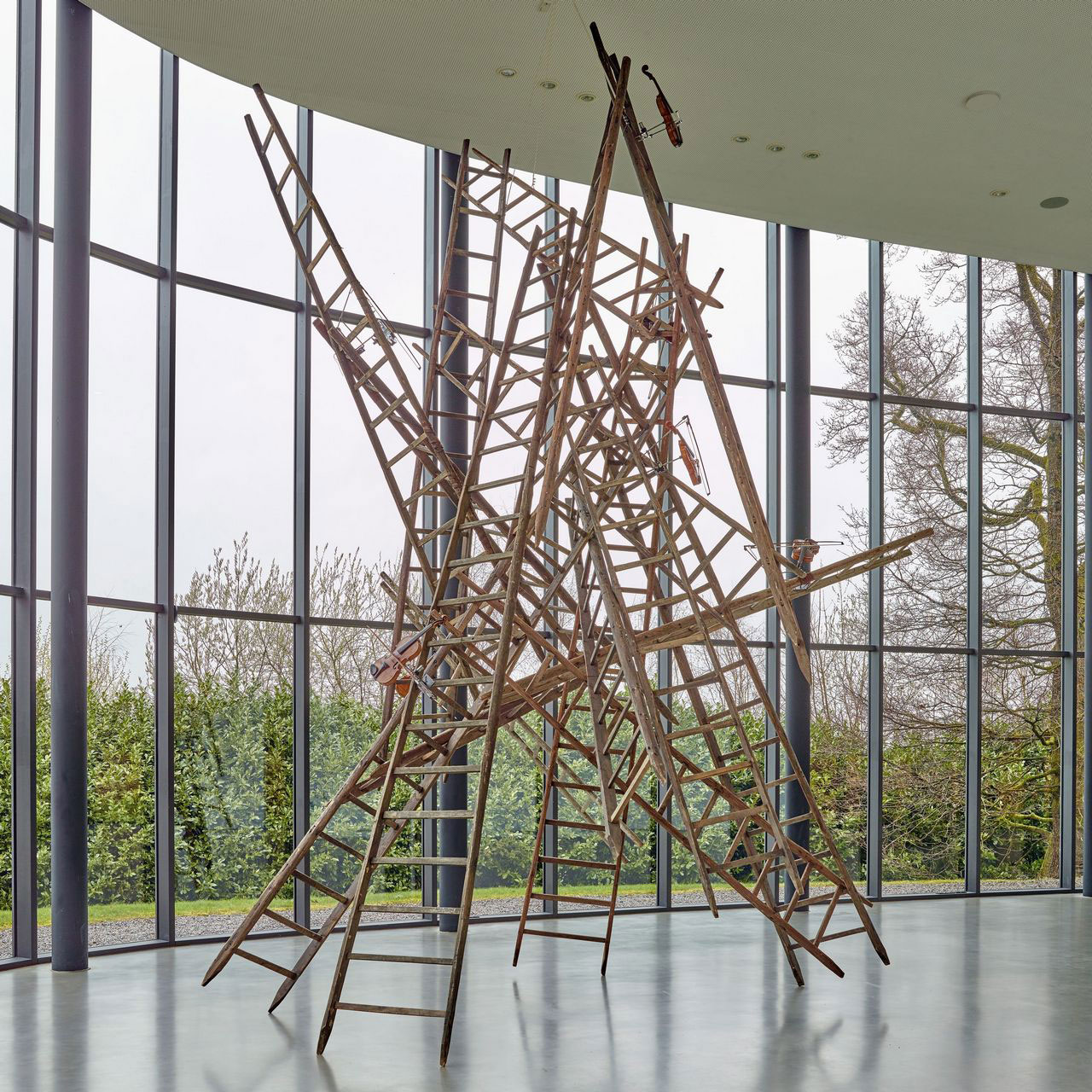
These works include the installation “Tower of the Nameless”, which Horn created in 1994 as a site-specific response to the war in Yugoslavia in a Viennese stairwell: The artist erected a tower of fruit ladders featuring motorised violins, which referenced the violin music played by refugees in the doorways and underground tunnels of Vienna, and invited these people to contribute their violin playing to the installation. “The Prussian Bride Machine” (1988), one of Horn’s painting machines, which illustrates her connection to Surrealism and the readymade.
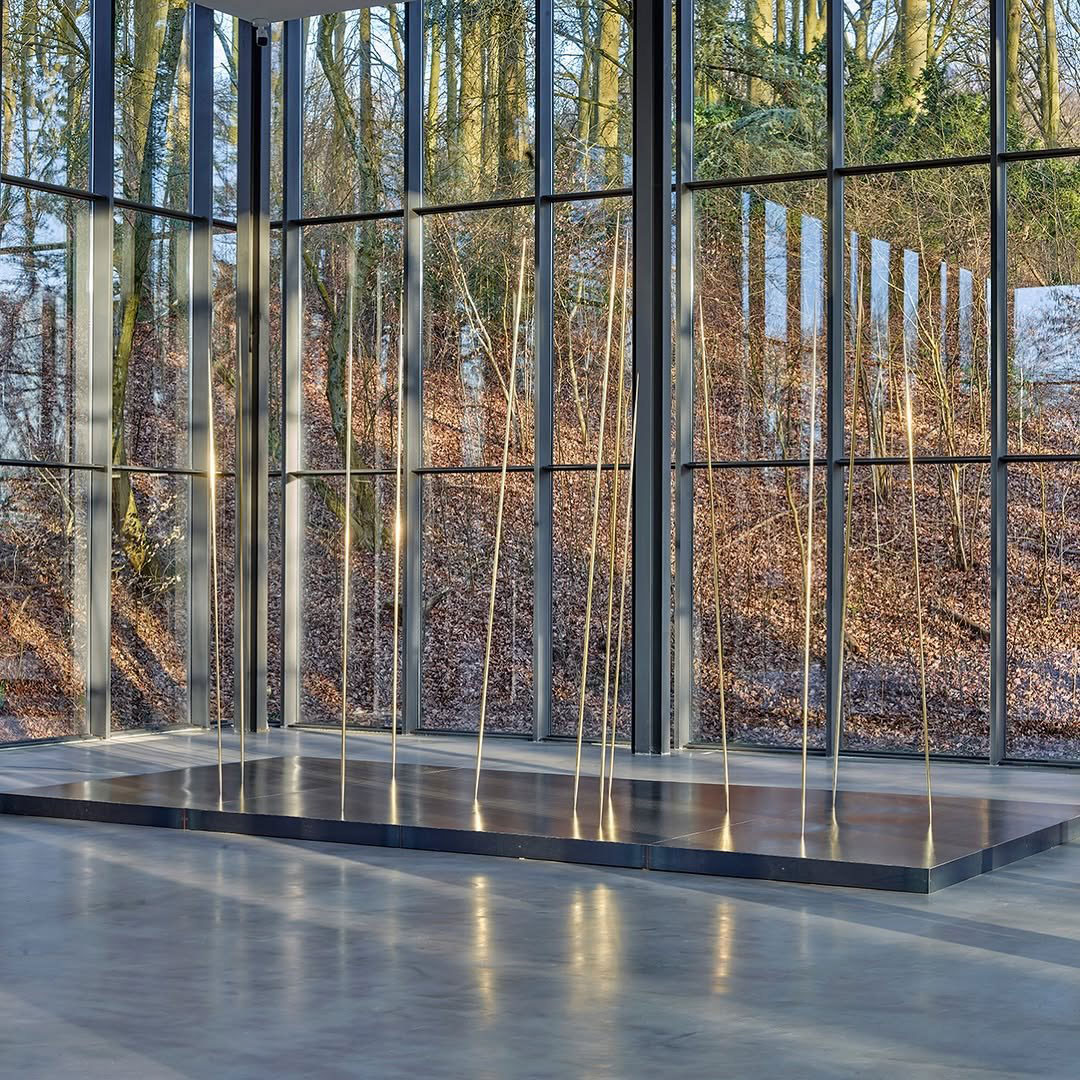
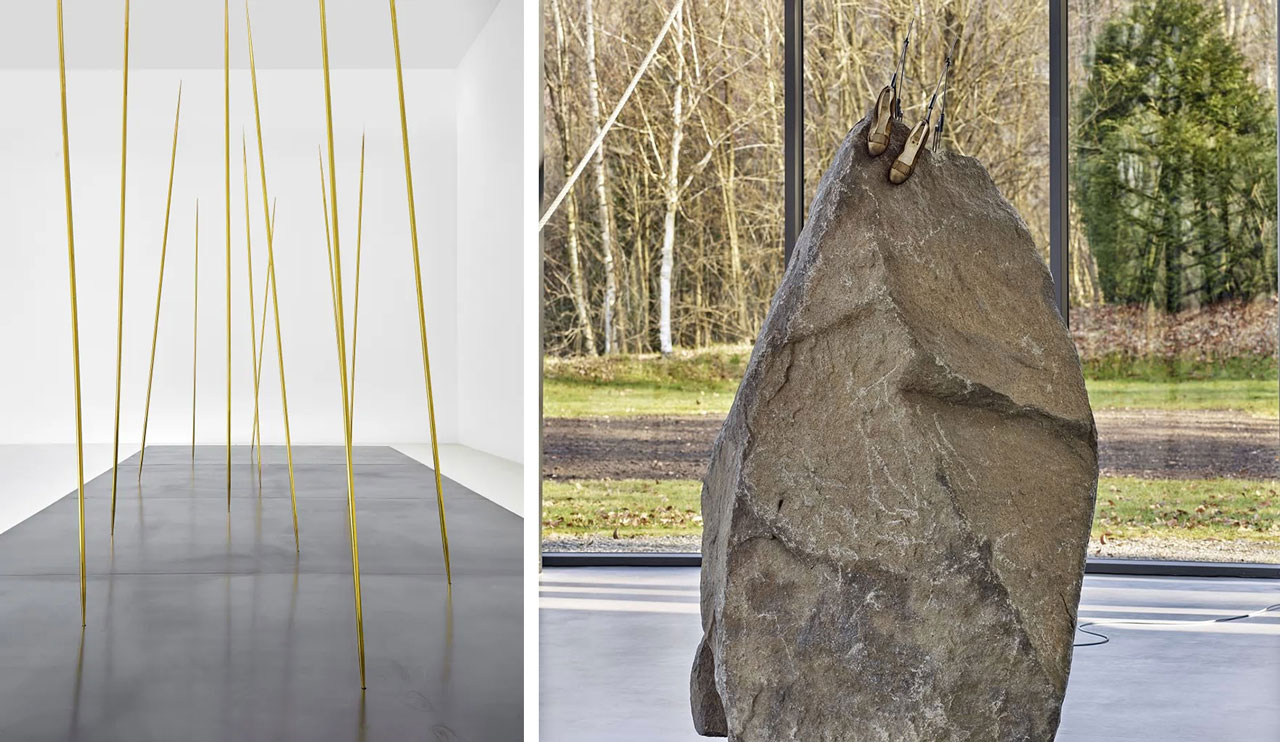
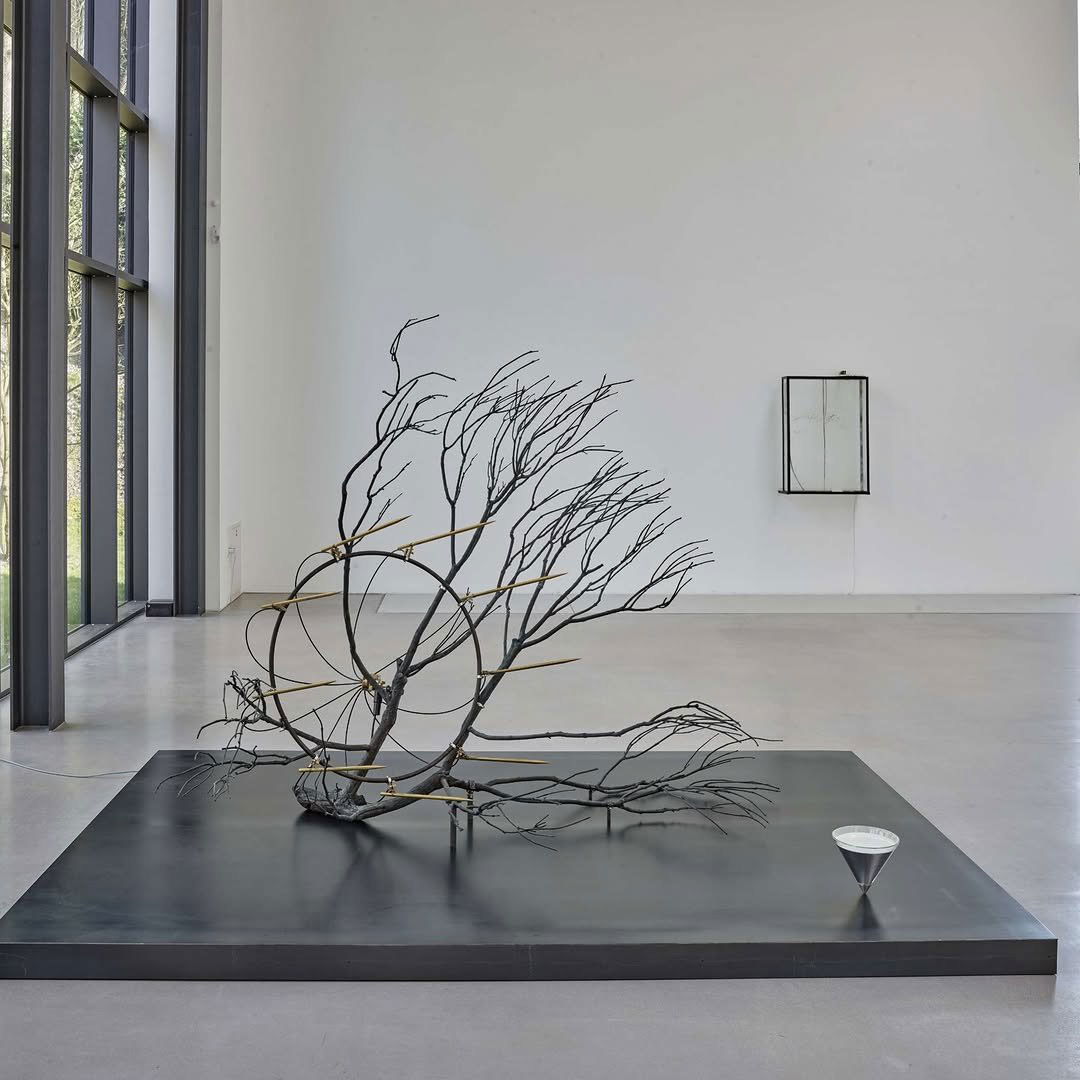
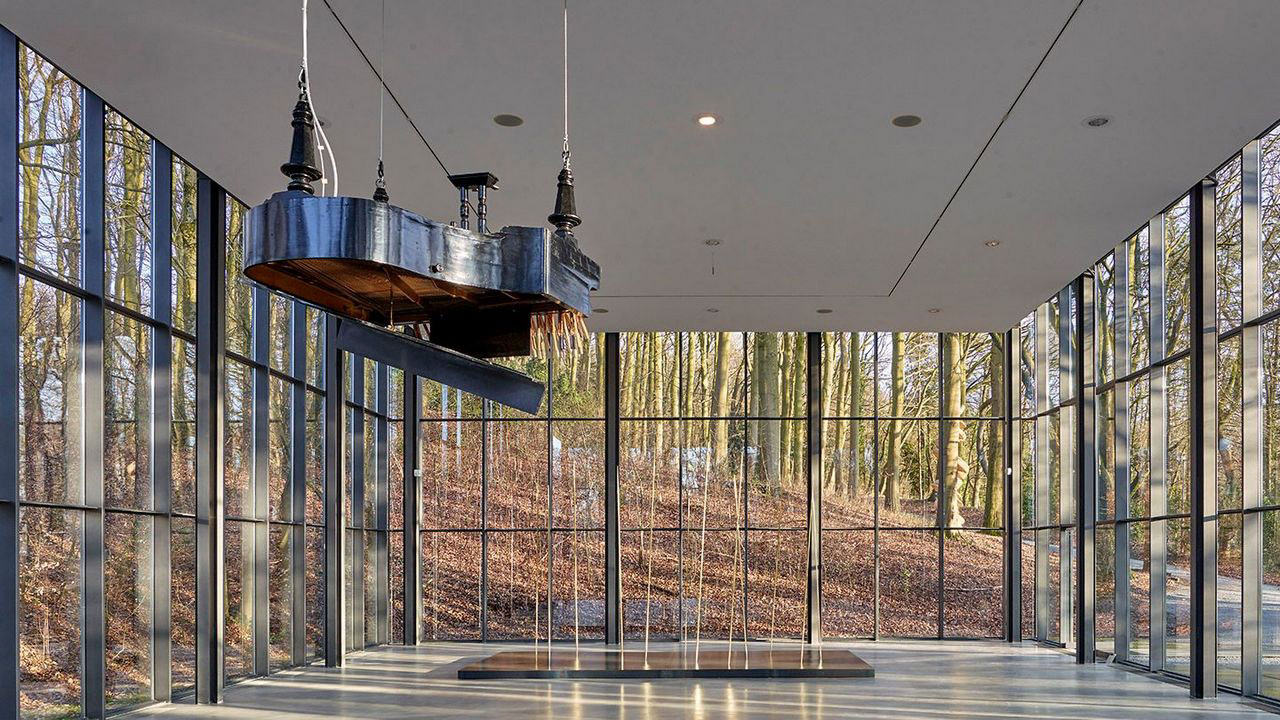
Also on display is the installation “Concert of Anarchy” (2006), a concert grand piano hanging upside down from the ceiling, whose keyboard falls noisily out of the body of the instrument via the mechanics of pneumatic cylinders and is subsequently locked back inside it. Also on display is a kinetic floor sculpture from Horn’s latest series, “Breathing Bodies” (2017), whose tapered brass rods rotate almost imperceptibly in varying directions. Another “Painting Machine” (1999) rhythmically sprays black ink across the entire surface of a wall, creating a gestural image. The installation is accompanied by objects that explore the tension between aggression and tenderness, such as the kinetic sculpture Kiss of the Rhinoceros (1989), in which a flashing spark of light is generated when two arcs with metallic rhinoceros tips come together.
This curatorial strategy aligns Horn with a lineage that includes not only sculptors but choreographers such as Pina Bausch, whose own work in Wuppertal transformed gesture into emotional architecture. Like Bausch, Horn treats movement not as decoration but as structure. The visitor does not simply view the work; they enter into its temporal logic.
A key aspect of this choreography is anticipation. Many of Horn’s installations remain still for extended periods before suddenly activating. This delay produces a heightened perceptual state: viewers become attuned to minute shifts—sounds, vibrations, mechanical cues. When motion finally occurs, it carries an affective charge disproportionate to its physical scale.
Sound is not ancillary in Horn’s work; it is constitutive. Mechanical actions generate acoustic environments that oscillate between music and noise. In pieces where bows strike violin strings or metal arms collide rhythmically, the resulting tones evoke both composition and accident.
This sonic ambiguity situates Horn within a broader experimental tradition that includes figures like John Cage, whose embrace of chance operations and ambient sound redefined musical authorship. Yet Horn’s approach diverges in one crucial respect: her sounds are always tied to physical gesture. They are not abstract events but the audible trace of movement.
The effect is often uncanny. Machines appear to “listen” to themselves, adjusting rhythm and intensity in ways that suggest responsiveness. Of course, this is an illusion—yet it is precisely this ambiguity that gives the work its emotional force. The viewer oscillates between recognizing mechanical determinism and projecting sentience onto the object.
Horn’s material vocabulary is both consistent and unstable. Feathers, for instance, recur across decades—sometimes as symbols of flight and transcendence, other times as markers of fragility or loss. Mirrors introduce self-reflection but also fragmentation. Ladders imply ascent yet often lead nowhere.
In “Emotion in Motion”, these motifs are not presented as fixed symbols but as dynamic signifiers. Their meaning shifts depending on context, motion, and interaction with other elements. A feather brushing against a surface may evoke tenderness in one moment, abrasion in another.
This fluid semiotics aligns Horn with the legacy of Joseph Beuys, whose use of materials like felt and fat carried layered symbolic and political meanings. However, Horn departs from Beuys in her emphasis on mechanical activation. Her materials do not simply signify; they perform.
One of the most compelling aspects of the exhibition is its treatment of time. Horn’s works rarely unfold linearly. Instead, they operate in loops—cycles of repetition that evoke ritualistic behavior. This repetition is not monotonous; it is subtly variable, producing micro-differences that accumulate over time.
From a theoretical perspective, this aligns with ideas of temporal recursion found in both performance studies and systems theory. Each cycle is identical in structure yet distinct in execution. The viewer, encountering these repetitions, becomes aware of time not as a continuous flow but as a series of discrete events.
This temporal structure also introduces a psychological dimension. Repetition can soothe, but it can also unsettle. In Horn’s installations, it often does both simultaneously—creating a tension between familiarity and unpredictability.
Unlike conventional museum retrospectives, “Emotion in Motion” integrates the surrounding landscape of Skulpturenpark Waldfrieden into its conceptual framework. The park’s topography—its slopes, trees, and open spaces—acts as an extension of the installations.
Natural movement—wind through leaves, shifting light—interacts with mechanical motion, blurring the boundary between organic and artificial systems. This dialogue reinforces one of Horn’s central concerns: the permeability between nature and technology.
In this context, the exhibition can be understood as an ecosystem of motion, where human-made and natural processes coexist and intersect. The machines do not dominate the environment; they participate in it.
Viewed through a contemporary lens, Horn’s work resonates strongly with posthuman discourse. Her displacement of the human body into mechanical systems anticipates current debates around artificial intelligence, robotics, and the decentering of human agency.
However, Horn’s approach is neither celebratory nor dystopian. She does not present machines as replacements for humans, nor as threats. Instead, she explores a more ambiguous terrain: a space where boundaries blur, where agency is distributed, and where emotion emerges from interaction rather than origin.
This perspective positions Horn as a precursor to many current artistic practices that engage with hybrid systems—combinations of biological, mechanical, and digital processes.
Rebecca Horn’s influence is both far-reaching and difficult to categorize. She occupies a unique position at the intersection of performance art, kinetic sculpture, installation, and film. Her participation in major exhibitions such as documenta 5 marked her early recognition, while later retrospectives at institutions like the Solomon R. Guggenheim Museum solidified her international stature.
Yet “Emotion in Motion” suggests that her legacy cannot be contained within institutional frameworks alone. It persists in movement—in the continued activation of her works, in the influence they exert on younger generations, and in the questions they pose about embodiment, technology, and affect.
What “Emotion in Motion” ultimately proposes is not just an aesthetic experience but an epistemological shift. It asks us to reconsider how knowledge—particularly emotional knowledge—is produced and transmitted.
In Horn’s universe, understanding does not arise from observation alone. It emerges through temporal engagement, through the act of waiting, watching, and experiencing motion as it unfolds. Her machines do not communicate through language; they articulate through rhythm, tension, and release.
To encounter this exhibition is to enter a system where emotion is not represented but enacted—where meaning is not fixed or static but continuously generated through movement. It is, in the most precise sense, a language without words: a kinetic poetics that continues to unfold long after the viewer has left the space.
Photo: Rebecca Horn, Exhibition view “Emotion in Motion”, Skulpturenpark Waldfrieden- Wuppertal, 2026, Courtesy Skulpturenpark Waldfrieden
Info: Skulpturenpark Waldfrieden, Hirschstraße 12, Wuppertal, Germany, Duration: 14/3-30/8/2026, Days & Hours: Tue-Sun 11:00-18:00, https://skulpturenpark-waldfrieden.de/