PRESENTATION: Helen Frankenthaler-The Moment and the Distance
In an era when abstraction was being redefined, Helen Frankenthaler forged a language of color that felt both spontaneous and exacting. The Moment and the Distance revisits this achievement through monumental canvases that unfold across decades. The exhibition reveals not just stylistic evolution, but a sustained inquiry into how painting can hold immediacy and reflection in a single, expansive field.
By Efi Michalarou
Photo: Gagosian Archive
The exhibition “The Moment and the Distance” presents a substantial and carefully structured survey of Helen Frankenthaler’s work from 1960 to 1992. Organized in collaboration with the Helen Frankenthaler Foundation, the exhibition assembles over twenty large-scale paintings, emphasizing the ambition and technical innovation that define her mature practice. Rather than merely cataloguing a career, it constructs a narrative of transformation, organized decade by decade, where each period reveals a recalibration of method, material, and visual logic.
The title originates from a 1975 essay by Barbara Guest, whose description of Frankenthaler’s work captures its defining paradox: the coexistence of freedom and restraint, excess and discipline. This dialectic operates not only at the level of gesture but also within the spatial and chromatic architecture of the paintings. The exhibition makes this tension visible by foregrounding works whose scale intensifies the viewer’s physical and perceptual engagement. Color becomes immersive, gesture becomes environmental, and composition unfolds as a temporal experience rather than a fixed image.
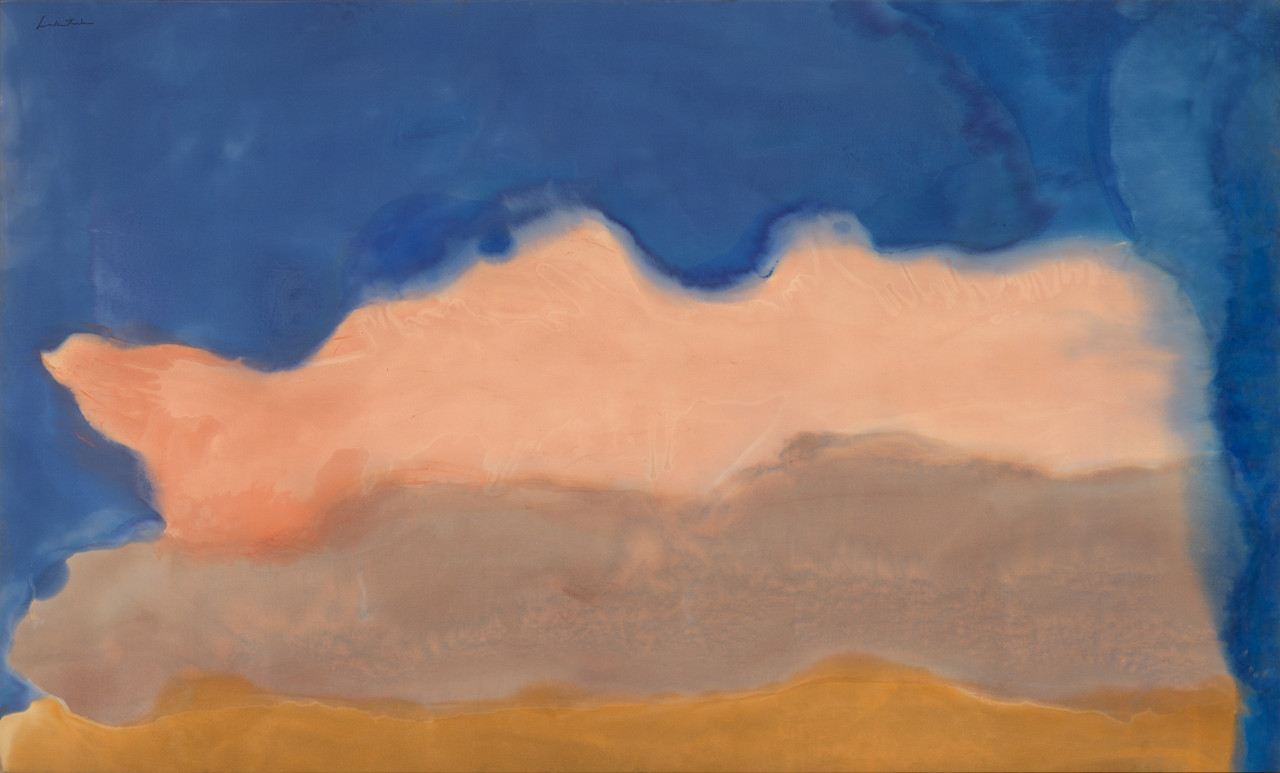
A foundational example is “Provincetown I” (1961), which demonstrates Frankenthaler’s pioneering soak-stain technique. By applying diluted oil paint directly onto unprimed canvas, she allowed pigment to seep into the fabric, effectively merging medium and support. The result is a surface that resists traditional distinctions between drawing and painting, where lines appear to hover while color saturates and dissolves boundaries. This approach, initially radical, would prove highly influential for subsequent developments in postwar abstraction.
The transition to acrylic paint in the late 1960s marks a significant technical and aesthetic shift. Acrylic’s faster drying time and greater chromatic clarity enabled Frankenthaler to construct compositions with more sharply defined edges and expansive color planes. In “Mornings” (1971), cascading bands of yellow, buff, and white descend across the canvas, interrupted by delicate linear elements drawn in black marker. Similarly, “Thanksgiving” (1972) juxtaposes biomorphic forms in a precarious equilibrium, suggesting an underlying compositional rigor that counterbalances the apparent spontaneity of the painted forms.
Frankenthaler’s engagement with art history is neither incidental nor derivative; it operates as a process of translation and reinvention. In “Auguste” (1977), she references the sensuous palette and tactile brushwork of Auguste Renoir, yet transforms these qualities into an abstract syntax of loosely structured marks. The painting does not imitate Impressionism but distills its sensibility into a new formal language, demonstrating her capacity to absorb historical influence while maintaining a distinct visual identity.
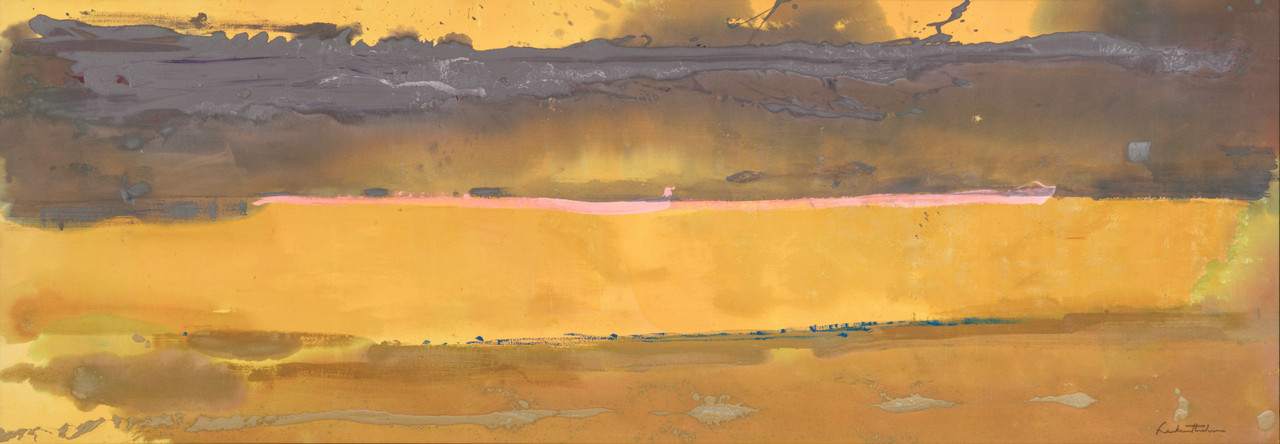
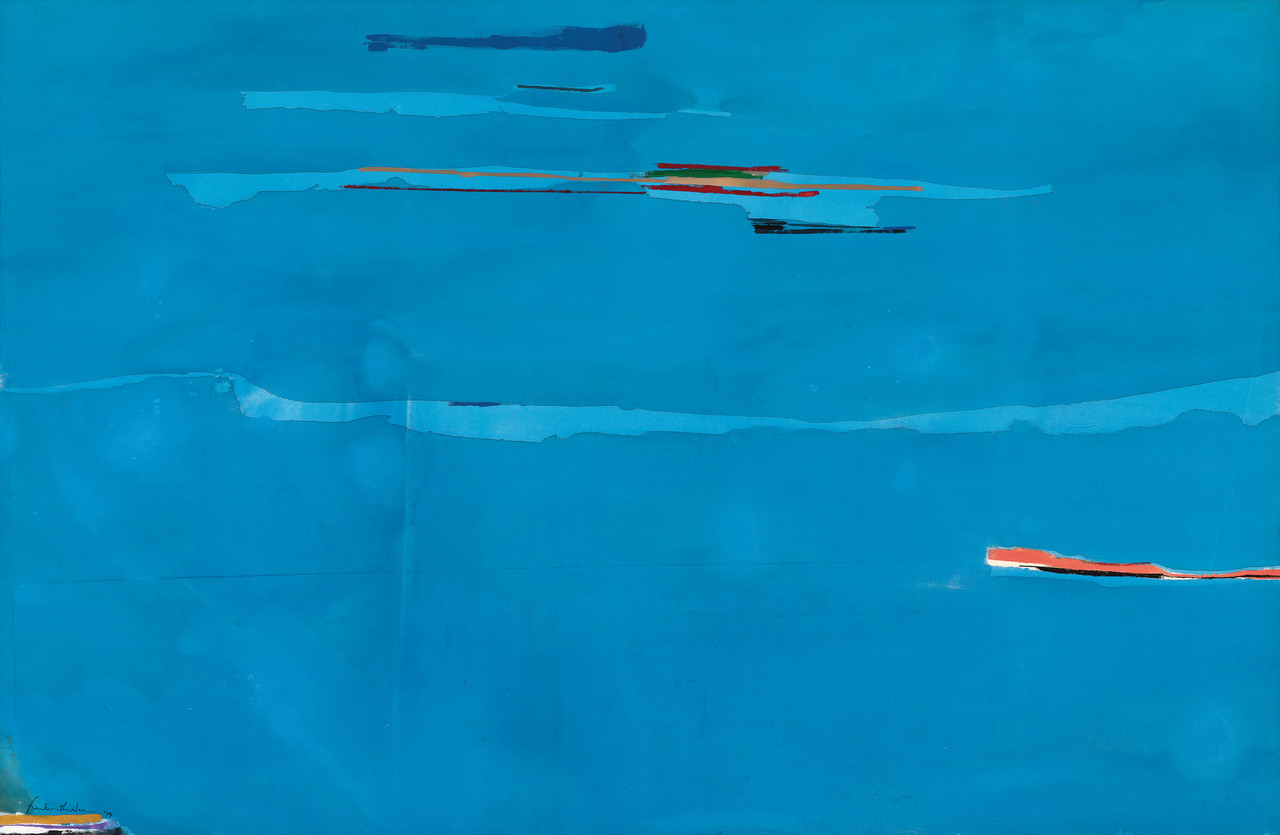
Landscape remains a persistent, though often indirect, presence throughout her work. Paintings such as “Ocean Drive West #1” (1974) and “Shippan October “(1981) evoke coastal environments through horizontal structuring and subtle chromatic shifts. These works are less representations of place than evocations of atmosphere—translations of light, movement, and spatial depth into abstract form. The reference to her studio at Shippan Point underscores the extent to which lived environment informs her visual vocabulary, even when the imagery remains non-representational.
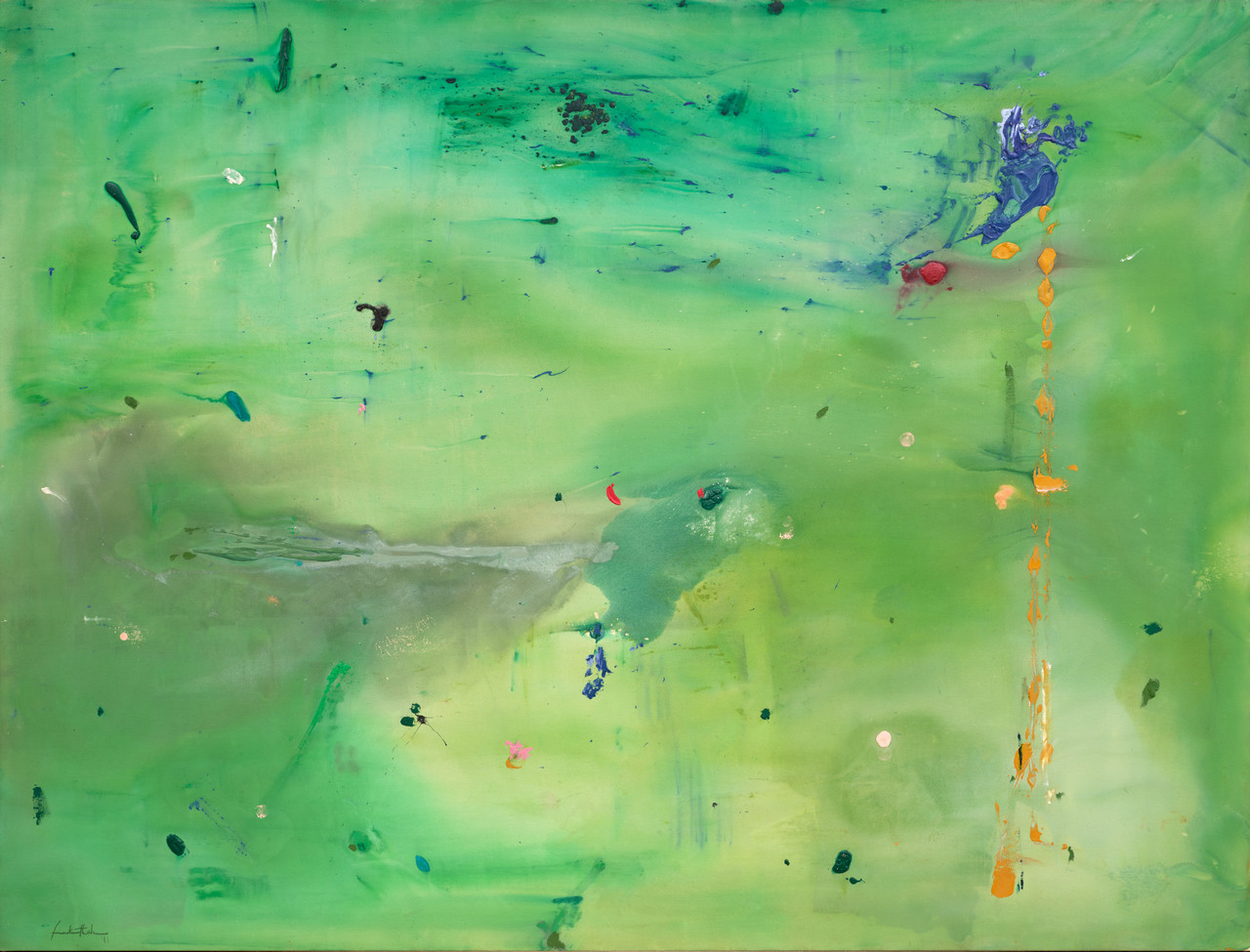
In later works, Frankenthaler’s exploration of material and form becomes increasingly complex. “A Green Thought in a Green Shade” (1981) exemplifies her interest in layering translucent washes with more opaque passages, creating surfaces that oscillate between depth and flatness. In “Janus” (1990), mirrored accumulations of gray tones confront one another at the center of the composition, framed by bursts of saturated color and diffused, almost vaporous textures. These paintings suggest an introspective dimension, where abstraction becomes a vehicle for exploring internal states as much as external perception.
Frankenthaler once described her paintings as “inner amorphous worlds… exploding on the surface,” a statement that resonates across the exhibition. The works on view reveal a sustained commitment to experimentation—each decade introducing new techniques, compositional strategies, and chromatic relationships. Yet this constant evolution does not fragment her practice; instead, it reinforces a coherent investigation into the expressive potential of color, gesture, and space.
Positioned within the broader trajectory of Abstract Expressionism and its aftermath, Frankenthaler emerges as both a bridge and a catalyst. Her innovations contributed significantly to the development of Color Field painting, while her emphasis on process and materiality continues to inform contemporary practices.
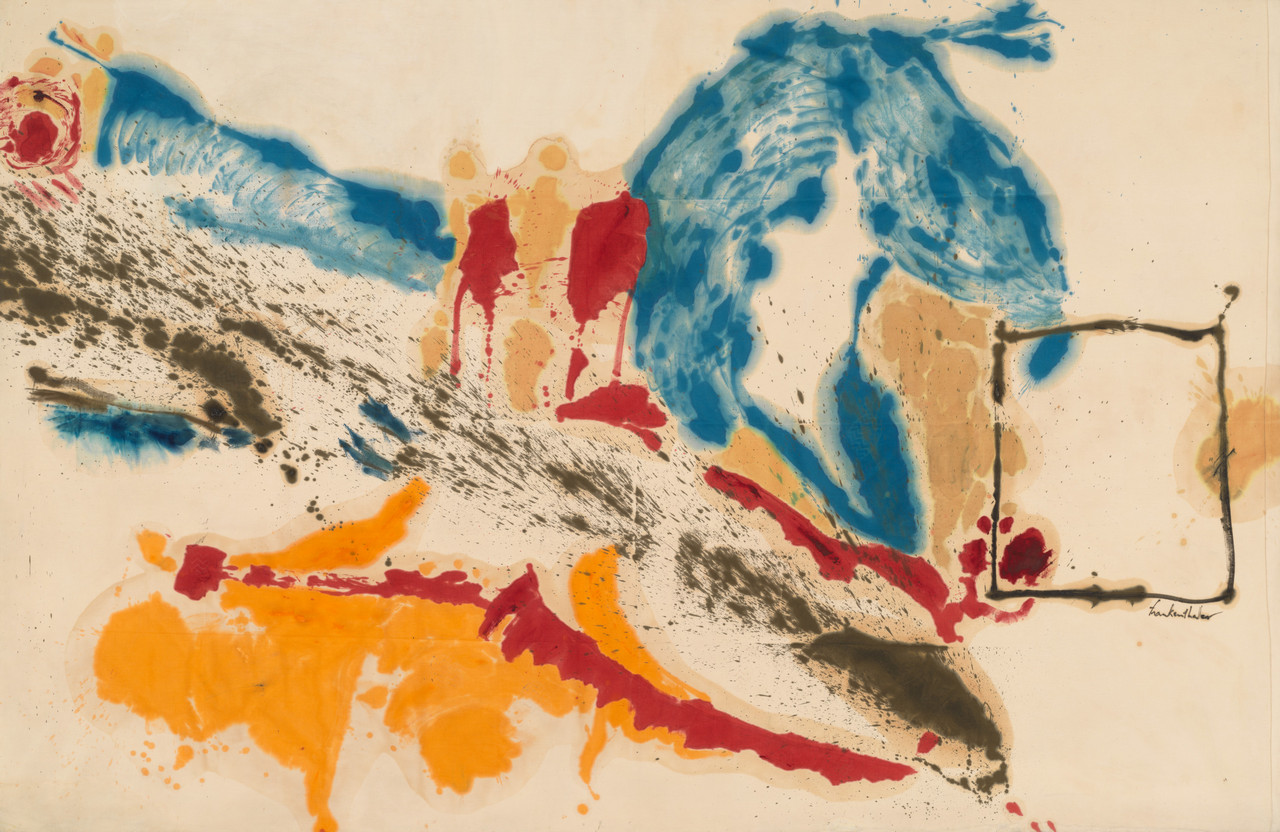
Photo: Helen Frankenthaler, Alassio, 1960, Oil on linen, 85 1/4 x 131 inches (216.5 x 332.7 cm), © 2026 Helen Frankenthaler Foundation, Inc./Artists Rights Society (ARS), New York, Photo: Rob McKeever, Courtesy Gagosian
Info: Gagosain, 522 West 21st Street, New York, NY, USA, Duration: 30/4-2/7/2026, Days & Hours: Tue-Sat 10:00-18:00, https://gagosian.com/