
ART CITIES: Vienna-Liesl Raff
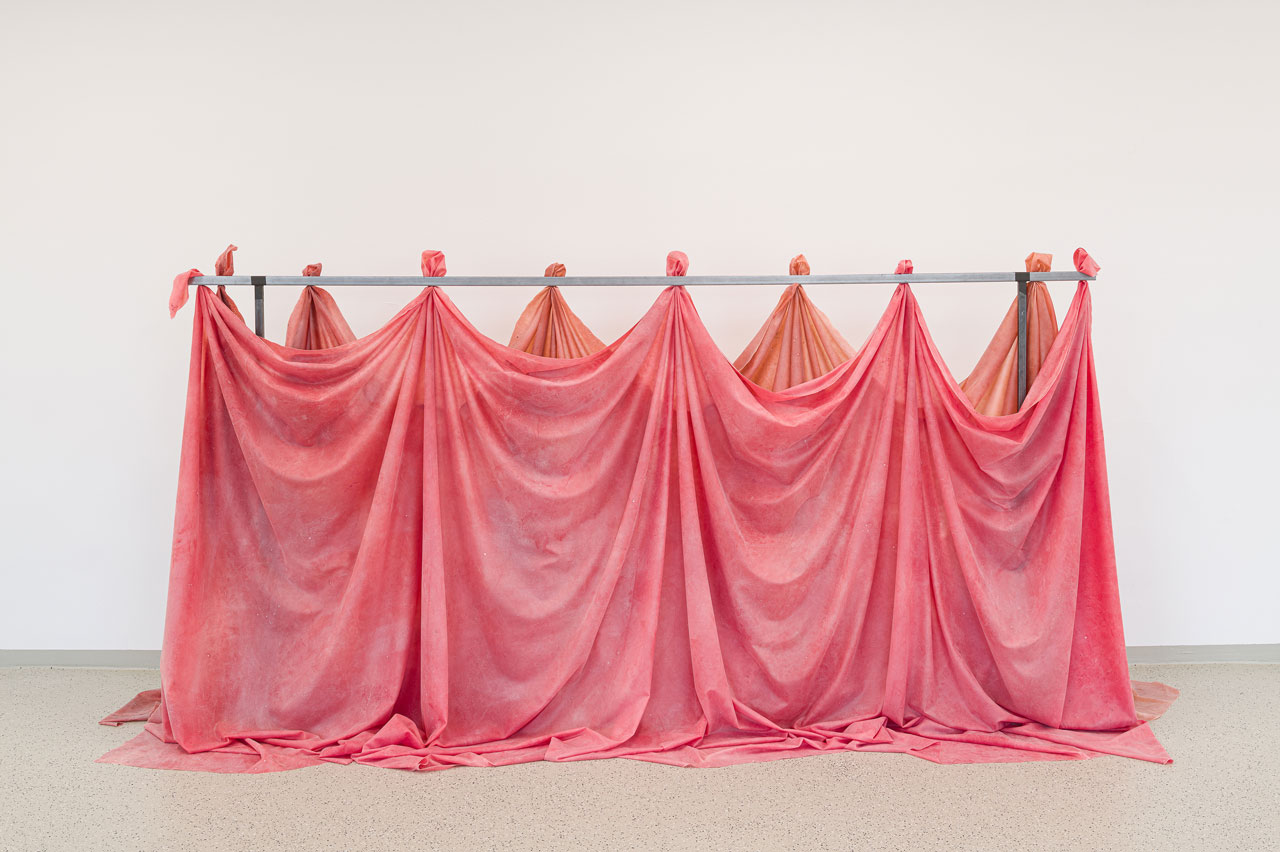
Liesl Raff’s sculptures explore the nuances of physical and social interactions through a profound appreciation of diverse materials and persistent experimentation. Her work features a semiotics of materials that begins where words fail. She has used natural rubber to showcase its adaptable and shape-shifting properties.
By Dimitris Lempesis
Photo: Galerie Eva Presenhuber Archive
Liesl Raff’s latest exhibition, “Wallpapers, Gathers and Mirages, presents a rigorous and highly controlled re-articulation of the core principles that have defined her practice in recent years. Rather than expanding outward into new conceptual territory, Raff turns inward, consolidating her formal vocabulary into what reads as a spatial “model case”—a distilled environment in which materials, processes, and social propositions are tested with precision.
At first glance, the exhibition title might suggest a loose taxonomy of works. Yet this would be misleading. The pluralization (Wallpapers, Gathers, Mirages) functions less as a list and more as a system of interdependent operations. Each term signals a mode of spatial and social engagement, and together they construct a grammar through which the exhibition unfolds. Crucially, the “space” invoked here is not an abstract curatorial framework but the literal architecture of the gallery itself. Raff intervenes directly in its cascading sequence of rooms, restructuring them into a tightly orchestrated progression that foregrounds spatial assignment over conceptual ambiguity.
At the center of this system lies the notion of “Gathers”. Understood both as a material process—folding, accumulating, assembling—and as a social metaphor, it encapsulates Raff’s long-standing interest in co-production and collective formation. However, a notable shift occurs in this exhibition: where earlier works positioned social interaction as something emergent or indirectly catalyzed, here the dynamics of engagement are more explicitly directed toward the viewer. The exhibition no longer merely stages conditions for possible action; it actively scripts modes of encounter.
This shift is reinforced by the intimate zoning of the gallery rooms. Each space operates with a heightened sense of address, guiding the viewer through a sequence of encounters that are at once immediate and performative. The visitor becomes simultaneously spectator and actor, navigating what reads as a stage-like environment composed of discrete yet interrelated object groups. These serial arrangements function almost scenographically, transforming the exhibition into a site of enacted observation.
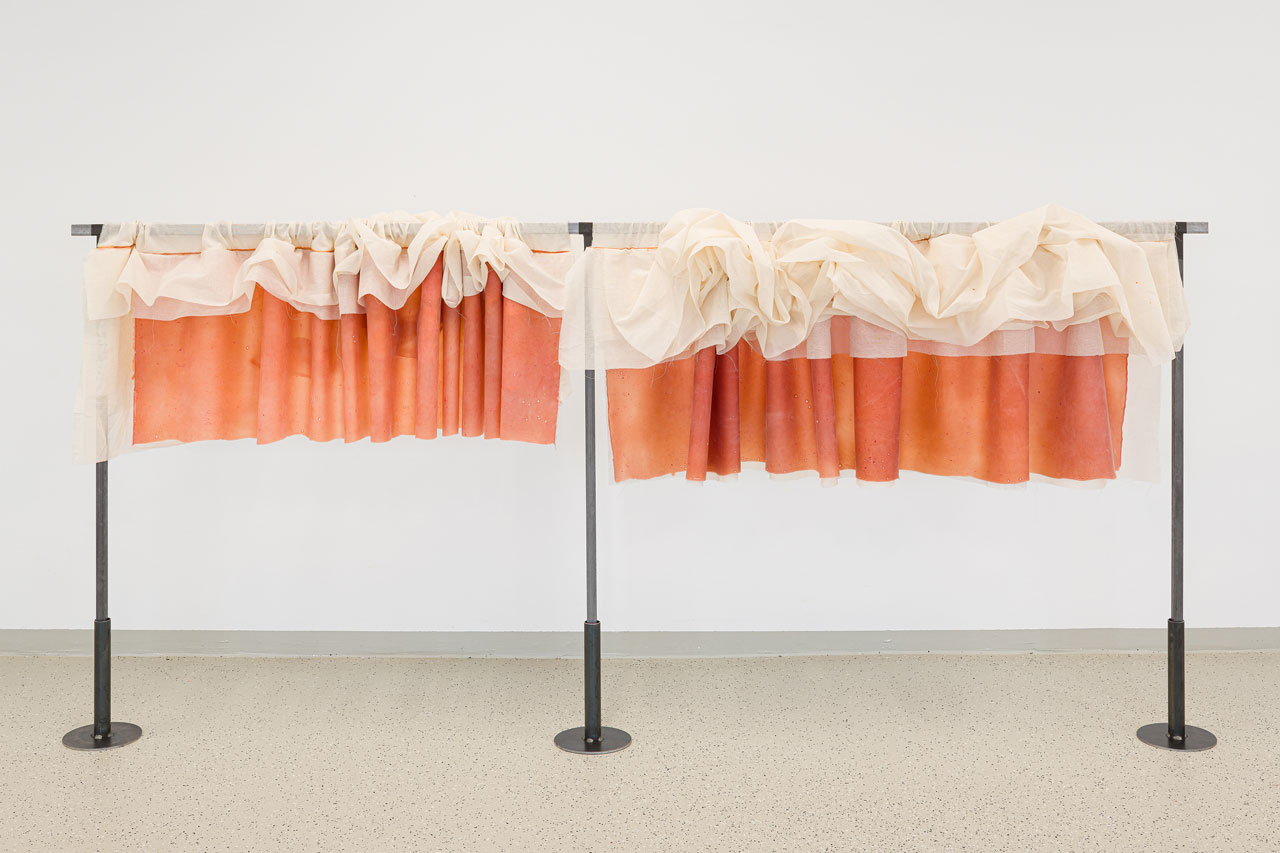
Despite an apparent formal abundance—objects evoking mirrors, curtains, garlands, and festoons—the exhibition achieves a surprising economy. Each element carries a clearly defined functional role: concealing, revealing, condensing, fixing, redirecting. Importantly, these functions do not aim at illusionistic spatial expansion. Instead, they operate through delineation, emphasizing boundaries, thresholds, and zones. The logic of enumeration embedded in the title thus becomes spatially legible, distributing representational tasks across the exhibition with clarity.
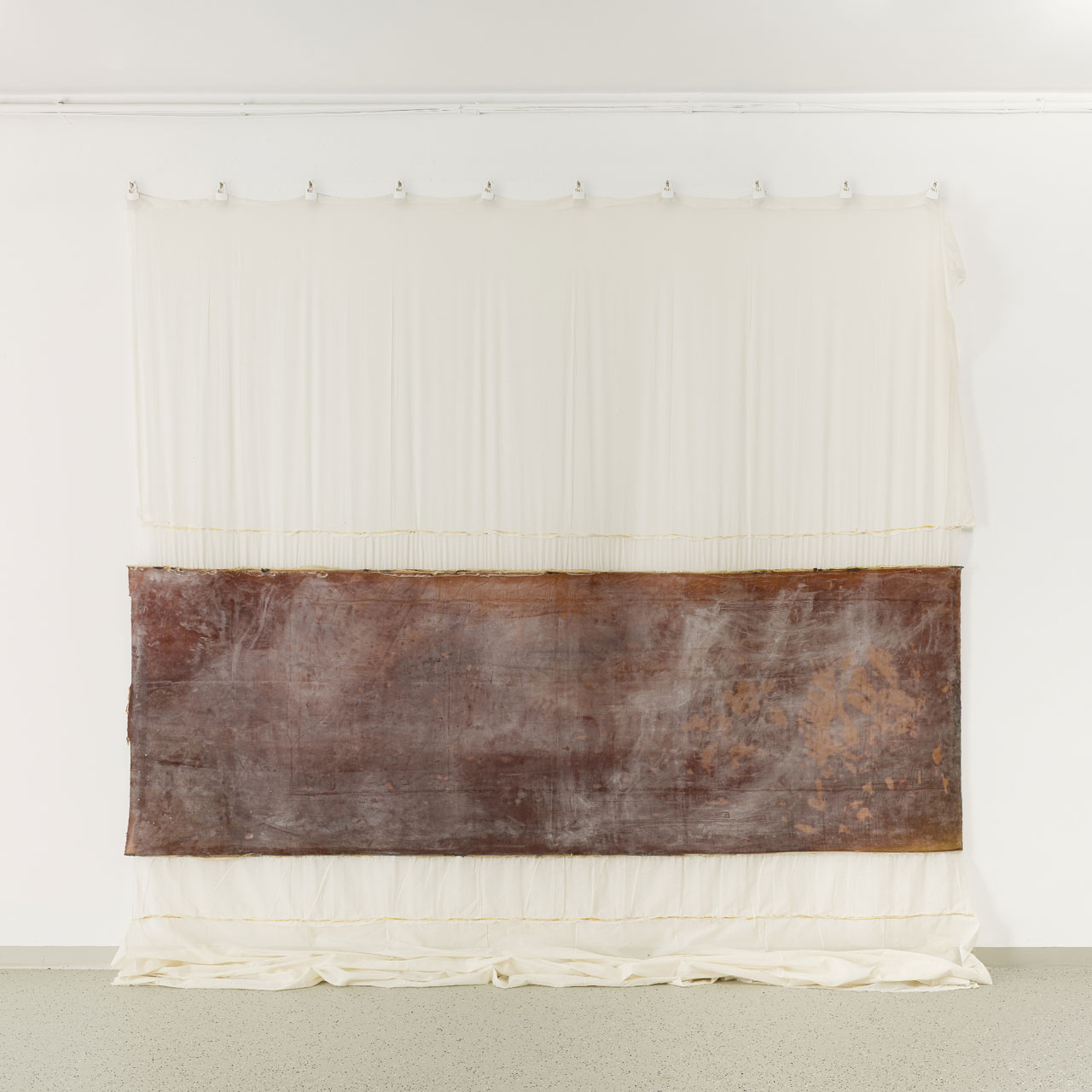
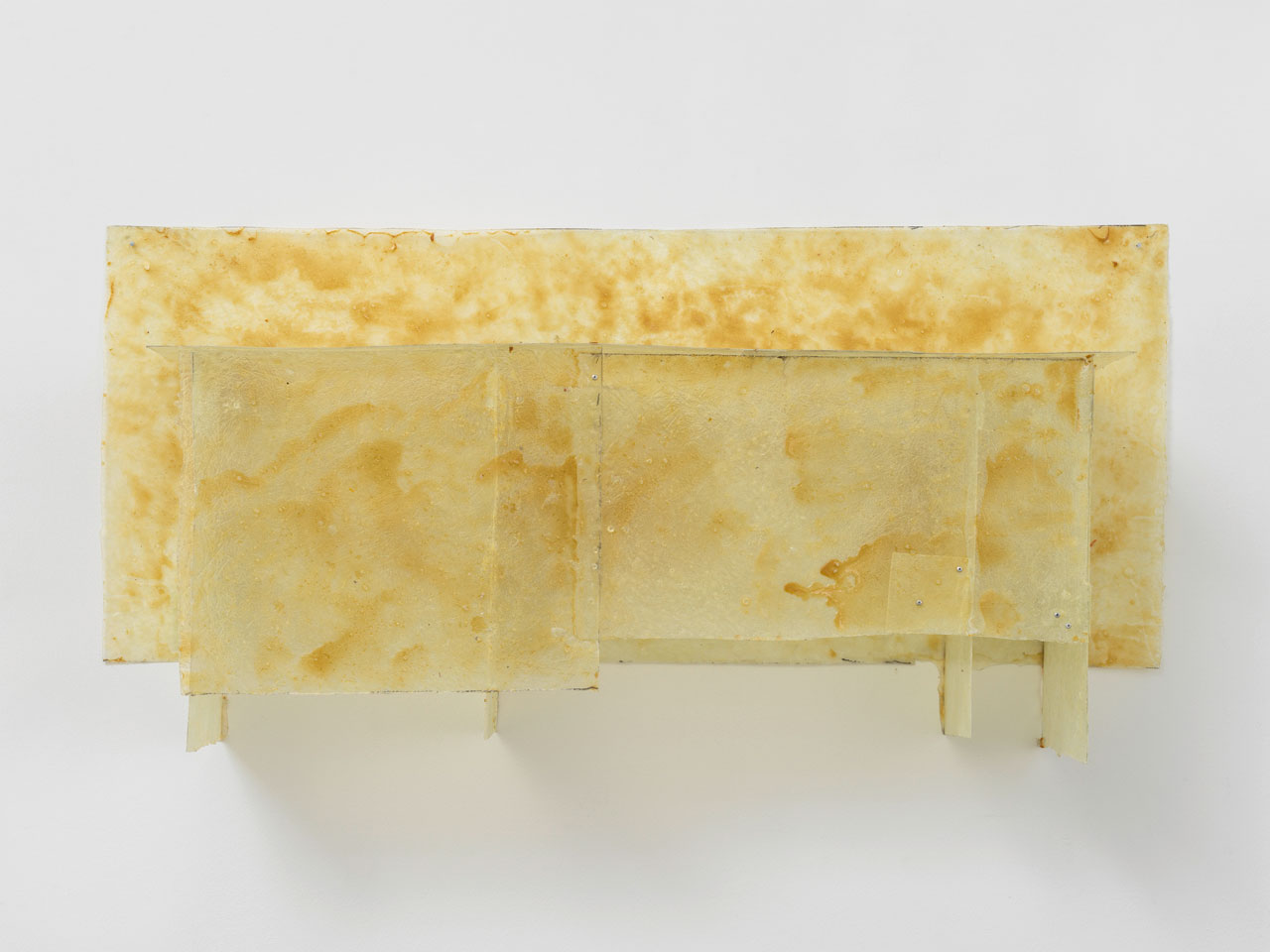
Materially, Raff restricts herself to a concise palette: textiles, latex, and formed steel. These materials exist in a state of technical and formal interdependence, each contributing distinct structural and sensory properties. Textiles introduce flexibility and softness; steel provides rigidity and linear definition; latex occupies a volatile middle ground, its behavior governed by time-sensitive processes of pouring and solidification. This triadic system generates a productive tension: although the exhibition privileges objects over large-scale installations, the objects themselves become intensely space-forming through their interaction.
The production logic underlying these works is equally significant. Raff operates through a rule-based system of defined procedures and sequential steps. Yet this is not a purely algorithmic process. It is better understood as orchestrated variation: small adjustments—surface treatments, seam configurations, steel profiles—produce nuanced differences across otherwise consistent forms. The scope for post-production is deliberately minimized. Decisions are embedded in the act of making, particularly in the handling of latex, whose material properties resist revision. Once cast, its form, surface, and structural behavior are largely fixed, subject only to natural processes of aging, shrinkage, and transformation.
This embrace of material contingency introduces an additional layer of complexity. Latex, as an organic and time-sensitive medium, demands anticipation rather than correction. The production process must accommodate variables that cannot be fully controlled, integrating them into the conceptual framework of the work. In this sense, Raff’s practice negotiates a balance between strict procedural definition and the inherent unpredictability of matter.
“Wallpapers, Gathers and Mirages” can be read as an exploration of archetypal forms and operations. The objects do not merely occupy space; they simulate and enact underlying structures of social organization. Their formal variations echo patterns of interaction—aggregation, separation, concealment, exposure—rendering the exhibition space legible as a social field.
What emerges is a subtle yet disorienting reflexivity. Viewers become aware not only of the works but of their own participation within the system those works construct. Observing the exhibition entails observing oneself observing—an experience akin to watching one’s own gestures from a distance while still inhabiting them. Raff’s exhibition thus operates on multiple registers: material, spatial, procedural, and perceptual. It is in the precise alignment of these registers that its critical force resides.
Photo: Liesl Raff, Tip (Gather 1), 2026 ,Metal, latex, pigment, talcum, aluminum tape, 160 x 210 x 120 cm / 63 x 82 5/8 x 47 1/4 in, © Liesl Raff, Courtesy the artist and Galerie Eva Presenhuber
Info: Galerie Eva Presenhuber, Lichtenfelsgasse 5, Vienna, Austria, Duration: 29/4-24/7/2026, Days & Hours: Tue-Fri 12:00-18:00, www.presenhuber.com/
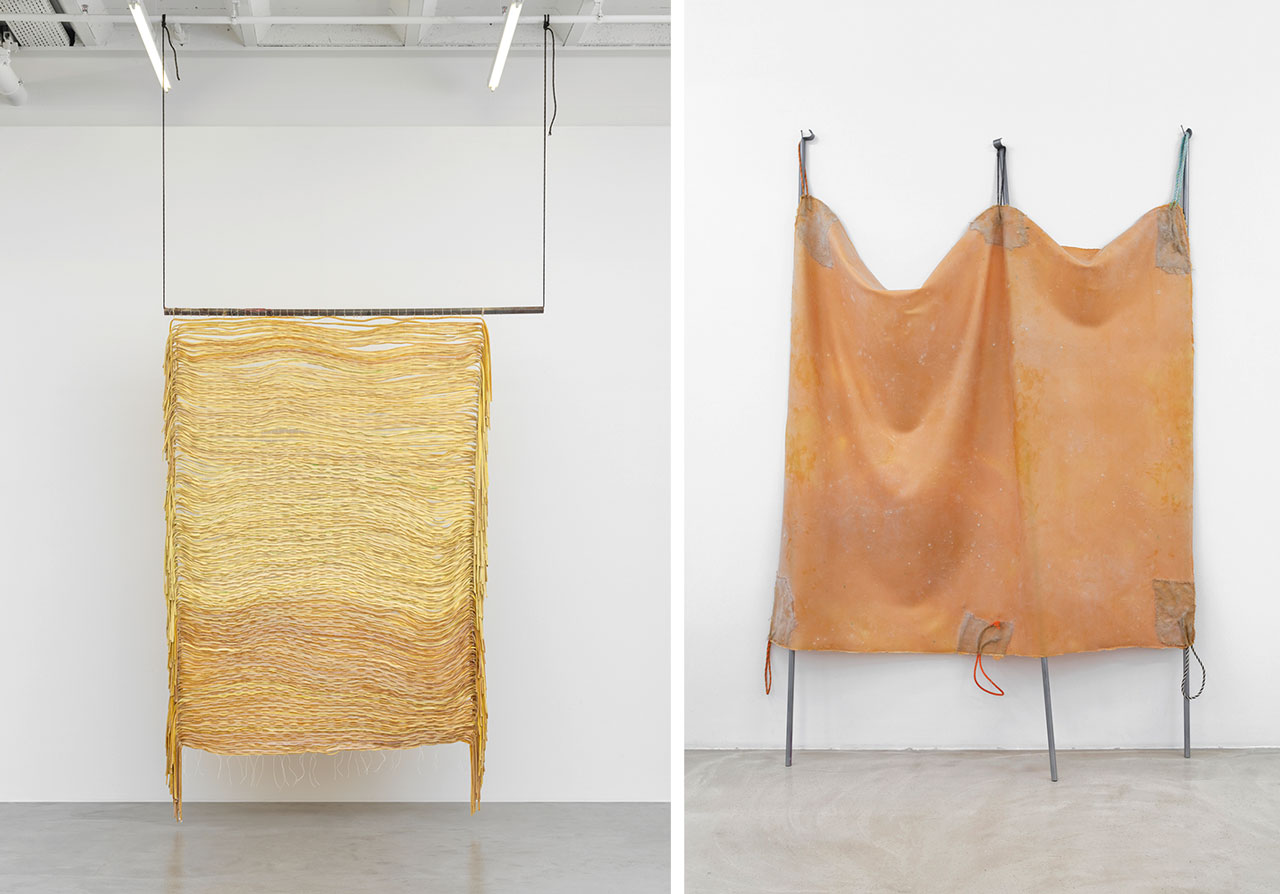
Right: Liesl Raff, Coat 4, 2022, Latex, metal, rope, fabric, pigment, silicone oil, dimensions variable, 275 x 180 x 30 cm / 108 1/4 x 70 7/8 x 11 3/4 in, © Liesl Raff, Courtesy the artist and Galerie Eva Presenhuber
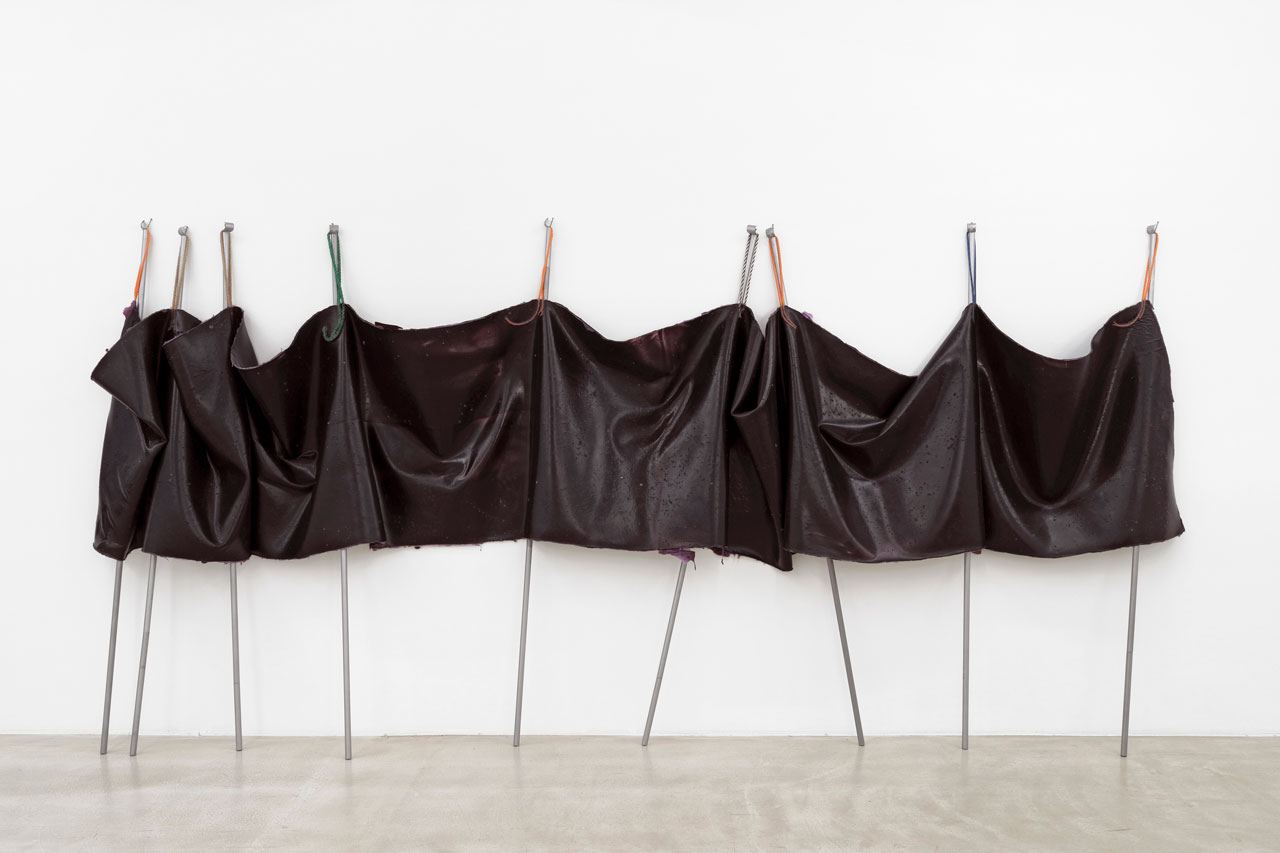
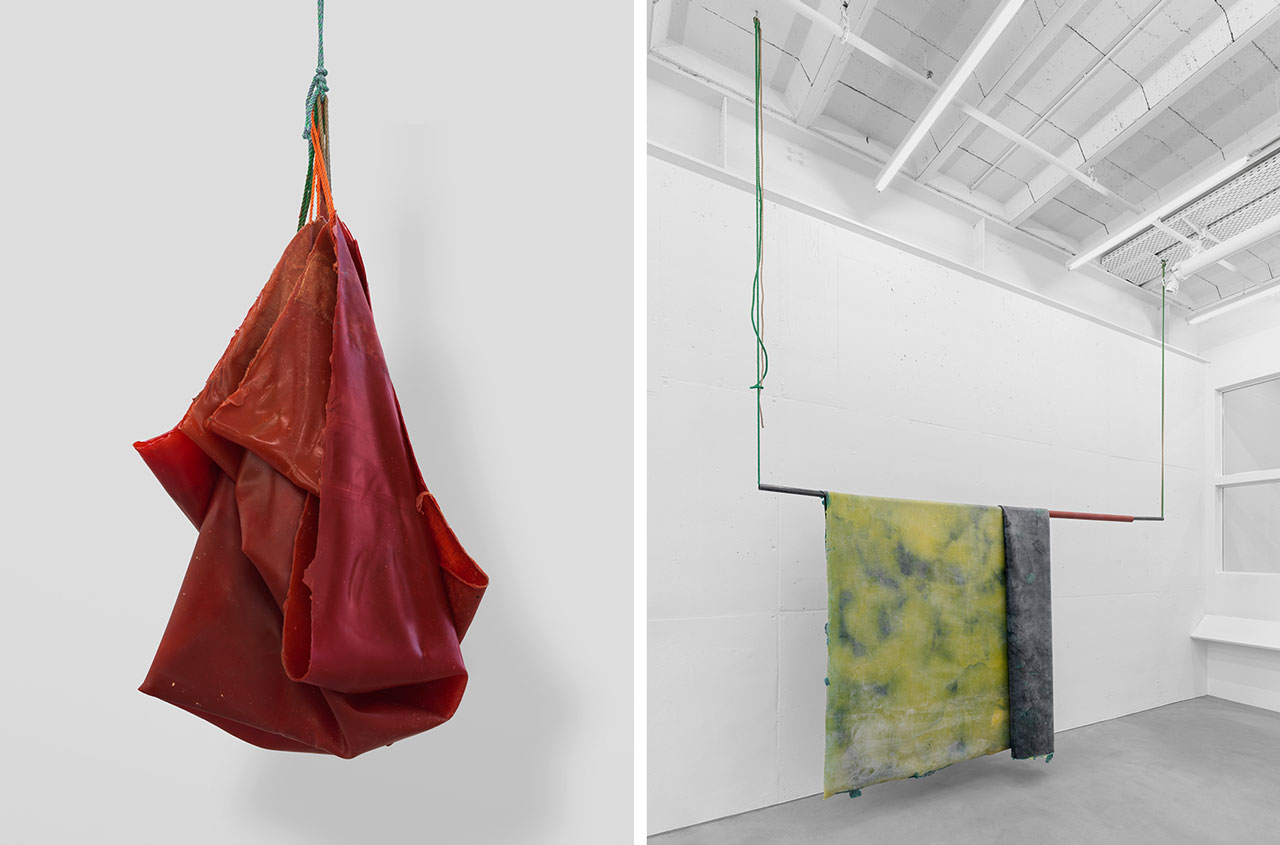
Right: Liesl Raff, Crease, 2024/2025, Metal, latex, rope, lacquer, pigment, talcum, 198 x 404 x 40 cm / 78 x 159 x 15 3/4 in, © Liesl Raff, Courtesy the artist and Galerie Eva Presenhuber
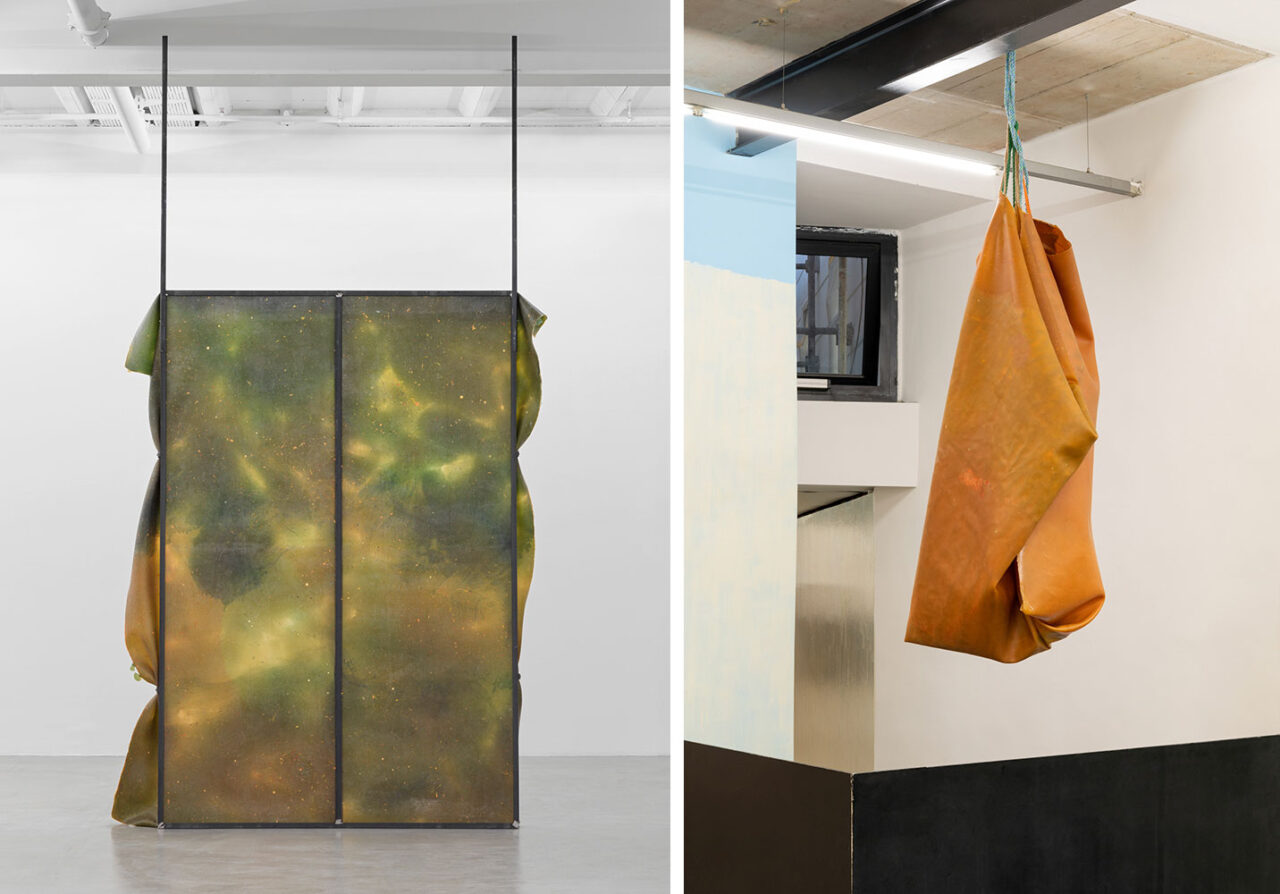
Right: Liesl Raff, Den, 2022, Latex, rope, jute, pigment, silicone oil, 270 x 130 x 100 cm / 106 1/4 x 51 1/8 x 39 3/8 in, © Liesl Raff, Courtesy the artist and Galerie Eva Presenhuber