
PRESENTATION: Marcel Duchamp
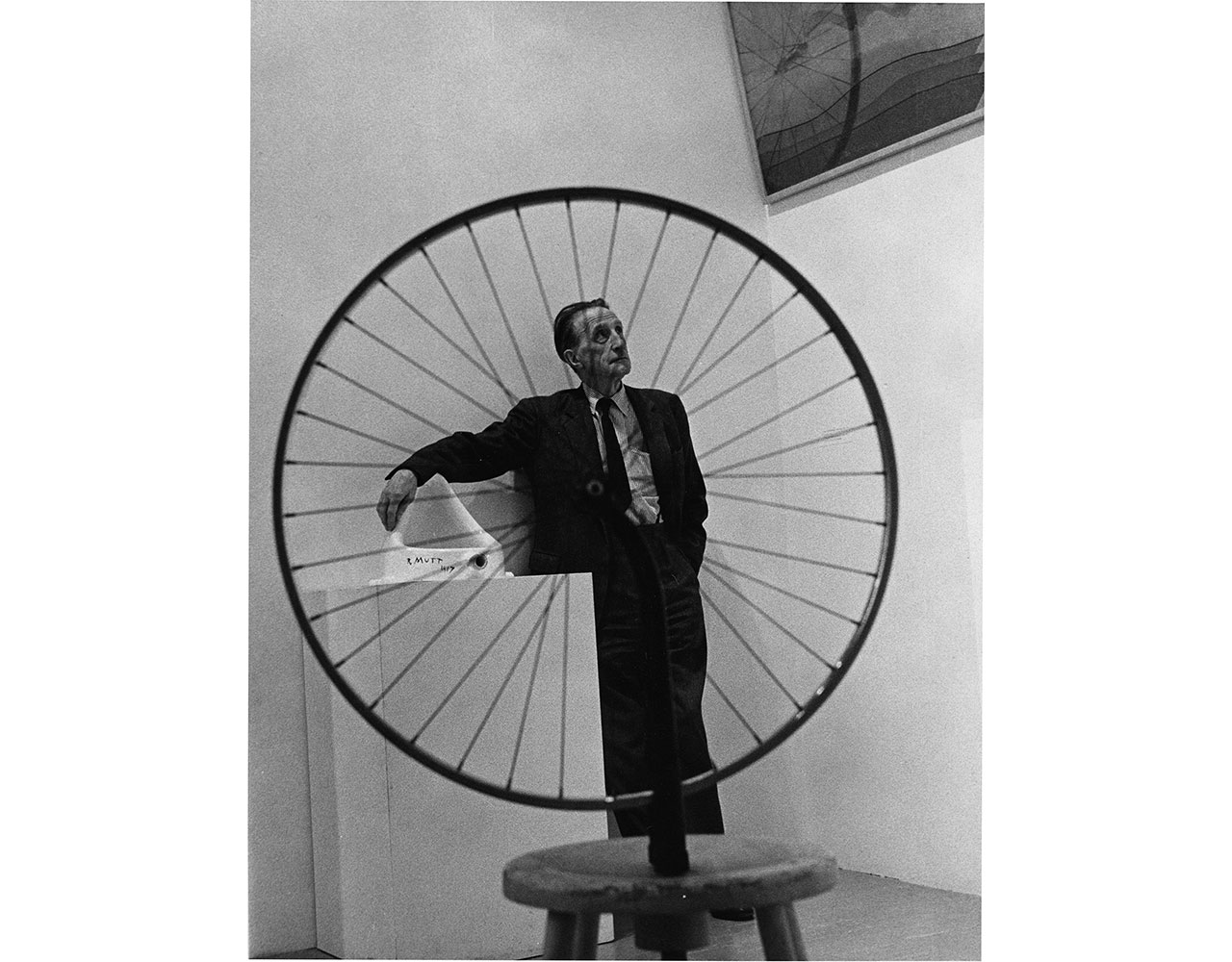
Marcel Duchamp emerged from an artistic milieu that shaped his early trajectory. His grandfather worked as a printmaker and painter, while his two older brothers were practicing artists whose example encouraged his own ambitions. Duchamp began drawing and painting in childhood and moved to Paris in 1904 to pursue formal study, soon exhibiting in contemporary salons in Rouen and Paris.
By Dimitris Lempesis
Photo: Gagosian Archive
A decisive shift occurred around 1911. Duchamp abandoned the vivid palette and figurative emphasis of his earlier work in favor of muted tones and fragmented, anti-naturalistic forms. Influenced by Cubism as well as developments in photography and film, he turned toward the problem of representing movement—not as optical reality, but as a conceptual phenomenon. Works related to chess, a recurring motif, further extended this inquiry by treating thought itself as a form of motion.
This early preoccupation with movement and perception ultimately gave way to a more radical redefinition of artistic practice. Gagosian inaugurates its new space at 980 Madison Avenue with an exhibition of key works by Duchamp, a choice that is both symbolic and historically reflexive. The presentation returns Duchamp’s work to the site where its editioned forms first appeared in the United States in 1965, at the Cordier & Ekstrom Gallery, foregrounding questions of repetition, authorship, and circulation.
Central to the exhibition are the 1964 readymades produced in collaboration with the Italian gallerist Arturo Schwarz. These objects are not straightforward replicas but deliberate reactivations. Because many of the original readymades—often ephemeral by design—had been lost or destroyed, the Schwarz editions, realized with Duchamp’s direct involvement, reassert the primacy of the concept over the material object. Authenticity, in this context, resides not in the original artifact but in the idea it instantiates.
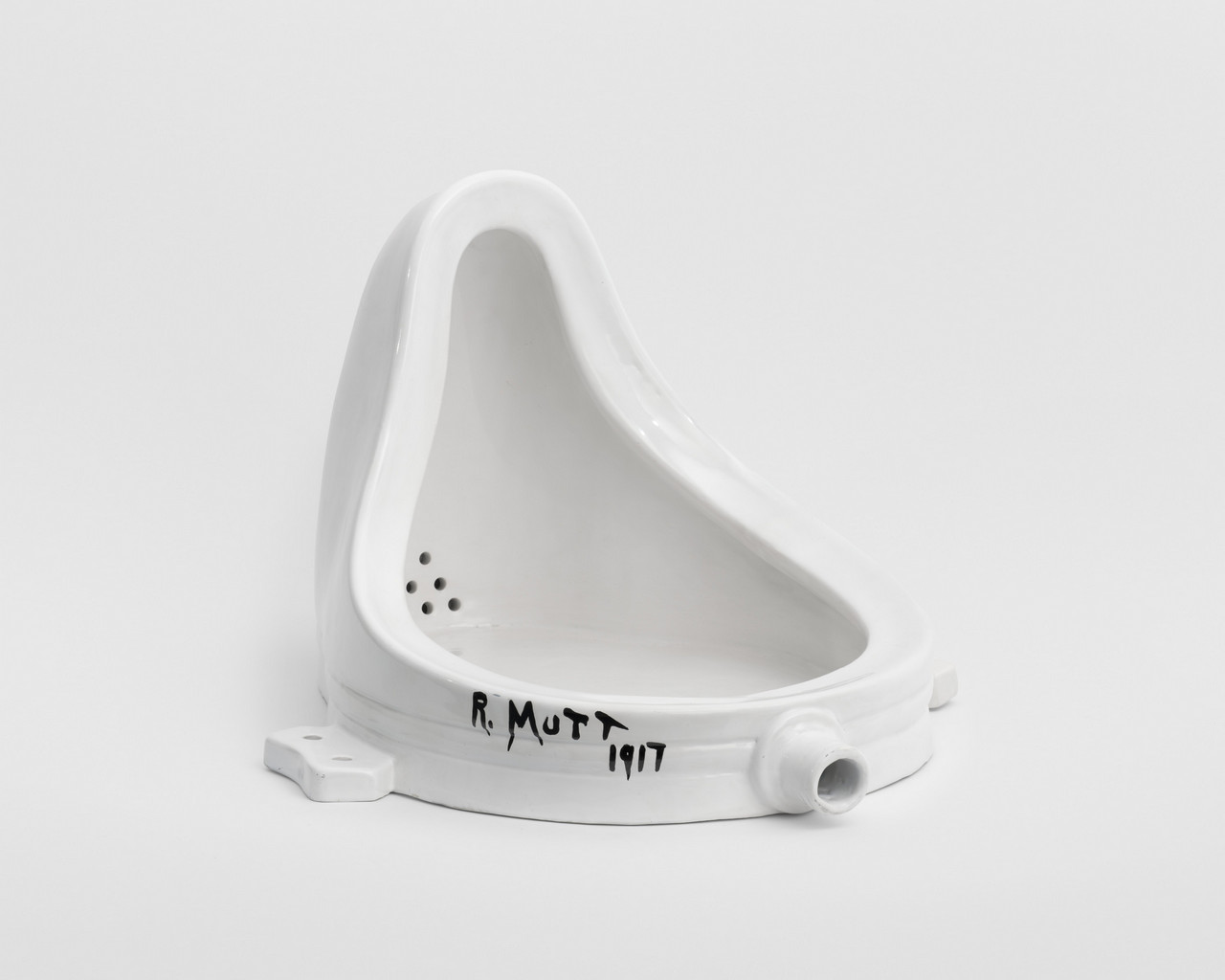
The exhibition includes canonical works such as “Roue de bicyclette” (1964, after 1913 lost original), “Fountain” (1964, after 1917 lost original), “L.H.O.O.Q.” (1964, after 1919 original), and “Porte-bouteilles” (1964, after 1914 lost original). Together, they exemplify Duchamp’s strategy of elevating ordinary, mass-produced objects through selection and designation. The inclusion of “Boîte-en-valise” (1935–49; contents 1935–41), his portable retrospective, further underscores his recursive engagement with authorship and self-archiving. Notably, the 1964 edition of “Bicycle Wheel” on view remains the only example not held in a major institutional collection, lending it particular singularity within a body of work defined by reproducibility.
Historically, most of Duchamp’s early readymades circulated only within his immediate circle. The exception, “Fountain”, was submitted to a 1917 New York exhibition under the pseudonym “R. Mutt” and rejected despite the show’s stated open-admission policy. Its dismissal exposed the institutional limits of artistic definition. Like many of Duchamp’s readymades, the original was subsequently lost and survives primarily through documentation and later editions.
Duchamp’s readymades are often framed in terms of negation—of craftsmanship, originality, and aesthetic judgment. Yet this characterization is incomplete. Rather than simply rejecting these categories, Duchamp reconfigured them. By selecting, repositioning, and titling existing objects, he displaced artistic meaning from manual production to conceptual framing. The artist becomes a mediator of perception rather than a maker of forms.
This shift reverberates across modern and contemporary art. Duchamp’s attenuation of the artist’s hand anticipates the serial strategies of Andy Warhol and the industrial finish of Jeff Koons. His use of found objects informs the hybrid practices of Robert Rauschenberg and Jasper Johns, while his openness to contingency and chance resonates in the work of figures such as Urs Fischer and Damien Hirst. What begins as provocation becomes, over time, a foundational logic.
The Gagosian exhibition makes clear how fully Duchamp’s strategies have been absorbed into contemporary practice. Recontextualization, irony, and institutional critique now function as a shared vocabulary rather than a radical rupture. Yet Duchamp’s work resists full assimilation. Its ambiguity persists: are these objects artworks, gestures, or propositions? Do they critique the art system, or operate seamlessly within it?
By situating these works within a newly inaugurated commercial gallery, the exhibition reactivates this tension. The gallery—historically tied to the commodification and circulation of art—becomes the very context in which Duchamp’s anti-retinal provocations are preserved and exchanged. The contradiction is not resolved; it remains constitutive of the work itself.
Photo: Marcel Duchamp inside the exhibition “The Art of Assemblage” at the Museum of Modern Art, New York, 1961, with his artworks “Fountain” (1950, replica of lost 1917 original) and “Bicycle Wheel” (1951, replica of lost 1913 original), Artwork: © Association Marcel Duchamp/ADAGP, Paris/Artists Rights Society (ARS), New York 2026, Photo: Marvin Lazarus
Info: Gagosian, 974 Madison Avenue. New York, NY, USA, Duration: 25/4-27/7/2026, Days & Hours: Tue-Sat 10:00-18:00, https://gagosian.com/
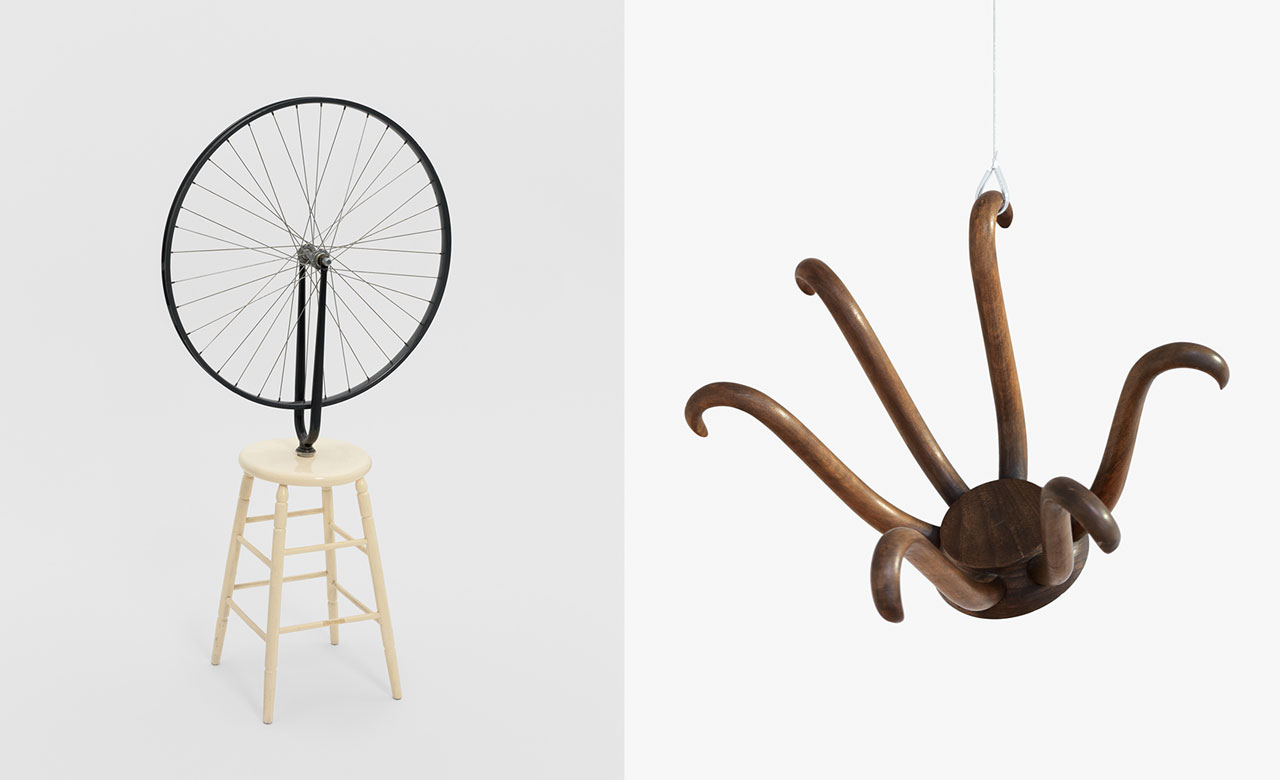
Right: Marcel Duchamp, Porte-chapeau (Hat Rack), 1964 (after lost 1917 original), Wood, 9 1/8 × 18 × 13 1/8 inches (23 × 45.7 × 33.3 cm), “Ex Arturo” (1 of 2 AP) + edition of 8 + 2 HC, © Association Marcel Duchamp/ADAGP, Paris/Artists Rights Society (ARS), New York 2026, Photo: Rob McKeever, Courtesy Gagosian
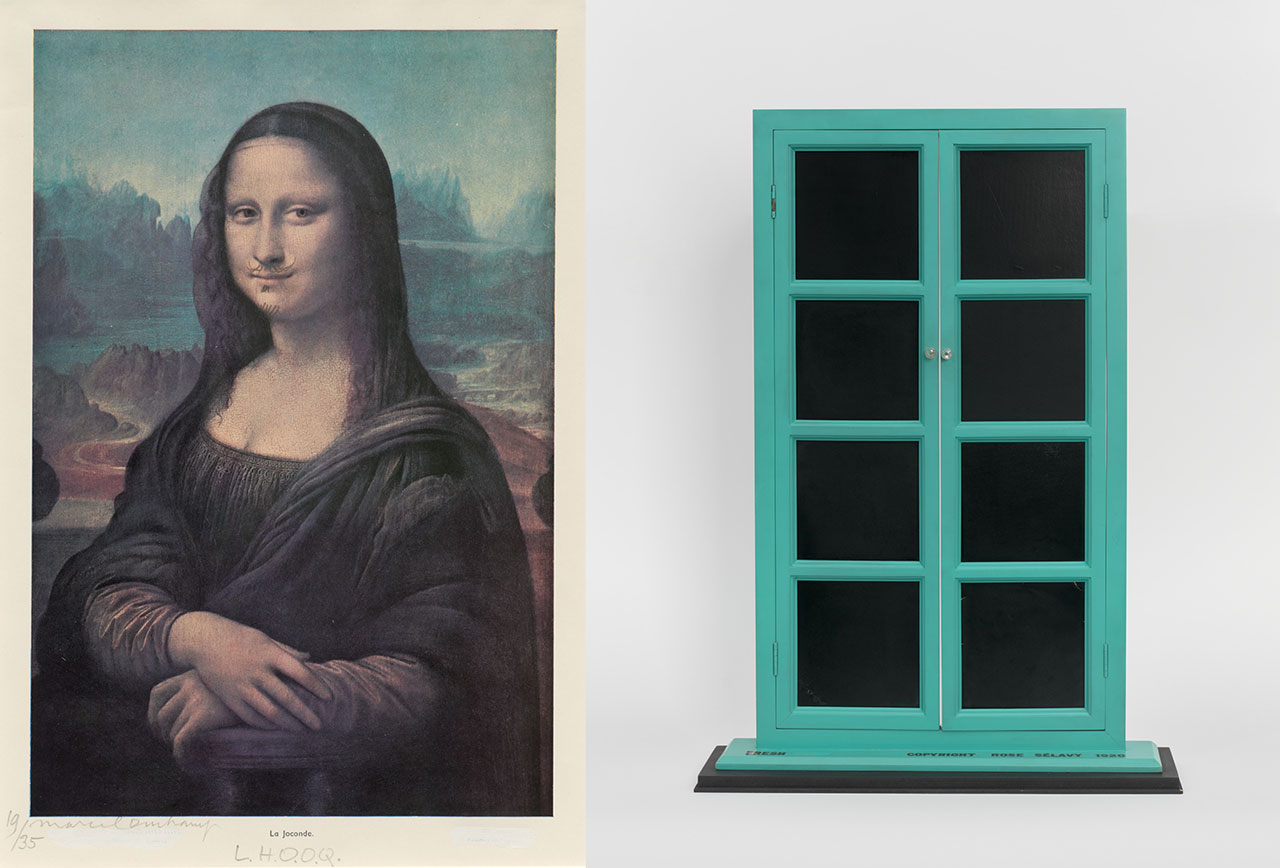
Right: Marcel Duchamp, Fresh Widow, 1964 (after 1920 original), Paint, wood, metal, leather, and glass, 31 7/8 × 22 5/8 × 5 3/4 inches (81 × 57.5 × 14.4 cm), “Ex Arturo” (1 of 2 AP) + edition of 8 + 2 HC, © Association Marcel Duchamp/ADAGP, Paris/Artists Rights Society (ARS), New York 2026, Photo: Owen Conway, Courtesy Gagosian