PRESENTATION: Francisca García & Mario Navarro-Unearthed Conversation
“Unearthed Conversation” presents new work by artists Francisca García and Mario Navarro. The project was developed in 2022 as a proposal for Chile’s national pavilion at the Venice Biennale, but has only now been realized at S.M.A.K. The two artists, who live and work in Santiago de Chile, share a critical and investigative interest in image, landscape, politics and utopias. García and Navarro each have their own individual artistic practices, but have been collaborating regularly since 2001, as for this exhibition.
By Dimitris Lempesis
Photo S.M.A.K. Archive
The collaborative project “Unearthed Conversation” departs from the 1964 Chilean documentary film “Aquí Vivieron “by Pedro Chaskel and Héctor Ríos, and from images taken by the NASA Perseverance Mars Rover on the planet Mars since 2021. Chaskel and Ríos’ documentary focuses on the excavation of material remains of the Chango culture (which flourished between 10,000 and 6,000 BCE) at the mouth of the Loa River in the Atacama Desert in northern Chile. In terms of surface and structure, the desert closely resembles the planet Mars. With this exhibition, García and Navarro connect these two landscapes and geographies, and use images to reflect on both the future and the past. As suggest- ed by the exhibition title, Unearthed Conversation, they elaborate on this link in a conversation.
The exhibition bridges the gap between subterranean archaeological traces in the Atacama Desert and the high-tech achievements of NASA’s Perseverance Mars Rover. The Atacama is both the protagonist and the back- drop of this exhibition. Like the exhibition itself, the desert brings together stories and traces of forgotten pasts. These include archaeological finds from the Chango culture, the presence of some of the world’s largest telescopes, and the indelible scars of the Pinochet dictatorship (1973-1990).
Using video, installation, sound, drawings and textile, García and Navarro invite us to think about how we might converse with a landscape. After all, every landscape bears memories of hu- man activity, such as traces of colonization and political systems. In the Atacama Desert, the archaeological past is directly linked to humanity’s cosmic dream. The artists prompt us to reflect on how landscapes carry stories within them, and how the unspoken and the invisible shape humanity and how we think.
The exhibition’s visual richness encourages us to commemorate what we can no longer see, such as the vanished Chango culture or the victims of the Pinochet dictatorship. This is not only about remembering, but also about critical reflection. Between the archaeologists’ simple hand tools and NASA’s cutting-edge equipment, Francisca García and Mario Navarro depict worlds that raise essential questions about events be- tween life and death.
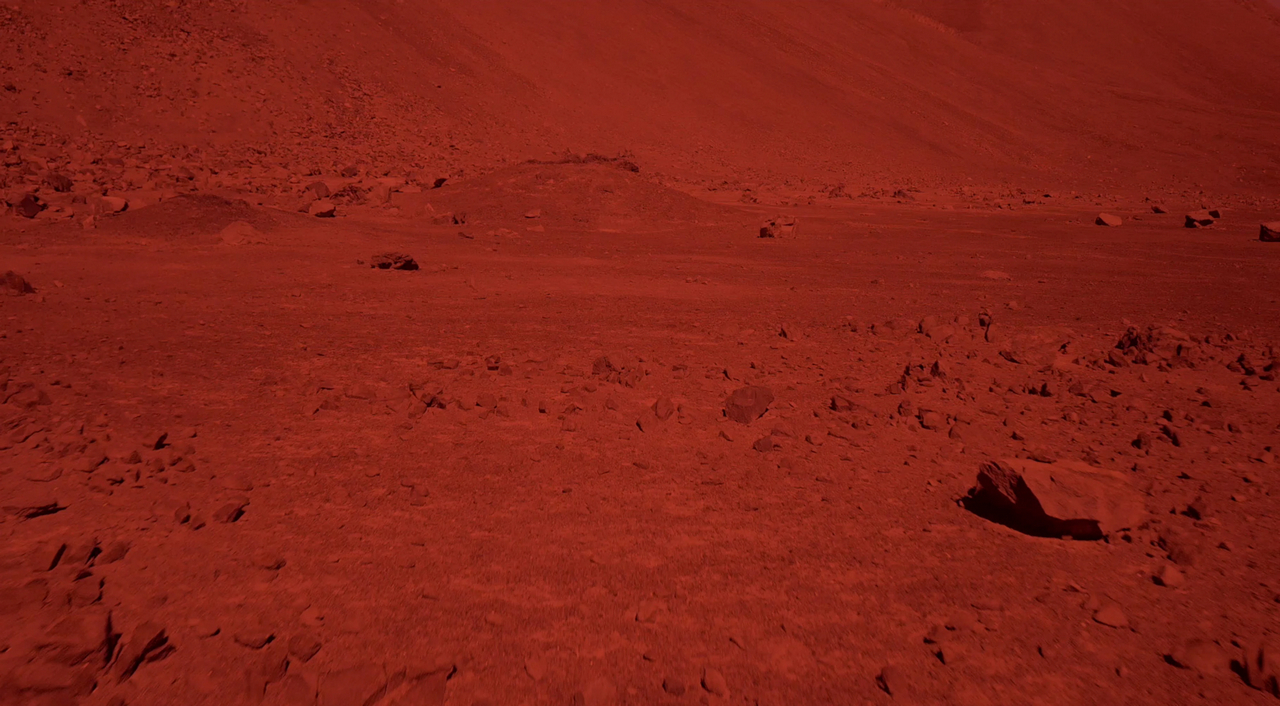
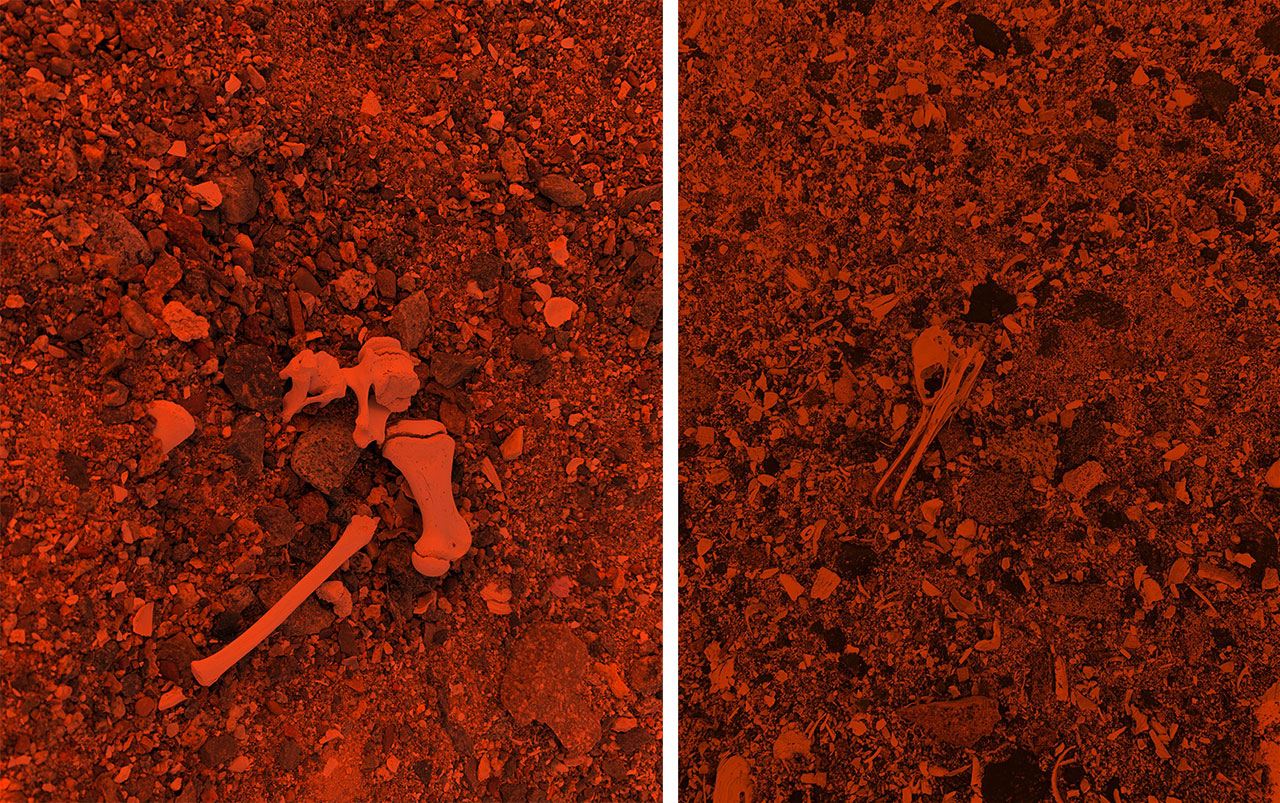
The title of the video work “687 días” (2026) refers to the length of one year on Mars, which corresponds to 687 days on Earth. The work consists of two projections. Both show images filmed by García and Navarro in the Atacama Desert, at the same site where Pedro Chaskel and Héctor Ríos made the documentary “Aquí Vivieron” in 1964, mimicking the camera movements and framing made by the NASA Perseverance Rover on Mars. The images are dominated by the colors blue and red. Mars has long been called the ‘Red Planet’ because iron oxide (rust) makes it look reddish-brown, but recent research indicates that the planet must have been blue about 3 billion years ago due to the presence of many rivers and a large ocean. The soundtrack consists of at- tempts to record the sounds of solar storms, wind on Mars, black holes and random noises, combined with electronic experiments. García and Navarro replaced the original im- ages from the 1964 documentary with a new way of looking at landscapes, particularly those of Atacama and Mars, shaped by cur- rent imaging technology and space research.
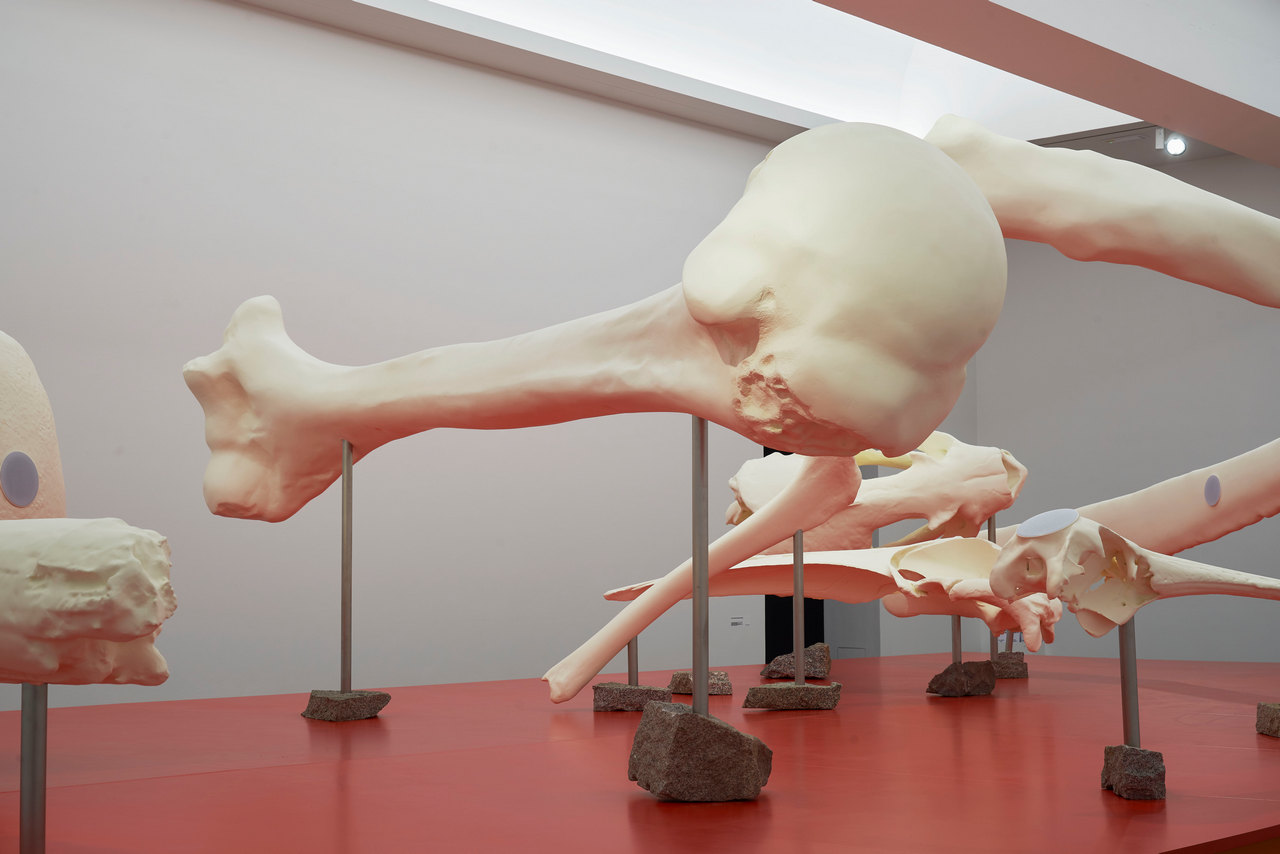
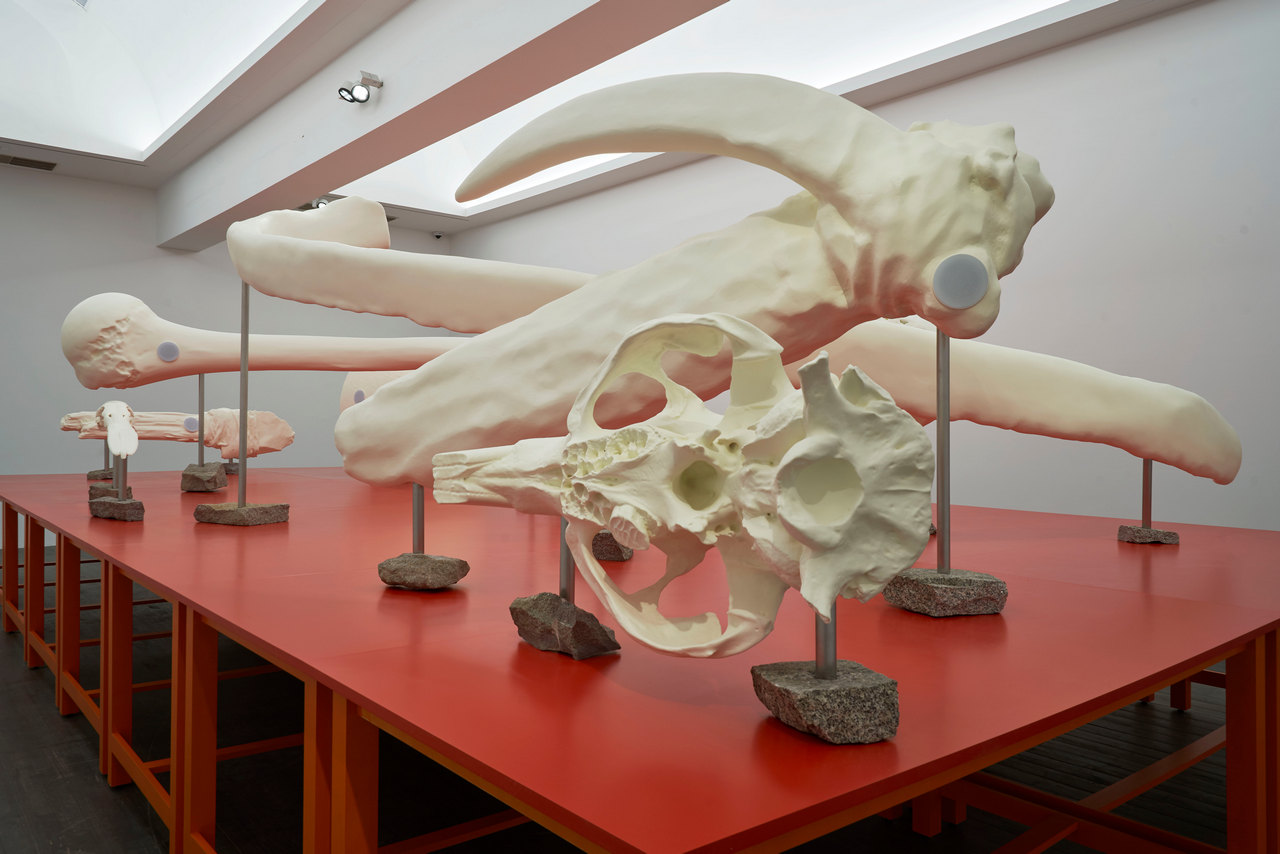
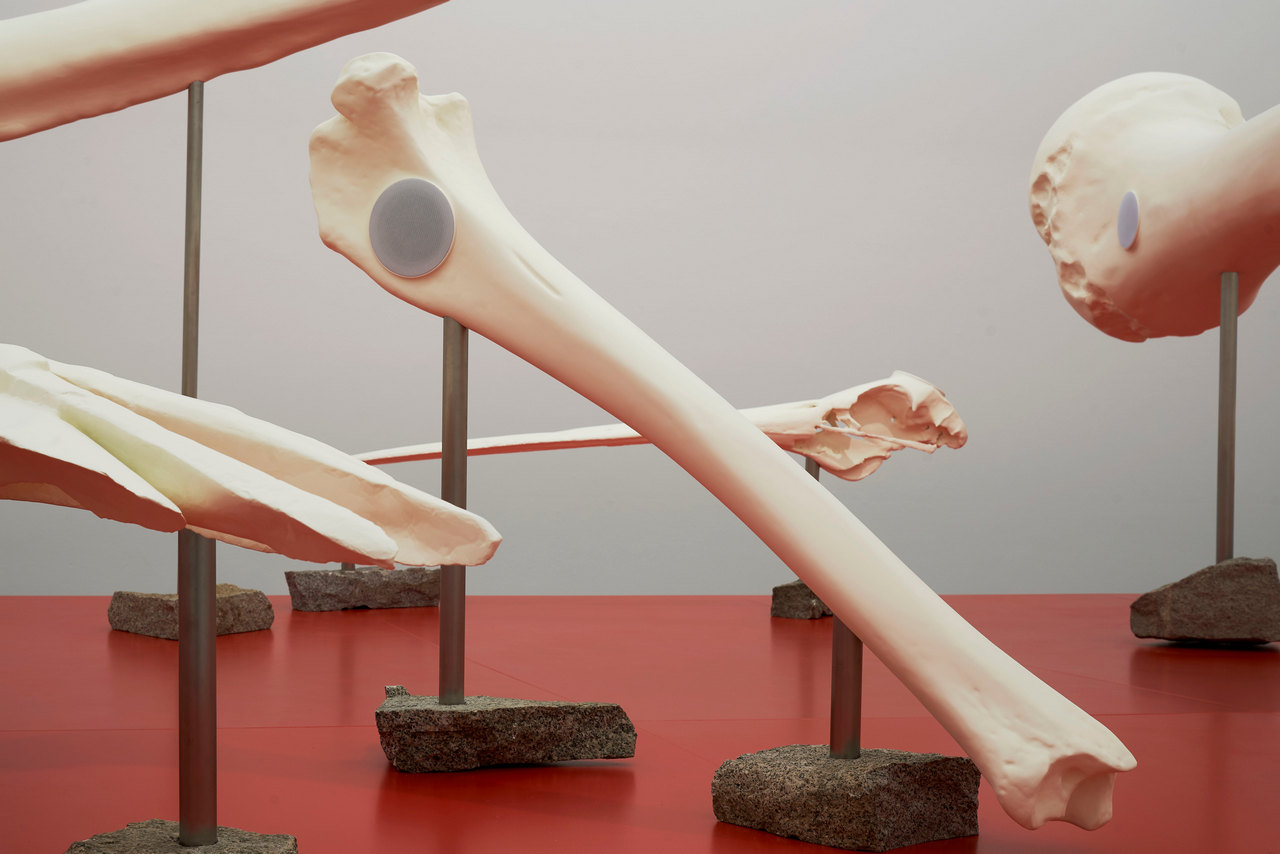
The monumental installation “Conversación desenterrada” ( 2026) consists of a ‘white landscape’ with a collection of enlarged bones of humans and animals, including those of a pelican and a whale, as well as an oyster knife and a fish hook. The tools were used by Chango fisherfolk and shellfish gatherers on the north coast of Chile. The ‘dead’ objects engage in conversation with each other in pairs, thus regaining their voice, as it were. At first, the conversations seem mundane. Memories are evoked of a time when the bones belonged to living bodies and the objects were still in use. But soon the conversations evolve into reflections on life and death, darkness and daylight, stars and the cosmos, among other things.
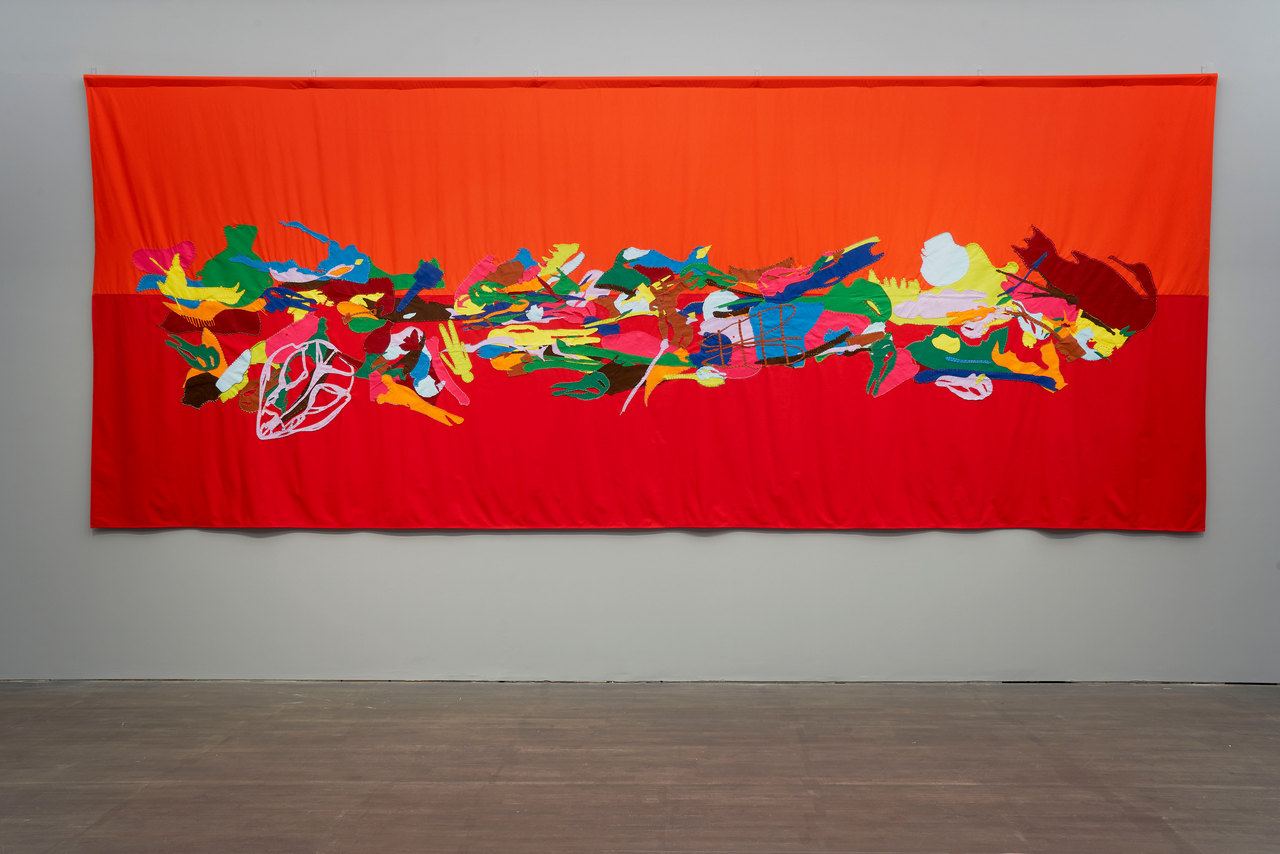
The colorful, monumental textile “Tumba de arena” (2026) unfolds like a cinematic landscape filled with silhouettes of objects that played an important role in the funeral rituals of the Chango fishing community. The deceased were buried together with their boats, pottery, textiles and tools, as well as the bones of animals and birds. It is literally an accumulation halfway between the surface and the subsoil. These objects were given to them so that they could continue fishing in the afterlife.
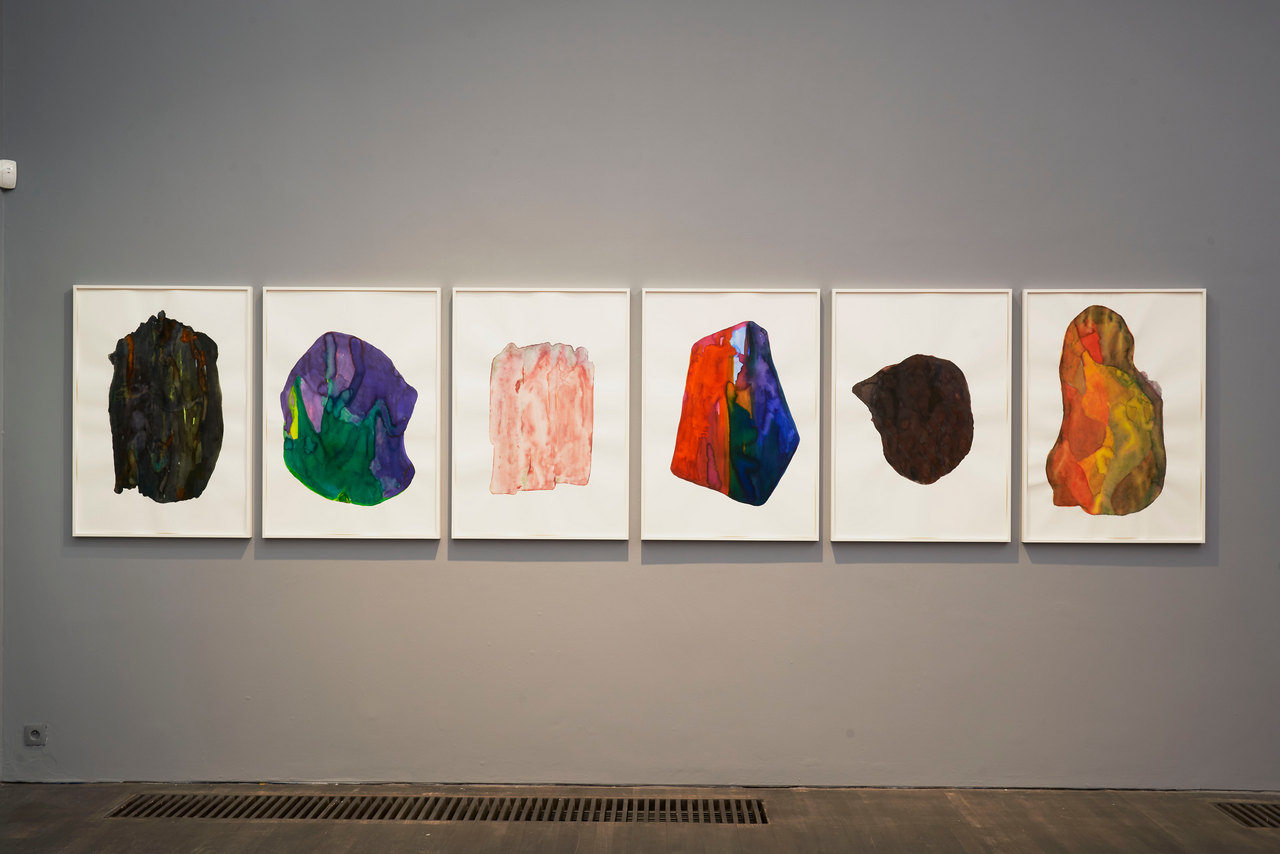
The 20 watercolors entitled “Rocas Flotantes” (2026), depict rocks that have been photographed and studied on Mars to determine chemical, climatological, and geological characteristics, among others, in order to investigate the possibility of life on the planet. These rocks are, so far, the only tangible objects of which NASA has published images. García and Navarro replace the digital images taken with NASA equipment with watercolors in which their personal, hesitant hands become visible. “Rocas Flotantes” reads like an inventory of rocks that have not yet been deciphered.
Photo: Francisca García & Mario Navarro, 687 días (687 days), 2026, video projection, 2 channels, sound, 6’57, © & Courtesy the artists
Info: Curator: Philippe Van Cauteren, S.M.A.K. Museum, Jan Hoetplein 1, Gent, Belgium, Duration: 3/4-13/9/2026, Days & Hours: Tue-Fri 9:30-18:30, Sat-Sun 10:00-18:00, https://smak.be/
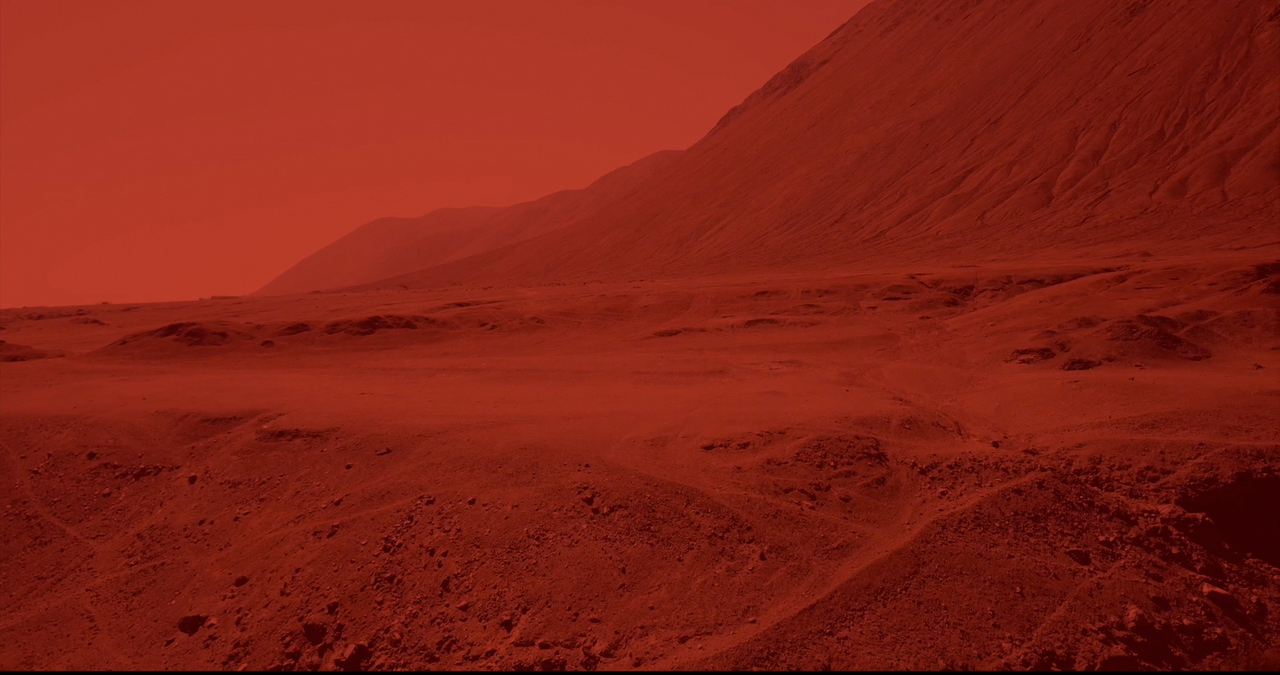
![Francisca García & Mario Navarro, 687 días (687 days) [film still], 2026, video projection, 2 channels, sound, 6'57, Installation view “Unearthed Conversation”, S.M.A.K. 2026. Photo Dirk Pauwels, © Francisca García & Mario Navarr, Courtesy the artists and S.M.A.K.](http://www.dreamideamachine.com/web/wp-content/uploads/2026/04/Installation-view-Unearthed-Conversation-by-Francisca-Garcia-and-Mario-Navarro-S.M.A.K.-2026.-Photo-Dirk-Pauwels-5.jpg)