
PREVIEW: Giuseppe Penone-The Reflection of Bronze
Giuseppe Penone invites us into a forest of permanence. The exhibition, “The Reflection of Bronze’, marks the artist’s first collaboration with Gagosian in New York and presents two major bodies of work that translate a half-century of arboreal obsession into the eternal language of metal. For Penone, bronze is not merely a material; it is a living, imitating substance that captures the very essence of transformation.
By Efi Michalarou
Photo; Gagosian Archive
Born in the rural Piedmontese village of Garessio in 1947, Penone has always breathed the air of the forest. He came of age as a protagonist of *Arte Povera*, the radical Italian movement that emerged in the late 1960s to challenge consumerism and industrialism by turning to simple, “poor” materials. At just twenty-one, Penone was the youngest member of this avant-garde, dubbed a pioneer by critic Germano Celant.
His foundational insight, which echoes throughout this exhibition, occurred early in his career. While observing the growth rings of a wooden beam, Penone realized that by carving away the wood around a knot, he could reveal the form of the tree at a younger stage of its life. This discovery led to his celebrated “Alberi” (Trees) series—carved wood sculptures that “strip” away layers of time to expose a hidden sapling at the core. In “The Reflection of Bronze”, this investigation finds its culmination. The fragile, organic memory of the sapling is rendered permanent, frozen in the alloy of bronze. As Adam D. Weinberg writes in his accompanying essay, “Bronze for [Penone] is not a more permanent, more marketable substitute… Rather, his use of bronze involves a profound, rich, varied, and lifelong response to enduring artistic questions”.
The exhibition “The Reflection of Bronze” unfolds as a carefully orchestrated journey through three distinct rooms, each a chapter in Penone’s meditation on time and matter.
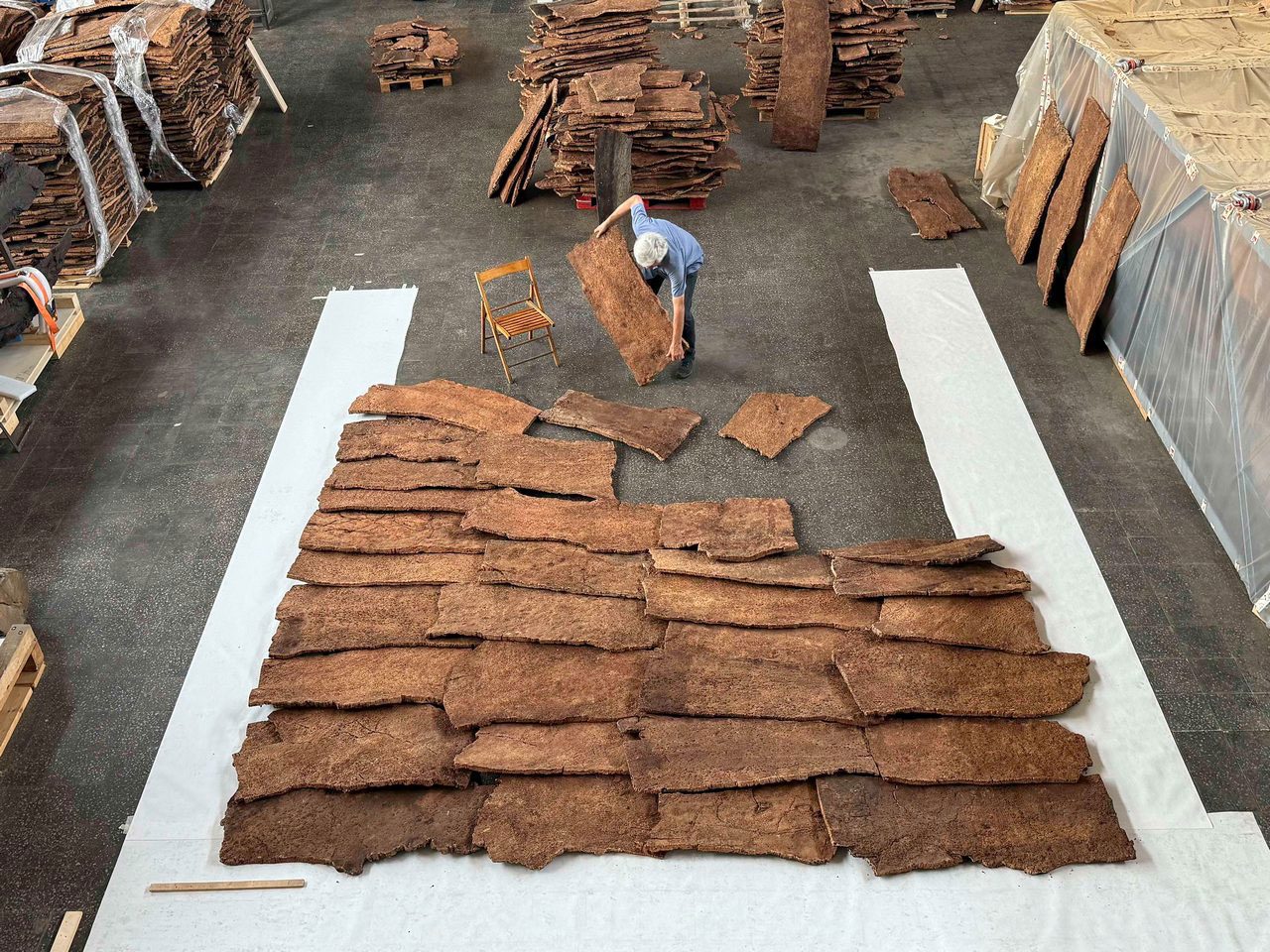
Upon entering, the viewer is immediately enveloped. The walls are lined floor-to-ceiling with sheets of cork, the renewable bark of the cork oak tree. This warm, textured environment, paired with bronze elements, alludes to the regenerative capacity of skin—both human and arboreal. At the center of this space stands “Marsia” (2024), a sculpture inspired by the tragic Greek myth of the satyr who lost a musical contest to Apollo and was flayed alive. Penone translates this brutal narrative into two connected bronze branches: one retains the rough texture of bark, representing the living satyr; the other is stripped bare, revealing the vulnerable, smooth wood beneath. It is a silent, material echo of Titian’s famous painting, a poignant reference to the violence inherent in the act of revealing a core self.
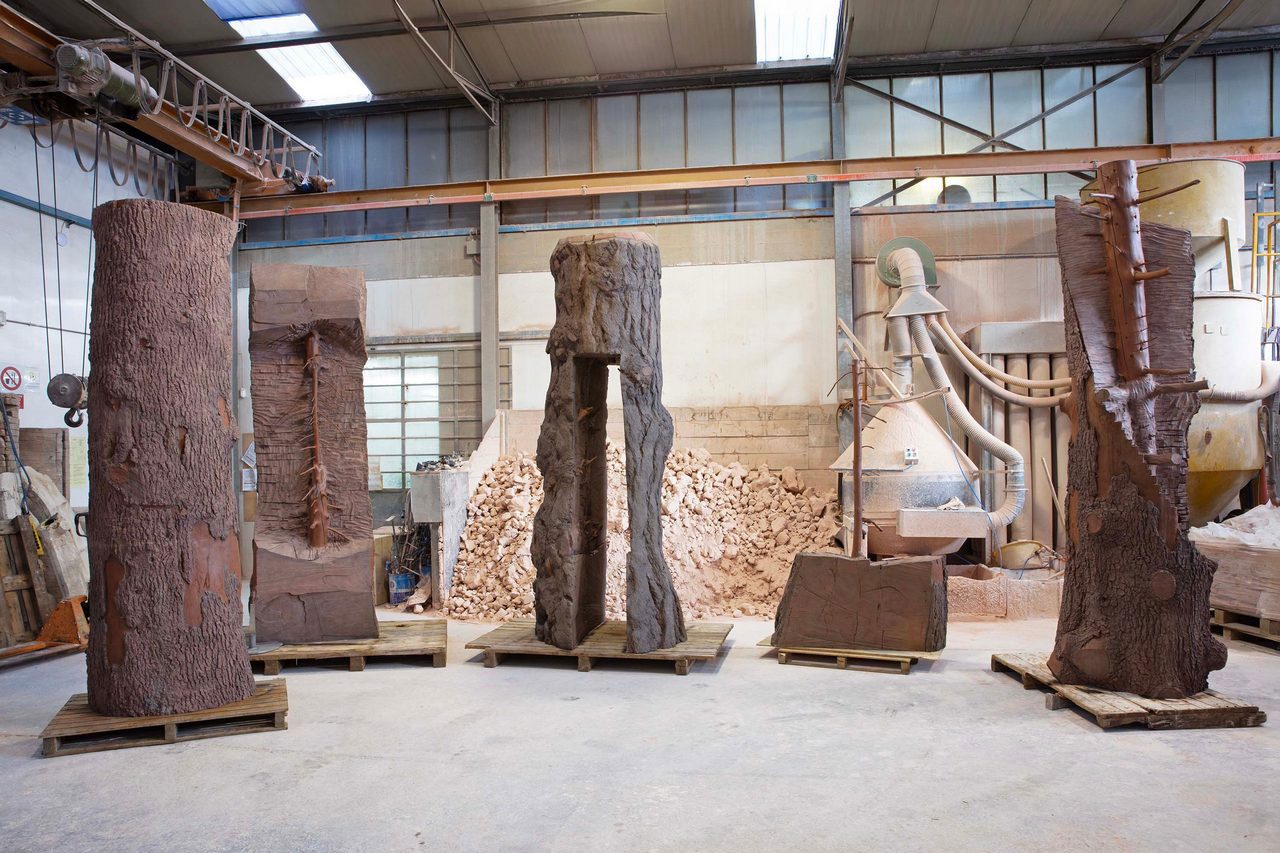
The second room houses four sculptures titled “Clepsydra”, created in 2012 and 2024. These works are bronze casts of carved tree trunks, marking the first time Penone has used the metal to reproduce these specific forms. Evocative images of chronology, they stand as silent timekeepers, their rings and knots fossilized in metal. Adjacent to them is “Un anno di bronzo – Larice” (2024), a sculpture of a tree’s bark in bronze that houses a real living plant. Here, the permanent and the perishable coexist, creating a visual paradox. However, the emotional heart of this room is “Trattenere 6, 8, 12, 16, 20 anni di crescita (Continuerà a crescere tranne che in quel punto)” (2004–24). This set of five bronze trunks, cast at successive intervals, is grasped at its center by a cast of the artist’s hand. This motif directly references Penone’s foundational 1968 “Alpi Marittime” actions, where he literally placed a bronze cast of his hand on a growing sapling, allowing the tree to slowly engulf it. The sculpture is a haunting metaphor for the artist’s touch, a moment of intervention frozen in time as nature continues its inexorable growth.
The exhibition’s final room is a meditation on the nature of reflection itself. Here, Penone presents “Riflesso del bronzo” (2005), a row of bronze panels. The first panel is polished and reflective, a perfect mirror. Each subsequent panel is a cast of its predecessor, accumulating the imperfections, textures, and markers of the traditional casting process. What begins as a pure reflection gradually degrades into an abstract, textural landscape of its own making. In this work, bronze assumes an intimate feel, becoming, according to Penone, “a perpetually imitating material, precious and humble, laden with history”.
To anchor this reflection in the deep past, the gallery includes an ancient Egyptian bronze mirror from c. 1539–1478 BCE, on loan from the Brooklyn Museum. This artifact from the 18th Dynasty—a small, polished disc of metal—becomes the ultimate ancestor of Penone’s panels. It collapses millennia, reminding us that humanity’s fascination with capturing its own reflection and freezing time in bronze is as old as civilization itself. As Weinberg describes it, this space confronts “what happens in the pause, the conceptual space between nature and culture, art and artifact.”
Throughout his career, Penone has moved fluidly between materials. Yet bronze holds a special place. After the Second World War, the alloy partially surrendered its former artistic prominence, only to regain currency through radical new approaches pioneered by Penone and his contemporaries. In his hands, bronze is not the heroic, monumental material of classical statuary. It is a substance of deep intimacy, capable of capturing the finest grain of wood, the gentle pressure of a fingerprint, or the fleeting cloud of a breath.
Photo: Giuseppe Penone working on “Marsia – cork (Marsyas – Cork)” (2025) in his studio, Turin, Italy, 2025, Artwork © Giuseppe Penone/2026 Artists Rights Society (ARS), New York/ADAGP, Paris, Photo: Archivio Penone, Courtesy the artist and Gagosian
Info: Curator: Adam D. Weinberg, Gagosian, 55 West 24th Street, New York, NY, USA, Duration: 22/4-2/7/2026, Days & Hours: Tue-Sat 10:00-18:00, https://gagosian.com/
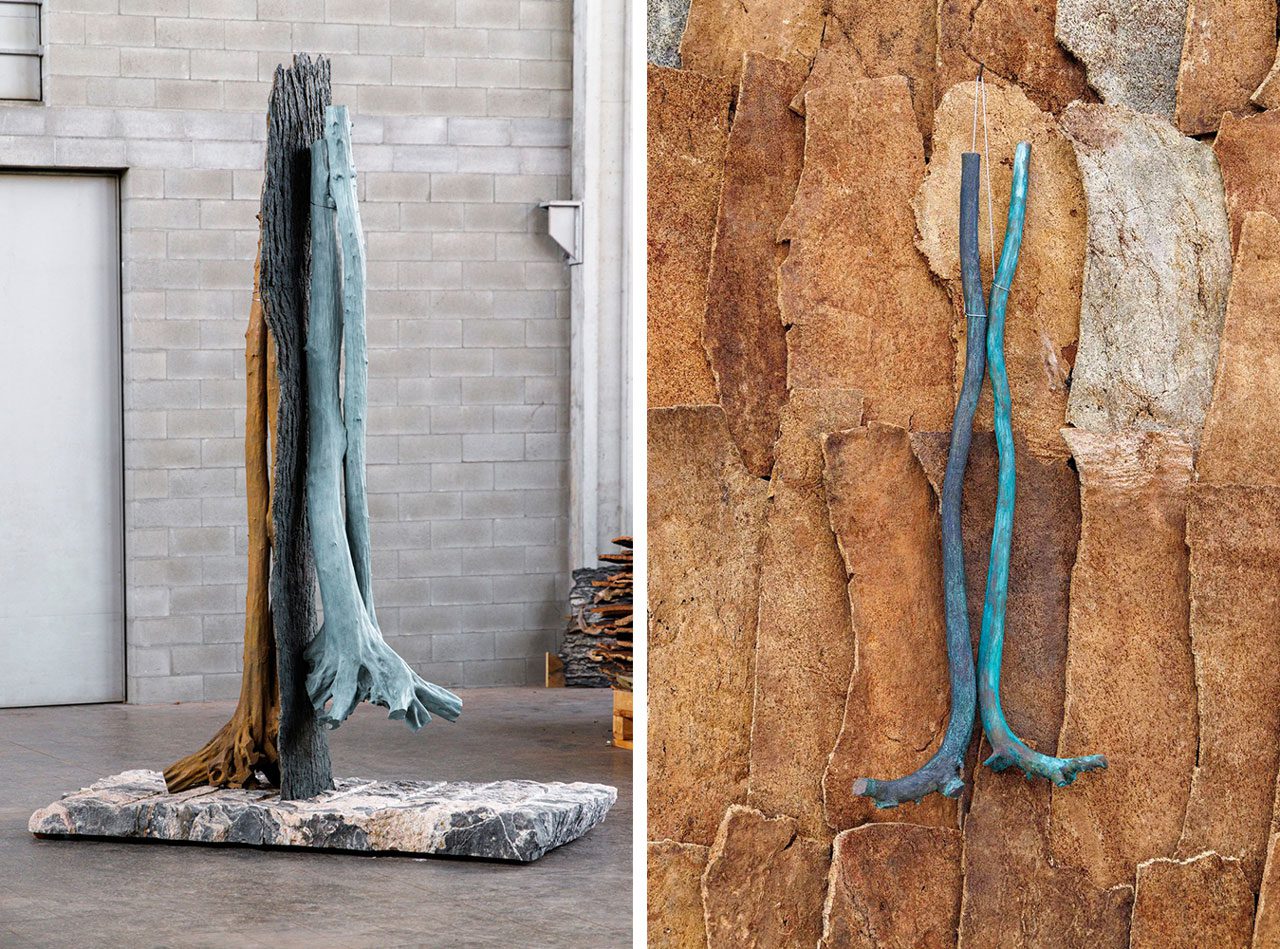
Right: “Marsia (Marsyas)” (2025, detail), Artwork © Giuseppe Penone/2026 Artists Rights Society (ARS), New York/ADAGP, Paris, Photo: Archivio Penone, Courtesy the artist and Gagosian
![Left: Giuseppe Penone with "Clepsydra [1]" (2012) at the foundry in Pietrasanta, Italy, 2025, Artwork © Giuseppe Penone/2026 Artists Rights Society (ARS), New York/ADAGP, Paris, Photo: Sebastiano Pellion di Persano, Courtesy the artist and Gagosian Right: Giuseppe Penone and Adam D. Weinberg at the foundry in Pietrasanta, Italy, 2025, Artwork © Giuseppe Penone/2026 Artists Rights Society (ARS), New York/ADAGP, Paris, Photo: Pepi Marchetti Franchi, Courtesy the artist and Gagosian](http://www.dreamideamachine.com/web/wp-content/uploads/2026/04/Giuseppe-Penone-and-Adam-Weinberg-ph-Pepi-Marchetti-Franchi.jpg)
Right: Giuseppe Penone and Adam D. Weinberg at the foundry in Pietrasanta, Italy, 2025, Artwork © Giuseppe Penone/2026 Artists Rights Society (ARS), New York/ADAGP, Paris, Photo: Pepi Marchetti Franchi, Courtesy the artist and Gagosian