ART CITIES:Berlin-Jürgen Mayer H.
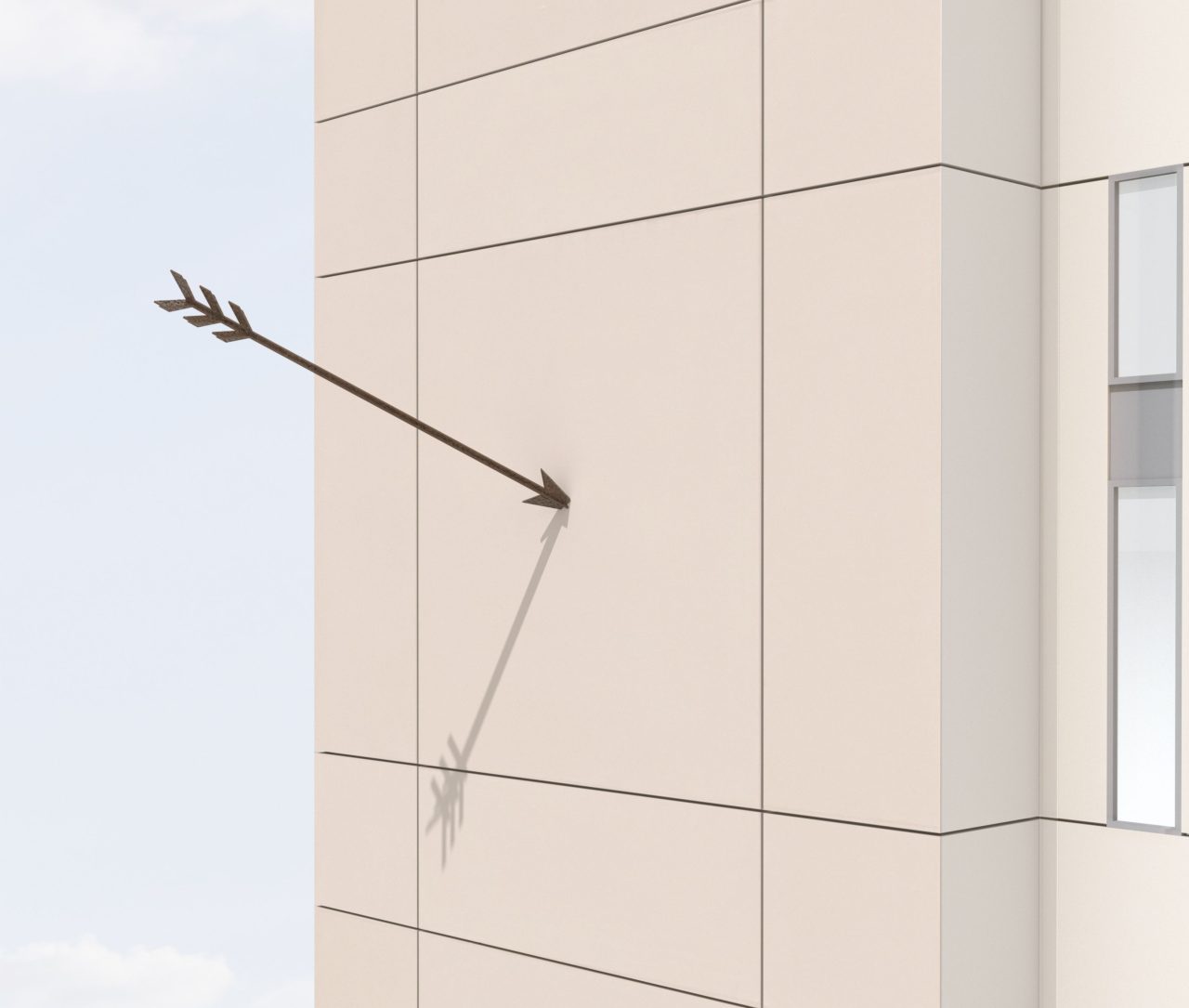
On 15 April 2026, the north façade of the Humboldt Forum in Berlin will be punctuated by a striking new artistic gesture: Südpfeil (“South Arrow”), a three-metre-long bronze arrow installed by the award-winning architect and artist Jürgen Mayer H.. At once subtle and provocative, the intervention commands attention not through monumentality, but through conceptual precision and symbolic charge.
By Dimitris Lempesis
Photo: Humboldt Forum Archive
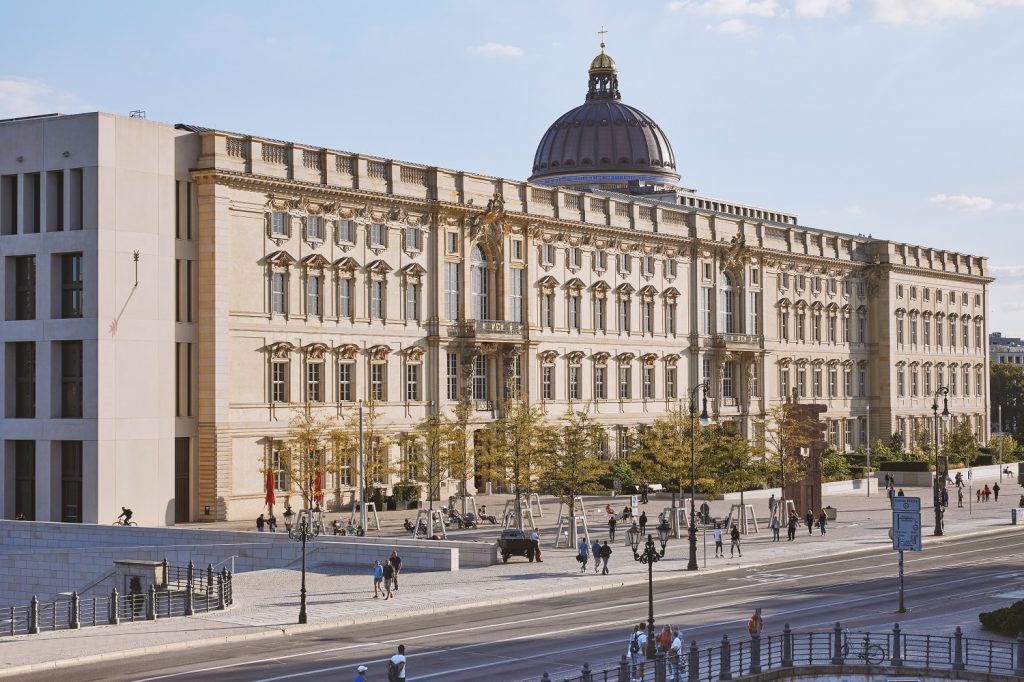
Visually, “Südpfeil” is disarmingly simple. A single arrow appears to pierce the imposing façade of the Humboldt Forum, a building whose architectural language draws heavily on Prussian Baroque forms. Yet this minimal gesture disrupts the surface both physically and intellectually. The arrow’s presence is not ornamental—it is intrusive, almost violent—forcing viewers to confront its implications.
The jury that selected Mayer H.’s proposal from 130 anonymous submissions emphasized precisely this tension: the contrast between the massive institutional architecture and the understated, almost surgical insertion of the arrow. The work does not dominate the structure, but it irrevocably alters how it is perceived.
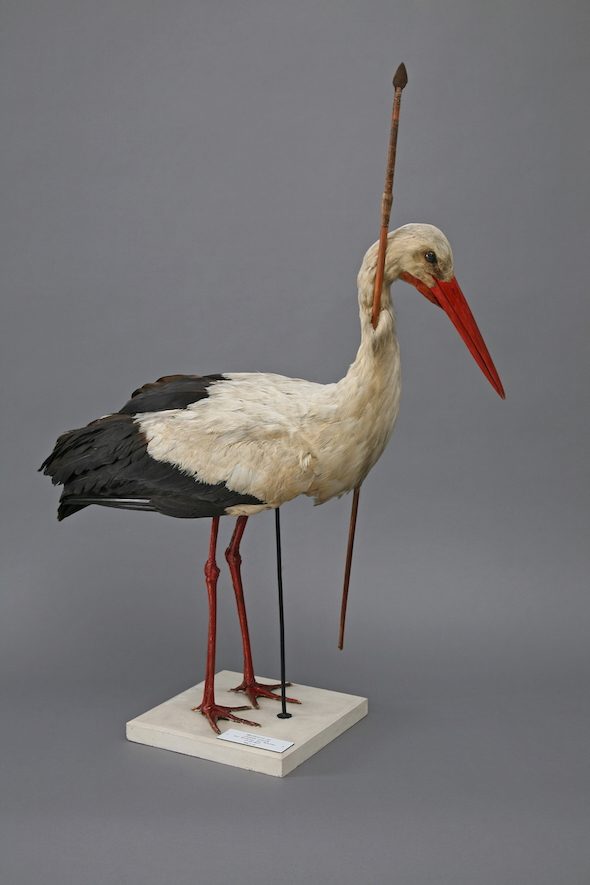
The conceptual foundation of “Südpfeil” lies in the phenomenon of the so-called “arrow storks” (Pfeilstörche). In the 19th century, European naturalists encountered migratory storks that returned from Africa with arrows embedded in their bodies. These birds provided early empirical evidence of long-distance migration between continents, making visible a global interconnectedness that had previously been speculative.
Mayer H. reinterprets this phenomenon as both metaphor and critique. The arrow becomes a signifier of movement, encounter, and violence—linking continents not only through natural migration but also through histories of colonial expansion and exploitation.
According to the artist, the arrow points southward—symbolically toward the Global South—and thereby invokes enduring asymmetries between industrialized nations and formerly colonized regions. These tensions, he suggests, are not confined to the past; they persist in contemporary economic disparities, cultural hierarchies, and political dynamics.
In this reading, “Südpfeil” operates on multiple temporal levels. It references historical injustices while simultaneously addressing present-day global inequality and the unresolved question of restitution and reconciliation. The arrow does not offer answers; instead, it frames a set of urgent, ongoing questions.
“Südpfeil” is the eighth and final commission within the Humboldt Forum’s Kunst am Bau (art in architecture) program—an initiative designed to integrate contemporary artistic practices into the fabric of public buildings. Its placement is particularly significant given the Forum’s own contested status.
The Humboldt Forum, housed in the reconstructed Berlin Palace, has been the subject of intense debate regarding the display of ethnological collections acquired during colonial periods. In this context, Mayer H.’s intervention can be read as both site-specific and institutionally reflexive. The arrow does not merely decorate the building; it interrogates it.
What distinguishes “Südpfei”l is its deliberate ambivalence. The arrow is at once an invitation and a threat, a gesture of connection and an act of aggression. It embodies a duality that resists straightforward interpretation. This openness is central to its effectiveness.
Rather than imposing a didactic narrative, the work encourages viewers to engage intellectually and emotionally. It creates a space for reflection without prescribing a conclusion. In doing so, it aligns with a broader tendency in contemporary art to privilege multiplicity of meaning over singular interpretation.
Ultimately, “Südpfeil” succeeds through restraint. It demonstrates how a minimal formal intervention can carry substantial conceptual weight. By embedding a single object into a historically and politically charged site, Mayer H. activates layers of meaning that extend far beyond the physical dimensions of the work.
In an era marked by renewed scrutiny of colonial legacies and global inequalities, “Südpfeil” offers a timely and incisive contribution. It neither overwhelms nor retreats; instead, it occupies a critical threshold—one that compels viewers to reconsider the past, confront the present, and imagine the possibilities of a more equitable future.
Photo: Jürgen Mayer H., Südpfeil, at the north façade of Humboldt Forum
Info: Humboldt Forum, north façade, Schloßplatz, Berlin, Germany, Duration 14/4/2026 – , Daily 00:00-24:00, www.humboldtforum.org/