
PRESENTATION: Anna Bjerger-The Dusk
Anna Bjerger’s paintings draw on images from her everyday surroundings. Small details, fleeting situations and quiet observations become the starting point for her work. Working with oil on aluminium, Bjerger balances the physical presence of the painting with the psychological resonance of the image. Her works offer quiet reflections on perception and memory, inviting us to look again at the familiar and discover the poetic potential embedded in the ordinary.
By Efi Michalarou
Photo: Galleri Bo Bjerggaard Archive
In her latest solo exhibition, “The Dusk”, Anna Bjerger turns toward a threshold state—psychological, spatial, and temporal—drawing inspiration from Pär Lagerkvist’s 1919 poem “Det är vackrast när det skymmer” (“It’s most beautiful when it’s twilight”). The title signals more than atmosphere; it establishes a framework for understanding the work. Twilight becomes both subject and structure: a suspended condition in which distinctions blur—between interior and exterior, presence and absence, self and image.
At the core of this exhibition is a shift in how Bjerger approaches painting. Rather than constructing fixed narratives or clearly resolved scenes, she treats the canvas as a space where images can emerge, hover, and remain unresolved. The paintings do not insist on meaning; instead, they allow it to surface gradually, contingent on perception and time. What matters is not only what is depicted, but the state of being within the image itself.
This marks a significant evolution in her practice. For much of her career, Bjerger worked from found imagery—photographs drawn from utilitarian and often impersonal sources such as travel brochures, local history books, or instructional materials. These images, stripped of their original context, became raw material. Through the act of painting, they were reconstituted, acquiring new layers of ambiguity and resonance. The resulting works occupied a tension between anonymity and intimacy; viewers often felt that these scenes, though borrowed, carried the weight of personal memory. Over time, such images became a kind of surrogate biography—fragments that stood in for lived experience.
Initially, this strategy allowed Bjerger to distance herself from emotion and memory, focusing instead on the formal and material aspects of painting. That distance, however, has now collapsed. In “The Dusk”, the reliance on found imagery is largely abandoned. Bjerger instead works from photographs she takes herself, drawn directly from her immediate surroundings. The intermediary is removed, and with it the protective layer of detachment. The paintings now emerge from a more immediate encounter with the world.
This transition is closely tied to a recent change in her life. After spending 25 years living and working deep in the Swedish forest, Bjerger has moved to the center of Malmö. The forest offered a sense of solitude and singularity, where what she saw felt uniquely hers. In the city, that sense dissolves. Every scene is potentially shared, already witnessed by countless others. The artist becomes one observer among many, navigating a visual field that is collective rather than private.
Her new studio reflects this condition. It is a blank, unaccumulated space—a tabula rasa not yet filled with the sediment of years of work. In such an environment, each object or image enters with heightened intensity. Nothing is neutral; everything is amplified. The act of selection becomes more acute, more deliberate.
But where is the artist in these paintings? She is present, but only fleetingly. Rather than occupying a fixed position, Bjerger appears as a transient observer, moving through spaces without fully settling into them. The first painting in the exhibition, “Red Socks”, provides a subtle point of orientation. It is a self-portrait without a mirror: a view looking down at her own feet. The gesture is simple but significant.
Thresholds recur throughout the exhibition. Stairwells, doorways, and windows dominate paintings such as “Magenta”, “The Flat”, and “Uninhabited”. These are not spaces of arrival or belonging, but of transition. Unlike the interiors of Vilhelm Hammershøi or Michael Anker, which often convey a quiet sense of domestic stability, Bjerger’s spaces remain unsettled. They are places of hesitation, of lingering just outside rather than fully entering.
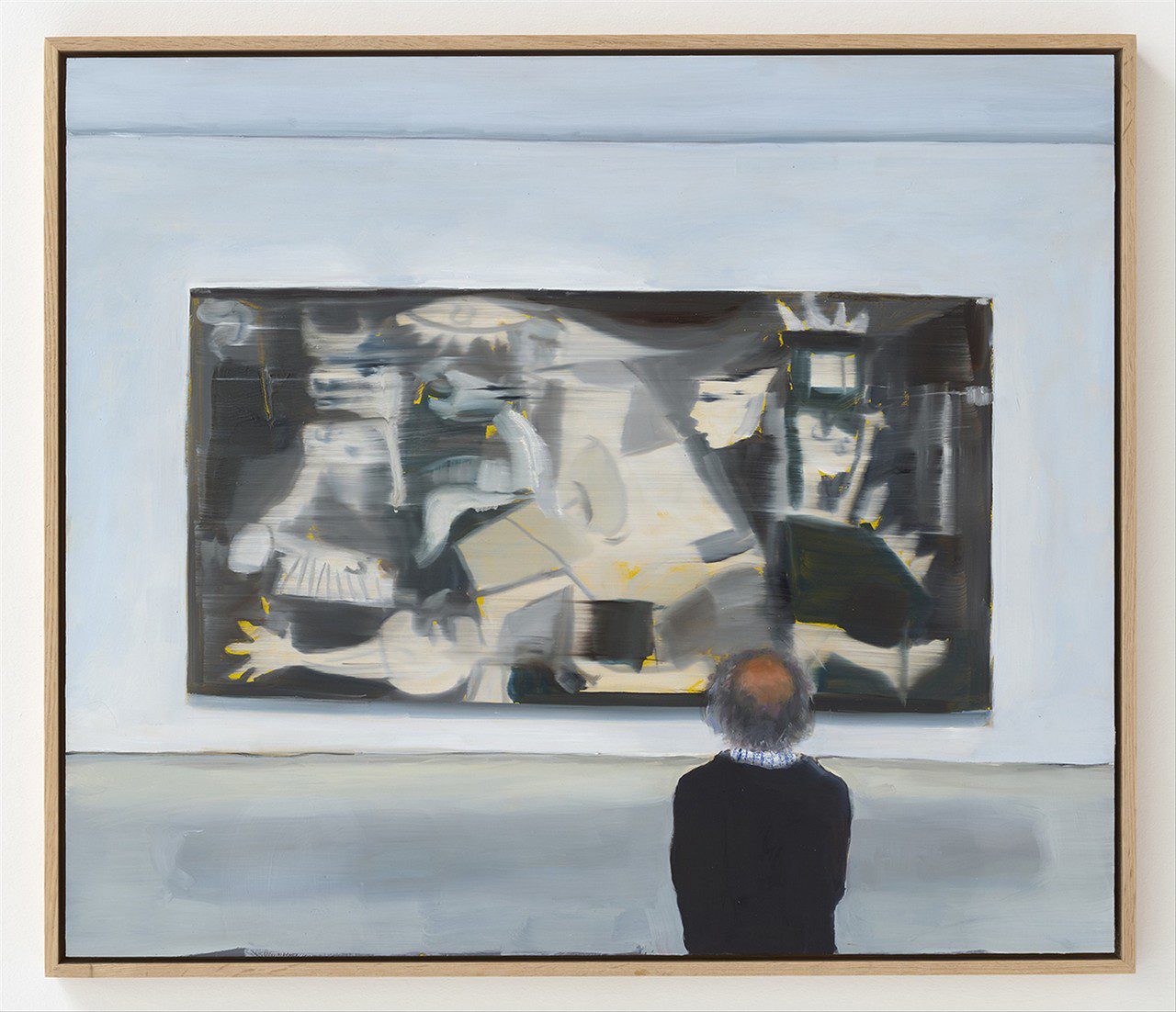
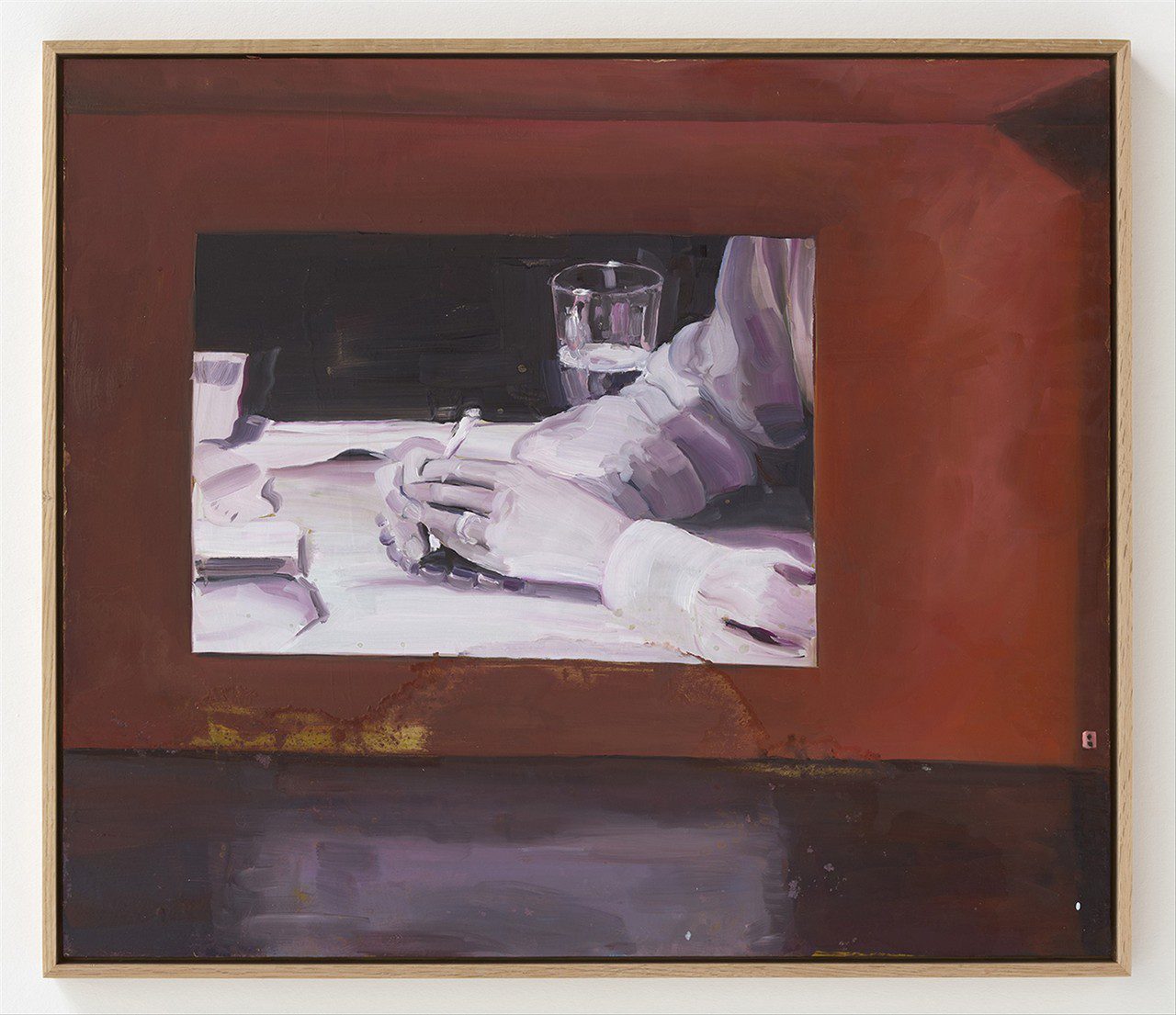
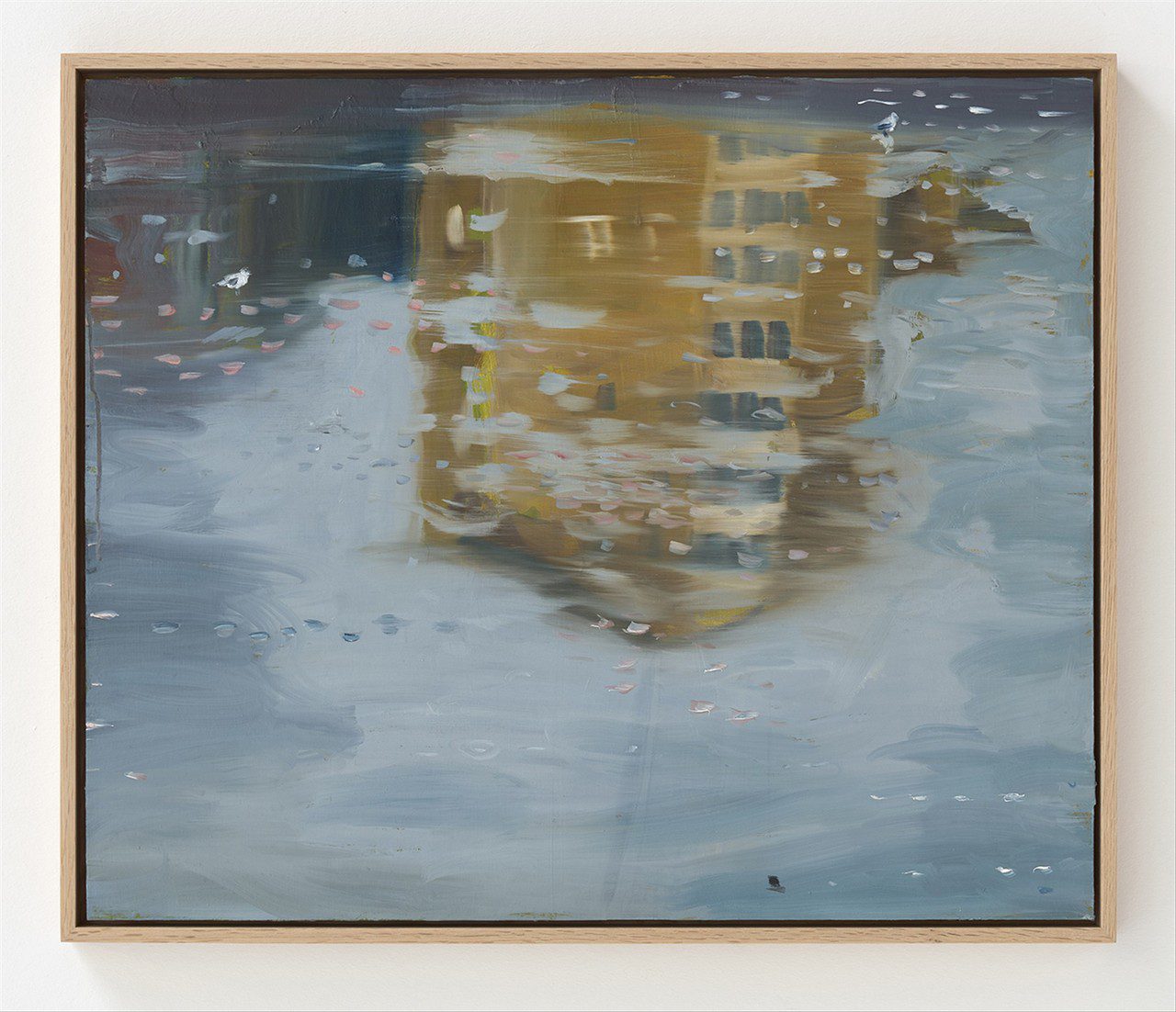
Public spaces also play a central role. Markets, museums, and café tables appear as shared environments where the artist’s gaze intersects with that of others. In “Madrid,” a figure stands before Guernica, absorbed in looking. The act of viewing becomes layered: we observe someone observing, creating a recursive loop that destabilizes the notion of a single, fixed perspective. In “From Another Place,” a fragment of a black-and-white film is projected onto a gallery wall. The image is already mediated, already displaced, and the painting reinforces this sense of distance. Seeing itself becomes uncertain, doubled, and deferred.
A key transitional work, “Pine”, isolates a single tree from its natural context. Removed from the forest and placed under stark artificial lighting, it casts multiple shadows, evoking the heightened theatricality of a stage. The image recalls the psychologically charged landscapes of Carl Fredrik Hill, where nature appears both familiar and estranged.
In “Outside / Inside”, Bjerger further complicates spatial coherence. A dark interior opens onto a brightly lit meadow that leads to the edge of a forest. The painting juxtaposes different painterly approaches: a carefully constructed interior against a more immediate, gestural landscape. The result is a space that resists integration, reinforcing the exhibition’s broader sense of disjunction.
At the center of the exhibition is the large-scale painting “Exit.” A concentrated pool of light reveals a wall-mounted switch, suggesting the possibility of extinguishing the very illumination that makes the scene visible. Above it, in the surrounding dimness, an exit sign glows steadily. The imagery is direct yet open-ended. The option to leave remains constant, even in darkness.
Bjerger has noted that she always looks for the exit sign in a room—that she can remain as long as she knows there is a way out. This impulse runs through the exhibition. The paintings do not seek closure or resolution; they remain in suspension, inhabiting a state of in-betweenness. Like dusk itself, they occupy a transitional zone—an anteroom to something not yet defined.
These works function less as narratives than as temporal passages. They invite the viewer not to arrive at a conclusion, but to linger in uncertainty, to inhabit the shifting space between presence and absence. The artist is there, but only just—visible in fragments, in gestures, in fleeting perspectives. And always, somewhere within the frame, there is the possibility of exit.
Photo: Anna Bjerger, Madrid, 2026, Oil on aluminium, 63 cm x 73 cm x 4 cm, © Anna Bjerger, Courtesy the artist and Galleri Bo Bjerggaard
Info: Galleri Bo Bjerggaard, Sankt Knuds Vej 23C, Frederiksberg, Denmark, Duration: 10/4-13/5/2026, Days & Hours: Wed-Fri 13:00-18:00, Sat 12:00-18:00, https://bjerggaard.com/
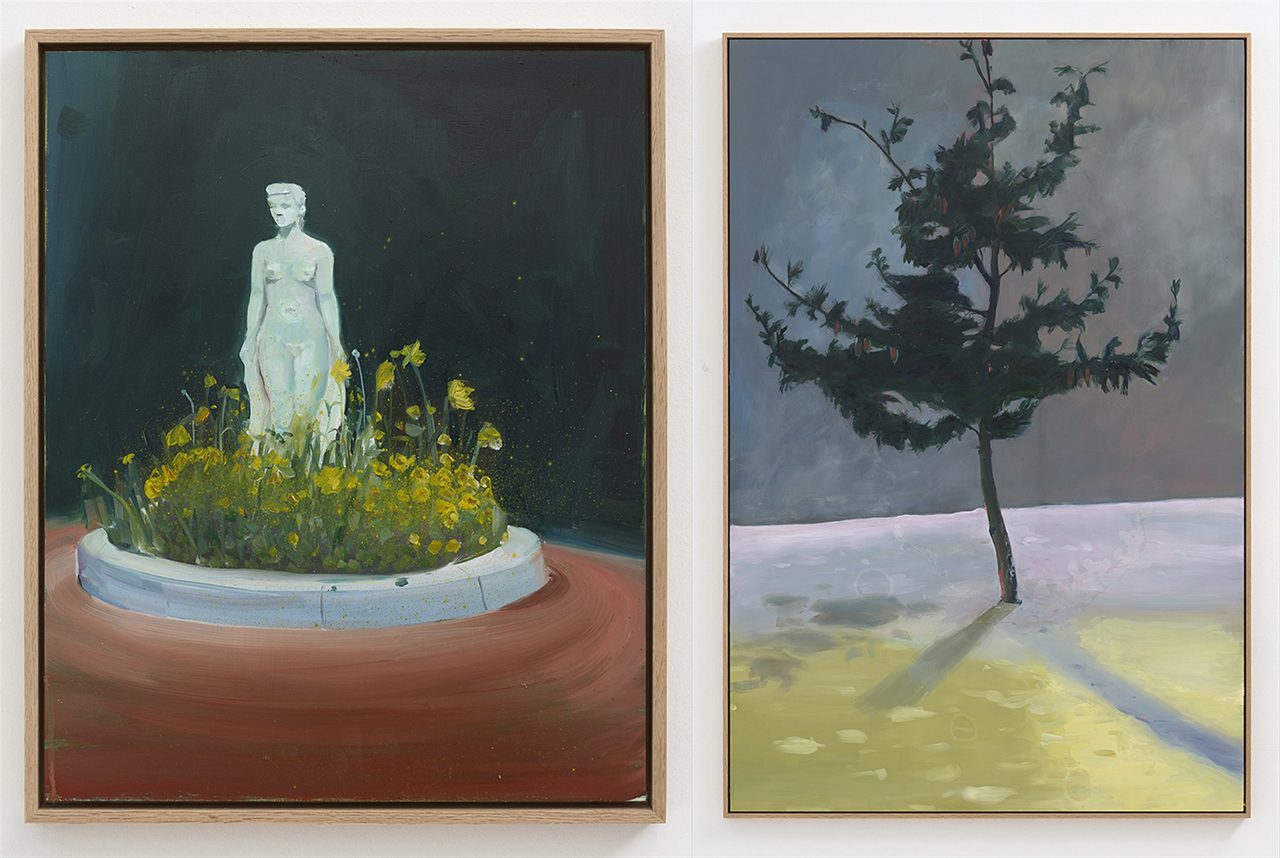
Right: Anna Bjerger, Pine, 2026, Oil on aluminium, 153 cm x 103 cm x 4 cm, © Anna Bjerger, Courtesy the artist and Galleri Bo Bjerggaard
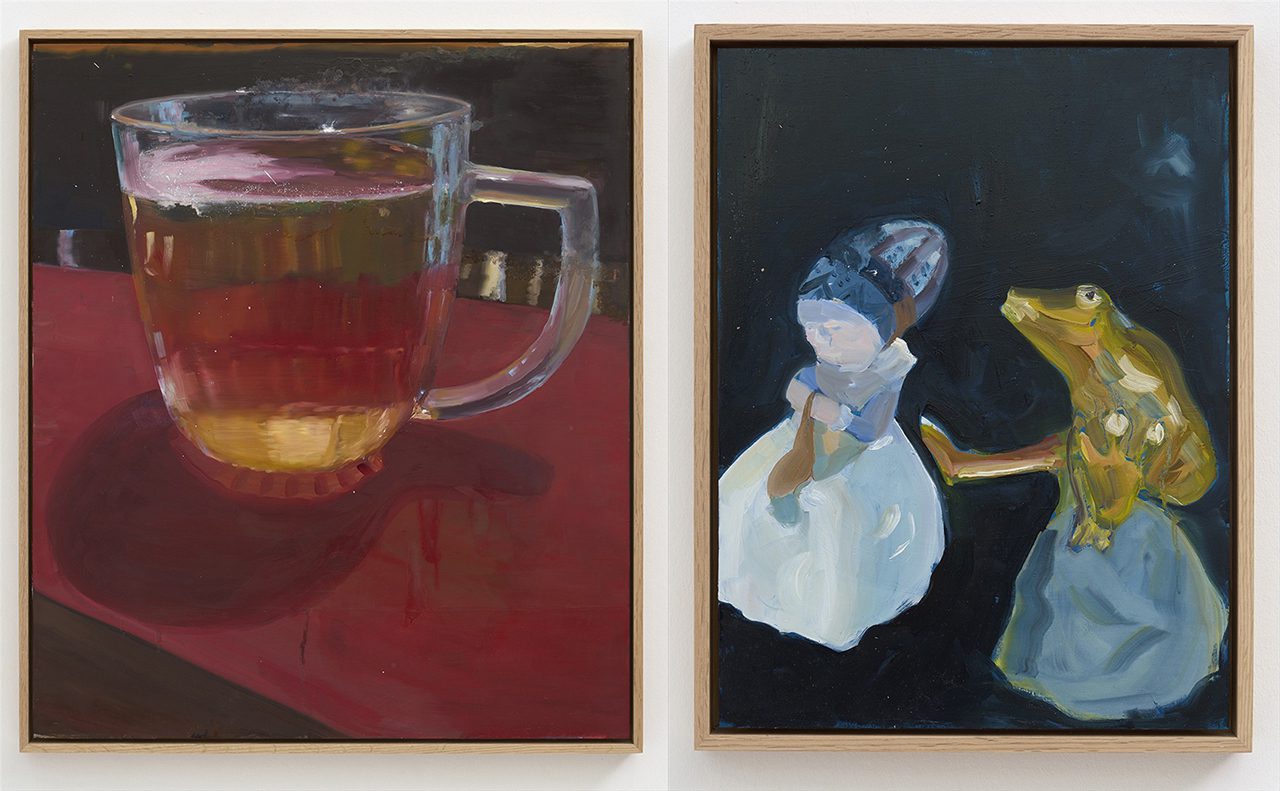
Right: Anna Bjerger, The Lounge, 2026, Oil on aluminium, 43 cm x 33 cm x 4 cm, © Anna Bjerger, Courtesy the artist and Galleri Bo Bjerggaard
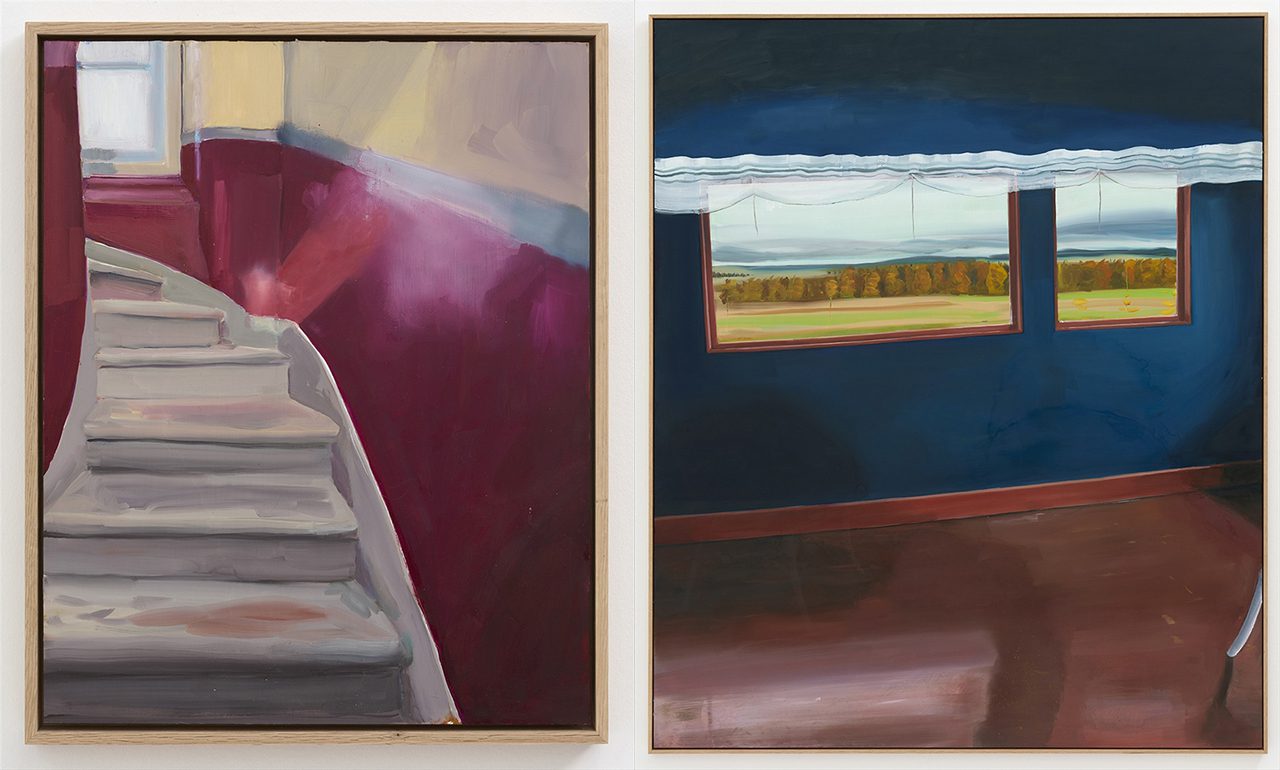
Right: Anna Bjerger, Magenta, 2026, Oil on aluminium, 53 cm x 43 cm x 4 cm, © Anna Bjerger, Courtesy the artist and Galleri Bo Bjerggaard
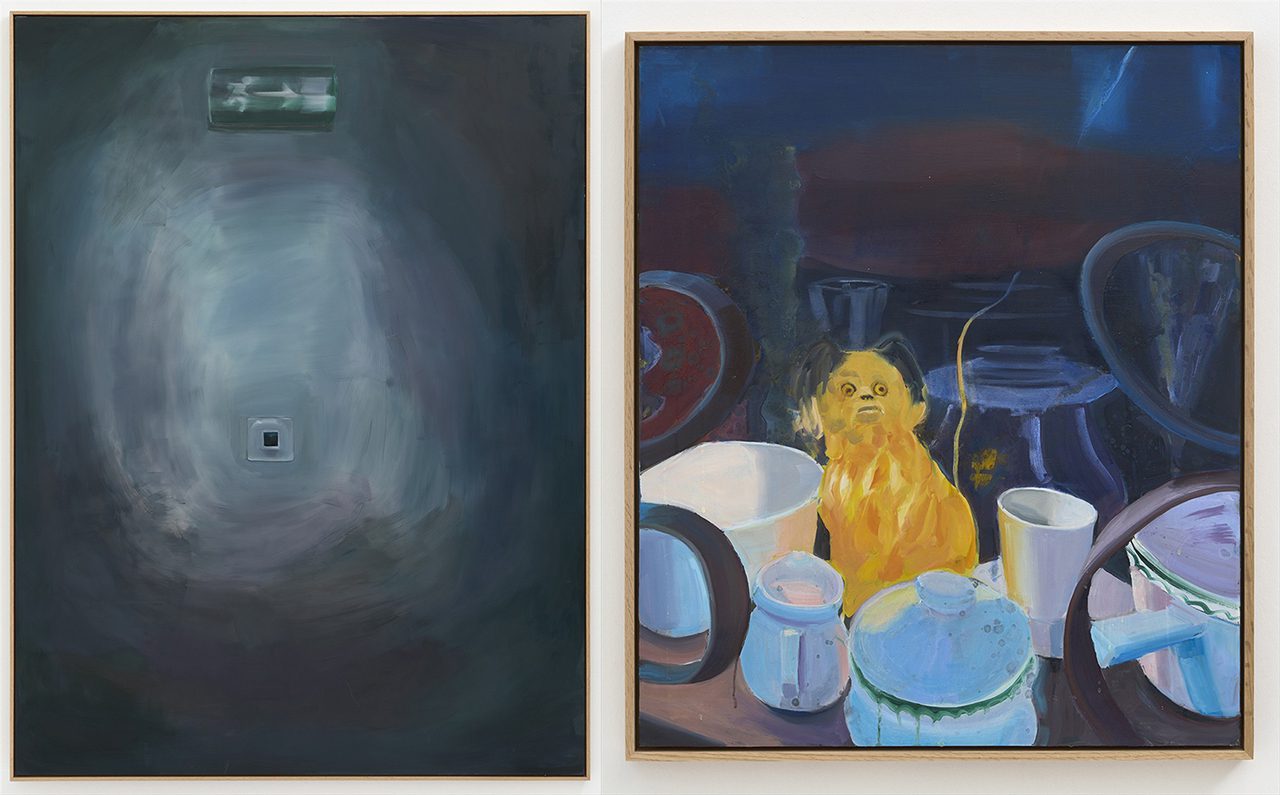
Right: Anna Bjerger, Light, 2026, Oil on aluminium, 73 cm x 63 cm x 4 cm, © Anna Bjerger, Courtesy the artist and Galleri Bo Bjerggaard
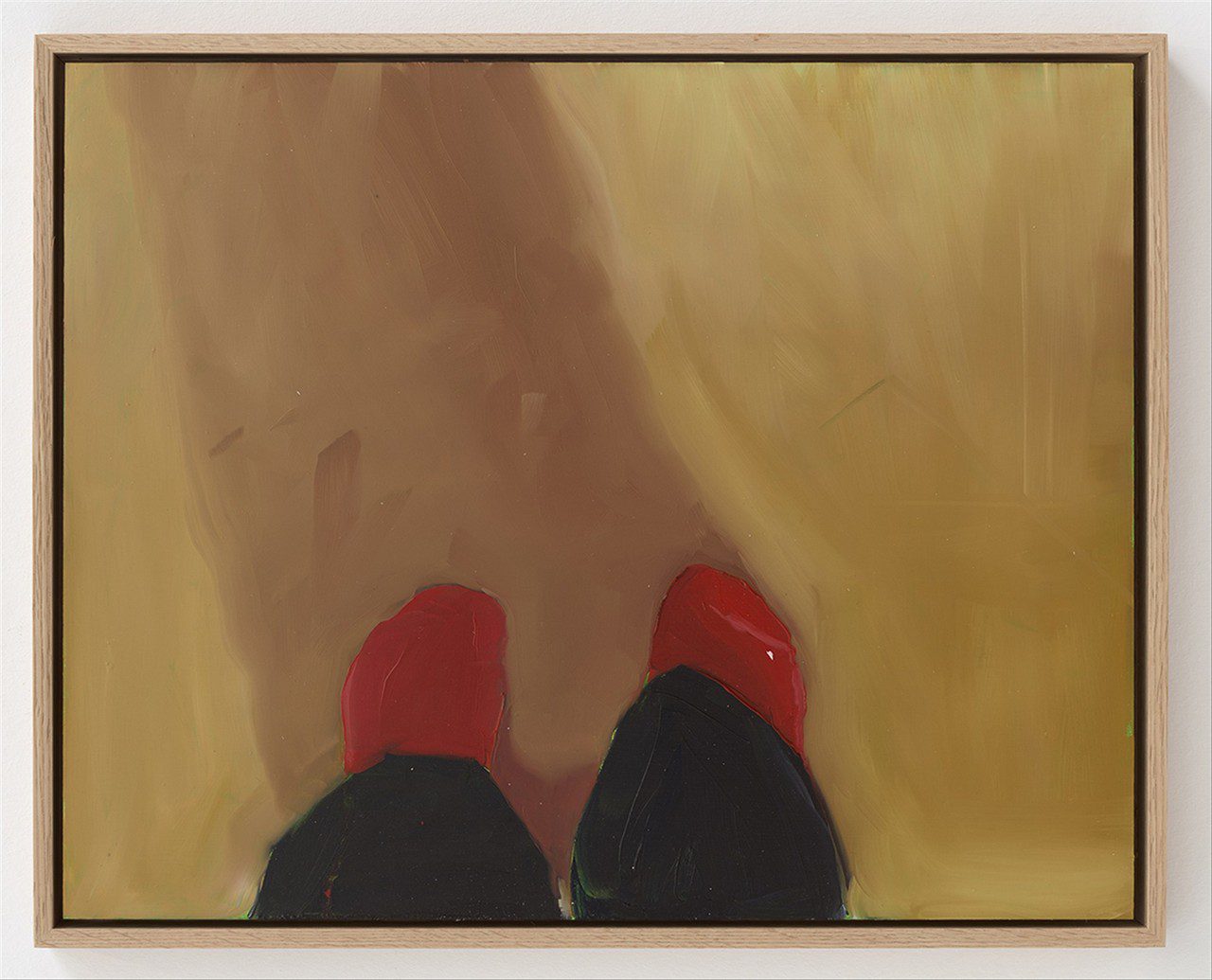
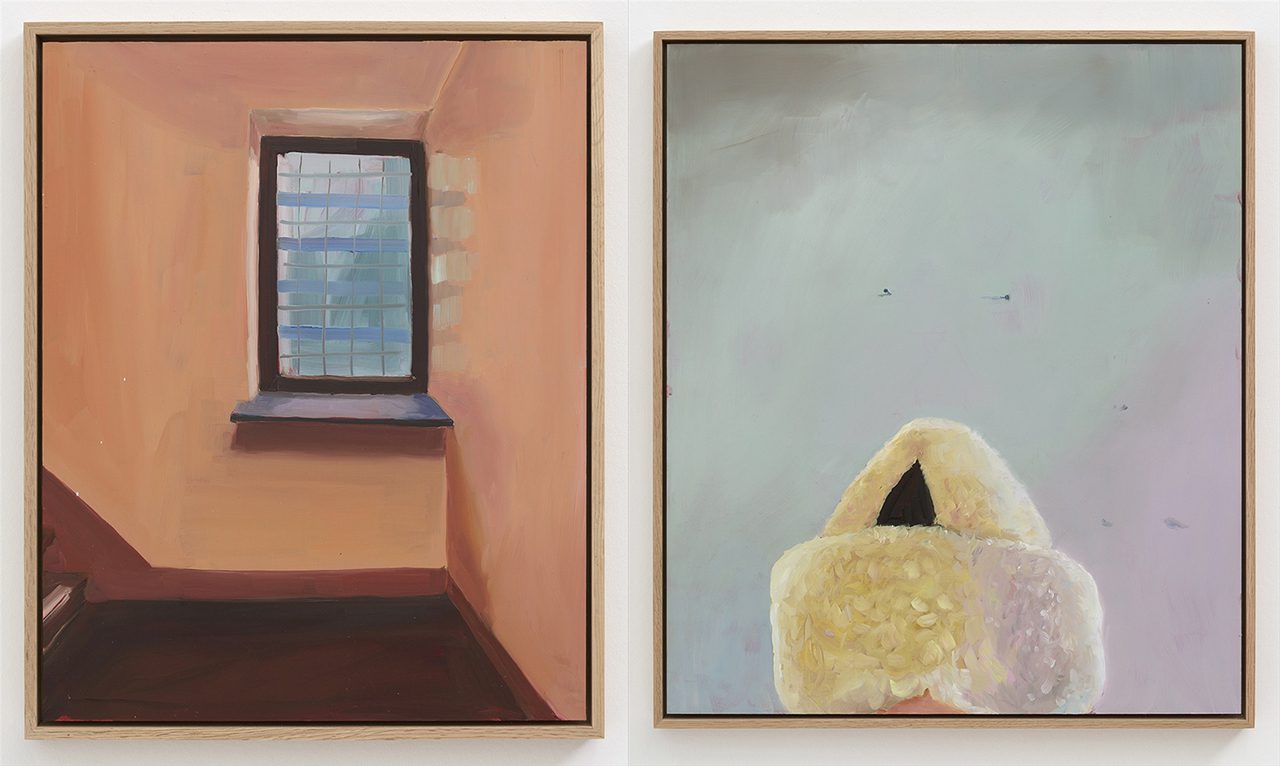
Right: Anna Bjerger, Studio Wall, 2026, Oil on aluminium, 73 cm x 63 cm x 4 cm, © Anna Bjerger, Courtesy the artist and Galleri Bo Bjerggaard