PREVIEW: Aria Dean, Sandra Mujinga, and Tschabalala Self
Galerie Eva Presenhuber brings together three of the most incisive artists working today — Aria Dean, Sandra Mujinga, and Tschabalala Self — in a group exhibition that examines how bodies are made, unmade, and reimagined across contemporary visual culture. Working respectively through moving image, sculpture, and painting, the artists interrogate the architectures of modern violence, the afterlives of grief, and the constructed nature of identity. Their practices resist spectacle, instead reconfiguring the terms through which subjecthood is perceived and felt.
By Efi Michalarou
Photo: Galerie Eva Presenhuber Archive
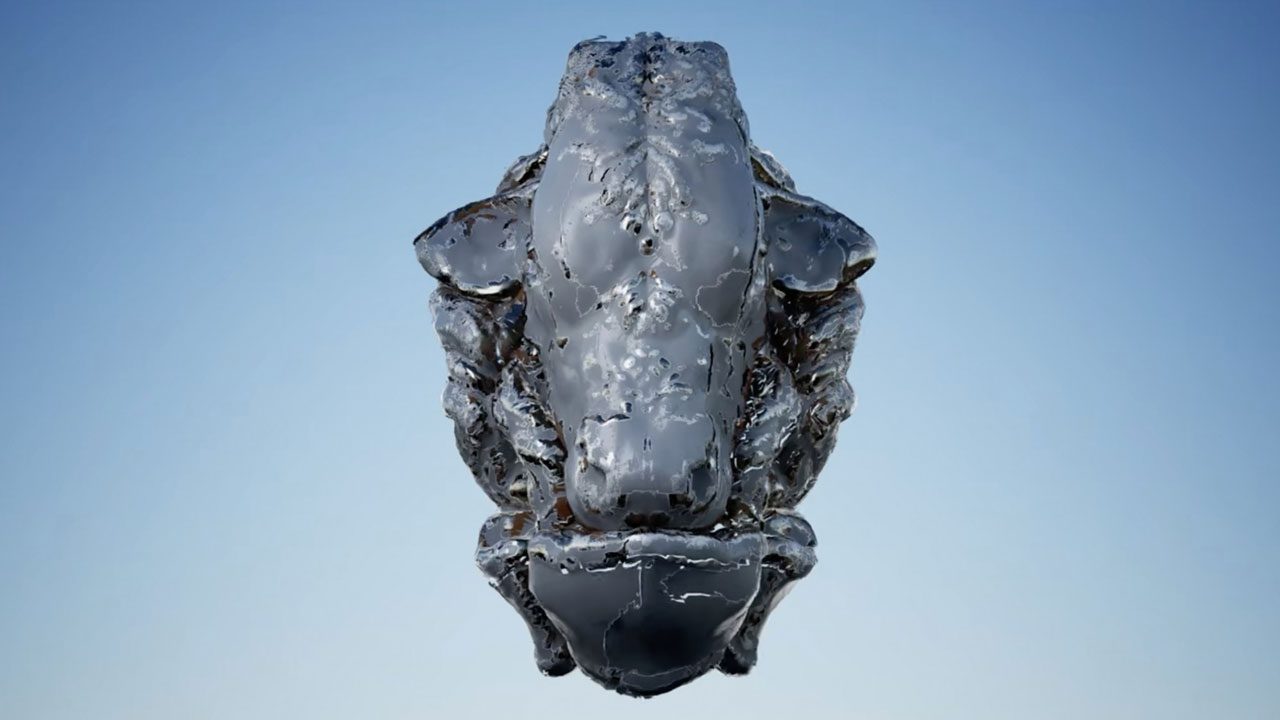
Aria Dean’s contribution unfolds across two works: the immersive film “Abattoir U.S.A.!” (2023) and the sculptural assemblage “Mambrino’s Helmet” (2026). Though formally distinct, both pieces critique the structural logics embedded in their source materials and hinge on the absence of a stable human subject.
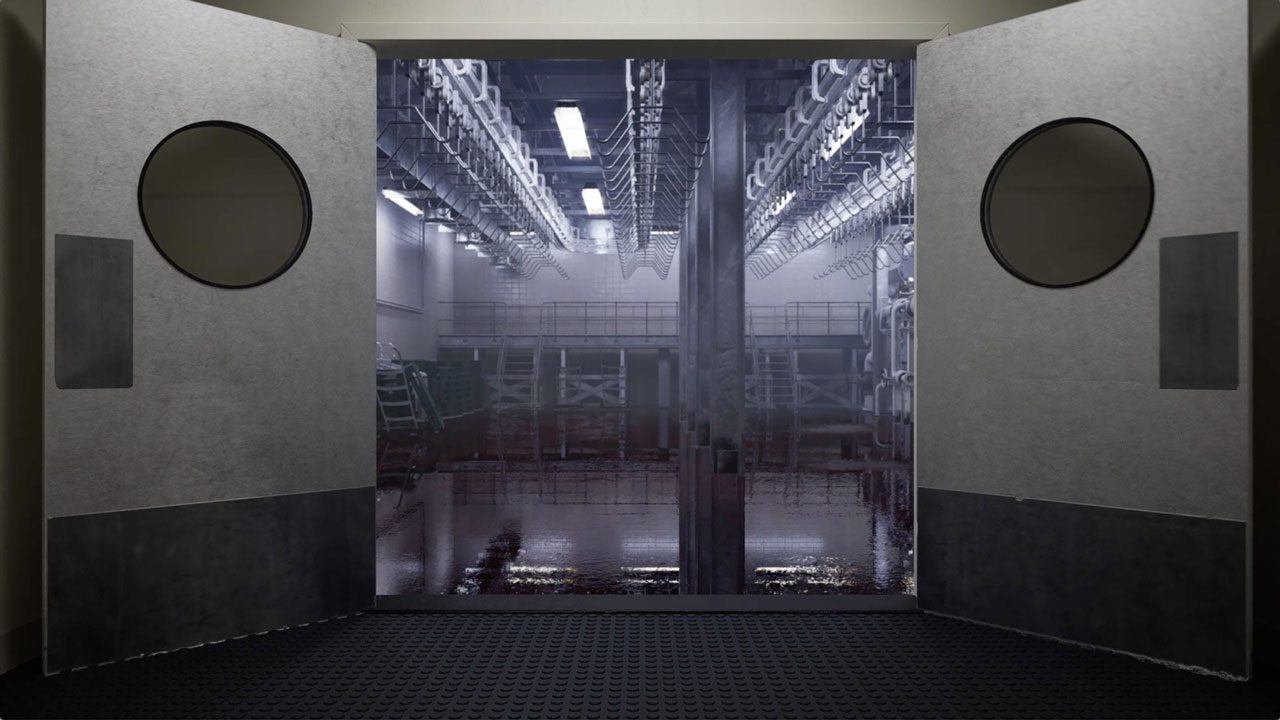
Rendered using Unreal Engine and accompanied by Evan Zierk’s disquieting eight-channel score, the film “Abattoir U.S.A.!” guides viewers through an empty industrial slaughterhouse. No workers, no animals, no bodies — only the architecture of killing. Influenced by Georges Bataille and Frank B. Wilderson III, Dean approaches death materially rather than symbolically, depicting the infrastructure that enables violence rather than its victims. The result is a necropolitical study of how modernity organizes death while withholding its spectacle.
The sculptural readymade “Mambrino’s Helmet” — a motorcycle helmet bound with foam, nails, and tape — invokes the episode in “Don Quixote” in which a barber’s basin is mistaken for a magical helmet. Dean mobilizes this slippage between reality and interpretation to question how narratives shape the world more forcefully than objects themselves. The helmet, like the slaughterhouse, is defined by absence: a container without a wearer, a myth without its magic.
Together, Dean’s works expose the conceptual, architectural, and narrative systems that determine how bodies appear and disappear in contemporary life.
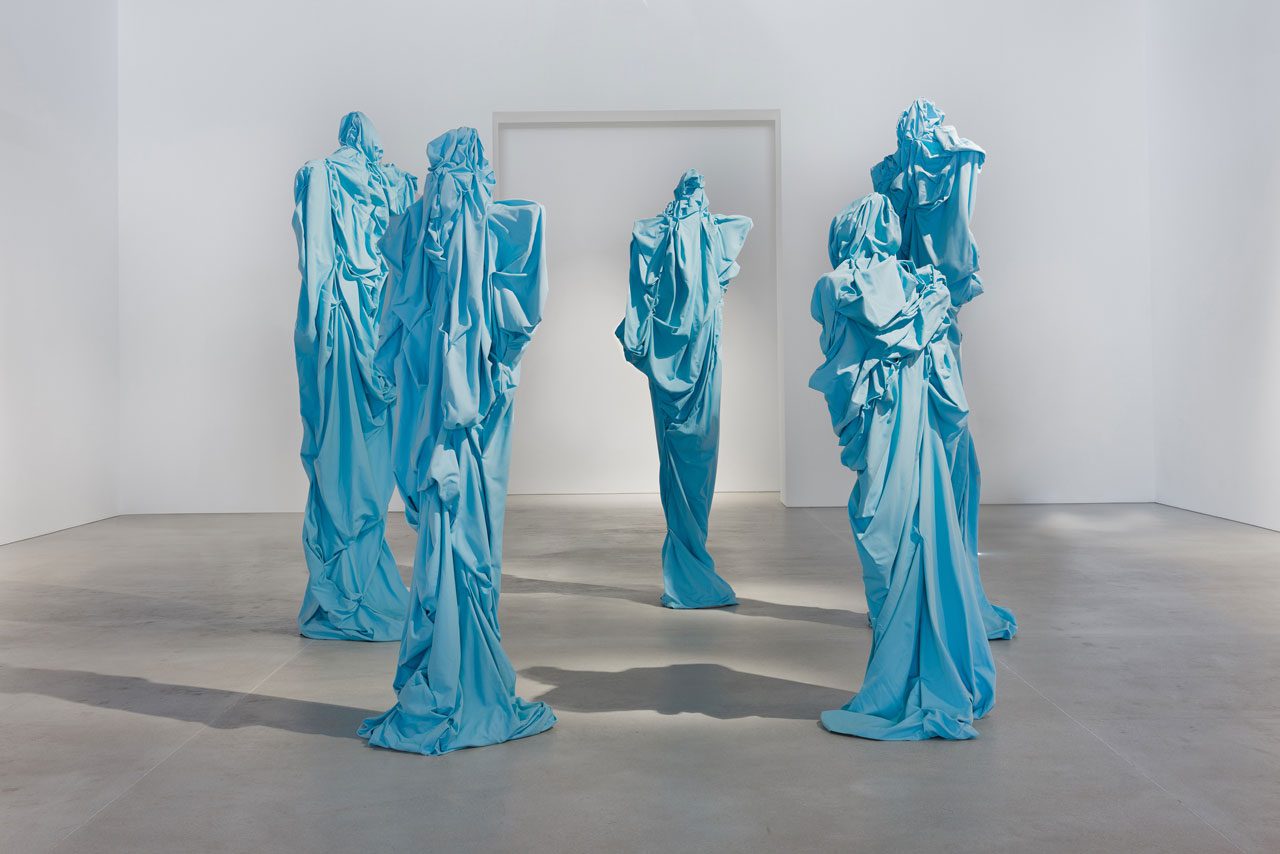
Sandra Mujinga’s sculptural series “Unfold and Repair” (2024) explores how bodies persist in the aftermath of violence. Five fabric-based forms — steel skeletons draped in cerulean cotton and padded with foam — stand at varying heights in a room bathed in blue light. Their gathered, hand-stitched skins foreground the slow labour of making, echoing the cyclical nature of mourning described by Christina Sharpe in “Ordinary Notes” (2023).
Mujinga’s figures hover between presence and disappearance. They are humanoid yet ungraspable, spectral yet grounded in material care. Rather than rendering suffering as spectacle, the sculptures protect the body through partial concealment. Fabric becomes a temporal medium: folded, stretched, and repaired, it holds memory, endurance, and the ongoing work of living alongside loss.
Her broader practice — informed by post-human theory, the afterlives of colonialism, and speculative world-building — consistently investigates visibility, opacity, and the politics of self-representation.
Tschabalala Self offers the exhibition’s most explicitly painterly position. Working across painting, collage, appliqué, and stitching, she constructs exuberant, larger-than-life portraits of Black women. Her method echoes the Surrealist “exquisite corpse,” assembling bodies from disparate fragments to explore how Black femininity is imagined, performed, and materially constructed.
In “Diamond”, “Kitten”, and “Wednesday” (all 2026), Self creates full-length patchwork figures whose identities emerge through accumulation: patterned fabrics stitched into the canvas become not clothing but structural components of the body. Skin appears as a mosaic of brown, beige, and ochre scraps, tattooed with painted marks that assert Blackness as a lived, spiritual, and embodied reality — not an aesthetic category.
Against saturated monochrome backgrounds, Self’s figures stand poised and self-possessed. Their seams remain visible, foregrounding the labour of construction and reclaiming the body as something actively made. This approach resonates with her broader practice, which has been widely exhibited internationally and centres the Black body as both subject and agent.
Across the exhibition, Dean, Mujinga, and Self articulate three distinct yet interwoven approaches to the body: Dean reveals the systems that structure disappearance, Mujinga sutures grief into forms that resist legibility and Self constructs presence through material accumulation.
What emerges is a shared refusal of passive representation. Instead, the artists foreground the architectures — physical, conceptual, historical — through which bodies are shaped, erased, or reclaimed. Their works insist that subjecthood is not a given but a site of continual negotiation, repair, and reinvention.
Participating Artists: Aria Dean, Sandra Mujinga, and Tschabalala Self
Photo: Sandra Mujinga, Unfold and Repair 2024 Cotton, steel, foam; 5 parts; Figure 1: 280 x 70 x 70 cm / 110 1/4 x 27 1/2 x 27 1/2 in, Figure 2: 280 x 70 x 70 cm / 110 1/4 x 27 1/2 x 27 1/2 in, Figure 3: 260 x 70 x 70 cm / 102 3/8 x 27 1/2 x 27 1/2 in, Figure 4: 230 x 70 x 70 cm / 90 1/2 x 27 1/2 x 27 1/2 in, Figure 5: 200 x 70 x 70 cm / 78 3/4 x 27 1/2 x 27 1/2 in, Courtesy GRAY Chicago/New York, © Sandra Mujinga
Info: Galerie Eva Presenhuber, Waldmannstrasse 6, Zurich, Switzerland, Duration: 28/3-23/5/2026, Days & Hours: Tue-Fri 11:00-18:00, Sat 11:00-17:00, www.presenhuber.com/
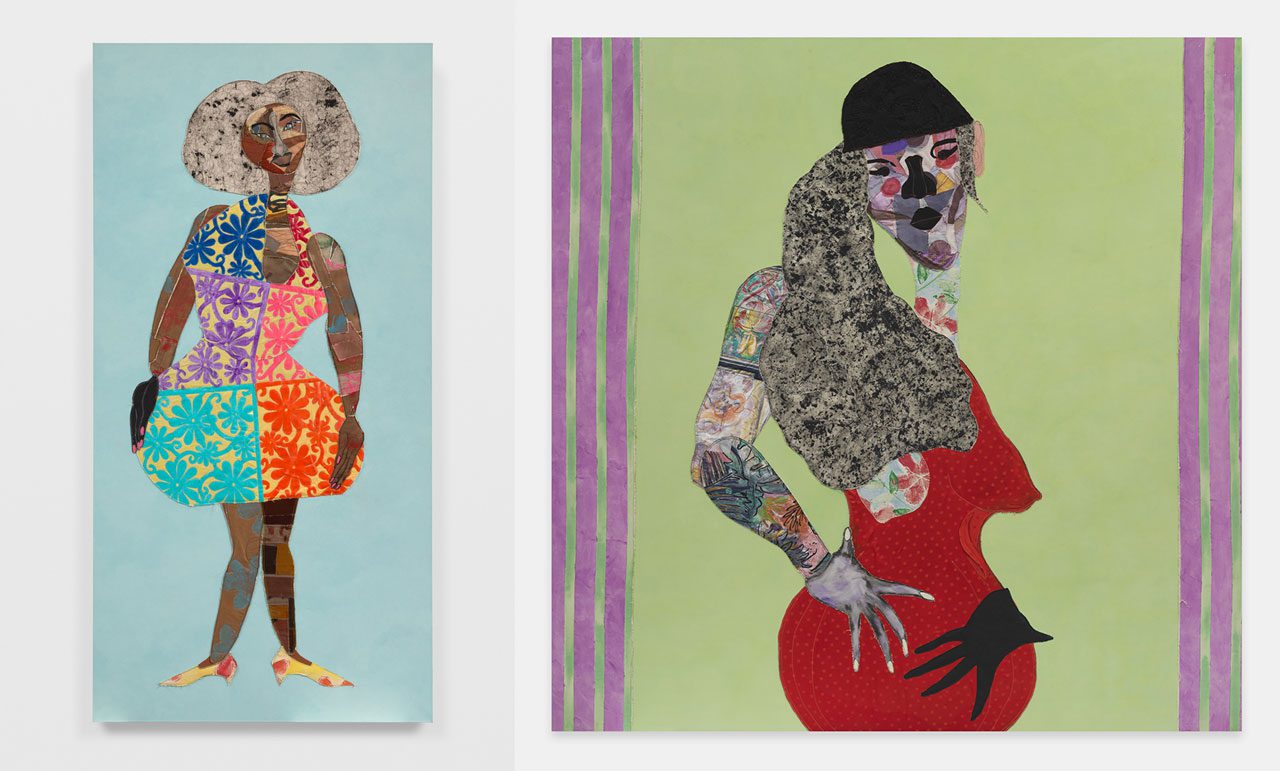
Right: Tschabalala Self, The Observer 2025 Acrylic paint, Fabric, silk, beads, thread, and painted canvas on canvas 244 x 244 x 4 cm / 96 x 96 x 1 1/2 in, © Tschabalala Self, Courtesy the artist and Galerie Eva Presenhuber