ART CITIES:Bilbao-Ruth Asawa
Ruth Asawa was one of the most uniquely gifted and productive artists to emerge in the postwar era in the United States. While the appreciation of her work has grown exponentially in the last decade, this international retrospective is the first major museum exhibition to fully consider every aspect of the artist’s exquisite, varied, and groundbreaking practice.
By Efi Michalarou
Photo: Guggenheim Museum Bilbao Archive
Ruth Asawa’s retrospective unfolds less as a chronological survey than as an immersive ecology—one in which art, life, and environment are inextricably entwined. Spanning nearly six decades, from 1947 to 2006, the exhibition reveals an artist who resisted categorization at every turn. Across suspended looped-wire sculptures, nature-inspired tied-wire forms, clay and bronze casts, paperfolds, paintings, drawings, and prints, Asawa constructed a visual language grounded in continuity, permeability, and relational thinking. Her practice challenges the viewer not only to see differently, but to reconsider how form, space, and lived experience interpenetrate.
Organized into ten thematic sections, the exhibition traces the evolution of Asawa’s ideas rather than simply her stylistic development. It foregrounds her commitment to dissolving binaries: abstraction and representation, figure and ground, interior and exterior. In her work, these distinctions are not oppositional but reciprocal. A sculpture’s interior is visible through its exterior; a drawing oscillates between depiction and pattern; a shadow becomes as materially present as the object casting it. This ontological fluidity is central to Asawa’s enduring relevance.
The roots of this philosophy can be traced to her formative years at Black Mountain College in the late 1940s. There, within an interdisciplinary curriculum that emphasized sensory experience and material inquiry, Asawa encountered a mode of learning that would shape her entire career. Studying not only art but also mathematics, philosophy, music, and dance, she absorbed a holistic approach to perception. Under the guidance of Josef Albers, she learned what she later described as “how to see”—a disciplined attentiveness to structure, proportion, and relational dynamics.
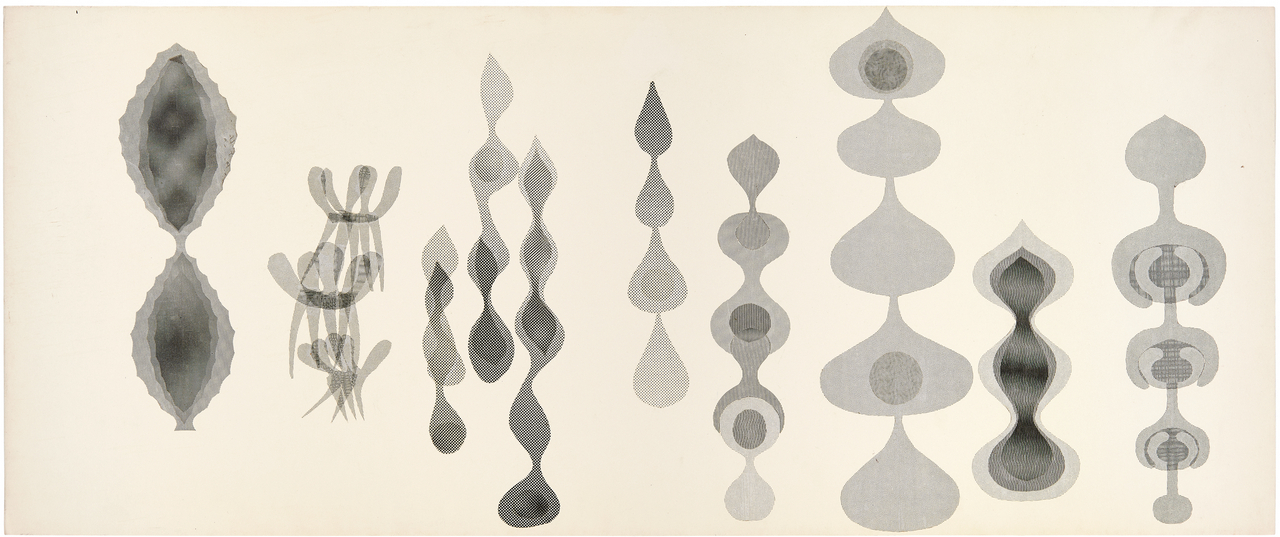
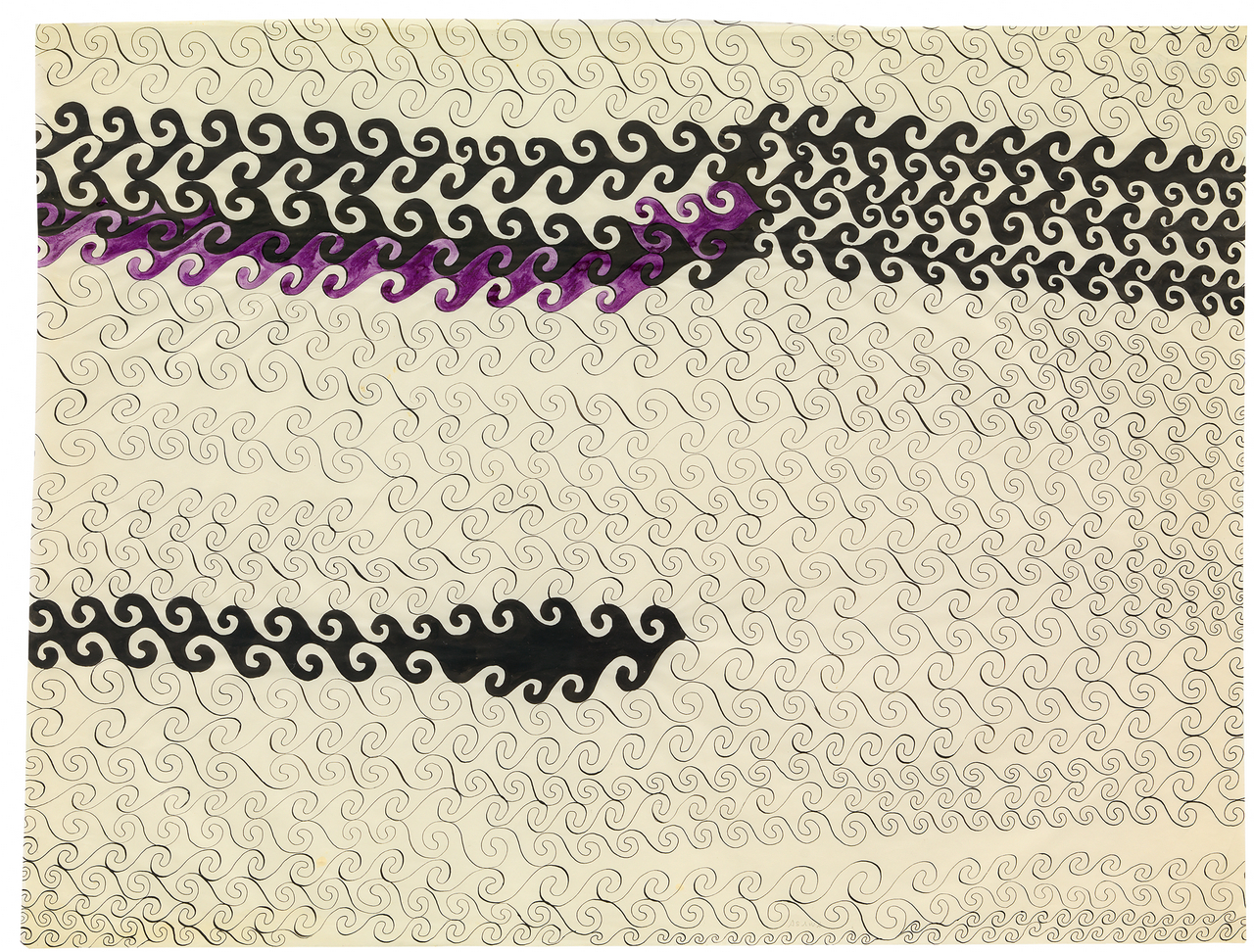
A key early work, “Untitled (BMC.52, Dancers)” (ca. 1948–49), reflects this environment of cross-disciplinary influence. Composed of layered, rounded forms set against a luminous ground, the piece evokes movement and rhythm without literal representation. Inspired by her experiences in dance classes, the work anticipates the spatial and volumetric concerns that would later define her sculptural practice. It is less an image of dancers than a translation of movement into form.
Equally pivotal was Asawa’s 1947 trip to Mexico, where she encountered traditional wire basket-making techniques. This experience catalyzed a breakthrough: by extending a basket into a closed, continuous form, she discovered a new sculptural vocabulary. This moment of synthesis—between craft tradition and modernist abstraction—became the foundation of her most iconic works.
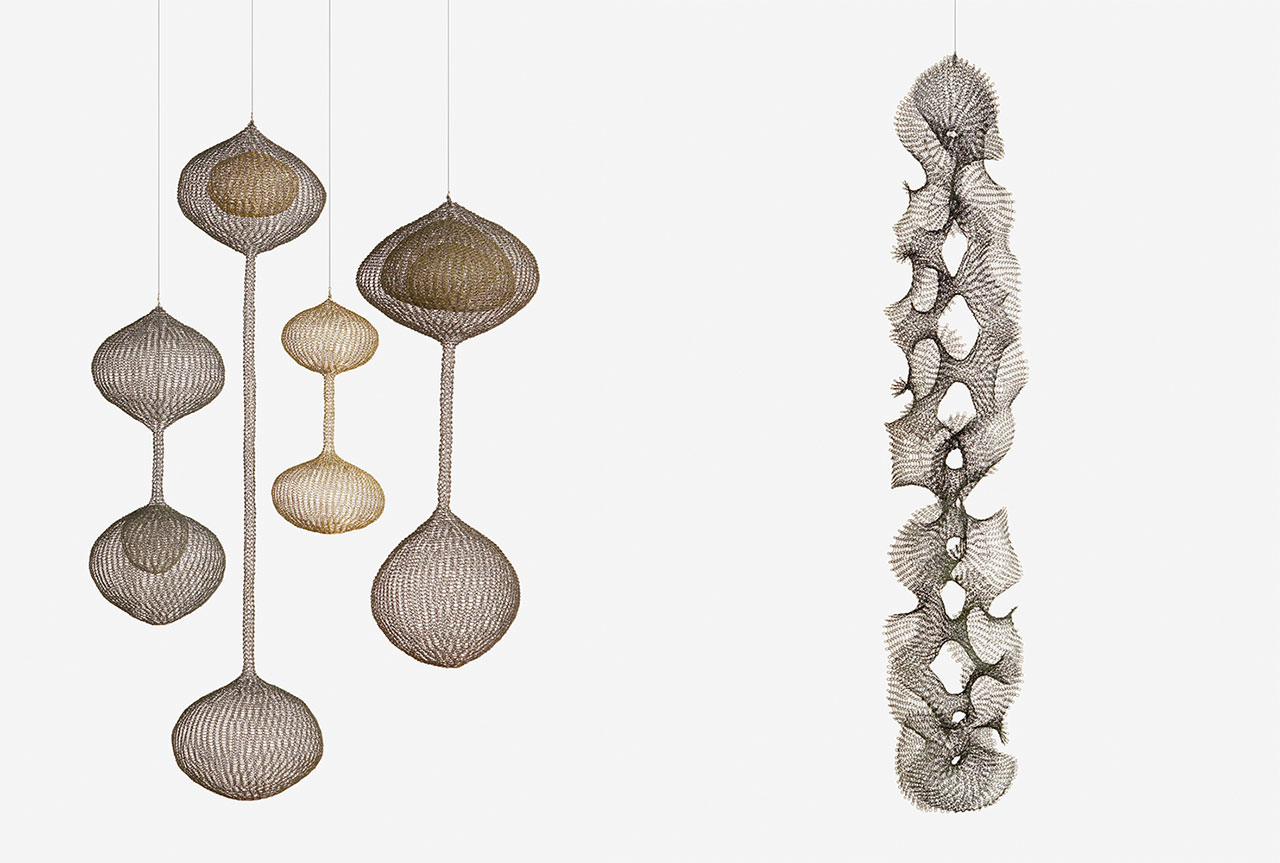
In the early 1950s, after relocating to San Francisco, Asawa began to refine this vocabulary. Her looped-wire sculptures, constructed by hand from industrial materials, embody a paradoxical combination of rigor and delicacy. These works are defined by what she termed “a continuous form within a form”—nested volumes that unfold from a single, unbroken surface. Pieces such as “Untitled (S.427)” (1953) and “Untitled (S.797)” (ca. 1954) exemplify this approach, with their layered lobes and interpenetrating spheres.
What distinguishes these sculptures is their radical engagement with space. Unlike traditional sculpture, which asserts mass and solidity, Asawa’s forms are porous, allowing light and air to pass through them. Their boundaries are defined not by enclosure but by relation. As the viewer moves around them, their shapes appear to shift and reconfigure, producing a dynamic perceptual experience. The sculptures do not occupy space so much as articulate it.
This concern with spatial continuity extends to Asawa’s understanding of shadow. She conceived of her works not as isolated objects but as systems of projection and reflection. A sculpture’s shadow, cast onto a wall or floor, becomes an extension of its form—another layer of volume. In this sense, her practice anticipates later developments in installation art, where environment and object are co-constitutive.
Despite increasing recognition—her work was exhibited in New York and featured in design publications—Asawa resisted the commodification of her practice. Although invited to mass-produce her wire forms as decorative objects, she declined, emphasizing experimentation over production. This decision underscores a key tension in her work: its accessibility and domestic scale coexist with a rigorous conceptual framework.
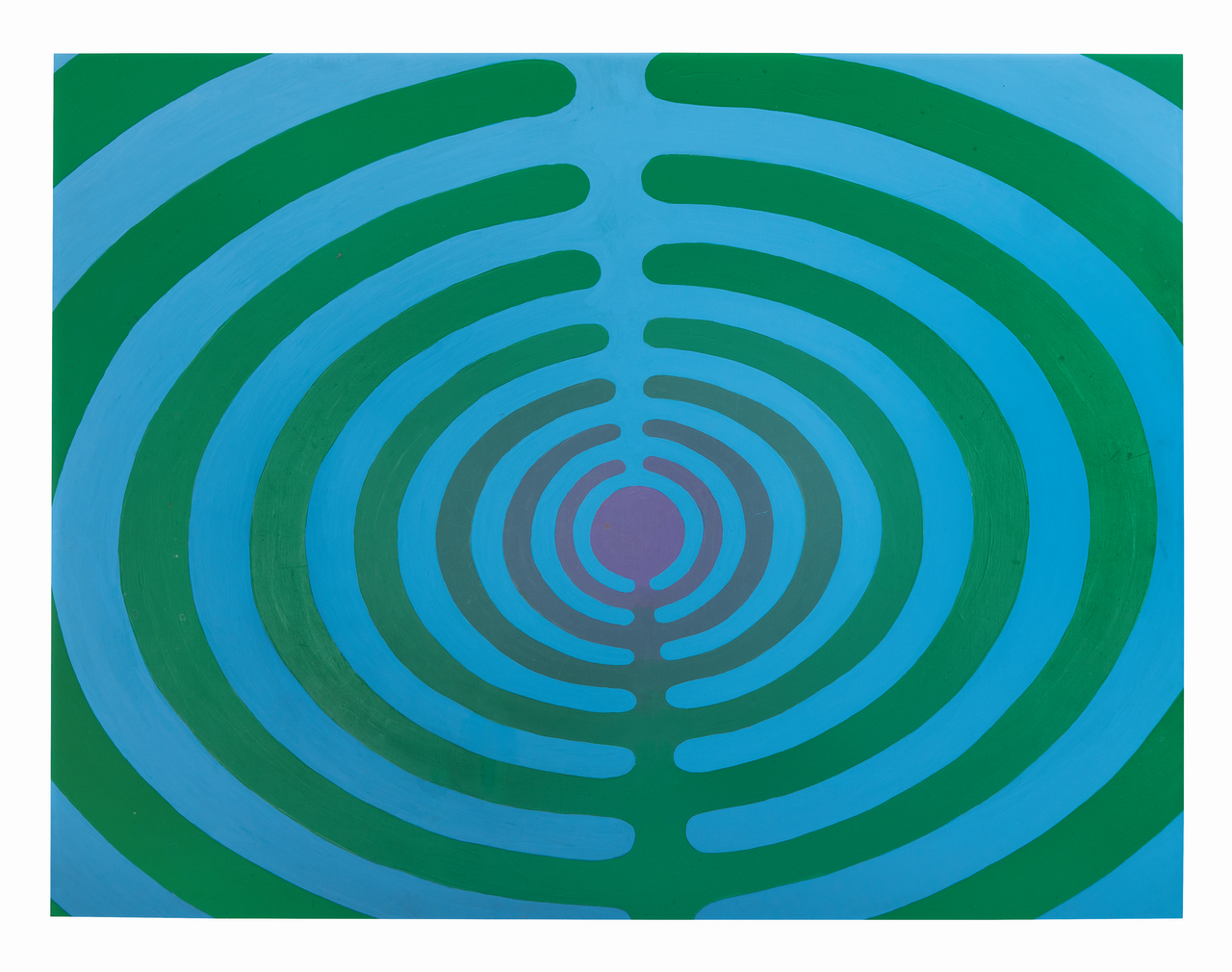
The mid-1960s marked another significant expansion of her practice, particularly through her engagement with printmaking at the Tamarind Lithography Workshop. During a brief but intensive residency, she produced a remarkable body of prints that traverse figuration and abstraction. Images of flowers, chairs, and family members coexist with more geometric compositions, all rendered with a sensitivity to line and structure that echoes her sculptural work.
Importantly, Asawa rejected hierarchical distinctions between mediums. For her, printmaking, drawing, and sculpture were equally valid modes of inquiry. This egalitarian perspective —rooted perhaps in her exposure to craft traditions—challenged prevailing modernist biases that privileged painting and monumental sculpture.
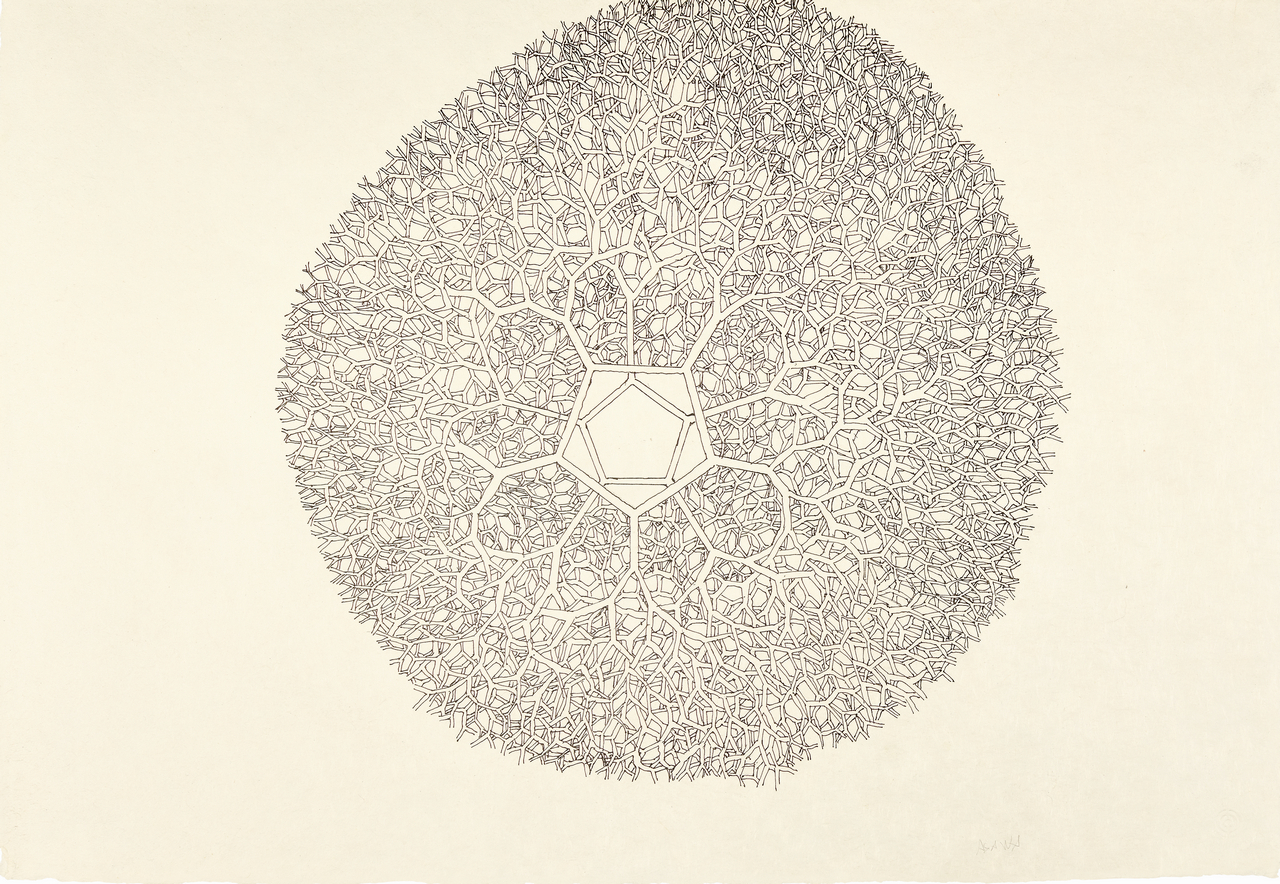
Around the same time, a new direction emerged in her work through the development of tied-wire sculptures. Inspired by the intricate structure of a dried desert plant, Asawa began creating branching, organic forms by bundling and manipulating wire. These works differ from her earlier looped forms in their emphasis on growth and outward expansion. Beginning from a central node—often floral or geometric—they radiate outward, mimicking natural processes.
Here again, Asawa’s sensitivity to material is paramount. She described her approach as following “what the wire dictates,” suggesting a collaborative relationship between artist and medium. The transformation of rigid wire into soft, plant-like structures encapsulates her fascination with dualities: hard and soft, artificial and natural, abstract and representational.
This period also saw a deepening of her engagement with drawing, particularly as a parallel to her sculptural explorations. Her works on paper—featuring airy blooms, net-like patterns, and branching forms—demonstrate a continuous feedback loop between two- and three-dimensional thinking. Drawing was not preparatory but generative, a site of ongoing experimentation.
By the late 1960s, Asawa’s practice expanded beyond the studio into the public sphere. Her involvement in arts advocacy and education reflects a belief in the social function of art. Serving on various arts commissions and councils, she championed access to creative education and the integration of art into everyday life.
Her public commissions embody this ethos. The bronze fountain Andrea (1968), with its playful assemblage of mermaids, frogs, and turtles, invites tactile and communal interaction. Later works, such as the “Origami Fountains” (1975–76), translate her longstanding interest in paper folding into monumental form. These projects are not merely aesthetic interventions but social spaces—sites of gathering, memory, and shared experience.
Perhaps most poignant is her Japanese American Internment Memorial (1994), which confronts a deeply personal and historical trauma. Created in collaboration with her son and another artist, the work reflects on the incarceration of Japanese Americans during World War II. Here, Asawa’s commitment to community and remembrance converges with her formal concerns, demonstrating the ethical dimension of her practice.
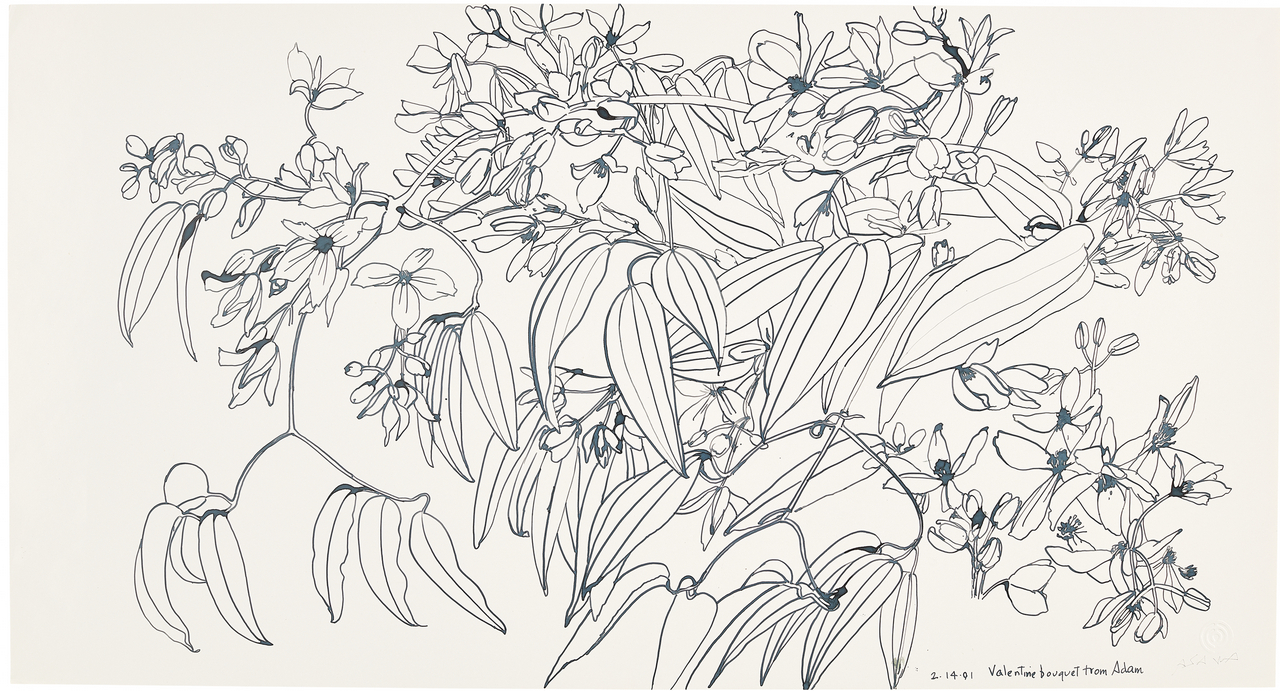
Throughout her career, Asawa maintained a sustained engagement with the natural world, particularly through drawing. Flowers from her garden—irises, chrysanthemums, hydrangeas—became recurring subjects. These works, often intimate in scale, are less about botanical accuracy than about attentiveness. Drawing from life was, for Asawa, a mode of presence—a way of inhabiting time and space.
Even after being diagnosed with lupus in 1985, which limited her physical capacity, she continued to produce these drawings with remarkable consistency. Many were based on gifts from friends and family, transforming acts of care into artistic gestures. In this sense, her late works function as both personal and communal archive.
Central to understanding Asawa’s practice is her conception of home as studio. Her residence in Noe Valley was not merely a site of production but a living artwork—an environment shaped by creative activity, collaboration, and family life. The house itself, with its open spaces and suspended sculptures, embodied her philosophy of integration.
Within this space, distinctions between art and life dissolve. Children’s footprints become design motifs; kitchen tables double as work surfaces; guests contribute to an ongoing creative exchange. The hundreds of face casts she created over decades form a kind of social sculpture—a record of relationships and presence.
The retrospective ultimately reveals an artist for whom making was inseparable from living. Asawa’s work resists spectacle in favor of sustained inquiry, privileging process over product, connection over isolation. Her legacy lies not only in the formal innovations of her sculptures but in a broader redefinition of what it means to be an artist.
In an era increasingly defined by fragmentation, Asawa’s vision of continuity—between materials, disciplines, people, and environments—feels both radical and necessary. Her work invites us to see the world not as a collection of discrete entities but as an interconnected field of relations. It is, in the fullest sense, an art of attention.
Photo left: Ruth Asawa, Untitled (S.046a-d, Hanging Group of Four, Two-Lobed Forms), 1961; copper and brass wire, (a): 152.4 x 43.2 x 17.8 cm; (b): 53.3 x 30.5 x 30.5 cm; (c): 81.3 x 33 x 33 cm; (d): 104.l x 40.6 x 40.6 cm;, Collection of Diana Nelson and John Atwater, promised gift to the San Francisco Museum of Modern Art;© 2026 Ruth Asawa Lanier, Inc., courtesy David Zwirner; photo: Laurence Cuneo. Photo Right: Ruth Asawa, Untitled (S.433, Hanging Nine Open Hyperbolic Shapes Joined Laterally), ca. 1958; copper wire; 193 x 38.l x 38.l cm; William Roth Estate;© 2026 Ruth Asawa Lanier, Inc., courtesy David Zwirner; photo: Laurence Cuneo
Info: Curators: Janet Bishop, Cara Manes and Geaninne Gutierrez-Guimaraes, Guggenheim Museum Bilbao, Abandoibarra et.2, Bilbao, Spain, Duration: 19/3-13/9/2026, Days & Hours: Tue-Sun 10:00-19:00, www.guggenheim-bilbao.eus/
Down: Ruth Asawa, Untitled (S.363, Freestanding Basket), ca.1948; copper wire; 11.4 x 19.l x 19.7 cm; Asheville Art Museum, Asheville, North Carolina, Black Mountain College Collection, museum purchase with funds provided by 2010 Collectors’ Circle with additional funds provided by Frances, © 2026 Ruth Asawa Lanier, Inc., courtesy David Zwirner; photo courtesy Christie’s
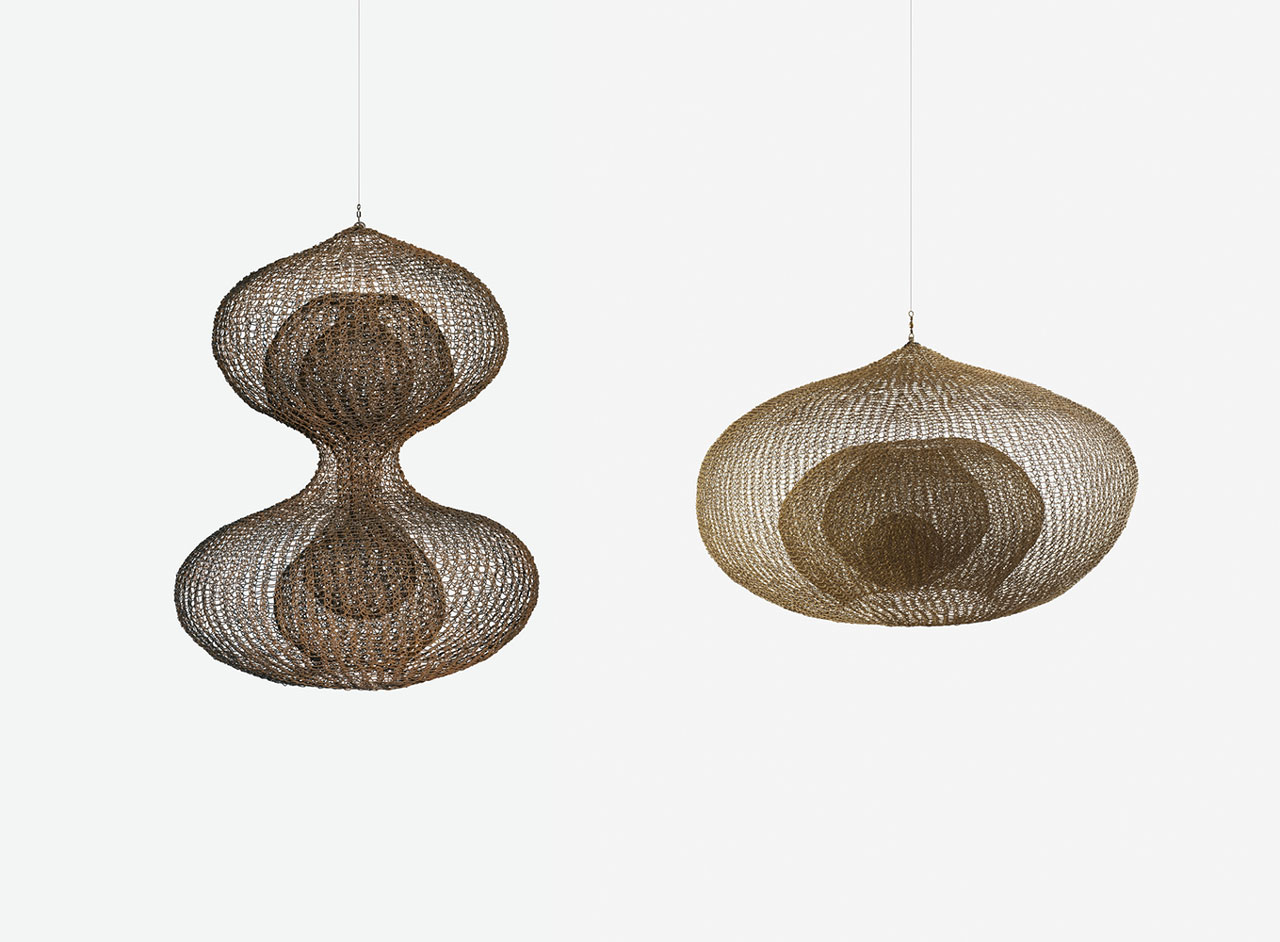
Right: Ruth Asawa, Untitled (S.427, Hanging Single-Lobed, Five-Layered Continuous Form within a Form), 1953; brass wire; 45.7 x 71.l x 71.l cm; Collection of Don Kaul and Barbara Bluhm-Kaul, Chicago;© 2026 Ruth Asawa Lanier, Inc., courtesy David Zwirner; photo: Maris Hutchinson, courtesy David Zwirner