ART CITIES: Paris-Abdelkader Benchamma
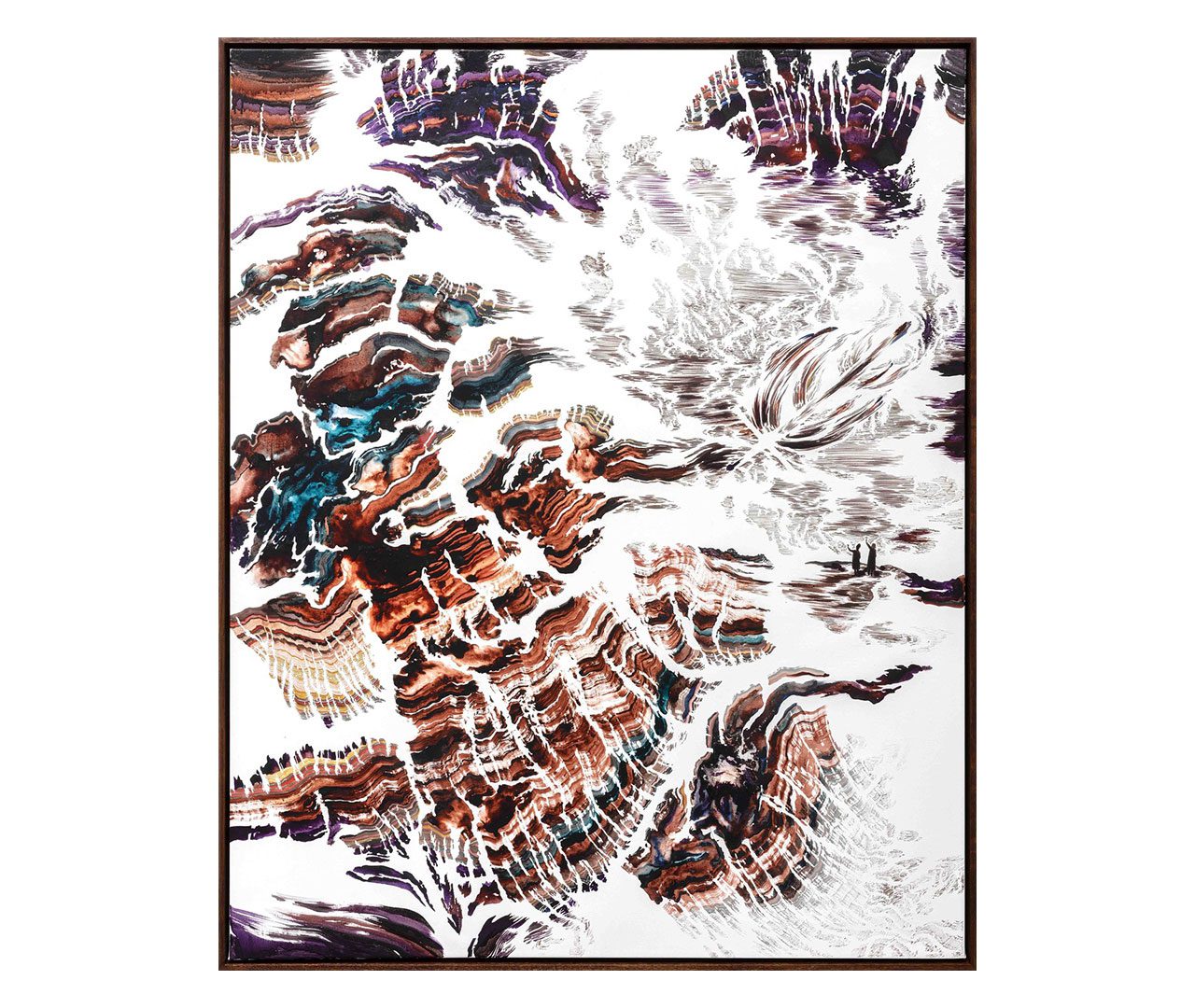
Abdelkader Benchamma’s work converts drawing into an architectural phenomenon: ink becomes a force that reconfigures walls into spaces of resonance, where geological time, collective memory and spiritual imaginaries converge. His site‑specific frescoes—often executed directly on gallery walls—operate between mural and painting, between the legible and the indiscernible, asking viewers to negotiate a terrain where perception itself is the subject. This approach has defined a career that moves fluidly between finely wrought, engraver‑like drawings and sweeping, ephemeral installations.
By Dimitris Lempesis
Photo: Galerie Templon Archive
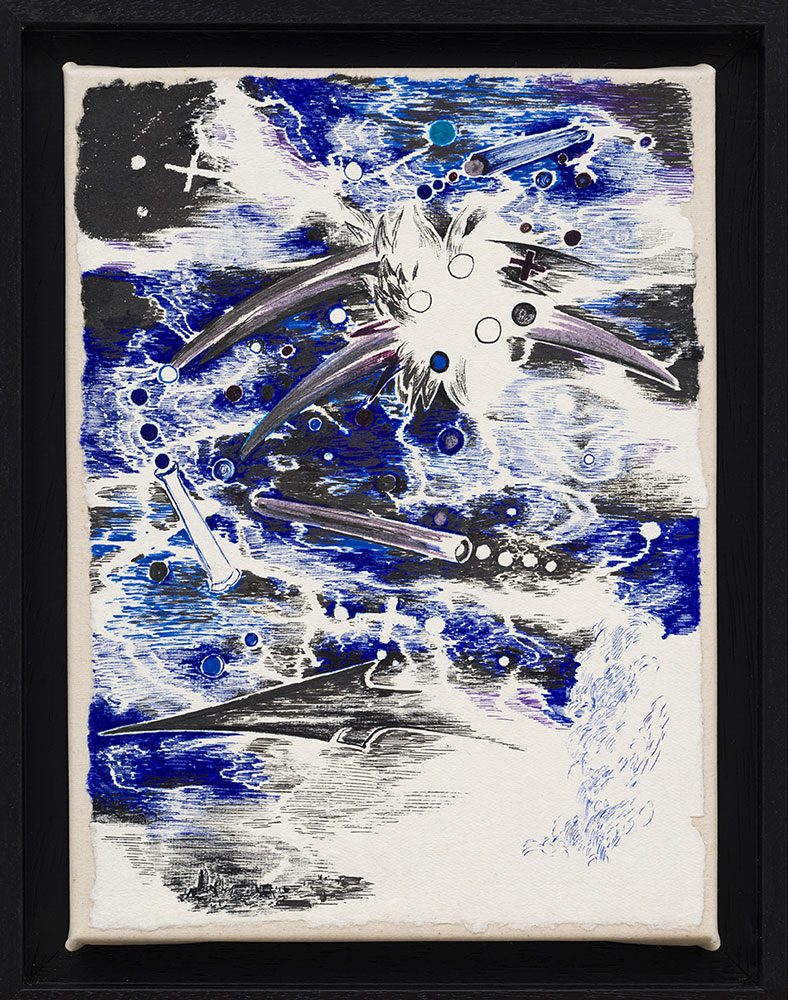
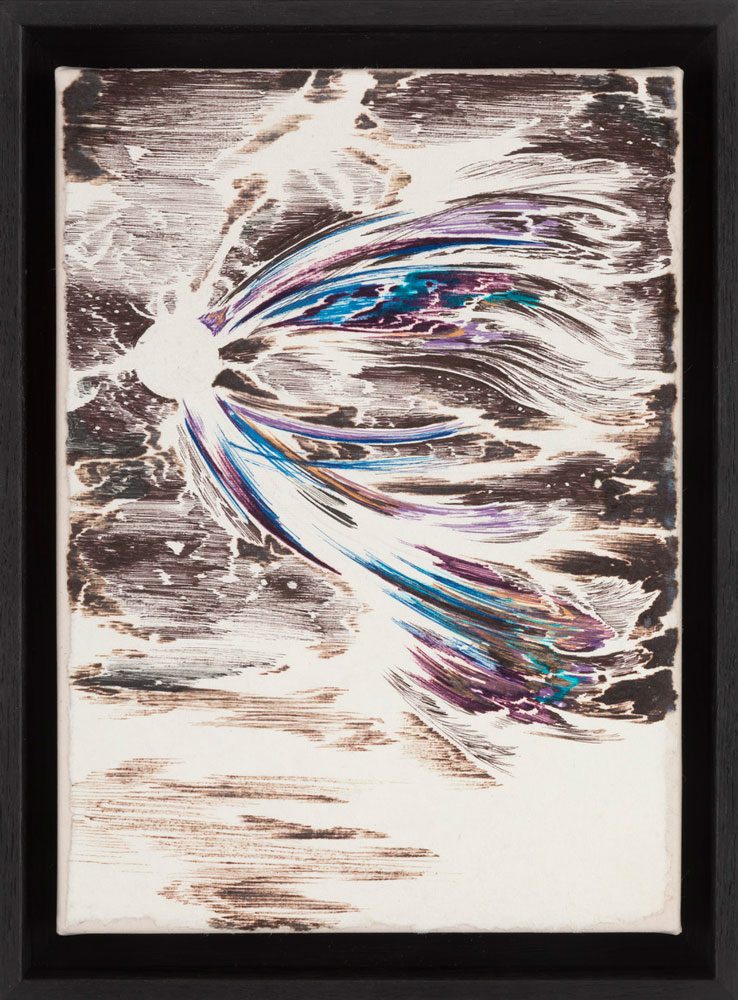
Benchamma’s visual language is built from a disciplined economy of line and pattern that produces fields of tension: folds, voids, vortices and strata that read as both geological cross‑sections and psychic topographies. Historically associated with black‑and‑white compositions, his recent work foregrounds color and larger formats that hover on the border of fresco and painting, amplifying the immersive quality of his installations. Whether on paper or wall, his drawings stage a sustained inquiry into how images persist on the retina and in memory—how retinal afterimages, neuronal persistence and cultural narratives overlap to produce meaning.
Benchamma’s practice is explicitly nourished by a wide corpus of texts and images—literature, ethnography, esoterica and astrophysics—that he collects and reworks into a personal visual atlas. Two historical manuscripts are central to the works in Signs and Wonders: the medieval Arabic “Kitab al‑Bulhan” (Book of Wonders), a late‑14th/15th‑century compilation that pairs astrological and geomantic texts with full‑page illustrations of zodiacal signs, talismans and jinn; and the 16th‑century German Augsburg “Book of Miracles”, whose gouache and watercolor plates depict comets, monstrous births and apocalyptic portents. Benchamma treats these sources not as antiquarian curiosities but as living templates that show how cultures construct images for the inexplicable.
Conceived as pages from a vast contemporary manuscript, his solo exhibition “Signs and Wonders” transforms the gallery into an organism threaded with passages to other worlds. Illuminations break free of their frames to infiltrate architecture; stars and constellations shimmer into forms that can read as drones, UFOs or meteorological phenomena; veneration of trees and stones persists as a kind of collective mnemonic residue. The exhibition stages a productive tension between unease and re‑enchantment, inviting viewers to inhabit a space where scientific cosmology and magical thinking coexist, collide and refract one another.
A striking feature of Benchamma’s project is the way it draws a line from premodern celestial anxieties to contemporary narratives that recast the unknown as threat. The same visual grammar that once read comets and prodigies as omens now resonates with modern spectacles—media panics, political hearings and institutional anxieties about unidentified aerial phenomena—showing how belief systems adapt to new technologies while recycling ancient fears. By making these continuities visible, his installations become critical sites for reflecting on how societies imagine danger, wonder and the limits of comprehension.
“Signs and Wonders” also marks a pivotal moment in Benchamma’s trajectory. In September 2026 he will begin a residency at Villa Albertine in New York, where he plans to work with the archives of the American Society for Psychical Research—an institutional collection that documents parapsychological investigations, case files and visual records. This engagement promises to extend his inquiry into the invisible, supplying new documentary materials that will likely feed future installations and further blur the line between empirical archive and mythic narrative.
What distinguishes Benchamma is not merely the scale or technical virtuosity of his drawings but their capacity to activate the uncanny. His frescoes do not illustrate a preexisting myth; they instantiate a condition in which seeing becomes thinking and architecture becomes a mnemonic device. The shift toward color and monumental formats intensifies this activation: the work ceases to be an object to be viewed and becomes an environment to be inhabited, a manuscript that readers move through rather than read. This strategy places Benchamma at an interesting intersection of contemporary drawing, installation art and speculative historiography.
For audiences, Benchamma’s installations offer a rare kind of perceptual training: they demand sustained looking and an openness to ambiguity. For institutions, his work poses curatorial challenges and opportunities—how to present ephemeral wall works that are simultaneously site‑bound and conceptually portable, how to frame historical sources without flattening their complexity, and how to host exhibitions that function as living manuscripts rather than static displays. The answers to these questions will shape how his work is preserved, documented and re‑presented in the years ahead.
Benchamma’s works are invitations to dwell in the liminal: between science and magic, archive and fable, surface and depth. As he moves into archival research in New York, his practice seems poised to deepen its interrogation of the invisible—not to resolve mysteries but to map the forms by which mysteries persist. Would you like a focused critical reading of a single work from Signs and Wonders that traces its sources, technique and reception in detail?
Photo: Abdelkader Benchamma, Entre la terre et le ciel, 2026, Ink an acrylic on canvas, 130 × 105 cm — 51 1/4 × 41 1/4 in., © Abdelkader Benchamma, Courtesy the artist and Galerie Templon
Info: Galerie Templon, 30 rue Beaubourg, Paris, France, Duration: 21/3-7/5/2026, Days & Hours: Tue-Sat 11:00-19:00, www.templon.com/