
VIDEO: Rachel Maclean-They’ve Got Your Eyes
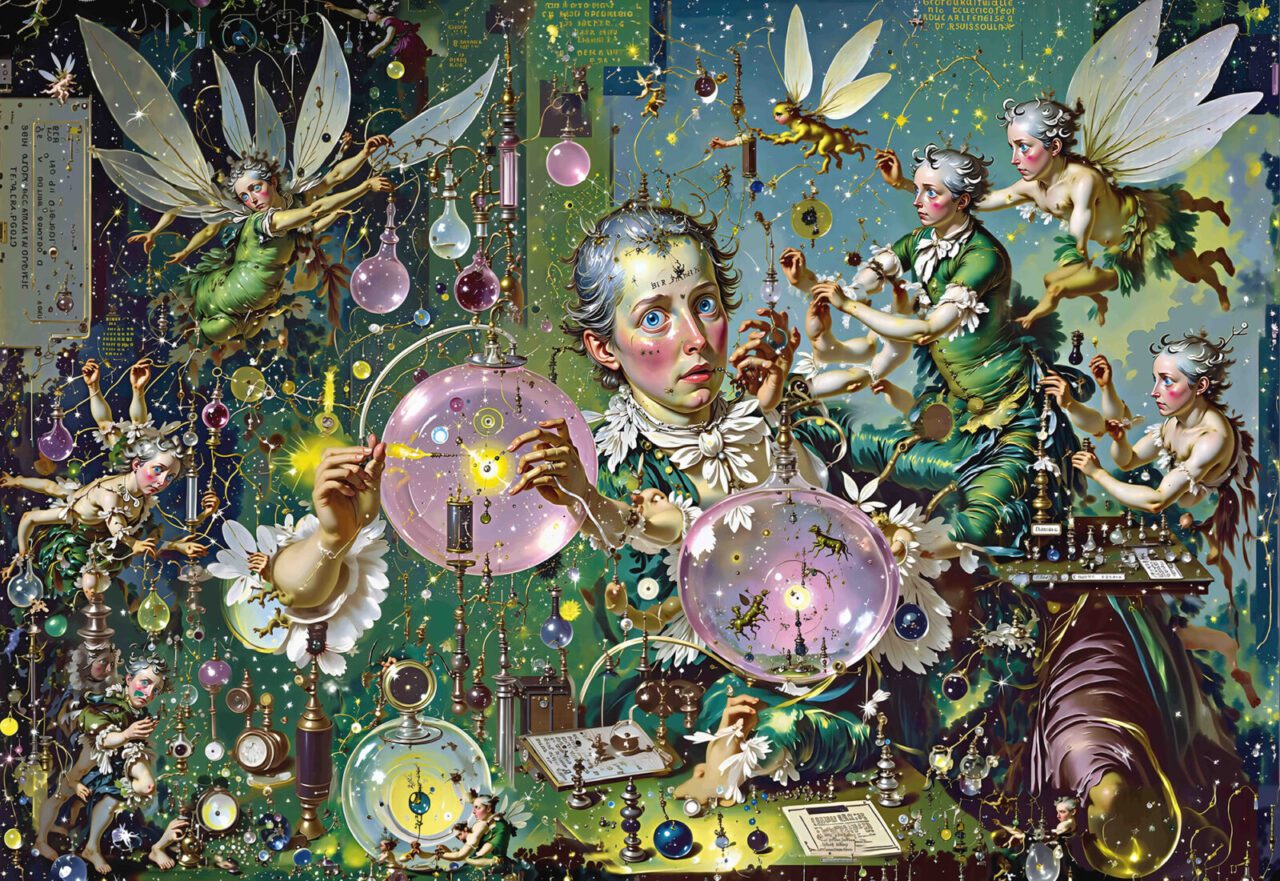
Rachel Maclean has, over the past decade, developed a highly distinctive artistic language that merges cutting-edge technology with a sharp, critical engagement with contemporary culture. Working across video, digital print, painting, and virtual reality, her practice resists easy categorisation. Instead, it operates as a hybrid form—part cinematic spectacle, part visual art installation—where exaggerated aesthetics and dense symbolism are used to explore themes such as power, identity, consumerism, and myth-making.
By Dimitris Lempesis
Photo: FACT Liverpool Archive
Rachel Maclean’s work is immediately recognisable for its hyper-saturated colour palettes, elaborate costumes, and the artist’s own repeated presence on screen. She frequently performs multiple characters herself, using digital manipulation to construct entire worlds populated by uncanny, artificial personas. This strategy not only foregrounds questions of identity and self-representation but also reflects the fragmented nature of subjectivity in the digital age. Her approach draws heavily on visual cultures associated with advertising, social media, and children’s entertainment, while simultaneously critiquing their underlying ideological structures.
Her achievements have been widely acknowledged within the contemporary art scene. In 2013, she received the prestigious Margaret Tait Award, which supports innovation in moving image work. She has also been shortlisted twice for the Jarman Award, further cementing her reputation as a leading figure in experimental film and video art.
Her recent exhibition, “They’ve Got Your Eyes”, marks a significant moment in her career, both conceptually and technologically. The project centres on the premiere of a new film generated using artificial intelligence models trained on Maclean’s own image and artistic archive. This process introduces a recursive dimension to her work: the artist becomes both the creator and the dataset, the origin and the output. As a result, the boundaries between authorship and automation begin to blur, raising urgent questions about originality in an era where machines can learn, replicate, and transform human creativity.
The exhibition space itself is conceived as an immersive environment that envelops the viewer in a surreal and disorienting world. Drawing a deliberate parallel between the contemporary boom in artificial intelligence and the experimental fervour of the Victorian era, Maclean situates current technological developments within a longer historical trajectory. The Victorian period, marked by rapid industrialisation and scientific discovery, was similarly characterised by both optimism and anxiety about the transformative power of new inventions. By invoking this comparison, Maclean encourages viewers to consider how technological progress is often intertwined with cultural fantasies, personal ambition, and the desire for control.
Visually, “They’ve Got Your Eyes” is rich with contrasts and contradictions. Sculptural elements—glowing, organic forms that appear to drip with viscous slime—evoke laboratory experiments as much as mythical artefacts. These objects blend the language of science with motifs drawn from Celtic faerie folklore, producing a hybrid aesthetic that is at once playful and unsettling. The result is an environment that resists stable interpretation, constantly shifting between enchantment and unease.
At a deeper level, the exhibition interrogates the relationship between technology and the self. AI systems, trained on human data, function as mirrors that reflect and distort identity. In using her own likeness as training material, Maclean intensifies this dynamic, confronting viewers with multiple, unstable versions of the artist. This multiplication of the self raises fundamental questions: who controls these representations, and to what extent do they remain “authentic”? Moreover, the work asks whether creativity is still a uniquely human domain or whether it is increasingly co-produced by algorithmic processes.
In this sense, “They’ve Got Your Eyes” operates not only as an artwork but also as a critical framework through which to examine the cultural implications of artificial intelligence. It invites audiences to look closely at the technologies that shape contemporary life and to reflect on the motivations—economic, political, and psychological—that drive their development. By doing so, Maclean positions her work at the intersection of art, philosophy, and technological critique.
Beyond this latest project, Maclean has produced a number of influential films that further demonstrate the scope and consistency of her artistic vision. Works such as “The Lion and the Unicorn” (2012) explore themes of national identity and consumer culture through a fantastical, candy-coloured aesthetic. “Feed Me” (2015) delves into the manipulative dynamics of advertising and desire, presenting a dystopian world driven by consumption and control. Her ambitious film “Spite Your Face” (2017), inspired by the story of Pinocchio, offers a darkly satirical commentary on power, truth, and political authority, and was notably selected to represent Scotland at the Venice Biennale.
Across these works, a consistent thread emerges: Maclean’s fascination with constructed realities and the forces that shape them. Whether engaging with fairy tales, political rhetoric, or digital technologies, her films challenge viewers to question what is real, who is in control, and how meaning is produced. In the context of her evolving practice, “They’ve Got Your Eyes” can be seen as both a continuation and an intensification of these concerns—one that confronts the viewer with the increasingly blurred line between human imagination and machine-generated worlds.
Info: FACT Liverpool, 88 Wood Street, Liverpool, United Kingdom, Duration: 20/3-16/8/2026, Days & Hours: Wed-Sun 11:00-18:00, www.fact.co.uk/