ART CITIES: Berlin-Katja Strunz
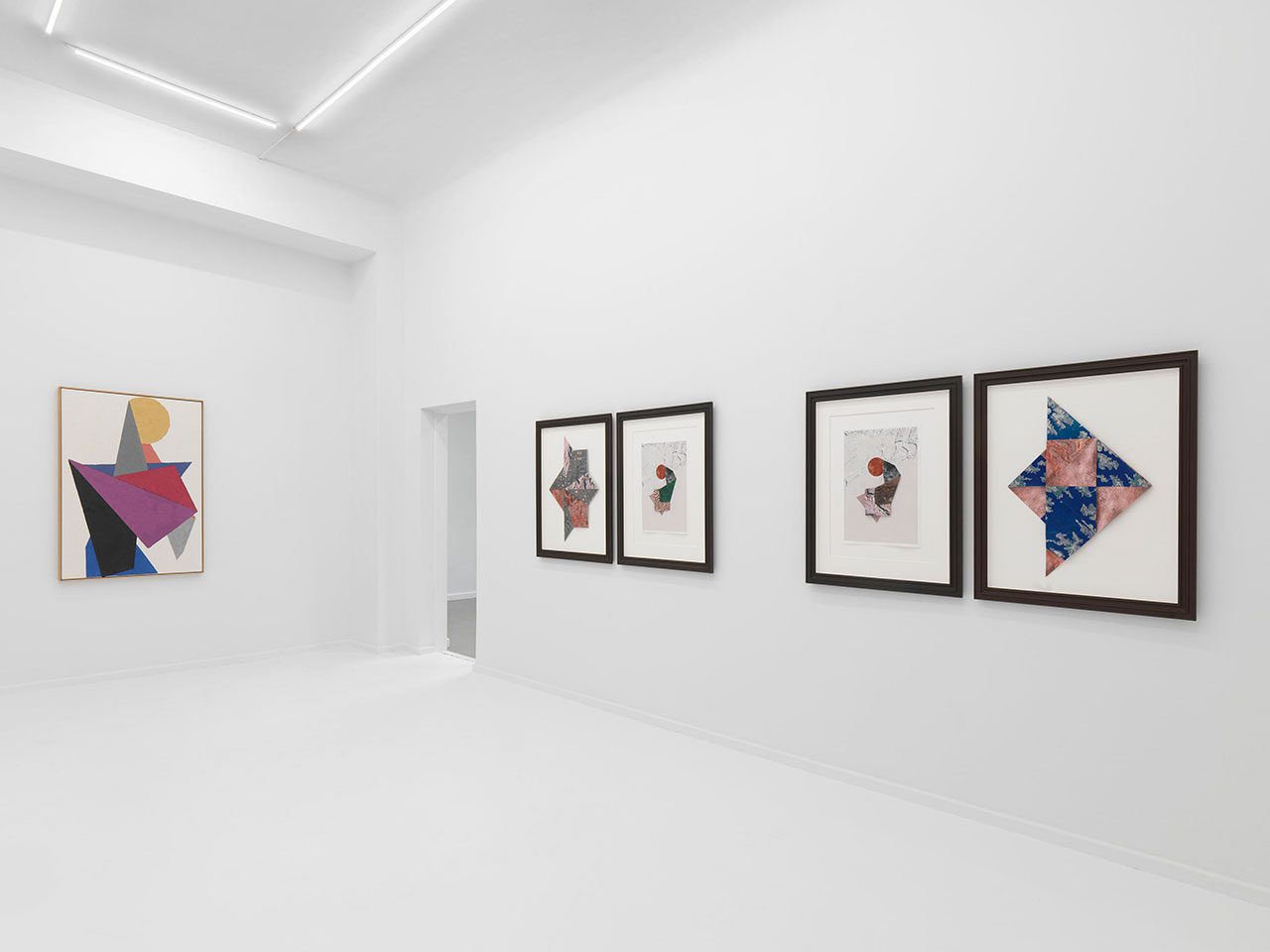
Katja Strunz has long explored the intersection of space and history through a distinct sculptural language. Her works are marked by folded, fractured, and collapsed forms—visual metaphors for what she describes as a “post-traumatic compression of space and time.” Angular planes, shards, and abrupt bends evoke architectural remnants or geological strata, suggesting that memory is not linear but sedimented, layered, and subject to sudden shifts. Through these gestures, Strunz creates an “architecture of recollection,” where material deformation mirrors the psychological and cultural processes through which societies remember and reinterpret their past.
By Efi Michalarou
Photo: N.B.K. Archive
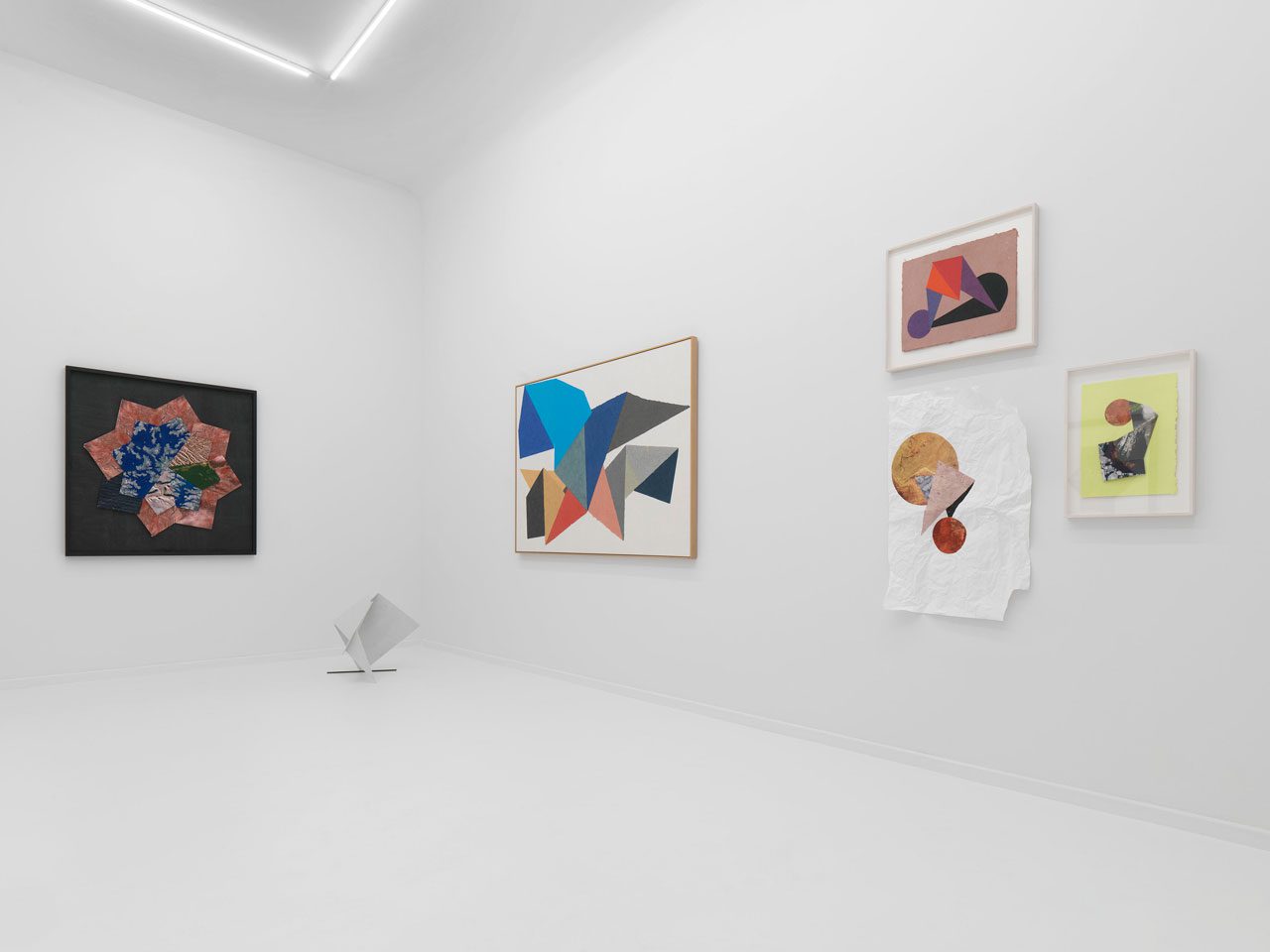
Katja Strunz presents “Future Collapses, Past Rises”, an exhibition that unfolds as a meditation on time, memory, and transformation. The project brings together multiple strands of Strunz’s practice—sculpture, collage, installation, and found objects—into a spatial composition where the past and future appear entangled in a dynamic, unstable present.
The conceptual and formal core of “Future Collapses, Past Rises” lies in the act of folding. Throughout the exhibition, folding functions simultaneously as a sculptural technique, an aesthetic principle, and a philosophical model. Lacquered steel sculptures—sharply angled and seemingly compressed by invisible forces—translate this gesture into three-dimensional form. Their surfaces reflect light in shifting ways, producing a multiplicity of viewpoints and reinforcing the temporal dimension of spatial perception.
Opposite these sculptural works, Strunz presents wall-based collages that extend the same logic into the realm of image and paper. Origami-like compositions constructed from high-resolution satellite imagery depict landscapes altered by human activity. By cutting, folding, and recombining these images, the artist reorganizes the boundaries of the terrains they represent. Mountains collide with coastlines; agricultural grids intersect with urban fragments. Landscapes become crystalline structures—simultaneously geological and bodily—where the Earth’s surface appears both fragile and continuously reconfigured.
These collages form part of the recent series In Formation (2025), in which Strunz works with satellite images produced by the Earth-imaging company Planet Labs, founded by former NASA scientists. The company documents the planet’s surface with extraordinary frequency, generating vast amounts of data daily. By transforming this digital information into folded analog compositions, Strunz translates planetary-scale observation into intimate material gestures, suggesting that the processes shaping global landscapes are mirrored in the small-scale operations of artistic practice.
The satellite-based works also introduce a subtle ecological dimension to the exhibition. Seen from orbit, the Earth becomes a mosaic of transformations: deforestation, urban expansion, agricultural intensification, and the infrastructural marks of human presence. Yet Strunz does not present these images as documentary evidence. Instead, her manipulations—folding, layering, fragmenting—transform them into speculative topographies where the boundaries between natural and constructed environments blur.
In this sense, the works embody a balance between becoming and disappearance. The landscapes they depict are in flux, caught between processes of formation and erosion. By emphasizing the multiple perspectives generated through folding, Strunz highlights the possibility that transformation itself might be the defining condition of our contemporary moment.
Strunz’s recent work is informed by theoretical reflections on time and environmental change. One important influence is the physicist Anders Levermann, whose book “Die Faltung der Welt” proposes “folding” as a conceptual model for understanding complex systems. In chaos theory, folding describes how dynamic systems generate freedom of movement within limited space—a process that allows for diversity, adaptation, and innovation rather than linear expansion.
Levermann argues that human civilization must learn to operate within the Earth’s ecological limits by embracing such adaptive transformations. Growth, in this view, need not cease; rather, it must be redirected through processes that reorganize existing structures. Strunz’s sculptures and collages embody precisely this movement. Their forms appear constrained yet dynamic, suggesting that creativity emerges from the tension between limitation and possibility.
A second conceptual reference comes from cultural theorist Aleida Assmann, whose work on memory studies examines the shifting temporal consciousness of late modernity. According to Assmann, the twentieth century’s faith in linear progress—an orientation toward the future that dismissed the past as obsolete—has gradually eroded. The geopolitical upheavals of the late 1980s, combined with ecological crisis and demographic change, have produced what she calls an “exhausted future.” In response, societies increasingly turn to memory as a source of identity and meaning.
Strunz’s work visualizes this altered temporal structure. Instead of presenting time as a forward-moving trajectory, her folded forms suggest loops, returns, and compressions. The past does not recede; it resurfaces, reconfigured within the present.
Within the exhibition space, sculptures and collages enter into a complex dialogue. Steel structures function as counterpoints to the paper works, translating the logic of folding into weight, scale, and physical tension. The viewer’s movement around them becomes part of the work’s temporal structure: each shift in position produces new alignments of planes, edges, and shadows.
Central to this experience is a sense of sequentiality without fixed order. Folding, unfolding, and refolding occur not as a single event but as a continuous process. Forms seem suspended between collapse and expansion, between stability and disintegration. The notion of a final, ideal form—so central to classical sculpture—is replaced by a perpetual state of becoming.
Through this dynamic, Strunz constructs a visual metaphor for historical consciousness. Moments of compression, fragmentation, or collapse interrupt continuity, creating openings where new connections can emerge. The past rises not as a stable archive but as a shifting constellation of references, narratives, and material traces.
Ultimately, “Future Collapses, Past Rises” stages a paradox that feels increasingly relevant in the twenty-first century. While modernity once imagined the future as an expansive horizon, contemporary experience often suggests the opposite: a future constrained by ecological limits, political uncertainty, and technological acceleration. At the same time, the past—through archives, memory cultures, and historical reckonings—asserts itself with renewed urgency.
Strunz’s folded forms capture this inversion. They suggest that time is not a straight line but a series of compressions and expansions, where different temporal layers intersect. In the creases of metal and paper, past and future meet—not as opposites, but as forces continually reshaping the present.
The result is an exhibition that does not simply depict change; it performs it. Through acts of folding, cutting, and reassembling, Strunz transforms materials into dynamic structures that embody the instability of time itself. Within these fractured geometries, the viewer encounters a world where collapse and emergence are inseparable—and where every fold holds the possibility of another beginning.
Photo: Exhibition view Katja Strunz. Future Collapses, Past Rises, Neuer Berliner Kunstverein (n.b.k.), 2026 © Photo: n.b.k. / Jens Ziehe
Info: Curator: Michaela Richter, N.B.K. (Neuer Berliner Kunstverein, Chausseestrasse 128 / 129, Berlin, Germany, Duration: 14/3-3/5/2026, Days & Hours: Tue-Wed & Fri-Sun 12:00-18:00, Thu 12:00-20:00, www.nbk.org/
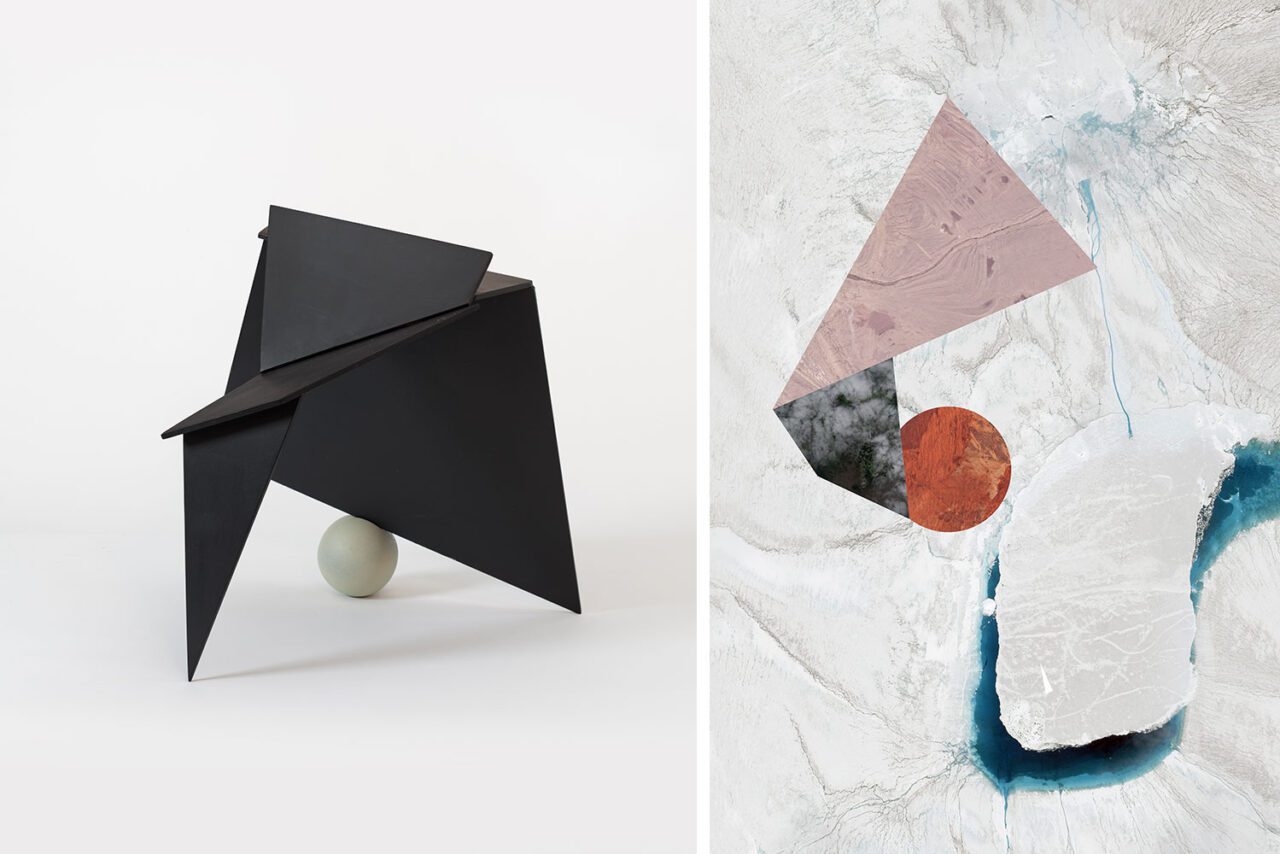
Right: Katja Strunz, In Formation, 2024, © Courtesy Katja Strunz; Contemporary Fine Arts, Berlin & Basel; Planet Labs PBC