PRESENTATION: Jonas Wood-Tennis Court Paintings
In his boldly colored, graphic works (spanning paintings, drawings, and prints) Jonas Wood has built a distinctive visual language that merges art historical references with the textures of everyday life. Interiors, houseplants, studio scenes, and objects from his immediate environment appear throughout his oeuvre, translated from three-dimensional reality into planes of flat color and crisp line. The result is a pictorial space that confounds expectations of scale and vantage point, where the intimate and the monumental coexist within the same frame.
By Efi Michalarou
Photo: Gagosian Archive
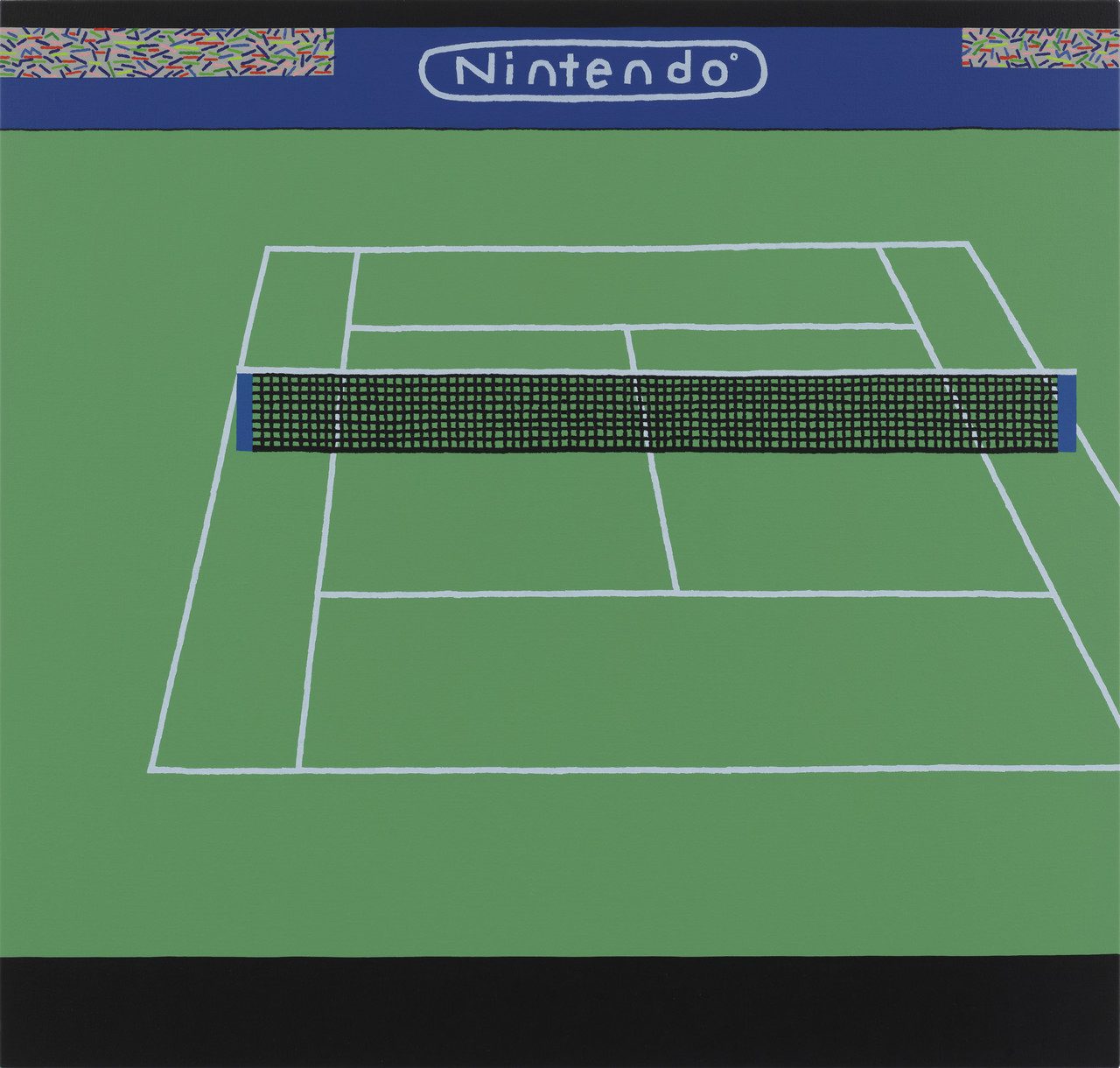
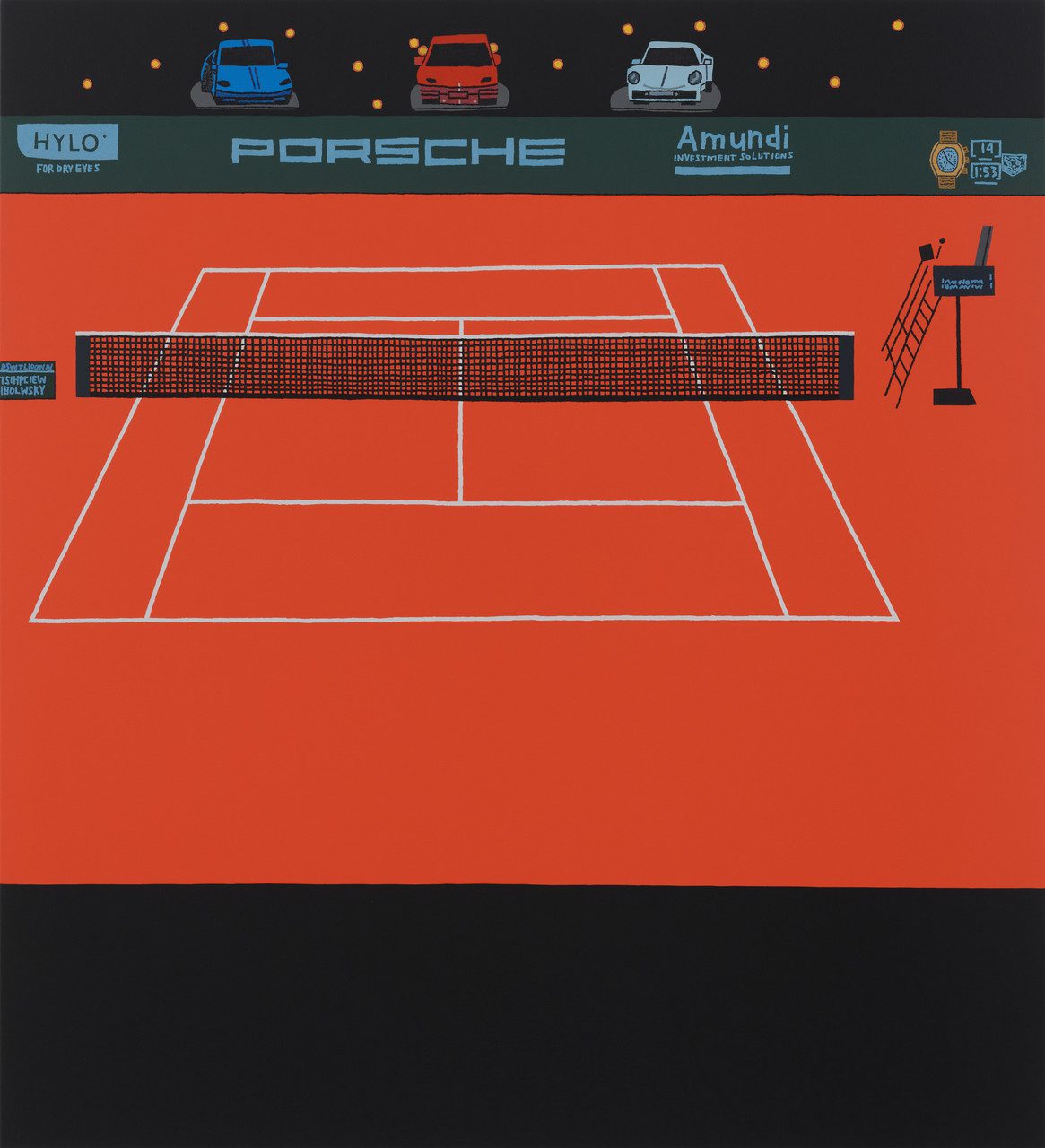
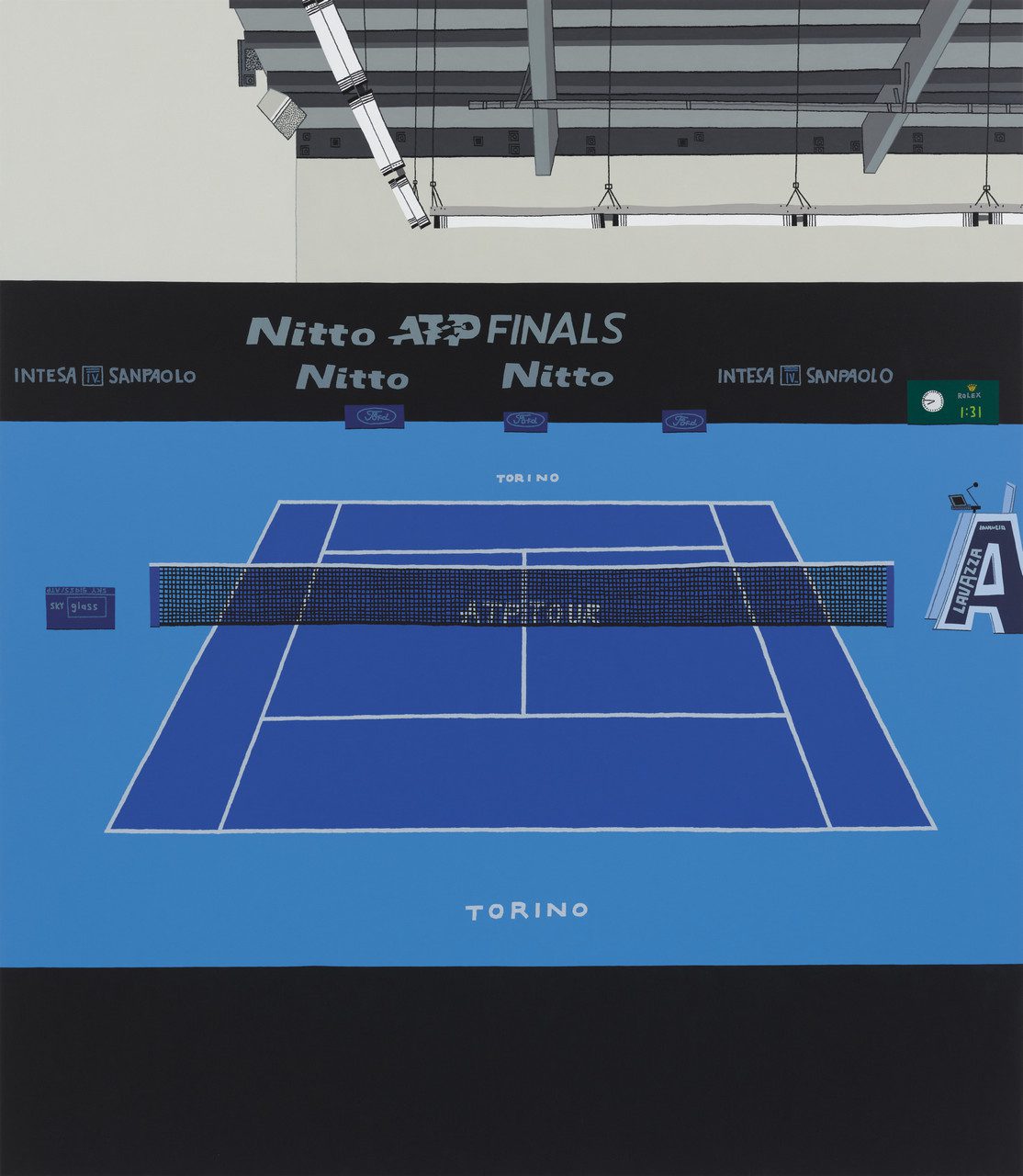
A new exhibition at Gagosian in Beverly Hills centers on Wood’s ongoing series of tennis court paintings, a body of work that the artist first initiated in 2011. Produced in 2025 and 2026, the latest canvases transform televised tennis matches into fields of abstraction. Each painting represents a match held at a major professional tournament from the circuits of the Association of Tennis Professionals or the Women’s Tennis Association, or at the Olympic Games, yet the athletes themselves are conspicuously absent. Instead, Wood depicts the court from a vantage point behind the baseline, compressing the entire arena into a foreshortened perspective that emphasizes the geometry of the playing surface.
The tennis court, with its standardized dimensions and varied color schemes, offers Wood a structure for serial experimentation. Each composition functions as a controlled system in which repetition and variation operate simultaneously. Saturated hues—emerald greens, clay reds, and electric blues—capture the distinctive surfaces of grass, clay, and hard courts. Nets, umpire chairs, courtside signage, and advertising banners punctuate the compositions, marking the subtle distinctions between one stadium and another.
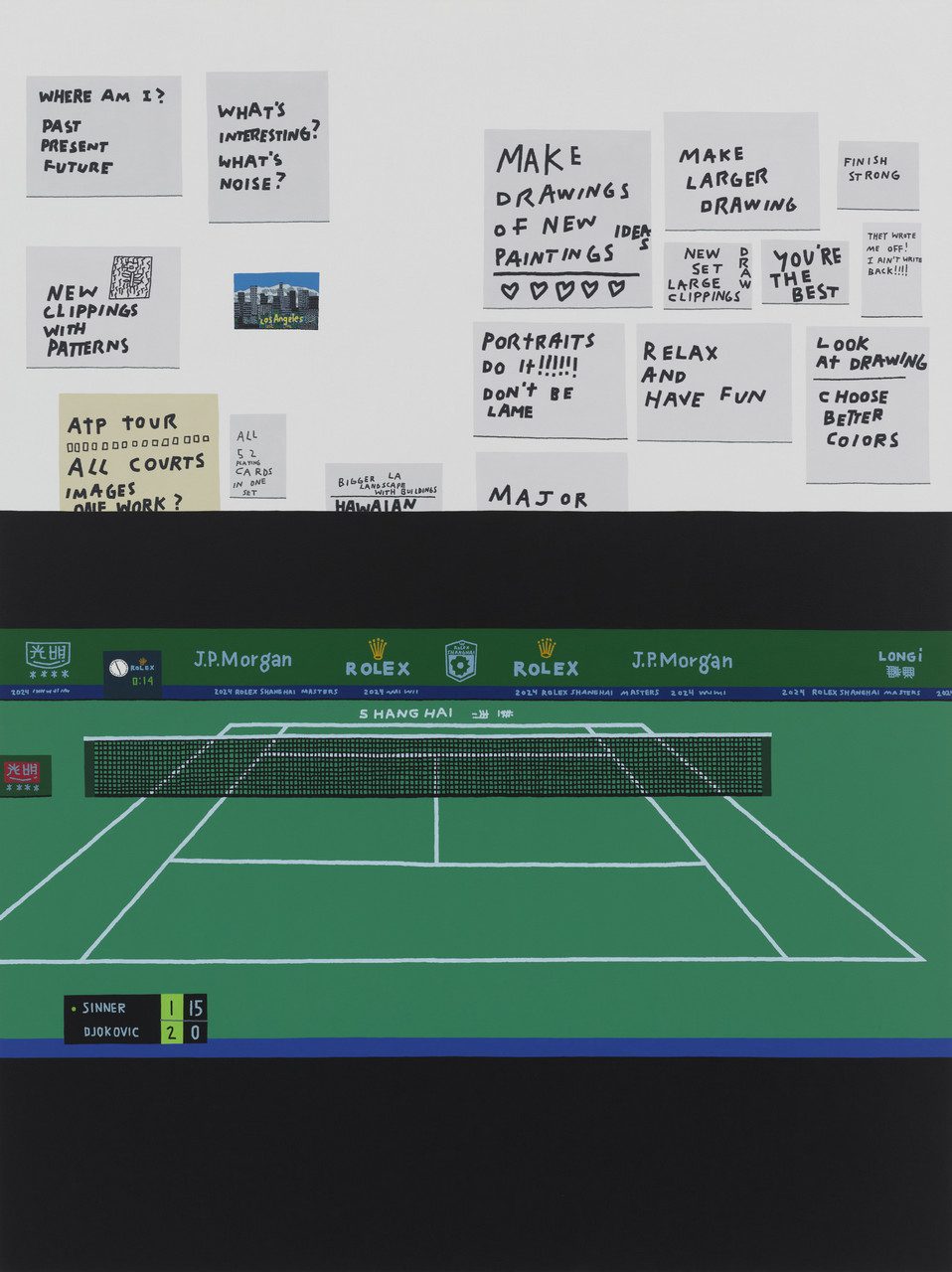
Occasionally, Wood introduces graphic overlays that mimic televised scoreboards, listing player names and running scores to anchor the paintings to specific moments in real matches. One work, “Nintendo 3” (2025), departs from this premise: instead of referencing a broadcast tournament, the composition derives from a tennis video game the artist plays with his children, blurring the boundary between mediated sport and domestic life.
The series’ strict compositional logic invites comparison to the disciplined color experiments of Josef Albers, particularly his “Homage to the Square” paintings. Just as Albers treated nested squares as laboratories for color interaction, Wood uses the rectangular geometry of the tennis court as a framework for exploring the relationships between pigment, pattern, and spatial perception.
Wood’s courts are often framed by large, solid black passages along the edges of the canvas. These areas evoke the experience of watching tennis on television in a darkened room, situating the viewer simultaneously inside the stadium and within the domestic space of spectatorship. The paintings thus reflect not only the spectacle of sport but also the mediated conditions through which most audiences encounter it.
Other works complicate this viewing experience through collage-like compositions that integrate fragments of Wood’s personal surroundings. Painted wood-grain patterns, brick walls, and speckled flooring suggest interior architectural spaces, while additional motifs—houseplants, studio ceiling lights, sports cars, and pinned working notes—appear as layered visual quotations. In these canvases, the tennis court becomes one image among many, embedded within the artist’s broader visual vocabulary.
A related painting, “Bball Studio with Tennis Court” (2026), depicts a cohesive view of Wood’s studio interior with a tennis match playing on a television screen. The scene effectively collapses multiple levels of representation: the physical studio, the televised game, and the painted interpretation of both.
Wood further expands the conceptual reach of the series through explicit art-historical dialogue. In several paintings—”Paris Olympics with Crying Girl” (2025), “Dubai with Nude with Blue Hair” (2026), and “Hamburg Open with Girl” (2026)—he incorporates reinterpretations of prints by Roy Lichtenstein. The borrowed imagery acknowledges Wood’s affinity with Pop art while paying homage to Lichtenstein’s exploration of the crossover between painting and printmaking.
These references underscore a key aspect of Wood’s practice: the fusion of everyday observation with canonical art history. In his paintings, the language of modernism intersects with the visual culture of sports broadcasting, video games, and domestic interiors.
Although rooted in the spectacle of tennis, Wood’s paintings ultimately function less as depictions of athletic competition than as landscapes of color and structure. The courts, flattened and stretched across vertically oriented canvases, become abstract fields—zones where color, pattern, and geometry play out their own silent match.
In this sense, Wood’s tennis courts operate as both subject and system: a familiar sporting environment transformed into a compositional device. Through repetition and variation, the artist reveals the underlying architecture of the game while simultaneously reflecting on the environments—both personal and cultural—that shape his artistic world.
For viewers, the result is a paradoxical image: a painting about sport without players, movement without motion, and a competition that unfolds entirely within the boundaries of color and form.
Photo: Jonas Wood, Torino, 2025, Oil and acrylic on canvas, 100 x 87 inches (254 x 221 cm), © Jonas Wood, Photo: Marten Elder, Courtesy Gagosian
Info: Gagosian, 456 North Camden Drive, Beverly Hills, CA, USA, Duration: 12/3-25/4/2026, Days & Hours: Tue-Sat 10:00-17:30, https://gagosian.com/