
PRESENTATION: Tracey Emin-A Second Life

For more than four decades, Tracey Emin has forged one of the most recognisable voices in contemporary art. Emerging in the early 1990s with a practice that crossed media boundaries—painting, drawing, installation, film, photography, textiles, sculpture and neon—Emin established a radically confessional artistic language. Her work transformed autobiography into a powerful aesthetic method, exposing emotional vulnerability while confronting social taboos around sexuality, trauma and the female body.
By Dimitris Lempesis
Photo: Tate Archive

The landmark exhibition “A Second Life”, presented at Tate Modern, is the most comprehensive survey ever dedicated to the artist. Spanning forty years of practice and comprising more than one hundred works, the exhibition traces the defining events that have shaped Emin’s life and artistic evolution. Conceived in close collaboration with the artist, it assembles seminal installations from the 1990s alongside recent paintings and sculptures—some exhibited publicly for the first time—revealing a body of work driven by emotional urgency, honesty and resilience. From the outset, Emin’s work stood apart from the dominant artistic tendencies of the late twentieth century. At a moment when conceptual and detached practices dominated the art world, she introduced an intensely personal mode of expression. Her art does not merely reference biography; it reconstructs lived experience through objects, narratives and gestures that invite viewers into the intimate terrain of memory. The exhibition opens with early works that demonstrate Emin’s lifelong relationship with painting. Among them is “My Major Retrospective” (1982–93), originally shown in her first solo exhibition at White Cube. The work consists of tiny photographs documenting paintings she produced during art school in the 1980s—works the artist destroyed during a period of profound personal crisis. These fragments of absence are shown alongside “Tracey Emin CV” (1995), a self-portrait presented as a first-person narrative of her life up to that point, and the video “Why I Never Became A Dancer” (1995). In the latter, Emin recounts episodes of humiliation and trauma from her adolescence in the seaside town of Margate.Together, these works introduce the core of Emin’s practice: a raw, direct voice that collapses the distance between art and lived experience.
Margate occupies a central place in Emin’s personal and artistic mythology. She left the town at fifteen but returned frequently during her early adulthood before moving to London in 1987 to study at the Royal College of Art. In recent years Margate has become the site of a profound personal and creative renewal. After the death of her mother there in 2016 and following her recovery from cancer in 2020, Emin chose to return permanently. She subsequently founded the Tracey Emin Artist Residency, a studio-based program offering free spaces for emerging artists. Several works in the exhibition revisit memories of this formative landscape. The textile installation “Mad Tracey From Margate: Everybody’s Been There” (1997) reveals an intimate diary of hand-stitched phrases, drawings and letters, exposing private thoughts with characteristic candour. In contrast, the sculptural work “It’s Not the Way I Want to Die” (2005)—a wooden rollercoaster inspired by the town’s amusement park Dreamland Margate—transforms childhood nostalgia into a metaphor for vulnerability, anxiety and mortality. Throughout her career, Emin has addressed subjects that were historically marginalized or silenced in art: sexual violence, abortion, emotional breakdown and the complexities of female desire. In doing so she has become a central figure in contemporary feminist discourse, challenging the boundaries between private confession and public testimony.
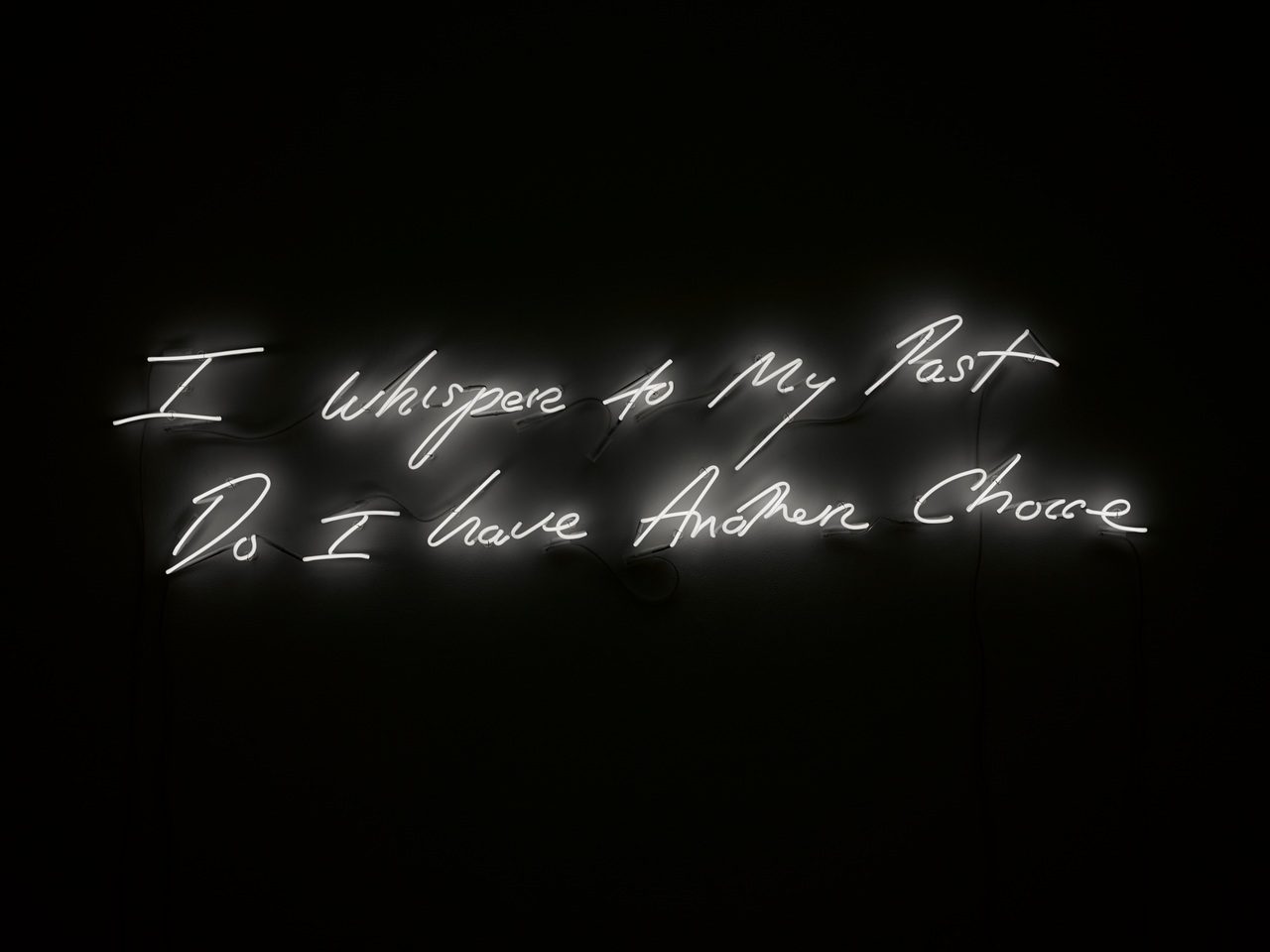
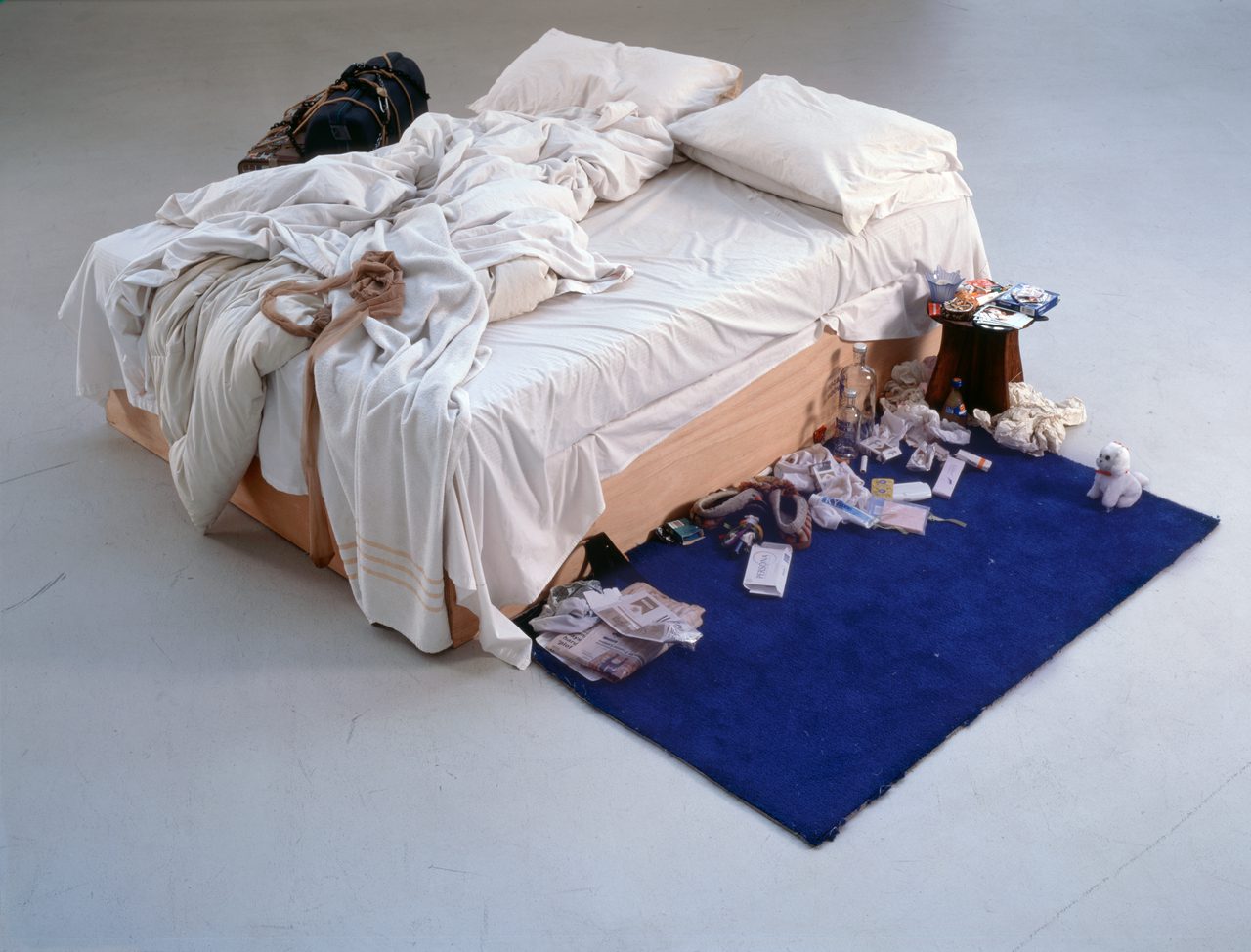
Works such as the neon “I Could Have Loved My Innocence” (2007) and the embroidered calico “Is This a Joke” (2009) confront the experience of sexual assault. Equally powerful is the video “How It Feels” (1996), in which Emin recounts an abortion that went wrong. Delivered in the artist’s unmistakably direct voice, the work describes institutional neglect, physical suffering and the social stigma surrounding women’s reproductive choices. Displayed publicly for the first time, the quilt “The Last of the Gold” (2002) extends this dialogue. Its embroidered surface features an ‘A–Z of abortion’, transforming the domestic language of textiles into a form of practical and political guidance. At the emotional centre of the exhibition are two of Emin’s most influential installations: “Exorcism of the Last Painting I Ever Made” (1996) and “My Bed” (1998).
The first documents a radical performance staged in a gallery in Stockholm, where Emin lived and worked publicly for three weeks in an attempt to reconcile herself with painting, which she had abandoned following her abortion. The installation records a ritual of artistic rebirth. Two years later came “My Bed”, one of the most iconic works of the 1990s and a finalist for the Turner Prize. The installation presents the artist’s unmade bed surrounded by empty bottles, cigarettes, stained sheets and personal detritus—a stark portrait of emotional collapse following an alcohol-fuelled breakdown. At once shocking and disarmingly honest, the work marked a pivotal moment in contemporary art’s embrace of radical subjectivity. Within the exhibition’s narrative, these works represent a turning point: the passage from Emin’s “first life” toward the possibility of renewal.
More recent works address another transformative chapter in Emin’s life: her diagnosis and treatment for bladder cancer in 2020. Rather than retreating from the visibility of illness, the artist has integrated the experience directly into her practice. The bronze sculpture “Ascension” (2024) reflects on her altered relationship with the body following major surgery. Nearby photographs depict the stoma she now lives with—images that challenge conventions of bodily representation while asserting dignity and survival. For Emin, the personal remains inseparable from the political. By presenting illness and disability without mediation, she expands the discourse surrounding the female body and the realities of aging and vulnerability.
The exhibition culminates with a series of monumental paintings created in recent years. Though marked by the emotional intensity that defines Emin’s work, these canvases possess a new sense of openness and transcendence. Figures dissolve into gestural lines and luminous color fields, suggesting both fragility and spiritual persistence. Amid these works stands the sculpture “Death Mask” (2002), a reminder that mortality has long shadowed the artist’s vision. Yet the surrounding paintings convey a renewed determination to inhabit the present—a creative energy shaped by survival. Outside the museum, the monumental bronze “I Followed You Until The End” (2023) extends Emin’s presence into the public landscape around Tate Modern. Confronting passersby with a visceral expression of longing and devotion, it affirms the artist’s enduring ability to translate private emotion into collective experience.
“A Second Life” ultimately presents more than a retrospective. It is the story of an artist who has repeatedly turned personal crisis into creative transformation. Through confession, vulnerability and an unwavering commitment to truth, Tracey Emin has redefined the possibilities of autobiographical art. Her work reminds us that the most intimate stories—of love, loss, pain and survival—can resonate far beyond the individual. In Emin’s hands, autobiography becomes a universal language, one that continues to shape the landscape of contemporary art.
Photo: Tracey Emin, Exorcism of the last painting I ever made 1996 © Tracey Emin. All rights reserved, DACS 2026
Info: Curators: Maria Balshaw, Alvin Li, and Jess Baxter, Tate Modern, Bankside, London, United Kingdom, Duration: 27/2-31/8/2026, Days & Hours: Mon-Thu & Sun 10:00-18:00, Fri-Sat 10:00-21:00, www.tate.org.uk/

Right: Tracey Emin, I followed you to the end 2024. Yale Centre for British Art. © Tracey Emin. All rights reserved, DACS 2026



Right: Tracey Emin, Is This a Joke 2009 © Tracey Emin. All rights reserved, DACS 2026