INTERVIEW: Margarita Vasilakou and Yannis Stefanakis
 Occasioned by the two-person exhibition of Margarita Vasilakou and Yannis Stefanakis at the Art Project Space, we discuss with the two artists about the path that led them to this intricate endeavor, as well as various issues related to the creative process itself and the social impact of works that touch on such sensitive themes. Two contradictory worlds come together here and the occasion is poetry: Margarita Vasilakou is inspired by Christos Kremniotis’ upcoming poetry collection On Fleshly Paper, while Yannis Stefanakis opens a dialogue with Andreas Embeirikos’ Oktana. The dark side of love is contrasted with its liberating power, as envisioned by Embirikos, the pioneering advocate of Surrealism in Greece. Somewhere on the Threshold between Earth and Sky, as the title of the exhibition is, the two creators intersect, both visually and conceptually, offering us a distinctive visual poetics. Though it delves into extreme states, it ultimately confronts us with our own selves in a deeply introspective reckoning.
By Valia Katsimpa
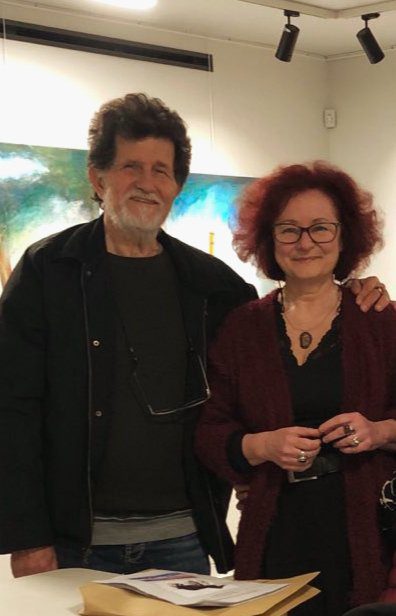
Photo: Courtesy of Margarita Vasilakou & Yannis Stefanakis
Life and art as a shared journey…Could you tell us a few words about this condition of companionship? To what extent does your everyday cohabitation shape and influence your creative approach?
M.V.: It influences me to a great extent. For many reasons, it is an inherently demanding—at times even harsh—condition, which is why it requires, at the very least, clearly defined boundaries between personal space and the artistic studio. Yet through constant interaction, these boundaries become increasingly fluid. Even this, modest as it may seem, is something that both affects and subtly shapes the trajectory of artistic expression.
Y.S.: My sense of solitude began to recede through my life alongside Margarita. Beyond that, one’s chosen person is the first to encounter the works—simultaneously their earliest viewer and, often, their most exacting critic. This is profoundly important. Of course, to receive rigorous criticism from one’s partner requires mutual respect and a substantial measure of professionalism, so that it is not perceived, even inadvertently, as a personal affront.
M.V.: For Yannis, I believe that shared life generally provides a framework of safety. Perhaps it does so for me as well, though to a lesser extent, mainly for reasons of temperament. In any case, one’s partner is the first—and most meaningful—witness to the creative process, and this is decisive in relation to the work that emerges. It is profoundly important, as it shapes not merely a static outcome, but almost the very trajectory of the creator.
What challenges did you encounter while preparing this new body of paintings, given the particularly sensitive subject of child abuse addressed in the forthcoming Christos Kremniotis’ poetry collection “On Fleshly Paper”, with which your work is clearly in dialogue? Which visual motifs emerged from your engagement with this literary work and how do they reinforce your denunciatory stance toward the blatant injustice of lost childhood innocence?
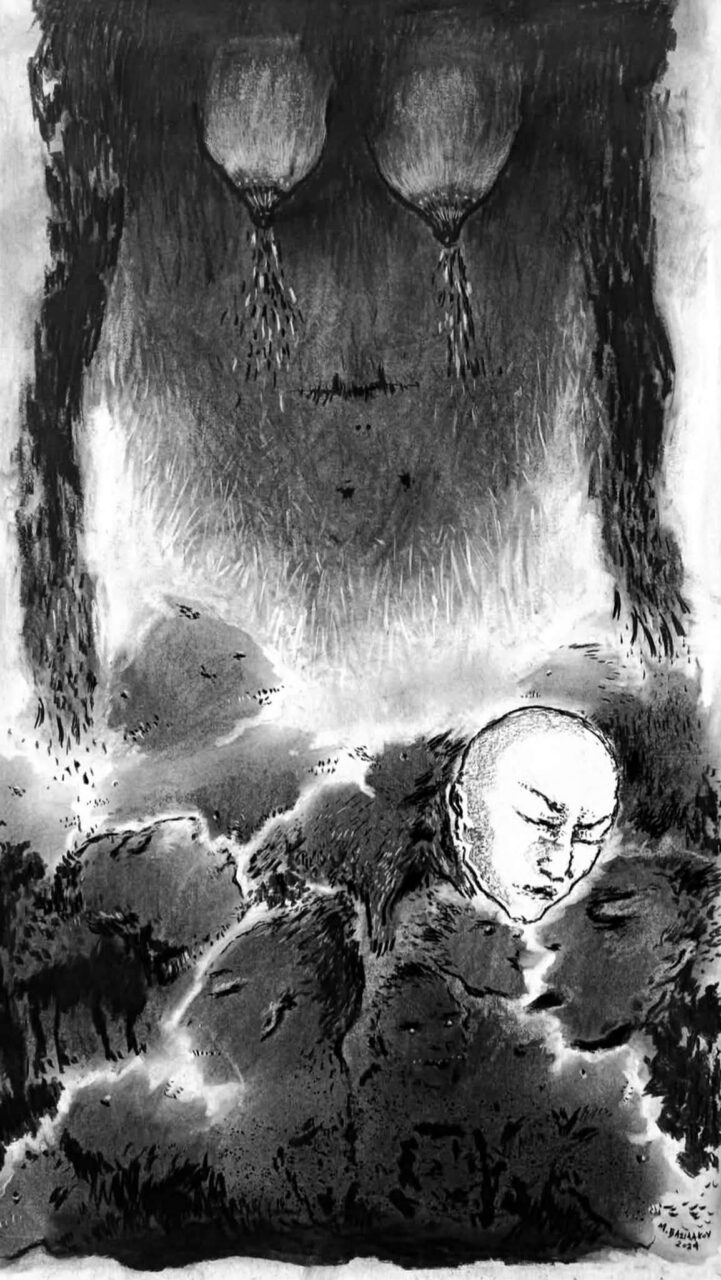
M.V.: Every stage of my collaboration with Christos Kremniotis on this particular poetry collection constituted, for me, the most painful descent I have experienced as a human being. You understand, of course, that the sexual abuse of children is not merely an event, nor something that simply happened. And the more we choose silence and indifference as a way of life, the more the darkness within us multiplies.
If I speak specifically about the difficulties I faced in relation to painting, I would say that one of the most serious was managing the intense emotional charge I carried, while attempting to render the trauma of child abuse without slipping into shallow sensationalism or the aestheticization of pain.
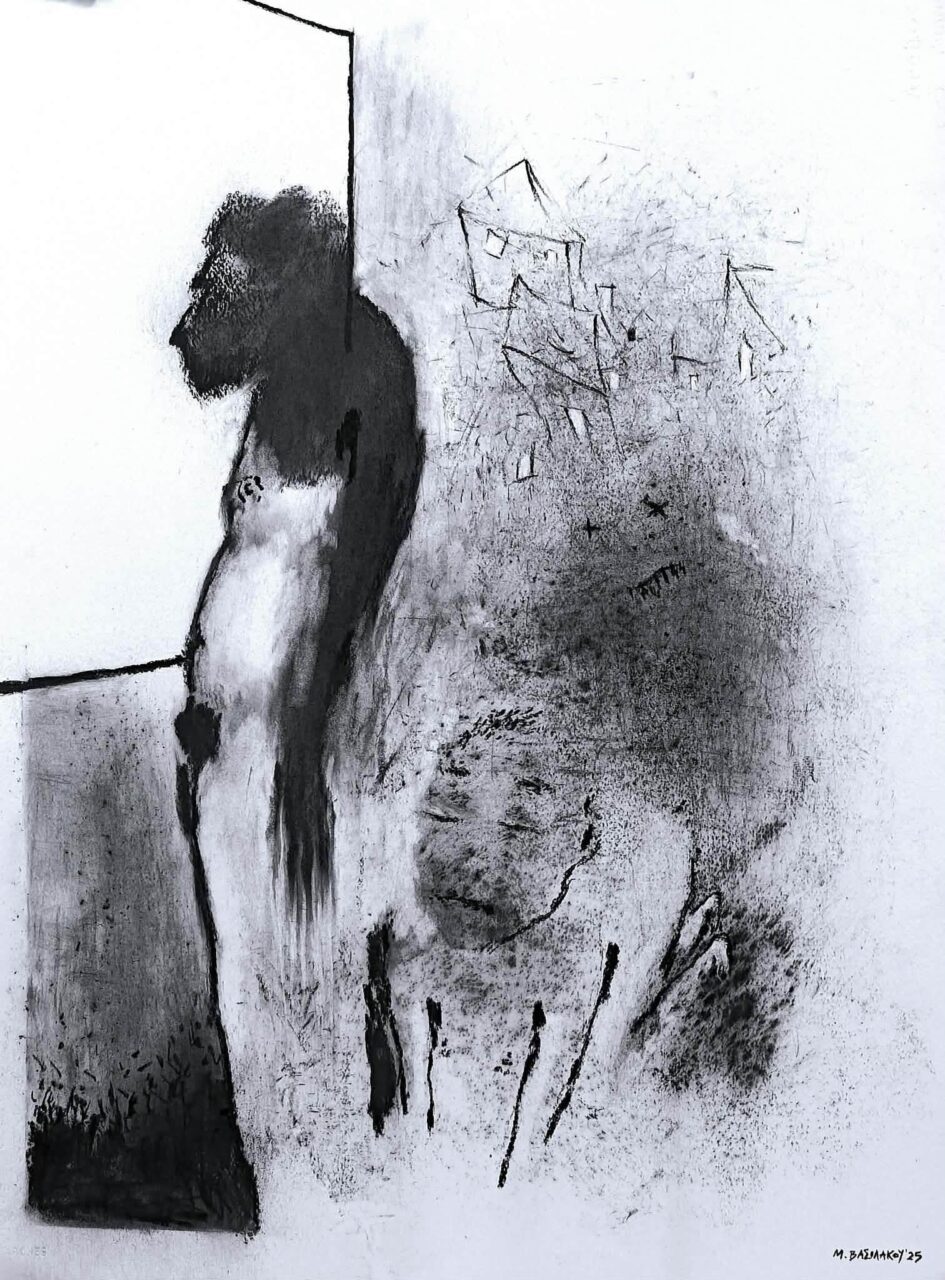
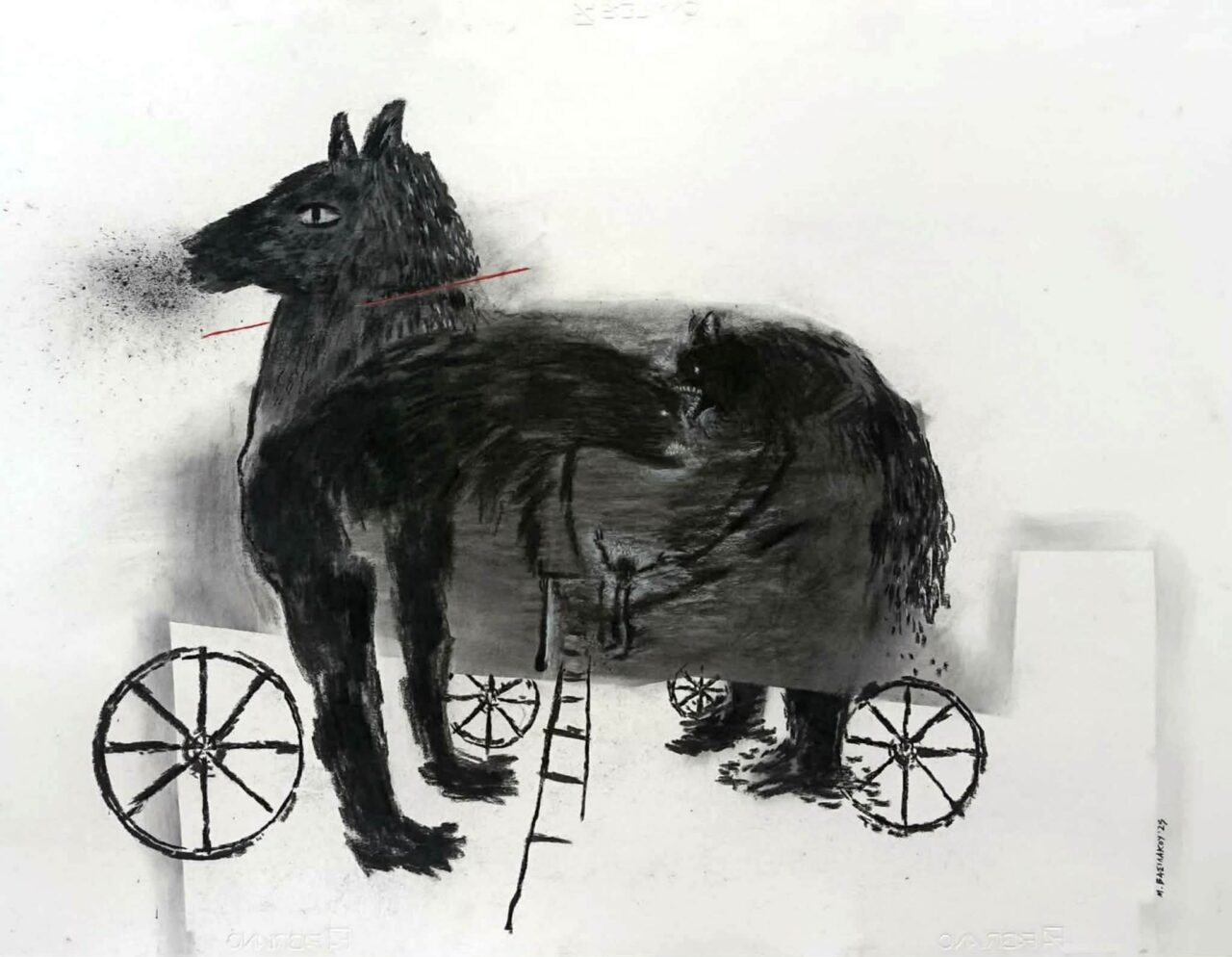
In relation to the visual motifs you ask me about (as an extension of Kremniotis’ poetic voice), in their denunciatory function as tools, I would first and foremost mention the choice of materials: paper and charcoal. Each carries its own force and symbolism, as do the stark contrasts between light and shadow and the use of heavy shading. These elements helped me το highlight situations such as the entrapment and silence that accompany abuse. Choices that, in my opinion and experience, do not easily leave room for the viewer to look away.
Do you believe that this exhibition—beyond its visual interest—articulates a vital social discourse? What other issues, aside from the grave matter of child abuse, are addressed here?
M.V.: I would say it must articulate a social discourse, insofar as it does not limit itself to recording pain, but operates as a fierce act of accusation. After all, art—beyond its classical aesthetic and philosophical dilemmas and its inherent value, which requires no external justification for its existence—has a responsibility to engage in social critique, and not merely to function as an object of aesthetic pleasure. Provided, of course, that it does not lapse into propaganda, thereby diminishing its artistic integrity.
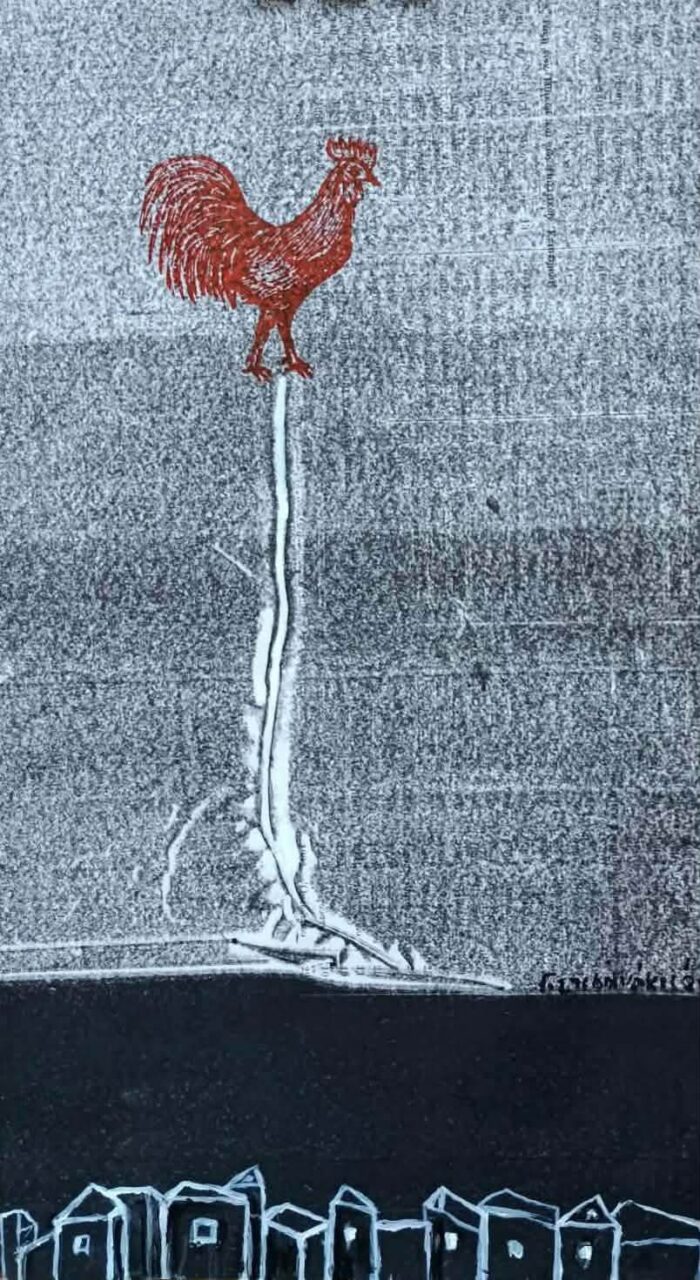
Y.S.: I completely agree. Fortunately, today we encounter a dialogue between these two situations. This is confirmed by most contemporary visual events, which demonstrate that art increasingly functions as a medium of social reflection. For obvious reasons, artists bear an added moral responsibility to intervene in reality and to articulate positions on urgent issues, going beyond aesthetic gratification. In this particular body of my work, I also raise environmental concerns: the suffocation experienced within fragmented cities, the lack of green spaces, the devaluation of animals within grey urban landscapes.
M.V.: Exactly. Even when this concerns the smallest aesthetic tremor—how much more so when critical issues are simultaneously addressed, such as the complicity of silence, the role of the social environment, institutional inadequacy, and the inertia of justice (which often leads to the secondary victimization of survivors), the existential void, and much more. In short, both the poetry collection and the body of visual works do not simply speak of a “social problem.” I would say this collaboration is a cry—against the brutalization of contemporary society—and an attempt to give voice to what is so often swept “under the rug” of Greek reality.
In your works, Oktana is visualized through ambiguous landscapes, as suggested in the exhibition text: “His cities—dreamlike, indeterminate, sometimes overtly threatening—appear before us as fragile versions of a future that depends on our choices.” What prompted this choice? In your view, is the path to true happiness the resultant of our personal choices?
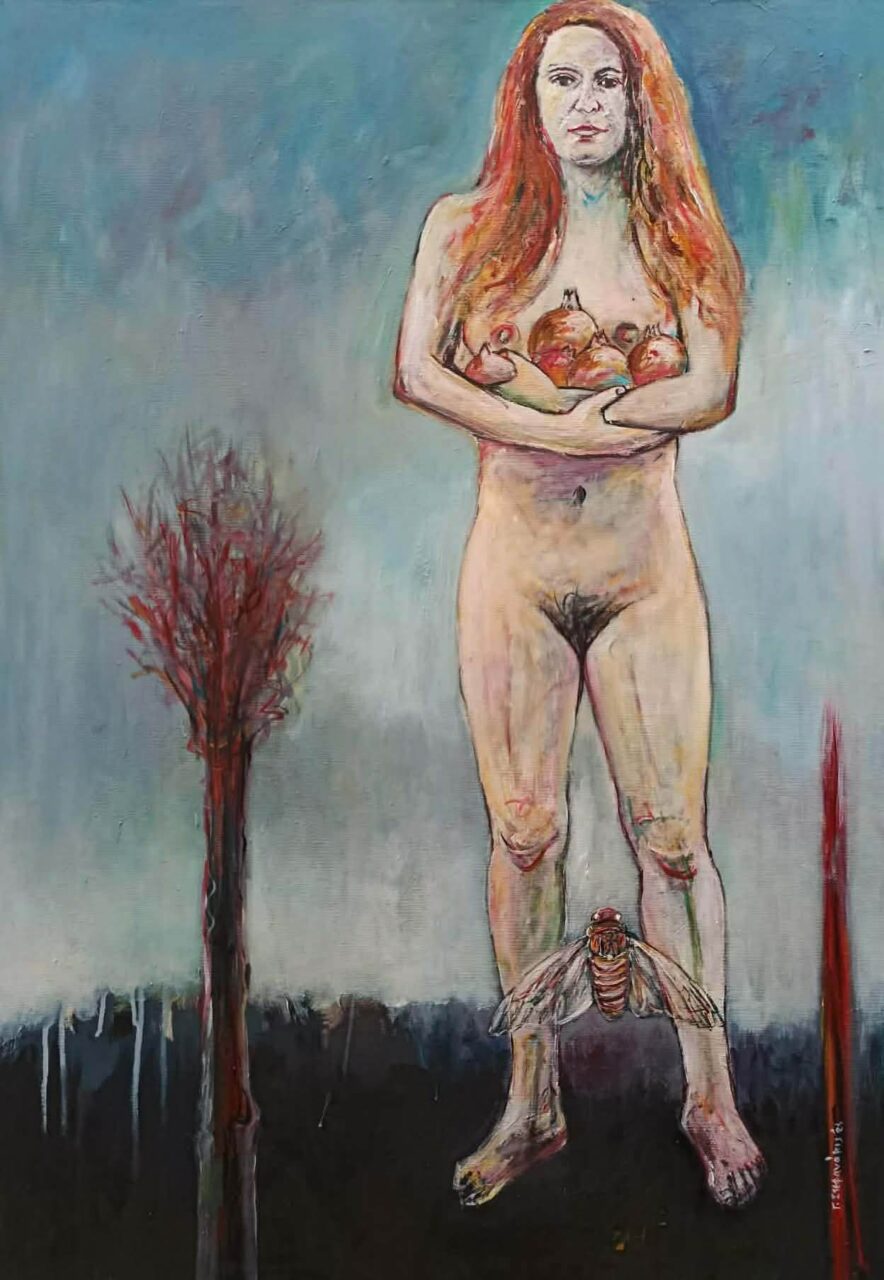
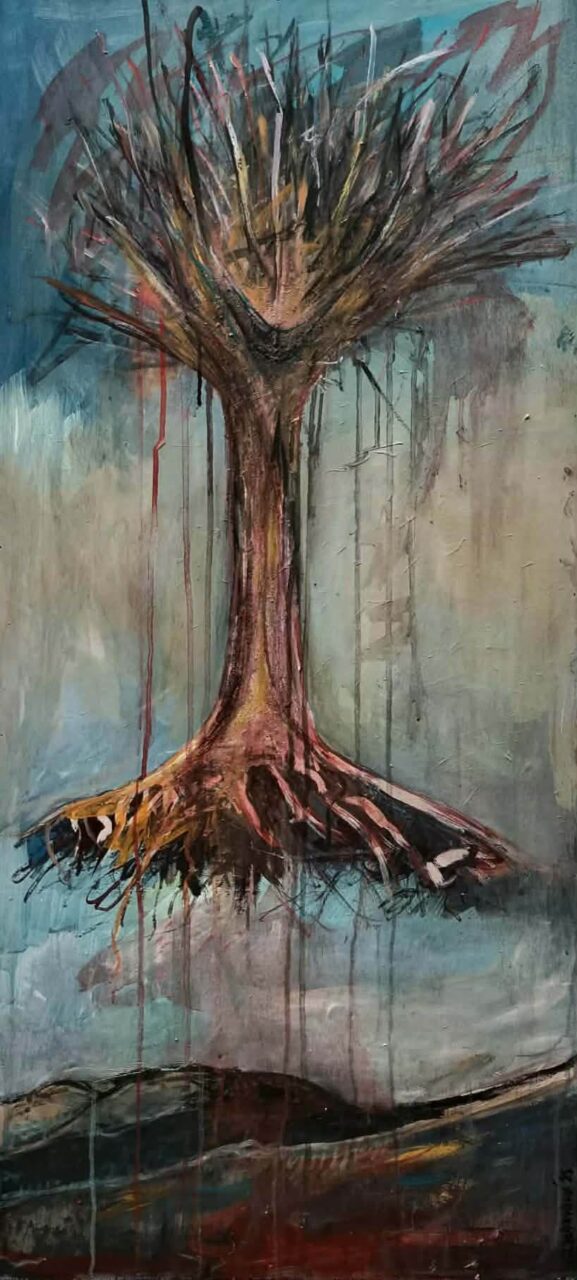
Y.S.: The choice of Oktana as a visual vehicle was not accidental. Oktana, as Embirikos’ “vision of a city”, functioned in my work as a space with its own dynamics, rather than merely as an idea. I felt and experienced this place as one where desire collided intensely with reality.
As for happiness, I believe it is not a random state, but something that emerges from the human capacity to transmute life’s difficulties into creation. Art demonstrates this with remarkable clarity in the simplest of ways: when, through painting, we learn to incorporate imperfection—the so-called “mistake”—and integrate it into the final outcome of the work.
At first glance, the dark figures in Vasilakou’s works seem to function as the negative image of Stefanakis’ forms. Yet, upon closer engagement, one discerns multiple and distinct layers of interpretation, shaped through their apparent contradictions. Would you like to tell us a few words about this internal dialogue between the works?
M.V.: Yes—if, at an initial level, the viewer perceives these two bodies of work through a relation of counterpoint, at a second level one also senses a resonance that operates as a form of equilibrium. That said, the first reading does indeed foreground something more than a merely aesthetic contrast, even if a profound one. What we are dealing with is a frontal collision between two worlds struggling over the human soul. This alone testifies to the existence of a dialogue unfolding between two extremes. Many elements—at least on the surface—attest to this: bodily postures, the role of light, the sense of space. Yet it is precisely here that the foundation of an internal communication and dialogue is established.
Y.S.: Naturally—the dialogue begins with the synthesis of contradictions and, in my view, culminates in a coherent narrative. The common ground of this dialogue is the body. And it is precisely at this point that the divergence in subject matter and the ideological tension are translated through material and technique, without one body of work negating the other.
M.V.: I would only like to emphasize that, in my view, the essence of this dialogue also resides at the point where the dystopia of child sexual abuse overturns the utopia of Andreas Embirikos’ vision of a city founded on free desire, innocence and spiritual elevation.
Where do these two worlds ultimately meet: Embirikos’ ideal city and the dark condition articulated by Kremniotis? In other words, does the exhibition reflect the dual nature of the human condition, with all its intermediate shades?
M.V.: I would say they meet primarily in the realm of inner quest and artistic truth. And if we seek the duality of human nature within this exhibition, we will find it in the placement of the desire for absolute freedom alongside the awareness of human limits and mortality. Overall, I would describe this encounter as both revelatory and violent.
Y.S.: In Oktana, Embirikos proclaims absolute freedom where love is free from guilt and power, while in On Fleshly Paper, Kremniotis records and denounces the ultimate perversion of that freedom: child abuse. The most nightmarish imposition upon innocence. I believe this exhibition reveals a segment of the spectrum of human nature, stretching from the divine to the bestial, with art functioning as the only space where horror can be spoken in order to be confronted.
“Threshold between Earth and Sky” — a phrase from Embirikos’ Oktana. The notion of the “threshold” implies a state of transition. Does it reflect here a collective existential condition, or rather a moment of transformation—deeply personal and temporally distinct for each individual?
Y.S.: I believe we would both agree that one does not negate the other. This phrase functions as a central axis of an ontological synthesis, in which, in a sense, the individual and the collective are inseparable.
In an era of digital over-saturation and the indiscriminate consumption of images, can art still convey meaning—especially to younger audiences—through the power of silence and inwardness?
M.V.: I think this is an exceptionally timely question. Living as we do in a state of digital saturation, where everything must shout in order to exist—within a constant noise, that is—the only viable stance is silence, mediated through the inwardness that characterizes art. Of course, this silence should not be understood as the absence of sound or meaning, but as an invitation to dialogue—primarily with oneself. Young people today are exhausted by noise and by the speed of information. They long for the silence a work of art can impose, yet they do not know how to demand it, how to claim it. We must also consider that their gaze has not been “trained.” The act of filling in gaps with one’s own thought is not simple; it requires maturity—pause and critical reflection. You understand what I mean.
Y.S.: I would add that, from this perspective, a work of art that enforces silence also provides a form of safety. I’ll cite my beloved Andrei Tarkovsky, and the decompression his films offer, or the kind of silence conveyed by the performances of Marina Abramović. In general, it is not easy for a teenager accustomed to fifteen-second videos to stand alone before a static artwork. Yet doing so is, I would say, a revolutionary act.
After this fertile dialogue between you, what lingers as an aftertaste? And what are your next plans?
M.V.: A line by Katerina Anghelaki-Rooke keeps circling in my mind:
“I bid the excess to flee. To slip into nothing’s heaven with the scantest few.”
Y.S.: For me, the aftertaste is the sense that the “Threshold” is not a void, but a place where matter enters into an equal dialogue with spirit.
As for what comes next… we shall see.
Photo: Father and two neighbors, 2025, carbon on paper, 100×70 cm, Courtesy of Margarita Vasilakou & Yannis Stefanakis
Download Greek version here.
First publication: 6/3/2026
www.dreamideamachine.com
© Interview by Valia Katsimpa
Info: Curator: Valia Katsimpa, Art Project Space, Falirou 66, Neos Kosmos, Duration: 11/2–6/3/2026, Opening hours: Tue 17:00–21:00 Thu–Fri 12:00–20:00 & Sat 11:00–15:00.