
PRESENTATION: Dashiell Manley-Periplums
The practice of Dashiell Manley is characterized by focused, repetitive, and often labor-intensive techniques and processes. Cultivating idiosyncratic techniques that are intertwined with East-Asian traditions of mindfulness, Manley manifests various psychological states throughout his work. Drawing on emotional responses to current events and 21st century socio- political realities, he painstakingly labors to build compositions in a process akin to Zen Buddhist practices.
By Dimitris Lempesis
Photo: Marianne Boesky Gallery Archive
In “Periplums” his recent solo exhibition, Dashiell Manley undertakes a project that is at once cartographic, archival, and deeply personal. Drawing on longstanding formal concerns—time, memory, abstraction—Manley reexamines the World War II–era incarceration of Japanese Americans while situating that history within his own family’s narrative. The result is a body of work that treats painting and film not as static objects but as lived itineraries: experiential maps shaped by repetition, excavation, and return.
The exhibition’s title is borrowed from Ezra Pound, who coined “periplum” in The Cantos, riffing on the Latin periplus, a written account of a sea voyage. For Pound, a periplum described a map apprehended from within—knowledge accrued through movement rather than surveyed from above. Manley adopts this concept both literally and metaphorically. His “Periplums” are not objective renderings of territory; they are embodied passages through geography and history, filtered through the contingencies of memory and the pressure of the present.
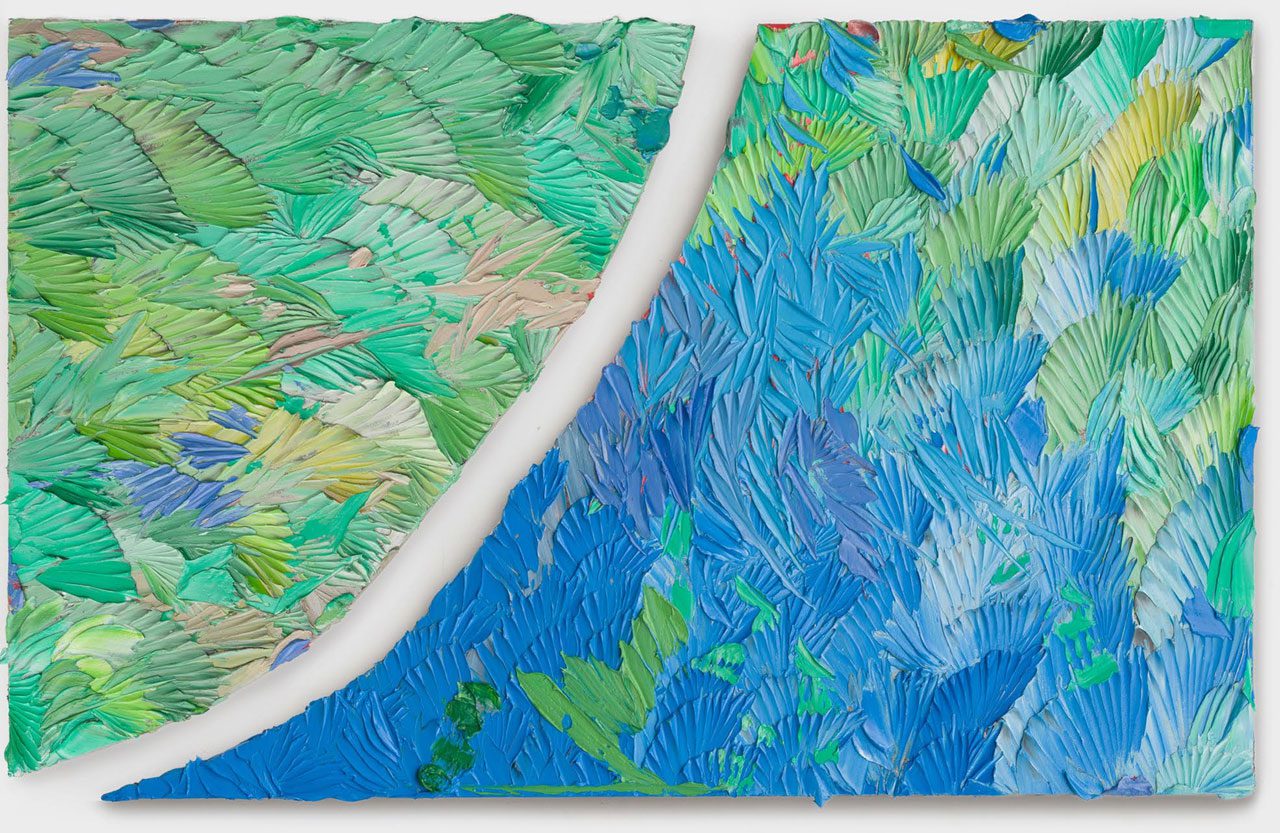
At the center of the exhibition is a new suite of paintings from Manley’s ongoing “Elegy” series, begun more than a decade ago. The “Elegies” have long functioned as a kind of psychological register. In response to the relentless churn of headlines—news alerts, breaking stories, the ambient hum of crisis—Manley developed a highly disciplined, labor-intensive process. Each canvas is first blanketed in a dense layer of oil paint. He then incises the surface with a palette knife, carving repetitive striations into the viscous skin. The gesture recalls, in part, the carving of Edo-period woodblock prints, but transposed into the language of abstraction.
These surfaces are materially rich and optically volatile. Dense chromatic fields vibrate under the pressure of repeated cuts. The marks accumulate like data points, forming a textured palimpsest that mirrors the saturation of the contemporary information economy. Yet across many canvases, subtle horizon lines hover—thin seams of compositional calm that evoke landscape painting’s promise of stability. The tension between frenzy and tranquility is deliberate. The “Elegies” capture the oscillation between the anxiety of the 24-hour news cycle and the seductive illusion that order persists beneath it.
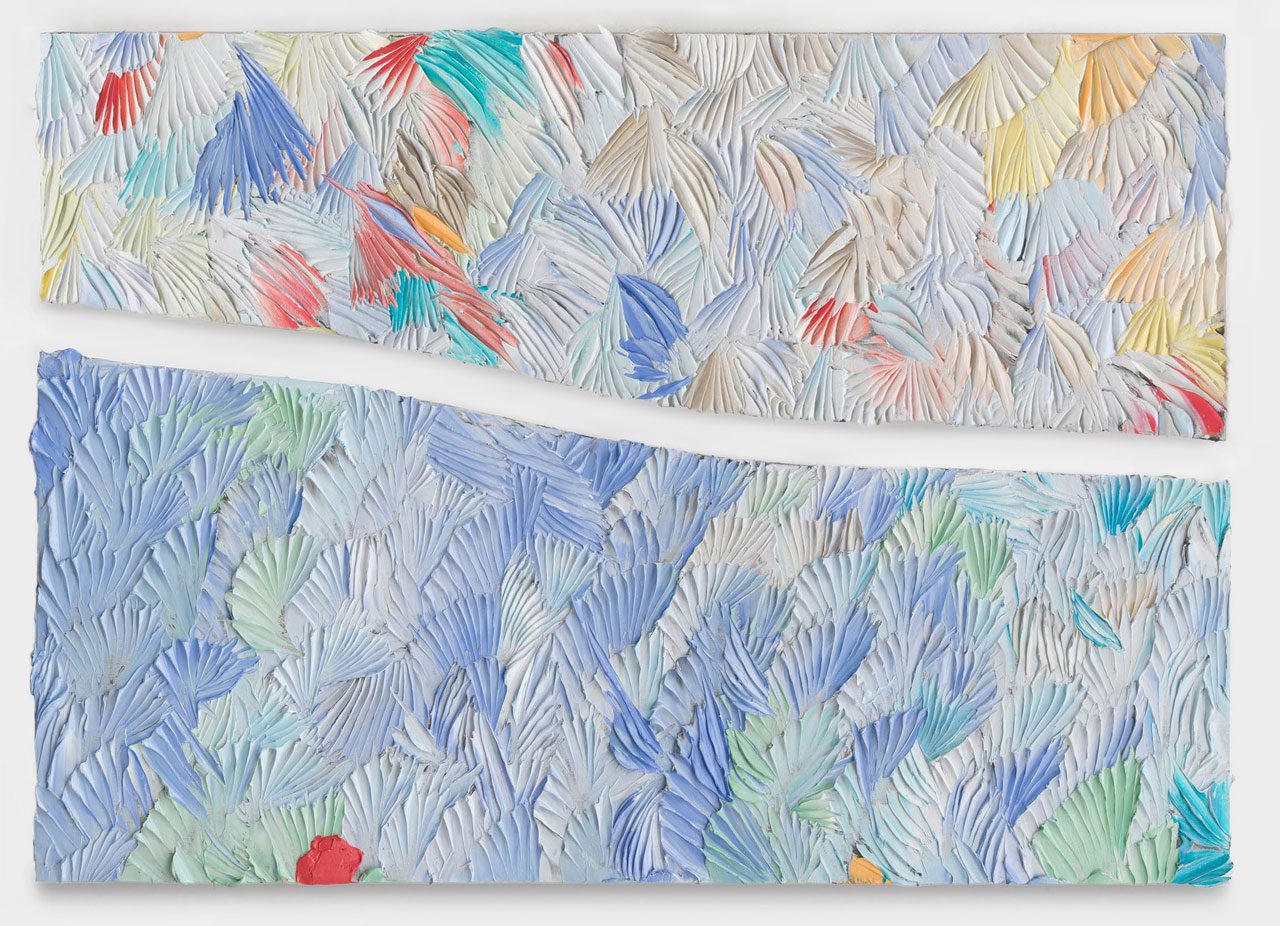
For “Periplums,” Manley subjects these works to a decisive transformation. Each canvas is bisected by a channel cut through the painted surface, following a segment of the route from his home in Altadena to Manzanar, one of ten sites where Japanese Americans were incarcerated during World War II. The incision is both violent and precise: a literal rupture that inscribes geography into abstraction. The painting becomes a map—not a bird’s-eye topography, but a wound that traces a lived journey.
Manzanar, located in the Owens Valley between the Sierra Nevada and the White Mountains, is the closest of the incarceration sites to Los Angeles. It was established after the attack on Pearl Harbor, when President Franklin D. Roosevelt signed Executive Order 9066 in 1942. The order authorized the forced removal of more than 120,000 people of Japanese descent—most of them U.S. citizens—from their homes along the West Coast to inland camps in California, Arizona, Utah, Idaho, Wyoming, Colorado, and Arkansas. The language of “relocation centers” masked what was, in practice, mass incarceration under military authority.
Members of Manley’s family were among those imprisoned. His grandmother was held at Tule Lake, the largest of the camps, located on the California–Oregon border. She and her brother were granted work release in 1943. Another relative, also incarcerated at Tule Lake, was reportedly deported to Japan at war’s end and was never heard from again. These absences haunt the exhibition. They are not illustrated directly, but their gravity is embedded in the act of cutting—a subtraction that marks loss as much as direction.
Manley has visited Manzanar repeatedly throughout his life, first with his mother and later alone. In recent years, he began researching the archives of the War Relocation Authority, encountering a vast repository of bureaucratic documentation and photographs. Among the most indelible are images by Dorothea Lange and Ansel Adams, who were commissioned to photograph the camps. Lange’s empathetic portraits and Adams’s stark desert vistas reveal both the dignity of the incarcerated and the severity of the landscape. Yet they also underscore the role of the camera in shaping public perception. Images intended to document injustice were sometimes suppressed or reframed, reminding us that archives are never neutral.
This awareness of mediated history inflects the exhibition’s second major component: a two-channel film installation that reworks, frame by frame, the 1939 “Old Glory”, a patriotic short produced by Warner Bros. as part of its Merrie Melodies series and starring Porky Pig. Originally conceived as a piece of prewar propaganda, “Old Glory” dramatizes American civic ideals through bombastic narration and patriotic iconography. Manley strips the cartoon to its chromatic and geometric scaffolding, abstracting figures into fields of color and rhythmic shapes. Narrative coherence dissolves; what remains is structure.
By disassembling the cartoon, Manley exposes the mechanics of persuasion. The installation becomes a meditation on how visual culture manufactures consensus and embeds ideology into collective memory. If the “Elegies” chart the psychic toll of contemporary media saturation, the film installation historicizes that saturation, tracing it back to earlier forms of state-sanctioned mythmaking. Together, painting and film articulate a through-line from wartime propaganda to present-day information warfare.
Manley’s investment in this history is not merely retrospective. Growing up with the story of his family’s incarceration, he understood it as both a personal trauma and a national inflection point. But the post-9/11 targeting of Arab and Muslim Americans, along with ongoing immigration enforcement practices, sharpened the relevance of that past. The specter of repetition—of policies justified by fear and enacted through bureaucratic language—animates “Periplums.” The exhibition suggests that collective amnesia is not accidental; it is produced through the very systems that claim to inform us.
What distinguishes Manley’s approach is his refusal of illustration. There are no direct depictions of barracks or barbed wire. Instead, abstraction becomes a vehicle for ethical inquiry. The carved surfaces of the “Elegies” accumulate like sedimented time, while the cut channels literalize a journey that is at once geographic and genealogical. The paintings are pulled backward into history, asked to bear not only the anxiety of the present but the accumulated weight of inherited memory.
To move through “Periplums” is to inhabit a periplum in Pound’s sense: knowledge gathered through proximity and duration. The viewer does not survey the terrain from a safe remove. One traces the incisions, senses the drag of the knife, feels the tension between surface and rupture. The exhibition asks pointed questions. What does it mean to revisit a site of historical violence? What can be learned by reworking the images and information that have shaped our understanding of it? And how might abstraction—so often dismissed as detached—serve as a conduit for historical reckoning?
In mapping the route from his home to Manzanar, Manley charts more than miles of highway. He delineates a continuum between past and present, between private memory and public narrative. “Periplums” insists that history is not a fixed topography but a lived terrain—one that must be traversed, interrogated, and, when necessary, cut open in order to be seen clearly.
Photo: Dashiell Manley, some distances, cuttings. (Cajon Pass), 2025-26, Oil on linen on plywood, Overall: 32 1/2 x 50 inches, 82.5 x 127 cm, a. 32 1/2 x 28 inches, 82.5 x 71.1 cm, b. 32 1/2 x 48 3/8 inches 82.5 x 122.9 cm, © Dashiell Manley, Courtesy the artist and Marianne Boesky Gallery
Info: Marianne Boesky Gallery, 509 West 24th Street, New York, NY, USA, Duration: 5/3-18/4/2026, Days & Hours: Tue-Sat 10:00-18:00, https://marianneboeskygallery.com/
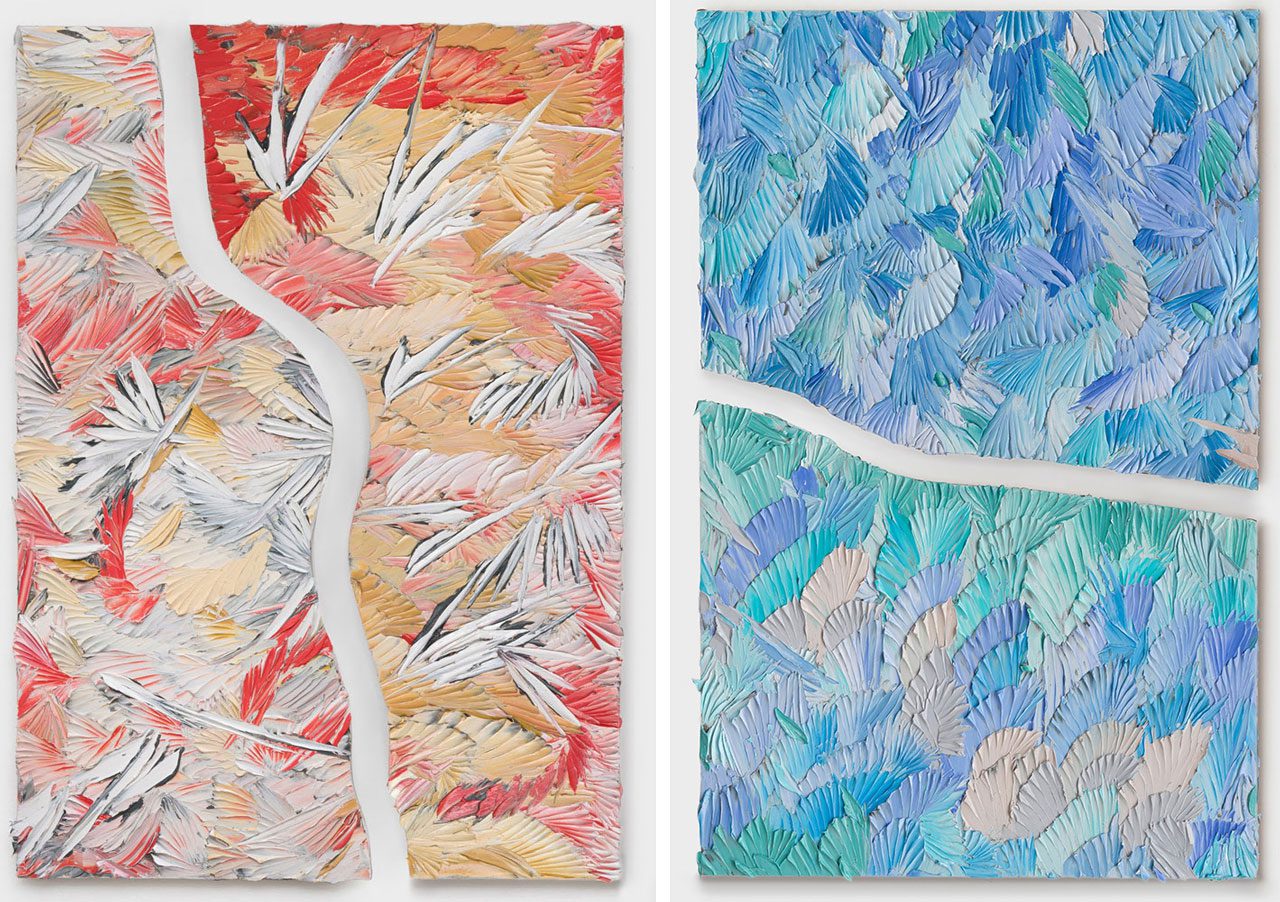
Right: Dashiell Manley, some distances, cuttings. (Monrovia to Ontario) , 2025-26, Oil on linen on plywood, Overall: 50 1/2 x 32 3/4 inches, 128.3 x 83.2 cm, a. 28 1/4 x 32 1/2 inches, 71.8 x 82.5 cm, b. 28 1/4 x 32 3/4 inches, 71.8 x 83.2 cm, © Dashiell Manley, Courtesy the artist and Marianne Boesky Gallery
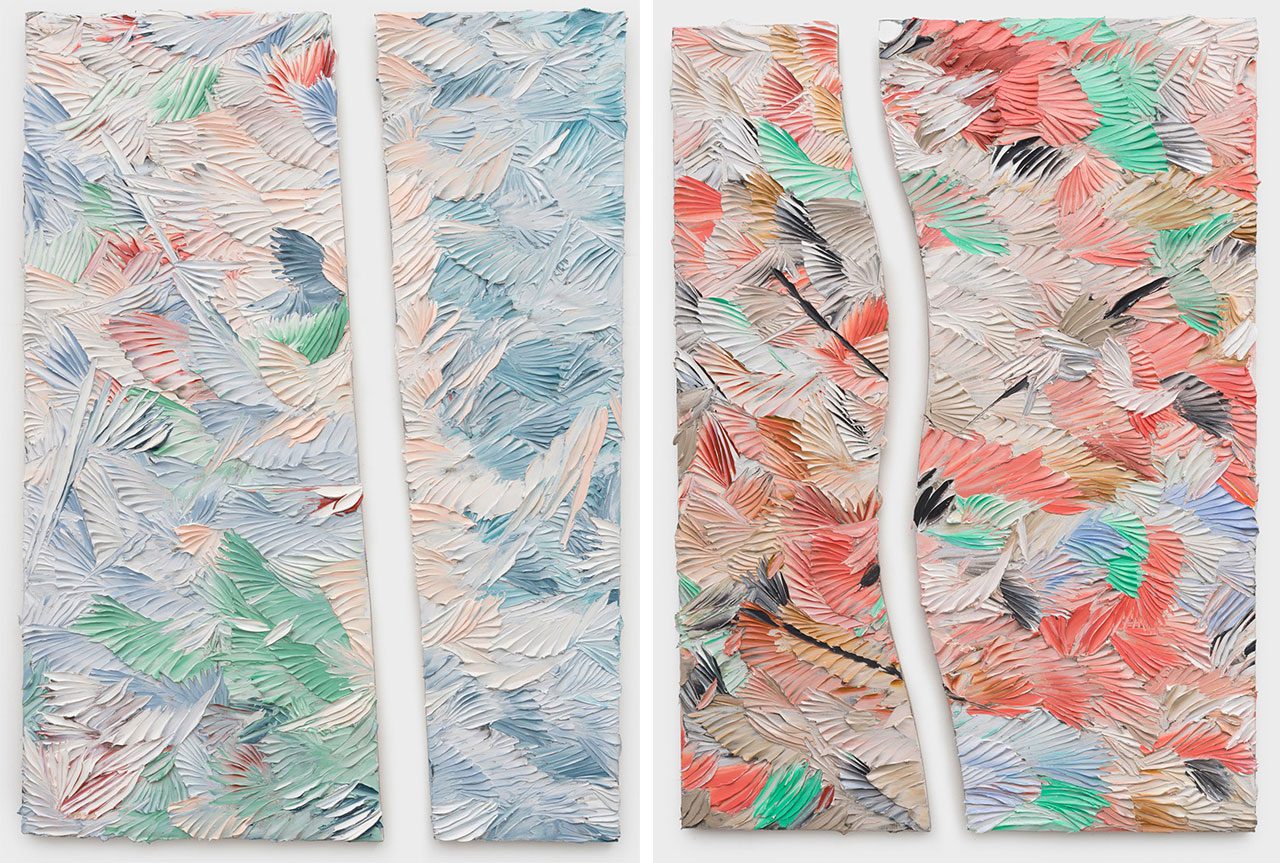
Right: Dashiell Manley, some distances, cuttings. (Brown to Haiwee), 2025-26 , Oil on linen on plywood, Overall: 48 5/8 x 34 1/4 inches, 123.6 x 87 cm, a. 48 3/4 x 15 1/2 inches, 123.8 x 39.4 cm, b. 48 1/2 x 22 3/4 inches, 123.2 x 57.8 cm, © Dashiell Manley, Courtesy the artist and Marianne Boesky Gallery
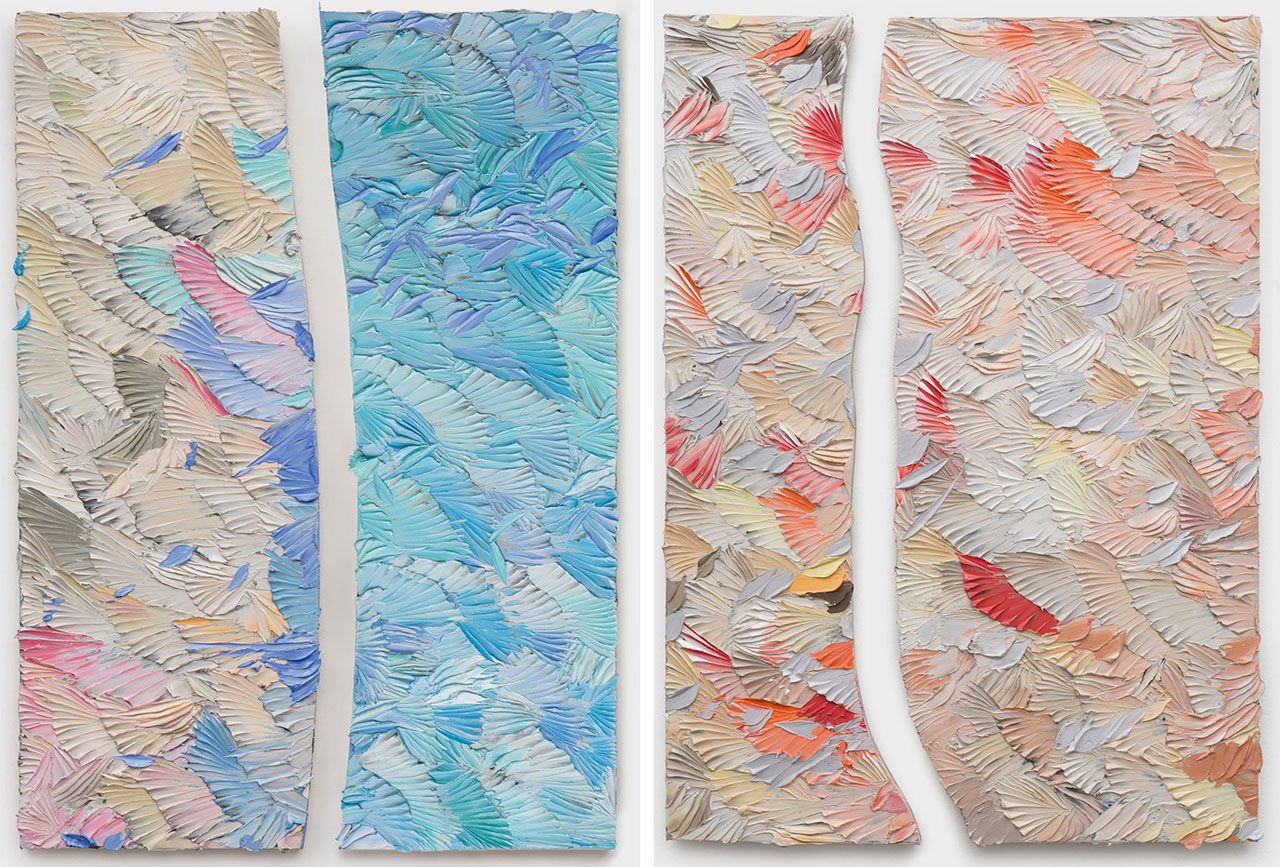
Right: Dashiell Manley, some distances, cuttings. (Brown to Haiwee), 2025-26 , Oil on linen on plywood, Overall: 48 5/8 x 34 1/4 inches, 123.6 x 87 cm, a. 48 3/4 x 15 1/2 inches, 123.8 x 39.4 cm, b. 48 1/2 x 22 3/4 inches, 123.2 x 57.8 cm, © Dashiell Manley, Courtesy the artist and Marianne Boesky Gallery
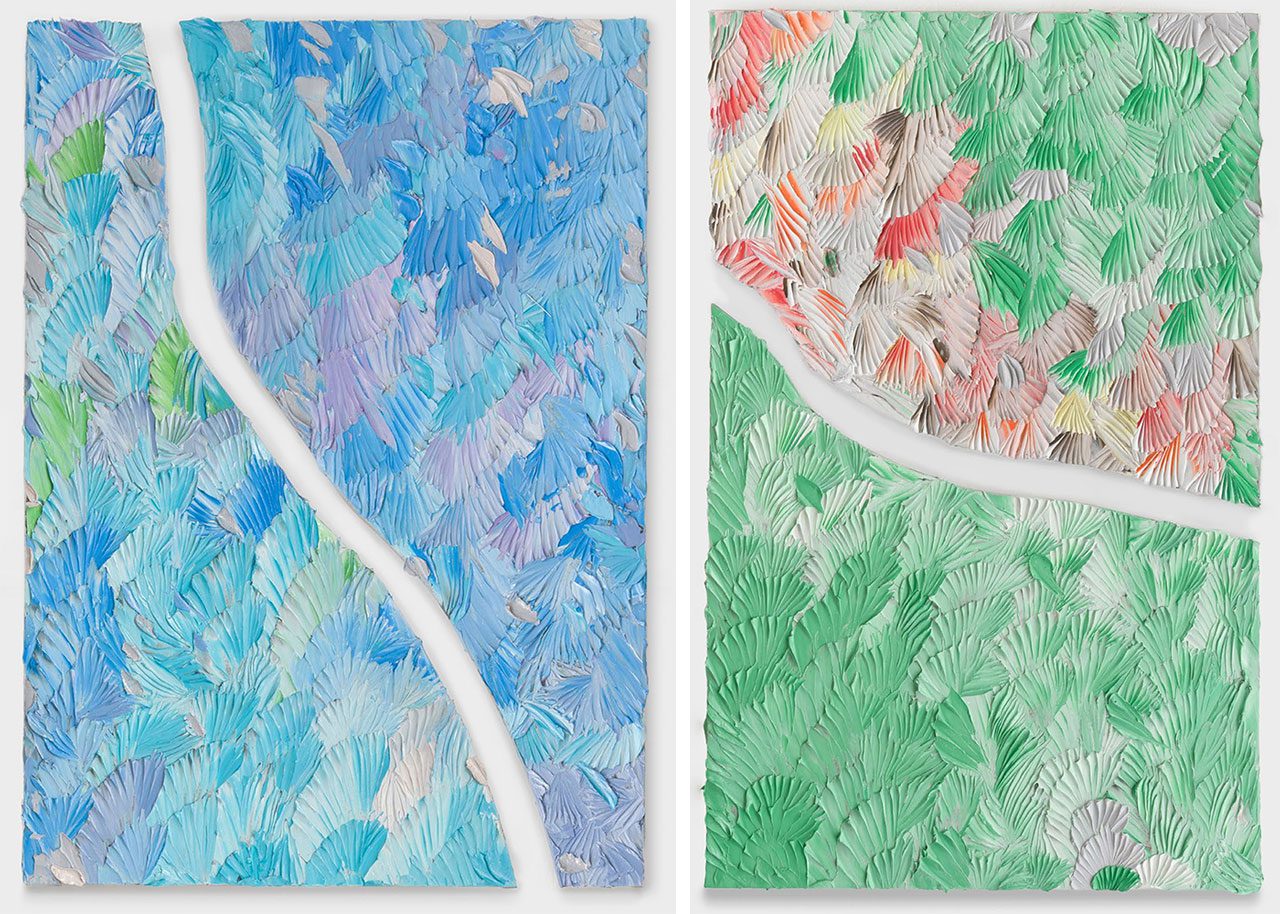
Right: Dashiell Manley, some distances, cuttings. (Haiwee to Manzanar), 2025-26 , Oil on linen on plywood, Overall: 48 3/4 x 34 1/4 inches, 123.8 x 87 cm, a. 48 1/2 x 15 3/4 inches, 123.2 x 40 cm, b. 48 3/4 x 22 inches, 123.8 x 55.9 cm, © Dashiell Manley, Courtesy the artist and Marianne Boesky Gallery