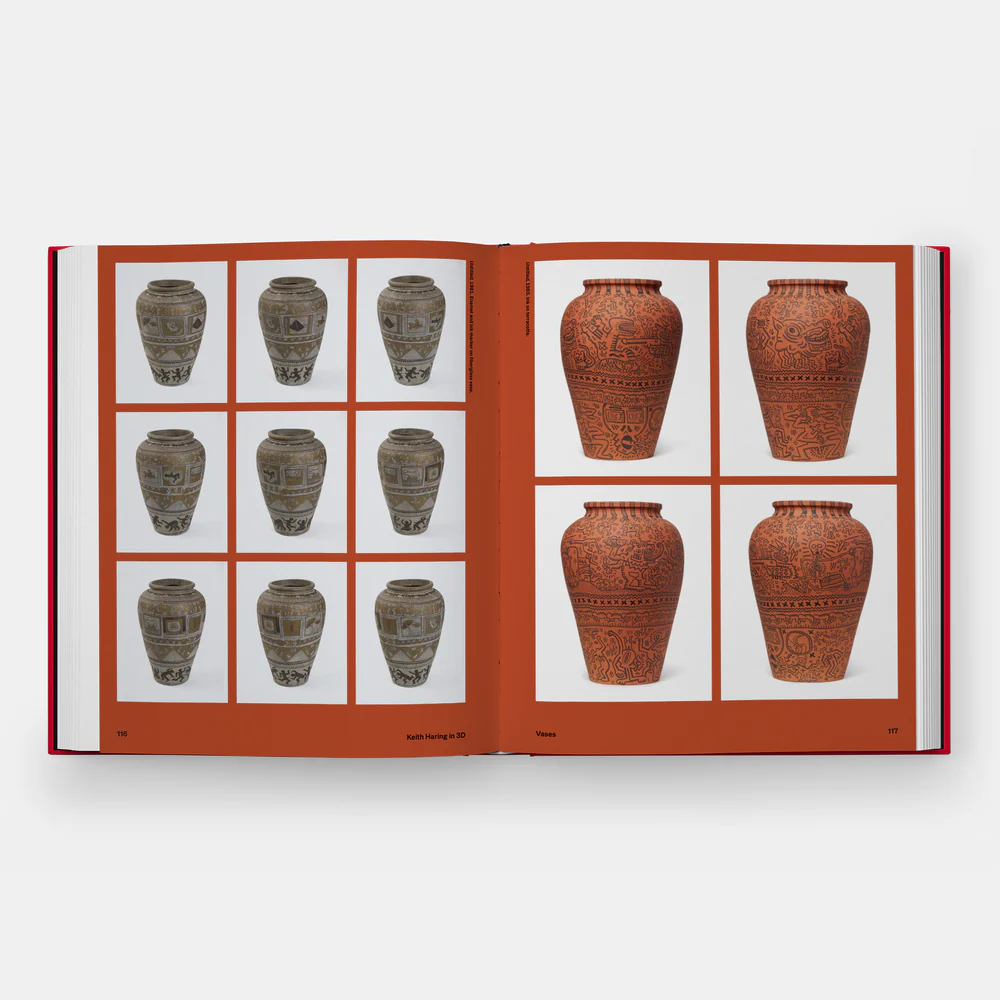
BOOK: Keith Haring in 3D, Phaidon Publications

“Keith Haring in 3D” by Phaidon Press, constitutes a significant intervention in Haring scholarship by centering his sculptural and object-based works within the broader trajectory of his oeuvre. While Haring’s chalk drawings in the New York subway system have long dominated critical discourse, this volume argues persuasively that three-dimensional production was not ancillary but structurally integral to his artistic methodology.
Haring (1958–1990) relocated to New York City in 1978 and rapidly embedded himself within a downtown milieu that included artists such as Jean-Michel Basquiat and Kenny Scharf. The book contextualizes this environment not merely as social backdrop but as a laboratory for cross-media experimentation. Essays within the volume trace how Haring translated his signature graphic lexicon into volumetric form—onto industrial objects, consumer goods, and architectural surfaces—thereby collapsing distinctions between painting, sculpture, design, and performance.
Particularly compelling is the documentation of Haring’s collaborative ethos. His partnerships extended beyond visual artists to choreographers such as Bill T. Jones, musicians including Madonna, and performers like Grace Jones. These interdisciplinary intersections foreground Haring’s understanding of art as relational and time-based, aligning his sculptural interventions with performance studies and installation art theory.
The editorial framework also situates Haring’s object practice within late twentieth-century debates surrounding commodification and accessibility. His use of quotidian materials—cars, appliances, retail products—can be read as both democratizing gesture and critique of art market hierarchies. The inclusion of archival photography, notably images by Annie Leibovitz, provides evidentiary grounding for these interpretations, reinforcing the performative and environmental dimensions of his work.
Methodologically, the book succeeds in synthesizing visual documentation with scholarly commentary. Its large-format design supports close material analysis, essential for a corpus often experienced only through secondary reproduction. By foregrounding objecthood and spatial activation, Keith Haring in 3D expands the interpretive framework through which Haring’s legacy is understood.
As a scholarly resource, the volume fills a conspicuous lacuna in Haring studies. It will be of particular value to researchers in contemporary art history, material culture, performance studies, and curatorial practice. More broadly, it challenges the reduction of Haring to a singular urban iconography and instead positions him as a materially and spatially sophisticated practitioner whose work anticipated immersive and interdisciplinary modes dominant in contemporary art. -Dimitris Lempesis