
PRESENTATION: Marina Xenofontos-Play Life
Marina Xenofontos’ work employs film and sculpture to consider the inevitability of failure and the marginalisation of personal narratives in civic spaces. By shaping interpretations and meanings, she explores interrelated facets of simulations, objects, and translations that allow for a remembrance of symbols and errors in their functions. Within this approach, traditional methods and processes embrace the ephemeral individual position within broader collective memory.
By Dimitris Lempesis
Photo: Musée cantonal des Beaux-Arts Archive
In order to unravel the mechanisms of canonical representations, Marina Xenofontos researches vernacular processes related to architectural forms and biographical sociopolitical contexts. Power structures of civic spaces are reimagined via an exploration of anecdotal stories and coincidental epitomes that represent sardonic reflections on mechanisms of production and understandings of history.
The Musée cantonal des Beaux-Arts, Lausanne present the work of Marina Xenofontos (born 1988 in Cyprus), in the exhibition “Play Life”, the artist has worked with the question of the double, which she explores at the point where real and virtual space intersect.
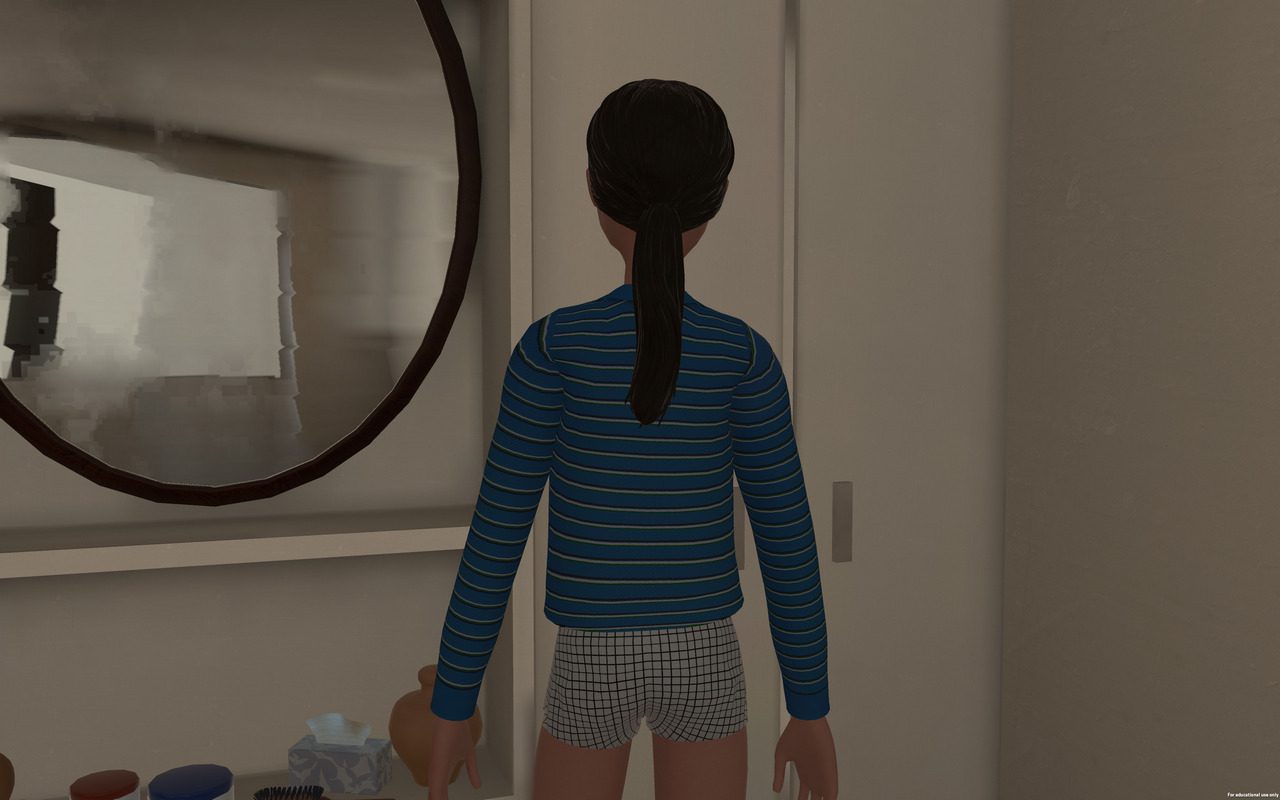
The exhibition is centered on a video game, “Twice Upon a While” (2018 – 2025), which visitors are an integral part of. The game’s main character, called Twice, is modelled on the artist herself. This girl moves through a seemingly ordinary place that constantly tips over into a dream world of choices to be made and dead ends, loops, and confusing twists to be navigated. The long-term development of this video game went from animation and sculpture to open-world RPG (role-playing game). Xenofontos is presenting the results for the first time in her show at the Musée cantonal des Beaux-Arts of Lausanne. There is no linear story or predetermined narrative outlines. Rather, what plays out with the help of visitors to the show resembles an original scene, an infinitely revisited childhood memory whose outcome, or outcomes, depend on the choices visitors make in the present. Within the space of the game a multiplication of doubles is opened up. Twice becomes a reflection of its players, who define their choices in their own image.
In 2020, Xenofontos literally staged the double in a sculpture with the same title as the video game, “Twice Upon a While”. It was a life-size wooden mannequin that the artist presented seated, prostrate on a mirrored table, pointing us as much to the world of fairy tales (“Once upon a time…”) as to the myth of Narcissus. More abstractly the sculptures seen in this show can also be read as forms of doubles. “To the Knees” (2025), a\n assemblage of aluminium tubes that rotate slowly, suggests the world of industry by both the materials making it up and the sound they give off. Although emptied of their original function, these physical elements bear with them a memory of their initial use whilst embracing new associations. Likewise, “Found Construction Site Ladder (2025) is a found object, stripped of its function and yet implicitly referring to the question of passing from one space to another and to the body, its presence and disappearance.
Whether static or in motion, Xenofontos’s objects are in transition. From one context to another, one function to the next. They are objects that are replicas of others, or translations that don’t strictly conform to the originals, like reflections or doubles that have come to haunt the exhibition space with the historical or personal content of their references. Through precise gestures, the artist lends those references new weight by shifting or transforming them and simultaneously reconfiguring the space they inhabit.
In “Play Life” the question of the identical and the almost same, true and false, real and virtual is diffracted and refracted, not in a play of dichotomies, but in a shift between levels of reality, contexts, timeframes, and given uses.
Photo: Marina Xenofontos, Twice Upon a While, video game, 2018-2026, © Marina Xenotontos, Courtesy the artist and Musée cantonal des Beaux-Arts
Info: Curator: Nicole Schweizer, Musée cantonal des Beaux-Arts, Place de la Gare 16, Lausanne, Switzerland, Duration: 6/2-2/8/2026, Days & Hours: Tue-Wed & Fri-Sun 10:00-18:00, Thu 10:00-20:00, www.mcba.ch/