PRESENTATION: Alvaro Barrington-On the Road (TMS)

Born to Grenadian and Haitian parents and raised between the Caribbean and New York, Alvaro Barrington’s practice explores interconnected histories of cultural production. Considering himself primarily a painter, Barrington takes a multimedia approach to image-making, employing burlap, textiles, postcards, and clothing, exploring how materials themselves can function as visual tools while referencing their personal, political, and commercial histories.
By Dimitris Lempesis
Photo: Thaddaeus Ropac Gallery Archive
Alvaro Barrington’s latest solo exhibition, “On the Road (TMS)”, brings into focus a powerful and evolving body of work titled “Cutout Paintings”. The exhibition marks a third significant iteration of these works, which trace a dynamic artistic and cultural journey from London to Salzburg via iconic art institutions and Caribbean street culture.
The title “On the Road (TMS)” resonates on multiple levels. On one hand, it gestures toward a literary lineage anchored in Jack Kerouac’s 1957 classic On the Road — a foundational text of postwar American counterculture that maps a restless quest for freedom and identity across time and geography. Barrington himself recalls encountering the novel in college, when the urge to explore and “find ourselves” drove many of his contemporaries, and his own travels through South America underscored this impulse toward movement and self-discovery.
For Barrington, who was born in Caracas in 1983 to Grenadian and Haitian parents and raised between Grenada and New York, the exhibition title equally evokes the rhythms of Carnival culture — a phrase commonly used in Caribbean communities to describe encounters in the streets. These carnivals, historically rooted in diasporic celebrations of cultural fusion and communal expression, have become global hubs of performance, sound systems, and sensory intensity. Barrington describes the “high energy” of Carnival — the music, the engine of the sound trucks, the smells and movement — as inseparable from lived experience and collective identity.
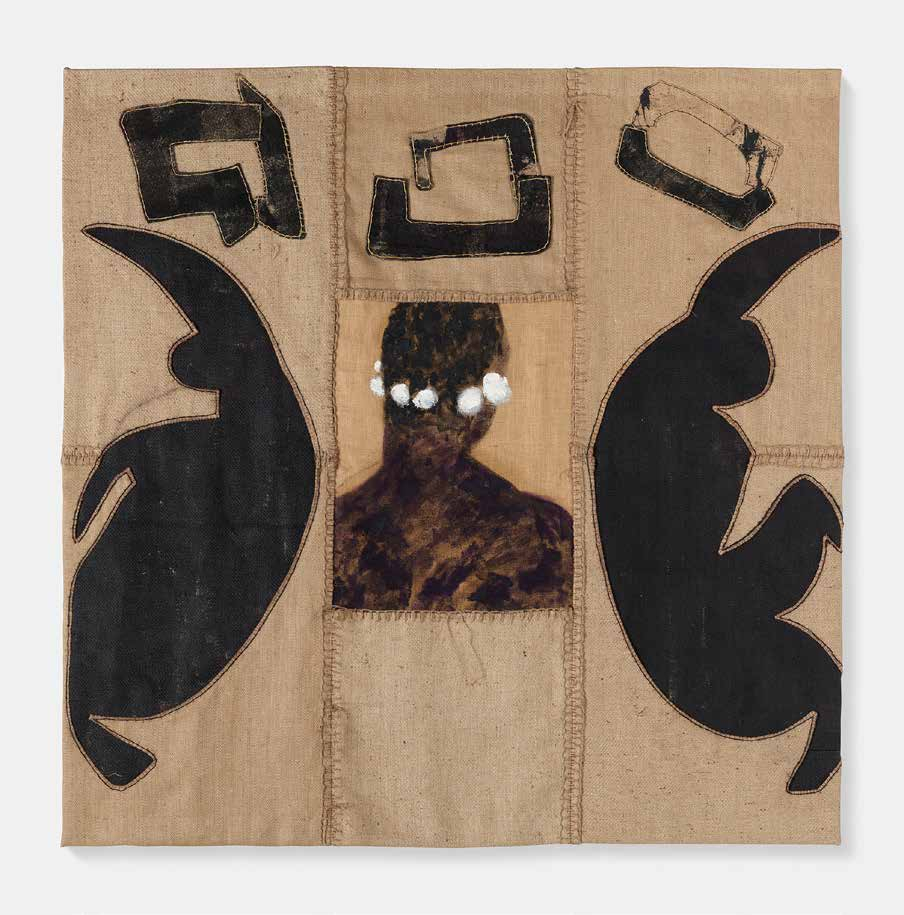
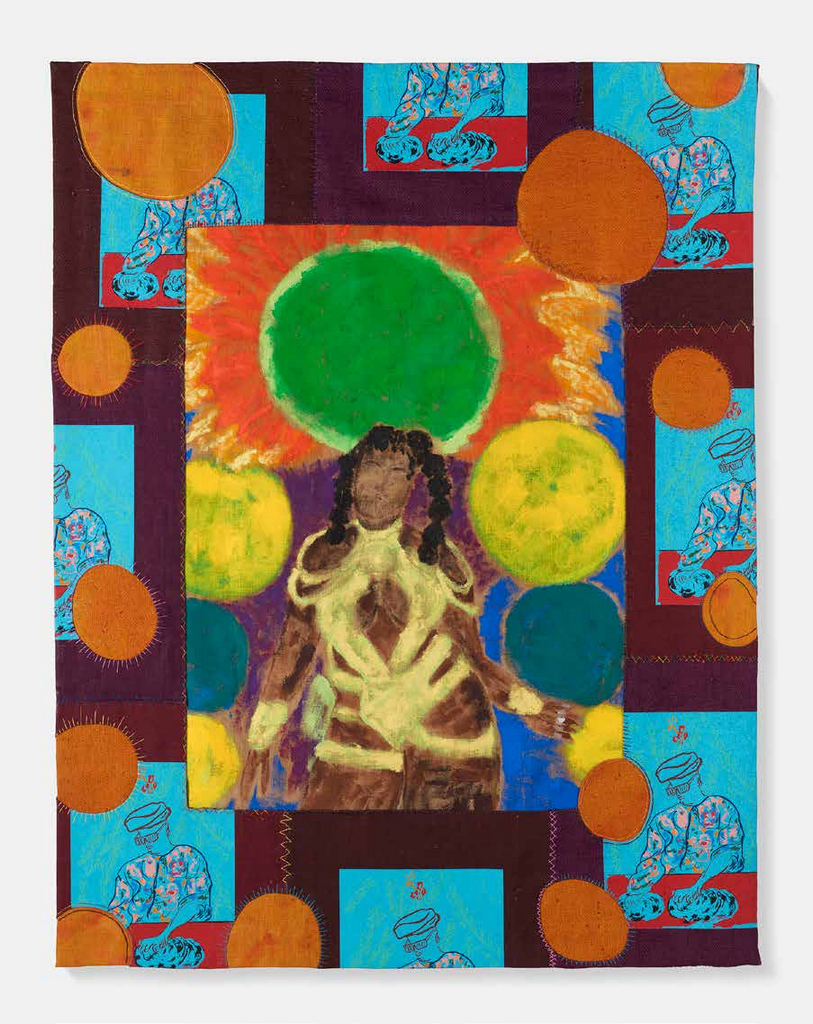
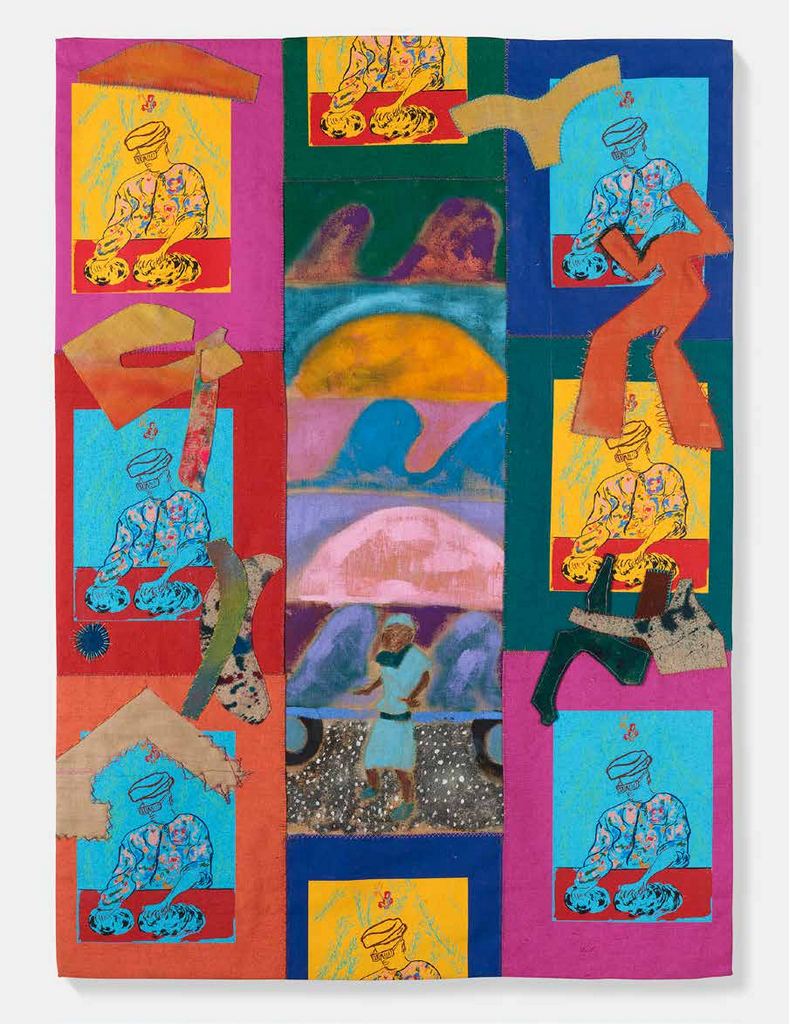
At Salzburg’s Villa Kast, Barrington’s “Cutout Paintings” unfold as a suite of collaged and appliqued wall hangings crafted on burlap — a coarse, tactile material traditionally used for transporting cocoa and coffee beans and historically favored by artists such as Paul Gauguin and Alberto Burri for its raw presence. Barrington’s choice of burlap continues his multimedia approach, imbuing the works with a texture that evokes tapestry and mobility — literal materials of travel and trade.
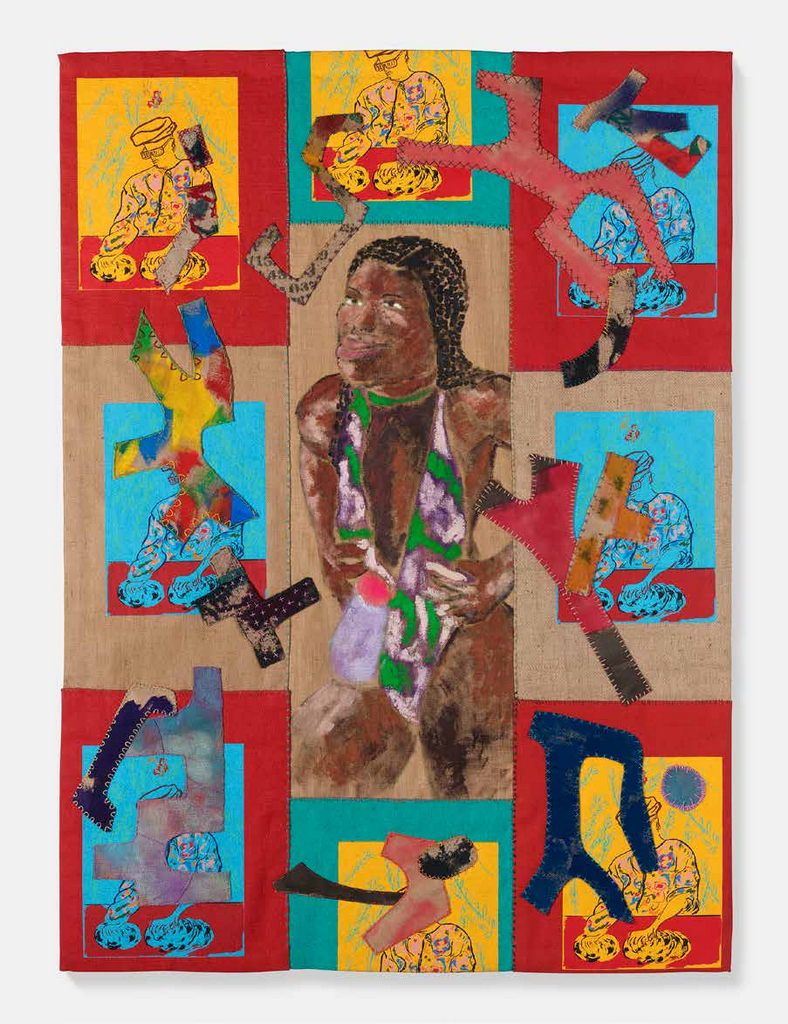
The compositions feature a vibrant procession of Carnival masquerade figures drawn from Grenadian and Trinidadian traditions, including iconic characters such as the Moko Jumbie (West African–derived stilt walker), Pretty Mas (ornate, feathered costumes), and Jab Jab (masked figures embodying post-emancipation resistance with black oil and chains). These figures are collaged into the burlap surface with silhouette cutouts and appliquéd forms that transcend portraiture to become embodiments of movement, ritual, and cultural memory.
Bordering many of these tapestry-like canvases are silkscreened portraits of Buju Banton, the celebrated Jamaican dancehall musician. Depicted at turntables with graphic clarity, these musical figures reflect Barrington’s engagement with the sonic cultures that animate Carnival spaces and his admiration for Josef Albers — particularly in the use of bold square backgrounds that echo Albers’ chromatic investigations.
The visual vocabulary of Barrington’s Cutout Paintings also embraces the geometric motifs of Kuba cloth patterns — traditional textiles woven from palm leaf fibers and richly decorated with stitched geometric forms that have served ceremonial and economic functions in the Kuba Kingdom of Central Africa. These patterns resonate not only with historical significance but also with a lineage of Western reception, such as Henri Matisse’s incorporation of African textiles into his Paris studio and his celebrated Jazz cut-outs of 1947. For Barrington, the Kuba-inspired patterns suggest musical cadence and dancing bodies; they articulate the historical exchanges embedded in trade, cultural flow, and artistic lineage.
In “On the Road (TMS)”, Barrington’s works do more than recall past exhibitions — from Tate Britain’s Grace (2024) to the Notting Hill Carnival’s Mangrove Sound Truck (2025) — they reflect a sustained exploration of identity as a communal, transnational force. The artist rejects static definitions of belonging rooted in nationality, proposing instead that shared cultural practices — from Carnival to online fandoms — forge spaces of recognition and connection that transcend geography.
The exhibition’s burlap surfaces, appliquéd forms, and rhythmic compositions articulate a layered essay on cultural mobility, artistic inheritance, and the ways in which histories of movement — whether through literature, migration, or festival streets — shape individual and collective narratives. Barrington’s “Cutout Paintings” thus stand as both archival and forward-looking, celebrating the vibrancy of diasporic culture while affirming the enduring human desire to connect, celebrate, and reinvent.
Photo: Alvaro Barrington, On the Road (TMS) A13, Blue Dancers, Kids Day, 2024-26. Oil, acrylic, flash, enamel on burlap / silk screen printed burlap, cotton linen, waxed cotton thread. 250 × 210 cm (98.43 × 82.68 in), © Alvaro Barrington, Courtesy the artist and Thaddaeus Ropac Gallery
Info: Thaddaeus Ropac Gallery, Salzburg Villa Kast, Mirabellplatz 2, Salzburg, Austria, Duration: 24/1-21/3/2026, Days & Hours: Mon-Sat 10:00-18:00, https://ropac.net/