INTERVIEW: Stavros Panagiotakis
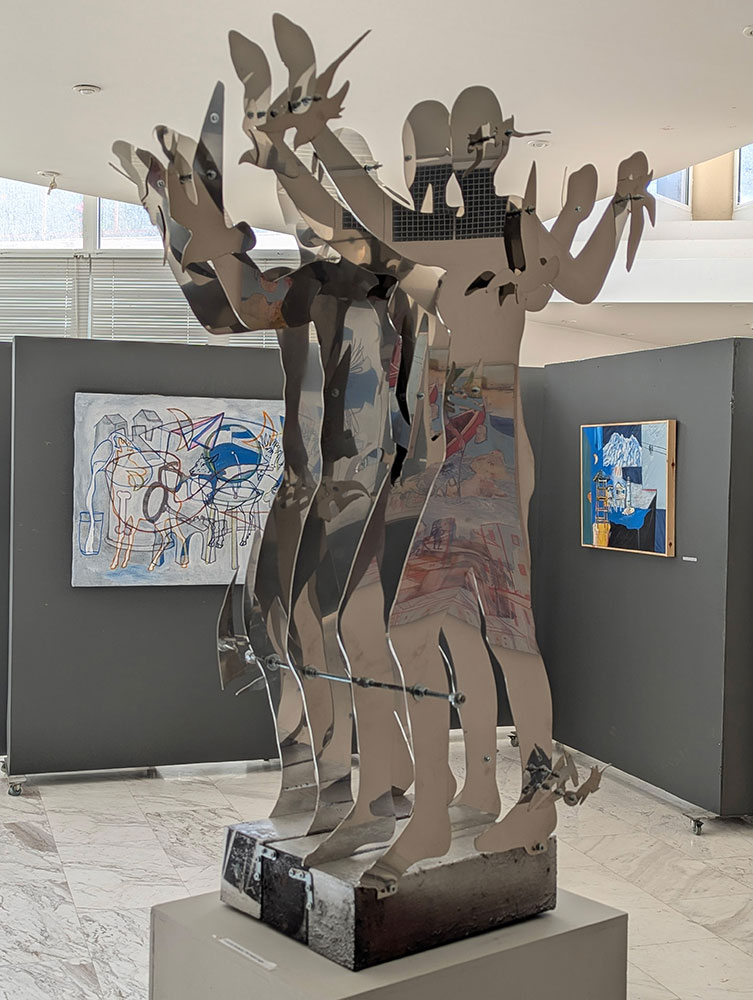
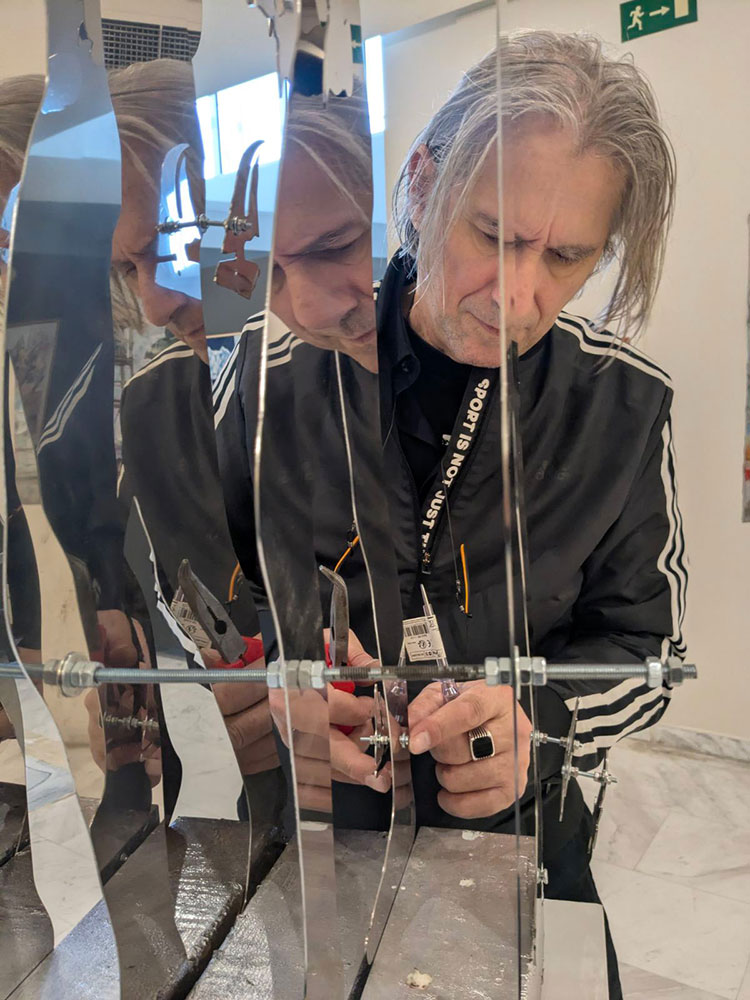 In an era where art is often confined within the convenience of the digital realm, Stavros Panagiotakis—visual artist and Professor at the School of Fine Arts of the Aristotle University of Thessaloniki—chooses the arduous path of returning to one’s roots. This is not a nostalgic reminiscence, but rather an act of artistic and existential emancipation. The year 2026 finds the creator at a particularly prolific moment, with his retrospective exhibition, “Amerotos Nostos” (Unquenchable Homecoming), garnering significant public interest in Crete. The exhibition began its journey in the imposing southern dormitory of the renovated fortress at Fragokastello, subsequently moving, enriched with new works, to the Chania Cultural Center, where its duration was extended until January 31, 2026. The title “Amerotos Nostos” suggests a desire for return that never finds rest—an “inner mapping” that transcends the physical landscape and plunges into collective memory. Through compositions that often incorporate actual soil from his ancestral land, Panagiotakis establishes a dialogue between the familiar and the novel, between lived experience and reflection. In the interview that follows, the artist guides us through the “layers” of his work, discusses the function of art in the public sphere, and shares his vision of art as an “ethical and cultural mirror” of human action toward the environment and sustainability.
By Mimika Christodoulopoulou
Photo: Stavros Panagiotakis’ Archive
The title of your exhibition links the desire for return with something that will never find rest… What made the need to return to your homeland so irresistible for you? Furthermore, this is a retrospective exhibition; how did you select the works presented at the Chania Cultural Center?
The retrospective nature of the exhibition arises from the selection of works from earlier periods of my career. I chose pieces that possessed a distinct cohesion—specifically, those containing compositional elements directly linked to my birthplace.
Fragokastello stands at the very edge of the Greek territory, the final frontier in the Mediterranean, facing Africa. This precise point was the starting line of my own time.
For many years, I had desired to present my visual work there—works that constitute a “biography in life” centered on the land of my birth. After decades of traveling throughout the world, I felt a profound need to re-establish myself within my place of historical origin, Patsianos and Kallikratis. Thus, the majority of the works were initially exhibited at the historic Fragokastello fortress, in the Southern Dormitory, which functioned as an exhibition space for the first time following its restoration. The exhibition was held under the auspices of the Municipality of Sfakia. Subsequently, under the auspices of the Region of Crete and the Regional Unit of Chania, the exhibition was transferred to the Chania Cultural Center.
The critical analysis by Efi Michalarou speaks of an “inner mapping” that transcends the picturesque nature of the landscape. How, and to what extent, does this spatial return affect you?
On many occasions, I found myself designing sets for my theatrical performances drawing inspiration from the architecture of my grandfather’s house and the broader region of my birth. Other works of mine were crafted using actual soil from my village (Kallikratis, Sfakia)—soil with which I outlined the whispers and voices of my ancestors, those sounds that speak not only to me but also to the younger generations. In the exhibition, which was initially staged within the historic Fragokastello fortress and later moved, enriched with additional works, to the Chania Cultural Center, I present compositions that encapsulate personal moments invoked by my lived experiences.
This endeavor was difficult and quite complex because it addresses an audience that operates under codes of conduct which are carriers of specific aesthetic values. By focusing on the familiar environment of Crete, one enters into a dialogue with a social stratification that positions itself in a very particular way toward the concept of history.
The solution I found was to ground the work in elements belonging to the familiar Cretan environment—materials, places, memories, and recognizable references—so that the initial encounter is based on recognition. I included works featuring these elements transformed into contemporary forms and compositions, strictly avoiding folkloric motifs or the reproduction of tradition. In this way, the viewer’s perception could evolve gradually: from the familiar to the new, from identification to reflection, and ultimately toward a dialogue that touches upon the relationship of local social structures with the sense of history. Thus, the work functioned as a bridge between diverse aesthetic expectations while keeping my artistic intention intact.
Your work is characterized by a palimpsest structure, where the accumulation of layers of color and their subsequent removal creates a profound materiality. This process brings to mind a “visual excavation.” Is this also the creative process behind the works presented in Crete?
I utilized the process you describe in my earlier works. In this specific series, however, I did not operate in that manner. The removal of material from the canvas is not a primary component here. On the contrary, the main compositional element consists of the layering of materials and the re-scripting of thematic elements onto the painted surfaces. In this instance, through the materiality of the works, images are synthesized to create an experience that is intellectual yet simultaneously becomes an experience of the senses.
By testing different media and techniques, I aim for the initial idea to take form as a transformation. Thus, form, color, and symbols do not function decoratively; they assume the role of meaning-carriers, concentrating personal intensities and cultural traces.
The artwork is a vessel of aesthetic values and can be seen as a field of cultural critique: not simply because it “comments” on our era within the condition of digital imposition, but because it resists the predetermined mechanisms of image interpretation. The composition is organized as a site where contradictions coexist: forms, natural and human elements, movement and stillness, the event and its trace.
The reading of the work is constituted in the relationship between the viewer and the image. Kant begins his thought by establishing the economy of reading and writing as the foundation of emancipation (cf. Bernard Stiegler: Vor der Biopolitik zur Psychomacht, p. 141, Frankfurt, 2009), where in Stiegler’s view, writing is Enlightenment. In this sense, the process of viewing can function as a means of emancipation. It suspends automatisms and creates the space for judgment. Precisely because it is not limited to the representation of the external world, the work attempts to reveal internal realities—psychic states, tensions, silences. The goal is to establish a visual space where the creator’s personal narrative is not imposed but transmits the experience to the viewer. A space that allows for free interpretation and reflection.
In your recent works, everyday objects acquire mythical qualities. What does the change of scale in a humble, familiar object symbolize for you?
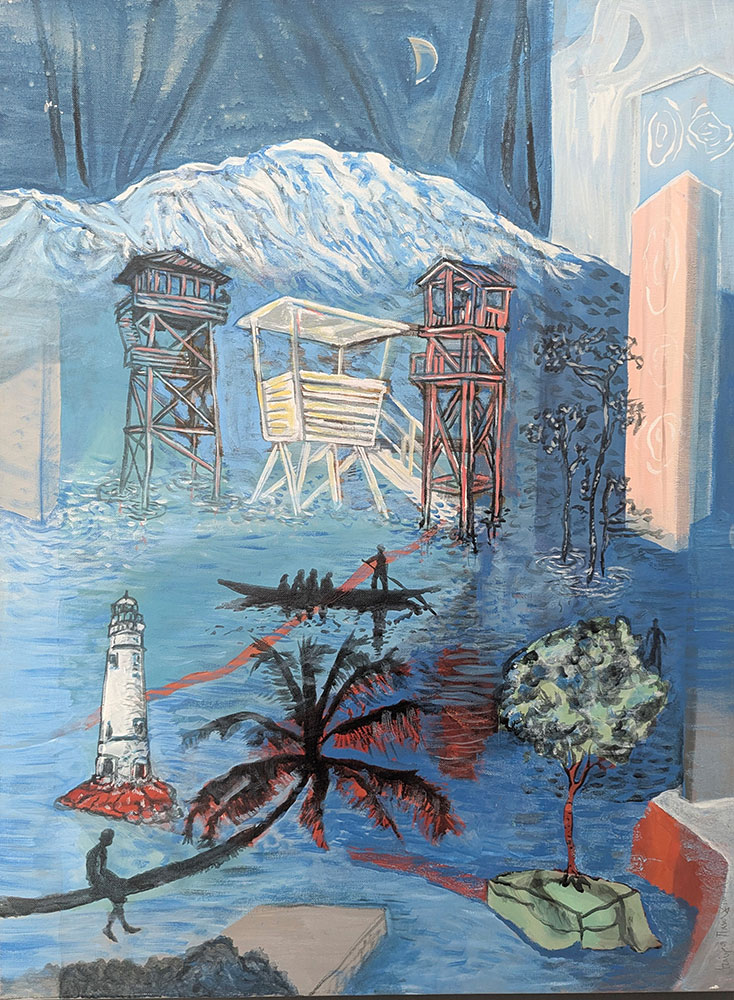
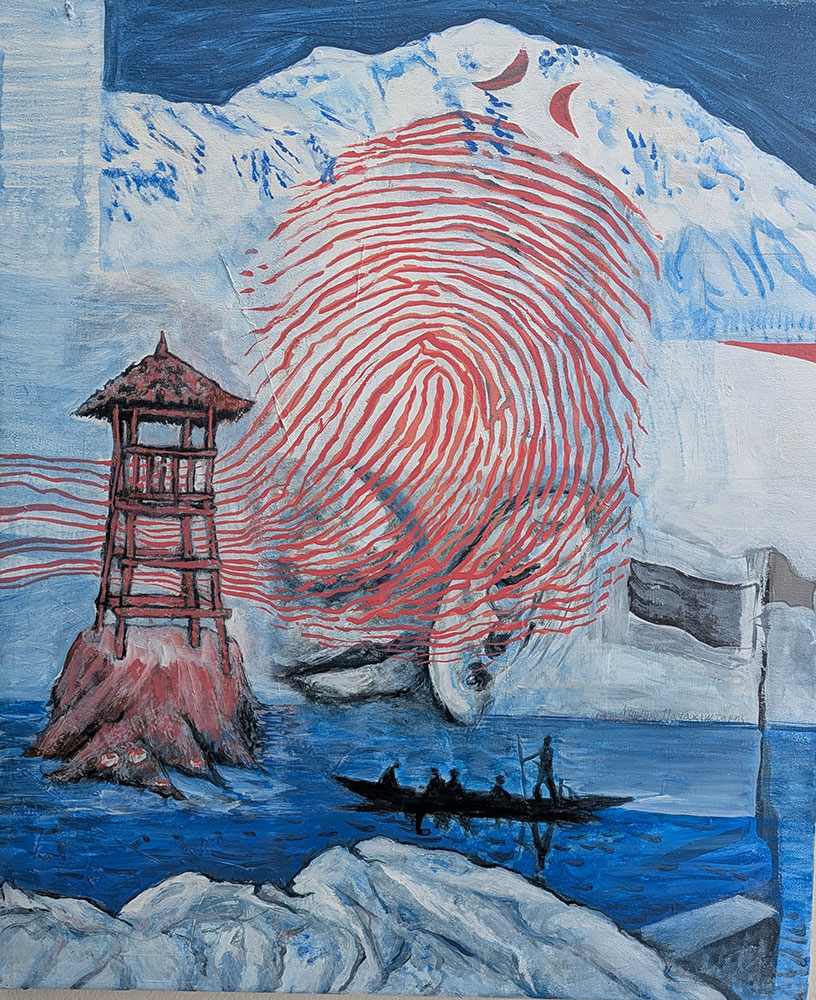
If you are referring to the watchtowers—as well as the lighthouses—that recur in my compositions, I treat them as points of pause and focus. They symbolize waiting, anticipation, vigilance, but also farewell. In life, we are all waiting for someone to return from afar; thus, we become observers of a situation. At other times, we say goodbye. What carries weight is not a “correct” explanation, but the adventure of interpretations—the multiplicity of meanings that open up before the viewer.
The work does not merely seek to represent images. It organizes a composition where forms, colors, and symbols bring the inner world to the surface as a reality with its own laws. Its power lies in its symbolic and synthetic function. Every element—a form, a movement, a chromatic contrast—gains significance from the relationships it creates. Just as in life, where rules, choices, and behaviors are interwoven to produce tensions, so too in the artwork are the elements entwined to render the contrasts and dynamics of internal landscapes.
These symbolic forms do not serve a personal narrative. They function as provocations that invite a reflective reading and a personal interpretation. Color is an expressive medium that willingly conveys emotion and intensity. The work does not remain a passive depiction. It becomes an active space for reflection where the viewer participates: synthesizing meanings, recognizing shifts, and ultimately reading something from their own psychic world.
You have repeatedly engaged with serious social issues, negotiating them through your artistic practice. What is your position regarding the social function of art in the current contemporary context?
The spatio-temporal nature of an era, the social framework, and the artist’s cultural standing all shape the trajectory of a creative work, serving as the creator’s fundamental and timeless inspiration. When I negotiate social themes (such as “Migratory Wings,” “Genealogical Tree,” “Silent Narratives,” etc.) through visual practice, my interest lies in ensuring the work does not remain at the level of mere commentary, but rather produces new conditions of reading. I want it to open a dialogue with public space and the audience, to activate memory.
Art, as I conceive it, is not a static object simply placed in a space. It is an ephemeral intervention, a site-specific gesture that activates the environment and shifts our certainties. It is constantly redefined because the time and place of its appearance change with it: the people, the habits, the codes, the ways of seeing.
The relationship between art and public space is not neutral. It is inextricably linked to how a society is organized, its stratification, and the cultural level projected by the city, the state, and the era. Within this context, the work approaches the human psyche as a living, shifting site. Life is not experienced linearly, but as a process of transformation and internal investigation. The image, instead of following a linear narrative, is constituted by fragments of spaces, times, and symbols that coexist—just as thoughts, memories, and emotions coexist in our consciousness.
At the center of the composition, the human form hovers in a delicate balance. The tilt of the body suggests an active effort at orientation, an intermediate point between falling and rising. The elements surrounding it function sometimes as constraints and other times as protective boundaries. Thus, the human condition is rendered as a permanent transition.
Natural motifs, and particularly plants, introduce life, evolution, and hope. In counterpoint, human constructs—ships, airplanes, lighthouses, urban landscapes—indicate the course and the idea of progress, but also the alienation that often accompanies the modern experience. The movements implied are not only spatial; they are internal journeys.
The lighthouse appears as a fixed point within a fluid environment: a symbol of orientation and expectation. The city, by contrast, captures the collective reality and the pressure of daily life. The lines and wavy elements function as connecting axes, like invisible currents of thought that unite the individual images and hold the core composition in cohesion.
The presence of the statue refers to memory and historical continuity: values and ideals that persist, yet often stand at a distance, as if observing modern reality without guiding it. The color palette, with contrasts and gentle or abrupt transitions between cool and warm tones, reinforces this sense of interiority.
Overall, the work constitutes a visual site where the psyche is rendered as a synthesis of experiences, images, and symbols. Life is not presented as a straight path, but as a field of interactions and meanings. The viewer is invited to move through this landscape and form their own reading—to stand, to observe, to reconstruct.
Art and public space: how much have public visual interventions changed over time? Which works have you created in recent years, and from where do you draw your inspiration?
My work originates from provocations related to place, time, and memory. I am interested in how the social context and public space influence the trajectory and the reading of an artwork. Often, art functions as an intervention: it appears under specific conditions, enters into a dialogue with them, and through this encounter, acquires its meaning.
In 2015, the outdoor work “Are y walking” (15 m. × 0.60 m. × 0.02 m.), made of stainless steel, was installed at Porto Valitsa, Paliouri, Chalkidiki. The choice of scale and material, but primarily the decision for the work to exist exposed to the natural environment, defined its reading from the outset: it is not merely an object that is “placed,” but a construct that is co-shaped by the site, the light, and the viewer’s path.
The linear development of 15 meters serves as the fundamental structural principle. The work does not ask to be viewed from a single vantage point; it asks to be followed. Its relationship with the body is direct: its scale refers to a course, a passage, a journey. This is why the title, “Are y walking,” functions as a question that is not just verbal but activates a stance. It is not addressed to a “viewer” standing still, but to a person in motion, changing perspectives, reading the work through time.
Stainless steel was not chosen as a neutral material. It possesses a specific behavior toward light, reflections, and the shifts of the day. In an outdoor environment, the material converses with the conditions and elements of the surroundings: one image in the intense midday sun, another in the low afternoon light, yet another when the sky is overcast. Thus, the work acquires a quality of variability without changing form. The transformation lies not in the construction, but in its encounter with space and environment.
The thinness of the cross-section (0.02 m.) and the narrow width (0.60 m.) create a tension between mass and line. The work is present, yet it does not impose itself as a volume. It maintains a “linear” economy that allows the environment to remain dominant, while the work functions as an indication, a point, an intervention that does not negate the site but highlights it differently. At this level, “Are y walking” functions as a kind of spatial measurement: a human scale that carves an axis through the landscape, without turning it into a stage set, in a diagonal trajectory of 30 degrees toward the sky, transcending the earthly firmament.
Because the work is situated in an outdoor space, its reception is not controlled. The “safety” of the white cube does not exist. Instead, there are the conditions of the site, the random passers-by, the differing moods of people, the weather, the seasons. This element is decisive: the work is not addressed to an audience prepared to “see art,” but to people who encounter it within their daily movement. Thus, a different relationship is activated: the work serves as a point that can cause a brief pause, a change of pace, a question.
The question of the title itself can be read on multiple levels. Literally, it concerns movement in space. But simultaneously, it can function as a commentary on the condition of modern man: how one proceeds, chooses a path, and finds oneself between direction and wandering. Here, the work does not “illustrate” an idea; it posits it as a condition. And this is achieved through a clear morphological decision: line, length, material, placement.
Ultimately, “Are y walking” constitutes an experience that is not exhausted by viewing. It is a work that demands body, time, and place. The viewer is not called upon to find a hidden message, but to stand before a simple, clear intervention and test it through their own movement. In this way, the work functions as a visual event that is integrated into the landscape while simultaneously reshaping the way the landscape is perceived.
In 2017, “The Balancers” (Isorropistes) was installed—a sculptural work I created within the framework of the Ecco Art program in Paphos (European Capital of Culture, 2017). The work was born out of that specific organization and the condition of the site: Paphos is located at a vital crossroads of the Mediterranean, in a region where history, migrations, and cultural intersections remain active.
“The Balancers” was organized as a public intervention that posits the issues of ecology, coexistence, and peaceful reunification as a constant effort. The concept of balance here does not function decoratively; it serves as a measure and a stance, as the need to maintain a meeting point between diversities. Its placement in public space was crucial, as the work addresses an audience that encounters it during their daily routine and incorporates it into their own experience of the place. Thus, the work does not just “narrate” an idea but is tested within the real conditions of the space and time in which it is presented.
In the years that followed, the pandemic intervened, limiting my opportunities for the outward expression of artistic creativity. Yet, creation does not stop; it continues, even in times of crisis, through other ways and at different rhythms.
Concurrently, my creative path in public visual interventions is not limited to a single direction. From 2010 to 2015, and later from 2017 to 2020, I curated the operation and organization of exhibitions at the chOros 18 gallery in Thessaloniki. I curated dozens of artist presentations and hosted contemporary dance and music performances. In October 2023, I established the S-Polis Gallery in Stavroupoli—the first gallery in the western districts of Thessaloniki—as another site for gathering and cultural presence.
In 2023, I completed and presented the performance “Geogenesis” at the Avlaia theater, which I directed in a primordially synthetic manner with the participation of ten artists from contemporary dance, music, theater, and video. Additionally, other visual performances and actions of mine were presented in public spaces—actions that test the boundaries between the synthetic work, the human being, and the urban environment, such as the performance at the Art Thessaloniki International Fair 2022, the performance held within the Municipal Gallery of Thessaloniki in 2024, etc.
In 2025, the installation work “Silent Narratives – History of the City” was completed, created for the Municipal Gallery of Thessaloniki. It is a mixed-media work of expanded means, measuring 6 meters in length and 3 meters in height, which was installed and presented at the Art Thessaloniki International Fair 2025.
At the core of this journey lies the need to maintain an open dialogue between the work, the site, and the people. The work does not stand alone; it is tested through time, through conditions, and ultimately through the gaze of those who encounter it. My work is in a state of constant evolution. I am not concerned with adhering to a fixed style or a single medium, but with choosing the tool that can most clearly render the idea each time. Sometimes this is painting, as it allows me to organize rhythms, relationships, and tensions within the image. Other times it is sculpture, as it provides weight, body, and presence, bringing me into more direct contact with urban space. In other cases, I work with installations or interventions when I need the work to function within real viewing conditions, whether in the natural environment (participating in “The Meadow of the Ephemeral – Land Art”) or in the urban space of everyday life.
This movement across media is accompanied by an investigation into the concepts that occupy me. Place and memory recur frequently, not as mere narrative, but as material that shapes the form of the work. I am interested in how an environment, an architecture, a path, or a trace of history can become a visual structure. Within this framework, I also use recurring symbols, such as watchtowers or lighthouses, as points of orientation, or tree leaves as provocations for multiple readings. I am not interested in a closed interpretation, but in the potential of the work to provoke different meanings and significations.
A significant part of my path is the relationship with public space within the context of presentation. I have worked on murals, actions, and performances, and I have undertaken curatorial processes and the organization of exhibitions. For me, the artistic act is not only the production of a work but also the condition within which the work meets “the other”: how it is staged, where it appears, what dialogue it opens with the public and the space.
Simultaneously, my research moves within the transformative shifts of the era. I am concerned with the digital condition and the way it affects attention, image, and reception. I use expanded means and digital tools where necessary, not as an end in themselves, but as part of the process. In recent years, my research has also turned toward the relationship between man and nature, the environment, and the development of sustainability. These are fields that function as criteria for how we perceive evolution and the future.
In the past year, in an effort to highlight the perceptions of artists and their place within today’s world through their work, I created the one-hour documentary “The Portrait of the Brain,” in which 60 artists participate.
Thus, my work evolves through transitions: from the image to the object, from the studio to public space, from personal experience to a collective framework. Each work is a new attempt to find the appropriate form for what seeks to be said, in a clear manner, and with an awareness of the conditions within which it is produced and read.
Let us remain a while longer on the subject of public space. How do you respond to critics who view spontaneous urban interventions (graffiti) exclusively as visual pollution rather than a form of social—and indeed, artistic—expression?
In the past, graffiti was treated as a forbidden form of expression. Today, to a large extent, it has moved to a different level: it is debated, documented, and taught even within university contexts, and is frequently executed by graduates of Schools of Fine Arts. This shift does not only concern art, but also the way a society perceives public space, the image, and the right to intervention.
Within this context, in 2016, 2017, and 2018, I curated and created large-scale murals on the exterior walls of Primary and Secondary schools in Western Thessaloniki. My starting point was not simply to “decorate” a building, but primarily to address the image of the school environment “holistically”: as a space of daily life and paths for children, teachers, and parents, but also as a piece of the urban fabric seen and traversed by residents and citizens at large who come into visual contact with the artwork.
These murals were placed on walls that, until then, were neutral and dormant. What is significant, however, is that these walls were directly within the visual perception not only of the school community but also of many neighborhood residents. Thus, the work did not remain “inside” the school. It moved outward and functioned as an intervention in public space, creating a new dialogue between the school environment and the surrounding urban area.
The reactions of the residents were of great interest and particularly positive. In several cases, the work opened up discussions, brought a sense of care to the space, and demonstrated that an image can change the daily experience of a neighborhood. There were more than a few occasions when interventions were requested for other spaces as well. Wherever feasible, these actions were carried out with the same logic: for art to function as a pretext for communication, as a shift of the gaze, and as a practice that brings life to surfaces that until yesterday were indifferent and passed unnoticed.
As a faculty member at the School of Fine Arts of the Aristotle University of Thessaloniki, you are in daily contact with the new generation of artists—a generation raised in an entirely different environment. Does this reciprocal relationship, this dialogue with your students, affect your own perspective? Are there elements in the views or aesthetics of young artists that have caused you to reconsider your own certainties?
Today, we all live, function, and survive within the same cultural environment. We share the same positive and negative social and cultural developments. We move within the same institutions, experiencing both healthy competition and adversity. Information from the media is, more or less, common to all of us; the same dominant narratives influence the way we perceive reality.
Within this framework, my daily engagement with higher education carries significant weight. Personally, I feel fortunate in my daily interaction with my students—approximately 150 individuals each semester. I consider higher education and the university environment to be a field of free expression but, above all, of open research. Through creative processes that delve into visual and broader reality, situations arise that I could never have created or experienced on my own. In this field of open research, systematic study is organized, methods are tested, arguments are developed, and a body of work is produced that is not confined to the individual but is linked to collective processes.
Creative processes within the university are not just about the visual act. They concern the way a thought is structured, documented, and transformed into a form, a proposal, and a result. From this collaborative condition, situations and directions emerge that would be difficult to produce solely on an individual level, precisely because they require a multiplicity of experiences, diverse backgrounds, and constant feedback.
At the same time, in difficult periods—both now and in the past—we often observe a loss of potential: talents that fade away because they cannot find the space, support, or conditions for continuity. In this sense, the production of culture is not the affair of a single person or group; it is a collective and institutional matter. The university serves as one of the primary sites where this dynamic can be organized through interaction.
In conclusion, I would like to ask: what comes next? It is clear that your work is in constant evolution, moving between different media and concepts. I wonder if you already know what the next conceptual axis you intend to explore will be.
The medium used does not interest art history as much as the result does. I have experimented with different visual media and languages to express each idea as clearly as possible. Thus, certain issues were addressed through painting, while at other times, sculpture better conveyed the concepts that were conceived for each specific project. Various analytical theories have attempted to establish objectively correct values. The artwork, while being a carrier of specific aesthetic values, is simultaneously a model of cultural critique that responds to the era of digital dominance.
My research continues with themes concerning the environment and sustainability (aeiforia) in the natural element, as the measure of human life’s evolution, featuring two-dimensional works as well as pieces that incorporate visual forms created with digital tools.
Artistic research is now turning toward the relationship between man and nature, treating the environment not merely as a backdrop but as a criterion and a measure of human progress. The sustainability of the natural element serves as an indicator of how human life evolves: the more harmonious and balanced this relationship is, the more meaningful and sustainable human evolution becomes, on both a social and an existential level.
In this sense, the natural environment is transformed into an “ethical and cultural mirror” of human action, revealing the consequences of our choices and raising questions about the future of life and coexistence. Furthermore, this approach suggests that evolution is no longer understood exclusively as technological or economic progress, but as a qualitative shift in man’s relationship with the natural environment. Nature becomes a field of consciousness and responsibility, where the limits of human intervention are tested, and the need for balance, care, and the redefinition of values is highlighted.
Thus, the research acquires a critical character, posing questions about how humans inhabit the world, how they manage natural resources, and how the concept of sustainability can serve as the foundation for a new perception of life that endures through time.
Download Greek version here
First publication: 25/1/2026
www.dreamideamachine.com
© Interview by Mimika Christodoulopoulou
Info: Curator: Efi Michalarou, Chania Cultural Center, 70 Georgiou Papandreou St., Chania, Crete, Greece, Duration: 24/11/-31/1/2026, Days & Hours: Mon-Sat 10:00-14:00 & 18:00-21:00