
ART CITIES: Zurich-Christoph Hänsli

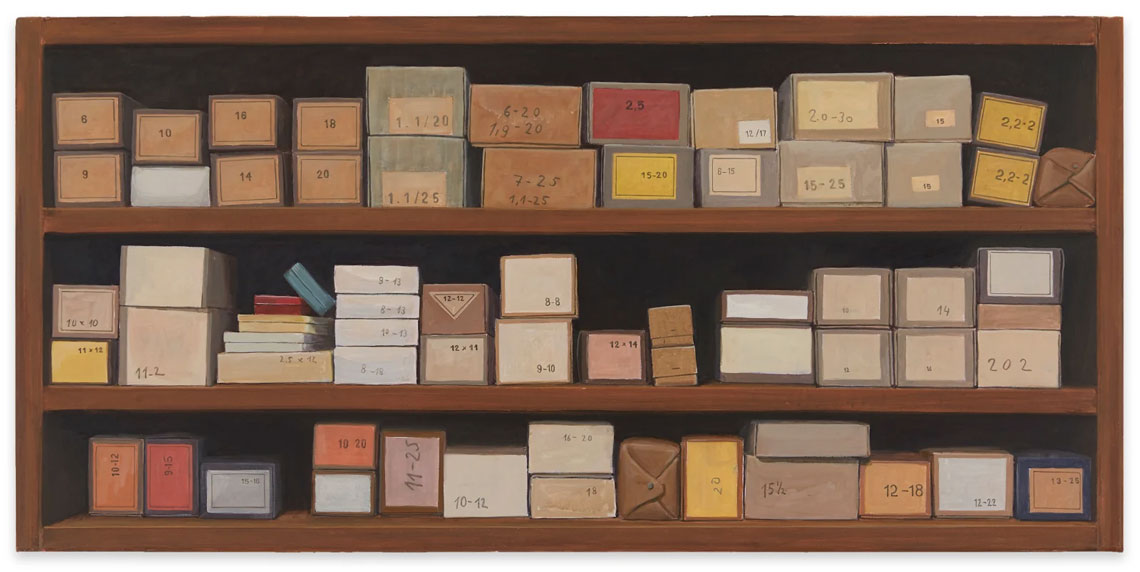
Christoph Hänsli is known for painting frequently overlooked everyday objects on a 1:1 scale. Since 1992, he is giving objects such as beer glasses, medicine packets, nails, paper scraps or discarded machines a new purpose on canvas and putting them thereby in the spotlight. His paints objects in order to be able to see them properly, in particular to make them tangible for himself. Crucial in his artistic work is the artist’s special approach to humour.
By Efi Michalarou
Photo: Galerie Peter Kilchmann Archive
Christoph Hänsli’s humour is a serious one, which is hidden, approaching the portrayed object carefully and respectfully, revealing life’s absurdities. Thus, the artist encourages the viewer to discard old patterns of perception and to approach things that one would otherwise not have considered ”image-worthy” with unexpected curiosity. The artist is often more interested in painting traces, imprints of things or beings rather than showing them directly. In this way, he depicts by not depicting, thus creating a play between the mere presence and absence.
Galerie Peter Kilchmann is presenting “Erledigt”, the second solo exhibition of Swiss painter Christoph Hänsli, whose quietly incisive works turn the overlooked minutiae of everyday life into images of reflection and poetic presence. Known for his meticulous figurative paintings of found or collected objects—rendered at actual scale with a restrained but unmistakable wit—Hänsli invites viewers to reconsider the seemingly banal through a painterly lens.
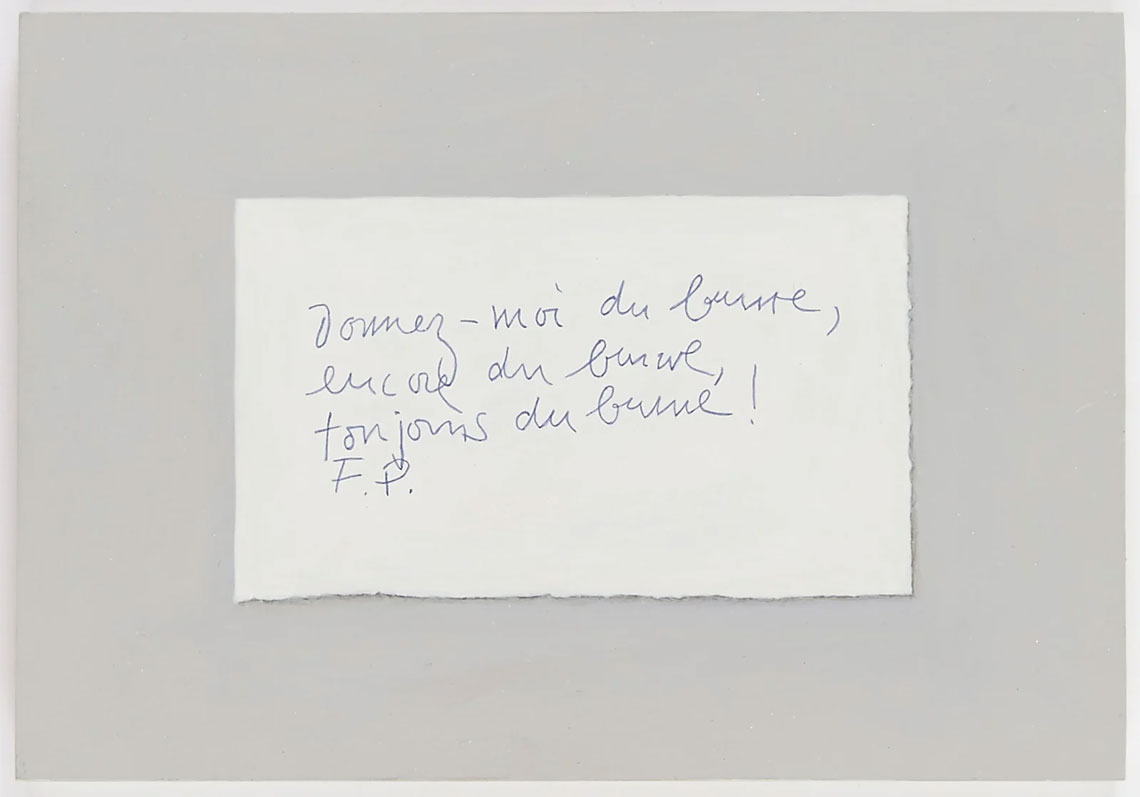
At the heart of “Erledigt” are a new series of small- and medium-format paintings executed in acrylic on canvas or MDF, created between 2024 and 2025. The exhibition centers on painted lists in various forms—crossed-out to-do lists, checked-off notes, order slips, and similar quotidian documents that normally serve a utilitarian purpose before being discarded. By pausing these fragments of daily life at the moment they have lost their practicality, Hänsli transforms them into visual objects of contemplation, shifting the act of reading into that of looking.
Lists, so ubiquitous they frequently recede from consciousness, become here subject and metaphor. They map a cycle of anticipation, completion, and renewal: tasks noted, worked through, checked off, and replaced by new ones. By painting these traces of activity, Hänsli makes visible a rhythm of remembering and forgetting—human presence without the figure itself. Handwritten reminders, erasures, layers of paint, and emphatic crossings-out evoke the passing of intentions and the sedimentation of time.
In “Erledigt, Diner” (2024), for example, fragments of a list remain legible beneath highlighter marks and forceful strikethroughs: “Wandfolie, E-Karte machen, Rechnung, Diner/Preview.” A central scribble suggests a later testing of a pen, as if the paper’s history were layered into the painting itself. Here the process of layering—from background ground to final gesture—is made palpable, evoking a chain of past moments that now reside only in the pigment and stroke.
Another work, “Erledigt, Test” (2024), uses an almost empty sheet interrupted by a sweeping scribble to make visible the dynamic movement of painting itself. In this and other list works, the frequent emphatic crossings-out propel the images toward abstraction; forms and patterns come to the fore, leaving viewers to wonder about what was originally written and what might have been erased.
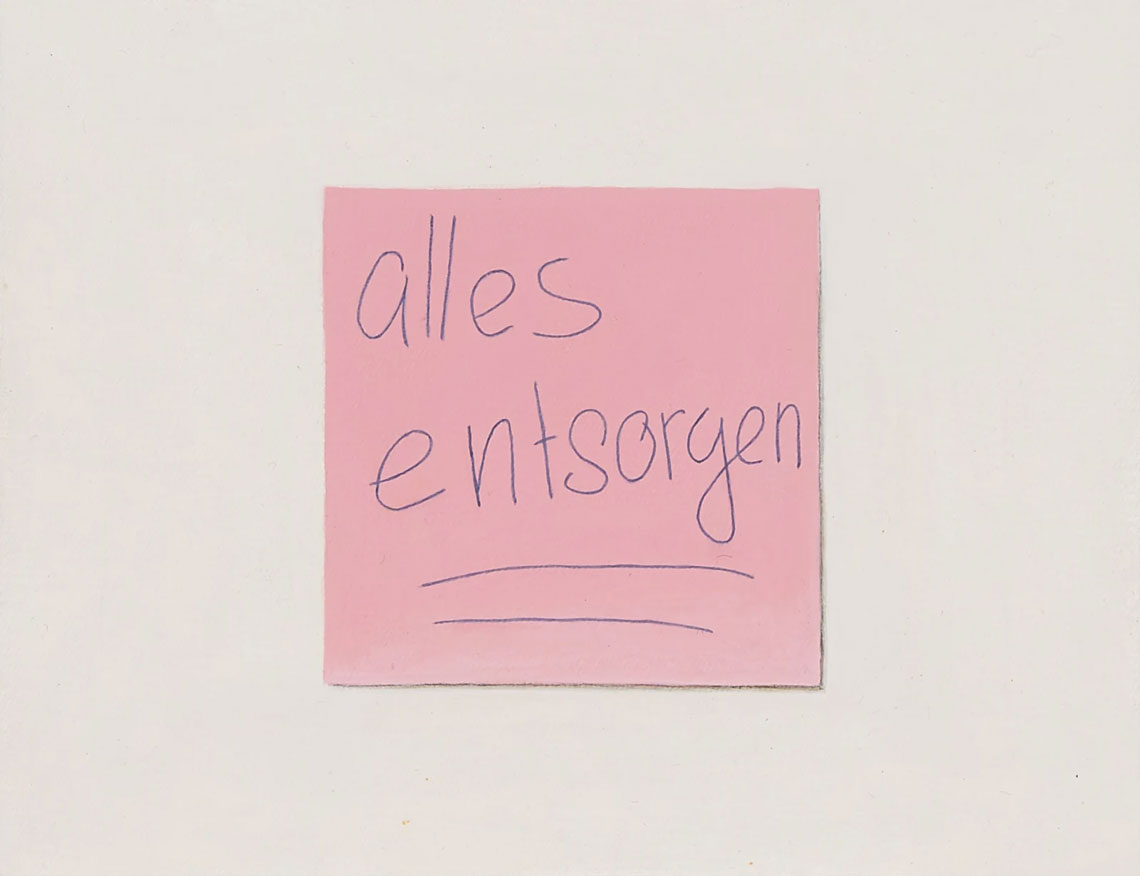
Elsewhere in the show, Hänsli revisits motifs that have long occupied his practice, including the interplay of typography and language. In “Kein Speck” (2025), a sky-blue post-it bears the message “Im Moment KEIN Speck!” (“No bacon at the moment!”), indicating absence rather than instruction. “Alles entsorgen” (2025) depicts a discarded note about disposing of objects that are already gone, while “Heisses Fleischkäseweckle” (2025) renders a cardboard plate advertising a simple food item with flowing cursive—showing an object by way of its textual trace rather than depiction.
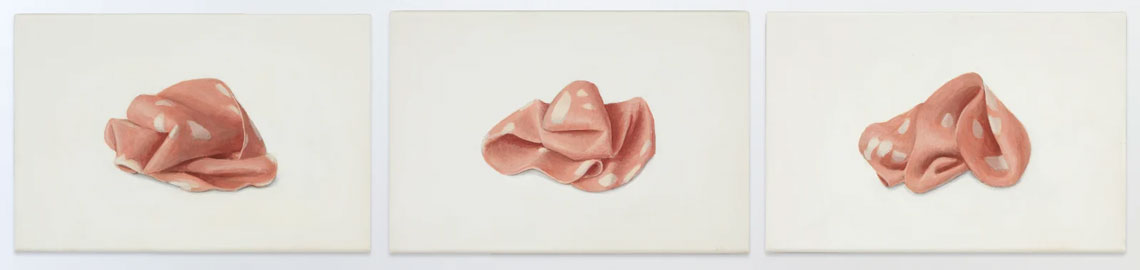
Hänsli also returns to one of his recurring visual subjects: remnants. In “Wurstzipfel Nr. 1”, “Wurstzipfel Nr. 2”, and “Wurstzipfel Nr. 3” (all 2025), he paints three sausage ends set against a layered white background, transforming them into sculptural protagonists within the pictorial field. Likewise, pieces such as Dreifaltigkeit (2024/25) take small remnants—a folded slice of sausage—and elevate it into careful pictorial scrutiny.
Other works in “Abdeckung Sicherungen” (2025), “Geschlossene Luke” (2025), and “Spind” (2024)—invoke closed surfaces that resist entry and conceal what lies beyond. In Spind, three uniform green locker doors initially read as banal, but over time accrue depth and patina reminiscent of reeds or forests at dusk; their absent labels leave their contents to the viewer’s imagination.
The series culminates in “Blattkäfer” (2025), a small but striking painting of a beetle pinned on a white ground, its delicate form captured with near-calligraphic precision. The insect, “done for,” sits like a jewel or specimen, a quiet testament to the exhibition’s overarching tension between presence and absence.
“Erledigt” unfolds as a meditation on the traces of life—its lists, leftovers, and overlooked scraps—and on the ways painting can slow down perceptual habits. In a contemporary context defined by haste and constant consumption of images and information, Hänsli’s work proposes a more attentive mode of seeing: one in which quiet humor and meticulous craft reveal the poetry embedded in everyday forms.
Photo: Christoph Hänsli, Kein Speck, 2025, Acrylic on canvas mounted on MDF, 14 x 18 cm (5 ½ x 7 ⅛ in.), © Kein Speck, Courtesy the artist and Galerie Peter Kilchmann
Info: Galerie Peter Kilchmann, Rämistrasse 33, Zurich, Switzerland, Duration: 24/1-14/3/2026, Days & Hours: Tue-Fri 11:00-18:00, Sat 11:00-17:00, www.peterkilchmann.com/
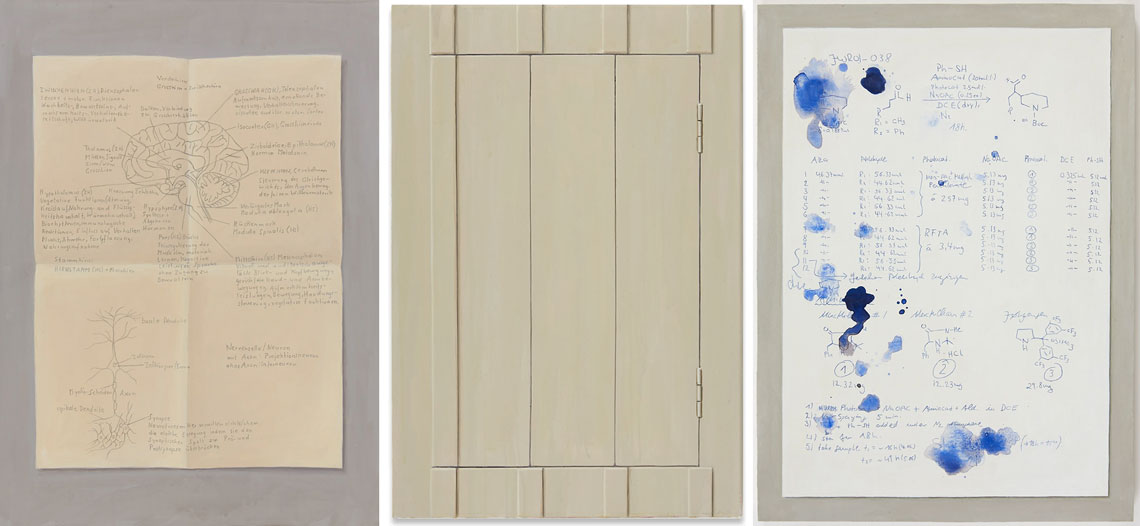
Center: Christoph Hänsli, Abdeckung Sicherungen, 2025, Acrylic on canvas, 47 x 37 cm (18 ½ x 14 ⅝ in.), © Kein Speck, Courtesy the artist and Galerie Peter Kilchmann
Right: Christoph Hänsli, Photokatalytische Funktionalisierung zyklischer Amine, 2025, Acrylic on canvas, 33 x 24 cm (13 x 9 ½ in.), © Kein Speck, Courtesy the artist and Galerie Peter Kilchmann